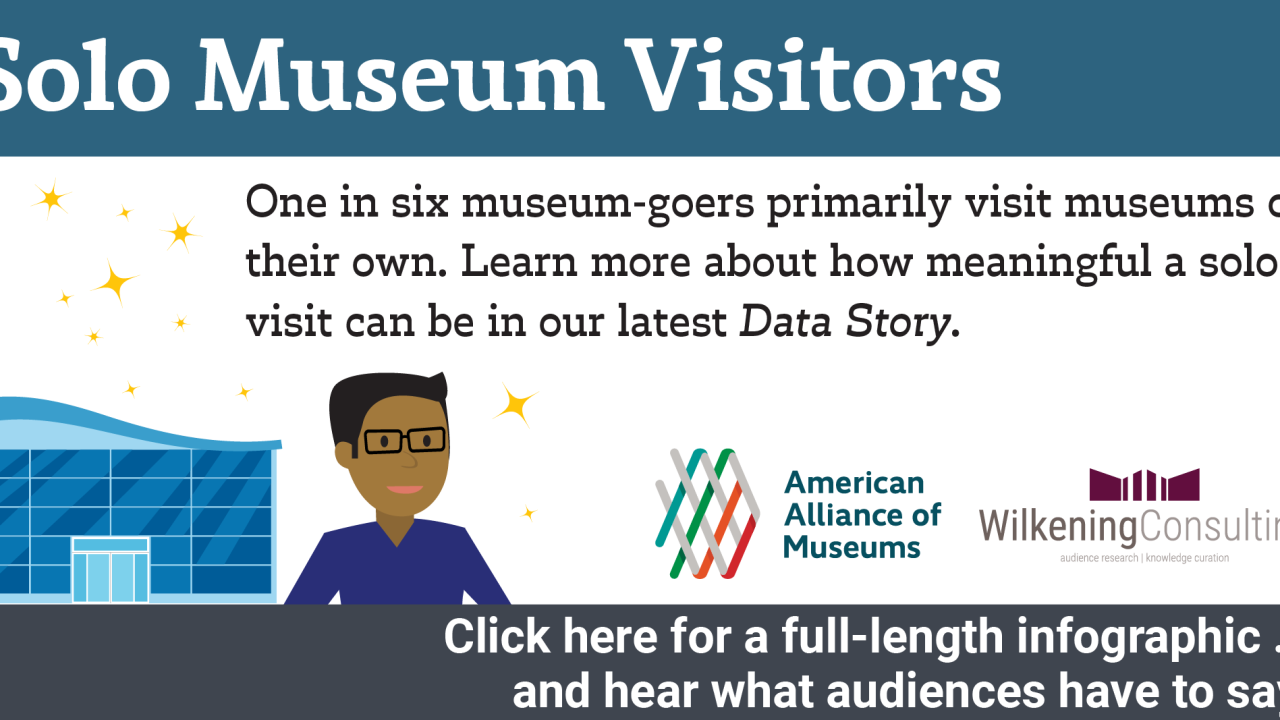
This visual Data Story is based on findings from the 2025 Annual Survey of Museum-Goers, a national survey of American museum visitors from AAM and Wilkening Consulting. Every year, the survey partners with individual museums to research their audiences and yield insights about their behaviors and preferences, both on an institutional and national level. (Learn more about the purpose and methodology of the survey here.) Interested in joining the 2026 edition on the themes of earned income and the meaning and value of museum experiences? Sign up by February 28 to join the survey launch in March.

“Solo museum visits – my happy place! I love visiting museums alone because it allows me to fully immerse myself in the experience. I’m a bit of an introvert, so solo visits also give me a chance to recharge. I can wander, reflect, and enjoy the quiet.”
Visiting a museum alone can be a very different experience for people than visiting with other people. The dynamic changes. There is often greater focus on the content, and emotional responses seem to deepen. Indeed, many of the most meaningful and emotive museum experiences our research captures come from solo visits.
While most museum-goers find themselves visiting museums on their own from time to time, nearly one in six say solo visits are the norm.
| Frequent | Casual (At least one museum visit in past year) | Sporadic (Visits museums occasionally, but not in past year) | |
|---|---|---|---|
| I only visit museums with family and friends | 31% | 43% | 45% |
| I mostly visit with others, but occasionally on my own | 30% | 26% | 22% |
| I sometimes visit with others, and sometimes on my own | 22% | 19% | 18% |
| I mostly visit on my own, but occasionally with others | 14% | 8% | 8% |
| I strongly prefer to visit on my own | 2% | 4% | 7% |
Frequent museum-goers are those who responded to a museum’s request to take a survey (and visit museums at the most frequent rate). Casual and sporadic museum-goers were sourced from our demographically representative sample of U.S. adults, and said they visit museums at least “every few years” (that is, not “never”). A whopping 79% of U.S. adults fell in this category!
For the most part, solo visitors are just like every other museum visitor in what they want and need from museums.
But in other ways, they are very different. To learn more, frequent museum-goers who said they “mostly” or “strongly prefer” to visit museums on their own received an open-ended follow-up question, asking them to tell us more about their solo visits. This Data Story explores what they said.
The overwhelming majority of comments, nearly three-quarters, were positive, sharing why these respondents thought visiting museums on their own was the best. There were five main themes that emerged (though most responses fell into more than one theme):
1. Go at my own pace…complete autonomy
This was by far the most common type of comment, with half of all respondents sharing this sentiment. They mentioned being able to spend as much time as they wanted, not having to worry about others being bored waiting for them, or the social pressure of ensuring everyone is having a good time. A few also mentioned it gave them time and space to read every single label.
“I like the freedom that comes with visiting alone. The ability to take in things at one’s leisure. Going with others is like trying to eat food off the same plate. It’s nice to have your own plate to be able to pace your appreciation of the meal.”
2. Deeper immersion and focus
By visiting alone, solo visitors reduce distractions and can focus entirely on the content. This gives them a degree of emotional and/or intellectual freedom as well, as they can think or feel freely, on their own, without others influencing them or their experiences.
“To engage with art directly free from social distractions. To hear my intuition.”
Experience Scouts
A recurring theme among a small number of respondents was the idea of scouting an exhibition on their own before visiting with family or friends. This allowed these visitors the best of both worlds: time on their own to deeply absorb AND shared experiences with those they care about.
3. Independent pursuit of their own interests and learning
Some respondents were proactive about pursuing their own curiosity, making a choice to visit museums on their own to learn…not because they can’t find someone interested in going with them but because they prefer to do this on their own.
“I like the solitude. I like the quiet. I like me when I learn something new in a museum.”
4. When traveling
Traveling, whether for work or simply taking trips on their own, also provides opportunity for solo visits.
“I think it’s important to be able to solo travel and see things you like even if it’s by yourself. It feels like investing in myself by honoring the things I like. I could visit any museum by myself.”
5. They are self-identified introverts
Others used the language of introverts, making clear that being alone can be exactly what they want.
“Museums are great places to go alone. It’s nice to lose yourself in an exhibit. The last thing I would want is an institution to support me in any way – I am there alone to essentially be ignored.”
Museum type mattered. A lot.
Art museums in particular were places that solo visitors felt were ideal for being alone and finding respite, sanctuary, and focused concentration. Indeed, the vast majority of comments from solo visitors talked about art museums.
“Prefer to visit art museums alone so I can spend time in the areas that appeal to me most without worrying about others’ needs. Places like zoos, aquaria, and botanical gardens seem to be more fun when visited with other people.”
In contrast, science centers (and other museums that are more hands-on) were more likely to be perceived as better for social experiences because of the fun-factor. And botanical gardens were also seen as social places for a stroll and a chat.
Interestingly, history museums, historic sites, and natural history museums scarcely came up in the comments.
But not all solo visitors prefer to visit alone; some are doing so by circumstance. That is, they would prefer to visit with others, but felt they had no one to visit museums with at this time.
There were three primary reasons for this:
1. Other people’s schedules
These respondents said that everyone’s schedules are so busy it is just too hard to find time to go with family and friends. So, they shrug it off and go on their own anyway.
“I typically visit museums alone because I often have more free time during the work week than my friends or loved ones due to my work schedule.”
2. Family and friends are not as interested
In this case, respondents indicated that their loved ones didn’t enjoy museums as much as they did, and so their choice was to go alone…or not at all. But they would prefer to have company.
“I would love to visit museums with others. It can be lonely alone, and it would be nice to have a companion to discuss things with. Unfortunately, I don’t know people who share my interests. I only have a companion when the museum happens to be interesting to someone else as well.”
3. They are alone
This group tugged at our heartstrings the most, as comments often hinted at sadness and loneliness. People who had lost spouses, people who struggled to make friends, and people who were isolated geographically from loved ones.
“I don’t have family and have a hard time connecting with people and making friends.”
Respondents who visit solo by necessity are interesting because they give many of the same reasons more casual and sporadic visitors give for not visiting museums…but their enjoyment of museums (and perhaps the social benefits of being in a public place they enjoy) pushes through any perceived awkwardness about visiting alone, and they visit anyway.
But can museums be more welcoming for solo visitors? We asked solo visitors how museums can better support them.
For the most part, their suggestions had little to do with them being solo visitors, but instead were the same things everyone else wants. They want to be welcomed, included, and to have autonomy over the experience.
They want clean restrooms, a place to have a bite to eat and a good cup of coffee (or tea!). And they always want more seating.
But there were a few solo-specific things that did come up, reinforcing that some solo visitors are feeling a bit stigmatized or less important than families and groups:
“For solo visit support, training staff and volunteers to not act surprised that someone wants to buy a solo ticket would be a good start and thinking about restaurant seating for solo visitors, since, unless there is a bar, it often feels like the tables should be left open for families or groups.”
You might also consider a solo-visitor “audit,” especially if you are an art museum (though any museum type can do this!). That is, determine what percentage of your visitors are solo visitors. Ask a few people to visit on their own and report back, candidly, on their experiences…and then work with front-line staff to make appropriate adjustments to smooth out the experience for solo visitors.
Because solo visitors are amazing!
And we want to encourage people to visit museums any time they want and are able to visit…regardless if they are visiting with family, friends, or are simply doing something for themselves.
After all, they are visiting museums because they love the experiences museums provide and are seeking deeper connection to the content museums share. In many ways, they are our most committed visitors and biggest fans.
And with their greater focus on museum content, it is no surprise that the museum experiences solo visitors share with us are often the most intensely personal, meaningful, fanciful, and imaginative, reinforcing their deeper connection in a positive feedback loop that is truly affirming of the capacity of museums to change lives.
“When I visit the museum alone, I feel free to go at my own pace. I linger when I want and move on when I’m ready. When I’m in the museum alone, I am fully in the presence of my own imagination. I can dream, brood, soar. My fantasy takes me to places of joy, laughter, and delight, but also to places of tears and bittersweet reflection. In the stillness of solitude, you can converse with the voices echoing from the past.”
Annual Survey of Museum-Goers Data Stories are created by Wilkening Consulting on behalf of the American Alliance of Museums. Sources include:
- 2025 Annual Survey of Museum-Goers, n = 98,904; 202 museums participating
- 2025 Broader Population Sampling, n = 2,079
- 2017 – 2024 Annual Surveys of Museum-Goers
Data Stories share research about both frequent museum-goers (typically visit multiple museums each year) and the broader population (including casual, sporadic, and non-visitors to museums). See the Purpose and Methodology (Update) Data Story from September 11, 2025 for more information on methodology.
More Data Stories can be found at https://wilkeningconsulting.com/data-stories/.
© 2025 Wilkening Consulting, LLC

Upcoming Events
-
I’m In Charge of A Museum Store. Now What?
Event Date:Presented by: American Alliance of Museums -
Core Issues Briefing Series
Event Date:Presented by: American Association for State and Local History (AASLH) -
Strengthening the History Workforce Virtual Summit
Event Date:Presented by: American Association for State and Local History (AASLH) -
Gettin’ To Know You: The Art of Networking
Event Date:Presented by: American Alliance of Museums






As someone who goes to museums solo 90% of the time, I totally relate to this! Love being able to take my time, focus on areas I’m most interested in, and reflect on my own.
Would love if museums provided better participatory activities for solo visitors, such as interesting museum routes (especially for larger museums) or activity sheets to do deeper reflections on works.