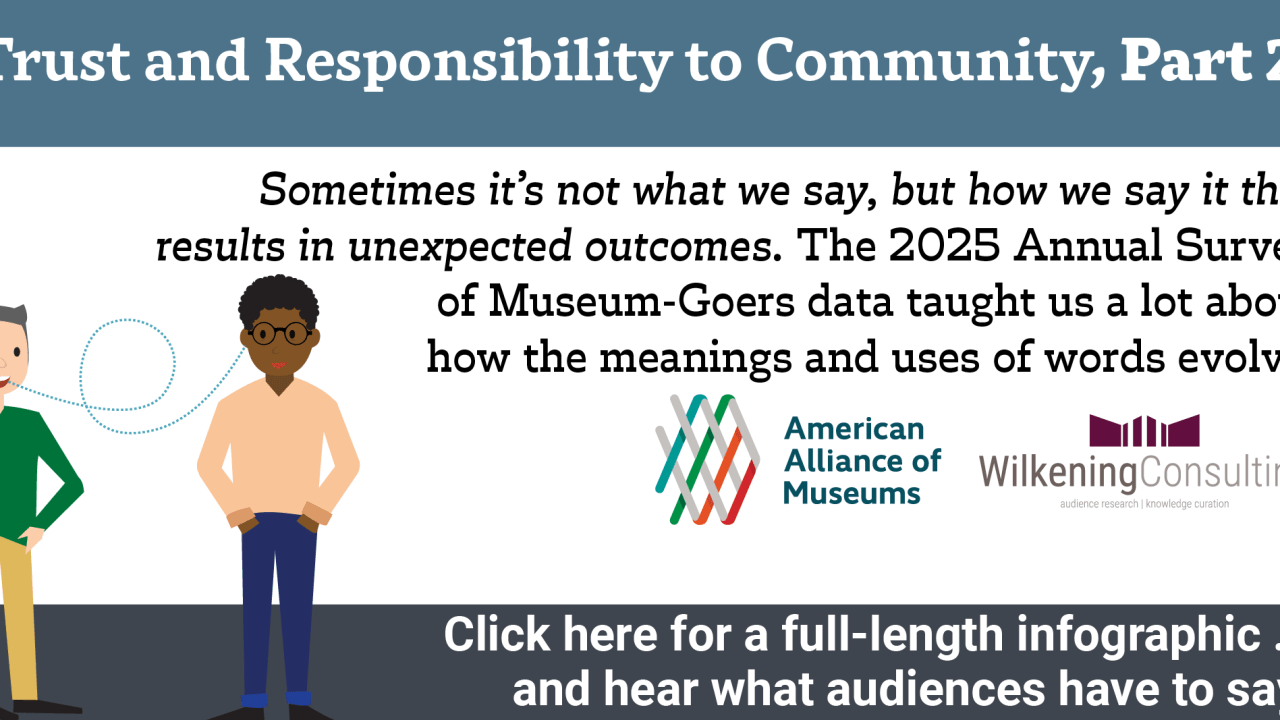
This visual Data Story is based on findings from the 2025 Annual Survey of Museum-Goers, a national survey of American museum visitors from AAM and Wilkening Consulting. Every year, the survey partners with individual museums to research their audiences and yield insights about their behaviors and preferences, both on an institutional and national level. (Learn more about the purpose and methodology of the survey here.) Interested in joining the 2026 edition on the themes of earned income and the meaning and value of museum experiences? Sign up by February 28 to join the survey launch in March.

Over the past several years, we have asked a lot of questions about how museums can better engage or serve the community.
And, consistently, we received pushback from about 10–20% of museum-goers saying this is “not your job” and to “stay in your lane.”
To be honest, we’ve always found this somewhat puzzling. Since virtually all museums are either nonprofit organizations or part of a government entity, serving the public is core to our work. So, why the pushback?
Last year, however, there were a handful of written-in comments that had a new take. In fact, we shared a couple in our Data Story Museum and Community: Perceptions and Engagement.
“The museum has unfortunately become a community center.”
“Community engagement … often detracts from the mission. Drop the ‘woke’ and pick up the painting.”
It was a lightbulb moment. A connection was being made between “community” and inclusion, and “woke” was being used as a pejorative to dismiss these efforts. They were suggesting that museums were using “community” to cover up a liberal political agenda.
To be clear, serving your community is not a political act.
But it’s important to consider why some individuals pushed back on this.
When we were writing the 2025 Annual Survey of Museum-Goers, we thought long and hard about these comments.
In particular, we wanted to sort out if this was an issue of what museums were doing or how museums talk about what they do.
And if the issue was language, was it the word community, or the words we tend to use around the word community?
Could we write a community-focused question that would not receive the political pushback our previous questions had engendered?
We started off by considering how the museum field talks about community in the first place. When we talk about community, we tend to use words like:
- Broaden
- Engage
- Serve
- Outreach
- Reach
Regardless of our intentions, these words have increasingly become polarized as words aligned with liberal values. Thus, it is less surprising that some conservative respondents (and some moderates) would find community-oriented questions using those words political, and they would respond in kind.
We had to start from scratch.
Keeping the word “community” was important to us, and we didn’t actually think that word was the issue. To frame the question, we drew on previous research we fielded examining history museums and the founding of the United States.
In particular, what did conservatives see as “American” values, and was there a value there that might work in our question?
And that’s where we found our word: Responsibility.
Responsibility is a word that conservatives identify strongly with, but liberals and moderates don’t perceive in particularly political terms. It also worked well for our question:
What do you think are the responsibilities of museums to their communities?
Did it work?
Our first test was to look to see what percentage of respondents said “none of these.” A response of 10% or more would mean it was a polarizing question, while a response of less than 5% would mean it was a neutral question that read as non-partisan.
Less than 1% of frequent museum-goers said “none of these.”
And scarcely anyone wrote in an “other” response either. Not only did the question work, but it worked extremely well.
What do you think are the responsibilities of museums to their communities? (Choose all that apply.)
Preservation of community history, objects, and stories
85% frequent museum-goers / 63% casual (at least one museum visit in past year) / 56% sporadic (visits museums occasionally, but not in past year)
Educating children in the community (including families with children and K–12 education)72% frequent / 55% casual / 45% sporadic
Sharing and supporting artistic expression
69% frequent / 47% casual / 40% sporadic
Using evidence to tell the truth
59% frequent / 53% casual / 46% sporadic
Providing a place of respite from our everyday lives
57% frequent / 38% casual / 27% sporadic
Sharing the different perspectives of community members
49% frequent / 42% casual / 28% sporadic
Promoting environmental sustainability and modeling sustainable behaviors
48% frequent / 39% casual / 24% sporadic
Tourism and economic development
44% frequent / 42% casual / 33% sporadic
Staying strictly non-partisan
35% frequent / 37% casual / 33% sporadic
Other – please specify
3% frequent / 0% casual / 0% sporadic
None of these
0% frequent / 1% casual / 3% sporadic
Frequent museum-goers are those who responded to a museum’s request to take a survey (and visit museums at the most frequent rate).
Casual and sporadic museum-goers were sourced from our demographically representative sample of U.S. adults, and said they visit museums at least “every few years” (that is, not “never”). A whopping 79% of U.S. adults fell in this category!
Our answer choices were similar to those we’ve used in the past. Overwhelming majorities of frequent museum-goers chose “preservation of community history, objects, and stories” as well as “educating children in the community.” Those responses make sense because they embody the strengths and missions of most museums.
“Sharing and supporting artistic expression” performs strongly as well (and does even better among art museum respondents), as does “using evidence to tell the truth” and “providing a place of respite from our everyday lives.”
Overall, casual and sporadic visitors were also enthusiastic, choosing several options (and scarcely any said “none of these”).¹
Our conclusion is that the word “community” has not become polarized in the way we initially feared. That was a bit of a red herring.
Instead, we discovered that words associated with community (outreach, engage, serve, etc.) seem to have been stigmatized in a political way.
Whether a question is asked directly or indirectly matters when interpreting results. For example, take a look at these two responses and their results:
- Sharing the different perspectives of community members
- Promoting environmental sustainability and modeling sustainable behaviors
This question functions as an indirect measure of attitudes toward inclusion and sustainability. Because we are not asking directly about these topics, respondents selected what felt most important to them in that moment. Those who chose them likely value them highly, but what about those who did not? Well, we don’t know. Their thoughts could range from mildly supportive to ambivalent to against. All we do know is they don’t feel strongly supportive about it in this context.
When we ask directly about these topics, however, we tend to receive far more positive responses.²
What’s the truth, then? Probably somewhere in the middle, which is why we don’t use a single question to assess people’s values on these topics, but a mix of questions to create a spectrum.
When thinking about your work, and considering pushback, there are two things to consider:
- The words that you are using to describe your work
- The actual work and how people will respond (we may have data about that!)
In the case of our earlier surveys, at least for some respondents, #1 (the words) was coming into play before #2 (the work) could even be considered.
You want your visitors to consider the content you are sharing thoughtfully.
As we continue to navigate politically fraught times for museums, taking care with the words you are using to describe your work becomes even more important. Not to avoid conflict, but to avoid unnecessary and pointless conflict.
Sometimes it’s not what you’re doing that creates a polarizing response, but how you’re talking about it. Consider:
- Not all words carry the same weight. Can you swap a polarizing word for one that reads neutrally without changing your intended meaning?
- Can you balance your language so that words that appeal to different political viewpoints effectively neutralize each other?
- Do you have colleagues or trusted volunteers with different political values that can help you identify polarizing language before it goes public?
Getting the language right matters. We’ll keep sharing what we’ve learned about language this year.
There’s more to consider, however. In a time of misinformation, disinformation, AI slop, and more, credibility becomes more important.
And we’ll examine that in our next Data Story.
Annual Survey of Museum-Goers Data Stories are created by Wilkening Consulting on behalf of the American Alliance of Museums. Sources include:
- 2025 Annual Survey of Museum-Goers, n = 98,904; 202 museums participating
- 2025 Broader Population Sampling, n = 2,079
- 2017 – 2024 Annual Surveys of Museum-Goers
- It is typical in samples drawn from the broader population for respondents to choose fewer things and move on to the next question. Frequent museum-goers chose 5.2 items on the list, while casual visitors chose 4.1 and sporadic 3.3. That is still showing enthusiasm for the question, but will result in lower percentages across the board.
- See Inclusive Content in an Uncertain Time, October 2, 2025 and The Spectrum of Climate Change Attitudes, October 25, 2022 for more information on these topics.
Data Stories share research about both frequent museum-goers (typically visit multiple museums each year) and the broader population (including casual, sporadic, and non-visitors to museums). See the Purpose and Methodology (Update) Data Story from September 11, 2025 for more information on methodology.
More Data Stories can be found at https://wilkeningconsulting.com/data-stories/.
© 2025 Wilkening Consulting, LLC

Upcoming Events
-
Museum Digital Summit
Event Date:Presented by: MuseumNext -
Environmental Monitoring for Collections of All Sizes
Event Date:Presented by: C2C Care/FAIC -
Digital Innovations in Collections Stewardship and Access at Jewish Museums
Event Date:Presented by: American Alliance of Museums -
2026 Cultural Governance & Leadership Series
Event Date:Presented by: American Public Gardens Association


Super interesting, thank you! I’ve always been keen on exploring and discussing the ways language is used, evolves, shifts meaning, etc. and how we (in all areas of life) can mold our words in such a way that intentions shine through and goals can still be attained – without setting aside our values and/or priorities.