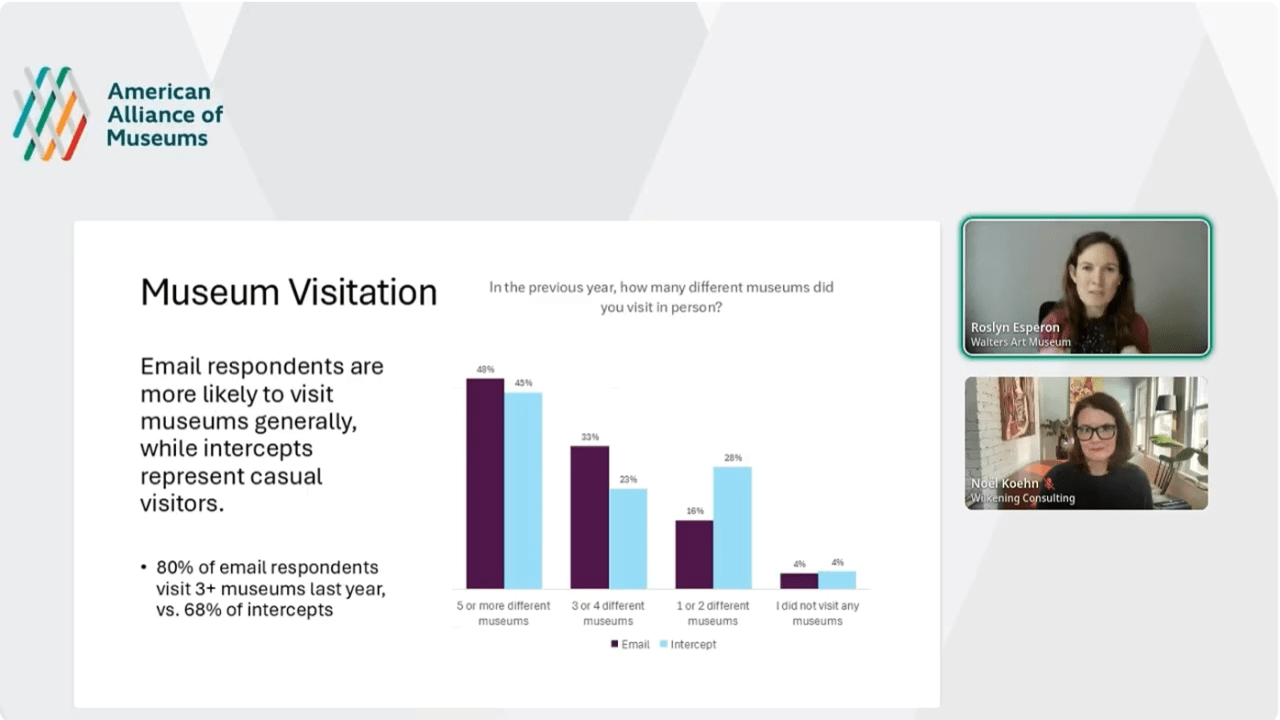
In this friendly, practical conversation between Noël Koehn, Sr. Consultant with Wilkening Consultant on the Annual Survey of Museum-Goers, and Roslyn Esperon, Manager of Evaluation and Audience Impact at the Walters Art Museum, discuss how museums can use intercept surveys to collect meaningful visitor data in real time and build a clearer picture of who is showing up and why.
Transcript
Cecelia Walls:
Hello, and welcome, everyone. We are gonna get started in just a moment. I’m gonna let a few folks straggle in, but we’ll get right with you.
Alright. Welcome to CAPTCHA feedback from visitors in museum spaces. Thank you so much for being here today. My name is Cecilia Walls. I’m the assistant director of learning content and operations here at AAM. I’m really glad you could join us for what’s designed to be a practical down-to-earth conversation focused on one of the biggest challenges many of us share, and that is how to get a clearer picture of who’s showing up in our spaces and why.
Today’s session connects directly to the annual survey of museum goers and is designed especially for museum professionals who wanna fill data gaps that can happen when we only rely on email lists or other off-site channels. We’re going to focus on intercept surveys, on-site surveys that help capture insights from the full range of visitors in real time, so the data is more accurate, more inclusive, and more actionable. Now I’m delighted to introduce our speakers. AAM professional member, Noelle Kone, senior consultant with Wilkening Consulting, on the annual survey of museum goers, and AAM professional member, Rosalyn Esperon, manager of evaluation and audience impact at the AAM tier three museum member, the Walters Art Museum.
Together, they will share how museums can use intercept surveys to collect meaningful visitor data on-site, build a clearer picture of visitor behavior and motivations, and turn those insights into action. We also have AAM professional member Jessica Strube senior research and project manager for welcoming consulting helping us out on the back end. And here are a few quick housekeeping items before we jump in. If you run into any audio or video issues, try refreshing your browser or rejoining the session.
Noël Koehn:
Everyone, I’m here with my colleague and friend, Rosalyn Esperon, who is the manager about evaluation and audience impact at the Walters Art Museum. And we’ve asked her to come and speak with us today to share her expertise in collecting visitor data on-site in the museum. Our annual survey, I hope you’re all familiar with it. If you are not by chance or want more information, you can go to museumgoers.org.
There’s plenty of information there. We collect that data every year, through participating museums like the Walters. And it’s really strong for collecting data for visitors who are already engaged museum goers. These are or tend to be people who are members or on the mailing list have gone to a program or somehow otherwise, given their email address to the museum to be contacted, for things like events and, surveys. Right?
And so, with that data we collect, we end up getting a really loud voice from those more engaged museum goers, which is great. Because we do wanna serve them for sure. But, we tend not to get so many of people who are, sporadic or casual visitors, like people who might just stop in or go on a vacation when they have, when they’re in town or maybe bring people in because they’re coming in from out of town family or something looking for something to do on a weekend. So, one of the things we can do is a broader population sample. Wilkerson Consulting will buy a sample from your area so that we can compare those people who are not on your mailing list to what you have there.
But then some of the people we’ve talked to that have participated in the, the survey in the past have said, you know, our data are great. We’re really happy to see, our visitors and, what they feel, what their values and sentiments are about what we’re doing.
But they their demographics don’t exactly match who we’re seeing in our programs or in our galleries.
So, we suggest doing what we call intercepts, which Rosalynn is our excellent expert on. And that is, getting staff or volunteers to actually stop, visitors in the museum and ask them to complete a survey like you would for evaluation or something. But this is, you know, a little bit more involved, so it takes some expertise. In that way, if you do those intercepts, then you can compare them to the regular mailing list data we have. Then if you do the broader population, that’s a third component of information to compare. So, that’s really good. And I just wanted to bring Rosalyn in to share her experiences with collecting intercepts because it does take some thought and planning. And I thought that the Walters did such a great job with that.
So, with that, Rosalynn, I would love it if you would share with us what why you why the Walters started doing intercepts.
Roslyn Esperon:
Yeah. Absolutely. And first, thank you, Noelle, and welcoming in team. For inviting the Walters and myself to come share this story. We started doing intercepts. We’d been participating in the AAM Museum survey since 2019. And when I started at the Walters, we were continuing that. And in 2023, we noticed that the age of our participants in the survey groups going up. We were seeing fewer parents. We were seeing the generation of folks increase in age. And that kind of clued us in that there was something different about our audience.
It wasn’t our hypothesis was, but that wasn’t actually true for our in-person visitors, but it was true for the audience that we were serving. Our newsletter email respondents. And so, we decided to try something different because we wanted to kind of test out this hypothesis. So, in 2024, and then again in 2025, we decided to do intercepts with our on-site visitors to be able to see what those were responses would look like and see how different they would be.
Noël Koehn:
That makes perfect sense.
Yes.
So, tell us about the planning process. What kind of, how did you prepare your staff and your volunteers to do this work?
Roslyn Esperon:
So, with our staff and our volunteers, we approached the intercepts as we do most evaluation, intercept projects. We use a random sampling method. So, if you’re thinking about an on-site intercept, you wanna kind of envision an imaginary line on the floor. And whoever is going to cross that line versus the person that you approach. And so, with our intercepts, we use that technique. And then of course, as we’re approaching somebody and inviting them to take part in the survey, we’re talking with them about what the survey is, why it matters, why we’re asking them to participate, how long it’ll be, and kind of all of those reasons why they might want to take part in this. And, of course, that it’s voluntary. So, they can stop at any time. You know, no one’s feelings are gonna be hurt.
So, we start with that kind of basic intercept approach. And we’ve used both volunteers and staff over the years to do this work together.
Noël Koehn:
So, I imagine if you’re, your evaluation department I mean, you guys are well versed in going up to strangers and asking them what they think about what they’ve just seen or how they’re using this space or whatever. How do they how do your visitors respond to your, the people conducting the evaluations and intercepts?
Roslyn Esperon:
Yeah. I found that the Walters visitors are just really generous with their time, and we very rarely get refusals. That is not to say they don’t happen. They will happen. And you know what? It’s okay. Or you just get to move on from that. Most people say yes. And I think that’s just such a heartwarming way for them to give back. Thinking about the intercepts and why they were so important for Walter’s, as a free and unticketed museum, we really rely on our newsletter to communicate with folks. And then being able to kind of, like, flip that to an on-site, and having that one-on-one conversation an invitation to our on-site visitors. So, People were really, really willing to engage with us.
Noël Koehn:
I’m sure we’ll probably talk about this in a minute. I was just gonna ask you really quick. Quickly what you were telling me earlier about, how you know, if you’re dependent on mailing lists and the mailing list is skewing older, trying to get, younger visitors to, respond to you to get, get buy in somehow, and you are finding that maybe those conversations were helpful in in creating that kind of connection maybe with the younger audience.
Roslyn Esperon:
Yeah.
Noël Koehn:
In person?
Roslyn Esperon:
I would say we’re definitely seeing a younger audience in in our responses. And so when we’re out on the floor doing either this survey or other surveys, just from that kind of lived experience, we’re seeing a much younger demographic in the museum. So that can include us in that this potential differences in audiences were happening. I think visitors that kind of across the spectrum are willing to engage with us. So all different levels of connections there.
Noël Koehn:
Great. So, when you when you’re planning to, to start talking to people in the galleries or in the museum or in the, the you know, your, entryway? Like, what how did you decide where you would approach people, and did you have any parameters on how you were telling of, like, boundaries of where they could go or best places to talk to people.
Roslyn Esperon:
Yeah. So, we’ve tried out a few things. In our early days in 2024, we had a volunteer staffed group that were conducting surveys for us for AM. And we had them try out in the middle of the museum, so kind of on our 3rd Floor in one of the lobby spaces outside of our galleries. And the feedback I got from our volunteers at that point was that our visitors were kind of still midway through their experience. Weren’t really ready to engage with this depth of a survey.
Noël Koehn:
Mhmm.
Roslyn Esperon:
At that point in their visit. So, we ended up doing a lot of our surveys in 2024, in kind of the inner lobby on the 1st Floor of the museum.
Some of our volunteers would remind me that our cafe was the perfect place to do those inter sets because folks were already sitting down. They were comfortable. They were ready to spend some time.
And then in 2025, we actually had a dedicated staff member, Beacher Skruzkin, come on as a fellow and she supported us with this project. So, she was stationed much like we, station someone for our museum exit survey. In that inner lobby area. So, the Walters has kind of a dual lobby. You’ve got kind of the outside area where the coat check is, then visitors have to come through a second set of doors to get to our inner lobby. So, what we found was most successful was that if you’re in that inner lobby, you’re capturing visitors when their museum experience is really still fresh for them, and they’re still kind of like they know they’re about to leave, but they fully they haven’t fully checked out of their…
Noël Koehn:
Mhmm.
Roslyn Esperon:
…of their visit. And at that point in time, we’re, inviting people to take the survey. We have some chairs set up so that they can sit down, spend some time. And it feels almost like this way of giving back, in terms of, like, as we are a free museum, they’ve spent a nice time with us. How can they give back? But can take our survey.
Noël Koehn:
I think that’s really interesting, as far as, like, I would I think if somebody approached me in the middle of a gallery, I would feel jarred, you know, from what I was doing. And to think about, like, the museum spaces and moving from the content areas to, kind of the interim space, the liminal spaces to go out the door. We start processing what you were just experiencing. And it like you said, it is fresh, and you’re you are thinking about it. So that would be a perfect place for asking questions. Like, the reflection is already happening. And then maybe and maybe the impulse talk about it is stronger too. So might end up with with more responses that way that were actually more detailed and accurate for you.
So, we talked a little bit about your staffing changes. You just mentioned your fellow that came on in 2025. And I was just wondering between those two years, what challenges what challenges did you face? And then between the two years, how did you how did you change your process and your planning? Like, what did you make that were different from year to year?
Roslyn Esperon:
Yeah. So, we definitely did change our process In 2024, we were trying this for the first time. We didn’t I didn’t quite, like, plan it out, early on. And so, we started it later. We probably started maybe in, like, April, and we’re trying to get all of our intercepts in with a volunteer crew who can sign up for some shifts but may not be able to cover as many as we were hoping for.
And we’re also, like, really trying to get to our 100-person quota, and doing the best they could.
So, with all our lessons learned of, like, how long it took to actually get to a 100 risk responses for on-site intercepts. When Beatrice came on, and we decided to move to that dedicated staff member to do our AAM intercepts. What we decided to do was start early. So, we ended up starting in February, and we were able to, one, run this all the way through the April. We ended earlier than we expected, which was lovely. And then Beatrice already was really familiar with the survey. So, it was great to have one person there because they were able to answer questions more easily and also because we were really sticking to our random sample protocol. So, I felt better about the validity of our data, and we were really much more intimately aware of what survey was about and able to support our visitors as they were taking it.
So,
Noël Koehn:
So, and I imagine too you’re getting more of a consistent, more of a consistent methodology using one person when you know, where we have it’s kind of the thing we end up with sometimes when we have a dozen pool, and everybody’s got a different story they wanna tell, in the galleries. Maybe that’s coming through with the way they’re asking questions or approaching, approaching potential, respondents as well.
I wanted to ask you really quickly. You and I had talked about getting a sample of 100 respondents, and I was wondering if you could share with us you know, why that number like, we’ll typically say, if your overall sample for the survey is about one fifty, that’s a really good sample, and we can we know it’s stable. So this is an addition to your mailing list, which is a good robust sample as well. So tell us about you know, how you landed on that number.
Roslyn Esperon:
Yeah. I think at first, it was kind of just our target of, like, can we even reach a 100 in 2024? And then by 2025, we felt like we could hit that number. It was a nice supplemental to the 500. We were collecting via our newsletter, and we felt like that was enough of a sample to get, like, a sense of what was actually happening on-site.
Hi.
Yeah. We had roughly 500 and from our mailing list. And so, with both of those combined, I think we are, like, just over 600, maybe just shy of 600 I have we’ll we can take a look at the data together.
Noël Koehn:
Oh, great. Excellent. So, you had mentioned that things took a little bit longer than you had expected to, and I was wondering that among other things, what, you know, what was different? What did you, how did how did how did reality play out a little differently than you had planned for? Okay.
Roslyn Esperon:
Yeah. Let’s see.
As I’m thinking about this, I think just how long it took for sure, was one of the pieces. So, to, like, put some tangibles here for folks who are thinking about doing this themselves, we spend twenty-six hours of data collection on the floor. Across 13 individual like shifts, over the course of two months. So, the first year, we kind of got our feet wet, and we were tracking towards that. The second year, we were able to actually budget our time and resources to be able to support this.
And so, sharing that in case that helps others as they are thinking about what your what your resource are resources are and what your needs might be.
But that was, I think, the biggest shift was starting early and really moving to having one person who was dedicated to doing the work.
Noël Koehn:
Right. I think about, you know, I live in Richter and I’m always at the BMFA, and, they have a really robust evaluation team that I’m always seeing when I’m leaving the, leaving the gallery. And it’s not multiple people, though. It’s always like one person for the shift, and they sit with you quietly. And I really appreciate that kind of one on one instead of feeling like somebody’s handing you flyers or whatever. You know, it just seems like a conversation, and more personal, which is great. So, okay. Maybe we’re gonna get into some data now. If you wanna share your slides with us. I just was curious about the discoveries that you made when you got your data back from your intercepts. What did offer that was so different from the information you’ve gotten in the past from just your mailing list respondents?
Roslyn Esperon:
Yeah. I’d love to actually share some slides and get kind of open that up. Hopefully, that
works well. I think everyone can see. Great. So…
Noël Koehn:
Right.
Roslyn Esperon:
…a little bit of orientation for folks, and we had talked about sample right here. In the slides that you’re about to see, our light blue is our intercepts. And that kind of dark purple is the folks who are on our email newsletter.
And as I was sharing earlier, if our kind of clue that, something was different, the reason why we want to explore intercepts was based on age demographics.
I’m excited to share this slide with you. So here you’re seeing that when we look at yeah. You’re shaking your head, Noel. It’s a huge jump. Right? So, in our purple, we have our email respondents, and 42% of them are 70 or older, whereas our on-site intercepts 43% of them were 29 or younger. And so when I think about doing AAM intercepts, I’m thinking about both of these set of, our audiences. So, the folks who are on our email newsletter, they’re Walter supporters. They are they are us. The folks coming in the door, they are also Walter supporters. They’re also us. But they they’re showing up in two different spaces. So when I think about intercepts, it’s everyone in the museum. And I think about our email as being just one part of everyone who comes.
So I’ll show you a few more slides, and we can take a look at how this kind of plays out in the rest of the data.
As we think about our on-site intercepts being younger, that also means that they’re much more diverse. Than our newsletter. This may or may not be true for your museum as well.
But it’s generally true on, a generational level, younger generation. More diverse.
We see differences in terms of gender our newsletter definitely skews much more women identifying or whereas, or in person visitors are much more kind of look like the census.
And then in terms of members of our LGBTQ plus community, we see that our intercepts, again, are younger visitors, are much more likely to be part of that community.
But equal portions identifying as ally is so important.
Education and politics. Here, as we are skewing older in our newsletter, we also are looking at higher levels of graduate degrees. In general, this is always just like such a big shock to me of how many, what percentage of our audience is and how bachelor’s plus degrees.
And then our liberal city of Baltimore here.
I’ll show a few more slides to illustrate some differences we’re seeing in demographics, our family status, Again, thinking about just the age and what that might mean for if you have a family and how old your children might be or if they live at home or not.
And then when they’re visiting. I think this is something that Wilkening Consulting always touches upon really well. The idea that, how many people are visiting how frequently are they visiting, and then if I look at the next slide, we’re seeing that our intercepts, much younger group, are visiting maybe, like, once or twice a year. But our older demographics, that email newsletter group are visiting much more frequently.
You’re also coming from different places, and this is really helpful Baltimore has kind of got a thirty-minute radius to it. You can pretty much get anywhere in the city in about thirty minutes. Outside of that thirty minutes, we’re getting into the county. And so when I look at data like this, comparing our email newsletter, I’m seeing a lot of folks that are, like, city to county right there. And then with our intercepts, I’m seeing a lot more people who are in the city or the segment that is four and a half four hours plus away being our segment of tourists who are coming to visit us.
So taking all of this data and then, being able to look at differences, not just in demographics, but in motivation and in their experience. And so one of the things that I’ve been able to do, from that is just kind of create a little profile of our intercepts versus our email respondents and share this up with our staff at the museum. So our intercepts, much more local, coming less frequently.
Really value fun, socialization. Again, they’re on the younger side. And then they have a different kind of desire and different community identifications than our email respondents. And our email respondents, again, also super valuable to the museum living in the county. They have different concerns. So for instance, parking is something that comes up for them, which may not cons come up for our intercepts that live nearby and a different demographic of individuals.
So I think the this has been really helpful to me having on-site intercepts in addition to our, email newsletter responses to the AM survey. Because as I’ve said, like, both of these segments are folks that we wanna work with. Who are supporting the museum, but they’re different segments. And so thinking about what their needs are, thinking about their motivations, and how we can be supporting them, we can tailor our messaging and our support differently to these groups.
I’ll pause there. Yeah.
Noël Koehn:
Yeah. That’s really that’s really fantastic. I’m like seeing the line and the email response that parking prevents visiting. And I have a couple of, museums wanna do their qualitative coding, like, the parking thing I hadn’t really thought about that, lining up with an aging segment, because that’s one of the ones, I’m one of the museums I’m thinking about specifically, actually, too. Another one, Florida where they talk about, the parking being such a problem, and both of these places do have an aging, response group from their mailing list.
So whether or not you have actually been able to get a hold of your board to get them to be responsive to this, or your funders. I’m wondering if you have ideas about how to approach your board and your, your stakeholders with these data to get them to understand who, who is engaged, who is potentially engaged, like, how you could how you could better serve these audience and what these data mean?
Roslyn Esperon:
Yeah. Absolutely. I think that there’s some really, great, conversations to be had particularly with our marketing team. That’s kind of the place that I started as I think about the fact that we’re using our email newsletter to reach out to respondents, and we also see that our intercepts aren’t necessarily the folks who are joining our email newsletter. So marketing is kind of my first step in this. And some of the things that have come out of this is thinking about, a welcome back to the Walters campaign, an on-site internal campaign where we’re actually, like, using and we haven’t done this yet, but the idea of, like, using sandwich boards and being able to say to folks coming into the museum what they should come back for. Like, what’s the next program coming up? When’s the next exhibition opening? Because we know those intercepts that we’re talking to aren’t necessarily
Noël Koehn:
Yeah.
Okay.
Roslyn Esperon:
…going to get on our email list. And thus, we need some way to, like, capture and capture them and share with them what’s coming up next to reengage them.
Noël Koehn:
Yeah.
Roslyn Esperon:
Whereas, like, our email respondents are super loyal to the museum. They’ve taken that step to be on the email list they are engaging. They’re reading. They answered the survey. So they’re super loyal. This is a whole segment of our Wall Street’s audience that feels, like, ready for,
for our development team to be talking with more And so they also have different concerns. And when I think about the parking, question, I think about well, could we be highlighting ways to reserve parking in our parking lot as part of, program registration? Or could we put that in our web like, you don’t have to worry about parking. We’ve got you covered. Here’s the link. You can reserve your parking spot right now.
Noël Koehn:
Yeah. That’s a really good, accretive idea. For that. I, I wanted to, point out again. We do have the, the q and a, in the chat open. If you wanna have questions, we’ll try to answer them at the end of the, our conversation. And if any of you have had experience with, you know, marketing too, and I know a lot of you have been working on, really trying to, engage with younger visitors. And when we’re specifically looking at trying to get their feedback, if they’re not gonna join the mailing list, if they’re not gonna read email, if they’re not going to you know, like, there’s certain ways that they communicate, differently than, those of us who are older. She have some great ideas for us, please share them. We’d really love to hear your feedback.
Okay. Here’s one. Roslyn, what do you wish you knew before you began? For any of anybody out there who’s interested in in running, intercepts of any kind, not just for our annual survey, what do you wish that you had known before you got started on this?
Roslyn Esperon:
This is gonna sound silly but start now. You know, the sooner that you’re starting at a the more practice you’re gonna get. I’m so glad that we tried this in 2024. It may not have been perfect, but we learned so much from it. And so we were able to, like, take all those learnings back in 2025, and it you can do this work at all levels of resources. Right? If you have volunteer, you can train those volunteers to do this. If you can you have a staff member that’s fantastic. If you have a $100 to put towards incentives to say thank you, we really appreciate your time. Have a note card. Have a sticker. Have a postcard. All of those things are so helpful.
And so I would say get started sooner, and there’s no reason to be afraid of doing this work. Visitors are super friendly. And if this is your first time out, on the floor, intercepting visitors and handing them a survey, you get more comfortable with it as it goes on. And I think you’ll find it it’s really rewarding. It’s been really rewarding for the Walters.
Noël Koehn:
Well, how would you, how do you feel like that doing the ASMG, you know, doing annual survey intercepts have strengthened your, team’s ability to do your regular evaluation work? Do you think that has impacted their confidence in what they do or changed an approach or anything like that? Or is it just kind of, like, it’s continuing to be excellent?
Roslyn Esperon:
I think we continue to learn from all of our experiences. So this survey is a longer survey than when we might run, for internal purposes. So learning there is just being really up front with visitors about the time that it takes. It’s better to be upfront than to be vague and lead to, like, a misunderstanding of expectations. Visitors are willing to commit the ten to fifteen minutes it takes to do the survey. And so with this kind of new opportunity, again, just like learning as it’s a bit longer, learning to be a friend, also putting out chairs, making people feel at home comfortable, I think is we’ve certainly learned a lot from doing this.
Noël Koehn:
So and I think you had said that you were using iPads, to do the annual survey. But we could also do, have a QR or something to walk someone through doing the process phone. Right? And I…
Roslyn Esperon:
Yeah.
Noël Koehn:
…places have actually printed out, and then put them in later, which would seem very time consuming, but also, you know, a way to do it.
So we’ve done both. In 2024, we tried using our QR code.
And we saw people say yes. And snap a picture, that QR code, go to the link, and then leave. And so the follow-through for us wasn’t there as much in affiliate in a QR code versus, like, a fully staffed experience where they’re doing it on-site. Another kind of, like, pro tip from, the I iPad standpoint is that because the survey is about fifteen minutes long, it allows us to be able to recruit two to use two iPads. So as someone is taking the survey, they’re deep into it, we’re still able to intercept someone else who’s walking out at that point in time. And then it helps us get to that 100 number of responses that we wanna see.
Noël Koehn:
Right.
Mhmm.
Mhmm.
That’s great. Yeah. I was just thinking that,
if someone’s doing it on their phone, I mean, you’re handing back the ads. You can see that it’s done. You can see which screen they’re on.
Roslyn Esperon:
Mhmm.
Noël Koehn:
They’re leaving. So that’s really helpful.
Also, just make sure that you’ve requested two links. Noelle is not gonna leave you hanging, but one link for your, email, one link for your on-site intercepts so that you can segment them out to afterwards.
Noël Koehn:
Right. Yeah. And then all the data’s comparable through the spreadsheets and the slide reports as well.
So tell us about your experience in running intercepts, purchasing a broader population sample and then comparing all of that together with your regular mailing list respondents. Like, what changed for you, or what were you able to see?
Roslyn Esperon:
Yeah. If I could paint a little bit of a picture, like, when we looked at our the intercept data versus the newsletter data If you’re thinking about this in, for instance, like, concentric circles, The smallest circle at the center is those email newsletter folks. Who are super loyal to your museum or cultural organization. They’re on your newsletter. They’re probably likely to donate. The, like, slightly larger circle, but beyond that is your in-person visitors who may or may not be engaging with your marketing. But it certainly come to your cultural institution. They’re aware of you. They’re willing to visit. And then the broader sample is, like, everyone in your, status statistical area, and, like, the biggest, broadest picture you can paint.
And so something that I like to do when I’m thinking about these three separate audiences that are either definitely visitors to the Walters or could be visitors to the Walters. We just need to figure out how to engage them or build awareness is in our AM survey, we ask the same custom questions across each of those surveys. And so, last year, we asked which of these Baltimore cultural organizations are you familiar with?
Noël Koehn:
Right.
Roslyn Esperon:
And we asked a second question. We asked, which of these Baltimore cultural organizations have you visited? And we’re going from awareness to consideration to actual decision making. And then the last question was, how were you aware that we were free? I think we phrased it a little differently than that. But the idea that we could compare, each of those audience segments on those questions.
And to take, for example, this question about awareness of the Walters being free, we hope and we expect that our email newsletter recipients know that It’s all over our email newsletter. And 90% or more knew that we were free.
When we got our responses back from our on-site intercepts, and that might be folks who have been quite a few times It could be folks that are coming to Baltimore as tourists and just coming for the very first time about 70% knew that we were free.
And then we moved to the broader population, and about 50% of those respondents knew that we were free. So that we have this big shift in, I think what is a really core message for our institution. And this allows us to say, yep. We need to keep going with this message of free out in the community. It hasn’t permeated everyone yet, and even folks coming in the door sometimes don’t know it.
Noël Koehn:
Yeah. I imagine. So I I’m thinking about like, I thought I got to visit your museum when we were there for the annual meeting a few years ago, and it felt very welcoming. And,
I would yeah. I think that’s it’s really important that people know, to be able to come and enjoy your fantastic collections.
So, I wanted to add in really quickly, you know, if, if you all have have experience enrolling in annual survey or you been looking at it or whatever, you’ll see our, that, because we’re in the regular enrollment session now, the base cost for enrolling is $13.95.
But we wanted to talk about the cost for this so that if you are, you need to get a broader population sample to capture that that audience that may not know, for instance, that the Walters Museum is free. If you wanted to get your, your broader metro area, that that sample would run between 2 and $3,000. And then you could add intercepts and the cost of the total bundle together.
If you had a big museum, I you know, you end up with so much data. If you have a small museum, you get up with so much data. But the full sample, all three of those bundle together with the base rate all of it’s, under $5,000. So one of the things that we aren’t hammering in our marketing message is just the I know everybody has, they everybody has funding needs. Everybody has a million. Like, the list is so long of what you need. But when we look at, this data collection, how affordable it is compared to hiring a firm to go run your own specialized study of understanding your, you know, your visitor ship in the area around you or whatever. And the really fantastic thing about annual surveys then we get national data, and we can see know, as a field, how are we doing across the entire, nation, which is really, really great. And we’re so grateful to the American Alliance of Museums for, working a partnership with us to collect this data and to be able to, to investigate what’s going on. And we’re happy that everybody gets to learn what’s happening, with their own numbers as well. We and we really love it. Rosalyn, you wanna take a few minutes and look at some of the questions that, that we’ve got in here.
And we’ve, as Cecelia has told us, people would do, they have uploaded some so that the first question we have is, what time period do you capture intercept survey data?
Daily for a month, or were you doing it on the weekends or, like, certain hours, and how big of a team or how many volunteers are pay stubs? So year two, you go down to one person, but how know, what were your plans, for timing and all of that?
Roslyn Esperon:
Yeah. And it definitely changed, so let’s talk about what the ideal set situation is. The ideal situation is that we have identified different time periods within the open hours of the museum. We’re a Wednesday through Sunday museum, and so we know that folks that are coming on Wednesday at noon are probably different from folks that are coming on our late-night Thursday at 7PM, and we’re different from folks that are coming on the weekend. People come when they can, and we know that different hours supports a wider variety of audiences. So in order to do our data collection, we created a calendar where we took, like, chunks of time, over the course of two months that kind of represented each of those different time slot when we were open. So, absolutely, you’re gonna see some weekend data You’re gonna see for us Thursday night, open late data collection. I wouldn’t start data collection exactly when you opened if because for us, we were doing that as an exit survey. So give yourself an hour or so before, after you open to start up.
Noël Koehn:
Okay.
Mhmm.
Roslyn Esperon:
But then, yes, trying to make sure that you have a representative sample of when you’re open. And how big of a team? So as I shared, in 2025, we added a team of one. But in 2024, this all was a little bit more fluid. We had a team of volunteers, probably four or five volunteers, and they were able to select slots when they were available. So, I would fill in the slots, when, to get that representative sample. But it was a little bit more again, fluid, I suppose.
So, if both are both you can do both. You can have either both can happen. My preference is towards the more scheduled, but it’s not the end of the world if you’ve got a sample of whenever volunteers are free because you’re collecting data, and that’s what matters.
Noël Koehn:
Right. You know, the next question is echoes one that I had with the you know, one of the panelists. I did a conference with the sheriff from an art museum. She was saying, you know, we get our responses back, and we walk in our gall and the people don’t look like the people who are responding. So, because we do collect that demographic data, in the annual survey. So I’m wondering if you are making, special, precautions or trying to cast a larger net to incorporate people who may not who are maybe, underrepresented otherwise in your, your visitor sample or your respondent sample from your mailing list. Did you have any kind of conversations about that or you know,
Roslyn Esperon:
Yeah. I echo that, that question because I think that’s pretty much what it also pushed us to go from our newsletter to on-site intercepts is having that concern.
Noël Koehn:
k.
Roslyn Esperon:
We’re doing on-site intercepts; we are really using that random sampling methods that we’re trying to get a selection of folks that are representative of our museum visitors. We are not at this point in time looking at specific segments of on-site visitors to see if we can collect more data from folks that are underrepresented. I think that’s a wonderful, like, next stage. For me, it was more like…
Noël Koehn:
Mhmm.
Roslyn Esperon:
…can we actually collect data from the folks that are coming into the museum?
Noël Koehn:
Yeah.
Right.
Roslyn Esperon:
So I’m gonna you know, let’s do that one next. I think that’s also really important work. It’s just not work we’ve done quite yet.
Noël Koehn:
Right.
Oh, yeah. So this is kinda we were talking about this a little earlier about, you know, typically, trying to gather information from program per participants. So this person’s asking a question about doing different kind of research questions for specific educational or adult programs. If we would maybe do a different set of questions, or perhaps in line with the standard intercept survey. And I’ll answer that in that we don’t have one currently, but that is something we’re talking about as a firm to be able to provide a pack of program a pack of questions that you could, add on or do at a separate point. To capture data specifically from program participants. And you are bringing up a good point, about
whether or not these are adults or they’re, you know, parents with, with children who are who are participating in the, in the response process and, because, you know, of course, the data would be different. So, that’s something we’re working on. We’re talking about trying to figure out how to best how to best serve those I’m gonna put my, email address at the end of the the session, and I would love to get emails from you if you have any ideas or questions, in the future. I’ll do my best to answer them. And if you have any ideas about me, questions or information you would like to gather from program per participants, I would love to, have a conversation about that.
Oh, yeah. So, Rosalyn, how are how are you working with, training, gathering volunteers specifically for evaluation? Like, one might imagine that they would be a different group of people from maybe your docent corps or people working programs or something. Do you see it different? And those volunteers and how might you try to gather that group versus another, you know, what am I trying to say, another purpose and, you know, another role in the museum.
Roslyn Esperon:
Yeah. And, Jay, thanks for this question.
We’ve been working on, our volunteer program has undergone some restructuring, and it’s been a great way to create roles for different volunteers. So evaluate volunteers as a category of volunteers that we have right now. They’re, a group of folks that, kind of emerged, because during one of our volunteer trainings, I happened to be there to present on our visitor data, and I had two folks, approach me afterwards saying, hey. I used to run focus groups. I used to moderate focus groups, and now I’m retired or I’m your under researcher, social work, or I love volunteering for the Walters, and I wanna do something. That allows me to do even more than just greeting somebody. And use the skills that I have. So we have a now we have track for evaluate volunteers, and those volunteers get trained by me on how to do surveys and random intercepts and how to do interviews. And they go through a training program, and then they’re…
Noël Koehn:
Oh, yeah.
Okay.
Roslyn Esperon:
…part of this lovely group that gets tapped for future projects.
Noël Koehn:
That’s excellent. I really love that. That you have that. You can you know if you soon as you go and volunteer some place and it’s big or it’s smaller or whatever and you feel like you have so much to give and you kind of end up in the in the wrong space. So that’s really fantastic to be able to really put people to work with what they’re curious about.
So, Cheryl, has asked about how long the survey lasts. So we had talked Rosalynn about, you know, telling people that at seven to nine minutes is not true. And that it’s gonna take longer than that. And seven to nine minutes might be the case if they were to go through the survey and hurriedly only answer their multiple, choice responses, which would be great data. We’ll take it. But a lot of people like to write things in.
And so what did you land on, Roslyn? What was your time that you ended up telling people, for completion of the survey?
Roslyn Esperon:
Please set about ten minutes. Ten to fifteen minutes.
Noël Koehn:
K.
Roslyn Esperon:
It’s where I think we landed to the best of my memory. And our folks realize that it’s a commitment that they were the folks who engaged, and that was the majority of them.
Then knew what to expect. And it is different when you’re sitting down with an iPad in your lap and you’re typing on an iPad. So it takes a little bit longer. I imagine then if you’re on when your phone were at your desktop, laptop, computer at home. So I think they really appreciated the honesty.
And following up with that incentive, that little thank you, We don’t tell people when we invite them that we’re gonna hand them a thank you present at the end. But it is a lovely way to say, we really appreciate the time you spend with us.
We’re grateful.
Noël Koehn:
We just got a few more minutes, but I wanted to touch on that really quick. Quickly. This has been a puzzle I’ve been know, rolling around in my head as I’ve been out this year at conferences talking to people, about incentives and, like, you know, we often, when doing data collection, have some kind of incentive. Like, you know, nationally, you all put on your annual survey, you advertise that there’s a drawing that, you know, these random drawings that you can get I we’re talking about maybe, you know, if we’re if we’re stopping people in the gallery to try to get their time, whether or not you offer them some And you mentioned that beforehand or not, and Rosalind’s just saying that you know that they don’t. And I was just curious about if you wanted to touch on, the kinds of incentives that you are offering and your approach to that.
Roslyn Esperon:
Yeah. Happy to do so. We tend to offer postcards or little blank note cards with images from the Walters collection on it. These are small things that cost under a dollar and are available in our gift shop. And, even these small things just make visitors feel really appreciated. It’s definitely an ongoing conversation I have with our store manager of, like, what sort of inventory are you overstocked on? Or are you getting rid of anything? Or do you have any surplus that you’d be moving? Can you move it to my office so I can use it as survey incentives? So partner up with your museum store for sure. See if there’s a way you can bulk discount it, when ordering or take something off their hands.
Noël Koehn:
Right.
Yeah.
Yeah.
Great. I am I’m going through you guys have asked so many good questions.
And I’m really bummed that I’m we don’t have time to, to get to them all. And I wanna, I wanna be able to, hear this last bit of information in this slide. I wanna thank the American Alliance of Museums for hosting our our talk today and for Roslyn donating her time to come and have a conversation. And, this is our, our QR code to get to the annual survey enrollment as well as information about the survey itself.
My contact info’s at the bottom. I would love it if any of you who did not get your questions answered, feel free to email me. I will try my best to get back to you and get answers for you. And if any of you have ideas about how we can help other people with their intercepts, if there’s anything that you’ve come up with to help with marketing, or incentives or any ideas you have that will get us more data, get every new more data, get us nationally more data, I’d love to hear it. Because we just want the information. We wanna know what people want, what their thinking about, so that we can, you know, better serve our museum professionals, and better see to better serve our, museum visitors. So, thank you so much for coming today, everybody. And, please be in touch. I would love to hear from you. Thank you to Rosalyn. And to Jessica Strube for running our chat and q and a here.
Roslyn Esperon:
Thank you so much for having me, and thank you for all the great questions, everyone.

Upcoming Events
-
AASLH Women’s History Hour: Leading the Change
Event Date:Presented by: American Association of State and Local History (AASLH) -
Museum Digital Summit
Event Date:Presented by: MuseumNext -
Environmental Monitoring for Collections of All Sizes
Event Date:Presented by: C2C Care/FAIC -
Digital Innovations in Collections Stewardship and Access at Jewish Museums
Event Date:Presented by: American Alliance of Museums