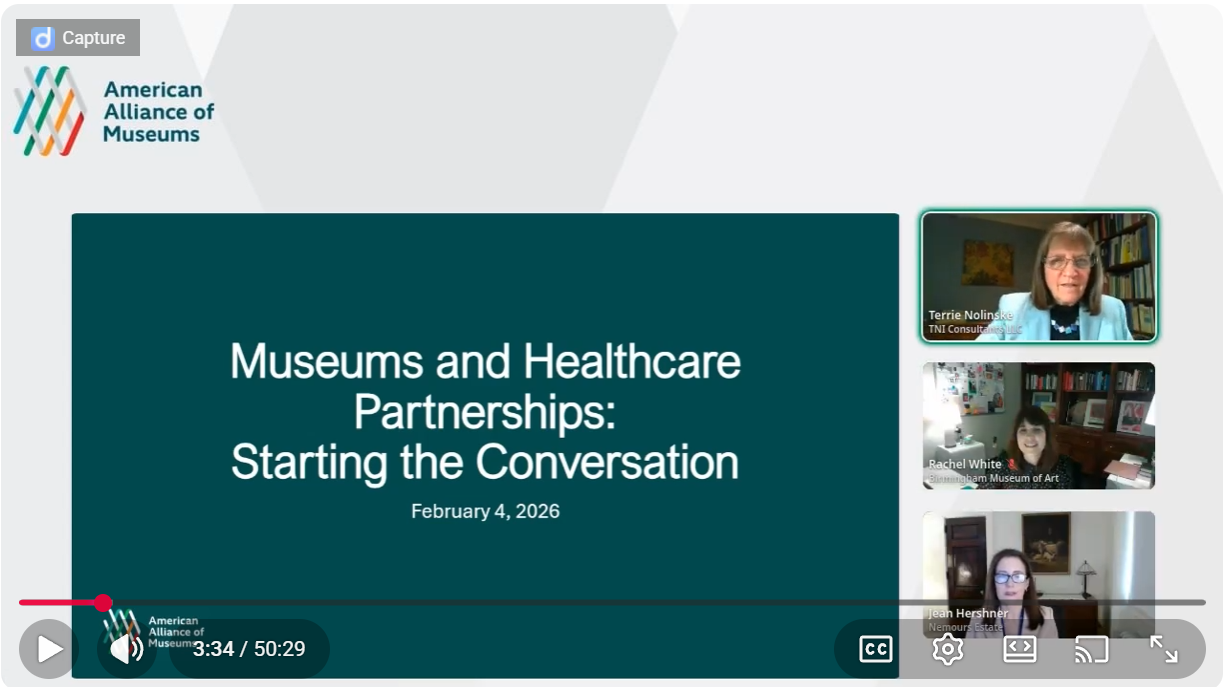
Why does Museums and Healthcare: A Practical Guide to Partnership matter now? While collaborations between museums and healthcare organizations date back to the 1800s, today’s landscape makes these partnerships more critical than ever. As funding cuts challenge organizations, leaders are seeking innovative alliances that deliver impact. Both museums and healthcare entities are trusted sources of communication and community engagement, and research increasingly shows that museum experiences can enhance well-being and health outcomes. This session explores how to start the conversation with a healthcare partner, offering practical strategies and a quick case example to inspire action. Whether you’re new to this space or looking to strengthen existing relationships, you’ll gain insights to help you take the first step.
Transcript
Cecelia Walls:
Hello, everyone. We’ll get started in just a moment. I’ll let people have a few seconds to hop in the session today. Good afternoon, and welcome to Museums and Healthcare Partnerships. Starting the conversation. Please feel free to use the chat to say hello, state your name, where you’re from, We’re so glad you could join us today.
My name is Cecelia Walls. I’m the assistant director of learning content and operations here at AAM. Today’s webinar focuses on how museums and health care partnerships begin, how they evolve, and what museums can learn from real world We’re thrilled to be joined by three speakers with deep experience in this work. First, we have AAM professional member, Terrie Nowlinski, principal at TNI Consultants. Who will share a little bit about our exciting new publication, titled museums and health care, a guide to partnership. I’m putting a link in the chat if you’re interested in purchasing a copy. And then Terrie will also give us some background on why this topic is important. And why now.
Next, AAM professional member, Jean Herschner, vice president and executive director of Nemours Estate, will share with, the story of their partnership with Nemours Children’s Health Hospital.
Highlighting how programs developed over time to support patients, families, staff, and the broader health care community.
And finally, Rachel White, director of learning and engagement at the AAM tier three museum member, Birmingham Museum of Art, will discuss prescribing art, an innovative collaboration with medical educate that uses art observation to strengthen clinical skills and physician well-being.
Together, our speakers will explore how museums can play meaningful roles in the health care settings from bedside and community programs to professional education, along with key lessons challenges, and takeaways that you can apply in your own work. And now I’ll turn it over to you, Terrie.
I’m handing it over to you, Terrie.
Terrie Nolinske:
Thank you very much, Cecelia.
Hello, everyone. Working with a team on this toolkit has brought together my careers as an occupational therapist and a museum professional.
As you can see on this slide, the content of the toolkit focuses on different types of partnerships.
Questions to ask, tips on managing what can go wrong, examples of funding, and examples of many types of evaluations including participant outcomes and the partnership itself. Next, the 12 detailed case studies represent truly cultural institutions from a to z, that’s aquariums to zoos, including historic homes, science and technology centers, health, children’s, and art museums who partner with various health care institutions.
Some of those include mental health and behavioral health agencies, continuum of care communities that include independent living, assisted living, skilled nursing, and memory care.
Day programs that train those who are neurologically divergent are also great partners, and don’t forget the health systems such as those who provide your health insurance.
Museum health partnerships certainly aren’t new. They’ve existed since before the eighteen hundreds.
But through the years, evaluation, research, and our evidence-based practice shows interaction with museum enhances health, physical, health, and mental health, and our well-being.
Research also shows that cultural institutions and health care organizations are influential visible, and trusted members of the community.
So why not establish a partnership with them to support our efforts in community engagement?
With that in mind, I’d like you to hear from our two authors of case studies contained in the toolkit.
Jean Hershner:
Thank you very much, Terrie. Again, my name is Jean Hershner. I’m from North State located in Wilmington, Delaware.
On the screen to the right is our primary building. A 47,000 square foot mansion designed by Carrère and Hastings. To the left, that poly European object is our water tower. And the modern blue and green glass structure on the far left of the screen is Nemours Children’s Hospital Delaware.
Next slide.
Just a very brief bit of context here. So the mansion you just saw was constructed in 1910 by philanthropist Alfred I DuPont.
And he would continue to expand his estate with additional buildings, formal gardens, fountains, fine art, and antiquities until his death in 1935. The image here on the screen is really just a glimpse into the formal French gardens.
In his will, mister DuPont establishes the Nemours foundation and directs that a children’s hospital be built on the grounds of his 300-acre home. His widow, Jesse Balducott, makes it her life’s work to ensure the hospital flourished, and she succeeded.
It was originally named the Alfred I. Dupont Institute, became the Alfred I DuPont Hospital for Children, which is how a lot of people in Delaware still refer to it, and a few years ago, it changed its name once more, Nemours Children’s Hospital Delaware.
Each name change signaled both an expansion of medical services as well as its physical growth on-site.
There is also a Nemours Children’s Hospital located in Orlando, Florida. Making Nemours Children’s Health one of the largest integrated pediatric health systems in The United States.
At the estate, we also believe that mister DuPont’s model of a historic home and pediatric hospital sharing the same campus is unique in The US and perhaps across the globe.
Next slide.
So you would think that with this setup, a hospital and a historic house and garden only steps apart. That there would be a lot of cross pollination after the estate opened to the public in 1977.
I’m sorry to say this was not the case.
But we started this work officially in 2018 by hiring our first learning programs coordinator, to offer educational programming on-site.
For about eighteen months, we worked to identify the main audience for these future programs.
Again, you would think the answer is obvious, but I do want to say that this roughly year and a half of discovery really transformational for us. Began learning about the restrictions of working directly with patient populations. Like single use items, cleanable surfaces, etcetera.
And started developing some ideas. At the end of this period, of course, we determined that we have an incredibly rare opportunity to impact the young lives of young patients as well as their families and clinical staff.
The hospital community was, without a doubt, our learning programs department’s main audience. On a separate track, the estate’s manager of gardens and grounds was serving on a campus committee that was seeking to curate a garden experience for patients and the more associates at the hospital.
Both of these initiatives, educational programming and a hospital garden, were in the early implementation stages when COVID nineteen arrived. After catching our breath, the estate’s leadership team used that unforgettable pandemic year to really refine our vision.
We knew that Nemours’ state would always be a beautiful historic home, public garden, and arboretum. Well, we challenged ourselves with question. What could we do to benefit everyone in the hospital next door?
In the coming slides, I will highlight a few of the programs that evolved from those discussions. The estate team also leaned hard into creating a more accessible welcoming entrance experience.
This included creating a brand-new pedestrian access that would be convenient for both our public visitors as well as guests from the hospital.
Patients and patient families are always admitted for free. Nemours associates with up to four guests are also always admitted for free. And I feature a statistic here on the screen about the outcome of really recalibrating that entrance experience.
So the year before the pandemic in 2019, we had 342 people visit the estate from the hospital the whole year. At that point, they had to enter through a back gate, and they had to agree rules of conduct, and it was clunking cumbersome. By 2024, three years, after introducing the new entrance with simplified admission procedures, we had over 10,000 guests from the hospital.
We also worked hard at getting the word out about the changes we were making, and ensuring that all people felt welcome.
On the screen, I have been also included small little dates beside each of these points because I want to demonstrate that in our case at least, prep work was a years long process with some items remaining ongoing.
Case in point, the estate put a lot of effort into being more physically accessible throughout the property. For us, this included modifying thresholds, installing ramps, converting p gravel pathways to hard surfaces that are easier for assistive devices to navigate.
This accessibility work will remain in progress for many years into the future, but we are making a difference one project at a time.
Next slide.
So as we were refining our vision internally, and making physical changes, we came became intentional about establishing x So with key contacts in the hospital. For us, this was and is the Department of Child Life Infection Prevention, Patient Experience, and various therapies, just to name a few. In addition, the estate’s gardens and grounds team continued its earlier work with the hospital’s weight management and volunteer services departments on the hospital garden project which involved into the present day Can Grow Garden.
The main point here is that we didn’t wait for internal work to wrap up neatly before beginning the external work. We These two sides of that equation evolved on parallel tracks. And the picture on the screen is a perfect example of that simultaneous internal, external development.
In the early weeks of COVID, the estate team wanted to show support all of the health care workers next door, our Namur’s colleagues. Who were under incredible pressure. So the gardens and grounds team picked growing on the estate. I mean, we were closed. No one was going to see them. Bundle them and distribute them at the main staff entrance. This simple heartfelt gesture was deeply appreciated.
But we discovered it was also effective at raising the estate’s visibility on our shared campus.
Even still, not a year goes by when I’m not asked at least once if the estate is doing the daffodil handout again. So making these external connections doesn’t need to be complicated or expensive. Just authentic.
Next slide.
As the state’s hospital partnerships evolved, our programs began to fall naturally into three categories. Associate programs, patient and family programs, and hospital-based programs. I have just a few of our numerous associate act activities featured here, and this is by no means an exhaustive list. These take place exclusively on-site at the estate to give staff a break from the high-pressure clinical environment.
And most of our programs have an element of nature in them or are entirely nature based. On the screen, of course, you are seeing yoga. We’ve offered this as a drop-in lunch time program, and we’ve also offer it as a department specific activity.
Therapy dog walks in this little list are a huge hit. This is where associates simply walk through the estate’s gardens with one or more of the therapy dogs. We offer this in partnership with the hospital’s associate wellness department. And also and the sign-ups for this event are filled almost instantly. Everybody loves a dog walk. And I have to say it’s a very low lift for us from a staff perspective. The BloomWell partnership is our newest initiative. This is a collaborative effort with several physicians who are avid gardeners they wanna bring the therapeutic effects of working with plants, to their fellow doctors. Their first event last spring was a plant exchange, which was open to not just doctors, but all staff interested in horticulture, followed by a flower pressing program, which late last year.
Next slide.
A few patient and family programs are highlighted here, and this is really only a taste of what of what’s available at any given year. I’ve highlighted free admission again because this is so key for our hospital families. They can come every day, multiple times a day. It doesn’t matter.
We want Nemours Estate to be a venue of well-being for them during an extremely stressful time. The annual day of remembrance on in this list is an event we host each year for hospital families who have lost a child, and it is our oldest partnership initiative.
Alfred I DuPont and his second wife, Alicia, with whom he built Nemours, tragically lost four babies in the course of their marriage. And we feel this event as a way to honor their grief as well as the losses suffered by modern day parents. The estate closes to the public early for this private and very meaningful remembrance ceremony. And it is offered in collaboration with the hospital’s palliative and pastoral care departments.
Pictured on the screen is an image from our mobility device friendly trick or treating event. This is one of my events the one of my favorite events each year. We have special hours for patient and associate families from the hospitals. We have a hospital block of time for this event, and we have public hours later in the day. This is a candy free event. So treats are activity packets and things like spider rings and stickers but the rubber duck fishing station, I think, is the fan favorite each year. All trick or treat stations are located along our accessible paved pathways. So kids can just dress up and be kids regardless of their mobility.
The hospital’s allergy department also has a table at this event, promoting the teal pumpkin project, which brings heightened awareness to food allergies and making Halloween safer for all trick or treaters. And in full disclosure, the patient the patient picture that’s here and the ones that are on the next few slides, we do have permission from those from parents. To use these images.
Next slide.
So the hospital-based program I have here, I feel is pretty self-explanatory. But these would not be possible without the great relationships with hospital-based partners, that make the magic happen in clinical settings. And it take it takes years to build those relationships.
The young patient featured here is holding up her party favor bag. So each May, May 12, on Alfred I DuPont’s birthday, of course, our founder, We provide cupcakes and party bags to patients who are able to receive them. So we work with, you know, clinical teams in the Department of Child Life to determine who can receive these these treats. And we also provide cupcakes for Nemours Associates so everybody can celebrate mister DuPont’s birthday.
Next slide.
So it has been and continues to be quite a journey. We started small and worked hard to match what we can do with what we found to be the needs in the hospital, like the daffodil distribution during COVID.
And we still do that, grounding our efforts in the history of the estate and what we believe to be the intent of Alfred I DuPont and his family. I also want to acknowledge, and I I can’t not acknowledge the ongoing support of our trustees and the amazing staff team here at the estate. Special recognition to Ken Darsney, our manager of gardens and grounds, and Annie Thomas Bubel, our learning and well-being programs manager, helping to develop these relationships.
This work is not easy.
And it takes every single person, no matter their role, to make the most estate a meaningful destination for our public visitors and the patients, patient families, and hospital associates next door.
Next slide.
As I wrap up my portion of this webinar, I leave you with my top takeaways assisted by this young man with a carrot. This picture was taken at a Can Grow Garden Harvest Party. Which takes which occurs in the hospital garden each September In partnership with multiple hospital departments, including infection prevention, which gives their blessing on all of the young participants in this event.
So my final points.
Assess readiness.
Readiness should be defined as a willingness to learn and make changes It does not require you to have all the answers. I promise you, We are still learning every day.
Also, working with patient populations is both rewarding but emotionally taxing. So be ready to give your staff time to process and receive extra support as needed.
Be authentic. Whatever you do, engage in the work that only your organization, your team is equipped to do. Do not try to be like everyone else. Be genuine and unique.
Embrace creativity and responsiveness. So this is, you know, adapt to what’s needed with outside the box thinking. I’ve added a note here on the slide about creating goals cautiously. Because it’s easy to be so focused on the specifics of a goal that new opportunities are missed or your goal doesn’t allow for adaptability.
So just be mindful of that.
Develop a pilot and pivot mindset. For us at the estate, it means we give ourselves the grace to fail. If a program or an event is not successful, make adjustments or drop it altogether, but we try again. Failure should be expected and embraced as a learning opportunity only. Otherwise, creativity becomes tentative.
And finally, go courageously. You just you know what? Just start. Whether that’s a phone call or text or email or making an appointment, be brave and begin. Because patients, patient families, and clinical staff need your creative and your resources, and making a difference is absolutely So best wishes in your own important work. And I hand the microphone over to Rachel.
Rachel White:
Thank you so much, Jean. Such incredible lessons for your project, but for all of us listening in.
I’m Rachel White. I am the director of learning and engagement here at the Birmingham Museum of Art. And I just want to thank Cecelia and AAM for hosting this webinar. And to Terrie for first reaching out to me to be a part of the toolkit. I’m grateful to share more today about prescribing art.
So what is prescribing art? So it is a biannual special topics course that happens over the course of a week. At the University of Alabama at Birmingham at their Hecker Sink School of Medicine. Eva, go to the next slide, please.
There we go. And it targets third- and fourth-year medical students. And it’s not taught at the clinic at UAB. It’s actually taught at four organizations, outside of the hospital. And that includes two on UAB’s campus itself. The Abram Engel Institute of Visual Arts, the Alabama Museum of Health Sciences. And then they come downtown to the Birmingham Museum of Art, and they also visit the Birmingham Civil Rights Institute. And on the left is a course schedule of the week at the various sites. So you can see at a glance how it’s all laid out.
Go to the next slide, please.
So the course goal, that came about from UAB, and then it has evolved over the years, is to improve baseline observational skills by exposing educating, and strengthening elements of awareness which also has benefits for physician empathy and mental health. And I’m gonna walk you through how we do that as well as how this program came to be with a particular focus on what we do at the BMA. So if we go to the next slide for me.
Okay. Starting the conversation, we were actually incredibly lucky in the UAB first reached out to us about starting the partnership back in 2011. So it is going on fifteen years now. Since doctor Stephen Russell, a professor and then an department of medicine and pediatrics, first reached out to us. He reached out to our former curator of education, to collaborate on a class. And he was inspired by a model that he had read about at the Yale School of Medicine, that had partnered with the Yale Center of British Art from the late nineteen nineties and the early two thousands.
And it was a partnership in which these two organizations brought dermatologists students together to take classes at the museum to hone their observational skills. And some of you that are interested in this topic may already know about this partnership, but also walk you through, what that foundational study was and how it inspired so many, other organizations and partnerships including our own.
So the instigator of the partnership was a professor of dermatology doctor Erwin Braverman at Yale.
And he was witnessing that his students were not doing a great job at describing patient abnormalities, in the on their grand rounds.
And he thought, how can I change this? He had studied art in the past, and so he was an avid art museum goer. And he thought, and I have the quote here, it occurred to me if I were to ask students who to describe some object that they were totally unfamiliar with, like a painting, that they wouldn’t know what was unimportant and what was important. They would describe everything in that object.
He felt that that was a critical type of training that was not currently being taught in medical school. And so he reached out to the Yale Center of British Art to create a course. And what you’re seeing on screen are students now that are still continuing this course the Yale Center for British Art.
On the right.
If you go to the next slide for me, So after several years of doing the course in the late nineteen nineties and early two thousands, and over, a 100 students had participated in the course. They were able to do a study, to find is this really working as we as we think it is. And they published their findings, in the Journal of the American Medical Association 2001. And they felt that the course through their data analysis had helped students improve their observational skills in comparison with those that had not taken the course. And on screen, I’m just I have a screenshot of you from JAMA of that particular article from 2001 that they published.
And so this was the study that Doctor Russell had learned about over his, course of study as a medical student. And then as a as a resident. That when he came to Birmingham, he wanted to incubate here.
Should we go to the next slide?
So in the early years of the partnership, we really brought that model to the BMA. And what you’re looking at on screen is an image of students taking, in front of a painting. By the American born painter Benjamin West. And you can quite see it because it’s very small, but it depicts the historical physician Erastostratus, performing a physical exam on a figure. That’s lying prone appearing fatigued in l in the center of the painting. No one is sure what is happening to the figure, and so they brought in this imminent physician, to do a test.
We do not tell students anything about the work, who the figures are, what period that we’re in. But we ask them to describe all that they see. And if they start to interpret, we ask them to take a step back and validate it through description.
So we spend about twenty minutes just describing all that they see in the object itself. And eventually, we do diagnose the painting, if you will. We learn that the young patient is succumbing to love sickness. And Doctor Russell then connects the artwork to the clinic asking the students can someone actually experience these physical symptoms from love sickness? Can someone actually potentially die from unrequited love.
And he talks about, well, the answer is yes. He discusses takotsubo cardi cardiomyopathy, which is a stress induced condition known as broken hearted syndrome. Patients who experience this have fatigue, shortness of breath, dizziness, cold sweats, and even severe chest pain.
If you’ll go to the next slide for me, you So doctor Russell officially published his own article of our course. And, in these types of museum and medical partnerships, in 2018 in the medical clinics of North America. Where he discussed our partnership and really the kind of the history of the evolution of these types of courses. And on screen, I just have some screenshots of this article for you. And then the Benjamin West painting that he also included.
And he was a part of the toolkit, writing with us. He collaborated with us on this project and even provided a quote that you’ll find in the toolkit that really summarizes his fifteen years of experience in these types of partnerships. And I’ll just briefly read it to everyone here. He says that museum based medical education is one of the few areas of medical training where visual literacy is taught.
By stepping away from the clinics and into the galleries, learners can take the time to truly see what is in front of them.
When done with self-reflection and coaching, these skills serve to benefit patients and their providers. Strengthen the human connection that is foundational to effective clinical care.
And thank you for the hearts. So we’ll go to the next slide.
So I know this is a webinar about expanding the converse I thought that we cheated a little bit and that the, medical school first reached out to us. But I wanna share that how we’ve continued to expand the conversation over the years, playing to our particular strengths as well as sort of looking beyond the BMA and the broader community and how we might enhance this course. And this may give you a few applications that you might wanna suggest when reaching out to other health care organizations or to hospitals.
So we have a long-standing program called the sensory empowerment program here at the BMA, where we have tactile recreations of works at our collection. For visitors with low or no vision, to be able to touch, to experience art. For instance, we, every other month, we meet with, veterans who have recently lost their sight and her kind of learning about this new way of being that they come to the museum and they are able to kind of touch these sculptures and have guided experiences. Helps them connect with art and also just connect with this this new way of being.
But we also want to create an opportunity for folks to experience maybe what this feels like too so they may have kind of empathy on what this experience is. So as another part of this program, we have goggles that replicate various visual impairments. Such as diabetic retinopathy, glaucoma, and macular degeneration.
And so during our prescribing our weeklong session, the medical students are given these goggles, and that’s what you’re seeing on screen. Both on the left and the right.
And then we move throughout the museum. We go down hallways. We go up elevators. Tricky points where there’s furniture and chairs strewn around.
We want them to be able to get the experience of disorientation or fear that their potential patients might feel. Particularly those new to vision loss.
And we also allow them to touch sculptures our registrars do approve this. You’ll see that they’re wearing gloves. This is something that our veterans too are able to experience. But we allot the medical students who are touch sculptures with these goggles and then using their hands, see if through touch, they can also share with us the details that they are finding on the surfaces of these particular works. And then they answer particular questions about that art object.
But the goal though overall is from this very brief experience and empathy is to be able to take on their potential patient’s perspective.
And bring that experience back to the exam room once they’ve kind of left our doors.
If you go to the next slide for me, Okay.
I’ve come show a funny title. Doctors are people too, of course. But it’s a final experience with the VA. We really wanna focus on medical students as people. We understand that this vocation has high levels of stress and burnout. That not only affects them when they’re in the hospital but when they’re at home with their families with themselves. And so during this session, we lead students through an art making activity as a creative prompt, which leads to, like, incredibly fun social experience. What you’re seeing on screen is one of our museum educators leading them through a clay hand building exercise.
And then we also allow them to take a personal tour of the BMA using a set of prompts. And so on the right of the screen is a worksheet that we created that we give to the students for them to move throughout the museum on their own. And I know it’s hard to see with this very small writing, but we have a selection of prompts for them.
And these prompts are such as, find an artwork that reminds them of someone that they haven’t seen in a long time. We suggest taking a photo of that artwork and send it to that person as a way to reconnect.
We also ask find an artwork that depicts a landscape that reminds them of their favorite place. We ask them to take a few deep breaths while they imagine the sounds and the smells that they might experience there.
So we want the museum to continue to be a place for them of rest you know, after they complete the course.
If you’ll go to the next slide, So we also have a full circle mode kind of at the end of the course sort of linking back with the emerging field of neurostimulation. So the positive effects of viewing art and of art making are being studied down more than ever.
And then in this in this field of neuro aesthetics, scientists and researchers are recording how art can not only spark creativity, but improve mood, improve memory, reduce stress,
and help us forge connections with others. And what I have on screen is just a an a cover of a newer book by Susan Magsimmitt and Ivy Ross that discusses this research.
Go get the last slide for me.
So I kind of walked you through kind of what we do during our two sessions in this weeklong course at the BMA. I know at most intense said that I wanted to spend the most time on it. But I did want to kind of share with everyone here that this is a course that takes place throughout Birmingham and to share a little bit about what’s happening at other sites.
So over the course of the week, students also travel to the Alabama Museum of Health Sciences where they look at historical medical teaching models. And that’s what you’re seeing here in this image. Though it’s not great, but you’re seeing WAC models of ailments, in boxes. That they’re all, looking and discussing in more depth.
And they also have a discussion there about navigating ambiguity when diagnosis isn’t always clear. And they also talk about when medical understanding has changed over the years and so how diagnosis has also changed as modern medicine has evolved.
During this week, they also visit the Abram Ingalls Institute for the Visual Arts where they do additional observational workshops like ours looking at particular works of art, encouraging, close looking.
But they also do some other art making activities like blind contour drawing. Where they’re really, we hone in on drawing just what they see just to reinforce that slowing down of looking. And not sort of jumping to a conclusion.
And finally, they visit the civil rights Institute for a session on understanding bias. Where they discuss, medical trust, in particular communities They also discuss biases that have existed in health care.
And as we note in the toolkit, the concept of, quote, kind of observation, how I initially discussed it looking at a painting has evolved over the past fifteen years of the course.
Where we’ve started from observing objects to observing context to observing our personal responses. And all the while, we apply these lessons to the medical field.
If you go to one more slide for me, This is our last one, with some takeaways I wanted to leave everyone with. So the first one I have is play to your strengths. You know, we are a visual art institution, and so we’re able to use our collection to improve observational skills, which is a stated educational need in medical school from the medical community.
But we also flipped the script.
So although we are a visual arts institution, we have a program for visitors with low to no vision. And so bringing that into the course also allowed us to approach other healthcare challenges. Such as the ways in which patients and clinicians connect and understand one another.
And finally, expand your network.
So in the early stages of our course, we did explore medical biases and distrust and ambiguity at the BMA. But then we thought, is there another organization that has this knowledge base that could help expand perspectives, and really kind of help to kind of hone in on these particular areas better than we could. And so the course is the better for it, from enlarging from the BMA to these kind of four other sites throughout Birmingham.
So that is all that I have to share through prescribing ARC. Guess I will kick it back to Cecelia who’s gonna open it up for questions.
Cecelia Walls:
Alright. Thank you all so much. Thank you, Jean and Rachel and Terrie, for sharing all of that with us. I’m gonna head over to the q and a. Section over to the right. If anyone has questions, please feel free to enter them there. We did get one question for BMA’s prescribing our program. Is the partnership primarily steered by the medical school or the museum? What would you say is the funding and work distribution percent age share between the partners And, also, does the school provide credit to students?
Rachel White:
Yes. The school does provide credit to students. It is a special topics course that students register for. And, UAB’s curriculum does require a special topics course. That students can take in a wide variety of topics, not just us. Where they all receive credit. But students can join to take this particular course. And we typically have about 10 students for each semester that we do it. So they do get credit.
Think there was a question about, do we receive payments?
We don’t currently receive payment for the course, and I think most everyone within the partnership offers in kind resources. Staff time, we do not charge students to use our space. We do not charge students for materials. But the Birmingham civil rights Institute does char does charge students an admission fee. But it really is a part of our mission, and there are other ways that we do receive support from UAB at the museum, just maybe not particularly for this particular program at I think the first part of that question was who is steering this? And that’s a great question.
It was initially steered by UAB in the fact that they host this special topics course; they work to promote the course. The students are registered through UAB. But it really is collaborative in terms of, like, how we approach the week and how the week has evolved. We sit down together with doc Russell and think about who else needs to be at the table. And we all kind of talk with one in with one another as we plan out the week. We also have surveys. So when we receive feedback from students, we kind of talk with one another about how we can change or improve or augment the course in any way based on that fee. Feedback. So it really is collaborative in terms of how the course goes about each semester. Though it is primarily driven by UAB, and that is a course for students for street credit there.
Hope that helps.
I guess, Terrie, are you jumping in?
With a case study to share?
You may be muted.
Cecelia Walls:
If you look down at the bottom row, you should see the microphone icon. No?
Terrie Nolinske:
I apologize. Yes. It is. It is different. Anything we see, of course, people recognize and try to do something about. Whereas mental health issue are often not as apparent.
And there are also, precautions different from physical disabilities versus mental health. On mental health units?
Often, you can’t take sharps, like scissors, pointed pencils, and so working together with the mental health technicians or associates on the unit or the head nurse very, very important, both in the physical and mental health realms.
To understand best what the needs are, what the constraints are, and what you’re able to bring in and what you’re not and use.
Cecelia Walls:
Thank you. I hope that helps, Leah. Those are the two questions that we received. If anyone else has a question, feel free to pop it in there. I will just ask a question of my own to the group, really quickly, if you were to start from the beginning, and you had no health care partnerships in place. How would you start conversation?
Terrie Nolinske:
I’ve been asked that question a lot as I’ve been working on this, and through the years, that I’ve been a therapist, And I’ve just started calling museums when I was practicing as a therapist. Because that conversation can work both ways. And I call the art museum or the Museum of Science and Industry or the historic homestead, in the neighborhood. And sometimes starting small is best, because often smaller museums don’t have the same visibility and welcome connection with the rest of the community. But just starting out, talking with a manager, the education person, sometimes collections, sometimes at the hospital.
The office of patient experiences, the office of, volunteer service yields good results.
To, again, just start the conversation and be prepared when you call to give examples of how you can contribute. To the partnership, to working together. Because as you might imagine, the person on the other end might not know anything about this and have the same vision. And so creating that shared vision through continued conversation, of course, is very important.
Cecelia Walls:
Thank you for that, Terrie. I think that’s enormously helpful to kinda get an idea of who do I reach out to. What do I do? What where do I start? So thank you. We did get a couple more questions. Margie asks, for Nemours Estate, programs, were there specific trainings available for program coordinators? To help best meet the needs of participants, whether that be through hospital-based programs or patient programs?
Terrie Nolinske:
Mhmm.
Jean Hershner:
It’s a great question. We did have some training available for really on understanding how to work in a clinical environment. Through Nemours. You know, the hospital, I will say Nemours is an organization requires a lot of training, whether you are patient facing or not. But there were additional there were additional trainings internally that Annie was able to participate in in order to able to have a better understanding work more efficiently, with directly with patient population. That that is a great question, and every facility will be different. We’ve been speaking a lot about hospitals, but certainly community based, like nursing homes and other places like that, may have their own requirements. But as you as you connect with those other health care institutions, it’s a great question to ask and also signals that you’re willing to learn and you have an understanding that there that there are going to be some that you there are there are gonna need to be some lessons learned in order to really be effective with your programming.
Terrie Nolinske:
Yeah.
And if I can build on that, the say the aquarium of Aquarium of the Pacific, for example, works with the child life department at their partnership house children’s and women’s hospital and the Child Life staff actually orient the, aquarium staff and teams that bring things in and walk with them until they feel comfortable continuing the program on their own, you know, with supervision and meetings to determine who’s going to be seen.
Jean Hershner:
Yeah. For pediatric hospital, Department of Child Life is where you wanna start. Other places, patient experience…
Cecelia Walls:
Excellent.
Terrie Nolinske:
Mhmm.
Jean Hershner:
…is start is would be number two. At one places to begin.
Terrie Nolinske:
Mhmm.
Yeah.
And in the toolkit, we have many, many resources, for
Rachel White:
Well, certainly expanding it in other states or places I mean, we are not unique necessarily in the work that we do with UAB. I mentioned the, using museums to enhance observational skills. Has been done in kind of other institutions. And, actually, I believe at the University of Texas at Dallas that may have a tremendous resources and syllabi of different medical school and museum partnerships.
I think what we do that is unique is bringing in that empathy component, also bringing in the art making component and making it kind of a more holistic course. And so, you know, potentially there is aptitude for kind of more work to be done there.
And there was a first part of that question you don’t mind repeating that, Cecelia.
Cecelia Walls:
Just expanding the two other schools or in other places.
Rachel White:
Right. UAB is the primary medical school here in Birmingham, though I will say we have worked with other hospitals. We’ve worked with residents at Grand View Hospital. The these studies. And so, the question that was posed earlier about how do I start, I mean, I think medical schools are a great option first just because there have been, kind of research and article articles published on the efficacy of those partnerships.
But I think that there is continuing education that also happens and so, you know, residents and physicians are kind of also looking potentially for extracurricular opportunities that also can enhance observational skills and also support physician well-being. So yeah, we have expounded out of the student realm into the kind of practicing medical professionals realm as well.
Cecelia Walls:
That’s wonderful. Thank you so much.
Terrie Nolinske:
people to learn from that pertain to the research that’s being done and has been done, as well as just other toolkits to reference and resource, on multiple subjects and multiple ways of doing, with diverse, populations and partnerships.
Cecelia Walls:
And a lot of different types of examples of what museums and part health care partnerships
Terrie Nolinske:
Mhmm.
Cecelia Walls:
look like and what they’re doing in different places. Definitely. We also have a tip sheet available for everyone here, all of you participants. If you’d look in your,
Terrie Nolinske:
Yeah.
Cecelia Walls:
modules over on the right, you’ll see a resources section, and you can download that toolkit there. We’ll also try to send that out with the recording. This is being recorded, and you will receive, access to that in the next day or so.
I think that’s all the questions that we have. I would like to thank you so much, Terrie, Jean, and Rachel for sharing your expertise and your experience.
Your thoughts today. And we’ve heard so much now about how Museum Healthcare Partners can begin with some simple conversations and then grow through trust. We hope that today’s webinar sparks some new ideas for you, have joined us today. And as you continue to explore this topic, we encourage you to take a look at the toolkit and the tip sheet And thank you again for joining us and for the work that you do to serve your community. So we hope to see you at the AAM Annual Meeting and Museum Expo in May, where all of these wonderful examples will be shared.
And thank you all and have a great rest of your day.
Terrie Nolinske:
Thank you.
Jean Hershner:
Thank you.
Upcoming Events
-
Museum Digital Summit
Event Date:Presented by: MuseumNext -
Environmental Monitoring for Collections of All Sizes
Event Date:Presented by: C2C Care/FAIC -
Digital Innovations in Collections Stewardship and Access at Jewish Museums
Event Date:Presented by: American Alliance of Museums -
2026 Cultural Governance & Leadership Series
Event Date:Presented by: American Public Gardens Association