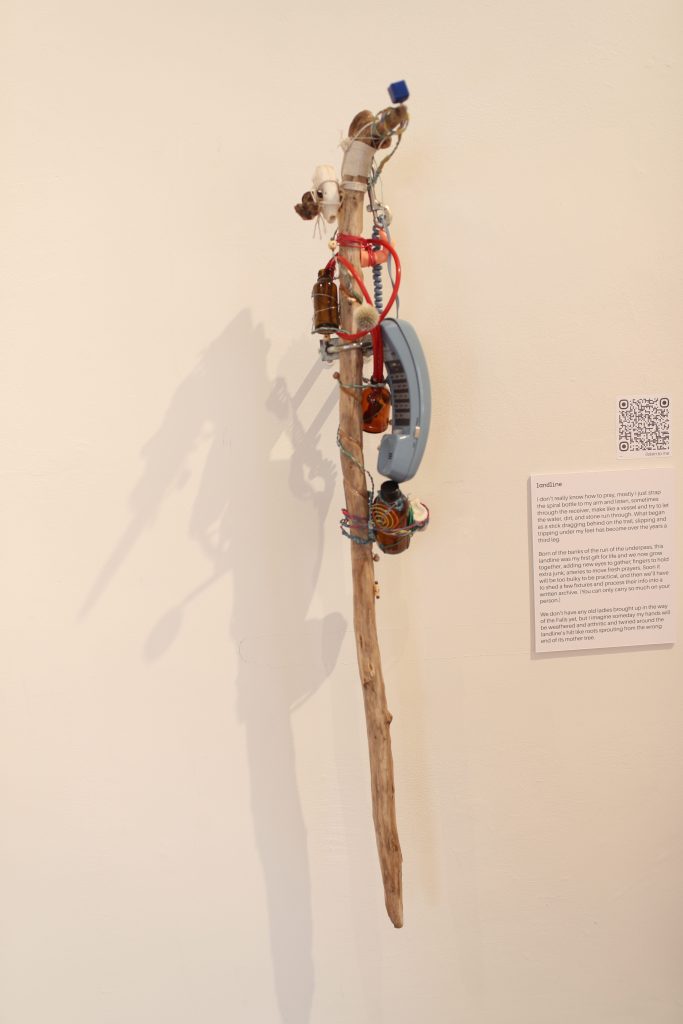
“I don’t exist in an after climate crisis—we know now that there is no after, only varying degrees of loss, varying degrees of change. My mother was a climate writer who found that her words had run dry one day, that she had run out of ways to relate. Now she knows at least ten squirrels by name and can spin twenty years of history from the contents stuffed up in a strainer. The Falls community was still in its infancy when she joined, living intentionally at the edge of every flood and building a culture from the discards of eras gone and going by. She raised me in her ethic of the Landline, always with eyes and ears and feet rooted to the movements of the world around me, to take in what feels foreign and strange as a possibility for new meaning. I’m not as much a communicator as she is, but I do my own forms of translation and transposition, refitting the old and asking what else it could be. As the sea has risen to meet the river and the meaning of the old city has itself deteriorated, my friends and I have taken up reseeding by night, littering kale and chard and beans beyond washed out fences. There are three parking garages by the harbor that I’ve had my eye on since the last flood…an herbarium, I imagine?”
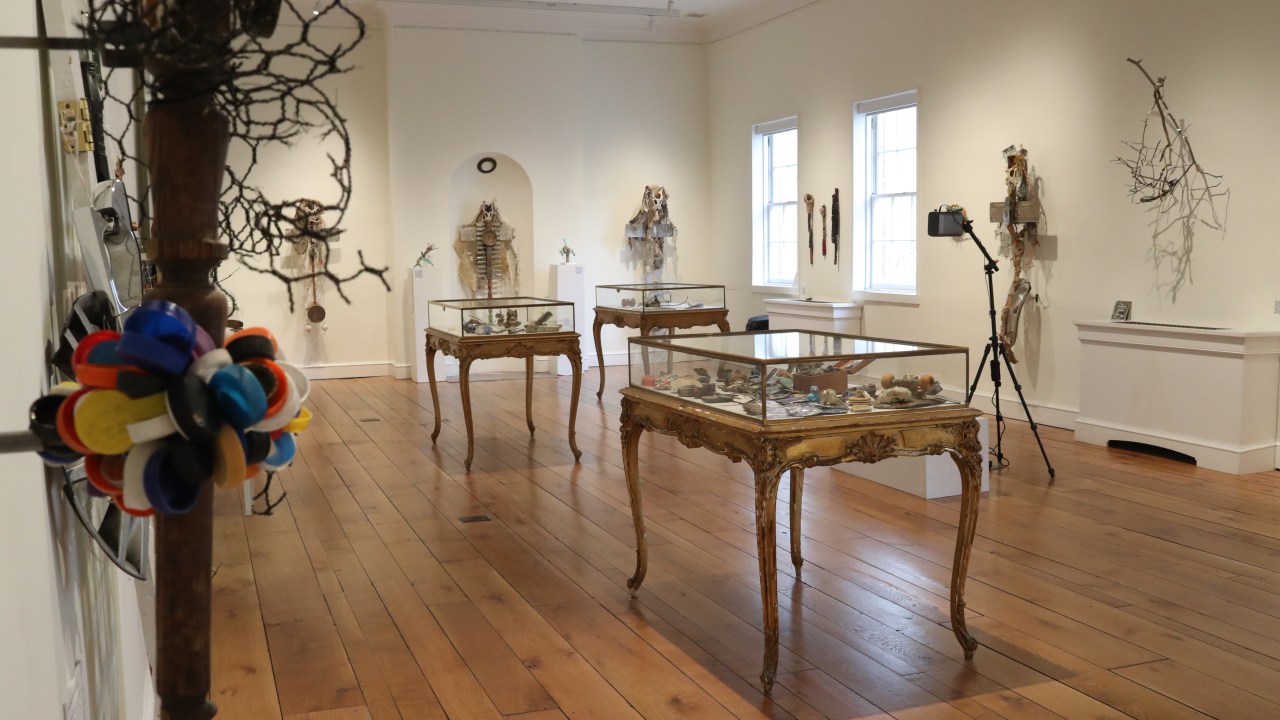
So speaks the maker of the Landline, a imaginary artifact from the future in The Future of Here, a recent collective exhibition we curated at the Peale Museum in Baltimore. Rich with twine and tubes and wire including the winding cord and handset of a tabletop phone, the Landline is a walking stick built, in fact, around a landline. But this is both known and unknown by the imagined maker of this object from a time to come. “I don’t really know how to pray, mostly I just wrap the spiral bottle to my arm and listen, sometimes through the receiver, make like a vessel and try to let the messages in the water run through,” she says.
The Future of Here gathered and presented imaginary artifacts from the everyday life of a future people that might one day inhabit the landscape of this city we now call Baltimore, once our own civilization was long gone. The exhibition was an invitation to reimagine this place along the Jones Falls River and the Chesapeake Bay in a distant future beyond our fossil-fueled present. We considered what local landscapes and cultures might look like in a time far beyond the Baltimore we know now. We sought to imagine what artifacts people of that future time might produce, and how, especially, they might make creative use of the many things we leave behind.
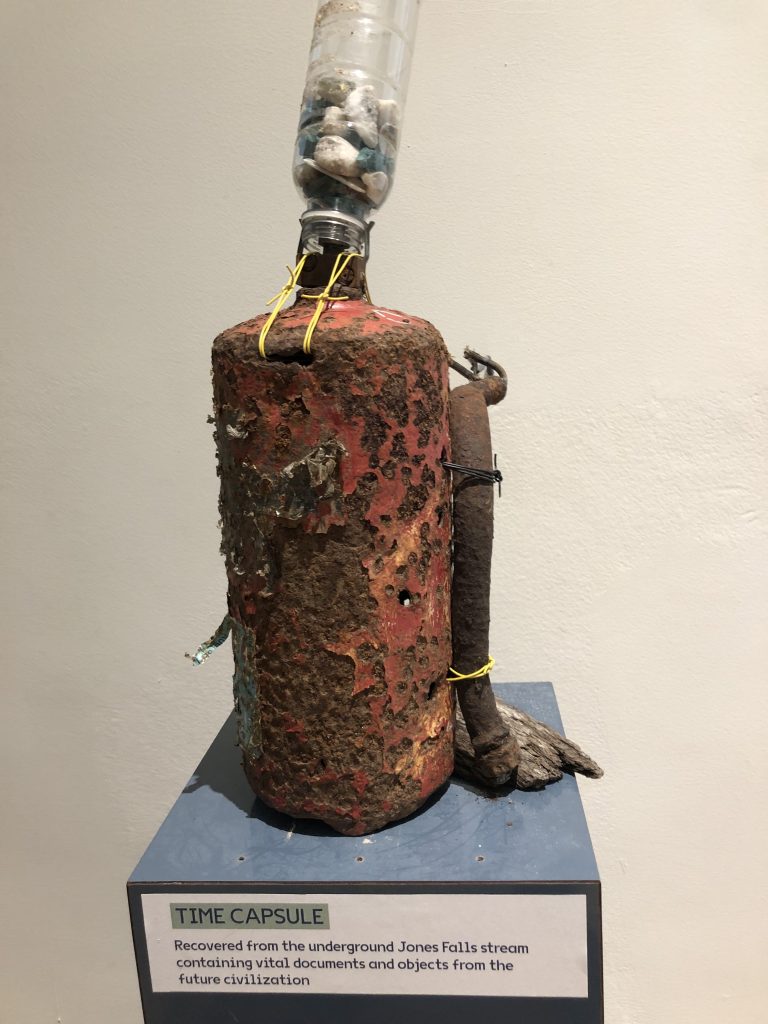
We curated this exhibition together as an anthropologist and an artist, and members of a class we co-taught at Johns Hopkins University in the fall of 2024. By assembling its objects from the trash and debris we leave behind as a society now, the exhibit raised questions about what we value and what we tend to neglect, and how we might begin to change those values and habits. What does it mean to build a museum exhibition from waste materials that might otherwise be buried and forgotten in the margins of our urban landscapes? How will the museums of the future interpret the significance and even the beauty of what is left behind from our troubled present? What would it mean to try to absorb meaningful lessons from the enormous amounts of waste we are leaving behind for the future?
Consider the many despoiled landscapes of the Chesapeake Bay and local watersheds like the Jones Falls in Baltimore: junk heaps, rotting piers, spoil basins, and the many lingering marks of this region’s industrial heritage. Our exhibition sought to imagine what these places have been and what they may yet become as elements of future lives: what it means to live in the aftermath of the ruined promises of the past and present. The Jones Falls was once so polluted by local industries that the city forced it into underground tunnels and culverts many decades ago. Remainders of that history and all the objects that people still leave behind – soda cans, rusty machine parts, plastic toys, broken glass – can be found everywhere along our streams today.
As a class in the fall of 2024, we went looking for such waste materials as unknown treasures, gathering them up as the foundation of our collective art studio. Each week that fall, we surrendered ourselves to the landscapes of our urban watershed, and our imaginations of what this place could one day become. We made our way through railway underpasses and neglected streambeds, turning our senses from the commotion of city streets to the vibrant yet unseen riverscape. We imagined what the human things and nonhuman things we found could one day become when our own civilization faded away, crafting new objects and imagining the stories and significance they might carry one day. The found remains of an old fishing reel, for example, became what we called the Oracle, brought into class in a velvet case on the first day as an invitation to imagination and speculative storytelling.
Priming our brains with poetry and ethnobotany, historical maps and speculative fictions throughout that semester, we tuned into the rhythms of the city’s hidden environments and the creatures who live there. We recorded subtle sounds, patterns of light, pawprints and landmarks, studying how these places respire, blossom, and decay. We invented a new culture for the distant future and the roles its people might have, imagining how they might live with this environment and the relics of our own time. The exhibition that grew out of the class presented artifacts and evidence from this collective journey into the future. As Skye Neulight, an undergraduate environmental humanities major at Johns Hopkins put it, we made an effort “to practice our listening and our speaking in very different ways.” Neulight was the maker of the Landline, a work that grew out of her reflecting on “what it would mean if I could pick up this phone and hear something nonhuman on the other side.”
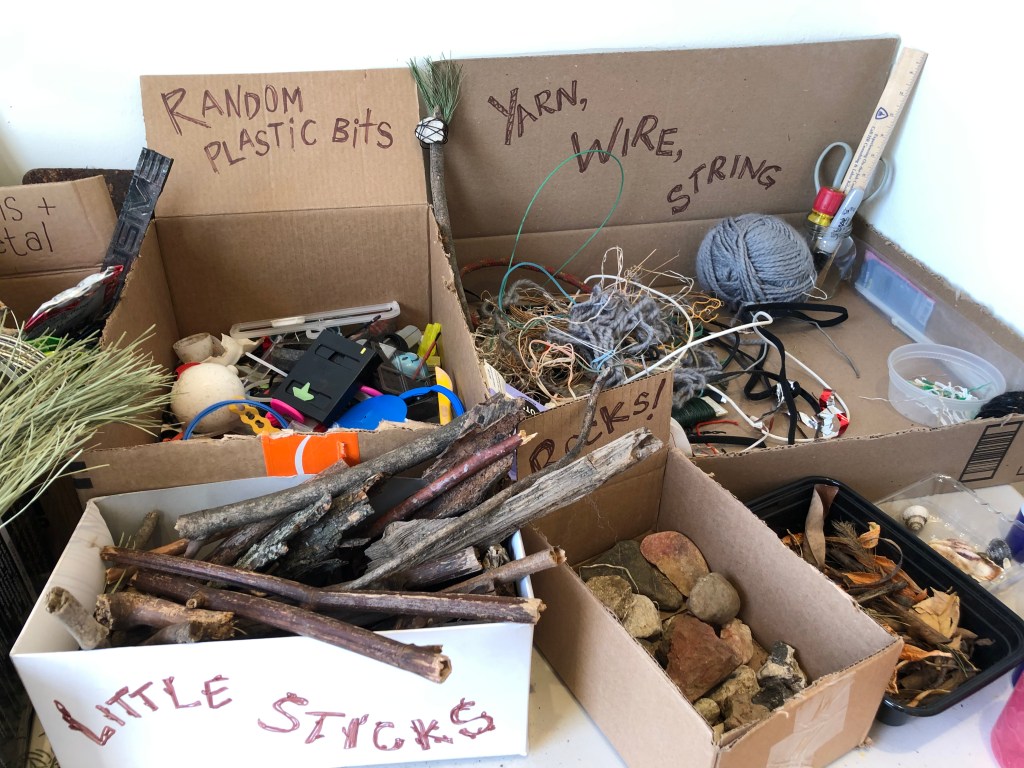
The Future of Here dreamt of a more symbiotic and hopeful time to come for our watershed and planet. We hoped that visitors would be inspired by our collective experiment, building their own stories and resources to face an uncertain future. We found this embodied in the many ways that people interacted with the exhibition, which was visited over a thousand times during its six week run at the Peale Museum in the spring of 2025. “FORGIVE US,” someone wrote on a round paper tag and suspended from a wooden branch in a corner of the gallery as a message to the deep future. We set up one of the rooms of the exhibition as a maker space filled with boxes of odds and ends — plastic tubes and bottle caps, lengths of wire and string, bits of metal, wood and bone — that many visitors used to fashion artifacts of their own, leaving them perched on tabletops and windowsills. “I dream of a Jones Falls free of cars where humans and animals can enjoy nature together,” someone wrote on a note held with a clothes pin along one of the walls.
We held a series of workshops in the space, on plant medicine and climate grief, on possible museums of the future and the paradoxical idea of an archaeology of the future, on how to think and work with the ruins of our time. One of the participants in that workshop on ruination, environmental humanities scholar Gisela Heffes, later proposed in a speculative essay that the exhibition could be taken to embody a museum or archive of extinction. “While these artifacts weave a network of voices embedded in both their materiality and immateriality, creating a polyphonic fabric where extinctions and presences overlap,” Heffes observed, “they also point toward a future.”
The exhibition closed with a workshop on how to make musical instruments from leftover bits of rubbish, and a panel discussion on art and anthropology that included several of the students whose work was featured in the exhibit galleries. Lindi Shepard, a graduate student in education, walked everyone attending the panel over to an object that looked like a small rake fashioned from wood, brush, rope, and plastic, which she called a Storycatcher.
She talked about the challenges and frustrations of the task we had set ourselves, of imagining a distant unseen future from the standpoint of the landscape itself. Eventually, she said, she tapped into “the sensibilities and the wisdom of the waterways we were exploring, stopping and listening to the river, what it had to say, what it had to show.” Her Storycatcher was inspired by the ways in which branches along the river picked things out of the moving water, inviting all of us to imagine a future in which people worked with such natural forces rather than against them.
Those people of a distant future might look back to our present as the time of a Great Unraveling, her exhibit speculated, “an unraveling of minerals from the Earth, of nutrients from the soil, of connections between species and place.” But devices like the Storycatcher could remind us too that “things can be rewoven.” And people of that time could bring stories too into that weave.
“Stories are the currency of our culture,” she imagined them saying. “They are seen as gifts from the unraveling which must be picked up and woven anew. We do not collect to throw away; these items have intrinsic value. We collect to build and to revere. To honor the stories contained within these time-fluid capsules. To return them to their rightful place in the weave of time.”

Transience is real, and the things of our time will likely outlive contemporary civilizations and their people. Hundreds of years from now, when archaeologists of the future sift through the remnants of this time, what will these materials tell them? How will they interpret the lives of those who inhabited this moment, making sense of what we did and why? What might the museums of the future hold one day, as embodiments of what the people of that time deem worth saving from ours? There remains a deep afterlife to the things we leave behind and the stories they will tell.
Upcoming Events
-
I’m In Charge of A Museum Store. Now What?
Event Date:Presented by: American Alliance of Museums -
Core Issues Briefing Series
Event Date:Presented by: American Association for State and Local History (AASLH) -
Strengthening the History Workforce Virtual Summit
Event Date:Presented by: American Association for State and Local History (AASLH) -
Gettin’ To Know You: The Art of Networking
Event Date:Presented by: American Alliance of Museums