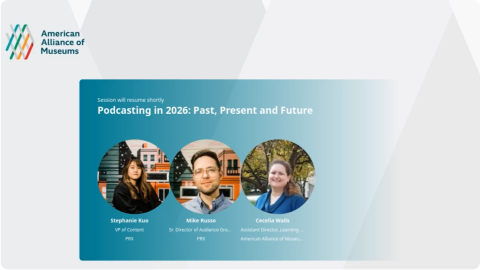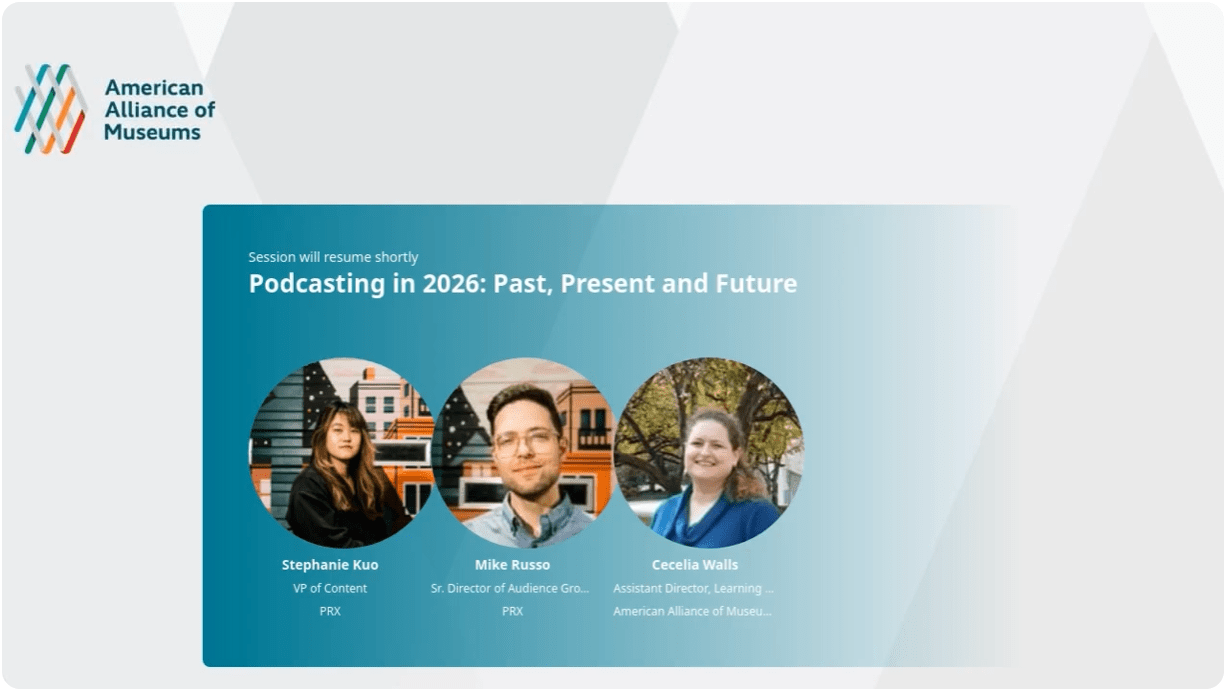
Are you a new audio creator who is trying to navigate the current podcasting landscape and wondering where and how you might fit in? The industry is generating a lot of headlines and discussion about what’s next amid financial ups and downs, market saturation, format shifts and overwhelming corporate influence. In this session, PRX provides an overview of the stakes, trends and players in the world of podcasting as well as what it takes to produce a desirable, feasible and viable podcast in 2026 and beyond.
Additional Resources
Transcript
Cecelia Walls:
Hello, everyone. We’ll give everyone just a minute to get settled in.
Stephanie Kuo:
I haven’t been in a webinar in a really long time. Actually, no. I think about it.
Cecelia Walls:
Alright. Well, we’re glad everyone is here today. Good afternoon, and welcome to podcasting in 2026. Past, present, and future. I’m Cecilia Walls with the American Alliance of Museums. As you know, podcasting is at an inflection point with big questions about sustainability, saturation, and who gets heard. Today’s session, led by our colleagues at PRX, will explore the current podcasting landscape and what it takes to create a desirable, feasible, and viable podcast. As we look ahead to 2026 and beyond. So this webinar is being recorded and will be available to registrants following the event. Closed captioning is available and AAM members will also be able to access the recording on our website in a week or so. Please put any questions in the q and a tab to your right. And feel free to introduce yourselves in the chat. With that, I’m happy to turn things over to Stephanie and Mike.
Stephanie Kuo:
I think this is Yeah. Yeah. I’m sharing my screen right now. So alright, I think we can all see that. Hi, everybody. My name is Stephanie Quo. I’m the vice president of content at PRX. I am a little congested this morning or this afternoon, so bear with me. At PRX, my job is to oversee all content. That means our podcast portfolio, our broadcast terrestrial radio portfolio, as well as creative development for our production unit. And so I am I’m in the content all the time, and I’m joined by my colleague, Mike Russo.
Mike Russo:
Hey, y’all. It is so good to see you. And, like Stephanie said, we’re both part of PRX. And Radiotaopia. I do a bunch of audience work. Here, and I’m really excited to talk about the trends and the current state of podcasting. And all that kind of stuff. I’m actually located in Kansas, City, Missouri. So I saw somebody shout out Saint Louis. In the chat, which is great. And just excited to talk about stuff. Like Stephanie or I think like Cecilia said, free to keep using the chat like you are. And yeah. Awesome. I love Missouri. And we will continue to respond and try to collect those things. I think there’ll be a lot of moments for questions as Stephanie kinda, like, leads us through all of this. And so we’ll try to do good be a good job do a good job of, curating those and bringing those questions to the forefront. So can’t thank you enough for having us.
Stephanie Kuo:
Thanks, Mike. I was gonna also add on that I live in New York, but I am from Dallas, Texas originally. So I see that there’s someone from Fort Worth in the chat. We’re not we’re viable cities or sister cities, however you wanna, however you wanna frame it. So good to see you all here. Alright. So let’s go over what the days or what this lecture is gonna cover. So in this first section, we’re gonna talk about why podcasting, some of your organizations might be wondering, is this a worthwhile endeavor?
What is the return? Why does it matter? Is it too late? We’ll talk a little bit about why we think pot is a really effective and exciting medium at this time. We’ll give you a historical overview. We can’t know where podcasting is gonna go unless we know where it from, and PRX has been very fortunate to be around since the beginning of podcasting and our growth an organization tracks very closely to that of podcasting as an industry. This part’s kind of fun. And a little bit interactive as well. And then finally, the largest section of this not 2025, 2026, the largest section of this lecture will be about the landscape in 2026.
So, Mike, why podcasting?
Mike Russo:
Yeah. So we like to lead off with kind of just celebrating or kind of showcasing, why we really believe and think investment in the medium is really important. And so a few of those things are if you aren’t familiar, I’m sure everybody here is a podcast listener, but how we talk about the industry and that there’s a consistency to it. There’s a trackable way that it comes to you. So they’re really showcasing this in this war that you’re gonna hear over and over again about building a parasocial relationship, which is, one of the things that we have listed right there. And then that they can be as relevant in and timely and pop into you as well. There isn’t, like, there doesn’t need to be appointment scheduling, that they kind of adapt their life with you. And this you really creates a unique, intimate, and emotional, like, type of medium that I would argue is hard met with any other ones. And the last thing that we talk about is that it fills your third space, joins you with you when you are walking the dog, when you washing the dishes, and things like that. And so it joins you in your life and, again, just builds into that parasocial relationship, which is super unique and great.
At the same time, the completion rate is virtually unmatched. There’s a 70% completion rate for the medium as a whole. And when Edison did their survey in 2024, 93% of people who conducted the survey said if they start a podcast, they listen to most or all of the episode, which is frankly unheard of. I think it just shows the power of the medium and how it’s adapted over its twenty plus years which we’re gonna kinda try to give you a little bit of a history and then I think that we also wanna talk about the other thing about that that it’s the loyalty and the ROI is, virtually unmatched. And so, nearly one fourth of the podcast listeners if you are a podcast listener, listen to twenty-two hours a week. So that’s in the high end of the podcast listeners if they’re really filling up that time. And then the average American that is a podcast listener.
So if you’re in that percentage, you have eight to nine episodes a week that you’re touching at some point. May not necessarily, fully complete, but that there is like, some like, you’re investing in some of them and then moving along to other ones. And then finally, the, the call-to-action conversion, which is, like, and we’ll get to the monetization and the ad revenue part of this whole thing. Is 31% of Gen z and 69% of millennials report purchasing a service product from a podcast ad directly which is a very high, CTA conversion. And really gives you a lot of return on your investment. But as I alluded to, we’re gonna pass it to Steph to do this historical overview.
Stephanie Kuo:
Yeah. Thanks, Mike. This part is actually a really fun section because podcasting feels incredibly young, but it has a really rich history as well. So at PRX, we like to think about podcasting in waves or chapters or segments. And wave one is going to be the very first. So this is in the very early February 2003, 2004.
This is when distribution of audio through RSS feeds is discovered. An RSS feed is essentially a single a link that is able to take, that’s able to update simultaneously or in real time, and it sends, content. It sends whatever is on it to, captures, platforms, everywhere. And so this idea and it’s pretty much how blogs were set up. And so we realized that we could put audio on an RSS feed and, people could get audio updated in real time. They could see audio files in real time. And this is how we realized that we could start up. We could do podcasting. The word podcast is first coined there are some are, articles out there that say one specific person first used it.
Did Apple come up come up with it because of the iPod? We’re now sure, but we know that the first time we ever hear it called a podcast and not an audio through RSS is sometime in 2004.
Wave two. This is when things start to get a little bit more exciting. There is the launch of the iTunes directory, which is fully supportive of podcasts. So prior to this, iTunes was just a place to listen to music, download music only. And then they started uploading some of these, these files to iTunes. And, actually, one of the first podcasts I ever listened to was in 2005, and it was a Drakes anatomy companion podcast and that was a and I didn’t even realize I was listening to a podcast back then. And then the release and early adoption of the iPhone So this is somewhere in the mid aughts. And so the idea of companionability and being able to take your media with you became more possible with a phone that had all of that at your fingertips.
Wave three. I would say wave three is around the time that I got started in podcast Mike, I would probably say the same for you. This is kind of the first big boom of podcasting. Is that Apple Podcasts the Apple Podcasts app is released as part of the iPhone iOS. So what’s important about this is that it’s not buried in iTunes anymore.
It’s not a separate app that you had to download yourself when you turn on your phone. It was already pre-installed, already programmed so that when you turn on your iPhone, the app was already there. It removed a major barrier for people to listen, and it allowed podcasting to really flourish. So a combination of a technical change, and then we’ll talk about some, like, cultural taste changes as well. Spotify, a little bit after this, saw what Apple Podcast was doing and started to adopt podcasts for Spotify. If you’re a Spotify user, you’ll remember that it was a little clunky at times. And they were really trying to figure out how to segment music apart from podcasts. But all the major platforms were starting to see that other music platforms were starting to see the potential of also distributing podcasts.
Both of these suggest that smartphone adoption and mobile listening is growing not only in The US, but around the world. And this next one is, these are all technical advancements. But then there’s one very big cultural change in podcasting and it is the start of a podcast that really changed the trajectory of it as an industry. Does anyone have a guess of what podcast that came out around 2014, 2015 changed the name of the game. You can put it in the chat. Yep. You all are right. It’s the launch of the cereal pot podcast. There are cereal revolutionized the industry in a lot of different ways. One, from a technical standpoint, it was one of the first times that we ever had to figure out how to get people to listen in a serialized fashion, get people to move from one episode to another, how we would be able to monetize a feed that, how we’d be able to put ads on a feed like that. PRX is actually very much involved in the early iterations of Serial and how we use our platform to distribute that podcast and grow it. But then it changed a lot for the podcasting industry as well by introducing a format that was really new. It wasn’t, you know, the first time we’ve ever heard of a serialized piece of media. That’s what a lot of television shows are like. We’re already used to it in television and books. But this idea that you didn’t have to, podcasts weren’t just catalogs, weren’t just anthologies of different episodes you can listen to, but there was an actual sequence. And there was also a way to listen so that you were immersed in a story. And Serial also was the birth of one of the most successful genres and continues to be the most successful genre, true crime. So we credit serial for a lot of things, and I think that, there are there’s a lot of debate that can be had about if those changes were for the better. Or if there or if they made things more difficult for independent podcasting, but I think, mutually, we can say serial shaped podcasting into what it is today.
Alright. Wave four. Wave four is, I would say, sometime around COVID. I would say between 2019 and 2022. When we really start to see major economic shifts in podcasting. So it’s not just this cool, quirky thing that the kids are listening to. It’s becoming a real revenue source and a real player in the media landscape.
So because of the popularity that had been accumulating through serials, through the format, through a lot of producers putting out work between 2014 and 2018. We start to see corporations be excited about the possibility of being in the game. So we see corporate acquisition and consolidation of wealth happening. I have an interesting graphic to show you all after this so you can see really visually how this how this shook out.
We saw giant booms in catalog, and there was a race for bigger portfolios and more shows. We were, the industry was really honestly throwing cash at any producer who want to make something interesting. And because of this, because there were there were clear economic upsides to this new format, we saw the growth and the demand and the growth of ad technology that really allowed, producers or, podcast networks to connect with brands who wanted to put their ads on these shows. And so something called dynamic ad insertion was developed. And dynamic ad insertion is just the ability to have ads update in real time. So, an ad could run so an ad that runs today could also run far into the back catalog, and you didn’t have to actually physically bake in an ad to your audio files. So it really allowed a lot of flexibility for sponsors and made it much more appealing to them.
We saw the first billion in ad revenue around this time. So this was a big a big step, and people really talked about it. This is something that we are actually really proud of at PRX is that we played a really important role in the early globalization of podcasting. And so podcasting became really big in The US and The UK and in Australia in the earlier days We were all very early adopters to the plat to the medium. But we were starting to see other countries in Europe countries in South America, across the African Continent, really start to adopt it as a way to prop up independent voices. And PRX around this time, we launched a program called the Google Podcast Creator Program, and this is an opportunity strictly for international podcasters to come learn from us and for us for us to learn from them as well.
All of this said and all this said and done, though, corporate acquisition, a lot of wealth is being pumped into the into this system. We’re seeing more and more adoption and more and more users. We’re starting to see then as a result, pressure on what was once an open and independent ecosystem. The joke of podcasting being friends doing this in a in a garage was very much the truth about what podcasting used to be before this. And now the standards and the expectations of what podcasting should be was experiencing a major shift. And the idea that you could just start a podcast became less and less So let’s talk about the, this audio ecosystem. Right? Podcasting in 2015 looked a little bit like this. Our CEO, Carrie Hoffman, put this together, and she up until recently, was updating it pretty often until it was actually impossible to keep with all the updates. So I’m gonna get you as close to the most current version as possible. So in the audio ecosystem, around that first boom when serial came out, we saw radio being a really integral part of podcasting. A couple of production studios, some networks being, being built, mobile apps, and a couple of tools that were able to distribute podcasts.
Ten years later, though, and this is as of last year, this isn’t even the most up to date version of this, this is what the audio ecosystem looks alike a lot more of. I wanna highlight two sections of this. Which is that everything that’s highlighted in hot pink or fuchsia magenta is PRX and how PRX is involved. So you’ll see that PRX is very much a part of public radio, an ad technology and tools, publishing and distribution tools. We have and distribute some of the top shows that are their own ecosystems out there. We have been we have been a part of forming networks podcast networks. We are a big publisher ourselves. And, thanks to the investment into the team I used to, lead, the idea that, podcast training became a big part of the industry well, and that’s a little bit of what we’re doing here. The next part I wanted to point out is this little cluster of red in the top right corner. This is a visual representation of that of the corporate acquisition and that consolidation of wealth. And so we call this the acquisition clusters. Is when we were seeing, Spotify acquire the licensing rights for The Joe Rogan podcast. Spotify, Gimlet, Podcast, The Ringer, Joe Rogan, all became one company. Entercom, became Odyssey and acquired Pineapple Street in Cadence, ’13. Amazon acquired Wondery. This was a time of massive growth.
So today, we might actually be onto, you know, a fifth wave and beyond, but this is something that we still continue to see in our current environment. We’re navigating a fluctuating economy. We, as much as every industry is affected, we are as we are prey to the ups and downs of market influences as much as anybody else. And so, we see that ad and sponsorship opportunities become more variable Some of them are being clustered way at the top for celebrities and for some of the higher grossing podcasts out there, but we know that what Adam the Adam sponsorship environment ten years ago is very different than what it is now.
There are, an end to flashy acquisitions and building those big catalogs. There’s a big shift to making having a really clear brand and a clear message in the portfolios that you create now. There’s sophistication of podcasting across the global markets. Before, we were seeing independent users and a couple of podcast listeners or a small percentages of podcast listeners across the country Now we’re seeing each of these countries. A lot of these countries have their own podcast tools, their own networks, their own support groups, their affinity groups, their trade groups. And we’re starting to see podcasts become a very standard piece of the media pie across the world and not just in The US or The UK?
This is something we’re gonna get to later today, but I’m sure you all have heard that there is a growing interest and urgency around video. Podcasting is his historically an audio medium, but we are being told and we’re seeing that there’s that, new appetites and new consumer behaviors are starting to shift us to video as an as an as a format instead. And so what does that mean for something that was historically audio? What does that mean for our production capacity? What does that mean for sales? What does that mean for marketing? We’re in a lot of, conversation and existential conversation right now. And finally, star power. Amy Poehler won a Golden Globe for a podcast, and I never thought that would be something that we would see at the Golden Globes. But we see that a lot of the top podcasts, and you’ll see this in another section, are dominated by celebrities and figure heads that you know very well. And we are currently in this moment where our hypothesis is that star power sells. And I think we’re constantly having to challenge ourselves on that assumption, but it is something we can’t ignore.
Alright. So the rest of this, webinar is going to be built around what’s happening today. And I have we have decided that kind of there are a couple of main So order to kind of exist in 2026 and beyond, we need to talk about content sophistication.
Community building, and commercial sustainability. These are the three most important things going forward. So let’s start with content sophistication. This will be broken down into four subparts. We’ll talk about the comparative landscape, what are the big trending shows out there. We’ll talk about how PRX and a lot of other studios are developing content and the skills that we’re skills and the tools that we have. We’ll talk about what it means to build a content ecosystem, and we’ll touch on the difference between video and audio and what’s gonna be right for you.
Mike Russo:
Cool. Yeah. So I’m really pumped to talk about, the content landscape. And this is just a little bit of insight into, our, understanding of the industry. I don’t know how much we got to talk about PRX in general, and it’s not we don’t really have time to explain exactly everything we do, but we, like Steph said, have been in this industry for over twenty years, distribute, over a 150 podcasts broadcast, all of that kind of stuff. So we’re able to see a lot of trends from almost every genre, piece of the industry, network, all of that kind of stuff. And this this thing, which you could just pull up at Podcast Index, just gives a running total of how many podcasts exist currently. So there’s over 4,000,000 right now, and there’s, like, it’s in counting, and it’ll show you, like, how many are active. But there’s a little bit of nuance to understanding what that exactly means. So there’s 85,000 published in the last three days. So it is, like, a larger influx of more podcasts in theory than ever are being published. However, and this is one of my favorite stats, is that less than 4% of podcasts have more than 10 episodes, that are produced, for them. And so, basically, if you are able to, like, get to that level, then you’re at the top of all of these podcasts. There’s a lot of just, like, kind of efforts that go through that don’t really finish off or don’t aren’t really, like, full ideas. And sometimes they’re just smaller than 10-episode series and things like that.
And then also, Apple hosts roughly 2,800,000 podcasts, and only 436,000 of those are actually considered active. So it’s just important, and we’ll kind of slice this in a bunch of different ways, to think about that. There are these big numbers of it being oversaturated, but it’s also a much smaller landscape when you get into sophistication, targeting niche options, and just really, like, odd against dynamic. So, if we go to the next slide, then, we kinda just try to break this down of what does all of this mean. And I would say that the highlight or the line of what we’re gonna be really talking about is that good podcasting is more about quality than it is the quantity. Of the or being podcast or how many you produce and all of that kind of stuff. And also, it’s a it’s largely a graveyard of, of ideas or RSS feeds that are just kind of out there and broken up or maybe will be returned to in one day, but, like, that’s a not that’s a part of it that inflates this number. So if you are launching a new podcast, you’re not really competing with the 4,600,000 number, which is the big number. You’re more likely and how we like to frame it, trying to compete from an audience point of view of how do you unseat one of their favorite eight to nine podcasts. So both Stephanie and I are from the public radio world, and this is a common language in in radio world where they say p one or p two referring to how you program your car, and what radio station is your number one. And if we think about that, analogy, it’s the same thing for podcasts. If we had eight podcasts programmed in your weekly life, when you launch a new one, how are you going to unseat one of those for your specific person? That is the true audience question that a PRX were just trying to get future podcasters to really start by asking not going with this macro per, like, approach of all the podcasts and the giant number.
So, what Steph’s gonna do now yeah. Here you go. Is introduce this idea of, like, the top podcast in general, the billboards, the drop tent that top trending podcasts from a myriad of different places. And stuff. You can explain where you grab this from and what it is.
Stephanie Kuo:
Yeah. So there are several different rankers out there and podcast metric trackers. We’ll talk a little bit about why there are so many and why all of them look very different. But this this first one is from the most recent data from Edison, which we’ve quoted before, research institute for, media and platform trends. This is as updated as 2025. So from left to right is top 10. So number one for as a according to Edison is the Joe Rogan experience, Crime Junkie, The Daily, Call Her Daddy, Smartless, Stuff You Should Know, This American Life, This Past Weekend with Yovan, Dateline, and New Heights.
I will say I update this quarterly and Edison is probably one of the more stable ones. So these shows kind of certainly the first seven shows never really move. This past weekend with The Avon, New Heights kinda come in and out depending on if, one, if there’s, like, a massive political news cycle that’s happening. And so you might see political talk shows show up instead. But this is this is one of the trackers. Does anybody listen to anything here? Maybe not. Okay.
I think it’s also important to see that we have hey. Stuff you should know. That’s great. We have this American life. And that’s the only public radio one that we’ve had. It used to be very different. It used to look very, very different.
Alright. Now this is from PodTrak, which I believe tracks weekly. Right? My yeah. I think it tracks weekly. So this is as early as last week. This looks yeah, so this looks slightly different. There are some players that have returned, so you’ll see Dateline and stuff you should know show up again. But now we’re seeing a move towards news. So NPR News Now, The Daily, and Up First from NPR. Because this updates weekly, I think that we can make the assumption that news is trending higher because there’s a lot of stuff happening in the news. And we can see this start to move around depending on what’s happening in the larger sphere. So next week, this very much could change depending on if a lot of stuff happens at the Oscars. Maybe it’s a lot of, and culture podcasts that trend next week. We don’t know. But you’ll see also conservative news and conservative talk like Fox News and the Ben Shapiro show we have on purpose, which Shetty, which is self help and well-being. And then Dateline forty-eight hours are true crime shows. And then we have Barstool. Alright. Alright. So now there’s one that’s also, a very I believe, also weekly as well. But Podchaser tracks specifically what’s trending on Spotify and what’s trending on Apple, separately. So on Spotify, we see that Joe Rogan is number one. They’ve invested a lot of time and money into him, so that feels like that feels really that feels correct. But also Spotify presents. I actually haven’t listened to this or knew that this was a thing.
But are they I guess they’re turning their streaming like, their music streaming series into podcast podcasts, and that’s becoming a thing. We see The O’Hang again, the Sean Ryan show, the Daily’s here again, Creme junkie, the Diary of a CEO, Tucker Carlson, Good Hang with Amy Poller, and Up First with NPR.
Mike Russo:
And one thing that’s interesting about this is I know this is specifically the case with Diary CEO is that it is a, interchangeable video podcast. And so that’s another thing that you’re gonna see different on Spotify, which actually will also be the same capability in Apple near the end of spring.
Stephanie Kuo:
Yeah. So much like the 4.36 number that we showed you earlier, there’s a lot to take away from these charts and a lot not to take away from these charts. And so oh, there’s one more. Sorry. And podcast Podchaser for Apple, we have The Daily, Crime Junkie, Dateline, The Joe Rogan Experience, Pod Save America, Mick Unplugged, Up First, Megyn Kelly Show, Real AF with Andy Frizzella and the Ezra Klein Show.
I haven’t seen The Ezra Klein Show in a top 10 in a really long time, so this is interesting. Again, there are some heavy hitters that come back time and time again, Dateline and the Daily. Always in the top 10. The daily has the benefit of being a daily show so that the people are just listening every day. And so a lot of these are boosted how many what your numbers look like. Right? Alright. Now let’s compare that actually to what a top show is versus a top favorite show. Which the addition of the word favorite makes this different. So instead of what is being listened to in real time, it’s what do people say they like the most. And this is from sounds profitable, which is another, podcast business think tank newsletter. 11% say the Joe Rogan Experience is their favorite. Followed by Crime Junkie, The Daily, Call Her Daddy, New Heights, we see Mel Robbins show up here at The Breakfast Club, Morbid, Mister Ball in My Favorite Murder, Conan O’Brien, Rotten Mango, Sean Hannity, Dark History, and The Ramsey Show. Those are all shows that aren’t that did not show up in those metrics but are considered top favorite shows. Are any of these your favorite shows? Mike, are any of these your favorite shows? No. Alright. You’re muted, Mike.
Mike Russo:
So sorry. I was I was muted. Before previously, we had, Jesse say that they listened to almost all of them in that top 10 that you showed. Which was great. And I think that I listen to the daily quite often.
Stephanie Kuo:
Uh-huh. Yeah. Amazing.
Mike Russo:
And my wife I have to I have to inadvertently listen to crime junkie almost every day. So, yes, I think. At least if the elect Nielsen were picking up our podcast, then they would pick up crime junkie.
Stephanie Kuo:
If none of these are your favorite show, I would love it if you put your favorite podcast in the chat. This is actually a really fun opportunity to showcase how niche podcast listening can be.
So alright. So as we said, similarly to that big number we showed you, there is something that we should really kind of abstract from this. Whatever is trending is not the playbook. Podcasting is really decentralized. The thing about an RSS feed is that no particular platform owns who distributes the podcast. And so Spotify has a different way of catching metrics. Apple has a different way of catching metric catching metrics, and so does Podcasts. All these things. And all these different platforms have a different way of counting and displaying those metrics to you. So there really isn’t a single universe sized standard in the way that music has the Billboard Top 100 or that movies have I don’t know what the movies are or what TV shows use, but there isn’t a real definitive list or formula or ranking system. And so we really have to look multiple podcast trackers to see what people are listening to.
So just because they’re on there doesn’t mean that they are truly the most listened to. I think it’s also important to note that podcast audiences are niche. And they behave differently than TV audiences and film audiences and even book audiences. And so you can a show can be really successful even if it’s not in the top 10 or even in the top 100.Ultimately, though, we can’t all make the same podcast. If every new creator walked into the industry and said, I will do whatever the top 10 tells me to do, we would have too many Joe Rogan experiences. We’d have too much true crime, and we’d have too much celebrity chat.
I think one can argue that we kind of are maybe at that that crisis point or that inflection point, but we are not all celebrities. We do not all like true crime, and we’re not all Joe Rogan. And so it’s kind of really important to plant your flag where you think it, you’re best suited. However, Mike and I do look at these trending lists all the time because macro trends help us take the temperature of the industry and understand audience habits. So because of Diary of CEO being, a dual video and audio podcast, we can start to make some deductions about format preferences what matters to people, what doesn’t, and what advertisers even are thinking on a grand scale. Alright.
The next bit of this is content development. And this is something that Mike and I do a lot for a lot of partners and clients who wanna make shows.
Something that Mike says often is that the best kind of marketing and the best kind of audience growth is just having good content. It’s really hard to market things that are bad, so you kind of wanna do a good job making sure you’re product is good and marketing flows seamlessly through that. So let’s talk about content development and what that means to us.
Content development kind of, is wrapped around four main questions. For us. What are you making? Why are you making it? Why are you the ones to make it? And who is it for? These seem like pretty standard questions, but you’d honestly be surprised how few people actually themselves. Any of this.
Mike Russo:
So, we at PRX, we kinda developed, a, I guess, a paradigm or at least a, like, a line graph of understanding, like, where your podcast is so that you can start to decision make about the design of it. I did also wanna call out I love that somebody said bird note. That’s a personal favorite of ours. And we get a lot of Radiotopia shout outs, like Song Exploder and Normal Gossip We never get Memory Palace, so I, we love our creators at Radiotopia. So but, anyway, back to the real stuff. So this grid that exists right here is this the a decision matrix Alright. So one of the first questions I would like I ask people is, is it a is it a podcast? And especially in this era where podcast can mean video, it can mean brand, it can mean initiatives or other or social media, this is a really important question to ask yourself. Is there a need for us to do a thing as a podcast, or is it better suited for something else?
Are there other formats this could live as and potentially be more effective? Is it an audio rich experience? What makes the audio distinctive and interesting? I wanna point out that sound rich is a word in public radio. It was buzzword in public radio for many, many years. And, actually, what we meant was sound dense. So just because there were many, many layers of sound of birds chirping, of cars honking, and of the very the sound of coming out of a car with the with the microphone and saying hello to your interviewee, all of that. That’s all rich and it’s also dense. But sound rich can also just mean that the person who’s hosting it plays a very specific role and can be a really good character for people to follow. It’s full of good information. It’s best the information is best learned through auditory means.
And finally, does it actually have a specific podcast audience? We go, we work with organizations all the time, and we ask them who you want to serve with podcast, and they’ll just tell us who their organization serves. And just and this might be something that you all have to think about as well. Is are the people who visit a museum supposed to be the people who listen to the podcast? Is it meant to is it meant to be for them or meant to expand the brand of your museum or beyond? But there’s a lot of nuance to these questions here.
Does it exist already? Is all a pretty basic one. People will do a quick Google search. It’s important to know, though, that just because a podcast like it exists does not mean that it can’t be successful. Podcasts do function well as new offerings, and so I will say that a lot of podcasts are successful today, probably when, were probably successful because they came out at a time when they were the only ones. And can’t be replicated all that easily. But if it’s not new, what’s special about it? Was there a delightful spin to it? Some of that delightful spin could be that you all have a very distinct perspective that isn’t out there or that you have a really special host that you think could really attract and engage people? What is the value proposition? What are you what are you adding to people’s lives? What are you offering that no other show can even if the format feels similar? And how does the show do better than the others? Here’s some examples of shows that we’ve asked that question around while they were in development. So through the cracks, it show that PRX actually developed through one of our training, podcast incubators back in 2019. And it is a limited investigative series out of WAMU in Washington DC. And it’s about an eight-year-old named Melisha Rudd who was who essentially disappeared from her from her, homeless shelter and nobody could point no one could own there was no accountability for how she disappeared, and she still has not been found to this day. At the time that this show was being reported, there had already been multiple TV news segments about this. There was a documentary that was being filmed but are the producers of this, persevered for this as a podcast because they really wanted the medium, the medium really respected privacy and was intimate and was respectful in ways that TV news was not.
What was the spin on this was that you know, investigative shows, the true crime podcast was at an all-time high at this point. And instead of calling it a true crime show, they want to call it an investigative show. It was it a crime was at the center of it, but it wasn’t the point of the show. It wasn’t the crime was not the spectacle. It was not for spectacle. It was a means of understanding how systems can fail in the cities that we live in, and so it was meant to be investigative. It also was one of the only shows, investigative slash true crime shows at the time about a black woman made by a black woman. And so we saw in the twenty eighteen twenty twenties that a lot of true crime was dominated by white voices.
And their distinct value proposition here was that they were reaching a really different audience by talking about a fair by a neglected segment of the population. And doing a story in a way that was sensitive and potentially more interesting than what was already out there.
The telepathy chase as well, and Mike, you can jump into this because you you’ve listened to all of it. I don’t know if you’re a huge fan of it, but you know it a lot better than I do. But the telepathy tapes, if anyone’s listened to this, please put it in the chat.
Essentially is a scientific white paper on audio. Right, Mike?
Mike Russo:
Yeah. So I think that a lot of it this actually will get to future slide that we get to like that. One of the most beneficial ways to, like, have audience and grow audience is word-of-mouth. And so it really talked about something that felt otherworldly they haven’t heard of, and is now, if you follow the story, pretty controversial. The New Yorker did a really good expose about the legitimacy of it all. Why we included it here is that it would never be a way that we would recommend content to start. The first two episodes are literally about how academic research is conducted, to a, like, huge degree, basically, to try to prove legitimacy. And it’s like, it’s still kind of compelling and fun audio. And they really like put their, like, flag in their sand of, like, making that different because it’s not true crime. And it’s making something like, it’s trying to legitimize what might some might con call, like, a theory or something that’s a little bit, like, pseudoscience and stuff. And that’s the way to do it. It it’s great audio regardless of the legitimacy of the journalism. So sorry to go in on it, but that’s yeah. It’s a good example.
No. I think it’s great. I think it’s like I don’t I wouldn’t have thought that, like, a scientific white paper would be listenable. Or, like, a scientific process would sound good as audio. And she, the producer, really challenged that notion, and it went on to be extremely successful. There’s even, like,
Mike Russo:
Yeah.
Stephanie Kuo:
in her next in, like, her there’s, like, a new, like, how sad now at the very top of the show that says, that is the producer saying, I became more successful than I thought I was gonna be, and I think that’s really interesting. Normal gossip from Radiotopia, one of, my favorite shows and a favorite of many out there, was a show that really took advantage of the moment in time we were in. This show launched in 2020, 2021. And it was born from the hosts realization that she lacked She was missing personal conversations with her friends about the people in their lives. And so she wanted to start a podcast called normal gossip where people shared gossip about normal people. I think we’re very used to hearing about the tabloids and the and the celebrity blind items. And we were missing out on the on the brunch chats where we just asked about you know, hey. How was your how was that one friend doing? Or hey. Did you ever talk to, you know, your cousin about this? And it’s actually what dominates a lot of our interpersonal conversations with our friends, and it launched at a time when people were really separated and far away from each other. And we were all, you know, quarantined in our apartments and our homes. We weren’t able to see each other. And the natural flow conversation happening over Zoom just didn’t feel right either. And so Kelsey McKinney created a show where friends could just talk about the gossip they’ve heard. And it went on to be a huge success. And we’re very proud that it is in the Radiotopia portfolio.
Alright. So all these three shows are distinct in a lot of different ways, and they became successful not because they created something out of thin air that was never before seen. It was the most innovative idea ever, but they were able to put their value and be able to communicate why they were the ones to do it and why it mattered now.
Alright. And then finally, the most important question, who is it for? There’s, if you plan to make a podcast only for you and your colleagues to listen to, that is fine. That’s great. But it’s often not why people come to these lectures, why people come to PRX for help. They’re asking for how do I make a podcast that becomes commercially successful over time. And that requires you all to put on a different hat. And shift your perspective from what do I want to make to what do people want from me.
Not the idea I want to share, but what’s going to resonate Who how are people going to receive? And so good content is designed for real people and takes into account their needs, interests, values, and motivations it’s really helpful to think about a specific person out there that you’re trying to target as opposed to large demographic groups. Good content has a clear and distinct point of view I know exactly who this is for. And even if it’s not exactly me, I appreciate its authenticity.
Good content knows how it will serve the listener, content, no matter how good, should not be created for everybody. And we say this all the time. A podcast for everybody is a podcast for nobody. You can put in, just about anything in there. Marketing for everybody is marketing for nobody. We really believe that a podcast that aims to do all things for all people really constrains themselves creatively and doesn’t feel authentic or specific or interesting enough to any particular person.
Alright. So what is a point of view? For us, something that Mike and I haven’t said is that our backgrounds are in design, not Mike, graphic design, yes, but, like, specifically the designer products or the design of systems and how do we thoughtfully create things through processes. And so we teach, we teach and we consult on these processes all the time. And a point of view is a key part of how we make good content. And for every client and every partner we work with, we have to establish that point of view before we can even talk about the podcast ideas. So a point of view is a vivid listener profile based on a real person that helps anchor your product or your podcast and their real needs, values, and context.
By basing personas on call qualitative or by basing these point of views points of view and personas on qualitative and quantitative research, you can avoid the pitfalls of designing for anecdotal or generalized or extreme users. And so we are saying that there is, there’s benefit to taking as much quantitative data you can find about who your, who your users are and who you serve and combine that with someone that you’ve spoken to directly.
This is a visualization of how I like to think about a POV. Sometimes people ask me, if I create a POV, am I not just making a podcast for one person? And the answer is no. Well, you’re making it for one person, but that doesn’t mean that it will be listened to by one person. So I like to think of content development and the and the understanding of how it relates to audience by looking at a ripple of water. Your POV is the center. And if you make something that really speaks to them, that really feels authentic to them, they are likely going to tell a friend of theirs that they listen to this podcast. Word-of-mouth still remains one of the most, frequent methods of podcast marketing out there. So how can we enable POVs, our, like, characters or listeners to do some of that marketing for us? And so meeting their needs allows them to expand your audience. They’ll tell others and others and others. And so you’ll get to the end of this ripple where your audience really is.
We also think of it in terms of a marketing versus a human centered design lens. Both of these are necessary. For the creation of a podcast or for a creation of any product. But they ask different questions and they serve different functions. So a marketing lens will often ask what will satisfy the greatest number of people just enough to buy our product, use our service, or listen to our podcast or do x?
How do we get as many people in the door at least this one time?
A human centered design lens or a design lens that really focuses on persona and POV development asks, what will delight the specific people we created this product service or podcast for so much that they’ll do anything for it, and we’ll tell, and we’ll tell everyone they know about it. So one is about, one is about attraction and awareness. The other is really about retention. And advocacy.
There’s a question from Tom. Is POV kind of like the character of the presenter? It can be. I think that a POV can really be is quite flexible in Amorphous depending on how what your design goals are. A POV really should be an analog to a person in the audience you’re trying to reach. Sometimes that person is a lot like your host or is a lot like you in many ways. But you’re trying to remove yourself from the design process and actually talk to someone in the real world.
Yeah. It’s the other end of the user journey who’s supposed to be listening So you can kind of create that profile. And if you are in marketing, you do a version of this a lot already. And finally, is it meaningful, and does serve your POV? People aren’t just consumers or users. I’ve used the word the two words interchangeably. But I think a real important piece of content development and strong design is that you view these listeners as people who have lives, motivations, and needs, and all of those are fact factors into what they choose to listen to and why they choose to stay. And the more you understand those complex needs, the better you’re going to make a product for them. They are making, like I said, they’re making consciousness of conscious decisions every day based on a complex value and preference system that aren’t obvious to us. Even through demographic research. Nobody ultimately needs a podcast, and this is this is coming from two people who make them and listen to them for a living. No one technically needs any of these things, but podcasts are a vehicle for delivering needs like joy and connection to your audience. And finally, podcasts should speak clearly directly and authentic to POV. Alright. Please also continue to ask questions in the chat. Mike and I will be kind of toggling who answers what, but we’re because of time, we’re just gonna keep going. So, Mike.
Mike Russo:
Yeah. So, we, have the luxury of kind of also giving you some more industry perspective of how we talk about podcasts. In general. And I think one of the things is that it’s tough to under I all podcasts in general are actually creating content ecosystems And there was a time when they were just creating just the audio product, and that was enough. And they were, like, splashing that out and that and that being a thing. Now they are used, to have a whole environment that they exist in. And I believe this is, like, the best time to make a podcast if this is how you are embracing it because it gives you this content engine and this place to be in so many different places. And it also gives a content journey of maybe coming down to the long form of the podcast or staying with them. But also having different entry points, which is, like, the best idea of, like, a multifaceted user approach. So we’re gonna give you we’re gonna talk what this means and give you a lot of examples of how to understand that, and stuff. But feel free to keep on asking questions if any of that seems a little bit like high level.
So it when we talk about an ecosystem, we are specifically talking about the interconnected system of the content. So the platform or the audiences, the work flows, and what they and how they all around revolve around the podcast itself. And so we’ll talk about a lot of different, scenarios, but usually it’s that you’re making this piece of audio and that that piece of audio then becomes video somewhere else. It becomes an email. It becomes an event. It becomes a product. We’ll give you all of these examples. But that you have this, like, thing that kind of grounds your routine making in, whether that be weekly, monthly, quarterly, seasonally, all of that kind of stuff. And then you’re able to expand it in so many other different entry points. And then, we also wanna engage the core but notice we’re not using linear language. We’re saying ecosystem rather than saying, like, journey or road or direction. So we actually want the ecosystem to be expansive in that existing in one part of it, the video somewhere else. Might be just as enjoyable or good or at least you know how much you want what you want the user to be doing there rather than everything being, like, driving to the podcast. That could be your goal, but a true ecosystem has more benefit than just, linearly driving down the quote, unquote marketing funnel. And so these, ecosystems also just naturally exist. When you are launching something in general. And so, it just kind of the idea of how media is launched is that you maybe go grab an Instagram handle and you think about what you would put on that Instagram handle now. A social media platform originally designed to share photos, and now it’s talking about a podcast.
Well, how does that work? Well, that’s the beauty of an ecosystem is now you have content to fill that social media channel. And try to get out there and that kind of stuff. So this next one is a list of all it’s close to exhaustive, of, like, all of the potential places where your ecosystem could really expand if it were just one piece of audio podcast. So there’s obviously, the web or the digital. This is, like, the first stop in the space that I go for organizations. Is saying, how does making a podcast for you live on your website? That hopefully, tons of users are coming to you or potential patrons or, any type of audience that you might have, how is it generating content there and also, like, you have the side benefit of, like, capturing all the digital certain search engine optimization for all the keywords that might be listed there. Then there’s the obvious thing that I’ve already referenced, which is the social media platforms. And how it might show up in a place where you’re already prominent or maybe a new venture or an extension or something like that. Video is largely becoming the way to kind of, hack and adapt and really think about extension of your content. It doesn’t fit for every scenario.
So at PRX, we don’t really talk about them being completely one and the same. We talk about the necessary trend of a lot of podcast is becoming video. But there’s also, and we just spoke with Apple yesterday even though they’re changing to a more video centric format. They value the audio medium as well as, like, being the central force of podcasting, but video is one of the best ways to extend into the ecosystem. So for the sake of this conversation, we’ll be talking about it a good deal. There’s obviously events. And for museums and museums that we’ve worked with, thinking about podcasts and events, they go hand in hand. They’re a beautiful way to either develop an event or an extend event or extend your own podcast into an existing event. And then finally, there’s product usually something that has to be earned, but something that could be lucrative and fun and a great way to support podcasts. But also there’s extensions of, like, and we have a lot of these examples where our podcasts end up writing books. Or be parting, part of, like, a film thing that’s adjacent or television show. And then it extends the podcast ecosystem even further.
And so, why we endorse an ecosystem and that’s a lot of my job as marketing is that it’s going to maximize your effort. So if you just are in it for the art of making a podcast and you just want it just to be an audio and that’s why you did it, and we work with a lot of those creators. That’s great. I think you just have to change up your audience expectation because then that’s, like, a very specific niche audience with a very specific outcome. And that and that that is one thing. But if you want extension of something some message, or if you want an extension of what you do at your organization, then maximizing your effort into an ecosystem really has to be part of the game plan. It does boost discovery, but that’s not the only point of an ecosystem. So one of these examples is that roughly seven years ago, if you attended a podcast marketing lecture, they would say, do an audiogram. I’m familiar with that. It’s just like a wave signal moving by and words coming by, and then the audio playing. It’s largely proven those don’t really do much.
Those are kind of just astroturf on social media. They’re not really shareable. They are content in general that fills up a page, but they don’t really extend anything on true social media platforms. And so now, people have moved beyond the idea of just discovery because they’ve realized that even if it’s just content that’s taken from a podcast, people still want to exist and feel like it’s meaningful enough to share or maybe even feel like the entire podcast. And that’s really the movement of how, ecosystems are really transcending, the podcast landscape. They also extend your shelf life They make pot there’s tons of podcasts that we work with where if they’re an evergreen content, they can release the video content months later or they can spread it out over months, with short content, things like that. And then finally, it canvases your brand. It’s the best way to extend your brand if that’s if that’s a goal of your podcast is to get out some message or a new identity, or visually I ideas that it’s giving that that that thing in all those places.
And this is a infographic that you grabbed, right, recently, Steph? And, yeah, you wanna explain it a little bit?
Stephanie Kuo:
Sure. All that to say that all those pieces of that ecosystem, web, digital, social media, video, events, product, they’re all trying to take advantage or they’re trying to capitalize on audience attention. And so at the center of all this in a very dynamic media world, how are you capturing attention in how are you getting people in the door?
Mike Russo:
Love it. Cool. So we’re gonna talk about a handful of ways that we have seen ecosystem well, we’ve been part of actually, ecosystems that have extended, and grown. So we were part of doing an original podcast on Radiotopia called The Recipe, which worked with Deb Perlman of The Smitten Kitchen. And, Kenji, who is popular. They’re both very popular. Some of the most popular, food, makers on YouTube.
So they have their own, individual worlds of content making. But they didn’t have a podcast. They didn’t have a way that they were, like, systematically, routinely talking about food, so we created the recipe for them. When we created their recipe, we created an Instagram account that was dedicated just to the recipe. So separate from both Kenji and Deb or 50,000 subscribers, something like that. Based on just those clips alone, that’s the only content that it ever posted. And what we the idea was that we were using algorithmic discovery for the for you page of the Instagram model, and I think it’s also on TikTok and YouTube as well, of the people that are scrolling. If you’re hitting some type of food, you’re looking up macaroni and cheese. Like, the best way to make it, things like that, that we hid into that, and we we’re part of your content ecosystem. And it really works. And I think that that methodology is actually kind of just how most podcasts start and they design as they think about what are the smaller clips in the bite sized moments that are gonna come out of every episode. And that’s a beautiful way to really just fill out your content ecosystem. The extended easily into events, and then also content partnerships and some expansion of, like, monetary growth. Things as well. But, yeah, the ecosystem in general was part of the plan, and it worked out really well.
Separately, we also created a podcast with the rock and Hall of Fame called music makes us, where in this season, it was Kathleen Hanna of, Bikini Kill interviewing, other women about, the magic of making music in general and whatever their specific area of their career was. So here’s, Olivia Rodrigo, and then, we also had Amy from a meal and sniffers, and then, there’s Haley from Paramore. And so all of these things are examples of places where the content ecosystem extended beyond the podcast. So there’s two screen grabs. Of, their Instagram, which would I would say was the most successful part of the entire thing. Way outperformed the podcast. And that they had hundreds of thousands of views on these moments of both Hailey and Amy just sitting on their various, like, churches or stages or wherever.
Talking about, important rock and roll moments, for them and pointing back to, like, some of even the pieces of history that they had in the museum and so that extension had huge light and continues to be evergreen there. The, up into the corner up there is just a screenshot of how their website looks. They actually just produce these individual pieces of content that were text large description of the podcast, filled out the web page, and brought content directly into, the website for Rock Hall. And then finally, it took a life of its own where fans were posting on Reddit of new content because they were individually, excited about this into their own. Places. And so, that content extension was facilitated by having these moments or these pieces of, like, postable material.
And then, PRX works with Smithsonian on, a bunch of different podcasts, side door, and collected. And we just wanted to share a little bit about, the interesting aspects of there’s more to that. And so what there’s more to that does is it acts it takes a feature story or a story in general from every issue of Smithsonian Magazine and blows it up into its own separate standalone, podcast. And then from that, piece of podcast, they then create different social media materials where they’re using images behind it. So it’s like a more dynamic idea of what I previously described as an audiogram. This is a bird episode there. Sometimes it’s a direct interview that they’re doing. And it also is key aspect of the thing that they’re kind of building out in prominence for their YouTube page. So they have a very, like, robust YouTube page for the Smithsonian magazine, but now they have dynamic ways to interact with it. Whereas before, it might just be, the, like, a medium that was fit for digital or print or something like that. They’ve now given it a life all of these other places. And I think it’s a really, it’s a successful and really beautiful model of how to think about podcasts. And it rarely even mentioned it does mention the Smithsonian magazine, but there needs to be no familiarity with some Smithsonian magazine. To understand and appreciate this podcast that is relevant almost every episode that it publishes. We talked a lot about video and podcasting, And so, I’m gonna talk about now a little bit more in the weeds of how to understand video on podcasting, how we think about it, and how we talk about it.
So, here’s an example of a podcast that PRX, is part of, from Nova called Particle particles of thought. Particles of thought is a this is traditionally when people talk about video and podcast, they think about two people in a room talking, or maybe there’s, they’re separately talking. And they just show that experience. And in this this podcast, there is a three-camera shoot, so they jump between them all. And this fills out your YouTube channel really beautifully. They’re able to cut clips and all of that kind of stuff. This isn’t how it needs to be done. This is a higher end way of doing podcasts. We do three podcasts with Nova. This is the only podcast that does it to this level. So this is just a way to do it. And it’s probably the best way on YouTube to view it. And as Spotify and Apple are looking to both extend the video, the one to one, the diary of a CEO experience, like, that’s a nice way to have that. However, of those 150 plus podcasts that we do, for PRX, this is really the only one that we currently produce that has a one-to-one video. So that just gives you a sense of, like, where the industry is at. Is that, if somebody says, oh, you have to do it in video, that’s actually not true. This is just a lot of where the conversation is versus the actual production is being. And I also included on this slide the thumbnail for how you would click on it on YouTube or another episode. Because I think that that’s equally as important to think about in the content ecosystem is what is the experience of scrolling by this, seeing this on a page, and wanting to push, play and listen to it that to me is also video and is also your ecosystem and can’t not be thought of in the design process.
So another way that video is happening, I think, is a very easy example is the Kelsey Brothers podcast. New Heights, in that their YouTube channel is, dynamically created. And then if you were scrolling down, you don’t actually know where the new episode or old episodes begin. Or end. And that’s by design. So they clip up their best moments. They clip them up under ten minutes. They give that a playlist and just call that clippable moments. Right? Then they have the longer full episode, and then they have the shorts. And that’s really how YouTube wants you to think about it is all three of those experiences are different audiences. And this is getting in the weeds, but for those who care, it’s interesting lot of podcasters that we work with don’t do a full one-to-one experience. Of just recording the, podcast. And in fact, for a lot of the productions that we work with, they don’t you can say on, on the Kelsey brothers for a minute. The they don’t, they aren’t able to do that. So they do a clipping strategy that’s just, like, smaller clips and moments instead of ever producing a longer episode. And that really functions as a longer episode.
I’ll go to the next slide really quickly. So you can also just ingest your podcast directly into YouTube. As a podcast, and that’s kind of video. That’s what gets it on YouTube music, but it also fills out your page. So it’s worth talking about. And the last one, I just don’t wanna skip over, because I think it’s really important is when you make a podcast, whether or not you like it, you are an influencer or expert on something in general. Okay? And that thing that you are an expert on is the content in the area that you want to be publishing on and talking about. And so what we encourage our creators to do is to think about those moments of publication of when they can reach out maybe, affiliated with an episode or not to post directly onto their social media platform. So here’s a podcast that Steph and I both helped produced about motherhood, specifically in French, and it is for a French audience. And when Rihanna played the Super Bowl, they made a stand alone post about that and the importance of that. Never had an episode about that. That was just serving their audience.
Here’s a separate episode a separate example of, podcast called Science Versus, one we have no affiliation with. Where on their TikTok channel, they just have one of the two hosts expand and just talk directly, make it, like, a visual and live about something they talked about on an episode, but none of that audio is in the podcast at all. That’s the point I’m trying to make is that, like, it feels standalone. And then they just say something like, if you wanna check out more, check out our podcast. And people get it. They understand the ecosystem. It treats the audience as really intelligent. Gives them a lot of entry points. So, the next part that we’re gonna talk about is the community building aspect of podcasting. And how that happens and how we encourage that. So
Stephanie Kuo:
Great. Let’s start with podcast listening. Know what the what the larger lands is telling you about where people are. So we’ve mentioned Edison Research quite a bit. They do they
Mike Russo:
the areas of that community building that we’re gonna talk about are podcast listening, then we’re gonna go into discovery and audience trends, and the power of micro and niche. And so gonna kinda give you a bunch of different information that and trends and stats and things to kind of understand who is listening, how is listening, what my audience might be. What’s the popularity of podcast, all of that kind of stuff.
Stephanie Kuo:
they prepare a report called the infinite dial every year, and it gives you a huge trend map of everything from social media usage to smart speakers to podcast to radio. And they always have some pretty good stuff here. So they’ve been charting podcast familiarity since 2006. And as you can see, that’s continuing to grow. So two hundred and forty-five million Americans above the age of 12 now know what a podcast is, and that’s 85% of The US.
Back when cereal was big, only half did. So we are continuing to grow, and this this chart will continue to grow exponentially until we hit a 100. Now we now the numbers are gonna decrease a little bit because now we’re asking people, you ever listened to a podcast? This number also continues to grow. We are now at 202,000,000 American adults, or people 12. That’s 70% of The US population. That has ever listened to a podcast ever.
Now we’re down to monthly podcast consumption. This is where we start to see people who are integrating podcasts a bit more into their life. This number is much smaller because habit forming trends tend to be smaller here. So this is where we start to see some dips in the numbers. And so the first dip we see is in 2022.
And an important thing to recognize here is that there’s a dip in 2022 because that was when people, people hypothesize it’s because that was when listeners began to go back to work, get back into their cars, go back to commuting. And so their habit changed. So they were listening a lot in 2020, and they were listening even more in 2021, and they were having to recoup little bit. But it was it’s also important to point out that it still dropped to a level above 2020. It’s continuing to grow, and now this is 2025 was a first year that Edison is including listening and watching.
So a small percentage still considers, is considered to watch A pod podcast. And an important thing to note here is that may not seem like a lot, but as you’ve seen throughout all of these graphs so far, the trends expand over time.
Monthly podcast consumption based off gender men versus women in 2025, it was 51%,57% total with a variance for video. For men. And for women, 52% total with a variance from 45 for watching video. And so we were really, really, we we’re really, really close in 2024 for it to be for there to be total listening parity, but that has cinched dropped a little bit and fluctuated. I’m excited to see what we learn.
Next year.
And then finally, by age, we see that there’s a lot of podcast listening happening from age 12 to 34. As well as ages 35 to 54. And the thing that is most exciting for me actually is age 55 plus because for a very long time, we talked about how podcasts were a way to get younger audiences. And I think we are seeing here and learning that podcast listening is growing across all age groups and all age demographics. And that there is value in making something for specific groups that aren’t trending currently or of the dominant listening group.
And finally, what’s really interesting, obviously, is weekly podcast consumption. These are people who have fully integrated podcasting into their lives. They have to. These are the eight to nine podcast listeners a week. Continuing to grow bit by bit, we are now at 40% total of the population, 12 plus, 12 plus who listen and or watch. A podcast. And so like to see this number grow. If this number grows, that means more and more pod podcasts can continue to be made to fit into people’s habits and their rituals. Alright.
Some quick audience trends and discoveries, Mike. Is that yeah.
Mike Russo:
Me. Cool. Awesome. So we, there’s some things to add into these, like, pieces of data points that kind of, like,
Stephanie Kuo:
Yes.
Mike Russo:
I think, like, highlighted a little bit more. But in general, just how to think about this. Is that this audience gains on both of the spectrums So I think that’s, again, just to our point. Thinking about your POV, important because making a podcast for different even age groups has a different growth. Pattern and this has different, adoption. There is this growing preference for visuals, especially as, like, they understand the ecosystem. There is a lean towards, like, passive extended listening, longer podcasts. We get asked this a lot. What is the best length for a podcast? The cut the standard answer used to be, I think, thirty-five minutes was the average commute. For, an American citizen. Commutes changed, obviously, after COVID, things like that. And that’s just not how that’s just not the main form of podcast listening anymore. So, that level of, what is the longest, the best length was really a skewed data point, and it’s just how long your list listenership can sustain. And if they want to have that passive time and extend and hang out, or if they want the short and simple, and where do you fit in that. And that, like, in in general, podcasts can even start to, as they get focused, even go to the other end and start to blur genres. And be kind of a pastiche of two different things. And that’s another way to offer a different product for your consumer.
Let’s look at some graphs that kind of, jump into this a little bit. When asked from this survey from the podcast host, when you wanna find a new podcast, how do you do it? So 50% of the people clicked the button that said, I look into my podcast app, and I, like, try to see what they’re recommending, which is odd because Overcast doesn’t really, recommend that much if there’s a lot of Overcast users, but obviously, podcast, Apple and Spotify does. But what’s interesting is the rest of these kind of combined are what in marketing we would really call besides, searching on Google, word-of-mouth. And so combined, there are word-of-mouth moments, people telling you, other podcasts telling you, things like that. That’s almost the other, like, 50% of that. And so that’s just a moment where we kind of like to really think about the idea that, like, design something that somebody wants to talk about and think about how they would tell somebody else about the podcast. That is the best place to start for designing a podcast is how are they going to condense the idea of your podcast into a short idea and tell somebody else about it? We can pop down to the next, slide. So this one is a more updated, ask survey of, like, and Edison tried to reach out outside of, just traditional, like, people that answered their emails. So to get a younger audience, things like that. And they’re seeing the trending, idea of YouTube becoming more popular when people say they listen listening to podcasts. That could be watching, that could be YouTube, music with a traditional listening, in general, but that has been a slow shrinking of size for Spotify and Apple as YouTube, starts to expand into the market. If you ask a different survey, it would look different. I think the only thing to note here is that the collective idea of people who talk about podcasts are co are, cohesively kind of saying YouTube is a method for how I listen to podcasts or how I consume podcasts even if I’m passively watching them. And instead of fighting that trend and being, like, precious about audio, embracing it and thinking about, oh, that’s a great ecosystem extension for me and for what I wanna make one day.
And then this next slide is kinda fun to look at when we see what are the preferences for different places, across America for where they like different things. And I thought one of the most one of the more interesting things is the strong preference in the Midwest for sports.
Maybe they have the small they probably have the smallest amount of sports markets, but maybe they wanna keep up. With that. And the variances aren’t incredibly different. But there’s also like, you can kind of dive in and see, like, political talks strongest among the West, whereas also entertainment and true crime also. Are strongest among, the West. And so, it’s just interesting to see that even geographically, where you live might be a way to think about different audience. And one of the things that I think that this isn’t really saying, but it the highlight is that if you’re serving a local audience for specific both, Stephanie and I worked at different public radio stations, for, the news or the or stories that are important to your community. That is a very viable and unexploited, and kind of ripe for production idea to give people that, idea of, like, specific community where they live podcasting. And I think that although the numbers won’t be as big, the engagement will be super rewarding if done right.
We can go to the next one. I love this one. This is interesting. I feel this. So in in being a cute millennial, I listen to podcasts because I wanna learn something, or maybe I want breaking news. Or whatever. Not cute and looking, just and precious that I am, I am the trope of this. The, Gen z I love this, and I appreciate young people for bringing truth to, like, how the medium is consumed is that they’re unashamed to say, I’m just filling time.
That’s the third thing that I’m doing is I’m just putting on there to pass my, to pass the time between the next thing that I have to do or whatever it is. Number one being they just wanna be entertained. And number two, learning isn’t lost. Is but that’s where they surveyed it. When we jump over to Gen x, we have learning coming back up to the top and then breaking news and financial news So small variation of what, the, generational trend is for millennials. And then boomers, which I love is an interesting change is that there’s politics on this survey specifically was, was said to be the thing they’re looking for, breaking news and financial news. Another reason to just analyze is the fractioning of centralized news sources. Podcasting is obviously taken a huge, trend and political point. In that existence. And so you see that here with some of our older listeners as well. When we dip into younger listeners, it’s interest I love this survey, although a smaller survey, but a great one. 84% of Gen z monthly podcast listeners say that they have ever listened to or watched a podcast with a video component. So they are very aware of it. Right? And then a lot of them say it enhances it, that they look for it, that it’s really part of it. It’s just it’s tough to fight the trend that largely under 35, I think, is how this surveys kind of slice out. When talking about podcasts, you’re usually talking about a hybrid video experience. To a person who isn’t directly in the industry who have been listening to, like, big podcasts for a long period of time or maybe a public radio listener. These are two examples on the side over here. The, Emery Chamberlain and then the new heights podcast where it’s those are technical podcasts. Where they just rip the audio from the video experience. Very little mixing, very little mastering. It’s just kind of end-to-end chop. And they push it over to, the audio RSS feed to publish there and then trend as you saw some of that happen. That totally works for them, and it’s a great benefit to it, but they are they are very much video first and then making the podcast as a side quest for them or just as a byproduct which is a complete different, topsy-turvy turn of the industry and how we kind of thought about it twenty years ago.
Then here, we’re gonna explore the power the superpower in some ways of going, Mike, or going niche. So, again, that idea just to represent of, like, when you go wide in what in your development that it’s tough to kind of talk about and figure out what it is. But if you make it for a specific person, becomes infinitely easier for them to talk about it, sell it, and celebrate it.
So, when we talk about, like, those micro moments, we’re really thinking about that, like, the bigger number that you go for isn’t going to be better because there’s so many people in the world that giving them a true just experience for some one of the best examples of this is a podcast we distribute called Sleep With Me, which is a podcast to follow asleep. So it is the key design of it is to make something that is not very interesting, but not so boring that you wouldn’t, like, pay attention. So you hit this middle ground. You’re distracted and fall asleep. I myself listened to it for a while, and other people who then become reliant and addicted to it to fall asleep It was very good in doing a very specific thing and is wildly popular and makes tons of sales revenue as a result of that. That’s just, like, going in for this very specific idea, but other people being able to talk about it. And so and there’s lots of other podcasts that do the same thing now. And with that trend and make that work. They’re specific, there’s authenticity to it. They build up that parasocial relationship. And then that makes your ad reads and your successful callouts and your call to actions or your events or products you’re selling that much more palpable, which is why what people want when they want the affiliation with podcasts. And then success can be measured then by the depth of your engagement. And so, like, how many people do you convert over to your Patreon or your email letter or things like that versus, smaller or sorry, bigger podcasts. So here’s two examples of going niche that really went big. So, Chapo Trap House is a political podcast which you will never see in the top 200 of podcasts. I’ve never seen it, there. This is a screenshot from even a year ago, so it’s even higher than that. They have, if I can see the number there, it’s a large amount of, oh, so almost 50,000 members there. And they are generating, over a 100 yeah, $172,000 monthly. This is a podcast that every other podcast publishes behind a paywall. This is how they started it. They really kind of cornered the market on a specific political
Stephanie Kuo:
$101,172,000 dollars.
Mike Russo:
environment of, like, of a of a version of being left that they really make a lot of content for, and they have monetized it. They have done events. And they have this is their whole entire lid basically off of this Patreon model. And really going niche and not really having to explode on the ad side for it. So this is, like, one of the, the best examples of, like, when you have an active audience to do something well can also monetize them if that’s the only place they can get that type of content or they have a pair of social relationship. Another example
Stephanie Kuo:
I think it’s worth it is worth knowing that Shopify does not take out revenue, though.
Mike Russo:
oh, good. Yep. Great. Great point as well.
Acquired, is another podcast that is big. They were so big that they had a Madison Square Garden’s event. It looks like it sold out. I don’t know if it actually was, but it was very heavily attended, hard to do for a podcast. And they started, just by making stories that were about this how a company came to be built. From beginning to start and going really long, talking for hours, just two friends talking about it. They were very specific, very nerdy, and it worked. People got it. And people thought about it as, like, reading a book and how to master that. So became something of an elite podcast, and it’s been successful so that so much so that they’re sponsored by JPMorgan at this point. Yeah. So that those are two good examples, and I think, I know where we need to jump to for time, but we have a whole commercial. Yeah.
Stephanie Kuo:
Yeah. Yeah. We this is we always do this. We don’t ever finish it, but we will get a copy of the stack And, honestly, the commercial sustainability aspect of podcasting is really up in the air, and even some of the biggest networks are struggling with this. And so we don’t really have all the answers, but we can tell you what we’ve noticed very quickly before we go.
Mike Russo:
Could just give a q and a too.
Stephanie Kuo:
The realities of making money a limited series is hard to monetize if you think about advertisers, what they want is a lot of real estate and a lot of square footage. And a six-episode miniseries isn’t going to provide that in a way that an always on daily will or always on seasonal always on weekly show would. So sales, the national level, happens when there’s sustained volume What we’ve noticed is if you want to attract some of the larger national brands like Progressive or any Better Help, we see that we see returns happening at about 75,000 downloads per episode.
Over the course of thirty days. That’s a lot for our new shows. Profit off of sales is usually hard accomplish in the first three years of podcasting, so you may not see returns. You may never see returns, that’s why you need to have goals of podcasting that extend far beyond financial gains if this is something feels very important to you. And so in this, you will have we’ll talk about national sponsors, regional, local, crowdfunding, direct listener support, events, and grants, and all these other opportunities, and you will more information in there. I think some parting words for you all, though, is if there are a few things that you need to take away with you when you go back to your colleagues and talk about your podcast journey. The first thing you say, like, we need to know our audience. I mean, design for them and their needs.
Niche can be as or even more valuable than reach. Set expectations and goals that make sense for you, and ultimately learn and iterate Podcasts don’t stay the same over many years, so you can keep doing things and changing things up and reinventing your story, reinventing your ecosystem, But, that’s if we could leave you with anything, these are the four things that we take with us everywhere we go. And so, very rushed. But we did finish under time. And I will create I will turn this into a PDF that Cecilia and the rest and the AAM team can send to you all. You can flip through it at your own pace.
Thank you all so much.
Mike Russo:
Thanks for coming.
Stephanie Kuo:
Thank you all.
If you ever, I’m gonna throw my email in the chat. If you want to reach out about podcasts or you want to learn how you can get this off the ground, you can email me here. And I’m Cecilia can also use it in, in debrief emails to you all as well. Thank you all so much. Have a great rest of your day.
Alright. Bye. Contact customer support

Upcoming Events
-
AASLH Women’s History Hour: Leading the Change
Event Date:Presented by: American Association of State and Local History (AASLH) -
Museum Digital Summit
Event Date:Presented by: MuseumNext -
Environmental Monitoring for Collections of All Sizes
Event Date:Presented by: C2C Care/FAIC -
Digital Innovations in Collections Stewardship and Access at Jewish Museums
Event Date:Presented by: American Alliance of Museums