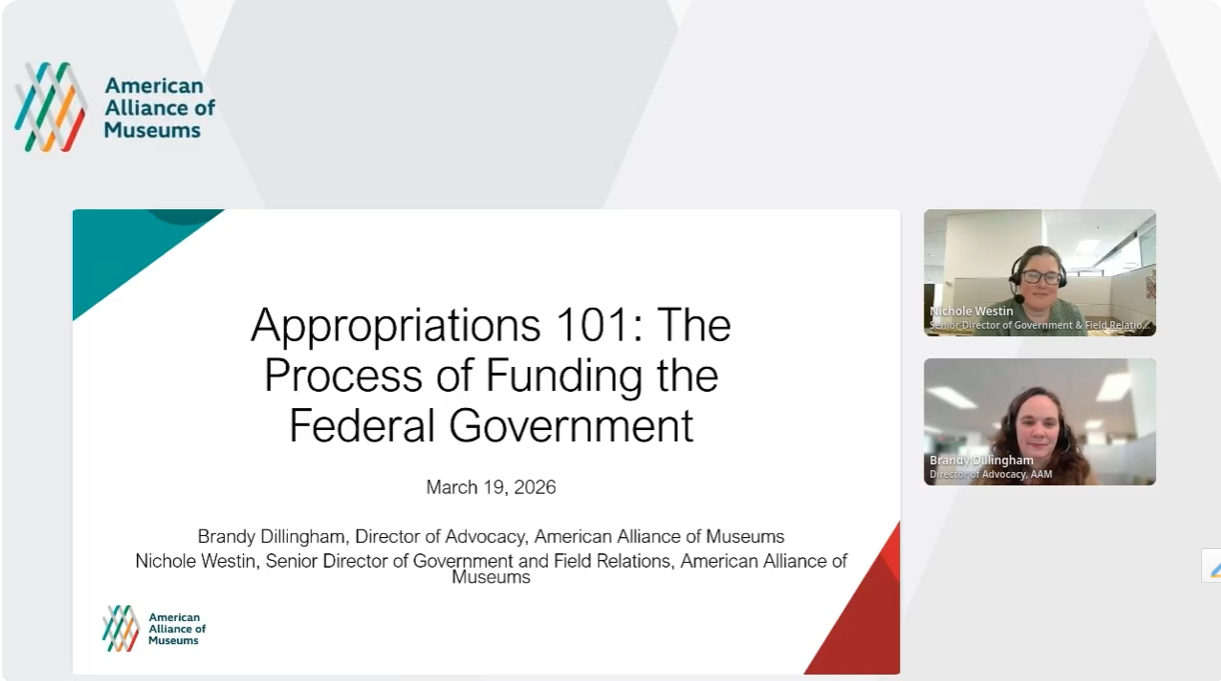
Have you seen the AAM’s Advocacy Alerts asking you to contact Congress about supporting funding for federal agencies that support museums but curious about how the process of funding the Federal Government works? This recorded webinar discusses the process of funding the federal government and how your advocacy helps support museums!
Transcript
Brandy Dillingham
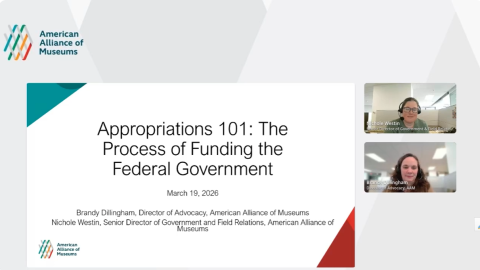
Hello, everyone. Thank you for joining us today for the Appropriations 101 webinar on the process of funding the federal government. My name is Brandy Dillingham. I’m Director of Advocacy for the American Alliance of Museums, and I’m joined here by my colleague, Nichole. Would you like to introduce yourself?
Nichole Westin
Sure. I’m Nichole Westin. I’m the Senior Director of Government and Field Relations at American Alliance of Museums.
Brandy Dillingham
Great. Thank you. As we go through the webinar today, if you think of any questions, feel free to type them into the Q&A and feel free to use the chat to introduce yourself and let us know who’s in the webinar with us. During the webinar today, we will take you through some of the appropriations terminology so that you have a better understanding when you hear some of these words used in our Advocacy Alerts or when you’re doing advocacy, how the process works, and the timeline or the general timeline that’s not always followed. Why you should be advocating at certain times on appropriations, and, where things currently stand.
Okay. So we’re going to start a little bit with, some terminology for you. Authorization versus appropriations. You may have heard this used, before. Authorization, there are authorization bills, and then there’s appropriations bills. So the authorization bills establishes and alters an agency or program. It does not actually fund the programs. It does set suggested funding levels, but it doesn’t actually provide the funding. But it sets up all the rules, how the program should run, and those type of details. So, for example, with IMLS, you may be aware that the library side and the museum side are set up very differently. Well, that was done through an authorization bill.
Appropriations, that’s the actual funding of those programs. Appropriations is done yearly and authorizations are typically done for five years is the general average, but could be a little less or a little more. So it’s not done all the time. And if an authorization were to expire so let’s say it’s a five year expiration timeline for the authorization and it expires on September 30th, those programs would still exist as long as appropriations continues to fund the programs even without the authorization.
So for example, NEA and NEH have not been reauthorized since, I think, the nineties. And those programs continue to exist because the appropriations committee continues to provide funding for it. And the same goes to even if a program is currently authorized. If appropriations does not provide the funding for it, then that program doesn’t really exist because it can’t fund anything.
So we’re going to talk a little bit about the budget committee versus appropriations committee. Yes, the House and Senate each have one of these committees. And I’m sure you’re wondering, well, what’s the difference? So the budget committee what it does is it approves an overall funding number. It does not break down how that funding is used, but it sets an overall number. Whereas, appropriations is the one that then takes that number and decides where it all goes. This is commonly called a 302b allocation if you’ve ever heard that phrase used before. That’s what they’re talking about. It’s the amount that’s given to each of the 12 appropriations bills.
And there’s two types of federal spending. There is mandatory spending, this is Social Security, Medicare, interest on the national debt. That is not part of the appropriations process. It’s not in the annual appropriation bills. And the appropriations committee is not dealing with that on an annual basis. Discretionary spending that is the rest of the federal government spending and that is done through the appropriations process. And to give you a general idea of how much is mandatory versus discretionary, according to the appropriations website, in fiscal year 23, the mandatory comprised 72% of overall federal spending, whereas discretionary spending, that’s what the appropriations committee does, comprises of about 23% of the overall federal spending. So that gives you an idea how much money they’re working with there.
So let’s get into some of the details. There are a couple types of appropriations bills that you’ve likely heard in either our alerts or on the news. There’s the regular appropriations bills, there are 12 of them that are done every- well they’re supposed to be done every year as individual bills. They will sometimes be packaged together in what’s called an omnibus bill, which is basically taking as many appropriations bills as you can into one bill and passing it all together. But in general, there should be 12 annual spending bills. The other term you’ve probably heard is a continuing resolution. This is continuing funding at the same level as the current or as the expiring fiscal year. This is typically used on a short term basis to help cover to help buy some more time for Congress when they’re trying to come to an agreement on appropriations. If they don’t pass a continuing resolution and haven’t passed the regular appropriations bills, this is when you run into the government shutdowns. And so continuing resolutions they’re typically short term, but Congress can decide to do a full year CR. Which would then get instead of passing the appropriations bills, they would just do a continuing resolution, keeping everything at the same level through until the next fiscal year.
CRs are not particularly popular because you can’t make any adjustments to any of the funding if you need to, for agencies, especially, like, with the short term continuing resolutions, it’s hard for them to plan you know, grant programs when they don’t even know what their budget’s going to be. So it’s not the most ideal way of doing appropriations, but it is something that can help by time when they’re trying to come to an agreement.
And then there’s something called supplemental appropriations bills. These are for emergency situations, usually. So a natural disaster comes through and it drains FEMA’s funding, and they need to provide additional assistance to FEMA, the states, the people who were affected. They would then need to do a supplemental appropriations bills in the middle of a fiscal year.
Okay. These are the 12 appropriations bills. So I have them here so you can see how it’s broken down. The ones in red are the ones that are most commonly of interest to museums. And I’m going to explain why in just the next slide. But I did want to highlight a few additional ones that’s on this list. While I don’t have Agriculture highlighted in red, some living museums like zoos, aquariums, public gardens may get grants through Agriculture, so there may be additional interest there. And I did also want to highlight the legislative branch appropriations bills because I know every time there’s a government shutdown, I get asked from my family members. Well, you know, is Congress impacted by the shutdown? And the answer is Congress gets all of its funding from the legislative branch appropriations bills. And so that’s Congressional staff. That is Capitol Police, Architect of the Capitol’s Office, which is their maintenance and cleaning. They do a lot of other stuff as well. The Library of Congress, Capitol Visitor Center, those are all included in the shutdown. So most of them are considered essential and would be working without pay. But I did want to highlight that because I know that’s a common question I get from my family. And so I thought some of you may have some of those questions as well.
But let’s talk more specifically about the ones for museums. IMLS is funded through what’s called the Labor, Health and Human Services and Education and Related Agencies Appropriations bill. This one is typically one of the more difficult appropriations bills to pass by itself. Just because it has a lot of agencies in there. It’s a large amount of funding that’s included. And so it typically has to be or as long as I can recall, they’ve had to pair it with other bills to help get it passed. But that is the bill that IMLS falls under. Interior, Environment ,and Related Agencies, This had this bill includes the National Endowment for the Humanities, National Endowment for the Arts, the National Park Service, the Smithsonian Institution, and historic preservation programs. So this bill has a lot of differing agencies that are of interest to museums. And then there’s Commerce, Justice, Science, and Related Agencies. This is where a lot of the science agency STEM education grant programs are within NSF, NASA, NOAA. That I know, children’s museums and science centers are have particular interest in.
Okay. Let’s talk about the timeline. Now this is going to be the supposed to be timeline that is not always followed. But it should give you a good indication of generally when things happen and how it’s supposed and how it all is supposed to flow. It typically would kick off in early February with the White House Office of Management and Budget releasing the president’s budget request. Like I said, it should typically be released in early February, but that’s not always the case. Particularly years when it’s a new presidency, they get inaugurated in January. They’re probably not releasing their budget in early February. But that’s an example of a year where it’d be thrown off. This year, it’s going to be later. Part of that has to do with fiscal year 26 not being wrapped up. Until well, it’s still not technically wrapped up, but it definitely pushes everything back. And the president’s budget is its goal of the budget is to inform Congress of what funding the president wants for the agencies and programs. However, while Congress does take into account the president’s budget request, the reality is that Congress is going to do whatever Congress wants to do. So the president’s budget is more of a suggestion. And a good example of this is you may recall last year in the president’s budget request, he had essentially defunded IMLS in the budget. But Congress chose to provide nearly level funding for IMLS instead. So that’s an example of Congress choosing to do what they want to do as opposed to following what the president’s budget request has. And this is very typical of Congress to do that.
Because at the end at the end of the day, Congress has to answer to their constituents, and they want to get reelected. And they can’t do that if a majority of voters are unhappy with their actions. So they very much care about what their constituents want. Now let’s get into to some important parts. This is where a lot of advocacy starts to come in. And this is when members of Congress submit their own funding priorities. This is typically done between mid to late February through April. It can vary from year to year. March is typically the busiest time for this. But, again, it may vary year to year depending on when the previous fiscal year bills get passed.
Now let’s get into to one of the most common things you’ve probably heard us if you’ve- our recent Advocacy Alert was about this, and you may have seen other places members of Congress do Dear Colleague letters on programmatic requests. And, programmatic requests are, for example, is like the funding for the Office of Museum Services, within IMLS. That would be a programmatic request. And these Dear Colleague letters the goal is to get as many members of Congress to sign on to the letter as possible. Because the appropriations committee, when they get that letter, they will look to see how many members have signed on. And the more that are showing support for the program, the more likely it is to get the funding that’s being requested. And so that’s why you want to try to get as many as signatures as possible. And that’s when you start to see a lot of the advocacy happening, especially with our write your representatives, Museums Advocacy Day is always late February. Partially because of the Dear Colleagues will start to circulate not long after that, and you want as many signers as possible. I’m actually going to turn it over quickly to Nichole to give a little more information about the OMS Dear Colleague. While I may take handle some of the grassroots advocacy side of it, Nichole is the one doing a lot of the direct communications with congressional offices on this. So I’m gonna let her talk a little bit about the Dear Colleagues.
Nichole Westin
Sure. Thank you so much, Brandy. So, as she mentioned, your colleague letters are sort of standard procedure when it comes to this. It is sort of a first look for the appropriations committees about what is going to be the top line asks across the board regarding various programs. When it comes to the Office of Museum Services under IMLS, we’re the only association that is strongly advocating for this along with some of the other museum associations but we’re the only group that does this. Which is why this letter is so important to us. For this year, for in both the House and the Senate, we’re asking for $55,000,000 for the Office of Museum Services. This is more or less level funding. The total number that was appropriated for FY26 was 54.7 so it’s a little bit of an increase, and it’s along the same lines as what they had during FY24 and 25. This morning, we received the final letter from the House. It was co-led by Congressman Tonko and Congressman Fitzpatrick. Tonko is a Democrat out of New York, and Fitzpatrick is a Republican out of Pennsylvania. And, again, Tonko is one of the co-chairs of our Museum Caucus. We were really excited to hear that there were a 133 sign-ons to this Dear Colleague letter in the House of Representatives. This is 10 additional members to the previous year, so we were very excited to see that. And we also had some brand new Republicans who signed on to this letter as well, which just goes to highlight the fact that there is still very strong bipartisan support for funding of museums and IMLS on the Hill. When it comes to the Senate, they are they’re behind the House by about two or three weeks. So we should be expecting the Dear Colleague letter for the Senate to start circulating sometime this week. So do keep your eyes and ears open for that because it’ll be included in an action alert where we’ll be asking people to ask their senators to join and sign on to that letter.
And, also, what we did, not only do they send out the letter, I do a lot of one-on-one work and reaching out to offices, asking for their help. If they sign-on to the letter before, we want to make sure that they’re aware that this is circulating and also reaching out to all the members of the Museum Caucus and asking for their continued support as well. So there’s a lot of meetings and one on one interaction with them to try get as many signatures as possible.
Brandy Dillingham
Thank you, Nichole. And I just wanted to add that there is basic basically a Dear Colleague for, like, every program you can think of, so it’s very competitive trying to get as many members to sign on as possible. And, while, I know sometimes when you see our Advocacy Alerts asking you to write about appropriations, it seems like we’re doing a rent and repeat all the time. The fact is is because the House and Senate are in different time frames. You’ve got IMLS, NEA, NEH, and all those in different bills. There are different times when things are moving. So while it may seem duplicative, it’s not. It’s actually us addressing those particular individual action items.
The next item that, members of Congress submit priorities on is what’s called Congressionally Directed Spending. These are basically earmarks. They just rebranded them since earmarks got a little bit of a bad rap, so they changed the name to make it sound better. Now earmarks are basically members of Congress saying we want funding for this specific project. Whereas programmatic requests for, like, OMS, whereas this is like, we want to give this amount of money for this university to do this one specific project would be an example of an earmark.
In the House, museums are not eligible for earmarks. However, they are eligible in the Senate. And this is where I’m going to turn it over again to Nichole to briefly talk you have any, like, advice or additional information you’d like to provide those who might be interested in earmarks?
Nichole Westin
Sure. Absolutely. So, the Senate earmark process actually opened up yesterday. And looking through it each senator has a certain number of requests that they can make. On a certain number of bills. So I think for labor HHS, which is under museums, there’s a certain number and so on and so forth. So they might only be able to make 75 requests under each bill. So that’s why it’s important if you’re interested in doing this to get it in as quickly as possible to your senators. And one of for an example, I think strong potential cases for having earmarks is maybe it’s an infrastructure project. Maybe you’re looking to you know, you know, redo your roof, you know, install new HVAC systems. Install sprinkling systems to protect your collections. Those are the kind of earmarks that you know, really go over well in various offices. Because it not only is supportive of the museum, but it also drives secondary economic benefits with jobs and, in the construction world. So that’s just an example. And you know, we can always help you craft something as well as look up what other offices have done. I believe last year, there was about $8.5 million in earmarks set aside for various museums across the country. So this is just an opportunity to kind of maybe look around in see what you might need, you know, $50,000 for, etcetera. I think one museum got a million dollars to completely reduce some infrastructure. So it is a good opportunity outside of the competitive grant program to really think about creative ways to utilize funding to support your institution. And again, that has just opened up on the Senate, and I think there’s only about a two week time gap on that.
Brandy Dillingham
Yes and I would just say go to your individual senators’ websites, and they will actually have a link for appropriations request and where to find the congressionally direct directed spending to submit, through their office. The next item is the appropriations priority letters. Now this seems to change from year to year, but in the past, at least, I’m not I’m not sure exactly how it’s going to run this year, members of Congress, in addition to the Dear Colleague and the process for submitting Congressionally Directed Spending, we’ll also do a priority letter that includes and ranks their priorities for the programmatic request and the Congressionally Directed Spending. So that’s another way that they’re indicating their priority levels to the appropriations committee. And one thing I did want to note that I forgot to mention when we were talking about Dear Colleague letters is that members of the appropriations committee does not typically sign on to Dear Colleague letters since they are the recipient of the Dear Colleague letters. So if you’re a member of Congress is on the appropriations committee, that may be part of the reason why they didn’t sign on to it. So just wanted to let you all know about that. And like we said, this is really our first real big push for advocacy when it comes to appropriations. As Nichole mentioned, we do typically focus on IMLS Office of Museum Services, and this is because we’re the ones that’s helping working with the Congressional offices to lead that letter. And museums are really the only ones advocating for that. Whereas, programs like NEH, NEA, historic preservation, There are other groups working with the Congressional offices to run those Dear Colleague letters, and we support their advocacy efforts, but we’re not leading them because they’re the ones typically leading those efforts.
Following members of Congress submitting all their priorities, the budget committee appropriations committee will start holding oversight hearings. This is basically where the agency heads will come and justify their budgets to Congress. And some of those hearings aren’t particularly interesting to watch, and sometimes they can have some interesting moments. So and by the way, if you wanted to know, you can actually watch hearings on the appropriations websites. If you really wanted to do that, you may not. Or you can wait until it’s recorded and put it on two x. And then outside groups typically, or outside groups have the opportunity to submit written testimony. Sometimes they’re invited to give in person testimony, but written testimony is the most common effort. AAM does submit written testimony to Labor, HHS, and Interior. Nichole, why don’t you talk a little bit about, AAM’s efforts there and maybe some details about what outside groups might put into testimony and, what the value of it is.
Nichole Westin
Sure. So I’ll keep it kind of brief. Mainly, when we’re currently drafting these testimonies now, and how they’re just a little bit different than the Dear Colleague is that it’s coming from us, and we’re able to personalize it in a way that really tells the story of how the funding is used. We go back through various grant you know, awardees. We look at programs. I reach out to people. We provide examples of what IMLS funding has supported and what benefits have been shown in the communities. We talk about how museums are economic drivers, and such. And you know, how, you know, with a small amount of money, you’re able to kind of you know, move things forward and really sort of, you know, act as critical cornerstones, in communities as education centers, economic drivers, workforce developers, and the like. So right now, I am currently finalizing some testimony for Labor HHS and IMLS, and also the Department of Interior, for the Smithsonian, NEA, NEA, and historic preservation. And those, I’m just really trying to make them as personalized as possible and tell as many stories of our communities, within the four page parameters that we are given with the type of font, size of font, margins, and the like because they have very strict rules. But this is really just an opportunity for us to provide personalization behind the asks.
Brandy Dillingham
And these typically take place between March and May. Really kind of depending on House versus Senate and then the individual year. So as I mentioned, advocacy for appropriations is really key during the spring. It’s key all year long, but the spring because this is when members of Congress are submitting priorities is really the first big effort. As I mentioned, this is when the the write your rep letters start to start to push those out. We did one last week, and the Advocacy Alert for the Dear Colleague letter on the House side. Once the Senate letter starts to circulate, you’ll see another write your rep appear in the next Advocacy Alert for that. Even though they seem similar, they actually serve two different purposes. Museums Advocacy Day, again, is that first big intro to the appropriations process. And we’ve seen on the Dear Colleague letter some of the new members who signed on this year that did not sign on last year. I noticed were offices that we did have meetings with that we had constituents go in there and talk about museum funding. So this is why that’s an example of why having those meetings are so important that time of year. And as we mentioned, every advocacy group in the US comes to DC in February through May to advocate for their issues piece of the federal funding pie. Everybody wants, everybody wants the funding. And if you’re not advocating for it, if nobody’s going in to talk to an office for funding, there’s no reason for them to provide the funding if they’re not hearing from anyone. And Congress does have it- it’s a tough job weighing all the all the competing priorities because, you know, everything’s important to someone, and so they have to really balance that out. And this is why the advocacy that that you all are doing is so important in the process.
So after all of the priorities are submitted and they’ve held their hearings, you would normally have the budget committee providing that top line spending number. And then the appropriations committee taking that number and splitting it between the 12 funding bills. Sometimes there’ll be another advocacy effort around this time. More so on the organization level. For example, AAM has sometimes signed on to group association letters in support of giving the highest funding level possible to Labor HHS because the more funding that bill has available to it, the better chance you have of IMLS getting more of that funding. So that’s the reason why there’s sometimes a second round another round of advocacy around that time. And just to give you a little bit of an idea of how the subcommittee allocations are split up. This is taken from the appropriation House appropriations websites, and this shows the breakdown from fiscal year 24. As you can see, Defense is by far the largest. But the next largest is the Labor HHS bill. As I mentioned, it’s one of the more ones to pass, and part of that is because there’s so much in it. And it has such a big percentage of comparison to some of those other bills. Where some of the easier bills to pass, like Agriculture, as you can see, is one of the smaller ones, and so it has less funding attached to it. But I just wanted to give you a visual sense of of how some of those percentages are sometimes broken down.
So following everybody getting their funding numbers and the subcommittees finding out how much money they have to work with, they will release their drafts of their bills, usually in conjunction with the subcommittee markups. This is where they have the chance to offer amendments if they want to make changes whether it’s to take money from certain programs, increase money for certain programs, try to insert language in the bill that’s not already in there. So they’ll vote on the amendments. They’ll vote on passage. Once the subcommittee does that, then the full appropriations committee will have their chance to do all of that. And then it would normally after that go to the House or Senate floor depending on which chamber it’s in, for voting. I will caution in the last couple years, the Senate hasn’t really followed this they’ve mostly just released their draft bills on their websites and then just negotiated from there as opposed to going through the full process. So every year is a little is going to be different, but this is generally the process they would follow. And this is another opportunity for advocacy because since they’re going to be doing amendments, this is a chance you want to make sure that, A. they’re not there’s no amendment trying to take funding from whatever program you’re advocating for, or if you see the draft bill and your program is underfunded, this is where you may try to get a member of Congress to offer an amendment to increase funding.
So one thing to keep in mind there that anytime you are increasing funding, any amendment that increases funding for one program it is required to take funding from another program within that same bill. So it can sometimes get a little tricky there. This timeline is typically between May and July, and it’s going to vary based on the bill. So you will see multiple Advocacy Alerts from us during this time period because the Interior bill typically moves earlier. In the process, and the Labor HHS bill tends to move a little bit later just because, again, it’s a bigger bill, and it tends to run into, more issues than some of the other bills. And they usually typically go with the easier ones first. Because they’re usually the first ones ready to go.
Okay. So after the summer sessions of committee markups, members of Congress will go home in August for the district work period. Now this is when members of Congress, they’re meeting with constituents, visiting businesses, attending events locally, and they are typically in their district for most, if not all, the month of August.
This is where we have the big advocacy push of doing Invite Congress. Where you invite your members of Congress to come visit your museum. And this is a great chance for them to see if you’ve gotten federal funding before. How federal funding has had an impact, whether it’s a program or you’ve used it to do whatever it is you’ve you’ve used it for. This is their chance to see that firsthand what that federal funding is being used for. Or if you have something that you think, future grant might be able to help with, this is your chance to show them. Or in general, just show them the value of of museums and why they should continue to be funded. So this is the next big advocacy effort following the summer activities. And we will be sending out more information on Invite Congress later this spring. But, this is just this is a great opportunity for them to see firsthand and to reinforce the value of museums.
Now in theory, they would next in September really July and September, they would do negotiations and final passage of the individual bills. This has not happened very much in the last couple years. They’re often behind schedule and will have to pass a continuing resolution. Instead. But the fiscal year does always end September 30th and in theory, they would negotiate past all 12 funding bills, and have them signed into law. And again, most recently, they’re typically doing continuing resolutions to buy more time, to get agreements, or passing them as packages to help get them through. Whenever the bills are, whenever we hear that negotiations have started and that final passage may be coming up soon, we will do another advocacy push, as they’re wrapping that up. Sometimes there’s a few false starts because you think they’re trying to move it, and then all of a sudden they hit a snag and everything slows down. So we may say we’re hearing that the bill could be on the floor next week, and then it turns out that, nope just kidding. They hit a snag, and it’s been delayed. That actually happened last year. I think we did an Advocacy Alert where it looked like the Labor HHS bill might come up in the Senate I think in the next, like, two weeks. And then the day after we sent that out, is when a lot of the stuff with the Department of Education happened and then that put a hold on the progress of that bill. So that’s an example of when things like that happen.
So here’s a recap of how the timeline would normally work. President’s budget request early February, members of Congress submitting their funding priorities February through April, the committee hearings, then the budget committee submitting the top line spending levels, followed by the appropriations committee splitting up those funding levels, followed by the appropriations committees doing their markups, considering amendments, passing their versions of the bills, floor consideration in those individual chambers, then negotiations and final passage of the bill with the fiscal year ending September 30. That is how the timeline typically should go.
Now let’s talk a little bit about the timeline. Fiscal year 2026. And this is an example of how things did not follow, schedule. So the fiscal year for 2025 ended September 30. So October 1, 2025 is when fiscal year 2026 began. However, no appropriations bills were passed, no continuing resolution was passed, so the government shutdown. As you all may recall, that went into November until Congress passed a short-term continuing resolution that reopened the federal government and kept it funded through January 31, 2026. In January, Congress did end up passing 6 of the 12 bills, appropriations bills, as packages. They were signed into law before January 31. Those agencies that were included in the package funded through September 30, so they were not shut down. However, the remaining agencies that were not in that six bills that were passed, did shut down. Luckily, this time, it was only for four days, and most services were not really impacted because it was basically over a weekend. Congress was able at that time to pass, five of the six remaining appropriations bills so those agencies are all funded through September 30. And they pass at that time a short term continuing resolution for the one remaining bill, which was Homeland Security until February 13. So nothing they were not able to come to an agreement. And so since February 14 through present, which is March 19 at the time of this webinar, Homeland Security is still currently shut down. And so until that’s resolved, whether they do a continuing resolution or pass a full year bill, that will continue to, anything under Homeland Security will continue to stay shut down. This includes, the big thing that they’re, having trouble getting over is everything going on over with ICE. But there are other agencies that fall under this, like TSA. It’s probably the one that’s most notable from, like, a a public experience because that’s the TSA agents at the airports aren’t being funded. So that’s where FY 26 currently stands.
But meanwhile, while that’s going on, Congress has to work on FY 27 because we’re already in that process. So that work has begun. As Nichole mentioned, the House has already done their Dear Colleague letter. That closed on Monday and is complete. And, Nichole, did you already mention how many signers? You did? And we did Museums Advocacy Day where we, again, did the big push for people to sign on. We just found out yesterday that the Senate appropriations committee deadline is April 21, which means the Senate Dear Colleague letter will start circulating anytime now and will have a deadline for members of Congress to send on prior to that April 21 timeline.
And the president’s budget request is rumored to be released on March 30 or the week of March 30. It may not be a full budget. It may just be what they call a skinny budget, which is like, overall top line numbers, but not necessarily into the details. But we’ll have to wait and see what they end up, what ends up getting included in that. And, of course, that’s subject to be pushed back as well. They do usually include the fiscal year 26 numbers in there, which, they don’t obviously, anything under Homeland Security has not been completed yet.
So we did want to touch on some upcoming advocacy. So we have a community sign on letter that actually just became available on our website today. The deadline to sign on is April 30, and I’m going to let Nichole talk about this.
Nichole Westin
Sure. Thank you so much. So this is going to be a letter that is sent to Congressional leaders. That would be the Speaker of the House and the Minority Leader and the Senate Majority Leader and Minority Leader. This is something similar was done in 2017 when 945 organizations, museums, and support associations signed on to a letter expressing the need to support museum funding. This one’s a little bit broader. It doesn’t just focus on IMLS. It focuses on NEA, NEH, some of the historic preservation funds and, STEM education and funding as well. It is mainly focused on informing them of the important role that museums in all shapes and sizes play in communities as places where, you know, orchestras play and dance groups play, education, economic developers, all the things that you all are very aware of. We’re hoping that we can have more sign on this year. The more that we have, the more better story we are able to tell. It’s been linked to in the chat, so please start sharing some of that information now. We hope to have you all sign on. It’s open to absolutely any association, organization, or museum that wishes to sign on to it. It is not open to individuals. If you are interested in supporting funding efforts, the action alerts is the way to go for individuals, but these are just sort of for the big organizations, I mean, and museums. So, you know, we just launched that. The deadline to sign on is April 30. If you were paying attention to the timeline information, that’s about in the middle of the process, so we’ll have plenty of time to sort of make our case. We’re excited about this effort, and you know, we will continue to update as more and more people sign on.
Brandy Dillingham
Great. Thanks, Nichole. And we hope that your museums are able to sign on as well. If you do have any questions, that web page does have an email address for us if you need to ask us any questions about the community sign on letter. We did want to let you all know about, some advocacy sessions happening at AAM’s annual meeting in Philadelphia, coming up in May. In case you’re planning to attend and are interested, we have an advocacy and policy roundtable session happening. And don’t worry, you will not have to listen to a presentation from us. It’s an opportunity for, you and your colleagues to sit together and learn from each other, discuss some of the experiences you’ve had, whether it’s policy specific or advocacy successes or challenges you face. It’s a great opportunity to learn from each other and a nice little break from being presented to you, as I know attending sessions at a conference sometimes. It’s nice to have, a break and be able to talk more to your colleagues. We are also doing an advocacy and government relations 101 session. That will be myself and Nichole and yes, we are presenting in that one. And then, we are do- I’m doing an advocacy open house in the AAM Resource Center, which is inside the Expo Hall. I will also be and general, spending a lot of time in the Resource Center. We do have an advocacy station set up there, so if you have any questions, you can feel free to find me there and ask questions. And, of course, Invite Congress is coming up in August, as I mentioned earlier, we’ll be releasing more details in the spring, but this is such a great opportunity for your members of Congress to get to see the work you’re doing, learn more about your museum, and some of the programs that you have going on.
And then the last slide here, if you’re looking for advocacy resources, the first QR code is for the Advocacy Alerts if you’re not already getting them. You can also find the community sign on letter on that page as well. These alerts go out typically once a month with calls to calls to action, policy updates. We’ll sometimes send out more frequent alerts when necessary. The other QR code is to our advocacy resources page. You could find some of our past webinars that includes one from May on in-district advocacy, there’s one in July about year-round advocacy and then one from September that was an advocacy 101. So, there’s other resources on that page as well. So now we’re going to turn it over to questions. Feel free to type in any questions you have into the Q&A box.
The first question we have, what are sample of approval for a museum? I’m not sure. Was that related to something specific, Nichole?
Nichole Westin
Yep. This was earmarks.
Brandy Dillingham
Oh gotcha.
Nichole Westin
And I can absolutely send you some information, Mary, if you wish. And I dropped in the chat a link to the FY 25 appropriation earmarks that were allotted. And there’s a search bar, and you can type in museums, and it will provide you a list for FY 25.
Brandy Dillingham
Great. And I’ll give a minute in case anybody is in the process of typing questions. I’m trying to think Nichole. Was there anything that we missed in the webinar that we should highlight? I know I kind of ran through some of it kind of quickly.
Nichole Westin
No. I don’t think so. Appropriations is such a fun, exciting topic So thank you all for, sticking with us.
Brandy Dillingham,
Yes. And every year, there’s always at least one appropriations bill that really gives them a lot of a lot of trouble. And it’s generally related to you know policy stuff happening in the world, as evidenced by the Homeland Security one. So it’s, there’s always one appropriations bill that’s the troublemaker.
Nichole Westin
I think oh, actually, I think the only thing I will say is that the appropriation process is going to be probably just a wee bit different this year because of the fact that it’s an election year. And, that will probably mean, they’ll either try to rush it as quickly as possible or the final votes will happen after the elections, and that could impact what is passed and what is not passed depending on the election results and forever. So, it could be an interesting fall. So keep an eye open for the action alerts, and certainly do sign up for those.
Brandy Dillingham
Yes. And if they do decide to push final votes until after the election, sometimes they will wait and see how the election turn out to decide if they’re going to finish them up in the so called lame duck session in December. Or if they’re just going to wait until the new Congress gets sworn in in January. That I’ve seen it go both ways. So it can definitely have an impact on how it all concludes this year.
And anytime the fiscal year gets pushed into the next year, it it always slows up the next year’s process. Okay. Since there’s no other questions, oh, since there are no other questions, we will give you back the rest of your time. But if do think of, any questions, please let us know. We do have one more question. If you’re awarded, how long would it take to get the funds?
Nichole Westin
I don’t know.
Brandy Dillingham
Yeah. That may be a question to discuss with the office you’re submitting a request to because it may it may vary based on individual like-
Nichole Westin
It may it depends on maybe who is a lot who is providing the funds, you know, what kind of how it’s going along, etcetera. Yeah. And it could be reimbursement basis. It could just be you get a lump sum. It really depends on what kind of funds they asked for, the amount, and which program it’s under because they all run differently, unfortunately.
Brandy Dillingham
Is there a worry that if you’re awarded, you might never see those funds due to politics?
Nichole Westin
I don’t think so. Because, I mean, if you keep in mind, that it depends on, like, what the final bill negotiation comes out to. Like, if, you know, know, because, again, you’re only allowed to do it in the Senate, you’re not allowed to do it in the House. So when they come and they kind of hack out their differences, there is always the possibility that your request does not go through. I believe most of them went through for FY 26 and so that is part of it, but it’s not necessarily tied to the executive order under those agencies, like, with IMLS because it’s just a different process. And it’s you know, the member themselves has requested the funding versus, like, through an agency. So but it is always a concern, especially if they’re trying to cut. But, usually, you know, that that would be a question to talk through with the senator that you’re asking through because they may be able to tell you what the experiences have been for others in that state. But, again, it all varies depending on the, one of the 12 bills that you are a part of.
Brandy Dillingham
Great. Thank you so much for your questions. If there are no other questions, thank you so much for joining us today, and I hope you found this webinar helpful. If you do have any suggestions for future advocacy webinars, please feel free to let us know. Thank you so much.

Upcoming Events
-
Strengthening the History Workforce Virtual Summit
Event Date:Presented by: American Association for State and Local History (AASLH) -
Gettin’ To Know You: The Art of Networking
Event Date:Presented by: American Alliance of Museums -
Environmental Monitoring for Collections of All Sizes
Event Date:Presented by: C2C Care/FAIC -
2026 AIC & CAC Annual Meeting & Conference
Event Date:Presented by: American Institute for Conservation