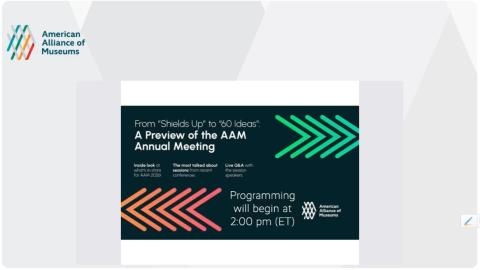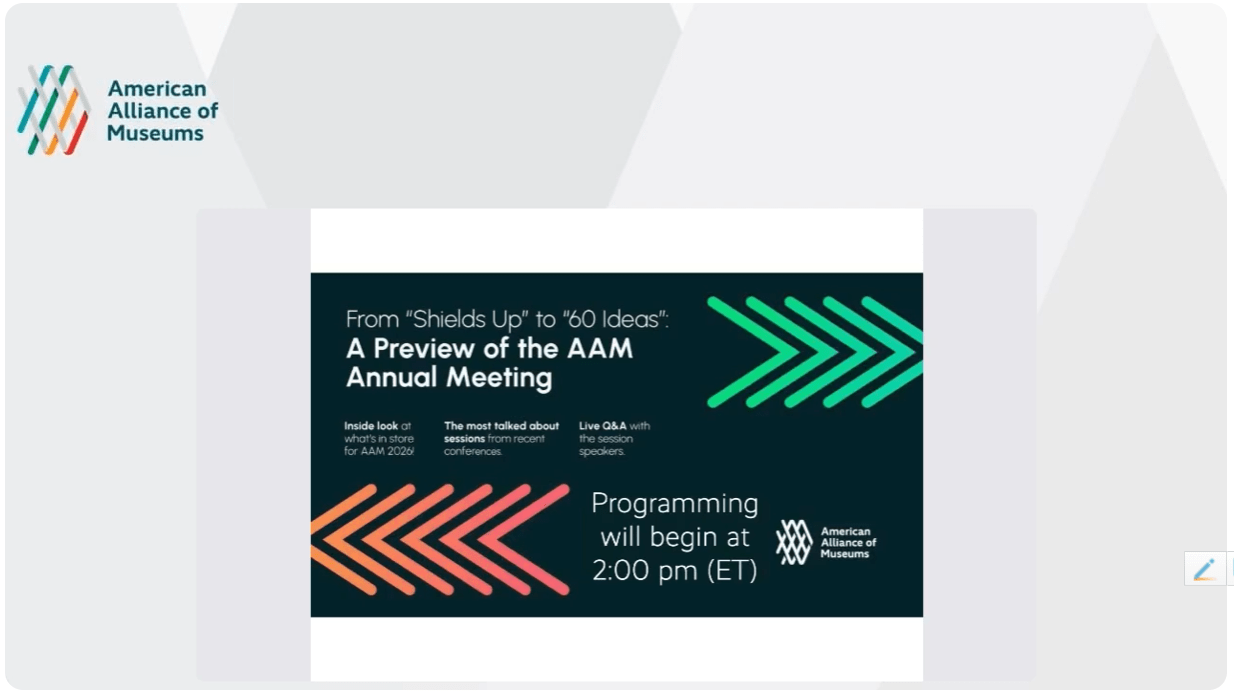
Curious about the AAM Annual Meeting & MuseumExpo but not sure what to expect? Join us for a special preview event featuring two of our most talked-about sessions from recent conferences.
From practical, rapid-fire innovation in 60 Ideas in 60 Minutes: Small Museums are Thriving to courageous leadership in Shields Up! Safety, Security, and Inclusion for LGBTQ+ Programming, you’ll experience the mix of bold thinking and real-world tools that define the Annual Meeting.
Plus, AAM staff will share an inside look at what’s ahead for the 2026 conference in Philadelphia, including new experiences, learning opportunities, and ways to connect. Whether you’re considering attending for the first time or looking to get re-energized for 2026, this is your chance to get a preview of the big ideas, lively conversations, and sparks of inspiration that keep people coming back year after year.
Transcript
Cecelia Walls:
Welcome. We’ll give everyone just a minute to to hop in the room here.
Thank you for joining us today. I’m Cecilia Walls with AAM, and we’re excited to bring you two standout sessions from recent AAM annual meetings as part of this special preview event. Today, you’ll watch recordings of 60 ideas in sixty minutes, small museums are thriving, and shields up.
Safety, security, and inclusion for LGBTQ plus programming.
Sessions that together showcase both the energy and the depth of conversation that define the AAM annual meeting experience.
Plus, AAM staff will offer a quick preview of what’s new notable, and not to be missed at this year’s AAM annual meeting in museum expo. After each recording, speakers from the original panels will join us live for a q and a conversation giving you the chance to dig deeper into the ideas and connect them to your own work.
We’ll start with 60 ideas in sixty minutes. Small museums are thriving. One of the most fast paced and energizing sessions from the annual meeting.
This session is exactly what it sounds like, rapid fire ideas shared by museum professionals doing creative resourceful, and impactful work often with limited time, staff, or by As you’re watching, feel free to add questions to the q and a tab for our speakers to address during the live q and a.
Let’s jump in.
Dean Phelus:
Good afternoon.
I’m Dean Phelus, associate vice president of the American Alliance of Museums. And I look forward to welcoming you and more than 4,000 museum colleagues to the two thousand and twenty-six AM Annual Meeting and Museum Expo in Philadelphia, May. This year’s annual meeting will feature more than a 140 sessions that highlight the remarkable ways museums serve as timekeepers, time travelers, time chroniclers, and even time seers. Together, these sessions explore how time itself has been a foundation for inquiry, learning, and discovery across the museum field. Reflecting this theme, a new subject track on museum essentials and evolving practices will feature sessions across all museum functional areas, recognizing that the work of museums must be both timely in practice and timely in purpose. Recognizing how important career development and growth are to our attendees, we are also launching Career Cafe, a series of hands on sessions covering topics such as resume writing, job search strategies, personal branding, and successful interview techniques. Another new feature is a creative aging series of five sessions highlighting how museums are developing programs and opportunities to engage and serve the fastest growing demographic in our communities, adults aged 55 and older.
Through these learning opportunities, the annual meeting offers a chance to be inspired. Discover new ideas, and connect with colleagues from across the field. We look forward to welcoming you to Philadelphia.
Victoria Sanchez Perez:
Hi. My name is Victoria Sanchez Perez, and I am the director of membership here in AAM.
Thank you to our AAM members for being a part of this community and for everything you do to support support and advance museums. The museum expo is getting bigger and better every year with even more interactive opportunities to connect with our vendors.
Keep an eye on your email so you can plan which booths you don’t want to miss. And when you need a break, we’ve got you covered. Stop by the puppy park to recharge after a full day of learning and pet some beautiful puppies. Grab lunch or snack, and unwind in one of our lounges. Don’t forget to swing by the digital media lounge where there will be live podcasts.
Be sure to stop by the resource center to share your feedback on new and current member benefits AAM programs, and more. AAM is always looking for ways to improve the member experience, and we want to hear how we can better support you. New to the annual meeting? Join us for coffee and pick up tips on navigating the conference and making meaningful connections with peers. We can’t wait to see everyone in Philadelphia this May.
Megan Lantz:
Hi, everyone. My name is Megan Lantz, and I am the director of belonging and connection at the American Alliance Museums. After months of listening, we at the Alliance are so excited to announce the launch of eight new pilot affinity communities this spring.
These communities will help museum people connect with one another share what they know and learn from each other, and level up their leadership skills. Access to our communities is a free benefit to all AAM members. The groups we will be launching this year are a community for BIPOC museum professionals, a community for educators, a community for those who work at ethnically and culturally specific museums, group of museum exhibitions professionals, group for LGBTQ plus individuals who work in museums, group for mid career museum professionals, a group for those who work in small museums, and a group for those who work in visitor services, visitor experience, or frontline staff.
Brianne Roth:
And hi, everyone. My name is Brianne Roth, and I’m manager of community engagement here at AAM. We are so thrilled to share that we opportunities this year to meet affinity community leaders connect with others, network, and learn more about the broader museum community at our annual meeting and museum expo this May in Philadelphia. Some of the key events where you can find others and learn more about our affinity communities include our find your folks and first timers on Thursday, May 21, our museum people meetups in the Expo Hall on Thursday, May 21, and May 22, and our connect party at the Philadelphia Museum of Art where you’ll be able to meet affinity community leaders and connect with others. We hope to see you there. And if you are unable to attend, please check our website for more information on AAM’s new Affinity communities.
AAM Annual Meeting Promotional Video:
Coming to AAM, it’s like a big family reunion.
Everybody’s here to help you. Everybody has had a first time, everybody wants to see you succeed.
The sessions are very informative, and there’s something for everyone here.
So I think it’s very a very beneficial conference. It’s well rounded and allows you to really mingle with your peers. You’re really part of a much broader field with such complex identities and to see these museums who have less than 10 employees and then to see these, you know, storied institutions that have multiple campuses.
I always look forward to this time because through my years going to annual meeting, I’ve established some really profound friendships. And there are many people I only see at the annual meetings, a time to reconnect and kind of be reinvigorated and inspired. I always have great takeaways, that I hope to put in practice at my institution. It’s also very encouraging to see all the different
Ann Bennett:
Good afternoon, everybody, and welcome to Ballmer, hon. How is everyone liking Charm City so far?
Yeah. So thank you for coming down to Baltimore. Thank you for coming to our session, 60 ideas in 60 minutes, the small museum edition. My name is Ann Bennett, I am the executive director of the Laurel Historical Society right down the road about 20 miles from here in Baltimore, and I am joined by the small museum dream team. So in addition to myself, we have Sue Goganian, Kenny Libben, and Ali Shell. And our museums range from here in the Mid Atlantic to the Midwest, to New England and a lot of our examples come from our own institutions, so you know that they are proven ideas, they are tried and true.
And we had a lot of fun with this session, I just have to say. And we had a lot of fun putting the ideas together. But we do want to hear from you. So there should be time at the end for lots of crowd input if you are willing to share. And to, learn from everyone here in the audience.
So just a few brief announcements. First of all, this session is being recorded. So thank you to AAM. For recognizing small museums and thank you to our sponsor for sowing your support for small institutions. If you do have ideas that you are willing to share with us, we ask you to please use the center microphone, so please come up and share with us later in our session.
Second, there was a handout of all our ideas. So if you did not get a copy, please do not be anxious. I am happy to send them to you, along with the presentation. After the session today. So please ask me or any of my auth awesome co panelists, and we will get that information to you after the session. We are really excited to bring these 60 ideas at actually 63 ideas. Again, we were really excited. And we hope that they represent a great mix of ideas for you. Things that you can implement right away at your institutions, things that you might need to tailor a little bit, or simply just be inspired by what your small museum coworkers and colleagues are doing in the field. And if you’re not ready to implement any of these ideas now, that’s fine too. Just be with us and get inspired, and be with your community.
Also these ideas are for institutions of any size, but hopefully you will find that they are the perfect fit for your organization where you are right now. So you won’t have to scale them down too much, which is sometimes the case at conferences of this size.
Lastly, while we want you to be inspired by all the ideas that you hear from us and from the audience today, if you can really only take away one thing from this session, let it be this.
Find your people. Find the group of people that you can talk to as a small museum professional. Because you might be in a volunteer run organization, might be a one stop shop, you might be a micro museum. But find someone to talk to to listen to, and even to vent to. I am happy to do that for you. I am offering the services of my coworkers and my panelists here as well, especially Ali. She is a consultant and will help you listen and vent you. But I also want to does offer two other resources just real quick before we begin.
Look up the small museum network on Facebook, it is an open group, just answer two quick questions, and I will approve it after this session is over. I am one of the administrators and the other one is a small museums association, They are, an up and coming on the rise national organization. And they also have an annual conference next year, it’ll be in February. In Gaithersburg, Maryland. So this is another excuse to come back to Maryland to the old nine states. It’s actually not too far away from here, but with traffic it’s terrible. It’ll take you at least an hour. So so with that being said, again, thank you so much for being here. I hope you learn a lot. Please feel free to stay afterward and talk to all of us And now I will pass it over to Allie to get us started. Thank you, everyone.
Alli Schell:
Can I just get a round of applause for small museums. Alright?
We go. Are you all ready?
We are starting off with education, and a lot of times small museums have a budget of zero, for education programs. So here are some ideas to implement that are scrappy and innovative on programs and activities.
Coming in at number one on your list of 60 is traditional games. So I’m gonna give you a very specific example because I love it. So this organization actually repurposed cornhole boards to tell about the war of eighteen twelve from a bombardment that happened on, on their town. So one side was British, one side was American, and each side of the cornhole boards has different rules based on what happened during the bombardment. But this is just something to rethink about traditional games like Jenga and other things that you can throw out the rules and do something new.
Another game I wanted to share, you can totally steal this this idea, is, it’s a actual game out there called Timeline, and I kind of repurposed it for my museum. So really quickly what you do is basically you get a world event, historic event on one side of the card, and on the back is the date of that event. And then, you have other people play and try to fill up the timeline, so each person is adding something to the timeline, trying to guess where it is. Can only know the answer when they flip the card over. This works really great to teach about your site’s history if you have a special exhibit. I do expansion packs based on special exhibits at our site. And different things like that that if you wanna teach people about the timeline or things that are going on in relation to your site’s context, This is a really great game. I have some examples up here if you wanna see it I love lamination. Native plants programming can be accessible to any site even if you don’t have a garden, even if you’re not interested in botanical studies at your site, this is something that’s really important that all museums should really advocate for And you don’t even have to have a garden. You can use this in pots and potted potted plants. And, this can be accessible to kids, you can do some scavenger hunt, see programs, virtual programs, any sort of thing that kind of advocates for people to plant native plants in their garden and maybe team up with someone in your community that can talk about it.
I’m just gonna, like, briefly cover summer camps in general. So just a reminder that summer camps don’t have to be a whole week. They can be a single day. They can be twice a week. They can be once a week every day for that or once a week for that month.
For camps. And along that, you can also use these like kind of one day experiences or twice a week experiences to test out different topics that might resonate with campers. This is really low hanging fruit if you’re looking to grow your outreach programs. Or, you know, add a little something in the summertime. Most libraries across the country buy in the library summer reading program. There’s different themes every year. And I think a lot of libraries also get funding so that they can host programs at their site. So we do this every summer. I create a new program and repurpose one, and we book about 20 of these. Which is really big for a small museum like mine, across the state of Delaware. So, really great way. I love low tech. I will always advocate for low tech.
I, love things like felt boards. You can’t really see it too well in the picture here, but on this felt board is an activity called like building a coin. So think about old school color forms. Can do the same thing with felt, and it’s super cheap. Same thing with magnets. I love magnets. So we have a big magnet wall at our museum, I create different activities. I use the laminator which is my favorite. In the other picture here, I just got this as another example. These are cut in half PVC pipes that you can use for a ball drop or something really fun using a magnet wall.
Alright. Onto volunteers. So I am at a full full time staff of two in my museum, and then we have about 100 volunteers that I manage. So I’m very well aware of all the different challenges that come from recruiting and since sustaining volunteers.
Here’s some ideas to help.
Alright. So this one actually came from one of our board members who put this challenge out. It is he gave away, $100 gift cards to any volunteer that recruited another volunteer and got that volunteer to stay on for at least twenty-five hours in their first year.
This really helps. And so the person that gets the the $100 is actually the recruiter. So it’s up to them if they want to share it with the volunteer that they newly recruited. I don’t know if they tell them that that’s why they’re, doing it and being on top of them, but this really helps with the the problem that sometimes you have with a volunteer that comes on for a session or two and then leaves just because life happens. So having someone on there to advocate for them and to keep them involved because there’s money on the line or whatever it is you wanna put out there, has been a really great challenge for us and has worked absolutely.
Volunteers still love traditional things like a potluck and you can certainly rethink some parameters of a potluck. Maybe there is a fun challenge like a cook off maybe you do them quarterly. Maybe there’s different themes. So and this is a really great thing too. If you don’t have money for catering, for special things, people get nosy. They love to see what other people bring. Don’t overlook potlucks.
Now, if you don’t have a volunteer manager at your site, this is a really great tool. I know you all have heard of volunteer application forms, so just a reminder that this is something you should absolutely have. A great way to screen volunteers, also to let them know, hey, this is our parameters, here’s what you can get involved with, so it’s right upfront for them And if you don’t have a volunteer manager, this just helps get all that information aggregated for you.
My favorite idea from this with the appreciation form is, which comes from Kenny’s museum, is you ask your volunteers, your staff, or your board members what their favorite things are. So it could be your favorite it could be your favorite ice cream flavor, color, shirt size, and then if you need to reward them or if need to send them something for get well, you have that information on hand like with his one board member, loved mashed potatoes instead of a dessert. So they got him mashed potatoes.
And then finally, this has been a that’s worked really well for us as programs as a volunteer funnel. So, having specialty programs in particular that draw in people that already have an interest in your site and you kinda funnel them into your volunteer We did a model t driving school that, we had people that wanted to learn more and were like, well if you come volunteer, you can certainly get more information and learn how to become a driver at our site.
With our youth, we have a train camp where they actually get to drive one of our trains. We found out through that program, we had a lot of youth that were really interested in actually getting involved with our organization.
Beyond the trains. So we created a whole youth volunteer program based off of that. It has been really successful to the state.
Passing the baton. Alright. Let’s go.
Ann Bennett:
Okay. Thank you so much, Allie. Yeah, so we should have said it’s going to be sixty minutes, 60 ideas in thirty minutes because again, we’re very excited and we talk very fast. But that leaves more time for all of you. So, was I gonna say?
Oh, yeah. And thank you for that, Ali, because I also wanna say that my small museum, I am the only full time, employee, and then we have two part-time employees of, up to thirty hours. So we do a lot with a little as I’m sure most of you in this room, can relate to. So I am going to be talking about the next two sections, inter actives and exhibits.
And we’re gonna start, with something from my museum again, really low tech options, low budget options and then higher end ideas of the same thing. So if you need to collect money and ideas at the same time put them into a donation feedback, container. So if you wanna go really high end, do what the Virginia Museum of History and Culture did. This tied in really nicely with their existing exhibits on the regions of the Commonwealth of Virginia. And then you can vote and know, represent the area that you live in, and then museum gets money and also gets a little bit of data about its visitors. And so we did something similar before we actually went down to Virginia.
But we just had a board member, make this with random craft supplies and it works just as well. We get the money, we get the data, it matched our exhibit at the time. And bonus tip, if you can get field trips or cub scout groups to bet against each other, it rises up the change and the dollar bills that you will get is So if you if you find them to live in different areas, then this is a win win.
So in terms of interactives going with exhibit space, we’re talking about having facilitated educational experiences. And these can be added to your museum at really every price point. The Museum of the American Revolution obviously has a much higher budget than a lot of us in this room, but it can be as simple as a bad up.
In in the corner. Or it could be a board with practicing how to tie knots or rope tying. Whatever the theme of your museum or exhibit is that you want to highlight, think about these two things. What hands on pieces can you pull out of that exhibit, and then what skill or fact do you want the visitor to learn?
So again, I my formative years were at a maritime museum, so we leaned really heavy into like the sea shanties because everyone needs to learn sea shanties. Right? And and also rope tying and things like that. So they can be added at any skill level, any participation level. And I will say don’t forget the adults. We love interactives too. Show of hands if you love the children’s interactives. Yes. Exactly. So don’t forget the adults when you add the facilitated experiences to your exhibits.
Also, going along with a similar theme is we have low cost interactives and these could be seasonal, they can be very super simple, they can be switched out very easily based on exhibits, based on seasons, and this is a nice way just to put a sign in a sign stand, have a basket of crafts, and a social media hashtag with it, and, you know, you can get engagements virtually, and on-site. So that’s a nice way to kind of marry those two aspects together.
Again, very similar. You can see that in this sign stand, we have, copies of primary source documents that you might have in your collection. And here at the Molly Brown house, they really highlight, Molly’s or Margaret’s life and capitalize on current issues or questions that might they might wanna highlight related to an exhibit, or related to a school group, that’s coming in. So again, these are infinitely switchable. You can switch in and out based on exhibits, the time of year, or anything like that for different groups or different needs.
And this brings us to archaeology. So how much time do we have left?
Like fifty minutes? I can I’m gonna fill up the rest of this time talking about archaeology. Because I’m an archaeologist and I can take us into a really deep dive about all the great ways you can do archaeology at your site. So if you have a chance to do archaeology, do it, or dinosaurs, but we won’t talk about that. Because archaeologists do not dig dinosaurs. But if you are not an archaeologist, look into grad students, or college students at your local college or university. And a lot of times, CRM firms or cultural resource management companies they’re required to do public reporting. So, they might already have to look for cultural or historical institutions to partner with. And so they can assist you with doing, archaeology programs or getting you started at your organization. And it can be very, very simple. This example from just south of here in, Laurel, South Laurel, Montpellier Mansion, They have, I don’t know.
Plastic peanut butter filled pretzel from Costco containers, something like that. And they filled it with sand, and replica artifacts. And you just kind of turn it over and it it’s very, very mess in the mess free option. But then there’s me at Saint Joseph Museum in a big trench of sand, just digging, again, adults love the interactives too. So you can be very messy or very high-tech depending on your budget and needs.
Okay. Excellent. So we will go on into the exhibit section. And just a reminder that exhibits don’t have to be heavy on content. It could just be an excuse to have fun and just kind of get tactile and just do something with your family or your friends. So, this is a great way in the museum to, talk on different phones, anytime you can have a rotary phone or an old-fashioned typewriter in your collection that is hands on. It’s a great way, to to have fun and get engaged. Especially with the younger and younger generations, you know, they don’t hang up the phone like that, they hang up the phone like that. And they’re like, okay. Now I feel old. But anyway, it’s just a great way, to have that low-cost interaction.
And exhibits can be everywhere. Has anyone been to the Saint Joseph museums?
Okay. Yeah. So, the exhibits extended into the bathrooms in the Saint Joseph museum. And it was interpreting one of their sites which is the Glor psychiatric, hospital museum. So they deliberately put you in a small space to do your business and then just highlighted all these phobias. And one of them right. So know, so if if there’s a fear of ghosts, then you go into a small room called the haunted bathroom. Right? There’s also one that is not pictured here for good reasons and that is the clown bathroom. So take your take your chances there, but again don’t pass up the opportunity to extend your exhibits anywhere. Obviously, this is higher end. They wrap the doors; they wrap the walls inside the bathroom. But if you have, a corner of your room, if you have a poster frame, if you have one display case, you can use that to extend your exhibits into small places and just keep layering that information that you’re interpreting.
This framework I see quite often and I really like it as as kind of an internal, easily understood framework for exhibits. And this could be the exhibit at of of, your museum. And so these two examples are from History Colorado. They have Denver a to z and 100 objects. And the Grand Rapids Public Museum has a to z as well. So with the Denver one, they had entire exhibits, entire rooms based off of this framework, with the Grand Rapids one, it’s just that wall that you see, so they have artifact representing either a letter or a number, and it’s a great internal framework.
Oh, and this is great. Allie, do you wanna model this with me?
So, again, you can do exhibits on the cheap, and they can be very useful and very low cost.
So they don’t have to be big and complicated. So my personal favorite tool is the blue painters tape. We have to hoard it in our office so the collections volunteers don’t find it. But, there are other ones. So how many of you have used the plastic corrugated yard sign type boards. Yeah. So you can use it in your exhibits. We’ve also used it in, you know, just updating yard signs. But there’s a useful tool actually cuts it.
Down a channel so you can fold it in half and make these little sign holders or whatever you wanna make bigger signs.
And you can cut all the way through a channel with it as well. Yeah. So, you know, no more Exacto knives, no more metal rulers, although those are very helpful as well. And so that is the, what, the Coroplast and the Coroclaw. Coroclaw which you can see here. Also useful tools are just spray adhesives, spray mount double sided tape, hard squeegees, for folding things, bone creasers, all all these, really handy things. If you’re a crafter, a lot of this will be familiar to you. So go into the craft section as well for your exhibits.
Okay. So how many crafters, speaking of that, do we have in the room here?
Okay, so good. So start rating your stashes. The Cricut machine or the vinyl label machine can really be useful tool for making in house exhibit labels. And like I said, they can be used to update the Coroplast for dates and signage that you might have outside of your museum. And if you don’t have one or don’t have the budget for one, check with your local library system, because oftentimes you can actually check out the machine and you just have to pay for the cost of materials. And as the note said, take the time to weed.
I don’t know what that means, but I think if you’re a crafter, you know what that’s you know what that means. I think it just means to clean up your work.
And then coming, to the middle of our exhibit section, what we did is we just peppered in our regular exhibit schedule with pop up exhibits or temporary exhibits. And we did this with a local photographer, Tracy Camilla John, she actually lives in Laurel. And it was great because not only were her pictures pictures gorgeous, but they matched the exhibit that we have on display in terms of looking at all the neighborhoods of Laurel. So we were able to capitalize on her network and to really boost our attendance and just have something that wasn’t history related. If you’re a history museum, you don’t have to just do history. So you can do arts and other social events as well.
And then coming into the Saint Joseph museums, like I mentioned before, they have several different museums under one big umbrella, and this was a really spiffy way I thought to represent visually all the different museums that you can see on their campus. And it was done by a single color and a single motif, a design or a picture So no matter where you ended up on the campus or the you can say, oh, I wanna go to the purple museum and and just head in that direction. So that was a very kind of low tech way of just bringing cohesion to multiple site interpretations.
And so this is fun too. This is a picture from the JFK presidential library, and this is just a way to get your staff paid or unpaid, your volunteers, your interns, even your community, do people’s choice. And this is great because you can showcase items that might not make it into regular rotation. You might have a lot of items that are super cool, but just don’t meet the theme of an exhibit. So this is a way to pick those out highlight them on a regular basis and they can be copies put into a display case like this one in Boston, or they can be online. This could be something that you do regularly and people can vote on it, and it could be turned into a contest. But this is a great way, to, again, show show your collection beyond just the exhibit that you have currently on display.
So these are great too. And if anyone has other examples of these from your museums, I would love love to hear more about this. So the idea of exhibit marketing going viral and doing something fun and wacky and creative and out of the box, can be found everywhere. Canadian Museum of Nature, American Revolution Museum, the Jinshan Arts Festival. That is all actually fake food, as an art form to, to really, you know, kinda highlight the exhibit. And they put him in vending machines, so vending machine culture is very, big. And it’s a special limited edition and they sell out very very quickly in these big popular, office spaces. But you can also get your living history costume nerds like me just to go dress up and markets occupied Philadelphia, for example, or just get a bunch of your friends to and get a dinosaur costume because honestly, that’s just so fun. You know, whatever whatever dinosaurs are doing in costume, mowing the lawn, dancing, I I will watch it on my phone.
So and then again, going back to some low tech options, these are examples of just ways that you can either get feedback, again, going back to that donation feedback, box that we talked about earlier. This was kind of a military based exhibit, and so that’s why they say sound off, but it’s just post its in a paper. You you see this all the time. It doesn’t have to be very, complicated, but it’s a way to get that feedback that you might not get elsewhere.
And then this was a very fun and creative voting exhibit. Again, this came from the, the psychiatric hospitals, so they’re talking about health and health care and medicine. And so you’re voting on the question by placing a tongue depressor into know, one of the voting receptacles. So just having fun and being creative with the information that you’re asking the public.
And so this is a way to do partnerships on current topics. This was actually a way to commemorate and memorialize the lives that have been lost in the years of the coronavirus coronavirus pandemic, and it provides space for families to come together to gather, to mourn, to heal, to process and just to show the public that these were people and they’re not just a statistic. And this is a great example of a museum being a resource for the community and being a place to heal, not just for the pandemic, but for really any type of tragedy or mass events that might have happened in your community.
That was what I was talking about. I’m sorry. I messed up. I’m sorry, that probably makes more sense now. I’m sorry about that.
And then sorry. I’m gonna go There we go. I got my slides mixed up, so I’m sorry. This is the one about exhibit partnerships, and so this can be done with other non profits or groups in your community, especially ones that encourage dialogue on contemporary issues. This is the example on border and immigration, dialogue. And then this is the one that we’re seeing about, the memorial, to, the, victims of the pandemic, and that can be turned into any, any memorial or sense of healing for your community.
So that, I think yes. That is where I end and Kenny begins. So thank you.
Kenny Libben:
Alright. Before we get into my list, one thing I wanna remind everyone, I’m sure if you’re in a small museum, you know this as well. For all of these topics, but especially events and programs, the best ones aren’t just an event or program.
They increase membership. They increase engagement. They bring attendance to your or I’ve attendance to your museum, recognition. More donors, more members, everything. So when you’re looking at these ideas or thinking of your own think how you can incorporate all the other subjects into it as well.
Alright. So first up, everyone knows ad alcohol, and that will usually make it a good event. So some of these ideas, one of them, the Britten House is a virtual idea where they will actually recommend suggested cocktails or drinks for that event, and then they host a virtual lecture.
You can also do them in person, obviously. They’ll the Barnes Museum will go to microbreweries that operate out of historic houses or historic buildings. And they will tell the history of that building while you’re there drinking at that location.
You can do a traditional holiday market, so this museum is actually in Upper Austria.
And it’s a small alpine farming museum. They do a Christmas and an Easter market, and it’s all local handmade goods. That are pretty much traditional to that area. So the town is about 2,000 people. They’ve been doing it for twenty years, but they bring in about 8,000 people per weekend. That come just because everything is local, handmade, and then they also use it to preserve local traditions and techniques, musicians, art craft, and cuisine as well.
You can always add food to make something popular. So this is from my museum. We did a World War one on the home front exhibit. Part of that, we tied in victory gardens, gave away seed packets, but the biggest straw was we went we gave all our volunteers and board members historic recipes from World War one, and they made them. And then everyone came in to try them. And I can assure you most of them are not worth trying. But that’s why people came in. This was a few years ago, so I forget. All of the crazy ones. But we had Welsh Rarebit which does not have rabbit in it, and it’s not from Wales.
Peanut butter soup was actually one of the more interesting ones. But you can find all kinds of these recipes online because the government made cookbooks and put them all over. So now it’s all public domain. So any way you can incorporate odd foods, that always brings people in.
Do anything hands-on with workshops. So the Richland Early American Center for History, they’re near me. They actually built a whole black smith shop. So every week, they have blacksmith locksmithing classes you can go do.
Other ones, like the Grand County Historical Association, pounding where you use real flowers and natural dyes to make designs on claw.
I’m I’m sure you’ve seen a million other ideas that museums do. Anything to let people do things hands on is always a great way to get them in, and they remember that experience with you. So Also if you have a green space, include that in your programming whether it’s for just social hours or outdoor lecture series.
There’s a million ways you can incorporate that.
Hiking series. We you’ve all seen a a walking tour in your city, but if you have a forest or a natural park, you can go do a natural history walking series with that. Or if you’re in a rural area, consider a barn tour. So this is a drive it yourself barn tour. They do it every other year, but I believe they sell about 500 tickets each year. And it’s their biggest event by far. Each barn that they have lined up it’s a volunteer owner that cleans up their barn. They’ll bring in food trucks, something interactive like a blacksmith or an artist, something like that.
And then throughout the day, people can just buy a ticket and drive around to all the different sites and see the these historic barns that are quickly disappearing so it’s a great way to both promote preservation of history and and give people a chance to explore these private properties.
You can also do archaeology workshops and discussions. So this is my museum. I will say we’ve put it on temporary hold, as most of you know, NAGP has been updated. So we are in the process of just making sure everything is kosher with that. In our case, we’re not actually showing people how to go look for the stone tools. But our area has millions of, indigenous stone tools that are found just from the fields when people plow. You can walk through them and for decades, that’s what everyone’s done.
So our session, we pair up with the Ohio Archaeological Society and do more of identification of stone tools. So Opportunities like that They’re always extremely popular with our museum.
Also, cemetery preservation is a big thing. We all know somebody who’s died and is buried. So, hopefully, they’re buried. Guess it doesn’t have to be. But, you know, you see all these old historic cemeteries around, and they’re all beautiful. Except they’re in disrepair. And so cemetery preservation is a big draw now. We teamed up with Atlas Preservation. I believe they’re out of Connecticut, but they do a national tour. They call it 50 states in fifty days. And we partnered with them to bring them to Ohio, and I think we attracted about 200 people to the event. So they learn how to clean headstones the proper way without damaging them, And then as you can see in that picture, also how to reset ones that are know, falling over or starting to lean. And it it’s a great way to help preserve people’s memories.
You can also do scavenger hunts, and there’s a couple different options with that. Can obviously do a scavenger hunt in your museum. You know, hand out a guide where people can go look to explore things that are in your exhibits, whether it’s relevant. To the exhibit or like the Cleveland Museum of Natural History hides cheeseburgers. It’s a huge draw for them. It doesn’t make any sense, but it’s fun to do. Another one, like my museum, we call it the adventure hunt.
It’s an outdoor activity that people drive throughout our community. And they have hints and clues to where to go, like historic sites, so it helps them discover the area. And for each task they do, they get points and then can win.
Alright. And for memberships then, I so this one set our time limit. This one is my favorite one. So we’ve developed a travel series where we will put together small group tours for our community, and our members can sign up and get the opportunity to travel abroad.
It’s been extremely popular. The best part about it is I get to go along for free. So I will always promote that one. You can also give away free membership. Oh, real quick, back to why that’s under the membership thing. We only offer the first week to sign up to members. So that may not seem like a big deal. Mostly strip sell out in two days. So our membership has more than doubled since we started the series. Because everyone wants to know how they can sign up.
And even though there’s only a few chances a year, they’re still willing to pay for an annual member. You can also give away free membership. I actually really like this idea. I believe it’s Sue’s Museum. They have a couple different ways that they do it, but if someone new moves into your community, give them free membership.
For the most part, membership doesn’t cost any of our museums anything. You know, my museum is free admission, so it certainly doesn’t cost us anything. But it makes them appreciate the gift you gave them, and maybe they’ll come in, and maybe they’ll keep paying you know, year after year.
You can also do different types of membership drives. I like both these ideas because I incorporate the month into them. So in February, you can do, like, a Valentine’s Day theme. Where a member can give away membership to someone else that’s not a member. Or, for the Marshall Steam Museum, they do a March membership madness. Which do you wanna that one real quick? Oh, you guys had two free guest houses. Oh, yeah. That’s right. Alright. You can also do special members only. Events This doesn’t just have to be film screening.
Think about any way that you give a perk for someone being a member. It can be a behind the scenes tour, It can be, you know, if you wanna do an antiques roadshow sort of thing where you have an appraiser come in to identify objects for people. What my museum does is we have a historic theater in town that was built as an opera house. It’s now state of the art movie theater. But we’ll rent that for private screenings, and we’ll show historic films.
And part of that is we try and make it more fun and engaging for our members So last week, we did Blazing Saddles, in addition to just showing that, we gave away bags of gold candy, we tied up, the Rolo tubes of candy to look like dynamite. And we passed out fake mustaches and badges so everyone can do photos, and then and then they get free popcorn as well. So that’s always a popular activity. And then to tie it all back together, bring alcohol. Into your museum.
So Anne’s annual meeting, they found out, was during Cico de Mayo. We all know annual meetings are super fun for everybody. But when you add alcohol, everyone did enjoy it. So, any way you can tie in a theme whether it has alcohol or not, but tie in different themes with your events it always gets people excited for something fresh and something new.
Alright. And now it’s up to Sue.
Sue Goganian:
I just wanna mention two things before I start. One, about the exhibits in the loo, Hang your event calendar in there too. It’s in captive audience after all. And the other thing is, most museums are small museums.
And we have a power that we’re not taking full advantage of, so I just throw that out there for anybody who needs to know that.
So we’re gonna start with community.
The Center for Contemporary Art in Bedminster, New Jersey participates in their local farmers market. Installing art displays and engaging the community with interactive opportunities such as coloring books for children,
Mini Trista museum staff serves the community brunch. Themed around holidays like Valentine’s Day and Father’s Day. They say it’s not just about indulging in delectable dishes; it serves as a reminder of how our community connects, interacts, and shares experiences.
So sites with limited hours, the Minidoka National Historic Site in Idaho installed a box where people can get brochures and trail maps after hours, plus stamp their NPS passport or scavenger hunt geocache, etcetera. I don’t know about you, but I’ve had calls from people who wanted their passport stamp when we weren’t open. This is a great idea.
Community collecting days at the Baltimore Museum of Industry, programs built around community collecting days. They could be stories or photos. Laurel Historical Society and Rehoboth Beach Historical Society have done photo ID nights in person and online. We’ve also put images on Facebook and asked people to identify people or places and to offer us additional items related to those topics.
This is one of the my favorite programs at my museum we do a community art show annually with a theme, and we attract I think our last show had 40 artists and about 60 works.
We remind the public that we are interested in societies only want things that are really old.
That’s not true. It provides acquisition opportunities for us, and it brings in income through commissions. The closing reception includes awards sponsored by the local art college and others.
Buy Nothing, Check Facebook, Google, and other sites for free or low-cost items. We are always trying to do more with less. Right? We also ask on those sites for donations of office furniture, monitors, or anything else that we need.
Partnerships and collaborations, Sorry. The Ashland County Historical Society hosts live bar trivia each month at a local pizza shop.
Trivia is free for all to play, with the restaurant providing gift certificates as prizes. The museum uses the venue to advertise upcoming programs, membership, etcetera. What was the slowest night of the week for the restaurant is now the busiest, with increased awareness and attendance at other museum events with younger demic demographic. This is a huge win win for everybody.
So this one. This is this is Kenny’s.
Playing off the Victorian tradition of hiding a pickle in the Christmas tree. The museum hides fake pickles throughout the community in December and post clues to their location on social media. A local business custom prints the resin pickles and a local art club custom paints each one. Often the hiding spot or the clues involve historical tidbits that lead participants to otherwise unknown locations or landmarks helping them discover and appreciate the history and the culture of the area more.
The Brandywine Valley Educators’ Forum suggests you form a local committee with area museums. Choose a topic to connect on like education, volunteerism, or fundraising and invite local professionals per to participate, brainstorm, and resource share. Some community foundations also convene gatherings of small nonprofits to share resources.
Partner with local hotels for the use of historic photos in buildings. They can be in the parking lot, on the room walls, or more simply in frames in the hallway. We also work with developers to add images to the exteriors and common areas of housing projects and office buildings, especially if there was formally a historic property on the site.
The Marshall Steen Museum hosts joint training opportunities that include other local sites, which can help to reduce training costs. They did this for audio description training and touch and the creation of touch tours, If they got 10 participants to come to the training, the cost would be $50 each.
Recognizing their strength was in running small museums, the Dennison Railroad Depot became a contract manager for several nearby historic sites. Providing administration, training, oversight, and resources to several institutions, This improved these sites while also earning income for Denison.
So Fundraising. The Denison Railroad Depot Museum also reached restored a historic Pullman sleeper car and put it on Airbnb. It gave new life and purpose to an otherwise unused site, while providing more income for the museum and an increased interest from the public in the history of the car.
The Marshall steam museum says, create your own merchandise. They invested in a button and a cricket muse machine to make their own buttons, bottle openers, magnets, ornaments, t shirts, and more. Great souvenirs. I also believe in selling merchandise that people can’t get anywhere else in your gift shop.
So The Landis Valley Museum holds a silent auction with items that utilize the talents of their volunteers and staff. The auction which features a variety of handmade furniture, woodworking, decor, metalwork, ceramics, artwork, and crafts, along with experiences and gift packages donated by area businesses raises money for the programs of Landis Valley.
So this is ours, We do a yearly holiday house tour of five to six private homes that sells out well in advance and brings in lots of new people. We usually sell about 250 tickets. This type of tour requires two shifts of four to five volunteers per house, and we would never be able to do that with our corps of volunteers. Realtors are perfect for this, because they love talking about houses. Our partnership with Coldwell Banker has been amazing, in addition to providing the majority of the They All it costs us is the staff the day of the program. That’s it.
So Ashland County Historical Society’s Pumpkin Glow event invites community members, businesses, and organizations to carve pumpkins and then display adjacent park. The park and buildings are lined with the jack o’-lanterns, and the community is invited come out at night and walk through the park to see all of the pumpkins lit up.
And, our final subject is board develop board relations and board development. The Ashland County Historical Society Youth Board is meant to give Ashland County teens a voice in their communities sector. Members have a chance to create inclusive and innovative programs, events, and initiatives with the assistance of the staff. Onboarding made fun.
This is Laurel Historical Society, I believe. Have an informal reception at a board member’s house for outgoing and incoming board members makes onboarding more fun by removing the formal structure of meeting spaces, and I’m sure it also makes it much more welcoming.
Yeah. Also alcohol. Yeah. Funny money.
Make strategic planning fun by ask by adding a funny money extra Give each board member dots worth a thousand dollars, to vote with and see what they would spend an imaginary donation on. You ever gotten an actual donation out of that?
Well, you can always hope. Right?
New board member orientation packet and meeting to get members up to speed on how the museum operates, recent financial statements and meeting minutes, as well as recent or recurring exhibits, programming, advertising, and more. We also give an in-depth tour of our main building, which is was built in 1781 so that they the board members understand some of our challenges. Board member expectations. That is the form that we give out to give out to prospective board members, which lists all our policies and a giving program, and we ask them to sign it yearly.
Includes things like respond promptly to every communication from staff or other trustees. And the minimum number of events they’re expected to attend each year.
And I’m gonna turn it back over to Anne. Alright.
Ann Bennett:
Thank you everyone. Hi, Regal. I told you it was a dream team. Right?
So, thank you so much for presenting today and for you being in the audience. And so we did that in under an hour because like I said, Wow. So many fantastic ideas in that session.
Cecelia Walls:
I would now like to welcome to the stage Allie Shell, Susan Goganian, Kenny Libben, and Ann Bennett.
Alli Schell:
Hey. What’s everyone?
Kenny Libben:
Hi, everybody.
Alli Schell:
Hi. We do have some slides to share. Because we saw a question about
Sue Goganian:
I’m Sue Goganian. I was the director of at Historic Beverly in Beverly, Massachusetts for seventeen years. And before that at the Old State House in Boston. And I’m…
Alli Schell:
…some other ideas. But, everyone just wanna go around starting with you, Kenny, then Sue, then Anne? Just give a, like I know they gave a little introduction at the beginning, but maybe just quick word about you, where you’re at now since it’s been two years since Baltimore. And I’m Alli Schell. At the time of this presentation, I was working at the Marshall Steel Museum. Now I transitioned on to running my own business.
Kenny Libben:
Yeah. Sure. So I’m Kenny Libben. I’m curator at the Cleo Red Fisher Museum. Same role I had two years ago. So still doing the same thing.
Sue Goganian:
at least temporarily retired and still living in Boston.
Ann Bennett:
Hi, everyone. I’m Ann Bennett. I was the director at the Laurel Historical Society when we did the presentation two years ago. I am now the executive director of the Howard County Historical Society, so I am inching closer to Baltimore with every transition. I’ve been here in Ellicott City for about a year now.
Alli Schell:
Does career coaching for museum professionals, and then I’m also the secretary small museum association. And you’ll see here we have our contact information. So I did up update it in your handout. So if you go to the documents section, if you miss that memo, we do have the original handout from the original presentation with our updated contact information as well as a PDF of our slideshow, which we which does have some updated things that we’re gonna be talking about today. So feel free to reach out to any of us. We would love to hear from you if you have any questions. We know that sometimes navigating things as a small museum professional can feel very lonely and isolating and we we all are wonderful resources and happy to help.
Then feel free, any of my other co presenters to jump in, but I’m just gonna share some resources with you all first, and then we can dive into any questions or just talk about some ideas that we had. But these are two different resource networks that we think are really great So, of course, the Small Museum Association, it’s one that I’ve been involved with the most. Of my career and can’t advocate for them enough. They do a conference every year and, also have just a lot of great resources on their website.
And then there’s the Small Museum Network. They are really active on Facebook. Facebook groups, and also a really great place for people to ask questions. Questions and get some answers in real time and commiserate on things and also what other places are doing.
Anything else you wanna add to that, Ann, or is that pretty much cover…
Ann Bennett:
No. That that covers it. Yeah. I just put the direct link into the chat. So, please click on that. I’m one of the administrators for the SMN group on Facebook. So please do answer the questions or you will get automatically declined, but we would love to have you, on the group.
Alli Schell:
small museum? And then Kenny, the wonderful professional that he is, has put together and is still collecting things for a sample document library on his website. And some of the things that we that were talked about during the presentation are part of this sample document library as well as other things that, other professionals have contributed to. So give that a checkout. On his website, on the link there, or you can use the QR code anything else you wanna share about this county, why you started this?
Kenny Libben:
Yeah. So it’s, it’s open to any museum. We have we have some pretty big ones that are starting to upload some stuff. If your museum is willing to share any documents, you would still own them all. You can edit them however much you want. Obviously, we don’t expect them to be updated, you know, constantly. But it’s just a way for other museums to, you know, try to develop their own. They can pretty much see what you do, what works for them. So don’t worry about if it’s the best document ever. It just helps give other people an idea. So if you’re interested in sharing any of your museum stuff, you can email me there, and we’re happy to upload it. There’s no cost at all if you ever wanna take it take it down, you can just email me and we’ll take it down. But every year, you know, as we develop more documents, we keep adding them up. So I do have some even this week. I need to get up there. But, yeah, hopefully, that helps other museums start to to get their documents in order and get some policies in place.
Alli Schell:
Yep. And sometimes you just need a starting spot to come up with a collections management policy or volunteer plan or things like that. So thank you so much, Kenny, for putting this together because the worst is when you’re out of place and, like, you get the direction to work on a document and make something, and then you’re like,
Kenny Libben:
Mhmm.
Alli Schell:
I don’t even know. I gotta go ask a bunch of people. Where do I even start? So I appreciate you taking some of the brainpower out of that. And then another one that we did wanna share is, the museum document exchange, similar to Kenny’s. You do have to be a member of the New England Museum Association or NEEMA. But…
Kenny Libben:
Yep.
Alli Schell:
they also have some other really great resources on there that are free. And upcoming workshops and things. But this isn’t our place where you can access some of the some documents and things that I think will be helpful. This is also in your handout. Okay.
So now onto one of the questions. And someone asked, you know, it’s been a minute. Since your presentation. Do you have anything to add? And what would they be? So we’re gonna we put a couple together for you for you all. Some are updates to past slides, and then, some are some new additions.
And in no particular order, we’re gonna start with creating your own gift shop items because we have some new additions to this.
Kenny, do you wanna start and share yours as, the image right in the middle? The clear red Fisher Museum is Kenny’s addition to this slide.
Kenny Libben:
Yeah. So one of the things we have recently started, these aren’t actually available in the gift shop yet, but we’ve used them for some programs. We had a grant to purchase a laser cutter, which is pretty adaptable for different materials you can use. We got it mostly for children’s activities, so we started making these items two of the big landmarks in our area, we have a state park which has an original fire tower that the civilian conservation corps built in the thirties. And then our town was also where one of the largest bus manufacturers in the country was located, so they’re a huge part of town history. There you can see we we made kits where you can actually assemble your own fire tower based on that original one. Or, out of wood, we built a little model that they can assemble of a bus, and then they can use markers or paint to color it you know, however they want. So it’s a great, very cheap children’s activity. I think each piece you know, each model is maybe 1 to $2 to manufacture. And they’ve been so popular that, yeah, we’re gonna start throwing them up in the gift shops that people can purchase and give us gifts or take home for a craft.
Alli Schell:
Oh my gosh. I love that so much. And I think going off that point too of investing in something like a laser cutter or the other example, which is up there, which is, with the Marshall Sea Museum. We invested in a button maker.
So, yeah, it’s a little bit upfront to purchase some of these items, maybe a good opportunity for board member or a donor to shell out a couple $100 to make these possible, but then in turn, you can use them to produce things that you sell in your gift shop. Like, these amazing laser cut models. Or in our museum, we made all types of things with buttons. You can not only just make buttons, but you can make magnets. We made bottle openers, all sorts of things. We also invested in a cricket. So we had a Cricut that at one point, we were making T shirts and logo things, but, of course, you can use it for exhibit labels. Too. And then on the far side, this is from a recent visit to, in York, Pennsylvania. There’s a place called key Keystone Kidspace.
And I caught this in their gift shop. So not only do they sell these little custom kits that relate back to activities that they do at their site, I think it’s a good chance for them to use up different materials that they may have left over or just materials they’re already gonna have on hand to put these little kits together. So, for example, one is around shrink They have another one that’s on, like, slot like, you can make your own slime. They have a, like, stem construction kit, and it’s totally things that they have left over, and they’re not super expensive. But it’s a really neat takeaway that’s like, memorable and something that directly relates to the site. I picked up a whole bunch. So, like, these are kinda cool. I’m definitely gonna, like, put this this in a in a kid’s gift for someone. And they also use their etch educators in their downtime. This is something that they will put together. So a great way to, like, have something really well rounded for your site.
Alright. Sue, do you wanna talk about this next slide?
Sue Goganian:
Sure.
Alli Schell:
Which I love this idea.
Sue Goganian:
So you saw both of these, logos in the presentation, but I thought it was a great opportunity to say that we actually, had an intern from a local art school that was brought in to create custom logos for several of our major programs. And it was a terrific experience. It went really smoothly. It Essentially, what we did particularly for the house tour tours, we gave them three or four years’ worth of photographs of the houses, so those are actual houses in Beverly that were on the tour one of the years. And it’s now become identifiable to the public and the tour sells out every year. So we get that out there in whenever September, October, and people know instinctively, okay. It’s a house tour. I have to buy my ticket. And it was and the art show, which we also do annually, was a way for people to be able to identify when the next, iteration of that was gonna be. It was a great experience. We did pay a stipend. And this was an art school student, but I think if you have schools in your area that have graphic arts department or something similar, it would be worth engaging with them because it’s a way to to make a program stand out.
Alli Schell:
Love this idea. I think so many of, like, events that I put on would have been useful having one of these custom graphics. So a really great way to utilize local students, local community members to put this together. And then I believe this is last one. Anne, you wanna talk first, and then, Kenny, you can share things or some updates and things to what you might have heard already in the presentation.
Great. Thank you, Ali. So this was just kind of a, I guess, a product that resulted from my time at Laurel and then onboarding with Howard County and working with different board members and different stages of their life. And I was just meant to emphasize how important it is to properly set expectations and to manage expectations for both the staff side of things and the board member side of things. So when I was at Laurel, we made a point of having an informal board orientation. It was at a board member’s house. We had some snacks and wine. And it was more of just like a meet and greet and get a way to honor the board members who are rotating off and honor them for their service as well as to welcome the incoming board members. And so that was kind of a nice tone that we were setting to get to know each other before we had to work into a professional environment. And also the staff was invited as well. I get to renew that idea that, you know, of staff and board relations, especially my perspective working with the executive director or the assistant director. And just making sure that expectations were properly…
Ann Bennett:
placed for what is board, governance, financial responsibilities, and then what is, you know, staff and operations expectations. And so laying that groundwork and, having you know, an expression of that in real time and informal setting where it was something very, invaluable and something that I’m looking to continue here at Howard County as I take on the role of the new executive director. But it’s also equally important to have documents and to have things that you can fall back to and, again, not only as it’s happening, but also to present to potential board members, and to, make sure that they understand what they are, signing on to, and it doesn’t ever hurt to have a formal agreement that they signed to whatever it combination of some give, gets, or point policy or anything like that, whatever you’re institution sets up. And if you don’t have any of those, go to any re recent library. You’ll get them. Great examples of that.
So I know Kenny has some experience setting the orientation handbook and how having a version of that that you give to potential board members, But, Kenny, I don’t know if you wanted to add anything in terms of having the importance of these expectations and policies documented.
Kenny Libben:
Yeah. So, I mean, there there’s not a lot of change from what you know, the recorded session did. That document the orientation handbook, is in that free sample library. If you go look at it, it is quite large. This was based on an ASLH of leadership and administration class.
You know, at a smaller museum, what we’ve learned is pair it down. If you’re we use this actually, we meet with board members before they get elected. So to make sure that they’re comfortable with what we’re how we operate, the amount of effort required. So we sit down with them. We go through this book one on one with them. And answer any questions, discuss what we do. And I find that’s a great way to judge their interest and how active they’re going to be. And then you don’t elect somebody who decides they made a mistake, and so they’re kinda zoned out and don’t wanna be too involved for the next you know, two or three years, however long their term is. So it’s a it’s not necessarily a recruitment tool, but it’s kind of a good way to vet potential board members. But, yeah, do not be afraid to look at the original and cut down a lot of it. There is a lot of detail there that that was part of the class. You do not need to make a 60-page document. You know, I think even two, three, four, five pages is more than enough. But you wanna give them some background, you know, what’s there and make sure if you’re not putting it in the handbook, make sure when they do get elected that they get the bylaws as well so they know. Legally how you operate.
Alli Schell:
My gosh. So important. I think we’ve all had that one or two board members that didn’t know what they were signing up for and just cruise controlled through her time on the board. So having these documents, having a good onboarding system is so important.
Kenny Libben:
Yep.
Alli Schell:
Let’s
Kenny Libben:
Yes.
Mhmm.
Alli Schell:
Perfect. And I know we only have a little bit of time left.
Those are all the big points we want to make. If there are any other questions, we could probably take one more. I don’t think I saw any from anyone.
And I just wanted to do a little plug for Anne and I because I think, once again, we are doing the only small museum focus session at AM. Hopefully, that will change. Just putting that out there because our session was packed in Baltimore so much so they had to do a whole separate room. So really showing the need for having small museum focus sessions that there are is probably the largest group of museum types in our country or small museums and, just just had to do that little say that little thing. But our session is going to be called flipping the hierarchy, big lessons from small museums. And really looking at small museums as a place that instead of a lot of times people think that the small museums should grow up and be like the big museum. We don’t want to grow up and be like the big museums. We’re already grown up. Amazing, little community hubs and and professional museums on our own. And so instead, we are we are saying that hey. Larger museums should learn from our resourcefulness and our ingenuity and creativity and the work that we do.
Being close to the community in in our small museum settings. So it’s gonna be a really another really great session where with two other small museum professionals, and it’ll be on Thursday at 02:45.
If you are coming out to the session. Do you see anything else you wanna add, Anne, before I know we might get kicked to the curb?
Kenny Libben:
Maybe. I don’t know. But, yeah, I…
Ann Bennett:
Yeah. I I I’m I team up with Ali again and just be an advocate for small museums. So if you are coming out, look for us on the small museum network. We can connect there. But also just to reiterate what Ali was saying and so also, you know, thank AAM again for this opportunity, you know, to platform, for here today. We really appreciate and grateful for this as small museum professionals and advocates. And sessions like this one today, the one we did in more, what, two years ago, the one Ali and I will do with some of our colleagues coming up in Philadelphia. They matter because, you know, small museums, historic house museums, like Ali just said, make up the majority of all museums in this country, but we’re very often priced out or professional developments. Opportunities. So, having these free sessions today and knowing that you can get, you know, more bang for your buck, connecting with small museum colleagues at these professional development opportunities. Is priceless. So please connect with us. We hope to see you there.
Alli Schell:
I see you coming in, Cecelia, because I know we gotta move on. Thank you. Bye.
Cecelia Walls:
No. This is absolutely fantastic. Thank you, Ali Kenny, and Anne for joining us today and for all of the great advice, all of these wonderful ideas that heard two years ago and still exist, didn’t still apply, and the new ones that you’ve shared today. I think everyone who attended this session got a really a lot out of it. So thank you, and thank you to the audience for coming today, and for your active engagement. We will have our second session seal shields up safety, security, and inclusion for LGBTQ programming starting at 03:30. You just go go back into the lobby and enter that room to join that session. And we hope to see everybody in Philadelphia.
Ann Bennett:
Thank you.
Cecelia Walls:
In May. Thank you all so much.
Ann Bennett:
Thanks. Bye bye.

Upcoming Events
-
Strengthening the History Workforce Virtual Summit
Event Date:Presented by: American Association for State and Local History (AASLH) -
Gettin’ To Know You: The Art of Networking
Event Date:Presented by: American Alliance of Museums -
Environmental Monitoring for Collections of All Sizes
Event Date:Presented by: C2C Care/FAIC -
2026 AIC & CAC Annual Meeting & Conference
Event Date:Presented by: American Institute for Conservation