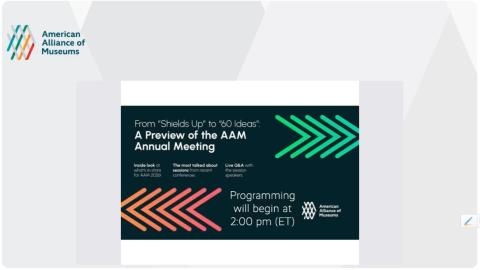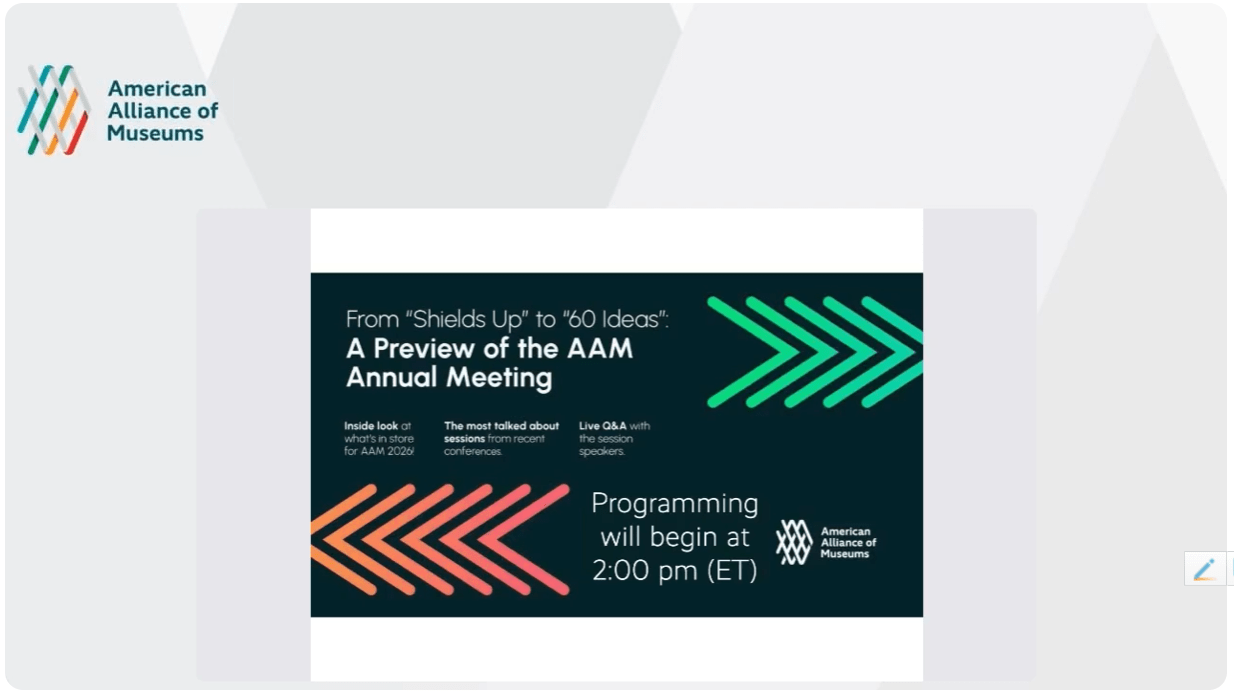
Curious about the AAM Annual Meeting & MuseumExpo but not sure what to expect? Join us for a special preview event featuring two of our most talked-about sessions from recent conferences.
From practical, rapid-fire innovation in 60 Ideas in 60 Minutes: Small Museums are Thriving to courageous leadership in Shields Up! Safety, Security, and Inclusion for LGBTQ+ Programming, you’ll experience the mix of bold thinking and real-world tools that define the Annual Meeting.
Plus, AAM staff will share an inside look at what’s ahead for the 2026 conference in Philadelphia, including new experiences, learning opportunities, and ways to connect. Whether you’re considering attending for the first time or looking to get re-energized for 2026, this is your chance to get a preview of the big ideas, lively conversations, and sparks of inspiration that keep people coming back year after year.
Transcript
Cecelia Walls:
Hello, and welcome back, everyone. I’m gonna give everybody a minute or so to get into the room, and then we will start our second session. Welcome back, for the second session of the day. Shields up safety, security, and inclusion for LGBTQ plus programming, a powerful and timely conversation that reflects challenges that many museums face and are navigating right now. This session explores how museums can remain mission driven and inclusive while also prioritizing safety, care, and preparedness. It centers courageous leadership and real-world decision-making offering perspectives grounded in lived experience rather than one size fits all answers. As you watch, we encourage you to engage with the session as, both content and catalyst and drop questions in the q and a section to your right. We will bring the speakers on stage live for q and a portion at the end of the recording.
But first, for those who might not have joined us for our intro session 60 Ideas in 60 minutes, AAM staff will now offer a quick preview of what new and not to be missed at this year’s Annual Meeting and MuseumExpo. Let’s take a look.
Dean Phelus:
Good afternoon.
I’m Dean Phelus, associate vice president of the American Alliance of Museums. And I look forward to welcoming you and more than 4,000 museum colleagues to the two thousand and twenty-six AM Annual Meeting and Museum Expo in Philadelphia, May. This year’s annual meeting will feature more than a 140 session that highlight the remarkable ways museums serve as timekeepers, time travelers, time chroniclers, and even time seers. Together, these sessions explore how time itself has been a foundation for inquiry, learning, and discovery across the museum field.
Reflecting this theme, a new subject track on museum and evolving practices will feature sessions across all museum functional areas, recognizing that the work of museums must be both timely in practice and timely in purpose. Recognizing how important career development and growth are to our attendees, we are also launching Career Cafe, a series of hands-on sessions covering topics such as resume writing, job search strategies, personal branding, and successful interview techniques. Another new feature is a creative aging series of five sessions highlighting how museums are developing programs and opportunities to engage and serve the fastest growing demographic in our communities, adults aged 55 and older.
Through these learning opportunities, the annual meeting offers a chance to be inspired. Discover new ideas and connect with colleagues from across the field. We look forward to welcoming you to Philadelphia.
Victoria Sanchez Perez:
Hi. My name is Victoria Sanchez Perez, and I am the director membership here at AAM.
Thank you to our AAM members for being a part of this community and for everything you do to support and advance museums. The MuseumExpo is getting bigger and better every year with even more interactive opportunities to connect with our vendors.
Keep an eye on your email so you can plan which booths you don’t want to miss. And when you need a break, we’ve got you covered. Stop by the puppy park to recharge after a full day of learning and pet some beautiful puppies. Grab lunch or snack and unwind in one of our lounges. Don’t forget to swing by the digital media lounge where there will be live podcasts.
Be sure to stop by the resource center to share your feedback on new and current member benefits AAM programs, and more.
AAM is always looking for ways to improve the member experience, and we want to hear how we can better support you. New to the Annual Meeting? Join us for coffee and pick up tips on navigating the conference and making meaningful connections with peers. We can’t wait to see everyone in Philadelphia this May.
Megan Lantz:
Hi, everyone. My name is Megan Lantz, and I am the director of Belonging and Connection at the American Alliance Museums. After months of listening, we at the Alliance are so excited to announce the launch of eight new pilot affinity communities this spring.
These communities will help museum people connect with one another, share what they know, and learn from each other level up their leadership skills. Access to our communities is a free benefit to all AAM members.
The groups we will be launching this year are community for BIPOC museum professionals, a community for educators, a community for those who work at ethnically and culturally specific museums, a group for museum exhibitions professionals, a group for LGBT plus individuals who work in museums, group for mid-career museum professionals, a group for those who work in small museums, and a group for those who work in visitor services, visitor experience, or frontline staff.
Brianne Roth:
And hi, everyone. My name is Brianne Roth, and I’m manager of community engagement here at AAM. We are so thrilled to share that we have opportunities this year to meet affinity community leaders, connect with others, network, and learn more about the broader museum community at our Annual Meeting and MuseumExpo this May in Philadelphia. Some of the key events where you can find others and learn more about our affinity communities, and include our find your folks and first timers coffee on Thursday, May 21, our museum people meetups in the Expo Hall on Thursday, May 21, and May 22, and our connect party at the Philadelphia Museum of Art where you’ll be able to meet affinity community leaders and connect with others. We hope to see you there. And if you are unable to attend, please check our website for more information on AAM’s new Affinity communities.
AAM Annual Meeting Promotional Video:
Auntaneshia Staveloz:
Coming to AAM, it’s like a big family reunion.
Sebastian Encina:
Everybody’s here to help you. Everybody has had a first time.
Hallie Winter:
Everybody wants to see you succeed. The sessions are very informative and there’s something for everyone here. So I think it’s very beneficial conference It’s well rounded and allows you to really mingle with your peers.
Saleem Penny:
You’re really part of a much broader field with such complex identities and to see these museums who have less than 10 employees and then to see these, you know, storied institutions that have multiple campuses.
William T. Harris:
I always look forward to this time because through my years going to the Annual Meeting, I’ve established some really profound friendships. And there are many people I only see at the annual meetings. A time to reconnect and kind of be reinvigorated and inspired. I always have great takeaways, that I hope to put in practice at my institution.
Saleem Penny:
It’s also very encouraging to see all the different ways that I can stretch and keep growing from meeting to meeting.
Auntaneshia Staveloz:
And then the Expo hall is just off the chain!
Tony Pankuch:
All right thank you all so much for coming out to our session Shields up inclusive Safety and Security for LGBTQ+ programming. we’re going to start off with some introductions and then dive into the content. so to start, my name is Tony Pankuch oh I need to actually there we go…My name is Tony Pankuch. My pronouns are they/them. I am the education and outreach coordinator at the Cummings Center for the History of Psychology in Akron, Ohio. I also Co co-chair and have co-chaired for the past two and a half years, the AAM task force for transgender inclusion. We create resources to promote trans inclusion in museums and cultural heritage institutions. Most recently we published Interpreting Transgender Stories which is focused on sort of how to go about interpreting trans history in museums and other institutions. I have my master’s in library and information science from Kent State University and in my spare time I am a cat parent, a very huge John Waters fan and a hiking enthusiast.
Samantha Evelyn Eisenberg:
Hi everybody, thank you so much for being here my name is Samantha Eisenberg I use the pronouns she/her and hers I’m the director of development at JQ International and I’ve been serving on the task force with Tony for about 2 and a half years. I was a museum professional for a long-time doing DEI work, fund development, community building… I also sit on the committee for the Circle One Archive History Festival in Los Angeles. I have my MA in social sciences from UC Irvine in 2018 and yeah, I’m a big Community organizer in Los Angeles. So, thank you so much for being here.
Regan Lopez-deVictoria:
I have my own microphone. My name’s Regan Lopez-deVictoria she/her. I am the program coordinator and grant writer at Drag Story Hour. I’ve been with the org for about 2 years I am an MLIS degreed librarian, go Huskies. I guess. I come to this work from a little bit of a non-traditional place and that I of course started in the theater and yeah that’s right then I became a librarian because that sounds normal and then took some time off to raise some kids. So, I’m back working with Drag Story Hour which is the perfect place for me and yeah happy to be here presenting with my colleagues.
Jonathan Hamilt:
Good morning, everyone. I’m Jonathan he/him. I’m with Drag Story Hour. I’ve been with the org for nine years now. I’m also a drag queen Ona Louise. She did not come today. I co-founded our New York City chapter in 2016 and then I was the first executive director of Drag Story Hour National and now I’ve taken a break and I’m just communications director keeping it cute. Yeah, and I was the first drag queen to read at the Metropolitan Museum which is really cool so gay rights.
Samantha Evelyn Eisenberg:
So, thank you all so much for being here just a little context setting why are we doing this session. I think a lot of people in the room are feeling the why but in April 2023 GLADD identified 161 incidents of anti- LGBTQ+ protests and threats targeting drag events since early 2022. That’s just like a couple years. Just this past January GLADD and the ADL recorded over 700 incidents of violence and threats targeting LGBT people in 2023 and anti- LGBT threats and protests target bookstores, libraries, community centers, and yes even museums, I know we’ve all seen it in the press. So here are some real-world examples. We’ve got Reverend Yolanda at the Children’s Museum of Manhattan showing how engaging and exciting and thrilling these events are and all of these horrible headlines about backlash and protest and controversy around that so that’s what we’re here to address today. We’ve also got this great picture, Cholula Lemon, at the Brooklyn Children’s Museum just to highlight what we’re doing. And I did also want to mention…we passed out a few of these handouts earlier these really encompass a lot of the main points we’re talking about. But with the Trans inclusion committee we’ve been working on a guide to talk about a lot of the things that we’re going to address, and we really encourage you to link up with us to get that full guide when it will be released in a couple months. So. I’m going to let Tony talk a little bit about our session format.
Tony Pankuch:
Thank you, Samantha. So our session format is going to be broken up into a bit of a panel and then a workshop. We’re going to spend about 30 minutes talking about preventative measures, addressing backlash when it happens, and then just creating safer events. After that we’re going to have a workshop, we’re going to the best of our ability with this room format break y’all up into groups and have you working through some hypothetical scenarios. And then we’ll have Q&A at the end. I do want to preface as well we’re this is as you probably are guessing already a heavy topic and a heavy session. We are going to be giving you a lot of advice and individual small things you can do. This advice is not meant to scare, intimidate, or dissuade you from carrying out LGBTQ+ programming, exhibits or initiatives. As public facing institution you should be really for any program keeping all of these things in mind. There are a lot of controversies happening right now around inclusive history broadly even beyond the LGBTQ+ community. And we’re not saying you have to do all of this stuff for every event, but we want to empower you all with a broad sort of swath of information and we hope that you’ll leave this session empowered to champion LGBTQ+ inclusion regardless of any anticipated backlash. And to have at least one sort of new actionable idea that you can use to improve the safety and security at your institution.
So, I’m going to jump back to Samantha here who’s going to talk about preventative measures in the internal landscape.
Samantha Evelyn Eisenberg:
Thank you, Tony. So me and Tony you’re going to bounce back and forth a little bit talking about a lot of things that you can do to address this issue and then we have a great the great Shields Up model from our colleagues at drag queen Story Hour that we’re really going to dive into. But we’re just going to go back and forth and talk about some other things Beyond outside and within the moment itself the event itself. So, the first thing we want to talk about is just assessing the internal landscape of your institution. Look at your values, understand your vulnerabilities, review your policies and your practices. A lot of Institutions came out with DEI statements in the last several years. Look at stated and unstated values. Review mission statements what’s included what isn’t. Get a pulse check from board, staff, volunteers. Some of your organizations have Affinity groups or ergs or things like that. How do people react. If you encounter discomfort or hesitation or outright opposition at any level of your team maybe you’ve tried to roll out pronouns or gender-neutral bathrooms and that might be a good you know tap people with institutional knowledge, ask them how that went. And connect with your DEI Mission values and Implement LGBTQ+ inclusion trainings and workshops as a part of that process you can work with your HR team.
Also understand your vulnerabilities you can look at your donors and your funding sources. Do they have a history of anti- LGBT rhetoric has there been protests in the past can you do some Google searches around you know a corporation or a foundation that might show up on your website. What’s your backup plan if you alienate some donors? Talk to your development team. And do you know how you’re going to communicate if you get any questions or criticism of your programming. Again, like Tony said, like we’re not trying to dissuade you here or anything, but this is all just things that you can keep in your mind so that you know what’s coming and you can anticipate challenges. And then you know review your policies your institution should have basic security, safety emergency policies. AAM provides great resources on all of these things or how to develop them at your institution if you don’t have them between visitor behavior and norms things about large bags rude Behavior recording. Make sure they’re visible you know the authority of the sign. And everything and ensure that your front-facing staff are trained.
The next thing is to kind of look at your local climate in your in your area where you’re at. Assess the you know identify existing allies build new relationships. If you have press contacts reach out to them and just be friendly with them. Make sure that they’re on your side build relationships with LGBT organizations you can go on Google. Instagram is a you know the Instagram search bar is a great place to find local LGBT organizations in your area. The law enforcement, I know, is a really challenging entity for a lot of us to interact with, there’s a lot of history of distrust with law enforcement. But sometimes they’ll have LGBTQ liaisons or something like that. They can warn you about hostile groups or upcoming events. Yeah, and you know just monitor social media and keep an eye out for threats and things like that. Tony, am I missing anything.
Regan Lopez-deVictoria:
Could I pop in and say. There’s a few great resources specific to supremacist groups and organized hate groups I would recommend taking a look at Southern Poverty Law center’s resources to determine they’ll really give you the ability to like zoom in right on your ZIP code. So, you can see the active hate groups that have been identified as such and are active in your area. That’s a super helpful place to start.
Tony Pankuch:
And then the one other thing I would say is just you know use your best judgment especially when you’re thinking about sort of security in terms of are you going to work with law enforcement, are you going to hire a private security firm security firm. You know talk to the people in your community build those relationships understand what the relationship is between LGBTQ+ orgs in your community and local law enforcement. Maybe there a security firm that a lot of LGBTQ+ orgs work with. That’s where having those existing relationships can be really beneficial to help you make those difficult decisions.
So, moving now to sort of the digital landscape of all this because when we talk about preventative measures a lot of this stuff really begins online now. I’m going to preface by saying I’m not an expert in digital security if you have a dedicated it department or specialist you want to keep them in the loop early when it comes to potential backlash and any safety or security concerns. If you don’t have a dedicated IT person or Department there are plenty of IT consulting firms and organizations that can help out with your institution’s individual needs. Tech soup for example provides discounted IT services for nonprofit organizations. There there’s also access now which is a bit more focused on sort of activist organizations, but they have a lot of resources for digital security that are relevant to nonprofits. So that’s AccessNow all one word but regardless of your it resources there are some sort of broad suggestions that we want you to keep in mind.
So, consider for example reviewing your digital footprint look at your website are specific staff names and contact info posted on your website. And if you are anticipating or actively starting to experience backlash you might consider replacing that with departmental email addresses or sort of a boilerplate comment form that can help people sort of avoid getting that individualized targeting.
You also want to review your privacy settings on institutional accounts and make sure no one’s personal information is visible. I’ve worked with some institutions that have a habit of like tagging people’s personal accounts when they’re posting about their staff members don’t do that. Don’t tag the personal accounts of your team, that’s extremely unsafe if you’re in a situation where people are trying to target your institution. And also turn on Google alerts for your institution’s name address if there’s a common nickname for your institution like in Ohio, we have the Wexner Center for the Arts better known as the Wex turn on those alerts and make sure you are aware of where your institution is popping up online. That can help you again to detect those threats ahead of time.
Also, event registration a lot of us use online registration for our events, particularly free events. Really requiring registration to get in the door of your event is a major barrier to kind of bad actors, it’s a good way to keep your event safer right from the get-go. Again, very simple thing you can Implement, and online registration is great particularly for free events. But that being said it does sometimes provide a level of anonymity anyone can go fill out that form you don’t really know who it is. If you are worried about Safety and Security your event. A simple barrier you can do is just require registration by phone or an in-person box office. That simple addition of human interaction is so useful to dissuade some bad actors like. That will keep people from making that step you know you can have that not quite a vetting process necessarily, but you can talk to someone on the phone and get more of an idea of kind of where they’re coming from for your event.
And of course, just managing your social media carefully you know we should all be having detailed social media management policies. You’re going to want to limit access to your institutional social media accounts to approved trusted and trained members of your team. Again, don’t tag personal accounts and you’re going to want to implement policies if you have an already governing tone and voice. When to respond to comments or messages and how to address criticism which we’re going to get into here on the next slide.
Oh no actually slide after this my bad so continuing to the digital landscape some of that data security stuff you know. Protecting your passwords nowadays just having a password is really not as safe as it used to be. You want to implement unique passwords in every institutional account that you have use a password manager Bit Warden is a great example of this to secure and encrypt your passwords. Two Factor authentication is now the standard for most things. If you have not implemented that for all of your institutional logins, you really should be doing that. That’s just a very basic data security minimum you might also consider downloading or installing a VPN or Virtual Private Network this is particularly important if your employees work remote in public spaces like for example coffee shops or convention centers. VPNs basically encrypt data and shield your IP address on whatever device you’re using allowing you to safely transmit data over public Wi-Fi networks. Not all VPN are the same like nordvpn is more of a sort of public consumer VPN but there are a lot of other organizations like tail scale or Cisco that are business scale vpns that can be implemented for your entire institution. They’re fairly reasonably priced for the most part and in lieu of a VPN you can also use you know secure and encrypted messaging services with your team online. Signal is a free communication app and also a lot of the apps that are actually all the apps that are baked into the Microsoft 365 suite are going to be encrypting your messages. So, make sure that your Communications are limited to those secure platforms.
And lastly just empower your team you know if you can provide data security training around issues like fishing password protection data storage and online privacy. Making sure you’re proactive in providing your team with access to that is really helpful. Vulnerable employees might be targeted if the institution itself is not targeted. So again, like protecting the individuals in your team and making sure they have the tools to protect themselves.
AccessNow has a great self-doxing guide. Doxing is the process of finding a person’s personal information online and they actually have a process that you can kind of do that for yourself and understand like where your information is online. So if you look up access now self-doxing guide you can explore that. And you might also provide access to employee identity monitoring services like delete me for example that can help to secure personal information online.
Moving forward once you do receive backlash, let’s say you’ve announced your event and comments are flowing in here are some tools to respond to that and deal with that. First off, you’re going to want to assess the actual threat Level of the messages. You know you need to be able to distinguish clearly between critical comments, outright hate speech and threatening messages. Where precisely your institutional policy draws, these lines is going to depend a little bit based on the institution. But in general you want to have policies in place for each type of message. So, for example criticism May warrant a response if it’s a constructive you know thoughtful critic criticism on a post. But you know always if you respond from an Institutional account be thoughtful do not escalate. Hate speech you know that’s more likely to be reported deleted to whatever social media Network you’re on. And if you’re receiving active threats to your institution’s safety, the safety of your staff, your volunteers that’s going to require a more serious response which I will get into in just a moment.
But as an overall thing when you’re managing online Communications engage in conversations but never arguments. Do not try and debate or humor hateful comments. Do not think that you’re going to like prove someone wrong with your snappy reply in the comments. It is really best to not engage with these messages and really kind of at most allow them to sit there or report or hide the messages. And make sure that these communication policies are accessible to everyone in your institution. And that they are followed consistently. If someone has access to your social media account, they need to be trained on what the tone the voice and the policies and behaviors of your social media is.
Regardless of the severity of any backlash you want to document, document, document. This can help you spot worrying Trends make inform decisions and understand your audience if you don’t already have a spreadsheet of like online messages and comments and interactions that your institution has. This is actually a really good practice not even just for backlash but for positive comments as well keep track of who your biggest supporters are on social media. Keep track of what’s working, what’s not working. And again do not escalate no matter how tempting it may be to try and educate someone in the comment section, generally speaking you should not be engaging with hateful comments. You should not be trying to debate or argue. And again consistently follow those policies so now I’m going to pass to oh actually I have one more slide my bad. So, when you oh that is you okay that’s you okay
Samantha Evelyn Eisenberg:
Yeah. Thank you so much Tony for everything about the online security. And you named doxing is a real threat there are very real threats. And I know that that this feels like a lot of like you know VPN passwords, but these are about monitoring the landscape and being aware of things before they happen so that you can come up with a plan and be ready to go. Documenting things are super important and they’re really going to help in the fall follow-up.
So, when you are threatened you have your drag queen Story Hour. You post it online you have registrations. You’ve received hateful comments, do not ignore the threats. I know it’s super kind of it can be scary to read that or to see that or to hear that and you kind of want to just go into this maybe they’re not serious or maybe that didn’t really happen, but it’s important to follow up. When comments cross the line to be threatening to your institution your staff your visitors anybody it’s important to take action. Report these to your team leaders report it up the line of management if you have systems for reporting this. I work in Jewish nonprofits, and we have systems to report to the ADL, to law enforcement to Jewish federations. You know talk to your HR and your team about how to appropriately report that. Do not engage with threats as Tony said, document them in detail. We are really emphasize you know museums as civic civil institutions so don’t engage in those hateful comments don’t let the public see that you are going to get boiled down in that. You know take the high road there notify relevant staff and volunteers of all threats. It may be really tempting to keep it to yourself or Hush Hush with the leadership team. But it’s important that people are prepared and briefed and ready for their emotional well-being as well as their physical well-being.
Empower your team members to take action to protect themselves. A lot of the digital security stuff Tony just touched on these are measures that everybody can take about protecting their identities and their passwords and their social media Footprints. And collaborate with your team it’s ultimately up to you to…Oh sorry.
Yeah, always include your team in the decision-making process if the majority of your team don’t feel safe pulling off an event just be mindful of their wishes and what they have to say. And if people don’t feel safe you know empower them to take the day off. Empower them to do what they need to do a lot of times team members are passionate about their project and determined to see it happen, so work with your people.
As we go into this and I’m just going to kind of talk about this briefly because we’re really going to dive into it in the workshop but know your layout when you know you’ve received threats that’s when it’s time to come up with a plan. You should have these plans either way. Review your floor plan ensure their clean and secure paths from the parking lot to the event space. Plan and document evacuation routes if opposition arrives to protest to disrupt the event, where will they go, how will you create space between attendees and oppositions. How will you secure enters and exits. Are there you know auditory barriers we’re going to talk about assigning roles in the Shields Up program. But think about entrances and exits, and as Tony touched on, track attendance you know get people’s information make sure that there’s like a screening protocol that really helps dissuade bad actors.
Yeah, and then the last thing is just securing your event. So, work with your security team if you have in-house folks, if you have relationships with law enforcement or a private security team, make sure everyone’s coordinated. Monitor your security cameras. You should have folks that are working on this but assign staff and volunteers to kind of like monitor. A lot of folks have walkie-talkie systems. It can be helpful to have codes just to communicate if there’s something funky or if you need backup or if somebody should come. And of course the last thing is to implement child Safeguard policies.
It’s always important regardless of your institution even if you’re not a children’s museum. Understand the needs of your families your underage visitors. And just stressing again museums is a s of civic and civil engagement and that we really don’t want to allow this kind of behavior or activity in the presence of our young visitors and our families. And that’s why we really emphasize de-escalation in these contexts.
So again we have deescalate, deescalate, deescalate again and again they’re going to talk about it so much. And just create a welcoming environment Tony will talk more about that. But as I mentioned on the handout we’re working on a guide with a lot more in-depth information about coming up with these plans and protocols so please take our contact information at the end to get all of that after.
Tony Pankuch:
All right, so that being said no one wants to cancel an event due to opposition, harassment, or threats but sometimes this does become necessary. For the safety of your team and for the safety of your visitors. So, if you do have to cancel your event notify registrant immediately and your, if your institution has been threatened in any way you need to allow registrant to create space between themselves and avoid walking into a potentially dangerous situation.
And really you need to be firm in your values, you know it is understandable to cancel an event if you have received a bomb threat, if you’re fearing for the safety of that event, but that does not have to mean surrendering or giving into opposition. If you’re writing public communications which you should be if you cancel an event. Write those communications with your supporters in mind do not direct your messaging at the people that shut down your event. Focus on communicating to the people who wanted to be there who wanted to support you. And really focus on sort of asking yourself what can we do. Maybe this event didn’t work out, maybe you cannot do the Drag Story Hour event that you wanted to do. But consider smaller events online events online exhibits private or invite only events, smaller and initiatives if you have to take baby steps that is okay. The important thing is that you stand by your values and you stand by LGBTQ+ people. If you can’t do this work with your team and figure out what you can do. Remain empowered in spite of opposition.
And then one more thing before we kind of get into the Shields Up program is just after an event or after cancelling an event. Regardless of whether it got cancelled went fantastically or had major issues debrief with your team debrief with all relevant members of your team. Frontline staff, organizers, the partners that you worked with for the event and allow people to discuss what made them feel uncomfortable or unsafe. You know anonymous staff surveys might be helpful here in order to get that sort of open-air sharing. And really focus on supporting your team’s mental health. Especially for LGBTQ+ members of your team. Having an LGBTQ event threatened cancelled protested can be really traumatic. Have resources to sort of implement trauma informed care within your institution. Create spaces for private or group discussions and be flexible with time off and schedule changes in the aftermath of something like this.
And really ensure that your team, this goes for any institution, ensure that your team has access to mental health resources so for example you know making sure that your health insurance plans do cover mental health care. Providing resources lists of inclusive counseling or therapy services in your area that you can share with your team. If this is not something that you necessarily think of as being in your budget, we actually talked to one organization that was able to successfully fund raise specifically for mental health resources for their team after a few of these they counted a few protests. So really consider this as a priority and really kind of put your money where your mouth is in terms of supporting your team. And lastly just continue to learn, adapt and again keep up the work it’s important and no matter how much opposition you face LGBTQ+ inclusion is the right thing to do period. I can say that AAM has said that in numerous policies. If you’re here that should be a pretty Universal belief, I think. So, keep up with the good work and on that note, I’m actually going to pass it over to Regan and Jonathan who are going to talk a little bit more about the Shields Up program.
Regan Lopez-deVictoria:
I’m actually going to come out front cuz I can’t see all y’all cute and oh yeah there’s my there’s my slide so hi Regan from Drag Story Hour. Right Drag Story Hour it is just what it sounds like it’s drag storytellers coming out to do a Storytime event. Which is a classic format that’s been around documented in public libraries since the early 1900s. So, story time is a wonderful format that has we’ve seen in schools and libraries and all sorts of wonderful variations firefighter story hour. Veterinarian Story Hour. And we have Drag story hour and it’s really important and I could talk about four hours about that, so you know catch me outside. But I wanted to give a little context to what drag story actually is before I dive into what Shields Up is.
So, Shields Up is our organizational response to a rapid escalation in not just the number of occurrences of opposition groups gathering outside of Drag Story Hour events but escalation also in terms of technique and hostility and what we really see as it can be a bit of a hot bed for potential violent acts. So, trying to get ahead of this work outside with a positive more organized way to address what’s happening outside of our events in the name of safety for our storytellers and our audiences. So oh I think these might be old slides but that’s okay.
There’s a safety ecosystem that I’m hoping my really pretty slides later will illustrate for you but essentially what we noticed the need was there’s a lot, right, there’s like a lot. Like thinking about security for an event, is a lot. And we wanted to make it easier to digest. We wanted to make it really personable. We want people to really embrace the roles that they have while they’re thinking about safety. And obviously we wanted to make it really cute. So that Shields Up in a nutshell, and oh thanks Jonathan, here are the guiding principles of shields up the first one is the big one deescalation, deescalation, deescalation, deescalation. What’s that mean? It means that when we have Shields Up outside of an event we do not engage with opposition. We don’t talk to them. We don’t look at them. We don’t shout at them. We do not counter them. We create distance between our storytellers and our audience members and the opposition. That is our job, it Shields Up. We’re just creating a path so our storytellers and audiences can come in and out of the bubble safely and we create a shield to maintain that distance. So, this is not the opportunity to engage the opposition. This is an opportunity to focus on our event programming and keeping it fun, joyful, and sweet.
I mentioned the ecosystem and I hope I could just show that to you in a second, but it essentially just creates a handful of roles that work in a handful of environments and that all flows together. It’s deliberate. If you’re thinking about safety in reaction to some angry letters to the editor or in reaction to a couple of comments that you got online it’s a little late in the process ideally a full Shields Up activation begins a month or two months before the event. Really being deliberate and thoughtful and there because there are a handful of roles you have to think about who best to recruit. So, it can be a bit of a long game right it’s never too late to Implement some safety techniques and practices but the ideal Shield Up activation is very deliberate. Is scalable so for a lot of our folks at Story Hour there are our chapters out there, they’re already doing this work right. It’s taken us two years to develop this framework and in the meantime our chapters have created their own systems, which is just like fantastic. And so, in those scenarios Shields Up exists as hey how’s what you’re doing is over here Shield Up like how do they interact how do they play what works what doesn’t like take what works and you know throw out the rest. And for folks who are just beginning to host Drag Story hour programming this is a great opportunity to take the framework in whole and try to execute it that way. It is very flexible, it’s also not mandatory through our chapters they it’s a series of recommendations and we really want people to make it work for them. So, if you’ve got something already going on or you have nothing this is still gonna work for you.
And that kind of leads into if it ain’t broke don’t fix it. Please don’t do that. The another the last guiding principle, protects the most marginalized protect the most. Our storytellers that are out there doing the sacred work of performing a storytelling act they are the ones at risk of the most bodily harm okay. And I think that runs a little bit counter to what we might think of in any sort of child program setting where of course we also want to think about the vulnerability of our young patrons and our audience members. But what Story Hour would ask you to consider is that the Storyteller is at the center and if we protect the Storyteller, they create a bubble of safety around them. And all the folks close to them are contained in that. If you have a Storyteller and they don’t feel safe that too spreads out.
So, we want to take care and Center our marginalized folks our storytellers and we’ll be taking care of our adorable audiences when we do that work too.
So, we’re going to kind of skip through here because I already talked about it there some things Shields up is not, but it is not one size fits all. Also, I do want to kind of mention that a lot of the techniques, the roles these are all adaptations of work that have that has been progress for decades and decades over you know street organizing and community organizing and actions. There is a rich history to organizing around safety in a public event. And so, the concepts are not they’re it’s not these aren’t like we didn’t reinvent the wheel. We might we created like a it we just made it cute for us. And it’s the structure that’s unique.
Okay so here’s my environment they I’m doing that because there’s a beautiful illustration and it shows you our lovely environments. But the three environments that we have are our bubble, we have a path oh okay here we go all right…We have the bubble, the path, and the shield. Inside the bubble is where the event takes place. So, I think that sometimes when we were first talking about this work we’re talking about internal/external but that doesn’t always work so well many times we have story hours outside right like in a courtyard. So, we wanted to create some terminology that really worked well for a variety of situations, and so the bubble is that is that place that bubble of safety where our storytellers inside working with our audiences with our handful of other roles to that that that’s where the program’s happening.
The path is where our audiences and storytellers access the bubble they can in and out with ease. It is a fun environment we have bubbles; we have chalk, we have music maybe. We are really invested in creating that safe fun path behind the shield because Behind The Shield is where we might see our opposition groups and they’re just over there, they’re just over there doing their thing behind the shield. So, we’re creating distance. So those are my environments.
Now we have roles. This is the safety team of Shields Up, so we have a captain we have Guardians which collectively are known as the royal guard. We have our Storyteller of course. And we have an organizer these roles will interact with other folks in the community and for a lot of you all that role might be venue contact. So that’s the person clearly representing the venue and able to work with the team to address some decision-making models, you know, working with the team to communicate the institutional behavioral policies and other policies that might be in play, they will work directly with the in-house security team, that’s your Venue contact.
And then we have our Ally groups so cute that llama with the headset, oh stop I can’t. Our Ally groups are so vital to this work we have I’m just going to name a few off the top of my head. We have the sisters of Perpetual Indulgence. We have Paras Patrol of course let’s see. Free Mom Hugs there are so many and of course those are the more nationally known ones. But your community will probably have an ally group that already exists and they may want to come in support. You might be able to invite them to join your Royal Guard, but it is really important that they understand this is a de-escalatory space right. So we want to really be working with our Ally groups just to make sure that we’re on the same page and to ensure that they understand that on the day of they’re going to be working in cooperation with the royal guard and they’re all talking to and looking towards the captain for those critical in the- moment decisions right.
Yeah, let’s here we have the model in in action it’s the full model. Inside the bubble you see our Storyteller doing their good work and being able to focus on the audience and their experience. We have our venue contact who’s able to monitor the audience, take care of their needs, monitor any sort of technical considerations. And we have the organizer the organizer is sort of like the stage manager or the company manager for the Storyteller. They take care of. They’re maybe they’re holding books they have water they’re holding a feather boa they are making sure that the Storyteller has everything they need to do their work in the event of an emergency. The Storyteller will work with the organizer to perhaps exit safely the organizer works with the venue to take care of all those imminent communication needs so that they can give the Storyteller the space and the piece of mind to do their work. Outside we have a captain who is directing The Shield, and The Shield is created with the Guardians the royal guard. And our Ally groups. And they are all working in cooperation to maintain that safe pathway and keep the shield up.
That is like a such a teeny tiny little nutshell, and I want to give just a little tiny bit of timeline and then we’ll move right along into our Workshop. But Shields up as a program is available to Drag Story Hour Affiliates. Classically speaking our Affiliates were chapters we would have a chapter director and a bunch of different volunteers, and these are very like you know hyper local groups right. We are shifting our model a little bit we will be announcing a way for institutions like libraries and museums to become Affiliates so you would be a Drag Story Hour affiliate. You have access to the full Suite of materials. We have some materials that we’re happy to share out that has a getting started guide with all these cute roles and the environments. Really gives a nice overview but we will be releasing. There’s a best practices manual that’s like 25 pages of very dry academic work all around how these roles work together. We have a very extensive resource appendix we will have a safety planning packet with a bunch of checklists and worksheets and ways to help folks get started. And we are really excited to announce that we’ll have a captain training module. It’s an online training module that will di do a deep dive into de-escalation not just as a word we say but as a set of techniques that folks can use in the moment to help keep things cute outside and calm. In addition to active shooter training Communications training and a whole other Suite of skills that we want to see our captains have out there. So, Drag Story Hour is really thinking about how we can create a legacy of creating teams across the country that are in the business of helping folks just like you keep queer events safe. So, thank you.
Cecelia Walls:
What an enlightening session. Thank you everyone for joining us for that. I’ll now welcome Tony Pankush, Regan Lopez de Victoria, and Jonathan Hamilt to the stage.
Tony Pankuch:
Hello, everyone.
Regan Lopez-deVictoria:
I’m Regan Lopez, Victoria, cutting off. Jonathan. She, her programs and development at Drag Story Hour. This was so interesting. I can’t wait to get into the different changes. Over to you, Jonathan.
Jonathan Hamilt:
Hi, everyone. Jonathan Hamill with Drag Story Hour. Director of communications. Thanks for watching that recording. It’s crazy that that was two years ago, and, how some things have definitely have not changed and some things that have changed a lot. So
Regan Lopez-deVictoria:
Yeah.
Jonathan Hamilt:
Just, excited to kinda talk about those differences and similarities.
Regan Lopez-deVictoria:
Yeah.
I don’t know where we wanna start.
Tony Pankuch:
Yeah. Maybe, Reagan and Jonathan, if you’d be willing to dive into sort of what direct story arc has been up to since then. Any specific changes, major developments that have happened since you shared the shields up framework? About two years ago?
Regan Lopez-deVictoria:
Yeah.
It’s really interesting because watching the video, notice noticing, that the model that we use was not in full color. So, I built and then I remembered, we had just gotten it, like, maybe the day before. And we’re so excited to finally have those visuals. So at the end of my bit of the presentation, I was talking about all the things to come. And I am actually pretty happy to say that all of those things, all of those deliverables, have landed and a few extra too. So the you know, we have our best practices, manual. We have an appendix. We have a secure online portal where everything lives, and our affiliates are able to access it that way. We have not just developed a live captain’s or, like, an online training module for the captain role, but we also have one for the guard.
Yeah. Like, all of those deliverables, landed in the last couple of years, and so it feels, it feels really great. To look back and be like, cool. We did a thing.
Jonathan Hamilt:
And we were able to take this presentation and actually share it with other organizations like American Booksellers, and different groups
I know the workshop was not part of this recording. But that workshop in particular was retooled for independent booksellers or for libraries and for museums alike. So it’s a really great to bring that training and workshop and expand on it even after this presentation. And we also expanded our affiliate status, not just to, the kind of signature chapters you think of, but to individual storytellers themselves or even a museum itself. Or an organizer can be an affiliate. So that really opened up a lot more doors for the trainings that we have.
Regan Lopez-deVictoria:
Okay. Yeah. We also took the, the Shields Up suite and have hosted a train the trainer event in the Bay Area happened about a year ago with the idea of, as the name might suggest, training some trainers to take these shields up frame and implement it regionally. So we are seeing some slow growth in that area, as well. And has kind of shown us how this framework can work in the real world and where it doesn’t and where we need to kind of tweak and change things. But that landscape itself is really different. Was just looking at the numbers. It’s a little sobering. The, the glad numbers that we talked about at the beginning of the program.
From the alert desk. It was a 161 incidents at that time. That ticker is at 3,382 incidents. Since June ’22. That is not drag specific, but that is pretty sobering.
That said, we have seen a change in the landscape of how protest and opposition are showing up. Our in-person protests activity has significantly decreased. Bomb threats had a moment for a second. And then they too, have stepped back and where we are now finding the need most prevalent in our story hour community is in digital security, and legal resilience, and we’ve been working hard in the last year to build up both of those, program points. So in legal resilience, we have a team of pro and low bono legal support that has helped us, do a lot of work behind the scenes, to prepare for what’s to come. We’ve launched a know your rights webinar, series, that continues to go on. And we also in the digital resilience world, we have access to DeleteMe and other, digital security resources that we’re able to offer now to our affiliates or not all affiliates, but are able to offer downstream, which feels really significant.
Yeah. It’s got more structure around it. If somebody expresses an interest in becoming an affiliate, we do an intake. And then I invite them into our portal to preview what the affiliate agreement like, give them a little taste of some of the resources, and documents that we have. And that kind of, you know, begins the conversation about what they’re you know, what their event production goals are, how they see Drag Story Hour in the you know, their broader programming landscape.
So it is exciting to be able to welcome museums bookstores, libraries, to the Drag Story Hour affiliate network as community partners.
Jonathan Hamilt:
And it’s not a pay to play model. This isn’t a commercial for us to sell you, affiliate statuses. It’s obviously totally free. And if you’re going to do an event with children and drag performance we invite you in to be part of our network.
To use these resources because it is safer And, we’d rather invite you into our community than just kind of braving the weather out and doing something alone. And you kinda really never know how controversial things may be even if it’s a if it’s as simple as, you know, a costume exhibit. Or a retrospective of just a queer artist. You just never know how what it’s what’s gonna happen. And even a year after this presentation that you just watched, we were invited to World Pride in DC and to work with Kennedy Center when all those things were happening around that that unfortunately got, we lost our contract with the Kennedy Center. So there’s all this this it’s actually it’s a whole more other piece of the puzzle when it comes to the poly of it all and navigating this other side of not this, physical threat, that we maybe we were really focused on with, like, the Proud Boys and hate groups, But now it’s sort of like this internal these mechanisms and things that are in place that we also have to.
Kind of outline and figure out as well.
Tony Pankuch:
Yeah. It’s interesting looking back on this session. At the beginning of the recording, I alluded to, I was involved in the, American Alliance Museum’s task force for transgender inclusion. Which was part of the, LGBTQ professional network of AAM. Of course, those professional networks went away for a little bit. They are now coming back in a new form. Really excited to share more information on that. Hopefully, in the next week or two, I believe. But one of the things we were really focused on in ’23 and 2024 was that fiscal landscape very much mirroring what y’all have been working on at Drag Story Hour. In the time since, you know, that project when the professional networks dissolved, that team sort of between burnout and other things going on, that project never really came to, fruition.
But I think nowadays, one of the major concerns that I’m hearing from institutions is again, less about that on the ground threat and more about funding digital security and really just maintaining institutional and community support for what they’re doing. In just a day to day, keeping the lights on, keeping people coming back to the museum, and maintaining relationships with people in power. Which is a challenge. You know? It’s difficult to address that in, say, a resource guide. But I think that, you know, I think a lot of the digital security stuff that we covered in recorded session still stands. I do want to point people actively towards a resource that I dropped in the resources, tab, which is that little piece of paper that looks like it’s kind of folded over in the corner. It’s called, let’s see, the drag defense handbook. That is a recent, resource that was designed by the q committee come it’s committee, but with a q instead of a c. And it is a resource that I think mirrors a lot of what our AAM committee was working on back in 2024. So if you’re interested in exploring some of those topics in more depth, I highly recommend checking out that guidebook. It’s a good resource. I have a question for y’all maybe that could kinda build on some of what is in recorded session. Is there anything in terms of the actionable items that are discussed in the recorded session, are there any sort of new action items that sort of come to mind.
Regan Lopez-deVictoria:
Yeah. I also put a few resources in there. I there there’s a link to the GLAD alert desk that we were discussing. Oh, I see. That’s the 2025 report. And I think I put a link in there somewhere to the live desk.
Maybe I didn’t. But I also one of the we one of the things that’s happened since the since we gave the original presentation also is we’ve made connections to some really great partners and had really excellent collaborations with organizations like the Southern Poverty Law Center. We were featured in their year in extremism report, came out right after this, that summer. Looking back at the 2023 landscape. So they worked we worked closely with them to gather data. They spotlight, one of our, affiliate storytellers, Tara Lipinski from Utah.
And that has been a really excellent, just relationship between two orgs. And we were connected to the, bridging divides initiative, which is a really interesting data collection dissemination, project of I think, Princeton University.
They send out situational reports, and I’ve attached here their key political violence and resilience trends from 2025, which is a heck of a read.
Again, quite sobering, but a really excellent snapshot of, what we’ve all been through in the last year and predictions for what may be to come, there are, it’s a really great resource. So I recommend folks checking out.
Tony Pankuch:
In these past two years that institutions should maybe keep in mind or should they about implementing?
Jonathan Hamilt:
I think our suite of resources that we offer our affiliates have gotten a lot rich and a lot more broad, and it’s really vast of the different things that we’re able to offer the people that we work with. I think a thing that simple things that we don’t really think about is knowing where you sit in the world and not centering that as the safety. Right?
So still in 2026, we still get a lot of people saying, oh, well, we just call the police, or, oh, we have security. And it’s not as simple as, oh, is that security protecting the art? Or is it protecting the people? What type of people does the does the security like to keep safe? And who were you bringing to the space? Who is front of house? Do you have non con you know, gender nonconforming or trans employees on the front line at the front desk. Who’s doing the story hour? So it’s just simple things that people kind of forget.
To really put front and center and communication. I don’t think we live in a world where we can’t communicate enough to each other. Of what’s going on step by step and using more secure ways of communication. We started using signal and, more doubt, I forgot the double encrypted end to end encryption.
Regan Lopez-deVictoria:
To end.
Jonathan Hamilt:
Yeah. So, just getting slicker and smarter about how we communicating keeping each other safe.
Regan Lopez-deVictoria:
I think there’s been a desire to think about community care holistically. Right? Like, after really triaging the need for physical safety precaution. It’s clear that, you know, not just our community, but the community more broadly is, you know, traumatized. And there is a need for community care and really exploring what that looks like so that it doesn’t so it has a real meaningful impact, positive impact, and doesn’t feel minimal or trite or, it’s a really interesting and important area of concern for the org. And we’re look you know, we have a couple of different new programs that we have, that we’re working with to explore that a little bit more in-depth. We have a care registry. We’re asking folks to give us a little data on what actually helps them feel good. We to the idea is to be able to resource, the org be able to send a little care package if somebody goes through something or has, has an incident.
In addition, we have a program called CoinPerce. That we are able to, utilize for storyteller support and also for safety support. So it’s, it’s in-kind support so people can reach out to us and be like, hey. I need some types and some new makeup and this wig for my for my story hours. Or, hey. I actually we have an event coming up, and we need a safety kit. And then I you know, we they fill out an application, and it’s, there’s an internal process. But being able to really send the stuff and do that work, I think, feels really important. And we’re trying, I think, to make it even easier and faster. It’s been a process.
Jonathan Hamilt:
Yeah. I think just going that extra mile and just remembering that we’re all human and we’re all going through stuff, and if you invite someone in and they have their favorite 3PM snack waiting for them in the green room or area, it’s just like an extra little thing to make them feel like, oh, like, you care about us more than just this booking or just this event. And it’s really how we treat each other before and after incidences that make the burnout not happen as quickly or as fast. And at the end of the day, we can take care of each other, and that’s the only way we can keep putting these events on. And, also, our events are really fun, and the joy and fun that that goes with that is way bigger and better than any of the opposition. So don’t be afraid to book a lot of stuff during pride or, like, Native American History Month everything. And if you wanna work with Story Hour, please reach out to us. We have so many affiliates and amazing storytellers throughout the country. So if you wanna bring some
Regan Lopez-deVictoria:
Yeah.
We just had a big event in December to celebrate ten years.
Jonathan Hamilt:
Joy and glitter to your institutions, please reach out to us. Because it’s a lot of fun. And it’s not so scary all the time. So…
Regan Lopez-deVictoria:
And that was really joyful and really wonderful and was in San Francisco at the San Francisco Public Library. They’re big main library. We had a bunch of storytellers from across the country, and, of course, local to the bay. It was really beautiful. I think we all needed that, I know I did, needed that space to really sink into, the beauty of what the work is, and it’s really significant and important.
Tony Pankuch:
Yeah. If I can hop in just speaking for my institution, I think that really caring for your community is such a key thing that you can do as an institution. And sometimes that sometimes that means hosting an amazing event like Drag Story Hour, Sometimes that means just checking in with a local LGBTQ org local activists, people who are doing the on the groundwork, seeing what your institution can offer to them. Whether that be a space for meetings, you know, loaning some tech supplies, any of these things offering a free guided tour of your space, you know, just anything you can do to sort of bring joy and contribute.
Even if it’s not, you know, big and public and flashy, I think that we as museums have resources to offer. And I think that we should be very proactive in terms of offering those to people who could really use those resources.
Jonathan Hamilt:
And even as a act of joy after when we did the session live, the three of us got tattoos together, at that last conference, which was a nice, departure from the heavy topics that we talked about. So.
Tony Pankuch:
At the Baltimore tattoo museum, they’ll less. So it was tattoos at the museum conference at the tattoo museum. So yes. Yes.
Jonathan Hamilt:
Not saying anything.
Regan Lopez-deVictoria:
That’s great.
Jonathan Hamilt:
Yes. Meta.
Regan Lopez-deVictoria:
There have been a lot more tattoos since then. Yeah. That’s one change that we can track.
Tony Pankuch:
Alright. Any questions in the chat? I’m not seeing any questions. Definitely encourage folks to check out those resources that we have listed.
Jonathan Hamilt:
And thank you, AAM, for having us back and for spotlighting this really this work that we do and kind of bringing it back into the light and thank you for your allyship in including us.
Cecelia Walls:
Oh, thank you all. Yeah.
Tony Pankuch:
And I will. Oh, I was just going to say, and I hope I’m not breaking any embargoes when I say this, but please keep an eye out for news on that LGBTQ affinity group. We will be doing a lot of very cool things at the annual meeting this year.
Cecelia Walls:
Absolutely. Yes. Tony is correct. And, yes, that notifications those will be coming out in the next, few weeks or so. Really, really excited about that. I would like to thank all of you for joining us today and a special thank you to our speakers Tony Regan and Jonathan for staying with us for such a thoughtful updates and sobering conversations, but really, really important the two sessions that you all watch today offer just a snapshot of what the AAM Annual Meeting and Museum Expo is all about. And together, they reflect the full range of the conference experience from really fast paced practical ideas you can put into action right away to deeper conversations about leadership values and navigating complexity in all of your work. That you’re doing, for your communities.
At the 2026 Annual Meeting in Philadelphia happening May, you’ll find hundreds of sessions like these spanning every museum type, role, career stage, and countless opportunities to meet and learn from your peers, share your challenges, and make meaningful connections. Across the field. So whether you’re looking for new tools, best perspectives, or space to think strategically about what comes next, The annual meeting brings all of that together in one place. So we hope that today’s preview gave you a sense of the ideas and energy that define the annual meeting and that we’ll see many of you in Philadelphia in May. Thanks again for being part of today’s program.

Upcoming Events
-
Strengthening the History Workforce Virtual Summit
Event Date:Presented by: American Association for State and Local History (AASLH) -
Gettin’ To Know You: The Art of Networking
Event Date:Presented by: American Alliance of Museums -
Environmental Monitoring for Collections of All Sizes
Event Date:Presented by: C2C Care/FAIC -
2026 AIC & CAC Annual Meeting & Conference
Event Date:Presented by: American Institute for Conservation