Throughout the year, AAM’s Center for the Future of Museums keeps careful track of how the future is looking, for our world and for our field. In its regular Dispatches series, the CFM shares both broad signals of social, technological, economic, environmental, and political change and regular updates on the new ideas emerging from museums themselves. (See this post for a note on how to find these updates in 2026.) This year, museums broke ground on a variety of fronts, including timely exhibitions, first-of-their-kind new institutions, novel digital experiments, and powerful community engagement and impact initiatives. Here is a sampling of the museum stories Dispatches shared this year, one for each month of 2025:
January
Bringing Anne Frank’s Secret Annex to New York, and the World
The New York Times
“Anne Frank the Exhibition,” a 7,500-square-foot multimedia installation that opens on Monday—International Holocaust Remembrance Day—for a three-month stay at the Center for Jewish History in New York before traveling to other cities. The result of a partnership between the Anne Frank House and the Center for Jewish History, the installation will replicate the cramped spaces that Frank and the others inhabited from July 1942 until August 1944, when the Nazis discovered them. [While the Anne Frank House is one of the most visited historical sites in Europe, with 1.2 million visitors every year, many people do not have the opportunity to travel to Amsterdam.] The re-creation will also be more accessible, occupying one floor, with nonfunctioning stairs indicating the different levels of the real annex.
February
The Charles H. Wright Museum’s digital transformation to becoming a ‘Smart Museum’
Autodesk
The Charles H. Wright Museum of African American History became a “smart museum” by creating [a digital twin of their building, which, together with input from internal sensors, gives them] the ability to access, collect, and analyze operational data to drive continuous improvement for their staff, visitors, vendors, and volunteers. The first hurdle the Wright encountered [in implementing this plan] was a lack of documentation for their building and assets. Unfortunately, all the original drawings and AutoCAD files were lost in a fire at the architect’s office, leaving the Wright Museum with very little to no documentation. The lack of proper documentation made capital planning, building maintenance, and plans to be sustainable difficult–posing hurdles for each sector of the institution. The Wright Museum [had] to start their digital transformation from the ground up, [using] a 3D laser scan to [capture] the geometry of [the building] and then turn that into a Building Information Model (BIM) [to create their digital twin.]
March
How the Museum of Food and Drink is redefining museums, one bite at a time
Salon
Brooklyn’s Museum of Food and Drink (MOFAD) is a first-of-its-kind institution, dedicated to exploring the rich intersections of food, culture, and science. [Their] current exhibition is “Flavor: The World to Your Brain.” MOFAD President Nazli Parvizi [describes the exhibition as] “a meditation on COVID, unpack[ing] the sensory experience that leads to flavor. It’s a really interactive exhibition—you smell things, you taste things. We have a brainwave machine that charts your brain activity while you’re tasting different types of food. We have an incredible smell synth—instead of playing music notes, it plays notes of odor, and you can really see how things mix together to form familiar scents and unfamiliar scents.”
April
National Public Housing Museum Opens in Chicago, Honoring Residents and Housing Justice
Chicago Defender
The [new] National Public Housing Museum [in Chicago] is the first cultural institution in the country dedicated to telling the story of public housing through the voices of those who lived it. Organizers made it a point to center people with lived experience in public housing at every stage of the process. [The museum includes] the Good Chaos Empowerment Hub, a space dedicated to programs that address the racial wealth gap, build solidarity economies and cooperatives, and create a cultural workforce that contributes to diversifying the museum profession. In place of traditional museum retail, the museum’s official shop is co-owned and operated by public housing residents. [In the] Doris Conant Advocacy Space, visitors participate in discussions of social justice issues to encourage action and meaningful civic dialogue [and] learn to challenge perceptions of what public housing was in order to re-imagine the future of housing for all.
May
Museum of Australian Democracy launches national campaign via ICON to fight fake news
Campaign Brief
Independent creative agency ICON has teamed up with the Museum of Australian Democracy (MoAD) to launch Question of the Day, a creative public education effort encouraging people to think critically about the information they see, hear, and share, aimed at helping Australians build everyday resilience against misinformation and disinformation. At the heart of the campaign is a set of Democracy Cards, each posing a curiosity-sparking question like “Is false info always a bad thing?” or “What’s the wildest thing you heard on social media that turned out to be false?” Shared across MoAD’s digital and social channels, these questions are designed to prompt reflection, encourage open dialogue, and embed critical thinking into Australians’ everyday media consumption habits. Importantly, the campaign rejects judgement and affiliation with any particular political party, in favour of empathy—encouraging Australians to see democracy not as a given, but as something learned, practised, and shared. Because a more informed electorate creates a stronger democracy.
June
A Historic House Museum Advances Small Artisans and Makers
Next City
Built in 1894 by German immigrant Christian Heurich and his wife Mathilde, the [Heurich House Museum] is a testament to historic craftsmanship and the contributions of artisans to the economic vitality and visual beauty of Washington, D.C. As assistant director of the museum, which is reinventing the traditional historic house museum model, [Alex] Fraioli is fighting for contemporary small-scale manufacturers to be seen as essential contributors to the local economy. She leads the Heurich Urban Manufacturing Incubator and the DC Makers’ Guild, two initiatives designed to equip business owners not only to build thriving enterprises, but to tackle extractive practices that undermine their very existence. Both initiatives are extensions of the Heurich House Museum’s mission to preserve historic craftsmanship while creating a path to success for present-day entrepreneurs striving to work in a similar capacity.
July
National Archives Museum’s new gallery to be powered by AI
Blooloop
The National Archives Museum in Washington, DC is set to open this autumn with a new gallery powered by artificial intelligence (AI) systems. The National Archives’ museum currently is undergoing a $40 million renovation, its first in 20 years, before opening to the public on 23 October. The 10,000-square-foot space features an interactive Discovery Center for students and teachers, and an exhibition gallery called The American Story. Here, guests will be able to engage with American history, which is customised and personalised to their interests through AI. When entering the space, guests will be asked to scan a QR code and select three topics of interest. As they walk through the gallery, AI systems will choose relevant documents and add them to a virtual folder.
August
Power to the people: London’s National Gallery seeks public panel to help shape its future
The Art Newspaper
The National Gallery in London is transforming its governance model by introducing a citizens’ assembly made up of members of public from across the UK. The new initiative, titled NG Citizens, will create a panel to advise the national museum on its future policy and direction. From next month, invitations will be sent out to 15,000 households across the UK. Fifty participants will then be selected via a “civic lottery”—a selection technique used to draw a representative sample of citizens. The next stage will involve selecting 20 individuals who will sit on the citizens’ panel over the next five years. The move has also sparked further questions about the governance and reach of UK museums. Guillaume Cerutti, the former chief executive of Christie’s, wrote on LinkedIn: “[The initiative] highlights a fundamental question facing all museums: how can cultural institutions remain relevant and accessible in an increasingly fractured world?.
September
The National Center for Civil and Human Rights expands at a critical moment in U.S. history
CBS News
A popular museum in Atlanta is expanding at a critical moment in the United States — and unlike the Smithsonian Institution, the National Center for Civil and Human Rights is privately funded, putting it beyond the immediate reach of Trump administration efforts to control what Americans learn about their history. The months-long renovation, which cost nearly $60 million, adds six new galleries as well as classrooms and interactive experiences, changing a relatively static museum into a dynamic place where people are encouraged to take action supporting civil and human rights, racial justice and the future of democracy. The center has stayed active ahead of its Nov. 8 reopening through K-12 education programs that include more than 300 online lesson plans; a LGBTQ+ Institute; training in diversity, equity and inclusion; human rights training for law enforcement; and its Truth & Transformation Initiative to spread awareness about forced labor, racial terror and other historic injustices.
October
An exhibition in New York City takes on censorship in the art world
The Art Newspaper
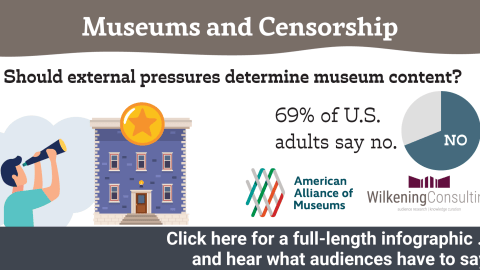
As US president Donald Trump’s administration continues to crack down on free speech in the culture sector, the non-profit organization Art at A Time Like This is addressing censorship head-on in the new exhibition Don’t Look Now in the Nolita neighborhood of New York City. The exhibition elevates the voices of artists whose choices in subject matter have come at personal, professional or political costs, whether that be through rescinded invitations, canceled opportunities or lost federal funding. According to a January 2025 survey conducted by Artists at Risk Connection, Pen America and the Association of Art Museum Directors, 65% of museum directors reported experiencing pressure to remove a work or call off an exhibition at least once over the course of their careers, while 55% agree that censorship is a “much bigger problem for museums today” than a decade ago. The exhibition also interrogates the broader economic engines driving rightward trends in art taste and production.
November
At the Museum of Contemporary Art Denver, inspiration for the water-stressed West
The Colorado Sun
In September, the Museum of Contemporary Art Denver opened the five-month exhibition “Water, Water on the Wall, You’re the Fairest of Them All,” the first by artist Roni Horn to focus exclusively on Earth’s most precious liquid resource. For museumgoers in the water-strained West, the exhibition could not feel more timely. With a federal deadline looming, the seven states of the Colorado River Basin have only days remaining to reach an agreement over how to divvy up the river’s shrinking waters. As state negotiators trade proposals and barbs over who should shoulder the burden of much-needed cutbacks, Horn’s exhibition allows for a more nuanced conversation about scarcity, one that transcends the zero-sum logic of Western water politics. Should compromise remain out of reach, the Colorado River negotiators might do well to consider a field trip.
December
Doug and his dogs: Watkins Museum earns recognition for preparing puppies for service
The Lawrence Times
The Watkins Museum of History has received a certificate of appreciation from Canine Connections acknowledging the more than two dozen service dogs who have spent time training in the building. Watkins volunteer Doug Tyler has brought 28 service dogs in training to his shifts over the last eight years. He estimated that the pups have collectively logged more than 900 hours at the museum’s front desk. Working service dogs are ADA-protected and can follow their owners into many spaces that may otherwise prohibit dogs. Puppies in training don’t get the same access, so Tyler was grateful he could socialize them with walks around KU’s campus, rides on public transit and three-hour shifts at the Watkins’ front desk. Watkins Executive Director Steve Novak said the dogs create a welcoming environment and a surprise for visitors. Tiffany Robbins, the outreach manager at the Watkins, faithfully sends calls out via museum socials when a dog is on the premises.

Upcoming Events
-
AAM Member Week
Event Date:Presented by: American Alliance of Museums -
AASLH History Hour: Is This Place Haunted?
Event Date:Presented by: American Association for State and Local History (AASLH) -
Disaster Preparedness for History Organizations
Event Date:Presented by: American Association for State and Local History (AASLH) -
From Informational Interview to Real Connection
Event Date:Presented by: American Alliance of Museums and National Emerging Museum Professionals Network