As a futurist, there is nothing I love more than encouraging people to think both forward AND back. America’s 250th anniversary is a great opportunity to reflect on our country’s past and to “remember the future” we want to live in the next 250 years. Today on the blog, Cory Garfin and Devon VanHouten-Maldonado, tell us how they created an an AI-powered chatbot to help Made By Us encourage museums to host a “wish wall” about America’s future.
CFM is already onboard! We will be hosting a Wish Wall in the AAM Resource Center at the 2026 AAM Annual Meeting and MuseumExpo in Philadelphia this May. I hope you will stop by to contribute your wishes for the near and far future of our country, and to upvote your colleagues ideas.
Yours from the future,

Elizabeth Merritt, Vice President, Strategic Foresight and Founding Director, Center for the Future of Museums, American Alliance of Museums
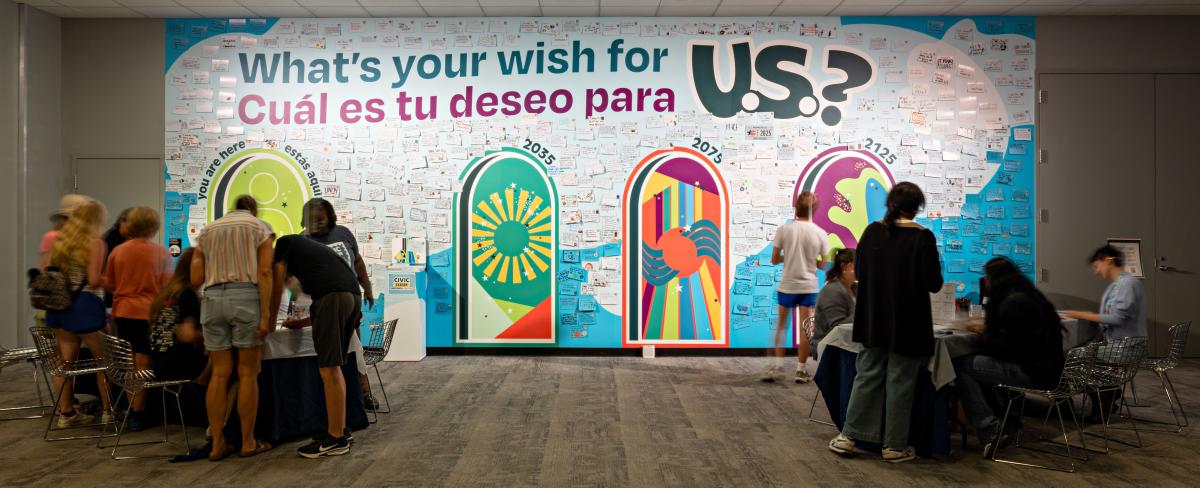
Since 2020, Made By Us (MBU) has been asking a simple question that invites civic-minded hopefulness: “What’s your wish for America’s future?” To date, 20,000 wishes have been shared on Wish Walls across the country at museums, libraries, and other cultural and community organizations. The walls are both collaborative art projects and calls to action. Now, with America’s 250th anniversary approaching, the team at Made By Us, Caroline Klibanoff, MBU’s Executive Director, and Adam Rozan of the Smithsonian’s National Museum of American History have set themselves the ambitious goal of signing up 250+ Wish Wall hosts. That’s the scale that would transform a small but impactful effort into a movement, and they’ve already signed up over 150 organizations. It also makes providing support challenging for such a small core team.
To onboard new hosts and answer their most pressing questions, members of the MBU staff, and now Adam, started offering monthly informational sessions. Even with the sessions, they anticipated a steady stream of individual questions as organizations moved from interest to implementation. “I wanted to find a way to both connect with and support many organizations at once, and to help individuals one by one, but I was also concerned about how unrealistic that would be,” Adam said. The team also compiled a thorough and detailed host’s guide full of insights gleaned over the last five years, but as a linear document containing answers to every possible question, it can be overwhelming.
To make those two things work in their favor at scale, responsiveness on an individual level and access to a trove of best practices, the team turned to us, Cory Garfin and Devon VanHouten-Maldonado, for help creating an AI-powered chatbot to answer questions from potential hosts. Cory comes from 15 years in the nonprofit sector, most recently as co-director of the arts and culture research practice at Slover Linett at NORC. Devon is Executive Director of SkyART, a Chicago-based youth arts organization. Together we’ve founded a consultancy to help cultural organizations with stretched budgets and limited capacity adopt AI tech.
In early conversations, the MBU team acknowledged that many museum workers feel trepidatious about AI. They’ve built hard-won trust with audiences and worked to put a human face on their institutions. Many also have concerns about AI Slop, job displacement, environmental impact, and “hallucinations” (when AI makes up information that sounds plausible but isn’t true).
These concerns shaped how we approached the project. The bot we created, called the Wish Wall Coach, is designed to handle questions with clear, documented answers, allowing Adam to focus on the relationship building and context-specific problem-solving that requires human judgment. To prevent hallucinations, we adjusted the bot’s “temperature,” a technical setting that controls how creative versus literal the AI responds. A lower temperature means the bot sticks closely to its training materials rather than extrapolating or inventing answers. If the bot doesn’t know something, or if the user simply wants to talk to a real person, it directs them to the appropriate Made By Us staffer or regional lead who provides support in their areas.
Our team built the Wish Wall Coach using Google’s Conversational Agent Builder, a platform designed for creating chatbots that can handle knowledge bases that are either “structured” (think spreadsheets with clear question/answer pairings) or “unstructured” (PDFs or other text-based documents). All of which means it can answer both straightforward FAQs (e.g., “What kinds of materials can I use?”) and more contextually complicated questions (e.g., “What do I do if leadership doesn’t see the value of hosting a Wish Wall?”). All without making anything up.
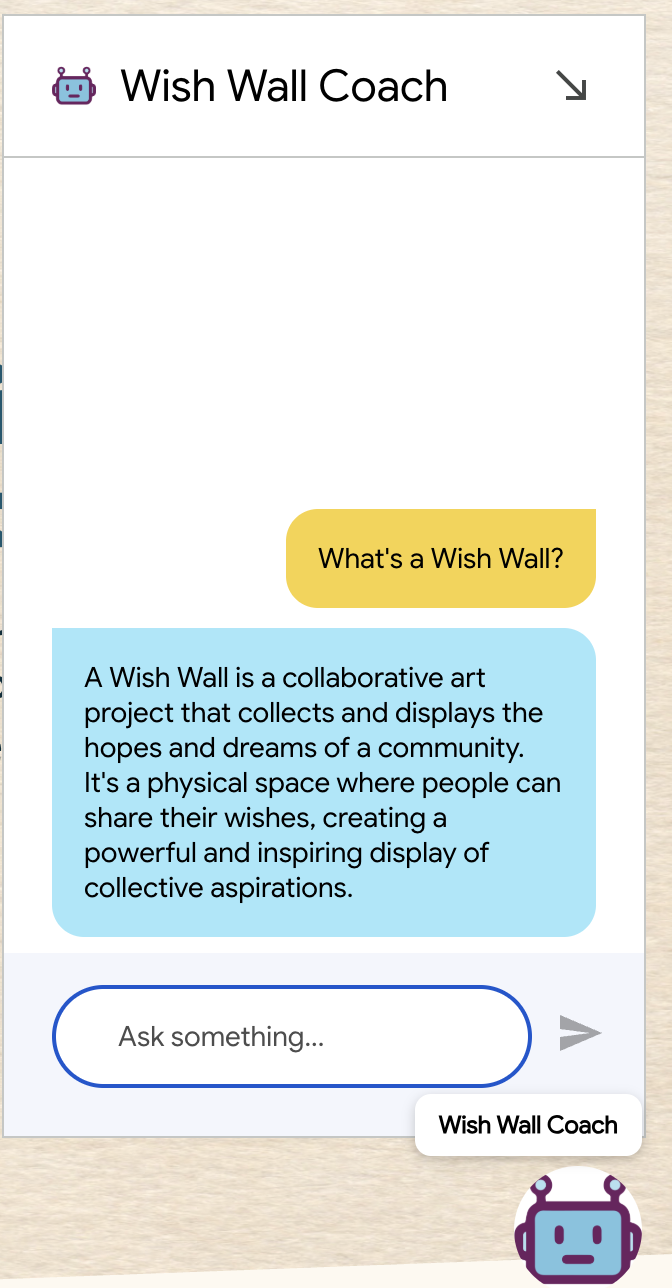
People can ask the bot questions most pertinent to them without having to wade through the entire guide. “What I love about it is that it answers direct questions and also suggests follow-ups if people need more,” said Caroline. Someone planning an outdoor installation can get specific guidance about weather-resistant materials. Someone worried about controversial content can understand effective moderation approaches. The information is the same as in the guide, but the delivery is tailored to what each host actually needs to know.
This is exactly the kind of project we want to see more of in the cultural sector. Our goal is to help demystify AI tools for nonprofits and demonstrate how they can build capacity without replacing human workers or requiring enterprise-level budgets. We plan to host webinars on these topics, and to invite cultural workers to share their own tips and concerns with their peers.
The Wish Wall Coach is live now. If you’re curious about how it works, try it out. Ask it about hosting a Wish Wall at your institution, or test it with questions about materials, timing, or handling challenging content. You can also sign up to host your own Wish Wall and register for Adam’s next informational session.
Upcoming Events
-
-
Industry Showcase: Innovative Digital Solutions
Event Date: -
Getting Started in Local Advocacy
Event Date:Presented by: American Association for State and Local History (AASLH) -
Creative Museums Summit
Event Date:Presented by: MuseumNext