Fall 2025: Accessing the Museum – Preview
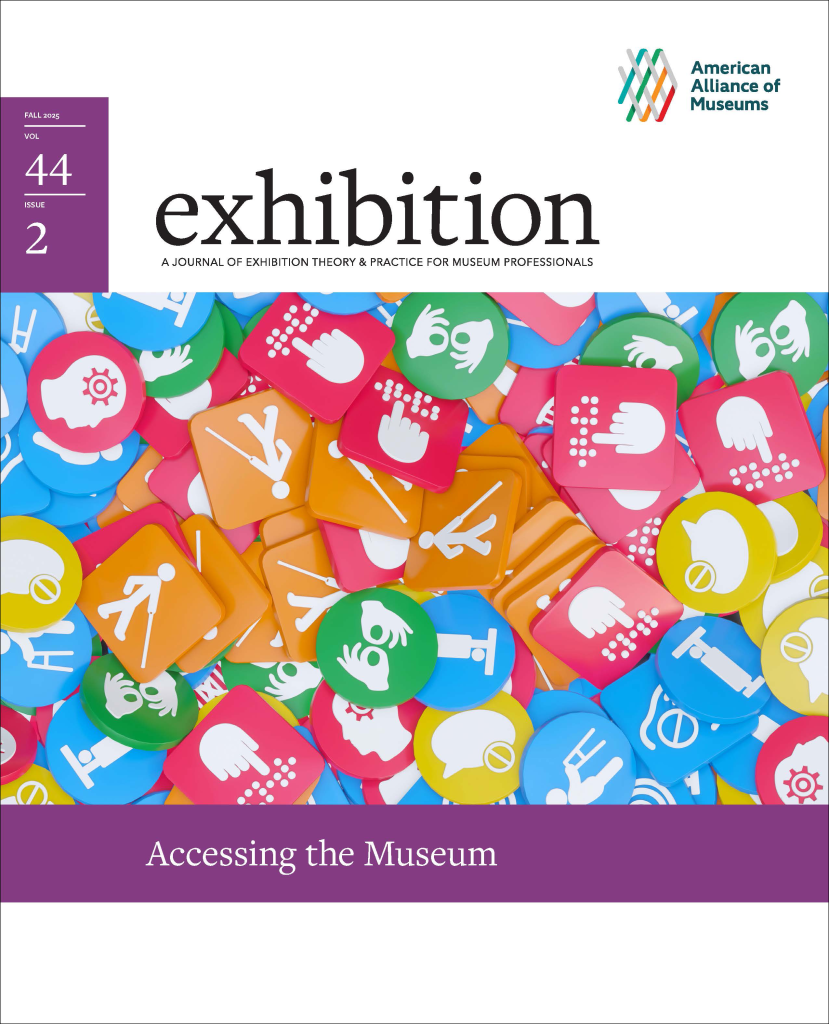
VOL. 44 ISSUE 2
Take a deep dive into what it takes to create more accessible exhibitions in “Accessing the Museum,” the fall 2025 issue of Exhibition. On the 35th anniversary of the passage of the Americans with Disabilities Act, we celebrate the progress our institutions have made in adopting universal design, co-creating with members of the disability community, and developing multimodal interpretation strategies—while acknowledging that embedded ableist biases are still barriers we must overcome if we hope to become truly inclusive.
Exhibition is an AAM member benefit for Individual and Museum Tier 2, Tier 3, Ally, and Industry Members.
In this issue:
Editor’s Letter
Exhibition‘s Editor, Jeanne Normand Goswami, reflects on the 35th anniversary of the Americans with Disabilities Act, celebrating the courageous activism that secured the law while arguing museums must now “push inclusive practice beyond compliance to embrace equitable, autonomous, and joyful experiences for all.”
» Read the full letter.
Multisensory Is Not Sufficient
Op-Ed | 🔒 Member Login
by Corey Timpson, Maria Braswell, Robin Marquis, and Sina Bahram
Too often, an offering is considered accessible when it achieves only the bare minimum: Can someone reach the content at all? That question misses a fundamental point and sets the proverbial bar so low that it may be on the floor.
An Ecoystem of Access: Building a More Inclusive Storm King
Feature | Free to Read
by Hannah des Cognets and Amy S. Weisser
Storm King Art Center, a 500-acre outdoor sculpture museum in New York’s Hudson Valley, has transformed its approach to accessibility from isolated accommodations to a comprehensive “ecosystem of access” that integrates physical improvements, staff training, and community partnerships.
Right to Rest
Feature | Free to Read
by Danielle Schulz and Karuna Srikureja
The Denver Art Museum’s exhibition “Composing Color: Paintings by Alma Thomas” centered visitor well-being by integrating universal design principles and rest as core exhibition features, honoring Thomas’s belief in art’s restorative power. Through spacious galleries, comfortable seating zones, multisensory activities, and reduced cognitive load, the exhibition created a welcoming environment where visitors spent twice the typical time.
The Sensational Museum: Embracing the Mind Shift
Q&A | 🔒 Member Login
Q&A with Dr. Charlotte Slark and Dr. Sophie Vohra, moderated by Jeanne Normand Goswami
How are museum professionals in other countries approaching accessibility? To find out, editor Jeanne Normand Goswami sat down with Drs. Charlotte Slark and Sophie Vohra of the Sensational Museum to discuss how their innovative project has integrated multisensory accessibility into UK museums.
Building Access Culture
Feature | 🔒 Member Login
by Elise Schaffer
In Fall 2023, Lehigh University Art Galleries (LUAG) launched its Access Culture initiative, a six-part professional development series facilitating arts professionals in appropriately and effectively engaging with audiences with disabilities. This article shares the approach and results of the initiative, demonstrating how small museums can actively center accessibility to support additional programming and initiatives.
Making History Museums Accessible to the Blind and Low-Vision Community
Feature | 🔒 Member Login
by Meg Bowersox and Jenn Tham
Staff of the Museum of the American Revolution outline three projects designed specifically for blind and low-vision (BLV) visitors in partnership with local disability advocacy groups: touch tours, audio descriptive tours, and tactile graphics.
In Feeling: Highlighting Disabled Artists through Empathy and Accessibility
Feature | 🔒 Member Login
by Molly Joyce and Kristen Nassif, PhD
Through an artist-led curatorial approach, partnerships with accessibility consultants, staff training, and embedded accessibility measures—including touchable artworks, multisensory engagement tools, and collaborative description-writing—an exhibition at Fralin Museum of Art seeks to transform institutional culture by centering disabled perspectives.
A Holistic and People-Centered Approach to Accessible Exhibition Design: Walker Art Center Case Study
Feature | 🔒 Member Login
by Doc Czypinski, Sarah Lampen, and Erin McNeil
By implementing systemic changes—including mandatory accessibility reviews before floorplan creation, ongoing testing and refinement in live exhibitions, and distributed responsibility across departments—the Walker Art Center transformed accessibility from a retroactive concern into an integrated, collaborative step in the design process.
Making Multisensory Interpretation a Reality
Feature | 🔒 Member Login
by Amy Hurst, Lynda Kennedy, and Charlotte Martin
Explore two different projects that together illuminate how empathetic, participatory design in exhibitions can transform public memory into action. Learn strategies for fostering personal connection, inspiring sustained engagement, and positioning designers as long-term agents of social change.
Embracing the Opportunity of Universal Exhibition Graphic Design: Success Stories from the National Park Service
Nuts & Bolts | 🔒 Member Login
By Valerie Faithorn
By integrating accessibility specialists from early project stages, carefully selecting typography and color palettes for legibility and contrast, reducing text while maintaining narrative impact, and incorporating user community feedback, three projects from NPS prove that accessibility guidelines inspire creative solutions rather than restrict design possibilities.
Affordability of Accessibility
Nuts & Bolts | 🔒 Member Login
by Violet Rose Arma
Through case studies from four institutions, this article demonstrates that museums can enhance accessibility through low-cost solutions—including tactile reproductions made with craft materials, sensory maps and bags, QR codes for audio descriptions, creative captioning techniques, and multisensory galleries—while emphasizing that meaningful accessibility requires centering disabled voices through community partnerships, conducting staff training, and integrating universal design principles from the earliest stages of a exhibition planning.
Building a Foundation of Accessibility: Resources for Exhibition Professionals
Resources | 🔒 Member Login
Resources contributed by members of Exhibition’s Editorial Advisory Committee
There are many ways to expand knowledge about accessibility and the disability community—from diving into disability history to co-designing an exhibit component with users while tackling the nuts and bolts of accessibility. This list of references and resources is a compilation from a handful of professionals who work in museums and exhibition development.
Share your thoughts about this issue of Exhibition!
About Exhibition
Published twice a year, the journal offers 128 pages of thought-provoking articles, exhibition critiques and commentary, technical articles, and essays. Each issue is organized around a theme, such as the power of words, exhibitions and universal design, innovation and community relevance, and new media in exhibitions.
Get Exhibition with AAM membership!
Beginning in 2025, Exhibition is now a digital publication and a benefit of AAM membership. Become a member to get access to thousands of digital resources, including Exhibition, Museum magazine, and much more.
Not sure if you already have access? Log in to your profile to check your membership. Don’t forget to ensure your individual profile is linked to your organization’s profile, if applicable, which will provide access to any organizational membership benefits.
Coming Up
Spring 2026
Present Tense
Fall 2026
Cutting through the Noise
Advertise in Exhibition
Exhibition is supported in part by our advertisers. Learn more about the opportunity and rates in our Advertising Media Kit. Explore advertising and partnerships.
Contribute to Exhibition
Calls for papers are posted twice each year (typically in November/December and April/May). While the editors welcome queries about contributions, please note that each issue is created around a specific theme.