This article originally appeared in Museum magazine’s May/June 2023 issue, a benefit of AAM membership.
The case for using emotion and metaphor in exhibition design.
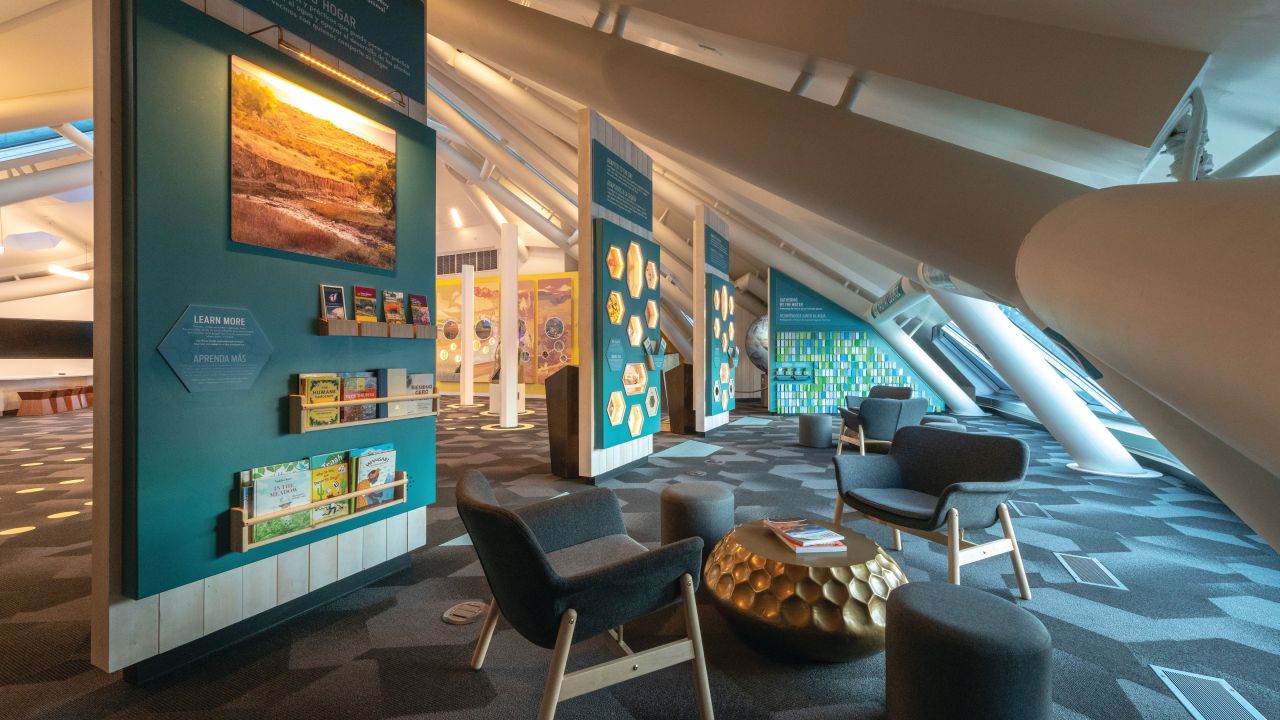
At the end of 2019, Denver Botanic Gardens opened “Welcome Home: Meet Your Habitat,” a semi-permanent exhibition that connects biodiversity, natural resources, and climate change. Developed by an interdisciplinary team that included biologists, art curators, botanists, and horticulturists, “Welcome Home” tests the idea that an exhibition can be a solution to a problem. But it’s also a love letter, an act of devotion illuminating the beauty and dazzling complexity that make the natural world worth fighting for.
Combining multimedia interactives with more than 50 specimens, “Welcome Home” is a story about the objectivity of data made meaningful through the subjectivity of feeling. Research indicates that subjective personal experience yields deep and lasting connections to ideas, not simply comprehension. Where climate change is concerned, this may be particularly true. Studies suggest that the human inclination to believe information that best aligns with preexisting beliefs and values is a significant barrier to climate change education. Confront someone with data that’s in opposition to what they believe, and you’re likely to further entrench what they already thought to be true.
How then, when science speaks the language of data, can museums talk about climate without activating the bias of belief? For “Welcome Home,” the solution relies on the human motivation to integrate information into our identities—emotion. Emotion sometimes feels like an unloved stepchild in scientific interpretation, inferior to intellect and best eliminated where possible. But emotion is not secondary to cognition—it is itself cognition, the model that allows us to make meaning of our knowledge, thoughts, and experiences.
Letting Emotion Guide Design
The primacy of emotion is evident not just in studies of climate change communication, but in our own evaluation as well. For example, when prompted to analyze example information, focus group participants instead often responded with emotional connections, preferring content that reminded them of fishing trips, their home garden, or beloved pets. The message was clear—even in intellectual analysis, visitors couldn’t help but feel.
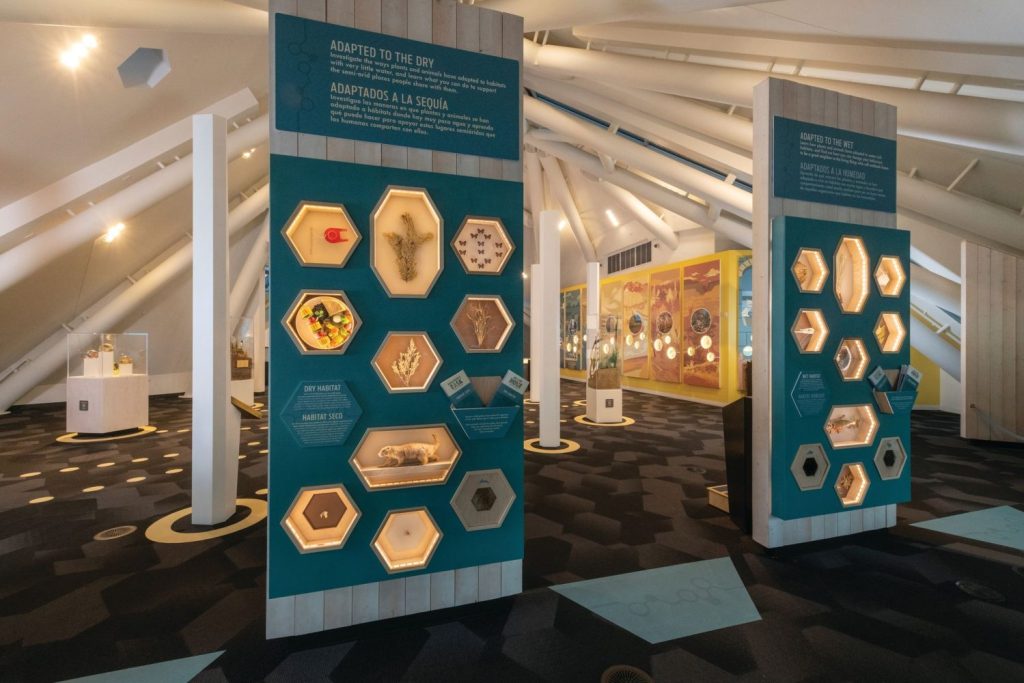
As a result, “Welcome Home” embraces the messy emotion of subjective experience. It’s designed to provide visitors with not only information, but also opportunities to fall in love with the beauty and strangeness of nature; an experience that uses how it feels as entry into what it means.
Emotion was a lodestar guiding the exhibition’s design, intended to support both affective and cognitive outcomes. The graphics are lyrical and gently nostalgic, and specimen cases are lit with a warm glow. Language and word choice highlight kinship—you might be friends with “cows,” but you might not bat an eye at the slaughter of “cattle.”
Specimens themselves also play a key role in emotional expression—among them are objects representative of humans, animals that ironically don’t get as much attention in biodiversity interpretation. A rubber ducky is displayed alongside blue spruce pine cones (Picea pungens) and a crow skull (Corvus brachyrhynchos) to illustrate the variety of residents in urban habitats; a pair of neon yellow sunglasses finds its place between earth star fungi (Geastrum smardae) and a branch from a Utah juniper (Juniperus osteosperma) to reveal the different kinds of organisms you might meet in a pinyon-juniper shrubland.
Placing human objects among rather than above other organisms yields opportunities for empathy that make the abstraction of biodiversity and climate more tangible, transforming the strangeness of the non-human into the familiarity of friends. It may be a stretch to ask visitors to care about how bugs fare amid rising temperatures, but introduce them to the quirky and charming behaviors of a particular beetle, and suddenly it’s easier to argue that they should care about how climate affects their new friend.
In “Welcome Home,” this invitation to friendship is followed by opportunities to act on it. Resources about economically attainable ways that visitors can support biodiversity and resource stewardship—reconsidering food choices, planting pollinator gardens, and similar actions—are featured prominently in a dedicated space. This idea of empowerment was also a clear emotional theme in the initial visitor evaluation—no one wants to feel helpless in the face of crisis.
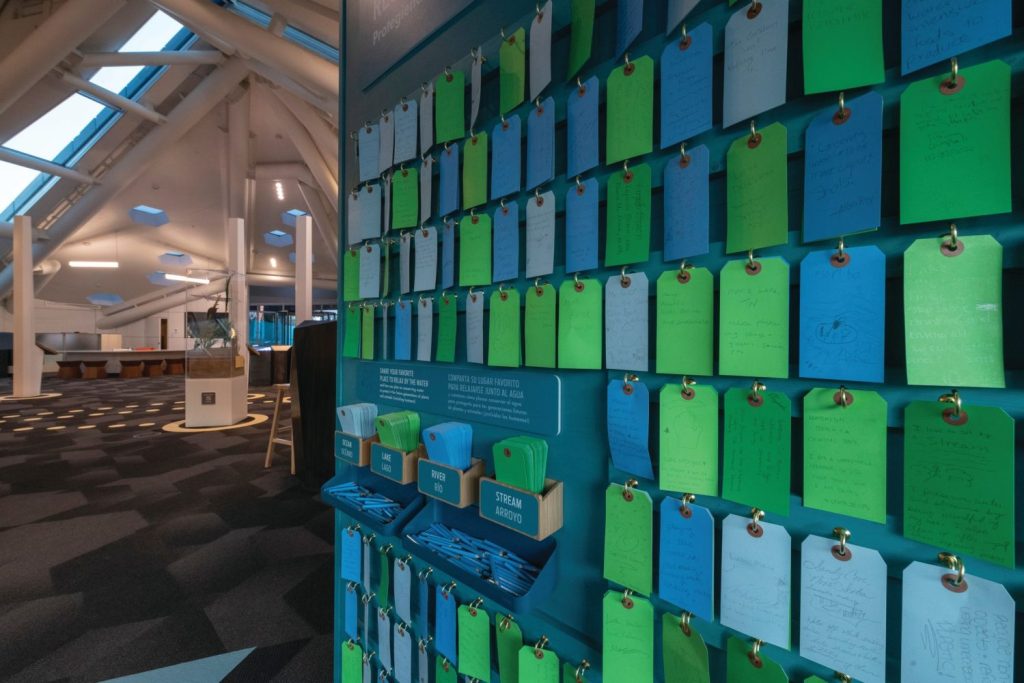
Nearby, a wall invites visitors to write about a natural place that they love and what they can do to help care for it. The answers are beautiful, funny, and sometimes heartbreaking, an aggregate of deep feeling and memories that tie us to the natural world.
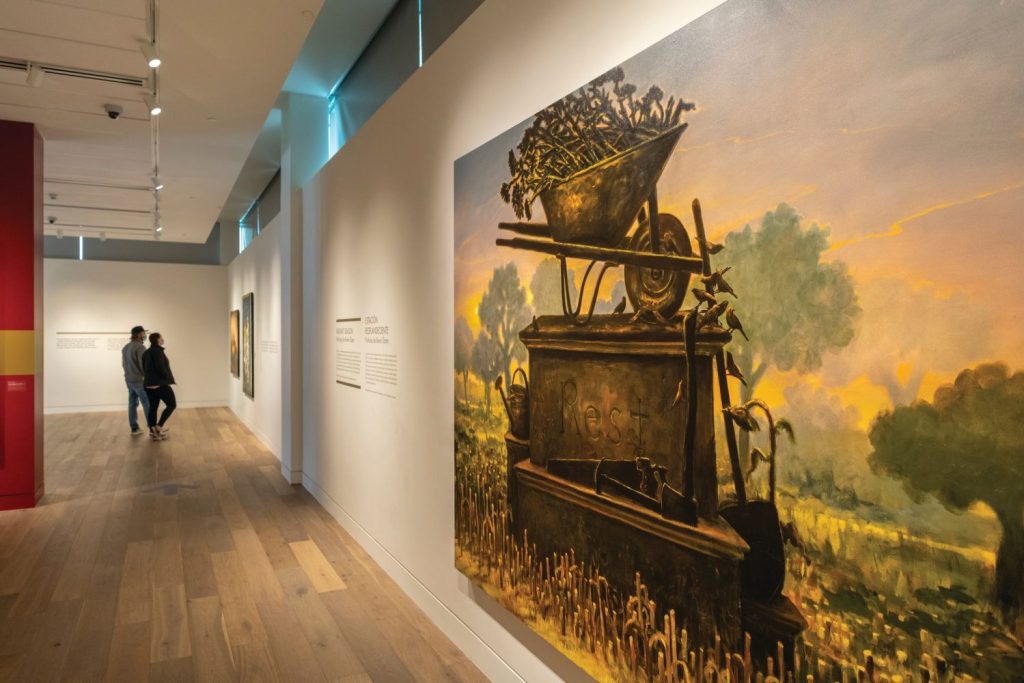
“Radiant Season” exhibition at Denver Botanic Gardens.
Making the Unimaginable Comprehensible
Taken together, these exhibition experiences immerse visitors in a central message—your house, your neighborhood, your state, your planet are habitats shared with friends and neighbors, human and non-human alike. Indeed the idea of scale—that “home” is both micro and macro—is one that’s carried throughout the exhibition. It’s also one that immediately presented a key challenge. How can you tell a story so vast that it encompasses the lives of every single person on the planet, every species, even the planet itself?
From a storytelling perspective, climate change is a narrative of truly cinematic proportions, a story in many ways about the end of the world as we know it. As a result, exhibitions about the subject can become mired in complicated details and information, caused not only by the complex and technical webs of data that describe the problem but the scale of the problem itself.
A system so big it becomes invisible to those inside it is its own kind of heuristic issue, in part because of the abstraction required to describe it. Scientists theorize that the human brain struggles with the enormity of climate crisis in part because our cognition is adapted to reflect the timescale of our individual lives. Perhaps it is simply not equipped to easily grasp events that must be understood across centuries and millennia.
Luckily, the history of science communication offered a solution for “Welcome Home”—analogy, simile, and metaphor. Metaphor may seem more like a poetic device than a tool for understanding scientific ideas, but it’s a powerful mechanism for translating concepts that don’t easily scale to daily experience. Pick up a science textbook and you’re apt to find all sorts of similes and analogies—particles are like billiard balls, cells are tiny factories.
In “Welcome Home,” metaphor is applied as a thinking tool to guide exhibition design. Not every element overtly addresses biodiversity and climate change; rather, each component offers a scalable conceptual model revealing the underlying principles. This holistic vision is the priority—take pikas, for example. If a visitor leaves knowing that these fuzzy, hamster-like creatures rely on alpine flowers for food, that’s great. But if they leave understanding that in some complex but tangible way they share resources and perhaps even a broader fate with pikas, that’s even better.
As a result, the structure of “Welcome Home” itself follows the theme of interconnection, with information and organisms subtly repeated across bite-sized stories that are each a unique facet emblematic of the whole. One interactive suggests that there are lessons about empathy and resource stewardship to be learned from the fact that leafcutter bees, magpies, and humans all build homes out of plant materials. A nearby pedestal features plastic trash pulled from Denver’s Platte River in a display reminiscent of oversized snow globes—an analogy for the long-lasting and inescapable impact that human activities have on the planet. As with any allegory, these are sometimes inexact—not all humans use wood to build homes, for example—but these stories act as a conceptual framework for the complexity of interconnection, allowing visitors to apply their own experiences.
The unique power of emotion and allegory as entry into climate and biodiversity science is not limited to scientific interpretation. Art experiences can approach the same problems, appealing to visitors who may find scientific exhibitions, however emotive, uncompelling. In a 2021 exhibition at Denver Botanic Gardens, for example, visitors were moved by painter Kevin Sloan’s luminous and poignant portraits of plants and animals that illustrate the fragility of the natural world. In a different gallery, visitors lingered in wonder over the sculptures of Judy Guralnick, strange and beautiful fusions of sprouting plants, fungi, porcelain figurines, and books—objects that contemplate how the natural and constructed worlds collide and interact.
Exhibitions like these use a similar emotional strategy to make the immense changes taking place around us understandable. Like “Welcome Home,” they contextualize the value of what climate change endangers. After all, how can you save something that you don’t truly see? Why should you fight to preserve something that you don’t love?
Keeping It Real
Successful climate crisis messaging also requires acknowledging the paradox of hope and despair—it’s foolish to pretend that climate news is anything but dire, and the enormity of the natural, economic, and political systems surrounding us are far beyond our individual control. But we also have influence within the web of collective activity and relationships that surrounds us, a network that is sometimes able to amplify outcomes beyond our individual capacity.
This is not to say that museums should promote feel-good remedies of questionable impact, especially given that AAM survey data indicates that visitors rely on museums for credible climate information. Encouraging visitors to reduce their individual impact can feel empowering, but it’s equally important that they also understand the role they can play in collective action. As such, the role of museums and botanical gardens in the time of climate crisis is plural and responsive. Museums must act as a source of accurate information but also emotional experience; museums can be a place of solace and joy in a time of environmental sorrow.
This may take many forms—an orchid striking in its alien beauty, a painting that surprises with a new perspective on a familiar landscape, a funny interactive experience that suggests we have more in common with dung beetles than we realized. Perhaps the real lesson for museums in the time of climate crisis is this: climate education must be much more than information. It can be an act of love for our communities and visitors, a place to venerate and escape into the beauty of the natural world, and a powerful testament to the value of what it seeks to protect.
Meeting People Where They Are
Creating experiences that speak to each visitor’s current level of engagement with environmental issues is a powerful way to unite emotion and comprehension. At Denver Botanic Gardens, these are some of many ways we meet people where they are.
Citizen science: projects that allow visitors to contribute their own data to real scientific work, including plant phenology and pollinator observations.
Botanical art classes: experiences for artists of any level that connect the beauty of nature with the joy of creative exploration.
Science chats: informal, volunteer-led conversations that illuminate science topics through social interaction and demonstration.
Upcoming Events
-
Doing More with Less: Creative Problem Solving & Funding Strategies
Event Date:Presented by: Southeastern Museums Conference -
Outdoor History Walking Tours 101
Event Date:Presented by: American Association for State and Local History (AASLH) -
I’m In Charge of A Museum Store. Now What?
Event Date:Presented by: American Alliance of Museums -
Gettin’ To Know You: The Art of Networking
Event Date:Presented by: American Alliance of Museums