In today’s post, Steve Light, Vice President for Education and Guest Experience, shares how Thomas Jefferson’s Monticello is fostering nonpartisan civic engagement during our country’s semiquicentennial and sharing resources other museums can deploy. This is the third in a series of posts presenting nimble, low-cost opportunities for museums to enhance their own programming around the 250th, whether by hosting one of Civic Season’s Wish Walls, a screening of the Better Together Film Festival, or facilitated conversations as part of Monticello’s Declaration Book Club. What your museum is doing to help your community reflect on, celebrate, and commemorate our nation’s history this year? Tell us about that in the comment section of this post, particularly if you can share resources or replicable models other museums can adopt!
–Elizabeth Merritt, Vice President, Strategic Foresight and Founding Director, Center for the Future of Museums, American Alliance of Museums
As museums grapple with polarization, culture wars, and declining trust in public institutions, many of us are asking what meaningful civic engagement can look like as we approach the Semiquincentennial of the Declaration of Independence. Five years ago, Educating for American Democracy (EAD) issued a report that described the United States as standing “at a crossroads of peril and possibility.” Decades of underinvestment in civic and history education, the report argued, had weakened the foundations of our constitutional democracy. At the same time, EAD identified the approaching 250th as a once-in-a-generation opportunity to invest in civics and history education.
With this in mind, on the 249th anniversary of the Declaration, Thomas Jefferson’s Monticello announced the launch of the Declaration Book Club, with support from More Perfect. The free, three-part toolkit issues a nationwide invitation for Americans to read, watch, discuss, and reflect together on the document that announced the nation’s founding ideals, and that continues to shape debates about equality, rights, and self-government today. The Book Club’s launch marked the beginning of a year-long initiative at Monticello to engage the public ahead of the Declaration’s 250th anniversary.
Designed for groups of friends, as well as classrooms, faith communities, and other civic and social groups, the downloadable resource supports three facilitated conversations that explore the Declaration’s revolutionary ideas and its legacy. Each meeting centers on about thirty pages of varied reading, ranging from timelines and guiding questions to short essays and primary sources. Rather than offering a single interpretive conclusion, the resource is intentionally inquiry-based: it asks participants to deliberate about what the Declaration has meant, how diverse groups of Americans have rallied around its language, and what it might demand of us now.
Monticello is one of the nation’s most compelling historic destinations, offering a powerful experience where visitors simultaneously learn about Jefferson’s ideals of liberty and equality, and about the lives of the people he enslaved. The work of creating the Declaration Book Club is grounded in Monticello’s new strategic plan, Climb the Mountain: Discover America, which lays out a vision for the organization to serve not only as a historic site, but as a civil-society institution that connects historical inquiry with the tools and dispositions of democratic self-government. Under the strategic goal, “Monticello for America, Monticello as America,” Monticello is using the 250th anniversary to explore what historic sites can do to build civic capacity at a national scale. That means creating spaces that help our audiences build evidence literacy, bridge differences, encourage deliberation, and foster civic imagination.
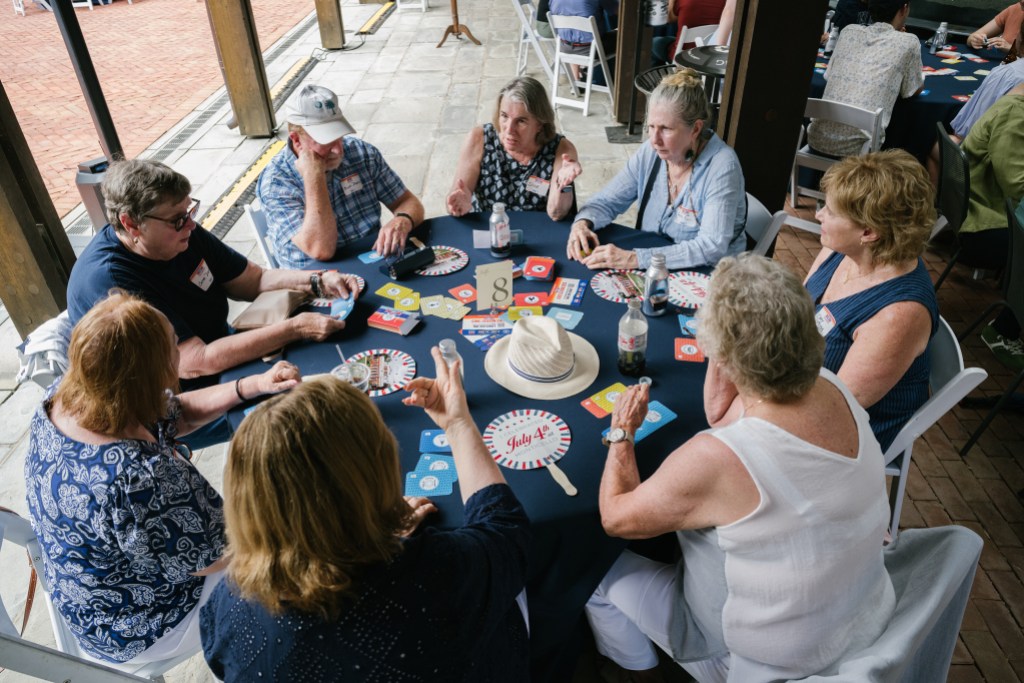
The Declaration Book Club is one expression of this broader strategy. On site, Monticello has launched Founding Friends, Founding Foes, a tour that uses the fraught but enduring friendship between Thomas Jefferson and John Adams to explore partisanship in the founding era, period debates over constitutional rights, and the concept of civic friendship. The tour is frequently paired with Feast of Reason, a program that invites participants to eat together and talk about the issues and questions that shape our civic life today. Utilizing a thoughtfully designed conversation card deck based on Tammy Bormann and David Campt’s Arc of Dialogue, Feast of Reason creates space for practicing the crucial civic dispositions of curiosity, listening, empathy, and meaningful connection. Programs like this suggest that museums and historic sites can convene meaningful conversations with careful framing, historical grounding, and shared norms for the conversation.
Monticello has also extended this work through partnerships. In 2025, at Democracy360, a biannual convening of the University of Virginia’s Karsh Institute of Democracy, Monticello and Karsh collaborated on Declaration Next, a participatory experience that brought together 35 students from colleges and universities across Virginia. After visiting Monticello and examining the historical context of the Declaration’s creation, the students formed their own deliberative body and drafted a “Declaration for the Future of American Democracy,” modeling democratic practice rather than merely studying it, and bringing historical ideas into the present while pointing to the future.
The importance of museums as places for this work has been eloquently argued by other leaders in our field and is reinforced by audience data. In a 2024 AAM blog, Sarah Jencks—recently selected as one of Monticello’s inaugural Civic Partnerships Fellows—argued that “all museums today should have a civic strategy.” An effective civic strategy is inherently non-partisan, and in a blog post last October, Colleen Dilenschneider noted that museums are broadly viewed as not having partisan agendas. This is true whether those surveyed are Democrats, Republicans, or independents. Dilenschneider has also documented how museums continue to maintain reputations as trusted institutions. In a polarized political environment, this sustained trust gives museums something increasingly rare: permission and opportunity to convene across difference. At Monticello, we see this daily, as visitors from across the political spectrum engage with the complexity of history, and with each other.
In addition to our efforts to engage the public at this anniversary moment, Monticello also aspires to provide support for a broader field of history and civic educators. In 2025, we received a major grant from the Carnegie Corporation of New York to help strengthen civic education through museums and historic sites nationwide. This investment will allow us to support the activities of EAD’s Community Learning Partners Task Force, a group of museums, libraries, historic sites, humanities councils, and community centers of various kinds that educate outside of a classroom or formal learning settings. The Community Learning Partners ecosystem includes more than 300 informal educators across the United States, and our goal is to sustain a community of practice that elevates successful strategies for weaving history and civics education together. We have launched a field-wide survey seeking to better understand the landscape of history and civic education in museums and other informal learning settings, and we invite you to participate. In November 2026, Monticello will convene its first national summit of the network, with the intention of establishing an ongoing conversation about the interwovenness of history and civic learning. As museums approach the nation’s 250th anniversary, the more consequential question may not be how we interpret the past, but how we design experiences that also help the public practice democracy in the present. Monticello provides an example: rooted in history, sustained by inquiry and conversation, and oriented toward the civic work of today and tomorrow.
Upcoming Events
-
I’m In Charge of A Museum Store. Now What?
Event Date:Presented by: American Alliance of Museums -
Core Issues Briefing Series
Event Date:Presented by: American Association for State and Local History (AASLH) -
Strengthening the History Workforce Virtual Summit
Event Date:Presented by: American Association for State and Local History (AASLH) -
Gettin’ To Know You: The Art of Networking
Event Date:Presented by: American Alliance of Museums