Do self-identified Democrats and Republicans differ in their beliefs that museums have political agendas, that they are mission-driven entities, or that they are “welcoming to people like me?” This guest post from Colleen Dilenschneider, co-founder of IMPACTS Experience, delves into the the data. A longer version of this article with additional research originally appeared on Know Your Own Bone, an excellent data-informed resource for cultural executives published by Colleen. The charts and analyses included here are reprinted with permission from IMPACTS Experience.
-Elizabeth Merritt, VP Strategic Foresight and Founding Director, Center for the Future of Museums, American Alliance of Museums
Americans spent the first half of 2025 adjusting to a new administration and its preferred policies. As one may expect for a research and predictive technology company specializing in understanding audiences, IMPACTS Experience was asked at even greater frequency how current events were impacting perceptions of museums—from trust perceptions to intentions to visit to projected daytime attendance. Thankfully, research shows that museums remain trusted. But do perceptions of museums differ when we segment the data by self-identified political affiliation?
The data in this article are from the National Awareness, Attitudes, and Usage Study. At over 388,000 respondents strong, it is believed to be the largest ongoing survey of perceptions and behaviors concerning cultural organizations in the United States. In this article, we’ve segmented the data for exhibit-based organizations including art museums, aquariums, children’s museums, history museums and historic sites, natural history museums and sites, science museums and centers, and zoos. We’ve also segmented the data for individuals in the United States who self-identify as Democrats (or having a Democratic lean) and Republicans (or having a Republican lean) in order to assess potential perceptual differences between these cohorts.
For context, 35% of Americans who profile as high-propensity visitors to cultural organizations identify as independent/other/unaffiliated. (A high-propensity visitor is a person with the demographic, psychographic, or behavioral attributes to suggest likelihood of visiting a museum. These are the folks who have interest in visiting museums.) This is compared to 36% who self-identify as Democrat (or Democrat-leaning), and 29% as Republican (or Republican-leaning).
There’s much more information where this comes from! However, in this article, we’ll focus on three key areas of interest in terms of perceptions of various types to museums: If they are believed to have a political agenda, if they are believed to be mission-driven institutions, and how welcoming they are believed to be for “people like me.”
Are cultural organizations perceived as having a political agenda?
Before we dive into differing perceptions between self-identified Democrats and Republicans, let’s look at perceptions of museums having political agendas in the first place and how this has changed in the last three years.
There is no “right” or “wrong” in terms of being perceived as having a political agenda. We work with some organizations that let out a sigh of relief when they see that they are not seen as having a political agenda, and we work with others aiming to influence policy (around conservation, for instance) that grow frustrated when they aren’t viewed as political enough in their estimation. The desire (or lack thereof) of being perceived as having a political agenda depends on the goals and strategies of an individual institution. However, looking at the data for the cultural industry as a whole helps us understand which organization types are perceived to have more of a political agenda than others.
The data below show the percentage of Americans who “agree” or “strongly agree” that each of these organization types has a political agenda. The data compare the values as of Q2 2025 to the same period three years ago (Q2 2022).
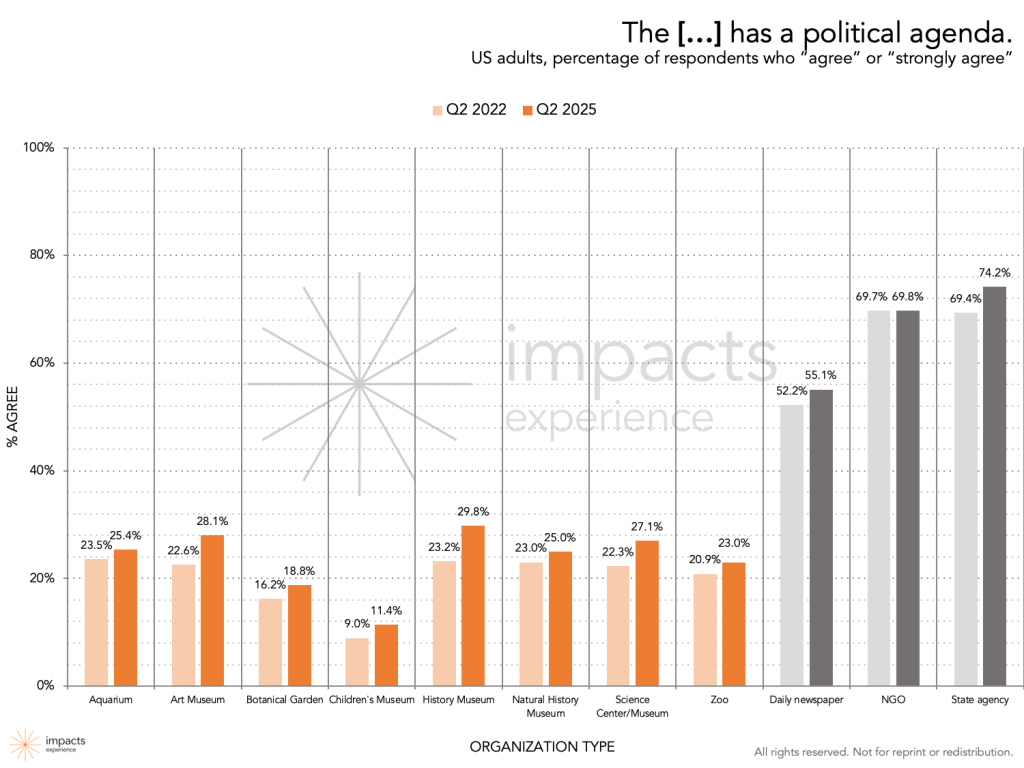
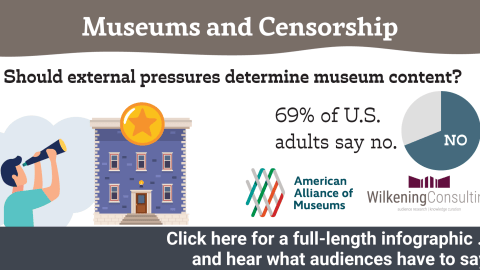
To the extent that it is binary, cultural organizations are not perceived as having a political agenda. In all cases, however, the percentage of Americans who believe that cultural organizations have a political agenda has elevated over the past few years. This said, the numbers remain comparatively low. As a point of comparison, over half of Americans believe that the daily newspaper has a political agenda, and nearly three-quarters now believe state agencies have political agendas.
Are cultural organizations perceived to be mission-driven entities by both parties?
On the whole, about a quarter of Americans believe that museums have a political agenda. But what happens when we start segmenting key metrics by an individual’s self-identified political affiliation?
In our conversations, respondents are encouraged to choose a major political party with which to affiliate —if they affiliate with a major political party at all.
The data below have been quantified as scalar variables on a 1–100 continuum. A value of 1 would indicate extreme disagreement with the sentiment, and a value of 100 would indicate agreement to a maximum level. In this chart, values at or above the mid-60s level would tend to indicate general agreement with the statements that the respective organization is mission-driven.
Don’t be fooled by scalar variables in these charts! A difference of even one point is notable, and a difference of two points is statistically significant. Even seemingly small deltas can be mathematically noteworthy.
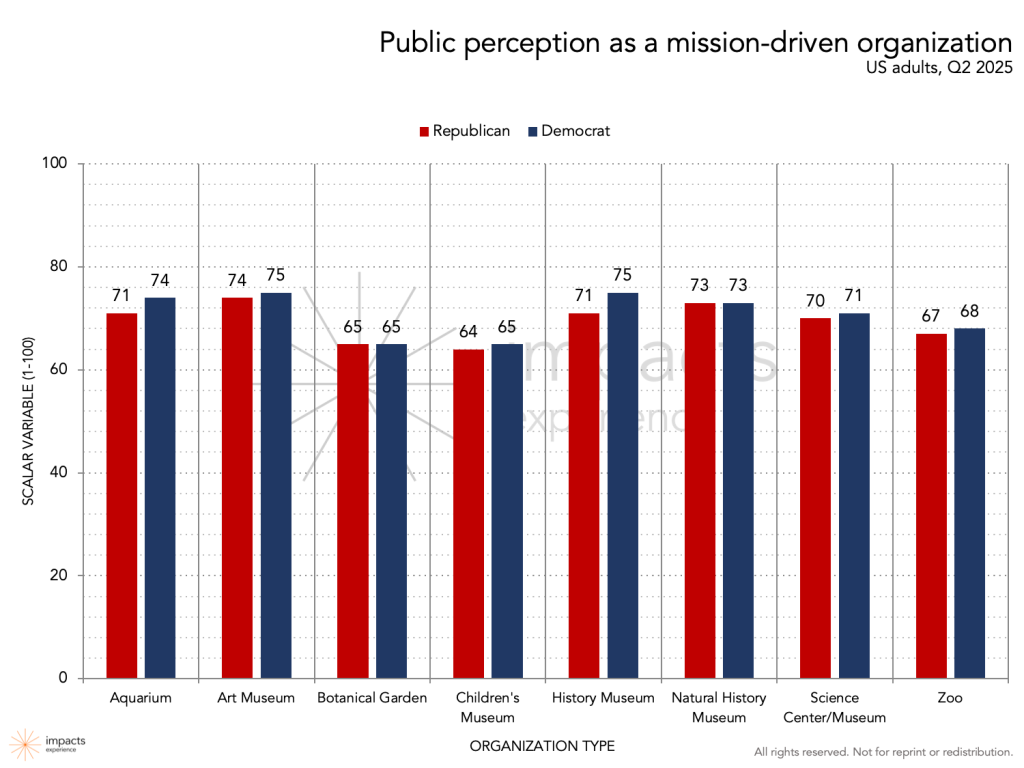
With values at or above the mid-60s for each organization type, both self-identified Democrats and Republicans believe these exhibit-based organizations to be mission-driven organizations. While values are generally higher for Democrats, the values for Republicans also express agreement with the statement.
Notably, the values are not opposites! Art museums, for instance, are believed to be among the most mission-driven cultural organization types among both Democrats and Republicans. Being seen as mission-driven among Democrats does not necessitate being seen as NOT mission-driven among Republicans. The belief that museums are mission-driven entities is something that we all can agree upon—or a majority of us, anyway.
On a related note, Republicans and Democrats also hold similar levels of agreement with the belief that cultural organizations should recommend behaviors or actions to support their missions. While Americans generally don’t love being told what to do, this suggests a seemingly rare expectation for cultural organizations. To see these data, visit Know Your Own Bone.
Do welcoming perceptions differ by political affiliation?
Do both self-identified Democrats and Republicans believe that different cultural organization types are “welcoming for people like me?” It’s an important question, as most museums aim to be welcoming to as many people as possible.
Please keep in mind that “people like me” is a broad statement. It can mean a variety of things, from “people of my skin color” to “of my age” to “of my level of educational attainment,” or anything else. Children’s museums tend to score lower on this metric than other institutions because there’s a whole segment of people who unsurprisingly do not feel that children’s museums are for them: people without children.
Again, the data below have been quantified as scalar variables ranging 1–100, with a value of 1 indicating strong disagreement and 100 indicating fervent agreement. In this chart, values above the high 60s tend to demonstrate agreement with the statement on the whole.
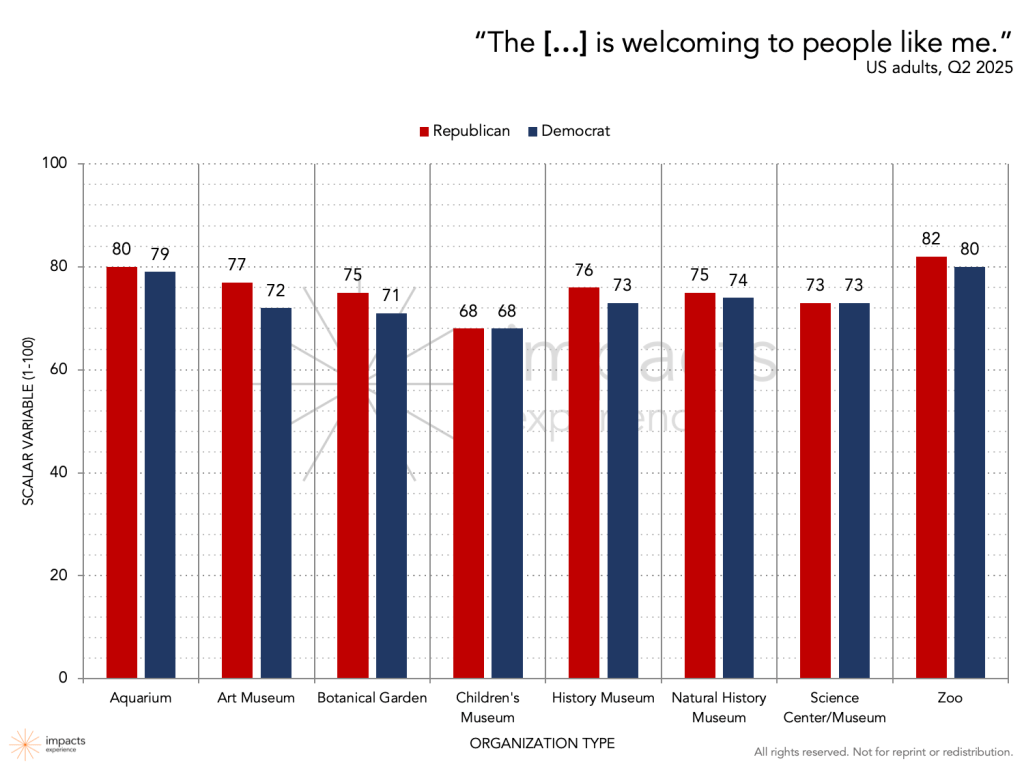
Good news! With values in the high 60s and above, exhibit-based cultural organizations are generally considered to be welcoming institutions by both Democrats and Republicans.
You’ll also notice that self-identified Republicans feel that cultural organizations are more “welcoming to people like me.” Generally speaking, self-identified Republicans are less racially diverse—one of the many factors contributing to welcoming perceptions. To quote one of our analysts perusing the open-ended responses for Republicans, “It seems it never occurred to many Republicans that they wouldn’t be welcome!”
Why does all of this matter?
In a country in which nearly everything risks feeling political and potentially polarizing, museums generally are not. And we find that heartening. Amid all of the conversations about differences, both parties believe cultural institutions to be welcoming, mission-driven entities.
Yes, there are subtle differences in perceptions—and this fact can help cultural organizations identify worthy goals to pursue. On the whole, however, both Democrats and Republicans agree on key aspects relating to the value of cultural institutions. While it is still important to consider the differences between these groups when crafting engagement strategies, one of the strengths of cultural institutions may be the trust and belief placed in them by both political parties. What Republicans and Democrats believe may differ, but when it comes to broader perceptions surrounding museums, their overall sentiments are quite similar.
For access to the full article, including data on performing arts organization perceptions as well as the expectation for cultural organizations to suggest or recommend ways for the public to support their missions, subscribe to KYOB+.
Upcoming Events
-
AAM Member Week
Event Date:Presented by: American Alliance of Museums -
AASLH History Hour: Is This Place Haunted?
Event Date:Presented by: American Association for State and Local History (AASLH) -
Disaster Preparedness for History Organizations
Event Date:Presented by: American Association for State and Local History (AASLH) -
From Informational Interview to Real Connection
Event Date:Presented by: American Alliance of Museums and National Emerging Museum Professionals Network