The Museum at Texas Tech underwent a major renovation and an addition and lived to tell the tale.
Construction and renovation are not things most museum professionals normally deal with. Odds are most of us will not be constructing a new museum building from scratch, but the chances are pretty good that many will be involved with a large renovation, repair project, or addition. These projects require attention to detail and a lot of time—neither of which we necessarily have in abundance.
This article originally appeared in the Mar/Apr 2026 issue of Museum magazine, a benefit of AAM membership.
» Read Museum.
The Museum at Texas Tech University went through a major life-safety project from 2016 to 2018, updating fire-alarm systems and adding new sprinkler systems. Then from 2020 to 2022, it constructed a 15,000-square-foot addition that includes collections storage, a gallery, classrooms, and offices. The museum stayed open to the public through both projects, which added extra challenges to their management. As the museum’s project coordinator, I was there every step of the way. Here, I share several essential lessons for surviving your museum renovation project.
Designate a Project Coordinator
First, someone from the museum staff needs to be the project coordinator. For our projects, Texas Tech was the project manager, but as assistant director for operations, I served as the coordinator for the museum. A project coordinator will read and examine everything, coordinate schedules, and serve as the liaison between the architect and contractors and staff—and maybe the visitors. The project coordinator becomes the single point of contact, the museum’s voice for the staff’s and the institution’s needs.
Finding a good architect—particularly one with experience working with museums or cultural facilities—is very important. They are the coordinator’s trusted partner in this process. In turn, they will help you find a quality contractor who communicates well. Texas Tech led both of these searches, but as coordinator I was the museum’s representative on the search committees.
It is rare that someone goes through museum training saying, “I want to be a facilities manager when I grow up.” Thus, the coordinator must educate themselves on the construction business. I had several meetings with the university’s project manager and the architect to learn about the process and what they needed. The coordinator also needs to thoroughly understand the museum’s scope of work—a clearly defined statement of what the project is to do. It’s not the coordinator’s job to design and figure out the details. Instead, the coordinator works with everyone to identify what needs to be protected and coordinates what the staff and contractors need to do.
Before Construction Begins
The project begins with the “architectural stage”—my term for the period when I was working with the architects. Architects call this first phase “schematic design”—when the architect works with you (the customer) to define and refine the project requirements and goals. This results in some rough drawings and ideas to illustrate the basic concepts of the design. That progresses into the architect’s second phase, “design development,” where the design starts taking shape and the architect drafts specifications for everything from steel beams to light switches. Then they will work on construction documents—a complete set of site and floorplans, sections, and detail sheets that are combined with mechanical, electrical, and structural drawings.
As a non-architectural person, the museum coordinator must spend a lot of time studying the documents to ensure they understand them. I bought a “blueprints for dummies”–type book and taught myself the sheets and symbols. If something doesn’t make sense, ask! Architects make mistakes too. All the subcontractors (subs) on the project will rely on these drawings. Seek—no, demand—time to review the blueprints before they advance to the next design phase.
Once blueprints are ready, the contractors begin bidding on the project. Ask the architect for a pre-proposal meeting. This meeting gives you a chance to tell potential contractors what your institution is trying to accomplish—your original project scope statement—and how a museum renovation won’t be a “typical” construction project. For our life safety project, we discussed the extra coordination that would be needed to keep visitors safe and the security precautions that would be necessary to access the “behind the scenes” work.
After the museum chooses the general contractor, and they have lined up the subs, hold a pre-construction (kickoff) meeting with the people working on the project. In this meeting, I detailed how the museum has valuable collections that belong to the public, that we restrict access to a lot of areas, and that those areas have special climate needs.
Tour the site with the subs, and share the perspectives of the architect and the museum. Invest the subs in your institution, not just the project. I highlighted how they would now be working with us in caring for the region’s heritage and the collections that we hold in trust for the public.
Just as you have to explain “museums” to construction workers, you will need to explain “construction” to staff. Introduce the staff to the architects and the foreman. Explain how this project will impact staff and what the contractor needs from them. Encourage staff to ask questions—and to tell the coordinator what they need and what they are concerned about. For example, our curator of art was concerned about subs walking on flat file cases. Could the contractor build box covers over them? They said yes, and they used rolling scaffolds over the covers so no one would have a reason to step anywhere else.
With numerous exhibits and programs, museums are busy places. The coordinator needs to create a list of the staff’s issues, or “have to protects,” for the construction team. For example we were very concerned about someone accidentally striking the Peter Rogers mural in the lobby with a pipe (or anything else), so the contractor built a wall in front of it.
When the coordinator has their initial list of “have to protects,” meet with the contractor and develop a schedule. When will work in the front-of-house areas have the least impact? What dates will the education program need access to certain areas? When does the museum need complete access to the event hall for the annual fundraiser? The contractor and the subs will be figuring out how long they need to work in a particular area, what areas will take longer, and how to plan their orders so supplies arrive at the right time.
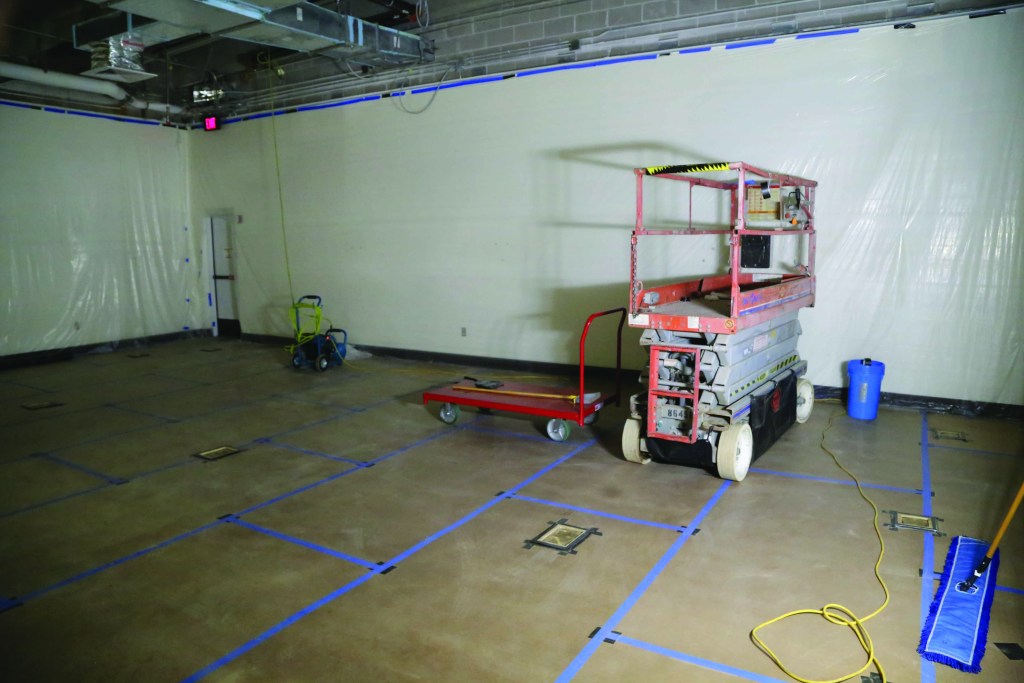
Can You Spot a Problem in this Picture?
The blue tape line is where the ceiling is going to be installed—right where the emergency exit sign is (enlarged in the inset photo). The ceiling installers would have caught this—but why not ask about it now while it’s still an easy fix?
Once Construction Begins
To keep construction moving as swiftly as possible, you’ll need to adhere to the schedule. If you agree to have a gallery emptied of its cases and objects by a certain date, make sure staff has a plan to meet that deadline. At the same time, if your contractor agrees to finish an area on a particular date, then hold them to that. But be flexible when possible—tell them when there’s some give in the schedule and when there isn’t.
There will inevitably be surprises that impact the schedule, too. Meet weekly with the construction foreman to go over what’s happening this week and what should happen next week, and maybe even the week after—so staff can have their areas ready. Our biggest surprise in the life safety work occurred in the ethnohistory gallery when we found that two small walls we thought were built from wood were actually several large walls, ceilings, and platforms. Rather than redesign the sprinkler system, we elected to have everything torn out and replaced with university-required metal studs. The architects needed to completely redesign this new gallery—without adding any extra time. We moved to the next work area while the redesigns took place and came back to that zone later without having to change the schedule.
Donors and the public enjoy seeing the progress of your project on social media, via a live webcam, and right in front of them when they visit. But if your project is more than a yearlong renovation, you might not want to appear “under construction” constantly. Ninety percent of our public spaces were renovated for sprinklers, so we were very deliberate in what we said on social media. If a gallery was closed, we would simply say that. We offered more detail when we relocated the main entrance or when the public would encounter the renovations. We always had extra signage and wayfinding on-site, highlighting what was open rather than touting what wasn’t.
Spotting Trouble
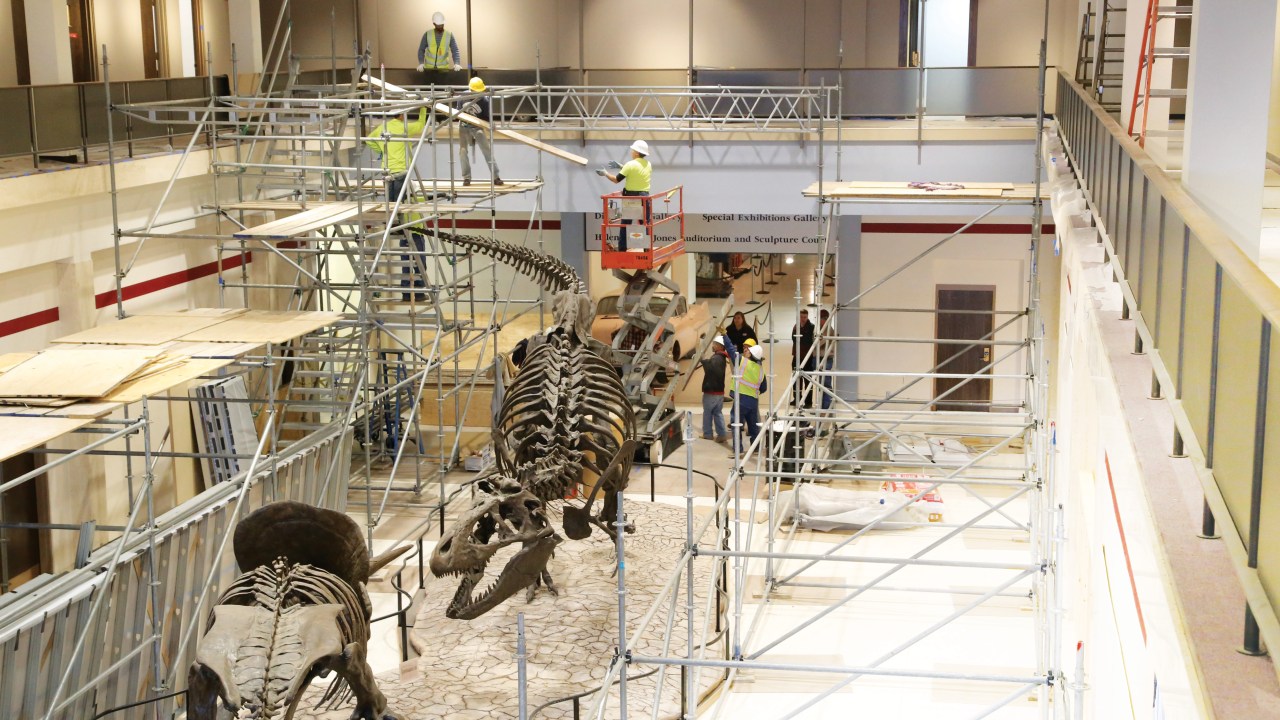
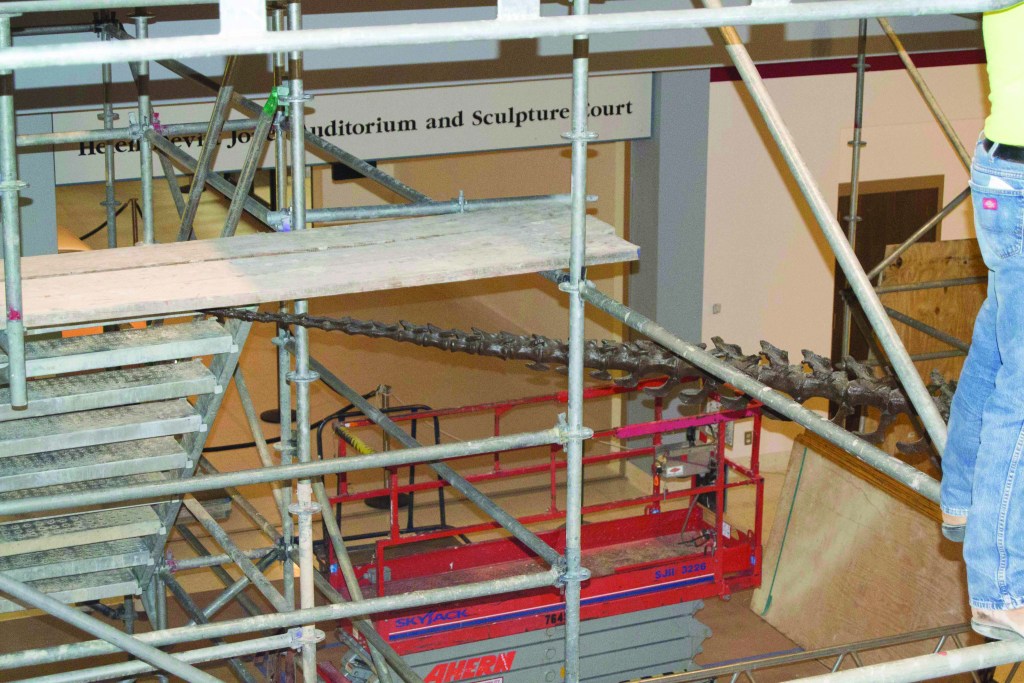
Construction workers don’t always pay attention to where they are. The day the scaffolding was being set up in the museum’s main gallery, we stationed someone on the balcony to watch. The workers tugged on the frames trying to “square up” sections but weren’t watching the T. Rex’s tail. The spotter’s job was to yell whenever they got close—a reminder for the workers to lookup. In the final setup, the stairs and scaffold frame was within 3 to 6 inches of the tail at three different points.
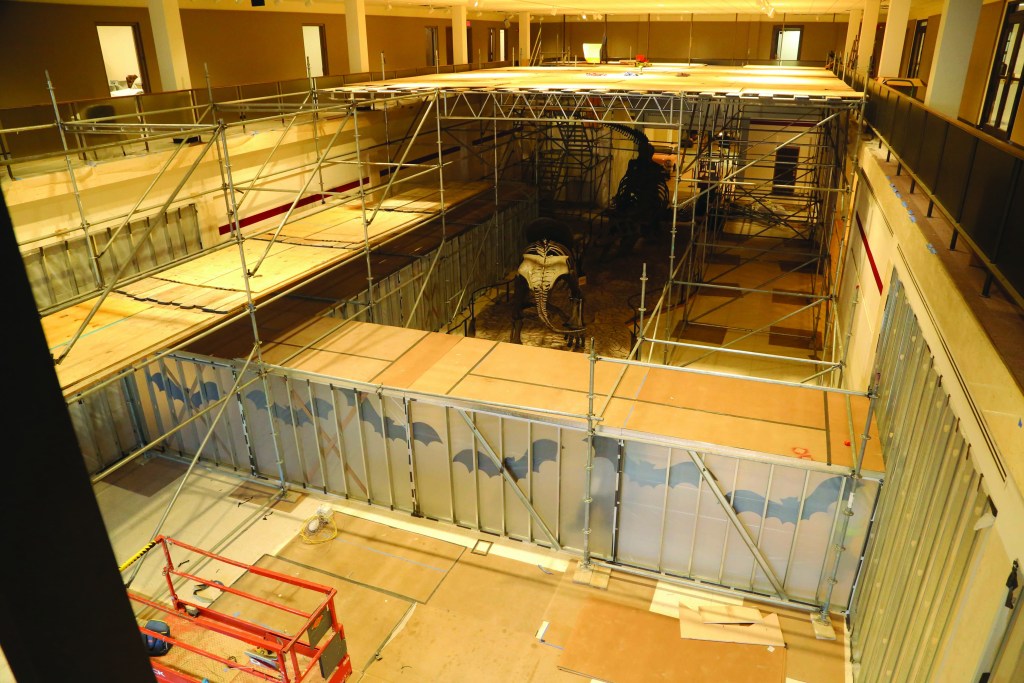
Lead a walk-through with the foreman and impacted staff a couple of weeks before commencing work in a particular area. Staff can tell the foreman their needs and concerns. The coordinator can assess how contractors and supplies get from the parking lot to that work area. The foreman will focus on details from the blueprints and tell staff what they need access to. Discuss and negotiate. Finalize who’s doing what. The contractor might be able to help move some large objects under staff supervision and after a 10-minute “object-handling class”.
The museum coordinator needs to consistently inspect the project, looking out for the museum’s interests. Are there appropriate signage and safety measures to protect visitors? Are the collections secure? Take notes and pictures, particularly of what won’t be visible later: pipes inside walls, electrical lines in the ceiling, and the route for the roof drains. Is the contractor finding any pre-existing problems? Can these be solved now? What will you need to come back to?
But respect the role of the general contractor’s foreman—don’t tell the subs what to do, tell the foreman. And don’t be afraid to play the “I was trained to catalogue objects, but …” card. If something looks wrong, it may be wrong—so ask.
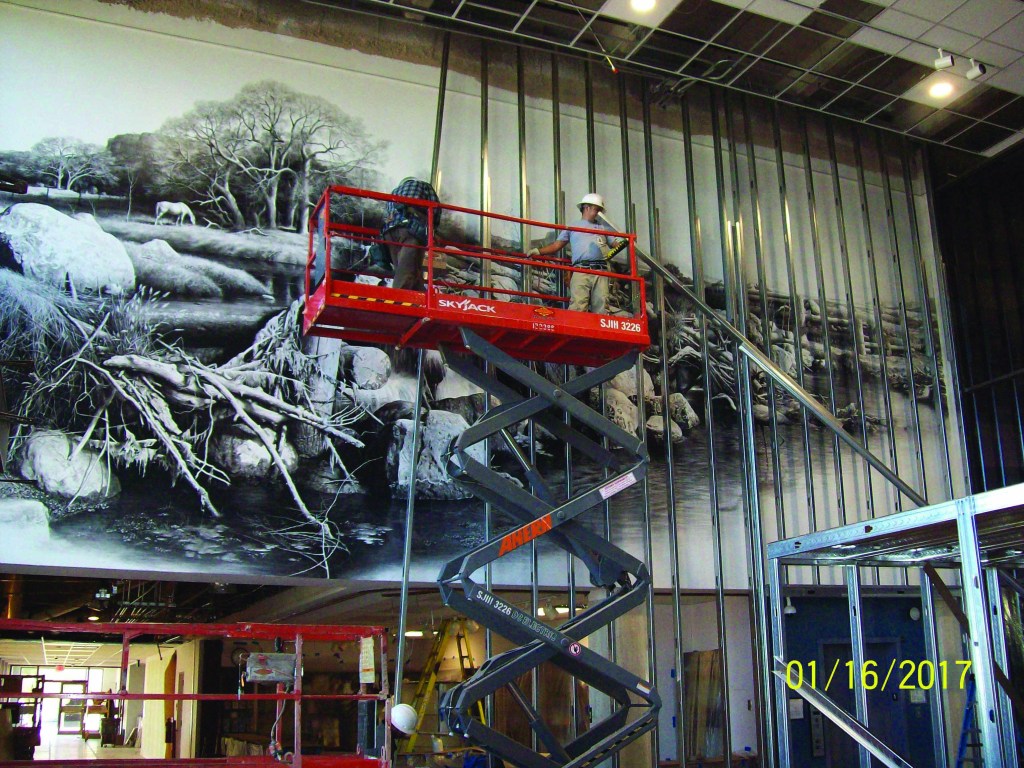
the lobby to make sure no pipes or materials scraped the plaster surface.
As Construction Concludes
As the project winds down, the contractor is going to ask for a “punch list”—a document listing all of the nonconforming work that the contractor must finish prior to final payment. Don’t just rely on the architect for this—the coordinator should go on this walk-through too. It’s your final chance to get things right. Are plate covers on all the switches? Do paint jobs look good and not just OK?
Finally, make sure the architect and the contractors turn over all the warranties and manuals for the new equipment, and the contractor or subs should teach staff how to use everything. The architect will compile and submit to you the “as-built construction drawings” that reflect how everything was actually constructed. Ask the architect to give you a printed set of “as-builts” for the museum—that will be a critical reference document for your facilities team for decades to come.
Once everything is done, welcome everyone—staff and the contractors—back for a special evening! Congratulate and thank everyone for their hard work. Invite the subcontractors’ families—workers score major bonus points with their kids for helping build something at the museum!
Don’t fear a construction or renovation project. The benefits—whether it’s new galleries or program areas, improved storage, or just forcing you to clean everything up—will have long-term benefits that make all the hard work worthwhile.
Upcoming Events
-
Outdoor History Walking Tours 101
Event Date:Presented by: American Association for State and Local History (AASLH) -
I’m In Charge of A Museum Store. Now What?
Event Date:Presented by: American Alliance of Museums -
Gettin’ To Know You: The Art of Networking
Event Date:Presented by: American Alliance of Museums -
Environmental Monitoring for Collections of All Sizes
Event Date:Presented by: C2C Care/FAIC