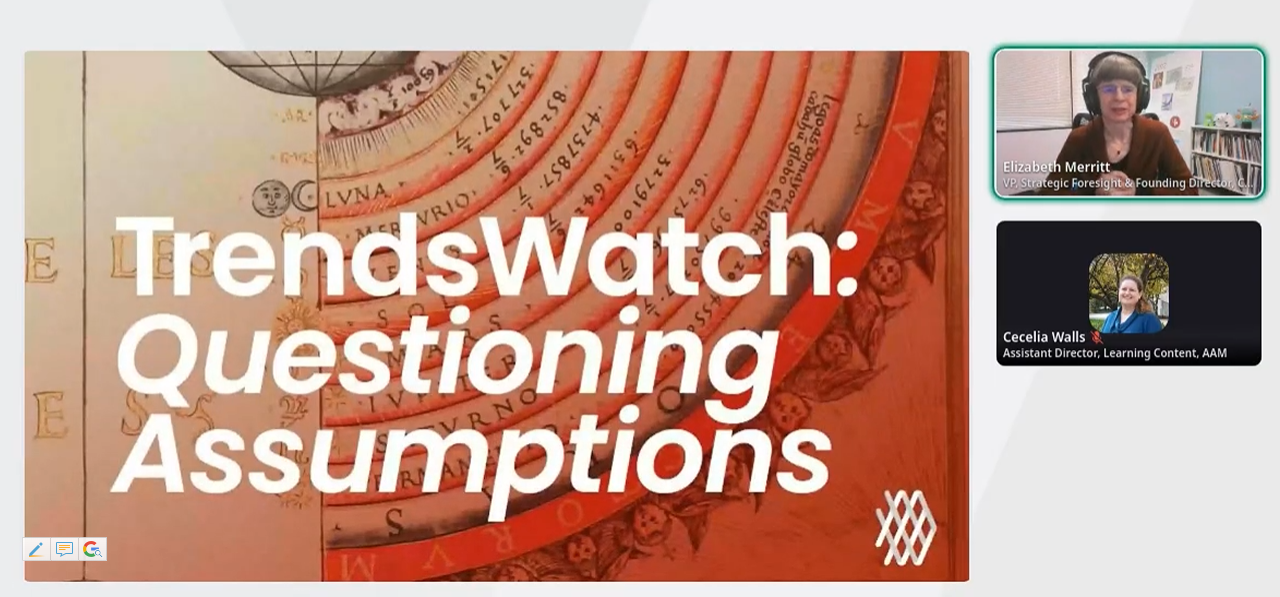
Center for the Future of Museums Director Elizabeth Merritt offers a tour of the trends featured in this year’s foresight report. How is individual and corporate philanthropy changing, and what practical and ethical considerations come with that support? How can museums cultivate the next generation of leaders in the face of stress, burnout, and frustration? What is the future of the whole nonprofit sector, given current attacks by politicians and pundits? And how can we retain the mental and emotional energy to exercise compassion in the face of these challenges? Elizabeth will share practical tips, answer questions, and preview how the field can engage more deeply with these topics in the coming year.
Transcript
Cecelia Walls:
Hello, everyone, and welcome. I’m gonna give everyone just a minute or so to get settled in. I hope you’re having a great day so far. We are really glad you’re here with us today. Thank you for taking the time to be part of a personal tour of Trend watch twenty twenty-six. My name is Cecelia Walls. I’m the assistant director of learning content and operations here at AAM, and it’s a pleasure to kick things off with you.
Today, Elizabeth Merritt, AAM’s vice president of strategic foresight and the founding director of the Center for the Future of BCMs, will take us on a guided tour of the trends featured in this year’s trends watch foresight report. Exploring how individual and corporate philanthropy is changing.
How museums can cultivate the next generation of leaders amid stress and burnout, and what the future of the nonprofit sector may look like in the face of current challenges. She’ll also share practical insights answer some of your questions, and preview ways to engage more deeply with these topics in the coming year.
Before we dive in, I have just a few quick housekeeping notes to keep everything smoothly running today. Please introduce yourselves in the chat section at the right and add any questions you to the q and a tab so that we can keep track and make sure those get answered. I’ll also be keeping an eye out moving them over if I see any pop up in chat. So, if it goes away, don’t worry. It’s over in the q and a.
And we’ll be sharing helpful links and resources over there in the chat as well throughout the session, so feel free to keep an eye out there as we go.
Alright. That’s it for me, Elizabeth, to take it away.
Elizabeth Merritt:
Cecelia. And I am going to share my screen so that everyone can see my presentation. I’m so happy to be with you here today. As Cecelia said, I’m Elizabeth Merrick, vice president of strategic foresight here at the American Alliance of Museums and direct of our Center for the Future of Museums. And one of my delightful pieces of my job is sharing some of my top line thought on trends every year in the form of the trends watch report.
We have been doing this report since 2012.And I just want to remind you before I dive into this year’s edition that we have a complete library of the back editions on the web and gonna drop a link to that in chat, And a lot of them are of enduring value. Just wanna point you to three of the reports that I particularly think are apt at this moment. In 2018, we came up with a scenario set looking at various futures museums might find themselves in, and it’s still pretty darn useful. In terms of looking ahead from this point in time. I’m going to be mentioning later one of the scenarios called wild times was kind of eerily precedent about the situation we’re facing today.
Another report I think might be of current interest was the 2020 report looking at the future of financial sustainability. I know many museums are experiencing disruptions to their traditional income streams, whether it’s problems with travel and tourism, whether it’s cancellation of grants, whether it’s disruptions to fundraising, and we’ll be talking about that today. And this was a nice exploration of some of the creative ways museums are developing new revenues streams.
And I would also bring to your attention the 2022 edition of TrendsWatch, which looked at museums as community infrastructure.
One of the things I’ll be discussing at the end of today’s webinar is the need for museums to very consciously make the case for the value that we bring to the public, not just as museums, but in terms of our essential role in supporting healthy, livable communities and vibrant education. I think that this report really provides many of the facts that museums can use in the kind of issue briefs they can use with funders and with elected representatives.
Okay. Let’s dive into this year’s oh, actually, there’s one more thing I wanted to say. A lot of the questions I get whenever I present Trendswatch are about how do I decide on this year’s trends. You know, why these things? Well, I do it through the virtue of the fact that I’m doing an enormous amount of reading every year. I come I look at what’s in the news, what’s coming out in research, what are people writing about, what are museum directors saying our issues, what are staff saying at meetings. I share a lot of the stories about that scanning in the dispatch’s newsletter. And many of you may have been followers of that newsletter over the years. It used to appear as a weekly enewsletter. And now we have transitioned it onto the web. So, if you want to continue to follow stories from my weekly scanning, you can use this website, am-us.org, /dispatches, to find the stories.
Well, when I looked over last year’s stories, here’s what rose to the top. And this is the addition of trends watch you should have in your mailbox now if you’re a member. I took a look at all of the themes that were bubbling up and the three top trends that I decided to address this year are changes in philanthropy, that may affect who is giving to museums in coming decades.
The looming leadership crisis, which is examining where the next people who are going to be leaders inside museums and museums are gonna come and finally, growing threats to the nonprofit sector as a whole and how we can secure our status in society.
Now as I mentioned, this mailed out last week So if you’re a member, you should have it in your mailbox. You can also find it on the web, and we’re dropping a link in chat for where to find that. If you’re a non-member, there’s also a preview and one free chapter for nonmembers. We’ll drop that in chat as well.
In addition to what I’m discussing today, I really hope you take a look print edition. It covers a lot more information, some of the other topics I cover there in briefer articles are how some museums are doing a marvelous job of cultivating compassion in the public.
Which is something we very much need today. And also, a practical look at how museum insurance is being disrupted by climate change. If any of you are regular attendees at the annual meeting, you may have come to my talks about trends watch in the past. Today’s talk today’s webinar is really in place of the overview that I’ve traditionally presented at the annual meeting. But starting last year, I used that slot at the annual meeting present breaking news and commentary on current events.
So, I hope I’ll see you in May in Philadelphia, and I’ll give you a brain dump on what I’ve been seeing in my scanning feeds between now and then. But today, let’s do a deeper dive into these trends and start with the theme. Okay.
The last thing I do when I write trends watch is I read all of my draft chapters, and I say, what is the unifying theme that’s jumping out at me? And this year, the theme that really seemed prominent is questioning assumptions. And assumptions are these bedrock thoughts that we think we know about the universe that we can rely on going through our day-to-day life. But it’s important to question those. Why? Because as Miguel Angel Ruiz pointed out, the problem with assumptions is we tend to believe that they’re the truth. And that’s fine if we’re right, assumptions are important. It’s how we navigate the world while conserving our mental processing power. We need to know that if we drop something, it falls down, that if we touch fire, we’re gonna get burned. That’s great. Gravity ain’t changing. Fire isn’t changing.
But it can be dangerous when the assumptions are false, when we can blithely walk off the edge of a metaphorical cliff thinking we’re on solid ground and find ourselves plummeting, because something that we thought was true has actually shifted. If you’ve come to my talks before, you’re probably familiar with the cone of plausibility, which maps out all the things that could be true in the future. And the farther out you go in the future, the more different things could come to pass.
The edges of the cone are defined by those assumptions about what we think can happen. And usually, we’re pretty certain about what those edges are. But this year, we’re finding that many of the fundamental assumptions cone, you know, what could possibly happen are wrong. And it’s morphed into what I’ve called the hemisphere of who the heck knows.
Some of the fundamental assumptions that have been upended in the last year for one thing, and I’ve been reading analysis about this, when the framers of the constitution, when the founders of our country framed the constitution, the assumption was that congress the court system, and the executive office would each jealously defend their powers providing checks and balances on each other and keeping the country on course.
That’s not what’s happening right now. For organizations including museums, I think the most pernicious embedded assumption might be that despite repeated shock to our system, at some point, we’re gonna remove we’re gonna return to some kind of normal, whatever that is, pre pandemic visitation.
A time when the wealthy signaled their status and influence by funding cultural institutions. Or a time when a college degree was a guarantee of employment, a good paycheck, and the ability to afford a home. So, all of those things may never are not true now and may never be true again. Help us take a fresh look and give our brains space to expand and consider what may be true now, for each of these trends, I’m going to be looking at three signals of change,
What are three things that are disrupting these topics? I’m gonna suggest three assumptions that we can question about how things have worked in the past may be working differently in the future, Three examples of things museums might do to adapt to those changes and also just one thing you can keep an eye on in the coming year. Now this is gonna be very brief discussions of complex topics, and I really encourage you to dive into the report as well as keeping an eye on the AAM web site in the coming year for more blog posts and future chats and other opportunities to dig into them in more depth.
But let’s start with philanthropy. Alright. Are some of the trends disrupting philanthropy? Well, for one thing, fewer people are giving to charity. Right? That’s very troubling. Let’s talk more about that in a moment. Younger donors are giving differently than their parents and grandparents did. And we’re seeing a profound impact on top of both those trends of the growing inequality of wealth in the US. Start with the good news. Here’s a graph showing trends in charitable giving from 1985 to 2020. And darn, that looks pretty good. It’s going consistently. This is adjusted for real money. So, you know, this isn’t showing inflation. The problem is when you dig into the data, that’s masking a much more troubling trend. The share of Americans giving to charity is regularly declining.
Alright? Fewer and fewer people are giving to nonprofits. How do you reconcile these two things? We’ve got great and growing amounts of total giving; fewer people are giving. So, what’s happening there behind the scenes? It comes down to a growing philanthropy gap that flex wealth inequality in the US. So here is a trend in giving in the nineteen nineties households with annual earnings of over twin 200 k We’re responsible for a quarter of all giving, while those over a million were responsible for about 10 But fast forward to 2019,that soared to the 200 k households being responsible for six and households over 1,000,000 being responsible for 40%As I say, this reflects the inequality of wealth. Right now, 11% of the wealthiest people in The US control about a third of the nation’s wealth. About $55,000,000,000,000, and that’s nearly as much as the bottom 90% combined.
Well, alright. That’s a fact. Is it a problem? Here are some potential downsides. First of all, nonprofits, including museums, may be facing greater competition for a smaller pool of donors. Alright? If you’re relying on fewer people to make the same total, there’s more competition for a smaller number of potential donors. There’s also dangers from overreliance on a small number of large donors. And some of the things I’ve heard people say are, first of all, if you all your eggs in one basket, if you have, like, three major donors who are responsible for most of the income coming to the museum, if even one of them drops out because they have their own problems or they change priorities, that’s a huge hit. The other problem is that gives those individuals a tremendous amount of influence over the museum, which doesn’t necessarily reflect itself, in a way that results in the museum being answerable to its community and the people they serve.
So, it amplifies the influence of wealthy individuals. What are their values? What are their priorities? And how does that guide the work of museums? Another fundamental shift that we’re seeing is generational shifts in behavior and attitudes towards philanthropy. So, for example, millennials and Gen z have financial significant financial burden. These are people who have graduated into a world in which it’s harder to get a good, well-paying job and they have an average of $30,000 in educational debt if they got an undergraduate degree. Degree, more if they got a graduate degree.
So, it’s their capacity to give on top of trying to afford to have a lifestyle that includes owning a home. They also have different values and x expectations about giving. For one thing, these younger individuals believe in issues rather than organizations. So, whereas their grandparents might have said, oh, I support the symphony of my town, and every hour, I’m gonna give to the symphony. They’re more likely to say, I’m concerned about environmental issues. And I’m going to give to organizations that are helping support the environment. Whatever those organizations are.
And that may change depending on who I see having an impact. The second thing is they don’t just wanna give, they want to do. They like to pair their involvement with getting involved with volunteering. So, it’s not just writing a check. It’s having opportunities to become engaged in real and meaningful ways in the work of the organization. They support. And the other thing is for their gift, even if that’s a little micro gift on a kick starter campaign or whether it’s a large gift to a capital campaign, they want to see demonstrable impact. Again, it isn’t just I believe in you as an organization. It’s I’m trying to make a change in the world. What can you demonstrate for me that this is accomplishing? So, this leads to an environment in which we need to question some basic assumptions. And one of those assumptions is bigger is better, at least when it comes to donors. It may seem like a safer strategy and a bigger payoff to say who are the largest potential donors that we can cultivate for big gifts.
But it may be that it is more stable in the long term and also have a healthier effect on the overall culture and direction of the institution to cultivate a large base of smaller donors. So, if you’re getting a large base of donors from your community, you’re more responsible and answerable to that community, and it’s going to, be more resilient against the loss of any one or small set of donors.
Another assumption to be questioned is that all money is good money. Single large gifts or grants from foundations can have a tremendous effect on the direction of an organization. And if that intent is in really good alignment with your mission and vision, that’s great. But sometimes it pulls you away from your own internal priorities or that mission and vision. So, it isn’t always true that because you have the ability to get money, you should take it, which goes to my next assumption. Which is a corollary.
There’s an assumption that the funders, whether they’re individuals or foundations, have all the power. And that you have to do what they say. And it’s turning out that actually there is a rising tide of opinion to challenge that assumption. And things like the trust-based philanthropies project meet the moment campaign are encouraging philanthropic reform. And a lot of people who are talking to donors are saying, let’s have a conversation about how we can have a more equal power dynamic where we come to the table as somebody who can help you make the change you want in the world.
Based on our expertise. So that leads to some thing’s museums can doin to both challenge these assumptions and build a more stable future for philanthropy, one is to go ahead and cultivate a broad base of small donors. We recently had a guest post on the CFM blog on community centric fundraising. We’re dropping a link to that post into the chat. Another thing that we can do is create healthy internal systems of fundraising.
Sometimes incentives internally can be perverse. If you’re telling a development department what’s really important is how much money you raise, the logical strategies to go after the largest gift. Not necessarily the gifts that are most sustainable or healthy in the long term for the organization. Cultivated a base of small donors can take a lot of time before it has significant payoff. And then last of all, I’d like to suggest we need to normalize the process of saying no. We should have conversations internally about when it’s right to say, you know what? It’s wonderful you’d be interested in giving mass money to us, but it’s a bad fit right now. So that’s something we’re gonna say no to because it would take us away from our priorities, because it comes with unacceptable strings. This could be true of grant funding or individual gifts. Or because it would have an unbalanced effect on our operations overall.
So very hard to say no to money, but something worth practicing. Here’s something to watch. Donor advised funds. Brief description. Donor advised funds are funds to which a donor can give money and take an immediate tax deduction. And then recommend grants that could be made from the fund over time. Frankly, it’s criticized as being a huge pool of dead wealth because there is at the moment no regulations about when the money to go out. So, it accumulates and accumulates and doesn’t necessarily do any good in the world. Butin 2023, DAFs held over $251,000,000,000 and they’ve increased by 400% in value in the past decade. So, it’s a lot of money in there.
And we are seeing increased legislative efforts to increase the distributions say you have to begin paying this out. So, there could be a significant pulse of money coming out of Apps that are available to the museums. One of the things I’m hoping to explore in the coming year is some practical advice on how museums can identify donors to Dapps and influence they’re giving.
Alright. Let’s go on to our second topic. The looming leadership crisis. Oh, I am gonna stop share sharing now because I want to actually run a poll with the audience. So let me just stop sharing my screen for a moment. Unions. And Cecelia ‘s gonna come back and help us run this poll. And the poll is going to be about your experiences in the workplace and your attitudes towards your career. I’m gonna read out what these options are gonna be, and then you’re gonna have to scroll down to see the options when you select one. But the options are would like to manage or I would like to manage currently or would like to manage more people in my organization.
Alternatively, you could say, I prefer not to manage other people. Do you agree with the statement I would like to climb the museum career ladder? Or you might say, I value private time and low stress over my career. Please check the next item if you would like to be a museum director. Someday. On the other hand, if you’re already a director, I’d like to know whether you agree with the statement Being a director is becoming harder and less fulfilling. After you hit submit, you’ll see the cumulative results ticking up on our screens.
And then Cecelia will keep an eye on that and share the results after she feels most of you have weighed in. So, I will give it over to you, Cecelia, to tell us how the progress on that is going.
Cecelia Walls:
Looks like we still have some folks answering the question. So, I’m gonna leave it open for another few seconds. On over there.
Elizabeth Merritt:
I’m gonna give some running commentary.
Cecelia Walls:
Yeah.
Elizabeth Merritt:
So, there seems to be some strong agreement This is interesting, actually. We’re getting a lot of diverse answers. So about 20% are saying they would like to manage people, but a solid 10% is saying they prefer not to manage people. About 18% are saying I would like to climb the museum career ladder, while the quarter say they okay. This is interesting. About 18% are saying I would like to climb the museum career ladder, but a solid 25% are saying, I value private time and low stress over my career.
Only 5% of you are saying I would like to be a museum director someday. And of those of you 20% of our hey. Well, this isn’t the percent of you who are directors. Cause I can’t correct for that. But 20% of people in the audience are saying, being a director is becoming harder and less fulfilling. Okay. That’s a
Cecelia Walls:
I’m gonna go ahead and close the poll now.
Elizabeth Merritt:
okay.
There you go. So, I think you’re seeing just in this audience that you were demonstrating some of the trends I’m gonna be talking to within career development and looking for future leaders Would you like to take the poll down, Cecelia? And I’ll bring the slides back. Here we go.
Alright. Your opinions pretty much mirror the kinds of things that are happening around the leadership crisis. We are seeing that over 40% of employees this is employees generally, not just nonprofits or museums, are rejecting promotions. They’re saying I don’t want to be promoted. That would put me in a position that I don’t want to be in, even if it comes with more money.
Over half of Gen z workers flat out say, I do not want to manage other people. This is not where my happy place is. And we have to look at this in the context that in the museum sector, over half of museum directors are between the ages of fifteen and sixty-four, and 20% are 65 or older. I also use this little graphic on the left, the SNIC in sneak in two more effects in addition to my three bullets. These are from the firm Give Butter, and they point out that 75% of nonprofit leaders plan to leave in the next fifteen years, and 60% are reporting daily burnout.
Where are this is a big issue? I mean, just in the past year, we’ve had a wave of retirements of longtime museum director Carol Charneau, who was at the Boston Children’s Museum for fifteen years. Jay Zu, who was at for at the Asian Art Museum for seventeen years, Lisa Phillips twenty-six years at the new museum. Lori Norton Moffitt, who had been at the Norman Rockwell Museum for forty years. And when these people leave, you leave. You lose experience. You lose collective knowledge, and you’re left looking for somebody who can step into those big shoes. Well, some of the what are some of the questions that we need to challenge about how we go about filling leadership positions at museums, whether that’s leadership at the staff level or the director’s position. Burn is that the next generation of museum leaders is actually ready to step up. Are they willing? Are they able? Are they interested? And as a subset of that, is director or CEO even a desire job right now?
And then last of all, and this is a very serious one that came up in my discussions with museums as I worked on this topic, that the time to start filling a position is when the incumbent leaves. And this may be an unstated assumption, but it’s what actually seems happen. The vast majority of museums don’t actually engage in succession planning. So, what are three things’ museums might do about that? Well, one thing is turn themselves into pathways for advancement. Providing opportunities and training and equipping people to evolve and institution or at other institutions. This is something it’s very hard to do, I realize, because it’s money from the budget. But I hope that it’s one of those expenditures that museums can see as an investment rather than a cost. We lose so much money when people leave. It’s really expensive to recruit new people. And in addition to the cost of recruitment, there is the loss in experience and the delay of projects and work when positions are left vacant.
Also, some of this churn is keeping people from staying in the museum sector. And becoming long term experienced museum people, whether they’re contributing that experience at their own organization or others. So, this is gonna mean actually investing in staff development, and that could be formal training, programs for the staff. It could be informal training like mentorships inside the museum or at other organizations. There are so many options nowadays. There’s virtual training. There’s training on demand that’s remote. There’s in person conferences. There are so many great independent professionals and consulting firms can provide trainers to come to the museum. When I talk to directors about this at some of the institutions who are doing really good jobs, they said another way to tackle this is in coalition.
So, it’s not just your museum on your own. Maybe museums in a given city can get together and say, how can we mutually invest in training programs for staff? And that way, we can all pitch in for the cost. And it might not just be museums either. It could be the nonprofits in the community. It could include the libraries. So how can we come together to really provide more supportive environments for people to see how they can stay in the field and advance in ways that give them the skills they need to feel confident. Another important subsection of this is normalizing succession planning. This has to be an ongoing process both for the leadership team for key positions and for the board looking for the director. And when I’ve talked to directors and board members about this, it’s clear why this is awkward. You know? You know, you’re still in your position. And we’re not trying to force you out. But can we talk about what it would look like to look for your successor?
The only way to get over awkward conversations is to practice them. And if this is a regular part of planning, you know, now we’re doing our institutional plan. What are the four positions that we’re identifying is really needing some proactive succession planning because they’re so integral to our work. For the board, you know, remember this is the once in a year that we’re gonna sit down and look at our succession planning and talk about some issues and maybe give assignments to get to go promising people out in the field. One of the things I’d love from you is, it has been tremendously hard to find sample documents of succession plans that we could share, for obvious reasons. There are specificities. There are issues of confidentiality. But if any museums out there have great examples of succession planning, either processes that they’re willing to share or sample documents I’d love if you reached out to us so that we could help support the field in being a better job on that.
For this trend, there’s something to watch that I tagged the impact of current pressures on the ability of the museum sector to diversify its staff and leadership. Now we know from having worked on this issue for many years that this is something that is important. It’s embedded in the values of museums, and museum boards. Want to diversify their staff, but in the past year, so many projects that funded DEI work and DEI related positions were canceled. And also, some museums have been feeling significant pressure to not make themselves target.
For potential actions against DEI work. A lot of DEI related positions were eliminated it’s scary the number of people who were vice presidents or direct directors of DEI initiatives who either were moved to different positions or lost their jobs. So if we’re going to actually pursue these goals that are central to our values, we might have to double down on creating a healthy safe, supportive working environment that enables all staff including BIPOC individuals who may be feeling particularly targeted this time to stay in the field and advance their work.
Well, that was a little down. I’m afraid that the next topic is even scarier in some ways. This is one trend I really wish I didn’t have to write about hadn’t risen to the level of importance that has actually assumed It’s one that I’ve been keeping an eye on for a long time. Actually, it was first addressed in that very first trends watch report back in 2012. Now at that time, we were looking at lower-level threats to nonprofits in the form of cities and states imposing payments in lieu of taxes on tax exempt nonprofits. So not quibbling with the fact that they are nonprofits, but saying, well, yeah. You’re nonprofits. We love you. And we know that you don’t have to pay, like, property tax, but we still have run the fire department and provide emergency services. So how about you pay us something anyway? Was an issue. But, unfortunately, since that time, the signals of nibbling around the edge’s nonprofits have continued to snowball.
Back in that scenario that I referred to in 2018, we set one of the scenarios called wild times in a version of the year 2040 in which most arts and culture organizations had lost their nonprofit status. And it was due to a charitable reform act that we postulated had been passed in 2035 that radically constricted the charitable So, basically, it said the only kind of charity that can be a nonprofit are, health and social services. And when we wrote this scenario, the forces that led to that action were driven by virulent partisan debates, a president who campaigned on a platform of minimalist government, a financial crisis, and, oh, look, a global pandemic.
So, I hope if nothing else, this is a lesson in paying attention to possible futures that lie at the edges of the cone because they could become mainstream. Well, unfortunately, these trends have accelerated. Some of the forces of change that we’ve seen contributing to threats to nonprofit status. Are fragmentation of attitudes towards the impact of the nonprofit sector overall. One of the things I did in TrendsWatch is I created a little essay that demonstrates how some people say that nonprofits are too lefty and liberal, and some people say that overall left nonprofits are too conservative so that we can get a feeling for how these concerns are nonpartisans, but spread across the spectrum.
But right now, we’re seeing a lot of attacks on specific and nonprofit perceived as antagonistic to the administration’s agenda. Has been much in the news. I’m sure you’re aware of it. Part of that has also included current proposals that would expand the ability of the Internal Revenue Service to revoke nonprofit status based on a broad suite of criteria. I explored this in greater depth in a post from last year called, is there an existential threat to nonprofit status? And we’ll drop a link in chat to that if you want to go read about this in more depth.
Well, this is all very high level. This is taking place at the level of presidential policy and congressional actions. What can museums do about this? Actually, there are some very practical daily actions I would like to consider, to present for your consideration. And the first is just talk to the general public and help them understand what it means to be a nonprofit. Back in 2018, researcher Colleen Dillenschneider she runs the research firm, impacts research, and writes the blog, know your own bone. Is excellent. She found that over half of the public whether they’re visitors or non visitors to nonprofit cultural organizations, weren’t even aware that they are nonprofit. So, they’re going to museums, and they wouldn’t be able to tell you that the museum is a nonprofit.
Well, and even if they are aware, they may not know what that means. Even many museum people think that nonprofit means you’re not allowed to make money or operating in the black is suspiciously commercial. There was actually an interesting recent exchange on this point. I don’t know if you’ve been following what’s been happening with the Kennedy Center and repositioning of who’s in charge of its board and renaming to add Trump’s name to the to the center. But, Richard Grenell, who was recently appointed president of the Kennedy Center, was quoted as saying, we cannot have arts institutions that lose money. So let me say that one more time. We cannot have arts institutions that lose money. There were some excellent commentary from Emil Kang pushing back and he said, well, I think that reflects a fundamental misunderstanding.
The nonprofit infrastructure exists for a different purpose. To support cultural activity that cannot reliably survive market discipline. In other words, if you could be a for profit doing all these things and make money, what’s the justification for being a nonprofit? It’s worthy of some thought, and we have to learn to be our articulate and literate in talking about it.
With our public and with our supporters. One practical thing we can do is we can join with the broader nonprofit sector in communication campaigns. And we’re gonna drop a link in chat to the nonprofit get it done campaign that’s been organized by the National Council of nonprofit. And that provides facts and tools and easy ways to contact your elected officials. And to that point, I think that the top line message is advocate. Advocate. at the local level, the state, and the national level, not just issues, but I’m sorry.
These are the assumptions I’m that we’re questioning that the public understands what it means to be a nonprofit, that they understand how they benefit, and that they will continue to place a high degree of trust in the nonprofit sector. And to respond to those, we can talk to the general public, ally with the nonprofit sector on communication campaigns, and advocate at the local, state, and national level, not just about issues but for general education, for awareness building, and for friend making.
So how can we make sure that when we talk to someone on the street, they’re aware that the civil society sector is an equally important part of society right up there with government, and with business. That 10% of the people in The US work for a nonprofit, that we have a phenomenally large impact on the economy overall. And are aware of all the ways in which their community is a better place because of nonprofits generally and also because of museums specifically. I hope I see a number of you at museums advocacy day later this year. Where you’ll be joining us on the hill to make this case in a practical way.
Something to watch. A lot of these current signals of change are either directed at specific targets like higher education or a cluster of large universities within higher education, though there have been a lot of shade cast on higher education generally and whether still a good thing. That benefits young people. Or specific nonprofits, museums, or otherwise. And I think one thing to watch is whether that rhetoric broadens to start being directed at nonprofits generally or, heaven for fanned, museums generally? And there have been little nibbles of this may be beginning to happen, but it isn’t mainstream yet. So I think that this is going to be a tremendously important issue over the next few years is for now, we still have the time and the ability to strengthen our base to get out there with a positive message ahead of any particular threats, But I think that there may be a narrow window to do that before it becomes reactive. I hope we can take advantage of that. Well, now it’s your turn.
Cecelia is gonna come back on stage. And I’m gonna stop sharing, and we’re gonna take questions, comments, reactions. I hope you’re not just lobbying questions of me. I you’re also using the comments section to give your commentary on this. I’m fine if it’s great if you agree with me. You can build on my remarks. Please do push back if you disagree about anything. And, also, we’ll see if there are any questions that we might be able to answer that you lob. I’m gonna take the slides off now so that we can be watching your q and a. And watching chat window. Hello Cecelia.
Cecelia Walls:
Hello. Thank you for that wonderful presentation, Beth. Elizabeth, will todays per participants be receiving this presentation? Deck is question number one.
Elizabeth Merritt:
Not this deck. First of all, I hope you get the report. It’s got all of this and more in it. Museum directors have received a version of this deck as part of the new monthly CEO foresight email that is a member benefit to Museum Directors. So, we’re happy to have provided that. I also would love to come address any museums or any conferences that would like to bring me to talk to their staff or their attendees so we can do some deep explorations of these topics.
Cecelia Walls:
Do we risk creating false assumptions by creating internal career paths if there aren’t leadership positions for staff to aspire and move? Into. This is more challenging for rural and geographically remote locations.
Elizabeth Merritt:
Absolutely. That’s a wonderful question. Thank you for asking. And I think part of that is being aware of the fact that many of the skills that museum people need and can be trained in are transferable skills. So, I think it would be a bait and switch if the training that we provided are this is something that’s only gonna help you if you’re going to be an x in a museum and whoops, the job wasn’t open. Because, you know, as in any profession, it’s a triangle. There’s this many people at the base, and it moves up. And the farther up you go, fewer positions there are. I think it’s tremendously, encouraging though that when I look at lists of essential skills for museum people, They’re totally transferable. If you’re good at this in a museum, you transfer it to another sector. And I think that one of the things that we as a field and museum studies programs can do is help people make the case for picturing that crosswalk.
Here’s what I do in a museum, and here’s why it’s applicable somewhere else. You know, in some professions, it’s easier than others. Development directors have real fluidity. Between where they’re doing that and what kind of organization. You know, if you’re a project manager, a good project manager is goal. And they could find a job in any sector, nonprofit or for profit. I and I think the more challenging thing is for things that may seem more museum specific like marketing. Well, no. Marketing is a very transferable one too.
Public education is it’s learning to make the case of breaking it down in what skills I needed to learn both soft skills and management skills, that are completely transferable. I think this question of especially small and rural organizations areas is difficult because, yeah, some people can’t relocate. And a lot of when people are talking to me about going into museums as a profession, I often ask them how mobile they are because there’s only a certain number of jobs. And if you aren’t able to relocate it makes more sense to try and craft your career to something that is fungible between different sectors.
Cecelia Walls:
Tripped. That question had come from Anne Fortescue, and she had another I think it’s more of a statement, but I will read it out. She’d like she’d like to suggest another question for the poll. Oh, please. Yeah.
Cecelia Walls:
Or another answer would be, I am satisfied and or feeling fulfilled with my leadership role in the museum.
Elizabeth Merritt:
We would’ve done that, Anne, except their Airmeet only lets us put six replies in. So, we had to edit our choice list of choices. But maybe this is a separate
Cecelia Walls:
But that is a good one. Yeah.
Elizabeth Merritt:
yes. That’s true, because I hope that that’s true for many people.
Cecelia Walls:
Yeah. The next question comes from Laura Roberts. We used to be able to count on the faith community, not just churches, but faith related nonprofits to insulate the overall nonprofit sector. I wonder if that is changing.
Elizabeth Merritt:
Wow. That’s a tough one. And I’m gonna go I’m doing this entirely off the cuff. So, cut me some slack here. I think there are two trends that may be weakening that protection. One thing there is there’s copious research, and I will direct you to Pew Research, which has many excellent sources of information on this. That participation in organized religion is on a prolonged and steep decline in the US. So fewer people have weekly or even yearly engagement in organized religion and have that kind of relationship that might give them warm fuzzy feelings about the church as being part of the nonprofit sector? Isn’t necessarily a reduction in spirituality, but engagement with actual organized religion.
The second thing is you may be following that there’s a lot of contention around right now around the Johnson amendment and whether religious nonprofit should be exempted from some of the restrictions on whether they can engage in certain kinds of political activity. And I think that one of one of the things people who are against making that change abroad has brought up is that it could erode trust not just in in churches, but in nonprofit generally if they were seen as being potentially partisan and not directly engaged in endorsing any given political candidate, which is the current situation. Those are two thoughts I have on that.
Cecelia Walls:
Okay. From Matt Florey, we have, is the demographic of direct directors changing, or was it always 50%, fifty, 65-year-olds, and 25 20% over 65-year-old. What’s the trend?
Elizabeth Merritt:
Yes. I wish I knew because one of the problems with data limitations is we don’t have a good longitudinal solid base of, like, fifty years of research of asking the same things. And as we go back, there are these big holes. And while nobody did the demographic survey of that then, I will say that just if you look at sort of individual careers of specific people and, like, if you go back through issues of museum looking at retirement notices, which I actually did at some point, it was kind of interesting. I have the impression that the demographic of museum directors has shifted older. And I’m not surprised because the demographics of The US has shifted older. The baby boomers were this huge bulge in the demographic curve. And as they made their way through the population and aged, professions followed that age bump as well.
So, I think even it isn’t necessarily overrepresented compared to the population. But I think to the rest of the population, But I think it may be overrepresented compared to earlier points in time.
Cecelia Walls:
And it looks like we have one final question for Anne, roughly, and hopefully, it’s a good one because it’s about hope. So given these alarming trends, what gives you hope?
Elizabeth Merritt:
Mhmm. Oh, I love that question. Thank you so much for giving me the opportunity to end on an up note. And I’m gonna have more than one thing, so bear with me.
First of all, I’m gonna start with this data, and you’re probably sick of hearing me say it and my colleagues say it. But the public love and trust museums. And that is strong, it is near universal, and it is nonpartisan. Museums, together with libraries, are the most trusted source of information, second only to friends and family among people who love museums were even more trusted than friends and family, which tells you something. And people value us for things that we know we do well. They value us because we present research based on scholarship, because we have the real stuff. Because we give them the facts and encourage them to think about them. Because we are nonpartisan. So one of the things I try and say to cheer people upright now is remember as Susie Wilkening has pointed out to us, there can be this this false consensus effect that if what you’re hearing is a lot of people yelling about what they’re upset about, you suddenly begin to think they’re the majority. They’re not. A very small percentage of people don’t like museums. I don’t know who they are. I don’t know them personally.
A very small percentage of people, I think, relatively speaking, have concerns about the nonprofit sector. Where we happen to be living in a time where those voices may be very loud and may be very influential, but that doesn’t mean that we don’t have the that the American public doesn’t have our back. They value what we do. They love what we do. When it comes to the leadership crisis, every time I speak to a roomful of young people who are excited about possibilities for what they can do with museums, who are full with ideas on how we could do things different and better, who filled with ambition about what they could do with their career to make a difference in the world. I go away jazzed and reenergized about what I could possibly do to help these young people become the leaders of tomorrow.
So, I think there’s a lot of positive things. I think there’s always the danger in my work of leaning too heavily in the negative. But I think that’s because I hope by doing so, I can help all of us avoid the worst happening. Because the best way to avoid a dark future is to be aware of it and take specific proactive steps not to get there. And to think about the brighter future that we want to live in where a lot of people love and support museums and are donating to it. It’s just if you ask what their regular donations are. It’s like, you know, I’m giving to National Public Radio and n a c NAACP and my local museum, and maybe even AAM. And if you talk to young people who are working in the museum, they say, oh, yeah. I’m really supported, and I feel secure, and I think I have good work life balance. I’m feeling good because, you know, I think I’m gonna be able to get a job in my museum, but if not, my director is encouraging me to look at these other places, and I really have good resume to try for those jobs, or maybe I’ll become an independent consultant for a while, that can be really cool. And I’m really hoping that The US comes out of its current stress and difficulties with a deeper appreciation for the fundamental role in nonprofit sector plays in America. I mean, we do in America. What governments do in a lot of other countries? We are the social safety net that isn’t created by the government sector in the US. And the downside of the things that are defunding that and destabilizing it, it’s causing a lot of pain in suffering in the short run, and that’s terrible. But I think in the long run, people will come back and say, oh, no. There’s a reason that we were supporting the nonprofits There’s a reason the government grants were doing really essential things, and there are reasons that big foundations should be encouraged to give money. To a variety of causes because it creates the stability and it creates the networks that hold our community together. And it makes my life personally better and better for my children. So that’s my bright, uplifting summary at the end.
Cecelia Walls:
I really appreciate that thank you for taking the time to give us your insights overall and for that hopeful last note. That brings us to the end of our time together today. On behalf of AAM, I want to extend a heartfelt thanks to you, Elizabeth Merritt, for sharing your insights and to all of you for being part of the conversation. We know there’s a lot competing for your attention right now. We truly appreciate you spending this time with us. If today’s discussion sparked any ideas or raised any new questions for you, we do encourage you to explore the trends watched, 2026 report more deeply and stay connected with the center for the future of mediums as these appreciation will continue throughout the year. We’ll be sharing some follow-up resources and links after the webinar. So, keep an eye on your inbox. And if you have any questions or feedback, please don’t hesitate to reach out to us at learning@aam-us.org. Thank you again for joining us today. We hope to see you at a future AAM program soon. Take care. Have a have a have a wonderful rest of your day.

Upcoming Events
-
Digital Collections Summit
Event Date:Presented by: MuseumNext -
The Federal Grant Landscape: What Museums Need to Know
Event Date:Presented by: Ohio Museums Association -
Accessibility by Design: Empowering Staff for Human-Centered Change
Event Date:Presented by: American Alliance of Museums -
Creative Museums Summit
Event Date:Presented by: MuseumNext