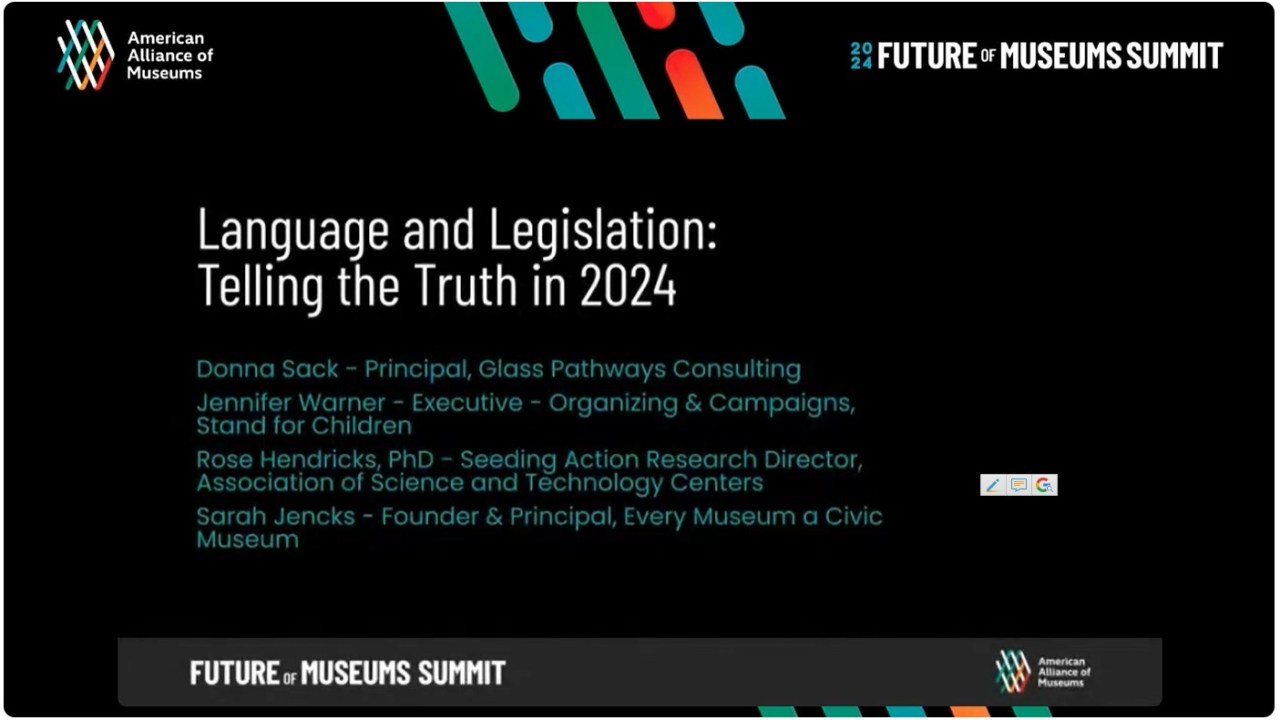
This recording is from the Future of Museums Summit held October 29–30, 2024. This session underscored the importance of being intentional about the words we choose and how language shapes audience connection and engagement.
Presenters:
Jennifer Warner, Executive, Organizing & Campaigns, Stand for Children
Rose Hendricks, PhD, Seeing Action Research Director, Association of Science and Technology Centers
Sarah Jencks, Founder & Principal, Every Museum a Civic Museum
Transcript
Jennfier Warner:
Hey, Sarah, could you start over again because we weren’t able to hear you at the very beginning? You were muted.
Sarah Jencks:
Oh, no!
Jennfier Warner:
There you are.
Sarah Jencks:
All right, let’s start over again.
Jennfier Warner:
Great.
Sarah Jencks:
Thank you.
Jennfier Warner:
You’re welcome.
Sarah Jencks:
Hi, everyone. Welcome to Language and Legislation: Telling the Truth in 2024. I am Sarah Jencks. I am the founder and principal at Every Museum a Civic Museum, which is a consultancy that works with museums and historic sites to help envision and enact their unique civic strategies. And I’m here today both moderating and presenting.
I’m here today with two fantastic leaders. We were supposed to have three, but we have two with us today. Jennifer Warner, who is the organizing executive at Stand for Children and the mind behind the Learn from History campaign, and Rose Hendricks, Research Director for the Seeding Action project at the Association of Science and Technology Centers. Donna Sack of Glass Pathways Consulting was supposed to be with us on the panel, but she had an emergency, and though we are grateful for her contributions to shape this session, she wasn’t able to be here today.
Here’s our agenda for today. This session builds on much of what Mathieu Lefèvre shared this afternoon in his More in Common research, but it’ll take a more practical turn and the sort of on-the-ground approach. Our goal today is to frame related situations in our field that are both dilemmas and opportunities and share some interventions that could help us respond to them. We only have an hour together, and we are sharing three interventions that are very rich, so this session is going to feel too fast, but our goal today is to create a deck of slides or share a deck of slides that you can look back on later. And they’re going to have a lot of information in them, so we hope that you’ll come back to them, pore over them, download the reports and related materials associated with them, should you choose to.
We’ll start by framing the problem and the opportunity, and then we want to take a moment to acknowledge the moral complexities of this work, and then we’ll offer three ways to respond to the dilemmas and get more involved. Let’s start by framing the problems and the opportunities.
We find ourselves in a period of great uncertainty and some real fear, as we’ve been discussing if you’ve been in the depolarization track sessions throughout the last two days. This panel comes to our work with the belief that we have professional and moral obligations to follow and share the evidence in our respective fields and as we become aware of it. That’s the first statement of the reality as we see it.
The second one is that in the US at least, governments at many levels are dictating what content can and cannot be taught in ways that go far beyond establishing standards of learning, and at times contradict the evidence. And museums and archives have begun to be affected similarly, and we imagine this will increase. So point three of how we’re framing this problem is that we have moral and professional obligations to share the evidence as we become aware of it in history and in science. Pardon me, I’m reading the wrong thing. As museums, we have unusually powerful resources to help teachers and students and other visitors, so long as they continue to trust us, and that last piece is really important.
So taking these three points into consideration, museums should cultivate the organizing and communication skills as well as cross-institutional networks that can help our staffs to support our communities so that they can teach and interpret the evidence. This is our framing.
And just to elaborate a little more, we’ve talked about this some; I’ve heard people talking about this throughout the last two days, the impact of legislation and policies, both are sometimes coming in the form of chilling effects. Fear of controversy or worse may inhibit inclusive programming, but intentional word choice can help us to speak to our target audiences in language they understand and appreciate. And they also can create new opportunities, as many states and school districts have passed legislation or mandated the teaching of ethnically specific history, civics, and climate change, and those teachers need museums to help them, as well as the teachers who are facing the chilling effects.
So having framed this problem, we just want to take a moment to acknowledge the tensions and the complexity because, pardon me, because how we might respond… So before we start talking about what we might do and how we might respond to these wicked problems, we want to take a moment to acknowledge that when one begins to engage in practically addressing policy and practice issues, in order to make progress, chances are good that there will be compromises, and compromises almost always mean that some groups lose ground. In our field, we very often want to stand by our ideals, and that is admirable. However, as we can see in the House, in the US House and Senate, when no one will compromise, we eventually grind to a halt and don’t get anything done.
So we want to name this challenge, the tension between appreciating compromise and critiquing compromise. This is a major issue that we don’t often talk about, and it underlies much of what has happened in the last 30 years, perhaps since the Contract with America in the mid-’90s. So keep in mind this compromise tension as we talk about our three proposed interventions, and then at the end, we’ll try to make time for conversation.
Our first intervention is shared by Jennifer Warner, and I’ll turn over the mic to Jennifer now.
Jennfier Warner:
Hi, everyone. It’s so great to be with you all today. Really looking forward to this conversation. As Sarah mentioned, I’m likely going to go faster than I’d like to make sure that we can get through all of the information, but I want to talk a little bit about a network that we created called Learn from History and how we went about addressing some of these issues, particularly with groups and organizations where we could not necessarily be political, did not want to be political, and the power that we can actually have as trusted members of our community and experts in our fields in that area.
So next slide, just to tell you a little bit about who we are, at Stand For Children, we work in the K-through-12 education space doing issue advocacy, working on elections, educating the community, and empowering people everywhere to be more civically engaged in our education system. And a few years ago, we started to experience an alarming and false narrative sweeping across the country, the idea that critical race theory specifically was being taught in K-through-12 curriculum, which was just not true. We found ourselves on our heels trying to both understand what was happening and figure out the best way to address it, and we realized we need to educate the public about what’s taught in schools, how tough topics are handled in the classroom, and most importantly, we needed to do this as nonpartisan and nonpolitical. Next slide.
We chose to structure our network as a national network with state and local reach. We did that because the attacks were coming so quickly and from so many different directions that we needed a national network that could disseminate information quickly and broadly. It’s also important when embarking on communication strategy that we understand how different groups of people understand the issue. So we conducted national polling, which provided us with some great research from which to build our communication framework. Next slide.
And the research was really clear and the support for these issues, we found, was broad and diverse across age, geography, race, and political ideology. A majority of Americans believed, one, that racism and specifically systemic racism is a real issue that must be addressed. Next slide. And despite the narrative, a majority of Americans believed that schools have a place in teaching thorough and accurate history.
So with that information, we created the communication toolkits available for anyone to download. Next slide. This provided a framework for frontline workers like teachers, school administrators, and others so that they can talk about the issue in ways that lead to actual conversations that help to lower the temperature and lower the rhetoric so that real conversations could actually be taking place and dialogue of understanding could be engaged. Next slide.
Crucial to having these conversations is always understanding that the misinformation and where people are hearing that from is coming from, right? It’s not happening in a vacuum. So we had to understand where people were coming from, both the general public and elected officials who were passing policies that undermined the teaching of accurate and thorough history. Next slide. And that allowed organizations like mine who also do political advocacy to pursue a strategy to stop this bad policy from getting passed at the state level, at the local school level, as well as being able to support school board members and other elected officials. Next slide.
Now, many of you are not in a position to be political and that may lead you to believe that because of that, there’s no role for you to play that can be impactful, and that could not be further from the truth. Like educators in our Learn from History network, your profession is highly trusted, and people see you as an expert. It’s these very qualities that actually make you the exact right person to have relational conversations, what I call, and we call in organizing space relational organizing, but don’t let that term intimidate you.
Simply put, relational organizing is about having conversations with people in your network that already trust you. Rather than having people talk to strangers about topics that can be divisive or raise the temperature of an us-and-them, we have people talk to people in their actual network where the goal is not to persuade, but rather, the goal is to have conversations that can lead to understanding and identifying areas of shared values. In a world full of misinformation, othering, increasing division, or just ability to talk to each other in a way that illuminates both shared perspectives and our shared differences, it’s crucial.
We use this form of organizing in the political space because there’s a lot of research that shows it’s actually more effective than traditional political communications, although it usually requires a lot more time than campaigns often have. And that’s why I think it would be really impactful for this community where you aren’t necessarily working towards a deadline of voting or legislation passing, but rather, where you can have ongoing dialogue with those who trust you and your expertise. And because of your longer runway, you can have real dialogue that applies curiosity, listening, and empathy into conversations with people you know but don’t necessarily agree with. Next slide.
There are four key steps to engaging in conversations with someone who you may not agree with. These steps can help us uncover what’s really behind the rhetoric. Oftentimes it’s fear, fear of the unknown, fear of uncertainty, which then helps to uncover the beliefs and values that we think are being threatened. And when we can name those beliefs and values, then we can see where we actually share values in common and then offer our differing perspectives or experiences.
So step one, understanding their points of view. This doesn’t mean you have to agree with their point of view, but by leading with empathy, we’re acknowledging that they are seeing something that we are not. Within this step, we get curious, and we ask questions That helps lead to step two, finding space for connection.
Asking questions can help us go deeper than the rhetoric and uncover those fears, and this is where we have the opportunity to find connection and then offer a different perspective. So for example, I understand the concern that your child may feel shame from hearing or learning about America’s history with enslavement. I worry about that for my child as well. That’s why I think it’s so important that we’re including the stories of resistance, the lessons about how enslaved people and immigrants contributed to and built our country. But some people might think of that as a woke agenda or indoctrination, but for my child, that allows them to see themselves in a positive and empowering light, and that’s important too.
So that connection, personalizing connection, is so impactful because it interrupts the fear and that helps us to move the dialogue to step three, moments of change. Sharing our personal stories and experiences can help to both illuminate the shared values but also illuminate our different experiences around those shared values and how they show up in our lives. You’ve given the person a different perspective that they can sit with because it’s not an attack on their identity or beliefs. And that’s really the key to having impactful dialogue, bringing it to that place of two people having a conversation rather than two people trying to defend an identity.
And then depending on where you feel the conversation is at and just know it might be probably not the first, maybe second or even third conversation, but eventually you can move to step four and offer a call to action. And it’s important to know that this call to action can be as simple as, “I would like to continue talking about this and learning from each other.”
Thank you so much. And with that, I will pass it over to Rose Hendricks.
Rose Hendricks:
Thanks, Jennifer and Sarah, for that setup. It’s so helpful to be able to have the broad context of both of your work to share some similar approaches and values from the domain of planetary health.
My name is Rose Hendricks, and I work at the Association of Science and Technology Centers leading an initiative called Seeding Action, which is designed to cultivate a culture of action to improve planetary health. Next slide, please.
When I use the term planetary health, it encompasses, there we go, three interrelated issues of climate change, biodiversity loss, and air, water, and soil pollution with the understanding that all of these issues have both human causes and human solutions. Our term planetary health uses the United Nations Framework Convention on Climate Change triple planetary crisis as a starting point, but shifts toward more of an asset frame, less about the crisis and more about the health, the thing we are working towards and promoting. Next slide, please.
The way we’re thinking about our challenge and opportunity ahead of us is depicted in this path graph. Many understand and are concerned about planetary health. So on the far left-hand side of this figure, you see this large group of people in red who understand the problems we face. They understand that climate change is an issue, that we’re losing species and that pollution is in their neighborhoods in many cases. As you walk down the path, you have many who are concerned, though you lose a few at this step, and continuing down the path still, a slightly smaller group who desires change, and then a pretty significantly smaller group actually taking action. At the far right side of this is the idea of embodying action or having action embedded or baked into the way somebody navigates the world. It’s just the lens that they see the world through. And we’re losing people at each step along the path. Few people are translating that concern into demands for change.
So the opportunity here is for us as a sector, as science centers, museums, and other public engagement organizations to find ways to encourage more people to take more steps down this path towards sustained, meaningful action for planetary health. Next slide, please.
Seeding Action is designed to meet this, and this really was developed over the course of 18 months with input from our members who told us they were already active on environmental issues but really wanted to do more and, in particular, wanted to support public action. So our response is an initiative that catalyzes and supports science centers, museums, and other public engagement networks and organizations in their work to cultivate a culture of hope and action to improve community and planetary health. We’re really deliberate about framing this as a culture of hope and action because we recognize that individual one-off actions are not the goal. They’re not trivial though; they all play a role in contributing to broader shifts in what’s normal, what’s seen as possible, and desirable. And so culture is really the ultimate aim for us. In turn, we will see the concrete reductions in pollution, climate change, and biodiversity loss. Next slide, please.
You might have noted that I refer to a culture of hope and action. We see these as really going hand in hand and we lean into this framing of active hope, not necessarily on building understanding of the environmental issues we face, as you saw depicted in that path image, lots of people are already there, but really cultivating a public engagement approach that helps us in favor of that culture shift. And we know from substantial research in many disciplines that having a sense that things can be better, that’s the hope piece, and that we all have roles to play in making them better, that’s the active piece, are really critical factors in determining the ways that people engage in action. So we really are looking for a shift from a culture of silent concern and fatalism, which is how I would largely characterize our current status, toward one of active hope and widespread engagement with solutions. Next slide, please.
The big picture of how we are doing this is through a networked collective impact approach. Each dot here is meant to reflect individual institutions and organizations that take diverse approaches to planetary health and public engagement. We’re all, every organization represented here in this conference and in our Seeding Action network, is unique. We have different missions, we have different cultural local contexts, we have different sizes and histories and so on. And so we’re going to take unique approaches, but by sharing insights along the way and working in coordination, we move in the same direction toward amplified impact. Next slide, please.
Specifically, what does Seeding Action do? What do we offer for members? We build connections that increase impact, so connecting network members to each other and to external experts and action-oriented groups to help build the partnerships that ultimately enable impact. We also build capacity for impact through things like training and coaching. We’re working toward being able to offer grants and the creation of additional resources and leading cohorts through institutional transformations as well. We leverage a number of communications, so creating messages, exhibits, programs, and other tools that can be adapted for different contexts and then creating communications that actually make the case for what all of our members are doing and share research, resources, events, and more.
And then to really feed back into all of this is our research and evaluation. So measuring the effectiveness of various messages and approaches for creating that kind of active hope and culture of action that I’ve been talking about and really studying what’s working across the network and how we can improve our impact as well. Next slide, please.
What this translates to for the organizations who participate in Seeding Action is outputs and outcomes at two different levels. They have new relationships and new capacity to engage in public engagement efforts that promote planetary health. They are able to benefit from and contribute to research and resources that supports evidence-based narratives and messaging, partnership development, and operational decisions, and results in ready-to-share exhibits and program models.
So as a result, the participating organizations have a significant public reach. They reach more people and new audiences that they might not have reached before. They have opportunities to make institutional changes in their facilities or their programming and partnerships as well. They have increased community capacity to take both proactive and adaptive action to improve local and planetary health, and really contribute to a growing number of people, we call them planetary health actors, who undergo substantial changes in the ways they think and feel and act regarding planetary health. They’re represented by those embody action groups on the path diagram.
Finally, on the next slide, we wanted to share the ultimate “to what end?” As we build more and more of these planetary health actors and communities across the world through museums actions, we’ll see a wide range of impacts. They all serve as the water that gives life to a more livable and just planet, things like healthier ecosystems, lower emissions, less extreme weather, and cleaner air, soil, and water.
Finally, next slide, I want to thank you for the opportunity to share this network and invite any person or organization to look at seeding-action.org and join. There’s no financial cost to join the network. We simply ask you to commit to prioritizing planetary health in ways that make sense for your organization. Again, that will look different everywhere. I would love to connect more with the people in the organizations represented at this conference.
Sarah, back to you to take us through the next portion.
Sarah Jencks:
Okay, thank you so much, Rose.
So far, we’ve heard about an organizing effort in a more traditional organizing way that supports teaching whole history, and then a community of practice. And now I want to take a moment to share with you some research findings that just came out last week from the Civic Language Perception Project. And they just released this guide, How to Talk Bridgey. We’ll talk more about the word bridgey in a moment. And it is a guide that was released specifically with the intention of helping people to think about how they can have conversations on November 6th, which, if you are not in the US, is the day after our Election Day.
The project was launched by the Philanthropy for Active Civic Engagement network, which is a philanthropic laboratory for funders who want to give more and be more active in democracy and civic life in America. And as you can see here, they’ve been doing this work for about five years. I found out about it about two years ago, and I became interested in this research for reasons that you can easily imagine that you’re going to see as we go through this deck. As this person, one of their people, one of their funders said, “The coded and loaded nature of civic terms has become untenable. Are there even words I can say anymore?” And another line that the presenter said on their release webinar was, “It’s hard to be a word today in the United States” because words get used and they get co-opted so quickly.
This research is the work of a partnership with Citizen Data, which is a major research firm around democracy practice, and they surveyed almost 5,000 Americans in 2021 and again in 2023 to find out how they perceived a series of words and phrases that relate to three civic arenas: democracy, civic engagement, and racial equity. And then they parsed the data using the categories listed on the lower part of the slide: age, community type, education level, you can read, employment sector, first language, gender, political ideology, political party, whether they’re registered to vote, what their civics education was, race and ethnicity, religion, the state they live in. And all of this data, this incredibly rich data is available on the PACE website, which is pacefunders.org/language, and I’ll put that link in the chat in a little bit.
But you can take a look at these terms. They’re wide ranging, but they’re terms that we use all the time from social justice and civility, diversity, racial equity, civic engagement, belonging, patriotism, liberty and freedom, democracy. So this research is very rich and we’re only going to be able to touch on it a little bit today.
The way that the PACE researchers were looking at these words is they wanted to know how they were being perceived by different people. And the first thing that they did was that they started looking at what makes a word, and they coined this term themselves, bridgey? And what they meant by bridgeyness is that they looked for words that were rated positive and had the highest net positivity, meaning the highest number of percentage of people who feel positive towards the word minus the percentage of people who feel negative towards the word, they ranked from lowest to highest. They also looked at the range, how different, how many people are thinking. If a lot of people think the word is positive and a lot of people also think it’s negative then that’s going to make it less bridgey. And the last thing is how many people rate the word highly as a polarizing word?
And so they determined that some words were bridgey and other words are not bridgey, meaning they had a lot of meaning to some people, but they had different meanings, or they had negative meanings to other groups. And so we’re going to look together at how these different terms were rated, and then I would love for you all in the chat to actually ask some questions and make comments about what you see.
The next two slides are both looking at a table that rates the words. The first slide are the more bridgey words and the second slide are the less bridgey words because I had to make them big enough that you could read them.
On this first slide, you’ll see the strength of bridgeyness is represented by a battery and how full the battery is, and the darker the color purple is means that the words were considered more, were ranked higher for net positivity, for a lower range of how people perceived them, and then also for how they were likely to drive people apart. And the words that were the most bridgey, and this won’t surprise you, but it’s worth thinking about, include community, service, liberty and freedom, that was a little more interesting to me, and then belonging, with citizen and unity coming pretty close up there. The middle words included civility, Constitution, which I would’ve thought was bridgey, but that tells us something, and equality.
And then on the next slide, if you go to the very bottom, you can see the least bridgey words were social justice and racial equity. And then in the 30 to 40% range of bridgeyness were republic, again a big surprise to me, diversity, patriotism, and interestingly bipartisan. And then in the 50s range, you have democracy, advocacy, bridging, civic engagement, and American.
So to go back to the first slide, the previous slide with the very bridgey words, these words that maybe don’t feel like they don’t have a lot of meaning to us but are words that everyone agrees are meaningful, are positive: community, service, everybody agrees on service, belonging, and then interestingly, liberty and freedom. And I don’t know if any of you have noticed this, but Kamala Harris has been using freedom a lot in her campaign, I think perhaps to counteract some of the co-opting of freedom and liberty sometimes seen by the right.
I want to ask you all to take a moment, and if anyone has comments or thoughts about or questions about these words, we’re going to look at who rated them in different ways next, so that’s coming up, but if anyone has any questions or thoughts about these, please put them in the chat. And while we’re doing that, I’m going to move on.
Who is rating these words differently? What can we learn about when we should use different words? Because we’re not saying, and the PACE folks were very clear about this, we’re not at all saying, “Don’t use any of these words.” We want you to use all of them, but we want you to know how they’re being perceived so that you can deploy them in ways that is going to have the effect that you’re looking for and that they’ll land right.
And so they looked at the signals, and the strongest signals in terms of the different categories we looked at the beginning came from political difference, age difference, and what they refer to as urbanicity difference, which means rural versus urban. And the people who had similar signals tended to be the liberal, younger, and urban tended to clump together. And then the strong conservative, older, and rural signals tended to clump together. And in the middle, you have the words that are bridgey that have a similar positive meaning or at least a positive meaning for people across different groups.
I encourage you to spend time with this chart, but we’re not going to be able to look at it too much clearer, although maybe I can… I don’t know if you can see it bigger here or if that was just for me. You can try to make it full screen. But this shows how the words signal according to political signals, age signals, and urbanicity signals. You can see each word and how it’s signaling and whether it’s a strong signal or a weak signal. So for instance, American was strongly owned by conservative and older voters or participants, and weakly signaled for rural, whereas the word diversity was strong liberal, strong younger, and strong urban. And then you have a word like Constitution, which had weaker signals so that’s how it ended up more in the middle.
And the thing about understanding how these words are perceived and received is that you can then figure out how you want to deploy them depending on what audience you’re talking to. And in fact, if you’re talking to an audience that is broad, that’s going to include people who are old and young or on different political spectrums or rural and urban, you can then make the decision to pardon me, to pair words together. So you might choose, for instance, to put democracy, which is a word that is strong liberal, and pair it with a word like liberty, which is strong older, and more of a bridging word, or democracy and republic. And similarly, you might choose to pair words, like if you’re going to say, “Social justice,” also use a word like patriotism. How could social justice and patriotism be deployed together? So really understanding the implications of these words is the goal so that you won’t unintentionally deploy a word.
The other thing that this research did is that they asked the participants in the research study to define, free form or long answer, civic engagement, racial equity, and democracy. And what they found was that it took people a lot of words to write their definitions. And you can see that in some cases it took lots and lots of words, up to 156 words, to explain democracy. And what this shows us is that these words have very complicated, nuanced meanings. And sometimes when we use them without any explanation or elaboration, the meaning that we intend gets lost. So be careful how you deploy these terms, and especially terms that are not bridgey, when you don’t have a lot of space to explain what you mean.
And in fact, the biggest lessons from the Civic Language Perceptions Project are to prioritize this idea of strategic connection across people rather than self-expression. So think about how best to connect with the people that you want to hear you rather than saying things exactly the way you want to say them. Again, this may sound like a natural thing to do, but having this data about how different people perceive language can really help us to avoid putting our foot in it.
And similarly, we talk about this a lot, but how can we be conveners as museums and encourage civil dialogue where people have the chance to elaborate and explain what they mean? Because so often people use the same word and they don’t mean the same thing, or they’re using different words, and in fact, they do mean the same thing. And unless we give them the opportunity to really dig in deeper, there can be real misunderstandings that happen.
Our three strategies for bridgey communication are tailored to your audience. Think about who you’re targeting and who you want to hear you and then choose your words accordingly. Pair terms like patriotism and democracy or equality and republic. And also, give people the chance to talk it out. Don’t just use a word and then, so to speak, walk away.
We’re going to come back together now and I’m going to give you some information about how to connect with these different groups, but then we’d like to have a conversation about how these different resources might be useful to you and what’s missing. Jennifer is going to put some links in the chat, but what can you do to take this information and move forward with it?
First of all, help us to shift mindsets. We all talked about mindset shift and how important it is. We can’t hide from this work. If we don’t have these conversations, there are a lot of people who are going to notice that we’re not having them. So sign up for the Seeding Action mail list. Consider whether your museum might want to be institutional member of Seeding Action. Sign up for the Learn from History mail list. And the group that I’ve been working with, Donna and I have been working with around teaching whole history and interpreting whole history is called Everyone’s History. And it’s an ad hoc advocacy community where you can sign up to be a part of that group as well.
And then share what you’ve learned with your networks. Go to the PACE Funders website, and I’ll put that link in the chat right now. Download their report, which is very readable and short, and dig into it and share it with your comms team. Share it with your program officers. Share it with your front line team. Because this idea that language is charged in terms of our psychological understanding of it is really… it’s not the way we usually think about language. Language words are symbols as much as they are practical meaning.
Could we take the slide down, please, Mike? Thank you.
And we hope that you all, as we said, we have one fewer presenter than we had intended, and we actually thought we were going to go way long, but we want to give you all a chance to speak up in the chat. What does this bring up for you? I see there are some questions in the Q&A, and I’m going to look at those.
Great question for Rose. “Do any art museums belong to Seeding Action?”
Rose Hendricks:
Yes, they do. We are actually only about 50% science centers and museums, and because that’s ASTC’s membership, the fact that we’re only 50% is kind of notable. We absolutely welcome art museums and have a few. And in fact, as more art museums join, we’ll be able to find more opportunities for collaboration across different museum types, which I think will be really fruitful. So certainly welcome art museums, history museums, any kind of organization that engages with the public to check it out and see if it feels like a good fit for you.
Sarah Jencks:
And I will just add, because Rose and I have had this conversation, that if anyone out there listening knows about how to find funding to support this kind of work, it seems to be hard to find. We all are looking to cross a divide between the traditional museum work and this new kind of, I personally in my own practice call it civic museum work, but getting funders to see museums and people who work with museums differently than they have traditionally is… I think maybe we need some new language and would love to hear from anyone who’s in the room right now about what you are thinking about as you’re hearing this. What’s striking you?
And I’m just looking at the list to see. We have folks from other parts of the country as well, or other parts of the world as well, so we’d be curious to know if these same issues are coming up in other places.
“How can we support museum professionals,” Kristen says, “in staying informed and adaptable to changing legal environments?” This is exactly what we’re trying to do in this work, and it’s different in every state, and in some places, school district to school district. There’s a really good piece that I don’t have the link to, but maybe Grace can find it or someone from AAM can find it, that was posted on the AAM blog by the head of education at the High Museum of Art in Atlanta, and I think it was probably a year and a half ago. And he wrote about how a specific school district wrote in and said that they couldn’t sign the agreement to bring the students there unless the museum had said that it would be neutral in all of its sharing of art. And they of course said, “Well, we’re an art museum. Art isn’t neutral, that’s not how it works.”
They were able to find a really good solution, I think, to change some language so that it worked for the school district and it also worked for the museum, but we’re all doing this. We’re all doing this learning as we go.
Jennifer, do you have any thoughts on the best places and the best ways to stay informed?
Jennfier Warner:
Yeah, actually, I would say PEN America has a really great repository of different legislation, regulations that are popping up across the country. That’s one way that you can stay informed, but also, I would just check what’s happening in your area because as you mentioned, Sarah, sometimes states are passing laws that are vague, but people have that chilling effect of, “Uh-oh, we’ve got a guard against something that isn’t actually written down.” And so that communication is really important to being able to make sure we know we can keep moving forward with this work.
Sarah Jencks:
And the transcending dogma, both Dean and Grace have just put in the chat, the link and the title, and I think their approach, the High’s approach to that, which is that they didn’t get defensive, instead they said, “How can we come to an understanding that’s going to meet everyone’s needs?” was really interesting to read. And it reminds me from my days at Ford’s Theatre of Abraham Lincoln’s line that he used to write a reply and then he would put it in his desk drawer because he didn’t want to ever respond while angry. And that our first response isn’t necessarily going to be the most productive one. And again, understanding the language perception can really make a big difference with that.
And Rose, I don’t know if you can speak to your planetary health, choosing the planetary health language, anything more about… I mean, that term is not one that has been politicized as much.
Rose Hendricks:
That’s exactly right, and a large part of the reason why we selected it. In addition, it really does encompass a number of environmental issues and different issues are differently relevant for different communities. And so we love both the asset framing of the foregrounding health in it and the fact that it’s an umbrella.
That said, we don’t think a lot of our members will necessarily lead with the term planetary health. A planet is huge and not familiar and tangible to people locally, and so we think that they’ll find the terms that really resonate locally and make sense for the local context, but for the network level, that’s where we’ve landed.
Sarah Jencks:
Well, if there are no more questions, I think we might close and cede, C-E-D-E not S-E-E-D, 10 minutes back to you all, but thank you very much for joining us, and we hope that you will find ways to make all of these resources come to life for you. There’s nothing like a community of practice when you’re trying to do something hard and different, and it’s exciting to see what Rose and ASTC are trying to do and the great work that Jennifer’s team at Stand for Children is doing with Learn from History. And finding research outside of our field, like the PACE Funders research, it makes all the difference. It can be hard to keep your ear to the ground in that kind of way, but the more we can do it so that we can create a community to support one another, the better off we’ll be.
Any last thoughts?
Rose Hendricks:
Thanks to everyone who joined. It was really a delight to share with you all.
Sarah Jencks:
Thank you.

Upcoming Events
-
Creative Museums Summit
Event Date:Presented by: MuseumNext -
-
-