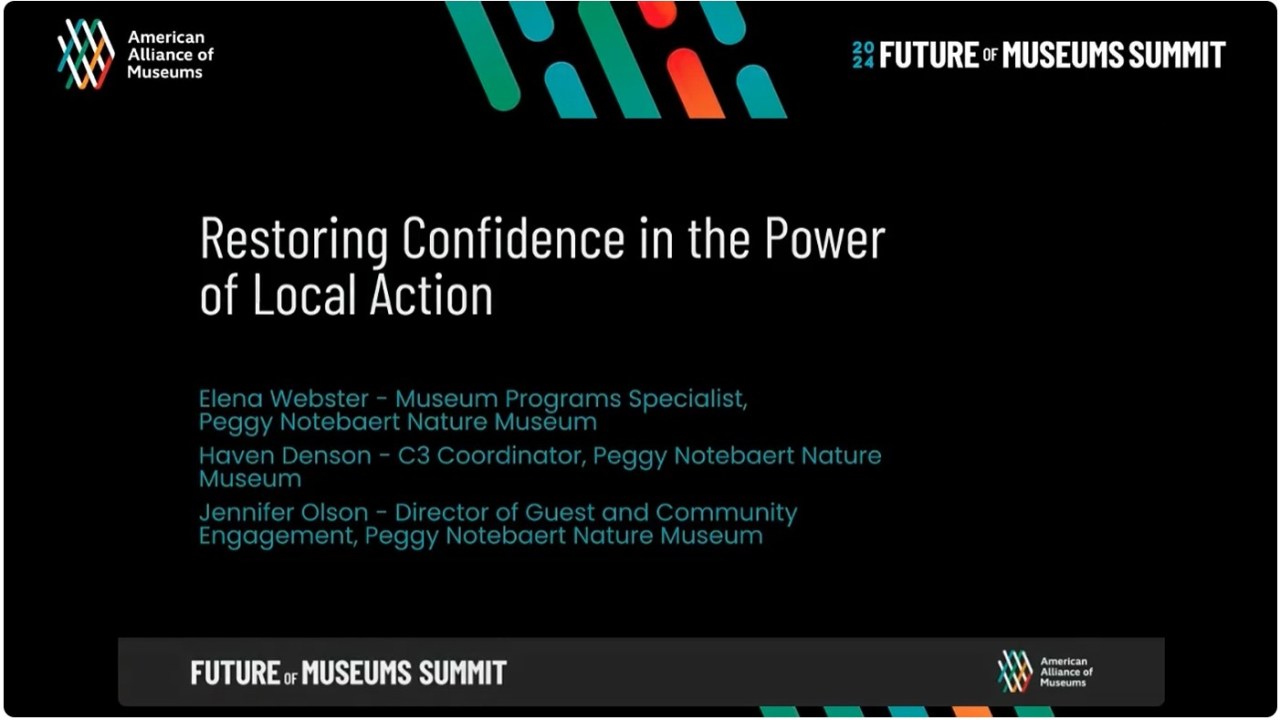
This recording is from the Future of Museums Summit held October 29–30, 2024. This session focused on combatting national-level polarization and declining public trust by highlighting how museums can effectively engage with and support their immediate communities.
Presenters:
Elena Webster, Museum Programs Specialist, Peggy Notebaert Nature Museum
Haven Denson, C3 Coordinator, Peggy Notebaert Nature Museum
Jennifer Olson, Director of Guest and Community Engagement, Peggy Notebaert Nature Museum
Transcript
Jennifer Olson:
Hello. Good afternoon, everyone. Get our slides up and ready to go. Perfect. There we are.
Hello, everyone. We’ll jump right in even as some more folks are joining. We want to start with introductions. So hello, you are in Restoring Confidence in the Power of Local Action. My name is Jennifer Olson. I use pronouns she/her. I am the director of guest and community engagement at the Peggy Notebaert Nature Museum.
Haven Denson:
Lovely. And I am Haven Denson. My pronouns are she/they. And I’m the C3 coordinator here at the Peggy Notebaert Nature Museum.
Elena Webster:
My name is Elena Webster. I use she/her pronouns, and I am the museum program specialist at the Peggy Notebaert Nature Museum.
Jennifer Olson:
In addition to our C3 team, as you see it here, we also have Darah Spar who uses he/they pronouns, who is our guest experience and engagement coordinator who also helps make this program possible.
First, wanted to set the stage a little bit. C3, the program that we’re going to be talking about today, is a community sustainability program rooted in communities of which our leaders are a part. So we wanted to paint a little bit of a picture of what our community is, joining from Chicago. We use the Environmental Justice Index from the CDC as a way to target our outreach to areas with the highest impact potential for our community sustainability projects.
As you can see, the south, southwest, and west sides, those darker blues, are the areas of highest need according to the EJI index. We are really proud that C3 is in all 50 wards of Chicago, and we’re able to have that very broad reach. And we know from the EJI that all areas of Chicago and Chicagoland, where our reach is, are going to benefit from some sort of sustainability action. Weatherization always helps everybody. Chicago’s surface water can use a little bit of love. So this helps us sort of target our outreach and gives you an idea if you’re not familiar of the sort of sustainability landscape in Chicago.
We are located at a museum in Lincoln Park where we can see the next slide, our beautiful building. We have this fantastic building in the middle of Lincoln Park, which is an affluent Chicago neighborhood on the north side. The mission of the Nature Museum is to create positive relationships between people and nature to grow our region’s connection to nature and science. The program that we’re talking about today, C3, the Chicago Conservation Corps, is housed in our GEE, Guest Experience and Engagement Department, which specializes in informal education and community engagement.
So, what is this program? What is C3 that we’re going to be talking to you about today? C3 is an ecosystem of ways that folks engage with the Nature Museum. It’s all focused on community sustainability. So folks can see sustainability as this giant systemic problem that requires actions by large corporations and governments and that calls for individual action are a distraction with no real impact. And that’s a really disheartening view to approach sustainability. We know that climate change, biodiversity loss, sustainability do require systemic solutions, but they also require community and individual actions that are proven to have a positive effect, especially a positive effect at scale.
So C3 focuses on educating community leaders on these scalable, effective sustainability solutions and giving them the confidence and the resources that they need to remove barriers to action. So it’s like a little lame to quote your own motto, but our motto is, “You want to do something. We can help.” And I think that’s a really good distillation of the program that we run through the Nature Museum, is because we all do want to do something, but we’re just not quite sure what’s going to help and what’s going to make a difference. So we hope that the C3 program and we see that it has this effect to remove those barriers to be able to do something.
We’ll mostly today talk about our C3 leaders. These are the folks that take our sustainability leadership training and then qualify for $250 in materials to do impactful sustainability projects in their communities. Because C3 is a community-centered program, I want to talk a little bit about our community and how our leaders find us. The participants in C3 don’t really neatly overlap with the audience of the Nature Museum. We mostly see families with young children and field trips. Our C3 audience is 18-plus folks who care about sustainability and are looking to expand from individual to that broader community action. So I’d like to say they’re the folks who already compost at home but are pretty annoyed that the rest of their apartment building doesn’t compost and is ready to do something about it. We can be that little push over your threshold out into your communities.
Because potential C3 leaders aren’t necessarily visiting the Nature Museum or a part of our sort of general communications, we have to get creative to find them all over Chicagoland. So we use networks like libraries and the Aldermen and their own local sustainability groups and organizations, those sort of affinity groups that naturally happen in communities, to find these folks and get the word out there. It helps when you say, “Hey, I can give you $250 of materials to help you make the change that you hope to see.”
We also see a lot of self-generated outreach that once we have that sort of leader in a community, we see an explosion of other leaders come from that person’s network when they see the impact. So that word of mouth outreach in sort of free happy hours at the Nature Museum and through digital communication, as well as our explorers program, which is sort of a lower barrier to entry, which we’ll talk about later. So that’s sort of our community, who takes C3, and how do they find us. Now we can dig into the program and its impacts.
Elena Webster:
I’m going to talk a little bit about our leaders in the leadership training course itself. Logistically, it’s an eight-week training course that we offer twice a year, once in the fall and then once again in the spring. It started 18 years ago in 2006, actually run by the City of Chicago. It was a municipal program. But after just a couple short years at the City of Chicago, the Department of Environments ceased to exist, our former mayor dissolved it, and this program was needing a new home. So it found its way to the Nature Museum, and we’ve had it ever since. Fits really nicely with our other environmental programs that we offer.
Since we’ve had it, we’ve trained over a thousand leaders from every ward of the city, and we’ve now been expanding out into the Chicago suburbs, and even into Northwest Indiana and very Southern Wisconsin. We’ve had 850 projects from all over the city, from every ward of the city. It’s growing every year. We just got another final report in today, so we’ll have to update these slides at the end of this presentation. Each project looks a little bit different. By taking this course, you are eligible to complete as many sustainability projects as you like. What we really care about is that different issues matter to different people in different communities. And it’s important for us to fund this community level work because Chicago is a city of neighborhoods. Each neighborhood has its own unique characteristics. It has its own culture, it has its own values, and it has a different relationship to environmental problems and sustainability. And by funding them directly, we’re able to let those communities decide for themselves what is the most valuable way to use that money and what’s going to help them the most.
So what is the class like in general? It is an eight-week-long class. It’s taught by the C3 staff that you see here. It’s also taught by local experts and past leaders and participants who share their experience leading these projects. We learn about project development, we learn about different pillars of sustainability, and we also try to provide some hands-on experiences and workdays as well. We have a lot of group discussions about what we’re learning. We answer a lot of questions. We try really hard to build a little community within our own class every single cohort.
Our leaders spend a lot of time exploring these big picture issues, but with local solutions. We learn about different aspects of climate change entirely through the lens of the Midwest and Chicago. Oftentimes when we’re learning about climate impacts, we hear a lot about what’s happening in maybe tropical regions around the world, we don’t hear about cities as often. So it’s nice to learn about what’s actually going to happen in the Midwest and in our city. We also network with peers and other sustainability thought leaders and try to foster a community of action in person and online. And we practice our community organizing skills and empower people to make a difference within their communities.
Our classes are taught by experts working in the field. These are just a couple of the organizations that we work with from all different parts of Chicago. These are people representing organizations like the Chicago Park District or Shedd Aquarium. These people are actually working in the field. They have real-world experience. They’re sharing their current research on what they’re doing for river conservation or the urban heat island effect. People are getting to hear straight from the horse’s mouth what’s going on in the city in these different aspects that we care about. Each of our presenters that comes is paid a $150 stipend for an hour presentation. Paying presenters is a really important value for us because it helps build reciprocal relationships with different organizations around the city, and it helps create partnerships with them as well.
Jennifer Olson:
So you might be thinking like, “This sounds like a great idea. Community action feels great.” No matter what your museum’s mission might be, that empowering those community leaders and getting your foot into every neighborhood in whatever city or town you happen to be in, sounds great. But how on earth do you do that? So I wanted to talk a little bit about our funders and our flow of money. These are the four big funders that show up at the bottom of all of our materials. We are a program at the Nature Museum. We’re really a flagship program, and it’s direct funding for community action about climate change. So we’re really quite lucky that we are thing that folks are very excited to fund and put their money toward the work that we’re doing. So we’re able to use this program more and more hopefully as a way to be budget relieving, that it’s not just paying for itself, but that we are crediting our staff time to that and building more overhead funding into the money that folks are willing to give us, and we’re able to show our work.
So as additional funders have joined us, we’ve been able to show how this sort of train-the-trainer model of our C3 leaders is able to have an exponential effect. One of our funders came in and effectively funds Haven’s position directly. We’re able to have a C3 coordinator. It’s not an endowed position, but there’s a one-to-one with that money there. And we have been able to see how much further our reach can get, having a dedicated staff person. So showing our work and showing the impact that their dollars can have to community action and climate action has been something that’s really helped us continue to fund the work that we’re doing and continue to do these sort of microgrants in communities.
Haven Denson:
Absolutely. These funders that Jen just shared empower us to financially support our leaders in the development of their own sustainability projects. So, to make sure that these projects are really impactful for each of our leader’s communities, we have a couple of requirements. Firstly, every C3 project has to involve and serve a defined community of people, and our leaders who initiate and develop that project have to be a part of the community that they’re assigned for. We have found that these projects are even more successful when that person has that personal tie to the community that they’re working with. We don’t encourage our C3 leaders to overreach into other people’s communities because we find that our products can be less impactful when you don’t know exactly what’s best for community and you aren’t personally a part of it. So we have our requirements that each leader has to be a part of community that they are developing their project with.
So this project also has to have measurable environmental benefits. These benefits might look different depending on what the project is. We like to keep it really open-ended so our C3 projects can be tailored to each community that they’re in. But no matter what the project ends up being, it has to have those measurable environmental benefits. A little bit later when Elena talks about some project examples, we’ll give some examples of those measurables as well.
This project also has to include a communication or educational component. We think this is really important, because not only are our leaders picking up litter, but they’re also teaching their communities the importance and the impact of their actions. So they’re teaching them why it’s important not to throw litter on the ground. They’re teaching them the places that you can properly dispose of a variety of different types of waste. So not only are you doing that action, but you are giving your community the education to kind of prevent these problems from continuing on in the future.
These projects inevitably allow our leaders to demonstrate and develop their leadership skills. They have to do a lot of community outreach to get their word out about their project, and we help connect them to local networks and organizations that will help spread the word, and they demonstrate those leadership skills as they develop their project.
We don’t just kind of throw our leaders to the wolves and tell them that they have to develop their own amazing project. We walk with them and work with them as they do that. Some of the support that we provide starts out with that $250 that we mentioned. For each projects that they get, that they develop, we are able to give them up to $250 to execute it. We also are often able to connect them with additional funding and resources that are leveraged from other sources such as our C3 experts that Elena mentioned, or other local sustainability organizations.
We also are able to give them individualized staff time. So when our C3 leaders are developing these projects, they’ll be assigned a C3 staff liaison, which might be one of us that you see on the call, as well as other staff members on our Guest Experience and Engagements Department. So we have staff liaisons that are assigned to leaders to help them develop, brainstorm, and execute their projects.
Let’s talk about our values: what drives us and what do we emphasize is important for our C3 leaders. Firstly, everything we learn about sustainability or climate change during the sustainability leadership training is through the lens of Chicago. Everything is tailored to what actually impacts us right at home. We talk about what’s going to happen local in our communities and how can we help protect it. Secondly, it’s very much community-driven. Everything we teach is geared toward a community level and those grassroots actions that can make a difference. Obviously, there are some big high-level issues that are related to sustainability that we can learn about, but we’d like to talk about those local issues and those grassroots actions so that our leaders can actually see the impact of their projects.
Finally, we are also welcoming to all. There’s no prerequisite to participate in the sustainability leadership training. Some of our participants happen to work in the field of sustainability while others are just people who love nature and are just getting started learning about sustainability for the first time. But no matter where our leaders come from, they’re all welcome to come to us for that information and resources and project development. We know that each community has their own unique experiences, and they have the knowledge of what would best serve their needs. So that’s why it’s so important for us to give them that direct funding and education, because they know what’s best for their community. I cannot think about a neighborhood across the city and know what it needs. So I’d rather give these resources to people who are in those communities and can really make that best impact.
Now that we’ve chatted a little bit about the structure of the course, let’s dig into some of the curriculum of the sustainability leadership training. Over the eight-week course, we have a couple different pillars that we talk about. The first one is community engagement. In this pillar, and for the weeks that we talk about community engagement, we bring in experienced C3 leaders. These are people who have already taken the class maybe in past years, who have already developed and executed their own projects. We have those leaders come back and talk to our new trainees. We think having that personal experience going through the course, they’re able to share what they wish they knew when they were a C3 leader, share what they wish they knew when they were developing their project for the first time. So we bring in our C3 leaders to give them that perspective.
We also train them on community engagement and project development through the lens of human-centered design. Human-centered design is a design strategy that puts people at the center. So we are designing not only for a community, but we’re designing with the community. So we are not telling people what they need to be better at sustainability, but we are asking them what resources we can provide them to empower them to make sustainable changes in their life.
We also go through a couple of different pillars related to local sustainability as well. The first one is green space. We talk about climate change in the local context, as well as the urban heat island effect, which being in Chicago, that does affect us, as well as stewardship over some of the parks and green spaces that we have in the city. And we learn about different local habitats in the city.
We also talk about water and some of the stormwater challenges. Chicago has some very specific water infrastructure that we really deep dive into so that people can know the context of where they live. We also talk about water at home, water use, how we can use our water more strategically to kind of impact change. We also talk about local water ecology. Having Lake Michigan and the Chicago River so close to home, we deep dive into what local critters and the local habitats that we have right nearby. We also talk about the local climate impacts, so how is climate affecting our water sources?
Next, we talk about energy, how that relates to the environment, energy efficiency and our energy usage within our homes, as well as greenhouse gases and transportation. We talk about biking and public transportation methods, as well as car use, and how it affects us here in the city.
Finally, our last pillar during our course is our waste pillar. Firstly, we talk about repair and how we can kind of lessen our waste by repairing what we already own. We talk about composting within Chicago. There are many different methods on how to compost, but it can be a little bit trickier when you live in the city and you don’t have a backyard, as many of our leaders live in apartments. So we talk about how they can get involved with composting. We also talk about our recycling infrastructure, what you can and can’t recycle, because it could be a little bit more complicated than we might initially think. And we highly encourage reducing and reusing our waste as big waste reducers.
All right. So a little bit more about human-centered design as this is a big part of our project development. Human-centered design is broken down into a couple different categories. The first phase of human-centered design starts out in inspiration. This is that research phase where we tell our leaders that they have to consider their communities, what communities they’re already a part of. We help them to identify the challenges that their communities face, and we call these the gaps, as well as the assets that they might have. These are the resources at their disposal that we call levers of change.Once they are in this inspiration phase, they’ve done all that background resource research, then it’s time to move on to the ideation phase, which is all the brainstorming and coming up with ideas. So we help design solutions with their communities as well as help them consider the feasibility goals and impact of the projects that they are brainstorming and designing. And then the fun part is the implementation, where they execute your project, they engage with their community, as well as get feedback so that they can keep improving for their future projects.
Elena Webster:
Let’s take a look at some project examples. Our first one here is Elizabeth. She focused on green space. Elizabeth is an elementary school teacher for Chicago Public Schools. She worked with her students and fellow teachers to clean up several unused green spaces that were on the school grounds and transform them into pollinator gardens. Elizabeth used her funds to purchase some tools for her students to use, some soil and some small fencing, which you see the students putting in the ground in this photo. They also were able to select some plants together and have a really lovely community planting day with the students and their families.
The students and their families were able to sign up for volunteer shifts for weeding and caring for these plants, for watering shifts. That engagement was really well received by the school and the families, so Elizabeth did a second project with a new grant, and they were able to expand some of these gardens. They purchased raised beds and are hoping to grow some more edible plants like herbs that they can take home and vegetables as well. This school in particular has a lot of Spanish-speaking families, so Elizabeth made some signs to distribute around the gardens about what a pollinator garden is, why it’s helpful, what are some of our Illinois pollinators. All of those signs were in English and in Spanish, so everybody was able to be included with this project.
Our next example is a water project, and this is Brian. Brian was a really great example of how you can partner with one of our friends or our partners to really expand the reach of your project and to get more monetary resources.Brian here decided to partner with Friends of the Chicago River. Friends of the Chicago River is a really wonderful nonprofit that does a lot of conservation work specifically for the Chicago River. And they host an amazing volunteer day every May called Chicago River Day. This is a city-wide event where you can sign up to be a site captain, and you are assigned a stretch of the river and a task. The task can be to pick up trash, or to plant some native plants along the riverbanks, or to do some shore restoration work. When Brian decided to be a site captain, he was assigned a stretch of the river and told that he should clean up the river.
The wonderful thing about working with a partner like this is they often supply you with all of the materials that you need. So Brian was given trash bags and trash grabbers and safety gloves and all those things. All he really needed to do was to recruit volunteers. Sometimes that can be really hard to convince people to come pick up trash with you on a weekend. So what he used his budget for from C3 was to buy lunch for all of his friends and coworkers and family members to maybe entice them to come pick up trash along the river on a really beautiful Saturday in May. And they picked up 16 large garbage bags of waste from their stretch of the river, which was really wonderful. And Brian has done this project twice, which is amazing.
Our next project example is Deloris. And Deloris is I think our record holder for a number of projects. I think she’s up to like 16 projects now. She is a pretty incredible C3 leader. She focuses mostly on energy and bike infrastructure in her neighborhood. So Deloris hosts an annual event every year called We Keep You Rollin’. This is an event designed to raise cycling awareness and teach people about bike and pedestrian safety, how to ride a bike, how to take care of a bike, and how to just be safe on the road alongside them. And Deloris has used this annual event in a really impactful way. She’s used it to help petition the city to develop better bike infrastructure on the far south side but also was instrumental in petitioning the city to expand Divvy, which is Chicago’s bike share program to the far south side of the city. This is important because typically, if you’re familiar with Chicago, the far south side of the city has been historically disinvested in by the city. So Deloris is a real mover and shaker and does really incredible work for her neighbors.
Our last project example we’re going to share is very topical for this week. This is Ivy, and she worked more of an independent way, but alongside her neighbors. She was really concerned about all of the pumpkins that end up in a landfill after Halloween has passed. They can create a lot of methane emissions if the pumpkins just pop straight into the landfill.
So, to help counteract those methane emissions and to prevent those greenhouse gas emissions entering the atmosphere, Ivy decided to host a pumpkin composting event. It was the neighborhood’s very first one. This was a couple years ago. It was a great way for neighbors to come together after Halloween. You throw your pumpkin in a dumpster and see if it explodes. It’s pretty fun for kids. Ivy was able to collect three tons of pumpkins from going into a landfill, which is preventing the emissions over 12,000 greenhouse gases entering the atmosphere, which is incredible. Ivy has done this a number of times. This started a couple years ago, and this has really taken off in Chicago, in the suburbs and in other places around the country. So this week I encourage you if you have pumpkins to take a look around you and see if there’s a composting event on November 1st or 2nd in any neighborhood near you.
We’ve got a lot of perks for doing these projects. One is that we don’t put any limits on how many projects you can do. You can do as many as you’d like, like Deloris does an annual event every single year, but you can do as many projects as you’d like within the same year as well. We have some people who submit a final report and their very next proposal on the same day. For every project that you do, you also get an annual family membership to the Nature Museum, and that gets renewed every time you submit a final report.
Our C3 community joins our member community at the Nature Museum, which is a really great way to get them involved. We get a lot of younger members joining that way, a lot of people who don’t have kids, which is different for us as well. And they’re able to join the networking and social opportunities that are specific to the C3 community, but also to the Nature Museum community as well. By being a Nature Museum member, they get discounts and promo codes for some of our family events. We just had a Halloween event this past Saturday that they would’ve gotten a member discount too. They get discounts for our summer camps and other learning opportunities that we host. We try to host learning opportunities for the whole C3 community every few months to keep people engaged and keep them learning outside of the course itself. And we also have a Private Leaders Discord channel where they’re able to meet one another to collaborate, to pool their funds for a bigger project, and to learn from one another and see what’s going on around the city in terms of C3 projects.
Jennifer Olson:
We’ve seen a ton of success with this program since 2006. So here are our braggables. We’ve got over a thousand leaders trained that community members impacted, is that strength of the train-the-trainer model. So it’s those thousand leaders that have then gone out and impacted that many folks living in Chicagoland. We have had over 860 projects completed. Our numbers here that I want to highlight, the 58% of trainees complete at least one project. So we do acknowledge some folks use C3 as just a learning opportunity for their own individual sustainability journeys, and that’s okay. These numbers are as of the end of 2023, 13% of our leaders that have ever taken C3 have completed multiple projects. And these are the two numbers that our efforts over the coming years are really hoping to affect. We want more folks who go through the sustainability leadership training to get over that hump and do their very first project. And we’re having levers that are making it a little bit easier after you do your first project. How can we support you to get on that train where you’re doing projects over and over again?
So we’re all over the city of Chicago as well as in the suburbs, as Elena said, and we have seen a huge increase in participation really since Haven came on board. Since we’ve had a dedicated staff member to outreach, every single iteration of the sustainability leadership training has been the largest one for the last three cohorts. So it’s a huge win. We’re really excited about that. And of course, we track our reduction in greenhouse gas emissions. The pounds of litter cleaned up, we’re getting better at it. We could have done better before, it’s fine.
But our sneaky output, our actual output, despite it being important, impactful climate actions is our leaders. It’s these folks who become the community leaders and the movers and shakers, and maybe even then get to the point where they outgrow our $250 budgets and start making bigger changes. That’s the dream, right? That’s how that becomes a sustainable action. And then we bring new people in who are ready to step outside of their front door. So C3 has been a launching pad for some folks’ careers. Kelli Pelc started The Refillery, which is a zero waste general store in Chicago. I forget when Kelli took C3, but it was well before our time. I forget. But she rejoined, came back to us, and said, “Hey, I saw some of your materials. I took C3 a long time ago. I’m interested in reconnecting.” And we’re like, throw doors open. So excited to see her, and now she’s returned as an expert during waste week to talk about zero waste actions that you can take. So we have this ecosystem that we’re continuing to cultivate since we’ve taken over the program.
We also want to shout out these other folks that have launched their careers in sustainability. We have a job board on our Discord, and that has lived in different digital iterations through C3. But Stef Funk who got a position on the Chicago Food Policy Action Council found that job through C3 and was kind enough to give us credit for launching that career and opening her eyes to this as a path. The other thing that I want to highlight of expanding the reach of C3 is not only these leaders that sort of “graduate” but really come back, they’ve just graduated from being leaders, is how we support and have sort of ended up supporting local organizations.
The local organizations we’ve listed here on the slide, the Edgewater Environmental Coalition, West Lawn Conservation Club, Chicago Muslim Green Team, and Bridgeport Environmentalists are some of the organizations that use C3 as a resource, and some of the members of their organization are C3 leaders. So maybe this org just keeps sending folks to the sustainability leadership training and uses those $250 budgets to fund things that these often entirely volunteer- and donation-run groups are trying to do. So $250 goes a long way if you’re running a budget of a couple hundred dollars for these environmental organizations. So we’re thrilled to purchase the rain barrels for their community garden as a C3 project. So that’s another way that our impact has been magnified in kind of an informal way, that we’re sort of a part of how you become a part of the Edgewater Environmental Coalition, is you take this sort of unaffiliated program. We’re so thrilled that we can be that resource for them.
Elena Webster:
We have learned a lot since we started up almost 20 years ago. The program has been around for a while. It has had two different host organizations. You may have heard me at the beginning, I said it started as a municipal-run program. It was housed at the City of Chicago and then came to the museum just a couple years later. This has had a bunch of staff turnover in the meantime, moving from the city to a museum, and within the museum itself has hopped apartments at least once. Eventually, this program almost died during COVID because of a lot of things we were struggling with during COVID.
Our spring 2020 cohort was canceled because of the pandemic. All of our cohorts were in person at that time, and it wasn’t safe to gather. But we spent the summer learning, and by fall 2020, we had tried an online pandemic cohort for the very first time, and it was highly attended and people really enjoyed it. This was back when we were still all working for home, trying new things and trying to connect online. But as people started going back to work, our cohorts started to get smaller and smaller throughout 2021 and 2022.
When we got to our spring 2022 cohort, we had only 15 applications, and we ended the cohort with about 12 or 13 people. This was our lowest cohort ever. And we were really concerned about the growth of the program going forward. So we knew we had to take a look at our operations, our content, and make some big changes to what we were doing. We revamped our admissions procedures. We modernized our curriculum. We received new funding to create a new position specific to the C3 program. And every cohort since our spring 2022 cohort has been the biggest one ever.
Some of the things that we had to look at were these artificial constraints where we were kind of getting in our own way, getting in the way of our own success of growing this program. One that we looked at right away was, why were we only open to Chicago City residents itself? Every cohort, we were getting requests from the suburbs, “Can I please join?” And we would say no. We had took a look at why we were saying no. At first, we thought it was probably from a grant that we were receiving, but we talked to our funders, and they didn’t care at all. So we changed the rule and said, “Sure, anyone in the Chicagoland area can join.” That includes Northwest Indiana and the Milwaukee area. We’ve had one Milwaukee resident as well. It also was really hard to sign up. There were a couple weird forms you had to fill out. It was hidden behind a couple forms on our website as well. And we decided to streamline that application process as much as possible. So it’s really, really easy to find our information and sign up right on our website.
We were also at the time requiring a payment for the course, which was $125. If that was not a good amount of money for you, if you couldn’t afford that, we used financial aid as a way to request an accommodation. When I think of financial aid, I think about filling out the FAFSA and going to college, which is very official, and this is just a very sweet museum that wants to help you. So we decided to change that completely and turn our program into pay what you can. So it is totally optional to pay now. You can also pay whatever’s comfortable. We have some people contribute $10, some people pay 50, some people are able to contribute $125, which covers our staff time and other resources. Other people donate more if they’re really enjoying the course, but it’s never a requirement anymore, which has really helped our admissions.
We also had some funny language. We have these meetings before the cohort starts that we used to call orientations, where you just come and learn about the program before you sign up for it just so you know what you’re getting into because eight weeks can be a big commitment, and orientation also was a word that we found was causing a little bit of hesitancy for people to just drop by and learn. So we changed that to just info session, and we saw the number of people registering for these just skyrocketed, because there’s a lot less pressure, and we don’t want to dissuade people from just dropping by to learn. We also recorded our info sessions and just put them right on the website. So if you are exploring the Nature Museum’s website and stumble upon this video, you’re able to learn about what this program is as well.
We tried to keep it as easy as possible to join this program. We also decided to keep the virtual. Even after we were able to go back to having in-person cohorts, we found that the virtual option let us have a lot more geographic diversity. People from the far edges of the city and the suburbs were able to join. We found that people with really busy jobs like teachers were more likely to join the virtual cohorts. A lot of people travel for work as well and can’t commit to joining us in person every Wednesday. So the virtual option was also great for parents with young kids too who struggle to find childcare to join an in-person class. So all of these things has led us to our biggest cohort ever. Our current fall 2024 cohort had 62 applications, so in less than two years we went from 15 to 62, which is pretty incredible. We’ve had really rapid growth and really strong evaluations ever since reinvesting in this and evolving the program.
Haven Denson:
So as we were identifying some of those barriers and learning those lessons, we asked ourselves a few questions. First, how can we engage folks with a lower commitment capacity? We heard from some of our leaders and potential applicants that they were really interested in getting involved and really interested in the program and our mission, but they didn’t have eight weeks of their time to give us, which is completely fair. So, to kind of impact that challenge, we brought back the Explorers program under the C3 program. The Explorers Track is something that used to be an existing level within the program when the program was still housed through the City of Chicago. And then we didn’t have the capacity to continue it on until recently.
So we brought our Explorers program back. Rather than an eight-week training course to become a leader, our Explorers can just opt into monthly events no matter who they are. So there’s no application process. We just host these workshops or volunteer opportunities, and anyone can just fill out and get on the email list and become an Explorer. Currently, we have a little over 350 Explorers members. So it has really expanded our reach of who we can get connected to C3. Once you fill out that short form and you join the Explorers, you also have access to the C3 Discord. There, you can find even more event opportunities, volunteer opportunities, and that is also where our C3 job board is as well. So anyone who wants to join Explorers, they have access to all of these resources.
We also asked ourselves: how do we re-engage folks who maybe had trouble with their first project, who didn’t know where to begin in developing in a project, or who have maybe taken the sustainability leadership training years ago and have kind of since disconnected from our C3 community? So to fill those gaps, we are now launching our C3 Ambassadors track. So this is a brand new initiative that we’ve been developing this year. Basically, we take C3 leaders who have already been through the course, who have already executed successful projects, and we connect them with current C3 trainees so that they can provide some mentorship and give them some advice.
We have long had C3 leaders come back and speak to our trainees, but in this new Ambassadors track, we’re able to actually connect them in a deeper way. We are able to connect Ambassadors with local leaders who maybe are a part of the same community. So they already have that existing backgrounds of what might be impactful or a successful project in that environment. This is a brand new initiative, like I said. So it is actually currently launching alongside the sustainability leadership cohort that is taking place right now. We are halfway through this current cohort, and once our C3 trainees complete the cohort in just about three or four weeks, then they’ll be matched up with our brand new Ambassadors. We’re very excited see how that will assist our trainees in developing successful projects.
Another thing we wanted to shout out is this other connection that C3 has to the Nature Museum. Since we have a lot of virtual cohorts for C3, we also often go out into different communities throughout the city. It was also important to shout out the physical space that we have at the Nature Museum. So in our Sustainability Center, we have a home at the Nature Museum for C3. The Sustainability Center is a permanent exhibit here. It was developed in support not only by Nature Museum staff, but also with the help and the expertise of our C3 partners. We asked them what information, what sustainability resources they had that we could put into the Sustainability Center, and integrate into our interactive gallery and rotating displays. The goal of this exhibit was to encourage that local action and build resilient and sustainable communities. The goal of the Sustainability Center aligns so well with the goal of C3, of developing and fostering that local action. So it was just the natural place for people to come and learn about C3 as well.
There’s a lot of projects exploration that can take place in the Sustainability Center. We have digital screens where visitors of the exhibit can scroll through and see some of those project examples that we shared with you all and learn about those C3 leaders success stories. They can find involvement opportunities, get connected to our email list through the Sustainability Center by giving us their email. There are also physical and digital resources. We have an in-house library at the Sustainability Center that we’ve developed in partnership with Chicago Public Libraries. So we have a lot of sustainability books that people can come and read, a lot of digital articles that they can gain access to. So all of this is kind of a great place for our C3 leaders to get connected or for new members of the museum to come and learn about C3 for the first time.
That is a kind of big overview of C3 and our program as a whole. We would love to pop into our Q&A and take a look at some questions that y’all might have for us.
Jennifer Olson:
Wonderful. I see the first question is, “For the eight-week training course, how many hours and days per week?” This has shifted a little bit over time, but it is one night a week or one day a week, depending on when we’re having it. We try to have it bounce around, and it’s just two hours. So it’s a total of 16 hours of training. And then we are really available. So we have a couple folks. We said we’re in the middle of a cohort now. We had a couple meetings today with leaders currently in the course, saying, “Hey, I have these questions,” or “Hey, I’m feeling nervous about this product.” So we make ourselves available throughout the course, but the course itself is 16 hours over eight days.
Currently reading the other question. I’ll read it out loud. Does the C3 program have a large presence in your overall content strategy? For instance, sharing about success stories, recruiting leaders, et cetera? Or is it hyper-targeted to individual communities? It’s kind of a little bit of both, right? It’s museums, right? It is a flagship program of the Nature Museum. So it does make an appearance in a lot of our communications and the way that we share the work that we’re doing. But like I said, our sort of general museum audience is so much like families with young children right now that there is a fair amount of targeting that needs to happen for our success stories and recruiting leaders. As far as individual communities go, I’m going to let Haven talk a little bit about the targeted outreach that they do.
Haven Denson:
Yes. So we are very intentional about advertising to different communities across Chicago and beyond. What we saw most recently, because the Nature Museum is located in Lincoln Park, in kind of a more affluent community in Chicago, we got a lot of super hyper-local leaders who lived very close by the Nature Museum, and were all coming, not all, but who are mostly coming from that close nearby neighborhood. So recently, what I have really done has been targeting far south sides, far west side of the city, and trying to expand our reach. The way that we target those communities is by finding those existing organizations there so we can tap into those sustainability networks that already exist. Like I said, like we talked about, we have a lot of word of mouth outreach. So as we get more leaders from those different neighborhoods, that automatically boosts our potential for even more leaders in those neighborhoods.
Even like Elena mentioned, expanding our requirements to no longer just be within the city of Chicago, that automatically got us a lot more participants from the suburbs. So as we grow and get bigger, we are seeing that geographic diversity as well. And I will call out… We mentioned this for a minute but didn’t emphasize that not only do those virtual sessions empower us to expand our reach to anyone all over the city and beyond, but we also alternate locations during our in-person sessions. So every other spring, we host our cohort at the Nature Museum, but on the opposite spring, we have a location off-site. So the spring before last, we were in Rainbow Beach Park, which is on the south side of Chicago for those local. And this upcoming spring, we’re on the west side in Humboldt Park. So we like to go to different neighborhoods to kind of target those different communities and make it a little bit more accessible to the wider city.
Jennifer Olson:
Wonderful. We have a question, “Have you received interest in replication in other cities? Have there been leaders from other communities who have taken the course so that they could replicate it in their communities?” I would say, kind of, it’s kind of the dream, that someday we will have, we call it like a binder strategy, that we have binderified C3, like, “So you want to start it in your community. Here are the tools that we use to create your own network.” But this sort of train-the-trainer model works, so we see and have connected with other organizations.
There was, oh, I’m going to forget, where there was a community in Minnesota who was doing a climate communicator course that, without knowing about C3, had done a train-the-trainer model of getting trusted community messengers and teaching them to communicate climate change messaging, and then sending them back out to communicate those messages. So it’s a model that’s really well accepted, and it is a dream to eventually have something that can amplify our impact, not only on our own community level, but as institutions and going around. I think it’s wonderful to share with y’all, because we inherited this program from the city. Similar programs are municipal programs, and I don’t see a lot of museums and cultural institutions amplifying their community impact in this way. So we are here, because we hope to be inspiring for those sorts of actions. Anything to add, friends?
Haven Denson:
I would say we definitely have some interest too. One of our leaders, Carolyn Vasquez, she does a lot of work with youth in her neighborhood. So she has kind of been working with us to take all the resources that we have and kind of put them on a level that would be more understandable for that youth audience. So she has kind of been working on replicating the course in a slightly different manner for the youth that she already works with and getting them those resources in a kind of similar course-like fashion. So we definitely have people be inspired by the C3 program, as well as a lot of leaders who just happen to be teachers, who kind of do the same thing, who take our program and a lot of the resources, and then do a project with their classroom. So on that smaller scale, we’ve seen some leaders replicate our strategy.
Elena Webster:
Oh. I see one last question, “Do you have any kind of evaluation strategy? I heard you mention feedback, but do you do regular evaluations of the program?” So we have a weekly evaluation for each class that we teach, and we take that feedback and review it together as a team and spend the next couple days before our following class, making adjustments if we need to. And a lot of this feedback is related to, “I didn’t have enough time in breakout rooms. I didn’t get to chat with my cohort members. I want to spend more time.” So we’re able to make these adjustments in real time during the class, but then we also have a final evaluation about the whole course where they are able to share their feedback with us about the presenters. They’re able to decide what was relevant to them, and we’re able to spend the in-between times between cohorts, looking at our presenters and our content and seeing if we’re still meeting the needs of the people taking the course itself.
Jennifer Olson:
I will also add, because of a recent investment from another person who’s excited to give the program some money and help us to continue to expand, we’re able to bring on contract project managers and an evaluator who’s working on their doctorate to come in and help us build a more robust evaluation strategy that we can use year over year. So we have those individual course evaluations going back all the way to the odds that we can look at, but we’re looking at what is a more robust strategy, like the question is asking, is another thing we’re looking to continue to develop and expand so that we can continue to learn and do better and to help us brag.
All right, and that is us at time. So thank you all very, very much for coming. You can find C3 on the Nature Museum website. Reach out to us there, and we’re happy to connect.

Upcoming Events
-
-
Is Social Media Still Worth It?
Event Date:Presented by: Southeastern Museums Conference -
Designing History Walking Tours Virtual Workshop
Event Date:Presented by: American Association for State and Local History (AASLH) -
AAM Affinity Communities Virtual Open House
Event Date:Presented by: AAM's Affinity Communities