Project management in museums is often misunderstood as task tracking or administrative oversight, when in reality it is a critical discipline for aligning strategy, people, and resources to deliver meaningful value. From Fragmentation to Alignment: Project Management in Museums draws from the author’s forthcoming book, which explores the conditions of museum project work, the project life cycle, and cross-project patterns that inform institutional alignment. The session also incorporates insights from a cross-institutional survey on digital tools, communication, and collaboration that informed and sharpened the book’s framework, highlighting recurring challenges that shape how projects unfold across teams and departments.
Transcript
Ariel Waldman
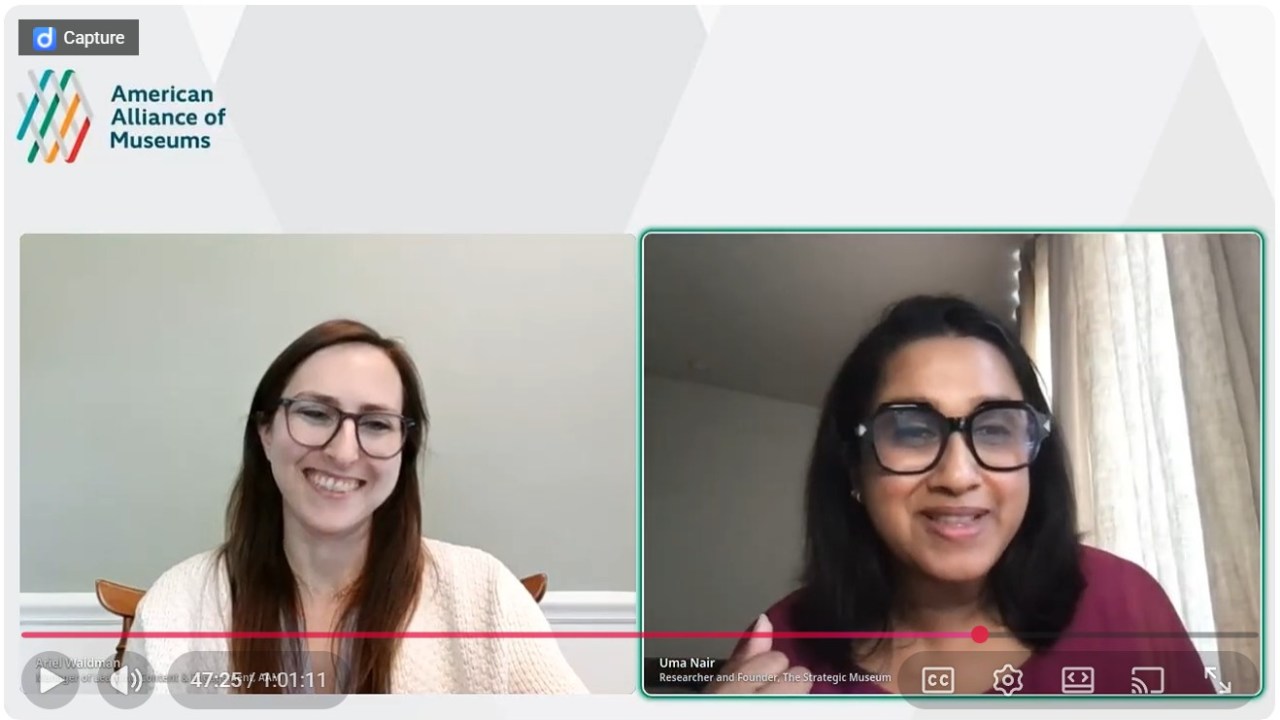
Hello, everyone. Welcome. I see some people are giving introductions in the chat. Please continue to do so. Let us know where you’re calling in from. Hello. My name is Ariel Waldman. I am the Manager of Learning Content and Engagement with AAM. I want to thank you so much for joining us for From Fragmentation to Alignment: Project Management in Museums. Today’s program is all about project management, which is often misunderstood as task tracking or initiative oversight when, in reality, it is a critical discipline for learning strategy and resources to deliver meaningful value. You’ll be invited to consider how projects function within a broader museum system, look at data from fellow museum professionals about their project management pain points, and we’ll dig into the project life cycle so we can align projects to best serve the museum and its audiences.
Closed captions can be turned on using the CC button at the bottom of your browser window. You’re welcome to drop questions into the Q&A tab on the right as we go, and please upvote questions that you’d like to see answered. There will be time to answer some questions at the end, and we will try to answer the most upvoted questions for you all. We are recording this for registrants and members to access in the coming days.
With that, I’m going to introduce our incredible speaker, Uma Nair. Uma is an independent researcher and the founder of the Strategic Museum, a consulting practice focused on helping museums strengthen clarity, alignment, and sustainability in how they work. She has over two decades of experience across the corporate, nonprofit, and cultural sectors, including leadership roles at Google and project management at the Getty Research Institute. Uma and I first met while she was writing her forthcoming book, Project Management in Museums, Transforming Workplaces through Future-Centric Practices, which I am very excited about. And I hope that by the end of the session, you will be too. So with that, I’m going to turn the stage over to Uma.
Hi Uma, welcome. I see everyone in the chat writing their welcome. We’re seeing people from all over the country.
Uma Nair
Hi Ariel. Thank you so much.
Ariel Waldman
I am so glad you’re here. And I’m going to just turn it over the stage to you to get started.
Uma Nair
Thank you. Thank you so much. Thanks. Hi everybody. I am so excited that you’re all here. Today, we are going to look at project management from a broad organizational perspective. Before we start, we have a really quick poll that Ariel’s going to put into the chat if you can take it just to understand how many of you have had any kind of project management training, whether it’s in formal or informal, self-studied, or you haven’t had any formal training. If you could do that poll really quick, that would be great. Think we can just give a minute. Oh, great. Informally, there’s a lot of informal project management training. That’s great. Alright. Thank you. Thanks so much, Ariel, for putting that in, and thank you all for taking that little poll because it helps me understand who is listening today, right now. So yes, so I said we are going to be looking at project management from a broad organizational perspective. We’re not going to get into every technical detail of project management and since that’s impossible to do in one session. But I’m going to focus on one aspect of project management, which is the life cycle, and talk about it at a high level. But we’re going to start with some of the challenges that we face in the work we do, and I want to explore how viewing our work from a project lens can help us create greater alignment.
So let’s start with something basic, which is: What is a project? So according to the professional discipline of project management, a project is an intentional time-bound effort undertaken to create a tangible product, a service, an experience, or a change. So from an administrative point of view, we can sure, we can think of projects as simply a collection of tasks. But what it is is really a strategic, coordinated effort involving multiple people, multiple decisions, and a whole bunch of information that’s all working towards a specific tangible outcome. For example, developing a brand new school tour for your exhibition is a project. Why? Because it is a temporary effort by different people in multiple departments to create a new learning experience. A collections audit can also be a project because it’s a time-bound effort to review object records, verify the information, and produce a clearer picture of the collection that multiple departments are going to be using. Adding metadata to your images on your website is also a project because it has a defined goal: a set group of images and a specific result to create more accurate, searchable, and accessible content for your audience. So museum work, as we all know, is full of projects like this. Right? But we don’t always recognize or structure them as projects. But if we do, it can help us quantify, track, and align how one person’s or one team’s or one department’s work can affect another. And make visible where information must move, where changes need to happen. And it also helps us shift our thinking from just saying, okay, we’re just completing these tasks, to collectively delivering an intended outcome. And this is where the project management concept of common languages and shared containers come into place. So project management delivers to you ready-made practices that just need to be customized and adapted for your museum. As I’m going to go through this presentation, you will hear examples of things that you do on a daily basis, but looking at it from a project lens helps us give us this common language and a shared container.
Now project management is not going to be a cure for every organizational challenge. It can’t compensate indefinitely for organizational dynamics or team culture issues. But if we adopt it intentionally, it can be one of the ways to make those conditions more visible and help teams perform and react to situations in a more aligned way. Because museum work is inherently complex. Right? So my argument is that project management can help us make that work more, that complexity, more intentionally solved. So what does fragmented work look like? Without a common language and a shared structure, the work begins to fragment. And that fragmented work looks like a bunch of these. These are some examples. Information can live in separate documents, in different inboxes, and individual memories. Decisions happen in one place; sometimes it happens in the hallway, and it doesn’t reach everyone it’s supposed to reach. Goals of the work could be interpreted differently by different teams and departments. The project still moves forward, but it does so in a fragmented way. Right?
This is not just, like, theory that I’m saying. I know that all of you have also faced this. And the survey that I conducted last year as part of research for my book also showed what this fragmentation is like in practice. So that’s one of the results from the survey that I sent out. Thank you all for taking this. One of the biggest project management challenges was too many competing priorities. Then we had weak accountability, unclear roles and responsibilities, too little time for planning, scope creep, and difficulty tracking progress. I feel that together, they point to a deeper issue. Right? People are being asked to coordinate all of this complex work without enough shared clarity, structure, or organizational support. There’s a whole bunch of information that came out, which I have also placed in the book. And I’m happy to talk about this separately as well. But I clustered the major themes that came out of that survey into these five challenges. Capacity and priorities. Rules, governance, and decisions. Processes, information, and tools. Communication and collaboration. And culture and organizational support. On the surface, these look like separate problems. But these are not isolated complaints. These are connected organization challenges that shape whether the people who are doing the work and succeed without constantly compensating for the system around them. If you pull on any one of these threads, you see how the fragmentation reveals itself. There’s too much work. It reduces the time that you spend on any one project. Right? And what happens from that? Rush decision-making. If you’re rushing your decision-making, there’s a possibility that you’re producing scattered documentation. If there’s scattered documentation, then there’s limited visibility across departments. Add in some, you know, outdated tools or uneven tool adoption, and rigid hierarchies, and ordinary work begins to feel unnecessarily urgent. And over time, the urgency becomes a normal way of working. So what looks like five separate problems is actually reinforcing the cycle of challenges. So if these challenges are interconnected, we need a way to address the work as this interconnected whole. Because, obviously, addressing just one at a time will only take us so far.
And why am I talking about all this? Because project management is a way to help coordinate all of the work that’s happening. Right? What do I mean by this common language and shared container? The common language in project management includes concepts such as the project life cycle, scope, risks, dependencies, assumptions. I know these are technical words, but we’ll come to them. The shared structure makes our language practical. It includes things like documentation, tools, processes, frameworks, decision pathways. And then there are the people who hold the work together. Ideally, these people understand how to use the shared language and structure and help others navigate it. Sometimes that is an official project manager. But in most museums, project management is carried out by unofficial project managers; they may be department heads, program managers, exhibition coordinators, educators, social media managers, administrative tasks. If your work involves coordinating multiple tasks, multiple activities across people and departments, the work that you’re doing requires project management. Projects also need sponsorship. A project sponsor is someone with the authority to champion the work and protect its authority, protect the priority of the project, and I believe, remove any organizational barriers and not create any more of them.
Now I know that none of these ideas are completely new to you, even if they sound scary or technical. Museum professionals already do this work. Every single day. You think about timelines. You think about responsibilities. You think about what needs to happen before something else can move forward. Right? What project management gives us is a way to name that work, make it visible, and create the shared language around it. So I hope you see that this is not about importing into museums a completely foreign way of working, but just to make the work a little easier. Right? So I can’t talk about every single aspect of this today in this session, so I’m going to focus on one element that I’m hoping you can use to take back to your projects, back to your museums after the webinar, and start thinking about it. And that is the project life cycle. If I can get that to that screen. Okay. Oops. Sorry, my computer just hung. Okay.
A project life cycle is the path that a project takes from beginning to end. Each step along this path is called a phase. And each of these phases have specific goals, methods, and outputs. Now I want to look at all of these phases. We’re going to look at them individually in a moment, but I’m going to look at them from a high-level alignment perspective. Now, like I said, each of these phases has different methods and tools and, you know, activities that need to be done, which we can’t get into today. But let’s look at them from this higher organizational alignment perspective. Now I’ve adapted the official project management life cycle into six phases for museum work: discover, define, plan, execute, track and iterate, and close. Now these phases are not always strictly linear; depending on the type of project and the approach you’re using, you may move back and forth as new information emerges. We’re not going to get into all those technical details today like I said earlier, but what we take away is that a project life cycle can give us a way to see the whole journey of the project. Right? And when you make this journey visible, we can see more than just the work that needs to get done; we can see where misalignment is happening.
The value of this project life cycle is also that it can be scaled to fit the work that you’re doing. You can apply this whenever you’re embarking on a collection of tasks that lead to an outcome. Anything from a major institutional initiative such as developing a strategic plan, or a relatively smaller project like launching a social media campaign or redesigning a school tour. You can use these phases. You have to; you kind of already do, but you can look at these phases individually and make sure that alignment is present. The depth of the process will change. The amount of time that you’re spending on each of these phases will change, but the underlying discipline always remains the same. Because each of these phases is also a point in the project journey to check for alignment. And we’re going to look at these six phases in a little bit of detail.
Discover. Aligns the project with the audience needs, organizational mission, and institutional value. Because before you decide how to deliver a project, or what to deliver, you need to understand why the project should exist in the first place, and whether it should proceed at all. Right? Imagine you’re redesigning the way educators can book a school tour to your museum through your website. Let’s say you have a booking form, and this is a very generic example, and I’m going to be very detailed about it. But just bear with me here. So during discovery, your activities might include reviewing the current booking page, or the booking form, speaking with the audience, which is your teachers or your educational staff, and identifying where the booking process is creating confusion or delays. Whatever the tools you’re using for this type of research, you’re mainly asking what is a problem or opportunity we are addressing? Who is affected by this? And is this feasible? Is this project valuable enough to justify the time, money, and capacity that it’s going to require? Now it’s not the project manager who makes these decisions. It’s not the people on the project team who has to decide all of this. This has to be a coordinated effort between the project sponsor, higher institutional priorities, and the people who are actually doing the work. Right? Now the project value lens is a concept that I introduced in the book as well. What I’m looking at is, from a project point of view, what is the value that you’re trying to create with this project? Project management as a discipline talks about different ways a project creates value. And I’ve distilled it down to three lenses. Most of the projects fall under one of these lenses. You’re either trying to fix something. Your project might be a restorative. You’re trying to fix something that is broken, repair something that is broken, or stabilize something. That is not working. Your project could be expansive. Something is already working really well. Your exhibition process is great, but you want to grow your audience. So you’re going to build on the existing work to create additional value. Or you may be looking at something that’s completely innovative. Right? You’re creating new possibilities; you’re using brand new technology maybe in order to do something that you’ve not done before. And projects can have overlap across these three values, but determining the primary value of a project really helps alignment happen. Because halfway through the project, we might be like, oh, you know what? We need to do this well. Or you know what? We need to do that as well. But then if it is possible to come back to that primary value and align the work back there, or maybe sometimes you do need to move away from that, but then at least you know. Right? So when you’re asking all these questions in this very first phase before you even start building the tool or building the exhibition or building the school tour, it helps to ensure that you have all the information that is needed to create alignment. And, well, I have done this many times, not just in museums, even in, like, corporate world. We sometimes create magnificent projects that are really not needed sometimes. So you don’t want that to happen.
Next phase, define. So define aligns the outcomes and the needs that you have uncovered in discovery across a project team and stakeholders and across institutional values. Right? So you’re asking, what is it that you’re actually committing to? Once the project has a clear reason to exist, you’ve collected information, the team needs to have a shared understanding of how and what it is going to produce. Because projects cannot be coordinated if different people are carrying different versions of it. For example, in your school tour project during the discovery process, you may find that you need to create a completely revised booking form. Maybe there’s a technical issue with the software that you’re using. Maybe the content on the page needs to be different. Or maybe you need to update the content on the confirmation emails. Right? So you’re going to make sure that everybody knows what the issue is and what needs to be produced. You’re aligning the team. So, again, project management provides you with ready-made tools to do this. Right? You have a project scope document. You’re going to outline what the intended outcome of the project is, what high-level requirements are needed, maybe the web page can only hold 100 words, so that is a requirement; the content needs to be written in 100 words. There’s always constraints and assumptions that we have while working in museum projects. And we also have roles and responsibilities. So you have tools like RACI Charts. Many of you might have heard this already. It’s a tool that helps identify stakeholders: who is responsible for the work, who is accountable for the work, who needs to be consulted, who needs to be informed. Again, aligning everybody. The value lens also in this phase looks at what success looks like through the value lens that you chose initially. Right? If it is restorative, you know that the outcome has to repair harm. If it is expansive, you know that the booking form needs to reach new audiences or the web page needs to reach new audiences. How do you do that? Maybe marketing needs to have a different campaign to do it. So it aligns every department that is involved to get to the same outcome. And if yeah. And if you skip this, people walk away with different ideas about what the project is. And who needs to be included, who needs to be informed, who needs to approve things. So you want to make sure all that alignment is happening. Again, I know all of this is being done. Right? It’s about getting things together to work in a coordinated way. And I’m inviting you to think about, as I talk through these examples and through these slides, think about any project that you’re working on or a problem that you’re trying to solve and see if these questions can be asked.
Sorry, my computer is really slow. Planning. Phase three planning. So planning aligns the ambition of the project with the capacity and the institutional priorities. This is where we ask, okay. Can we deliver this responsibly? We know we need to create this booking form. We know we need to let’s say interview the teachers and educational staff in our community, but do we have the time? Do we have the resources? Is this a priority for the institution? Right? So once you know what you’re exactly planning to do, you have to check that commitment against reality. So okay. Sorry, my computer is being really nasty. There are project management practices again that can provide you with tools that allow you to say, okay, this needs to happen before that happens. Again, for a school tour project, we don’t need to go into like, this much excruciating detail, but I want you to think about the way you’re approaching the work, again. Right? So when you look at the value lens, planning is where the value lens reveals what the project requires from the institution. If you’re fixing something, the institution should provide the stability and the care and enough time to fix what isn’t working. An expansive project may require additional capacity. Or funding. It may require support to hire. Right? When I work with museums, I’m always looking and calculating the capacity of the team. Thankfully, you have techniques and tools that you can use in order to determine that. An innovative project might require experimentation, flexibility, and a greater tolerance for risk and uncertainty. Does your institution possess that level of risk tolerance? Project management will give you tools and methods to calculate risks, to help give you strategies to mitigate these risks, as long as everybody is on the same page. Because when you make all of these aspects visible, the work becomes a lot easier. And if you skip these phases, the team is left to absorb the gap between what was promised and what is actually possible. Alright, I’m going to move the next one. I hope everybody is following.
Execute. Execute is where the work actually happens, right, where you’re actually doing the work. And this phase aligns the people and the work that is being done. So execute asks, how will the work move smoothly across the institution? The challenge is not simply whether each person completes a task; it is whether the work moves clearly between people and departments, where the handoffs happen on time, where the changes are communicated, that everyone understands what they’re responsible for next. So you’re doing a collections audit. How does the recording of the information fit in seamlessly with the CMS? Who’s checking the accuracy? When it is checked, and what if something is discovered? What is the next plan of action for it? Right? And because you’ve planned all of this really beautifully, things should go smoothly. Project check-ins are one of the tools that you can use. We do this. But then project management tells you what sort of check-ins and when these check-ins need to happen. Because unless you’re asking what has happened, what has moved forward, what is stuck, what decision is needed to be made? Is there a blockage for this decision being made? And who’s doing what next? All of these questions help not only move the work forward, but it helps bring everybody together. Right? And value lens also here helps the team protect project’s original intention. Are we still repairing the problem without creating additional problems? Right? Are we supporting growth without stretching people and resources too far? Are we still allowing room for experimentation, or has urgency and pressure pushed the team back towards safer or familiar choices? Again, I have to reiterate this. Execution is not simply completing tasks. It is coordinating people, information, decisions across an interconnected system. And when that coordination breaks down, we start bending on workarounds and individual, you know, staff heroics, which is not ideal.
Phase five. Alright. Track and iterate. Because execution rarely unfolds as planned, track and iterate aligns the current reality of the project with your original intent. Now this is a phase that happens concurrently with execution. We’re asking are we still creating the intended value. This is especially critical for museums as our work is so complex. And for example, if user testing reveals that educators are still confused by something about your school tour, this is where you’re realizing it, documenting it, and fixing it. Right? So tracking is extremely important. We have tools like dashboards, tools like dashboards, and what else do I like using for tracking? I mean, it’s a good thing because now we have ready-made project software that can do all of this, without a lot of, you know, manual labor. So is also where sometimes AI can be helpful in museums, but I think they’re a long way away from that. But it is possible. It is possible. So tracking is not about watching people more closely or causing distress. If done properly, it creates this situational awareness so that the team can see what is moving, what is blocked, and what adjustment is needed. Right? And this is where all the work that you did in discovery and define and plan is going to pay off the most. Because the better all of that has been done, you have going to have minimal changes at this point. Value lens helps us when you’re looking at the actual evidence. So, is the evidence that we have as a project is being execute, is the evidence showing that the project is repairing the problem? Is the evidence showing that there is value expansion? Or is it generating information as we go on? Are we adapting to that information, or are we simply ignoring the new information that’s happening, even when there’s evidence that we need to change something? Right? So because plans are based on what we knew at the beginning, tracking and iteration allows us to respond to what we know now. And if these activities are ignored, the problems still remain invisible until the cost of shifting becomes too high. Sorry. Alright. We’re almost there.
Closing. So closing the project aligns the completion of the project with the adoption of the outcome, the accountability after the outcome has been produced, and creates institutional learning and helps future decisions. Close asks: did the project achieve the intended outcome? And now what do we do with it? A project is not finished simply because the activity stops. It’s finished because then the result is transferred and value is assessed, learning has been captured. Retrospective documentation is, again, a tool that we can use. Who owns the result now? What has changed? What should we repeat, stop, change next time? Right? The value lens also helps the team look honestly at what the project ultimately created. Close also asks what the project required from the institution. Did it depend on unsustainable effort? Did it reveal a capability gap or a skills gap? Did it create a process that now needs ongoing support? Most museum projects don’t have a defined closure because we are jumping into the next project already. And this is one of the biggest mistakes that we make. Because when you don’t close a project intentionally without doing a retrospective, the same mistakes that we made can follow us into the next one. Right? So this is where the value of one project begins to improve the next project that we do.
To summarize, across a project life cycle, each phase creates a different kind of alignment. And imagine if every project in your institution, small or large, follow the same basic structure. Imagine if teams use shared tools, worked through clearer communication pathways, and knew what information they needed at each point. That would cause greater clarity, obviously, and greater alignment across the institution. So sure, we can always say project management is an administrative task; it’s about checking things off your list, but if you’re allowed to do it, your project manager is doing strategic work. Sorry. My slides are skipping. Too fast. An administrator of your project management asks, are the tasks up to date? A strategic view asks, what is this work revealing about how the museum delivers value? Don’t get me wrong. Tracking the task absolutely matters. It is critical because that’s how the work gets done, but that’s only one part of the practice. And I would be remiss if I didn’t clarify that project management cannot stand on its own without certain organizational conditions that support it and make this alignment possible. And these conditions have to exist at every level of the organization. The discipline of project management calls this the value delivery system. So the whole system consists of portfolios and programs and projects and products and operations at a different level than it has, and it talks about how the value of the project, of the work that we do, moves up and down and directly feeds into the institutional value. We don’t have time to get into that today. But what I’ve summarized here are the conditions that are required for effective project management to take place and effective project value delivery to take place. Museums need effective physical and digital infrastructure to create the shared container that we’re talking about. The tools, the platforms, the software, the working environments that allow people to coordinate their work. That could be digital environments. That could be physical environments. Within that infrastructure, they need shared processes and workflows so that we’re not reinventing how work happens with every new project. We also need clear pathways for communication. Top-down, bottom-up, across departments so information can reach people who need it. But tools and processes alone are not enough. Right? We need training, professional development, and opportunities to build these shared skills. And, of course, this requires leadership to articulate the value and vision and support the practices it expects staff members to use. Governance is critical. It must make decision-making authority and transparency crystal clear. Looking at these conditions, I mean, these are not new things in organizations at all. We’re all working towards this. But looking at these conditions from a project management lens can cause practical ways of moving this work forward. It creates a healthy and adaptable organization. And I totally understand these conditions are not- creating this is not always easy. And it’s also because many museums are working within inherited structures and traditions that were designed for a completely different era, for a completely different kind of work. Even ten years ago, people came to museums because we held the ultimate authority and expertise. Right? So a work culture was built in that way.
But today, it’s a little different. Right? Gosh. Museums, our work today, our projects are built around built around deep expertise and deep specialization, departmental expertise, scholarly autonomy, and layered decision-making. And I’m not saying that this is wrong. Absolutely not. These practices are critical to protect the stewardship and scholarship that you produce. It is nonnegotiable. But the world today, for better or worse, the way we work today, we require, the projects require agility and speed and cross-departmental coordination like we have never seen before. And it requires teams to adapt as circumstances change. So finding a common ground is absolutely essential if you are to move forward successfully. And, yes, project management is one of the ways that we can achieve this. I also want to mention that these challenges that we saw in the survey are not unique to museums. Okay? Most organizations face them. There’s always too much work. There’s always too many projects. But what is different is that a lot of organizations or successful organizations adapt faster than we generally adapt. So I just want to say that the goal is to not replace museum values or you know, change the type of work that you’re doing, or even make museums work like corporations. That would just suck the creativity and care and responsibility out of the work. But what we want to do is we want to build project practices that allow this creativity and care and expertise to work together rather than work against one another.
So as I close, I invite you to take back to your museum the product life cycle and the questions that we were asking. And, hopefully, you can use what I talked about today to identify which of the work that you’re doing, what work that you’re doing can be looked at from a project perspective. Or identify the different stages that your projects might be in. And I hope you can use these questions, and I know that we can put this in the resources of the webinar. I hope you can use these questions to pause and surface assumptions, ask questions to see where alignment might be breaking down. Because one project can give you clarity; when you look at multiple projects across the organization, that gives you a pattern. And if you see patterns of misalignment, this means that the institution can take this information to make better decisions and help achieve institutional strategy. So thank you for spending time with me today. That’s what I have. I would love to hear from you personally about your project work. So definitely hit me up. Thank you. I think we have time for questions?
Ariel Waldman
Yes. That was great, Uma. Thank you so much.
Uma Nair
Oh thank you!
Ariel Waldman
I’m so glad that you talked through, like, the questions because I think it’s so important that we align on, like, what we’re trying to accomplish. Because in museums, there’s so many things going on at the same time. We are trying to, you know, have our doors open while also trying to think of what’s next and always trying to serve visitors. So I think those questions that you provided just are really great at aligning everyone towards those common goals, like you mentioned.
Uma Nair
Thank you. Thank you.
Ariel Waldman
We do have some questions in the chat, and please continue to put your questions in the chat, everyone. First question from Sofia. Recommendations for tracking so people don’t feel surveilled. They say, I run into this often. There’s a resistance to share, loop in, forgetfulness, and then they’re placed in a position to check in and ask and track progress, status, etcetera. So do you have any recommendations?
Uma Nair
Again, yes. I completely understand what you’re saying. The issue with giving one kind of tracking advice or for any of these phases is that it’s a little difficult to do that without understanding your specific institutional needs. Generally, what I would say is you need to all come together and figure out one common platform or a tool that everyone is comfortable using and get everybody trained on it. Right? So that is the practical aspect of getting the tracking container going. But, again, there is that other organizational condition that I talked about. There has to be a sense of safety and security and communication about why this is needed. We’re not doing this. We’re not tracking to, like, point out problems or mistakes that anybody is doing. Right? So which is why it’s so hard to simply go ahead and introduce a tool or a software and get everybody trained on it and then just say, okay, let’s everybody use it. So I don’t know if that answered your question, but there are many tools. You can track even on an Excel spreadsheet. As long as everybody is tracking on the same Excel spreadsheet and not on multiple ones. So hope that helped.
Ariel Waldman
Great. Yeah. I love what you said that, like, everybody needs to have a common language. Everybody needs to be using the same stuff. So that way we’re all in the pool together. We’re all understanding what’s going on.
Uma Nair
Yes, and, sorry, I just want to add one more thing. It’s not going to be an overnight change. Okay? I think we all have to be very clear about that. It needs to be an intentional, sustainable, slow approach to it. Not slow, but at least intentional approach, and with the expectation that things are not going to change overnight because, hey, we’re all human beings, and, you know, we have ways to adapt to things. Also, the work is not stopping. So yeah.
Ariel Waldman
It’s like every project hopefully can be a little bit easier and a little bit better. So I feel like some of what you mentioned kind of leads into Jennifer’s question.
Uma Nair
Mhmm.
Ariel Waldman
Which is: how do you recommend bringing these approaches and phases to coworkers and leadership?
Uma Nair
I think, again, maybe send them this presentation. Maybe that’s a good place to start. But like I said, it is a slow adaptive approach. Right? It I mean, it doesn’t need to be slow, but it is an intentional approach. Training, I think, is absolutely critical. I mean, coming from the corporate world, I mean, it was ten years ago, but I still am very involved with people in the corporate world. And one thing that has not changed in the last ten years is professional development. The amount of professional development that organizations need is only increasing, so get people together, get training, and it’s not a one-time training. You need to just first learn the tools, learn the language; you need to come back, see if it is being adopted, get trained again. So it’s an iterative process of getting the organization to a place where everything becomes seamless, if that makes sense. Start with professional development. I think that’s a good place to start.
Ariel Waldman
Great. I know you mentioned that there is always an organizational component to figuring out what’s best for you and your museum. But Charlotte is wondering if you have any recommendations for project management software or apps any that, you know, maybe people could check out and decide what’s best for them.
Uma Nair
That is a- sorry. Go ahead.
Ariel Waldman
No. Go ahead.
Uma Nair
That is the most common question I get. It’s so hard to recommend one. I personally love anything that is on the cloud. I personally love anything that has seamless integration into your other tools. Now I remember talking to museum client about doing a tools audit, you know, looking at what are the different, you know, software that people are using for project management. I mean, you have your, you know, specific CMS work and you, you know, your ticketing systems, all of that. And, unfortunately, not everything talks to each other. In the ideal world, everything would talk to each other. But where are you doing your project management work? And most of the time and even the survey actually, showed that the biggest digital tool that is being used, and Ariel, I know we talked about this, the most common tool that is being used is SharePoint. And I don’t know if SharePoint is the best tool for project management. So you have to look at what are the needs of the organization, how many people are in the organization, what is your budget? There are so many aspects to consider, but I would start with doing an assessment of what everybody is using. Right? Again, you go to the discovery process; you can use the project lifestyle to even answer that question. So go through the discovery process, find out what people are using, find out what people like, find out what people don’t like, and then go from there. So that’s a nonanswer, I guess, to the question, but-
Ariel Waldman
No. That’s great. People also, thank you, in the chat people were giving recommendations of things that they like, so feel free, you know, to take some of that advice and just kind of do some research. Say, hey. Is anybody using, you know, Asana at the organization? Is anyone using Monday? And so that way like Uma said, kind of figure out what people like and what people don’t like, and-
Uma Nair
Yeah.
Ariel Waldman
start to kind of align people.
Uma Nair
I have seen this questions pop up in Museum Junction and your forums. And there’s a lot of really valuable information. People talk about what works for them and what doesn’t. Some, you know, some people are like, oh, I’m looking at there’s, like, a ten-person museum, and they’re looking at, I don’t know if you should be using Salesforce to- I’m like, no, no, no. Do not use Salesforce for a 10-person museum. Right? So that yeah. So talk to people and, you know, email me. We can talk more. I love talking about this stuff. So.
Ariel Waldman
Great. Madison is asking, what do you recommend as first steps for project management for middle managers in an organization that does not currently have all of the organizational conditions of success?
Uma Nair
Again, like I said, project management cannot cure organizational conditions. It’s a two-way circle. You can maybe start with tools. Maybe start with the work that you’re doing. You know? Take back those questions. And if it feels safe enough to ask those questions in a larger forum within your department, with a larger team within your organization or with senior leadership. Talk about it. Like, this is a project that I’m doing, and you know, can you explain how this is helping? I mean, I don’t want to just cause disruption. But it’s important to, like, go back and analyze this. Sorry. So the question was: what is the solution for middle managers to implement project management? Was that the question? Sorry.
Ariel Waldman
Kind of. And, Madison, feel free to reply to your own question here. But they said: what do you recommend as first steps?
Uma Nair
First steps.
Ariel Waldman
Or somebody who it sounds like Madison is really ready to kind of get their organization more aligned, perhaps, and ready to kind of have an easier project management life cycle. So what do you suggest is the first step? So you’re saying maybe getting people to talk and kind of figuring out what people are doing,
Uma Nair
Yeah. Mhmm. Yeah. Because going directly in with, okay. This is the tool that somebody recommended to me, and we should all get on this tool, is not going to work. Right? Because who has time genuinely to, like, learn a brand new thing and change the complete ways of working and adapt to a completely new system? So it needs to be a more therapeutic process of everybody coming together and then really genuinely, honestly talking about the concerns. So yeah. That should be the first step, I think.
Ariel Waldman
Great. Next, we have a question from Abigail. What resources do you recommend to learn more about project management? I will first plug Uma’s forthcoming book; I think someone else also asked where they can purchase the book. So it’s not out yet, but if you want to talk more about that, Uma.
Uma Nair
Yeah. Absolutely. I mean, the link to purchase is on the Bloomsbury website, but, obviously, it’s not published yet. It’s still, you know, in progress. But if you go to my website and you sign up, for you know, to be on the email list to learn more about when the book comes, that would be great. But I also and I don’t know if this is okay to say this here, but I’m also, like, starting something called a Museum Project Circle, where I’m hoping to have monthly conversations free of charge. Go to my website, sign up for it, free of charge. To just sit and talk about issues that we’re facing. Because the more we talk, like, as a community, I think the better solutions we can all come up. We don’t need to reinvent everything, you guys. Like, we don’t need to. There are plenty of books project management books, but they’re all very technical. So I’m hoping that this book that I’ve written is a little more you know, is a little more easy to understand. If you’ve understood whatever I’ve spoken in this presentation today, I think you will understand the book as well. But, coming back to resources, let’s talk. Let’s chat. I want to create more resources, and I think Ariel AAM is also looking at providing more project management-related resources. Right? So just hang in there. It’s coming.
Ariel Waldman
Yes. Absolutely. AAM is definitely interested. We are really ramping up our professional development offerings. And so it seems like this is a topic that people are really passionate about and maybe struggling with a little bit. And so we’re really looking forward to hosting more webinars, potentially courses, and really of course, Uma’s book that’s forthcoming that’s published in partnership with AAM, so we’re really looking forward to helping the field continue to bolster their skills in this really important aspect of museum work.
Uma Nair
Yes. Yes. That’s great.
Ariel Waldman
Great. I did put a link to the book in the chat so people can take a look there.
Uma Nair
Okay.
Ariel Waldman
I think we have time for maybe, like, one or two more questions. So, doodododo. And also, I sorry, just want to go back to Abigail’s question for one more second. Uma, you kind of mentioned this on Museum Junction: there are some really robust kind of conversations happening where people are kind of sharing their expertise, and that’s something I’ve really loved with everyone who’s here today is sharing their expertise in the chat. So please feel free. Museum Junction is AAM’s online forum for the museum community. It’s free. So feel free to take a look there. Start your own thread. Kind of starting the conversation around any questions you may have.
Uma Nair
Absolutely. Thank you. So and I just want to add one more thing. Samantha mentioned the resources from the Project Management Institute, which is PMI.org. PMI is the Bible. Is that okay to say? PMI is the foundational project management organization that has made this work easier. The book that I’ve written is based off of the PMBOK, which is PMI’s, you know, resource, the main resource. So, yes, absolutely go to PMI. There are a lot of Harvard Business Review articles, you know, about project management. So what we’re talking about is management training, basically. Right? Like, we are all such experts in our own fields. We just need a little more support with, like, basic management and strategy and project and tools-related information. So, yes, I completely agree with the PMI. Comment too. And, of course, Museum Junction.
Ariel Waldman
Great. I think we have time for one and a half more questions. So Neville asked: this might be a structural issue, but how can we ensure different departments with vastly different priorities can be tasked on projects that require their input? It seems like our biggest issue is saying, hey, this is a priority for you too!
Uma Nair
Mhmm. I totally see that. And this is where there’s no easy answer to this. Let me be very clear. This is where project management talks about the value delivery system that organizations need to put in place. So it is this concept of how a strategic priority is transferred into different departments. So there are different ways that they talk about portfolios and programs. And under these portfolios and programs, you have projects that are conducted by departments. So it’s a little bit of an understanding of how information moves through your organization, and it requires senior leadership support immensely. It’s not something like one project. You can use project management tools to, you know, create the best value for that one project. But if it has to impact the entire museum, they all need to come together, as you understand. Right? So it’s I don’t know if I answered that question, but it is a collective process that the organization needs to embark on. Mhmm.
Ariel Waldman
Great. Okay. I think we have time for one more question. It seems like there’s a lot of questions here I’m going to paraphrase of people who are dealing with people who think that working in silos is more efficient or how do we get how do we basically, it’s like, how do we get people on board with this? Whether that be leadership, whether that be the people who think it’s easier to just you know, work in their own little bubble.
Uma Nair
Oh my gosh. This is such a great question. And I’ll tell you why working in silos, I think, is more efficient. It’s because it helps you do your creative work without having to think about a 100 different things in 100 different ways. Correct? So if you can somehow ensure that all of those coordinating activities, if you can get all of those tracking activities, those interactive activities can be outsourced as much as possible to tools, to platforms, to common ways of working. Then yes, you should absolutely be sitting and working by yourself because museum work is deeply intellectual, which requires work to be done sometimes in isolation, for lack of a better word. Right? You’re looking, you’re deep thinking about these things. But what we need to do is we need to ensure that everything else that does not need to be thought about and that can be outsourced to technology should be done. We don’t need 100 meetings every day. If you can get things, you know, on a dashboard, everybody can see information is present in whatever ways that each level of the organization needs. So when we do all of that, it’s possible to, like, know, really enjoy your creative work. So that’s my take.
Ariel Waldman
Great. Great. I’ve also heard the phrase it’s like if you want to go if you want to go fast, go alone. But if you want to go far, go together.
Uma Nair
Yes.
Ariel Waldman
So I feel like that’s a big part of kind of this collaboration is making sure that you’re bringing in different perspective because, I mean, that’s what makes-
Uma Nair
Absolutely. Absolutely. Absolutely.
Ariel Waldman
museums rich places for our audiences.
Uma Nair
Absolutely. There’s nothing like collaboration, honestly, but we should be collaborating on what we need to collaborate on, not on every single thing.
Ariel Waldman
Well, thank you so much, Uma, for giving your expert expertise, and sharing,
project management with us today. This webinar is recorded, and all of the attendees will be receiving the recording. If you want the PowerPoint, it is in the resources tab, which you can access on your sidebar. It looks like a little piece paper with the corner turned down. So feel free to start the conversation with, you know, your colleagues by showing this presentation, showing the recording. We have a few webinars in August. One on what attending Museums Advocacy Day is really like, and then another one on submitting a winning AAM Annual Meeting Proposal. So we hope you will join us for those. I will just put a link in the chat. But I want to thank everyone again for sharing their expertise. Uma especially, but also for all of our attendees who are sharing kind of what they know. So thank you. We hope to see you again soon. And have a great rest of your day.
Uma Nair
Thank you.

Upcoming Events
-
-
-
Industry Showcase: Innovative Digital Solutions
Event Date: -
Creative Museums Summit
Event Date:Presented by: MuseumNext