This article originally appeared in the March/April 2019 issue of Museum magazine, a benefit of membership with the Alliance. Click here to learn more about membership!
Museums must embrace new values if they are to survive into the next century.
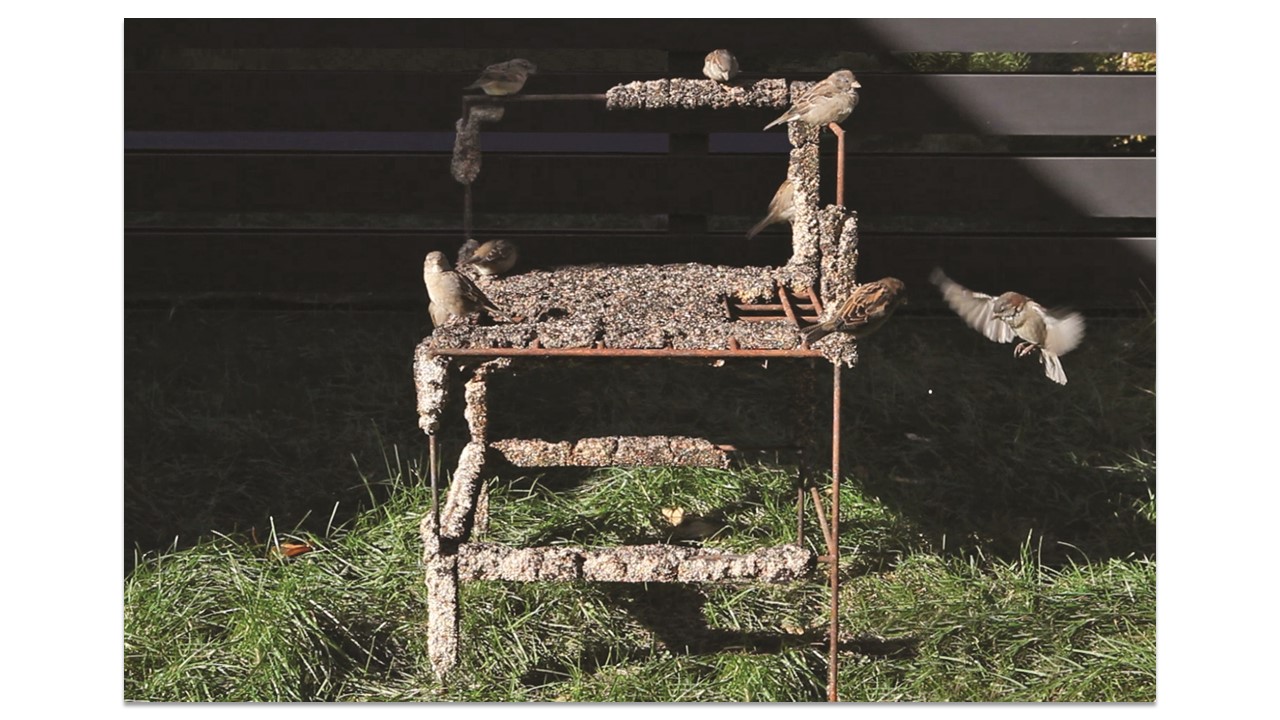
Last year for nearly six months, a chair designed by the artist collective OOIEE inhabited the yard of my Minneapolis home. Fashioned out of metal and compacted birdseed, After Donald Judd (Corner Chair 19.75), 2018, references the iconic design of American minimalist sculptor Donald Judd. Now a staple of most 20th-century museum design collections, the Judd chair has significant value in today’s art market. Despite Judd’s formal intents and utilitarian concerns, this highly prized object designed for his home has become an emblem of power, wealth, taste, and class in contemporary Western society.
Living through a season with OOIEE’s transmogrified simulacrum of Judd’s icon, I observed the chair’s slow evolution as it withstood the elements. At first, neighborhood animals approached the new lawn object with fear and suspicion, even disdain. But once the first brave creatures investigated, visitations increased. As winter hastened, the chair became a vital food supply for birds, squirrels, mice, and voles, all vying for a piece of the treasure before the first snow.
The dynamic of this backyard ecology provided a fascinating demonstration of today’s capricious consumer economy in action. In the current political climate fueled by rage, special interests, and polarizing leadership, the curious microcosm also offered a potent metaphor reflecting the fragile state of American democracy. Its consumption suggested the worst aspects of late capitalist society and the US’s diminishing position around the globe. Its deterioration encapsulated the challenge that all forms of institutionalized thinking are experiencing as American and Western culture continue to reckon with centuries of racism and systemic inequities.
There is no question that we are living in an unprecedented time of accelerated societal change that is shaking the foundations of institutions everywhere, including art museums. As platforms for artists and audiences to reflect on the contemporary moment, museums and the art they present have increasingly become flashpoints highlighting society’s most pressing concerns.
Crisis of Conscience and Confidence
In recent years, we have witnessed public calls to decolonize the museum space: the return of objects taken from other cultures, fierce debates about who has the right to tell whose story, exhibitions of alleged #MeToo offenders deferred or canceled, and artworks memorializing nations’ racist pasts taken down and/or recontextualized. Artists and activists, including hundreds of museum staff, have urged organizational leaders to disavow patrons involved in socially irresponsible investments that perpetuate violence and addiction.
These events have shaped contemporary museum culture, motivating a profound questioning of the ongoing relevance and purpose of museums. Will institutions founded on 19th-century values become reliquaries for the dead and a painful reminder of the past? Or will they become a testament to a history that is organic, inclusive, alive, and whole for all people and all times?
As museum directors, staff, and governing bodies wrestle with these questions, moral conflicts have emerged. The result has been a crisis of conscience and confidence within museums that has yielded high turnover rates at all levels of organizations, especially at the top. In 2017 and 2018 alone, a surprising number of institutional leaders in the US and Europe abruptly departed. Some directors were summarily and unceremoniously dismissed, others the subject of formal investigations. Still, others found themselves managing impossible situations in which they were caught between donors protecting the status quo and younger staff members demanding swift accountability to audiences seeking transparency and true structural change.
It was the year of the “Curator as Scapegoat,” according to Berlin art critic Jörg Heiser. In a keynote lecture delivered at the annual conference of the International Committee for Museums and Collections of Modern Art in November 2018, Heiser examined the social, economic, and political forces affecting cultural leadership today. Using Ruben Östlund’s recent film The Square as a springboard, which follows the downfall of a fictitious Swedish museum director embroiled in a public controversy, Heiser addressed the 2018 dismissals of real-world directors and curators Chris Dercon, Okwui Enwezor, and Beatrix Ruf in Europe, and Helen Molesworth, Laura Raicovich, and Philippe Vergne in the US. Heiser suggested that decades of exponential growth and museum expansion, an increased reliance on mega-exhibitions (or blockbusters) to deliver audience and admissions, and new trends that “event-tize” cultural experience have contributed to the current crises.
In this climate of volatility and discontent, a growing number of museum professionals have chosen to leave the profession. Those departing cite a variety of root causes, including frustration, burnout, internal resistance to change, and the challenge to curatorial freedom.
Most describe reaching an unacceptable level of personal compromise. As a museum leader at the center of a cultural appropriation debate in 2017, I found myself in this position despite a positive resolution to the controversy. Since my departure, I have tracked nearly 20 other curators and directors who have also left (or opted out of) the field.
While some have moved into the commercial sector, others have cultivated consulting careers, affecting the sector from the outside rather than from within.
What might this trend mean for museums? What does the face of museum leadership look like in another decade when the average tenure of an art museum director trends more toward 3–5 years rather than 10 years, and there continues to be steady rates of retirement? How does an already limited pipeline of qualified candidates address the growing leadership void at a time when museums most need seasoned leadership, tenacity, and resilience?
A survey of recent directorial hires in the US indicates that the criteria for leadership is evolving. More first-time directors and professionals from disciplines outside the curatorial ranks are stepping up, including museum educators, marketing directors, chief operating officers, development directors, and financial managers. Board leaders are also vying for and stepping into full or interim executive roles, some with little or no nonprofit experience. At New York’s Metropolitan Museum of Art, artistic direction and financial oversight were recently split between the director and a highly qualified trustee. Such shared executive leadership models provide an opportunity to redefine leadership roles to make them more sustainable.
While the diversification of the candidate pool allows for new skill sets to enter the mix, artistic and curatorial vision may at times be secondary to other agendas. Without strong agreement around shared values, however, this can lead to untenable conflicts and compromise. Last year’s crises at the Queens Museum in New York and at the Museum of Contemporary Art in Los Angeles highlighted the devastating consequences when staff and board leaders are not aligned on core values.
In this unpredictable environment, I worry about how hospitable the field will continue to be to women and people of color. The recent announcement of Kaywin Feldman to lead the National Gallery of Art in Washington, DC, marked a significant milestone; a glass ceiling was visibly broken. Yet Feldman remains one of only a handful of female museum directors in the US running institutions with annual operating budgets exceeding $30 million. And there are even fewer directors of color running organizations of any scale.
So, what does this mean for new colleagues benefiting from recent funding initiatives launched by AAMD and major foundations, such as Mellon, Ford, and the Walton Family, to diversify museum leadership for the future? What if the boards governing institutions don’t also change?
Will emergent leaders with value systems that continue to challenge the status quo be able to rise within the ranks? And even more important, will new talent even want these jobs, or be able to retain them, if the values of those who govern remain out of sync?
Those who work in museums (or aspire to do so) have a choice, fully knowing the paths that will render institutions irrelevant if change is not forthcoming. Recent staff protests at the Whitney Museum concerning the ethics of a trustee’s business dealings highlighted the lack of alignment between the donor’s values and the more humanitarian concerns of the museum and the people who work there. Another level of reckoning has commenced, and more employees at museums across the country continue to vote with their consciences and their feet.
Decolonizing Wealth: Indigenous Wisdom to Heal Divides and Restore Balance, a new book by philanthropy executive Edgar Villanueva, exposes the colonial dynamics at play in giving that lead to inequity and dysfunction. Patrons and those governing museums have an opportunity to model extraordinary humility and inspire exemplary change rather than reinforce persistent institutional double standards.
A New Set of Museum Values
I believe a tabula rasa is necessary if museums are to survive into the next century. A complete reimagination would reframe leadership around values-based thinking rather than performance-driven metrics. This means that those who lead and those who govern must equally dispense with the short-term measures of attendance, profit, expansion, and market validation. Instead, longitudinal perspectives that focus on building a creative culture and investing in youth would prevail.
The new culture, underpinned by the values of freedom, civility, tolerance, and resilience, would support artistic and creative freedom; strive to create a productive, healthy, and inclusive society; and foster responsible citizenry. Supporting audiences of the future would be the absolute priority. Conflicts and controversies would be embraced and thoughtfully analyzed. Underlying conditions and causalities would be understood rather than brushed under the table. Root causes rather than symptoms would be addressed. Experimentation would be incentivized. Failure would be tolerated. Humility and the desire to learn would be rewarded.
In the new normal, sociologist Steven Tepper’s Not Here, Not Now, Not That! Protest Over Art and Culture in America would be on every museum professional’s reading list. In this thoughtful study, first published in 2011, Tepper identifies common factors—including large population growth and significant immigration—across 71 US communities that have experienced art controversies. He asks why a play, a book, a film, or a public artwork is controversial in one community and not in another 100 miles away. His research offers a potent reminder that art—and the public response to it—has the power to reflect and express the mores and values of a society, especially when they are rapidly changing. His research is grounded in the firm conviction that art surfaces the questions that a society needs to ask to evolve and remain healthy and productive.
As I looked out my window this past December, I saw the last vestiges of OOIEE’s recast Judd chair. A community of birds was quietly feasting when one generous finch dropped a seed midair to another in flight. I smiled. For the first time in a long year of disappointment, I released some of the anger that the trauma of leaving my position had elicited. I felt resilient again and motivated to confront the challenges and possibilities offered by this compelling artwork and all that the chair’s “poetic surrender” to the elements and the animal’s gesture of empathy portend.
I appreciate that what I first saw as a harsh work of institutional critique, one forecasting the inevitable demise of culture and an end to its museums actually models a far more optimistic future. Yes, OOIEE’s provocation does ask us to acknowledge that “the paradigms so many of us have been playing along with are falling apart.” It also challenges us to imagine their radical renewal. Ultimately, the artists of OOIEE invite us to trust in the “becoming” through a generosity and openness to “unbecoming.”
Olga Viso is an independent curator and nonprofit arts consultant. She is the former director of the Walker Art Center in Minneapolis and the Hirshhorn Museum and Sculpture Garden in Washington, DC. She is currently a senior advisor at the Herberger Institute for Design and the Arts at Arizona State University and a visiting scholar at the Smithsonian Institution. In May 2018, she published “Decolonizing the Art Museum: The Next Wave” for the New York Times.
More on OOIEE
OOIEE (Office Of Interior Establishing Exterior) is a Minneapolis-based transdisciplinary studio that works on projects related to art, design, learning, architecture, and landscape. Founded by Matt Olson in 2016, OOIEE (pronounced “we”) has an “open practice” model informed by a love of research and an interest in using art history as material.
The studio participates in “climates of knowledge” with an open heart and is committed to intentions of generosity, kindness, and expansiveness. Its projects have been shown at the Aspen Art Museum, Etage Projects in Copenhagen, and ANNEX at M+B Gallery in Los Angeles.
After Donald Judd (Corner Chair 19.75) was part of a larger exhibition of OOIEE’s new work “I’ve heard it both ways,” presented at co. (company projects), an alternative art space founded by my husband, visual artist and publisher Cameron Gainer. The gallery and project space operate in the storefront below our Minneapolis apartment. Our home and exhibition space share an outdoor garden designed by OOIEE, where the Judd-inspired “finch chair” was installed.
This is not the first time that Olson and his work have inspired resilient thinking. In 2013, I commissioned him (and his previous studio, RO/LU) to design a kickoff event for Propositions for the Future of the Art Museum, a conference of international art museum leaders at the Aspen Institute; our goal was to imagine new models for museum operations, financing, and collections. The resulting provocation, “Chasing After Something That Hasn’t Happened Yet,” offered readings, a video, and a playbook for attendees to follow as I read, joining in at select times. Turning a common trust-building exercise for group meetings on its side, the “icebreaker” exposed the ease with which even the most independent thinkers conform to group norms.
Upcoming Events
-
-
Podcasting in 2026: Past, Present and Future
Event Date:Presented by: American Alliance of Museums & PRX -
Making Conferences Count: Before, During, and After
Event Date:Presented by: Ohio Museums Association -
From “Shields Up” to “60 Ideas”: A Preview of the AAM Annual Meeting
Event Date:Presented by: American Alliance of Museums


Yes. I wish I could have written this part as well as you have here:
“I believe a tabula rasa is necessary if museums are to survive into the next century. A complete reimagination would reframe leadership around values-based thinking rather than performance-driven metrics. This means that those who lead and those who govern must equally dispense with the short-term measures of attendance, profit, expansion, and market validation. Instead, longitudinal perspectives that focus on building a creative culture and investing in youth would prevail.
The new culture, underpinned by the values of freedom, civility, tolerance, and resilience, would support artistic and creative freedom; strive to create a productive, healthy, and inclusive society; and foster responsible citizenry. Supporting audiences of the future would be the absolute priority. Conflicts and controversies would be embraced and thoughtfully analyzed. Underlying conditions and causalities would be understood rather than brushed under the table. Root causes rather than symptoms would be addressed. Experimentation would be incentivized. Failure would be tolerated. Humility and the desire to learn would be rewarded.”
Thank you for this, Olga.