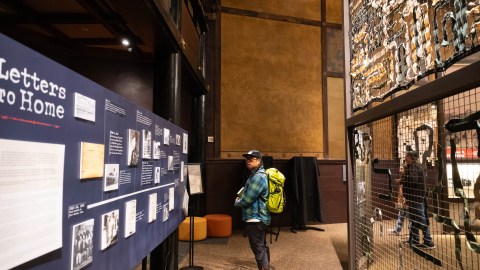
With its exhibition on water, the Ontario Museum of History and Art aims to educate and empower its community and address its wellbeing.
This article originally appeared in Museum magazine’s May/June 2024 issue, a benefit of AAM membership.
As glaciers melt, wildfires ignite, and atmospheric rivers create catastrophic flooding events, it’s clear that water management is an important piece of environmental conservation. Our societal wellbeing is intimately linked to our relationship with water—how we access it, how we ensure a safe clean supply, and how we care for this vital resource.
The issue of water has been on the mind of Californians for at least the past three decades. Southern California is one of the most studied places for water quality, and with a growing climate crisis that is deeply rooted in ever-decreasing water reserves worldwide, this local issue increasingly proves to be global.
When the Ontario Museum of History & Art decided to develop a new permanent exhibition on the topic of water in our region—“Built on Water: Ontario and Inland Southern California”—we focused on educating visitors about the intricate constellation of factors that govern access to water and its role in our environment, infrastructure, and community health. However, we were also intentional about designing the exhibition to help visitors think about water as a major factor in a community’s wellbeing.
Exhibition Background and Goals
The idea for “Built on Water” began in 2017, inspired by a grant-funded project to redesign the museum’s exterior landscape with native plants and water-saving features. At the time, curatorial staff realized there was a bigger story to tell about water and its importance in Ontario, a semi-arid city about 35 miles east of downtown Los Angeles in San Bernadino County.
After the museum was awarded a Museums for America grant from the Institute of Library and Museum Services in 2018, the five-year exhibition development began. Our curators diligently wove together research about the past, present, and future of water in the Ontario region, working collaboratively with local water agencies, archivists, teachers, tribal members, college students, and historians.
Through this research, the exhibition morphed from a narrative about the history of water infrastructure to a conversation about different forms of water management and the role of an individual citizen within the web of people who care for this valuable resource. The city of Ontario is situated above one of the largest groundwater recharge basins in the Inland Empire. Our team realized that this exhibition should encompass not only science and local history but also public health and community wellbeing.
As a municipal museum, our mission is to provide a space for residents and visitors that inspires creativity and preserves, interprets, and celebrates the history and cultural heritage of Ontario and the surrounding area. We serve a diverse community; Ontario’s population is approximately 185,000, with 70 percent of the population identifying as Hispanic or Latinx, 15.9 percent as white, 6.8 percent as Asian, 5.5 percent as Black or African American, and 0.1 percent as Native American. We knew that some people would visit specifically to view the exhibition, but the majority would be looking for something free to do on a weekend (the museum doesn’t charge admission) or to learn more about their city’s history.
Therefore, the 1,200-square-foot exhibition uses a variety of interpretive tools to share the story of water. Our team learned to be intentional in how we share stories and experiences, not just in terms of narrative perspective or learning style but also in using the exhibition as a site for community gathering and learning.
Inclusive Storytelling
The exhibition addresses the story of water by answering the following questions: Where does water come from? Who does water belong to? Do we have enough water? Who are the water guardians? In the exhibition, visitors are in a free-choice learning environment, allowed to be curious, seek archival and historical information, learn from community and environmental stories, reflect on their relationship with water, and consider how water is a resource tied to community wellbeing.
The team accomplished this in three ways: (1) we took the story and history of water and introduced diverse interpretive tools for different learning styles, (2) we prioritized community relevance and reframed the history we were telling with stories that spoke to a collective memory, and (3) we identified community leaders and professionals who serve as current stewards of water to bring awareness to our shared reality.
With “Built on Water,” our challenge was to distill a complex topic into an exhibition designed to reach a range of audiences, including K–12 school groups, new museum visitors specifically seeking information on the topic of water, and residents of all ages. To do this, we developed a range of interpretive tools that would provide entry points to different types of learners, such as hands-on activities and interactives, archival images and artifacts, infographics, audio, and digital technologies that include a virtual reality experience and a mobile application. We didn’t want visitors to feel intimidated by the exhibition’s content.
We also sought to create memorable experiences and spaces for intergenerational learning. One example of this is a magnetic matching game called Nature Scout, which reframes the story of water from an ecological perspective to connect visitors to our visible ecosystem and demonstrate how water supports biodiversity in our region. Visitors are asked to identify water resources, plants, and animals on a large fictional magnetized landscape and match where they live in our visible landscape. The game invites visitors to consider their role as stewards who protect plants and animals and approach their survival as an element of their wellbeing.
The exhibition’s history presentation includes multiple perspectives. The history of water management is complex, and we are committed to unpacking that layered story for our visitors in an unbiased way. Acknowledging the shortcomings of our prior history exhibitions, this time we worked with Dr. Meranda Roberts, an external consultant, museum educator, and citizen of the Paiute tribe, to develop a land acknowledgment for the exhibition. The land acknowledgement recognizes the importance of interpretation and encourages visitors to further question and explore the narratives that we present. By presenting history as ever evolving depending on who is telling it, we hope visitors recognize that they are also responsible for telling our local regional history.
The exhibition also incorporates testimonials from community members as a way to address community wellbeing. For example, the exhibition interactive Community Voices on Water is a collection of community stories, each about an individual’s relationship with water. One such voice is that of Maura Graber, whose family owns Graber Olives, a working and historic olive farm in Ontario:
“People take a lot of our resources for granted, and I think people need to understand that the air that we breathe, the water we need for crops, to grow the food that we need to eat, these are all things that we have to have for survival. These are things that you’ve got to be able to manage wisely and utilize very carefully, and really pay attention to how you’re using the Earth’s resources.”
After listening to the voices, visitors can contribute their own story on a printed water droplet display and read submissions from other visitors.
Connecting to Wellness
Our region continues to change. Parts of Ontario’s agricultural land is being developed into tract housing, offices, parks, and logistics complexes. Water permeates every aspect of our lives and society. Not only do we need water to live, but it’s a crucial component of food production, business, recreation, and so much more.
Much of the conversation around wellness is centered on mindfulness, a practice that focuses on consciousness, the present, and how we think or feel in our own bodies. However, the physical environment is equally, if not more, important. The health of our physical environment—including our water and air quality, the green spaces in our communities, and our access to healthy food options—has a direct correlation to our community’s wellbeing.

Part of our job as a museum is to offer information that is easily digestible, compelling, and encourages further exploration. With “Built on Water,” we considered how we could also empower visitors. Wellness in the museum can be embodied in a moment when someone recognizes how they are one piece of a larger narrative in which each individual’s action can shape the story. If we, as museums, are willing to give up some of our power as narrators, we can create more dynamic spaces for discovery that empower our community members.
SIDEBAR
‘Conduit’: A Complementary Exhibition
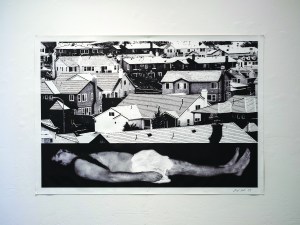
As a museum focused on local history and contemporary art, we wanted to develop an art exhibition that would complement “Built on Water.” That exhibition, “Conduit,” uncovers how the diversion of water has shaped the way we live through a critical examination of the tension between urban growth and the natural world.
The exhibition features seven Southern California artists: Christy Roberts Berkowitz, Gerald Clarke, Noé Montes, Lorene Sisquoc, Samantha Morales Johnson, Stuart Palley, and Lauren Bon and Metabolic Studio and includes drawing, photography, sculpture, and mixed-media installations. The artists investigate wide-ranging topics, including the relationship between colonization, the erasure of Indigenous people, and urbanization; recent environmental disasters; and speculative ecologies.
For example, roberts berkowitz’s installation of charcoal drawings, Sacred Ground: A Garden In Service and Gratitude to Dorothy Ramon and the People of Maara’, features 10 plants chosen by the San Manuel Band of Mission Indians (Serrano peoples) that are significant to the region. A small, framed drawing in the middle of the installation depicts mustard and English reed—two invasive species introduced by settlers to the West and East Coast, respectively.
Clarke’s installation, One Tract Mind, made after the 2008 housing crisis, is a commentary on the effects of land development in Temecula, California. The work includes a series of cups filled with water placed on the “roads” of a miniature tract-home community. It asks us to consider who rightfully owns the resources necessary for this and similar developments throughout Southern California.
“This group of artists has been brought together thanks to their diverse and astute observations of feedback loops,” guest curator Debra Scacco explains. The exhibition provides another opportunity for visitors to reflect on the broader impact of individuals and how each of us might envision a different future. “Conduit” is on view at the Ontario Museum of History & Art through May 19, 2024.
Upcoming Events
-
-
Understanding the U.S. History Sector
Event Date:Presented by: American Association for State and Local History (AASLH) -
-
Industry Showcase: Innovative Digital Solutions
Event Date: