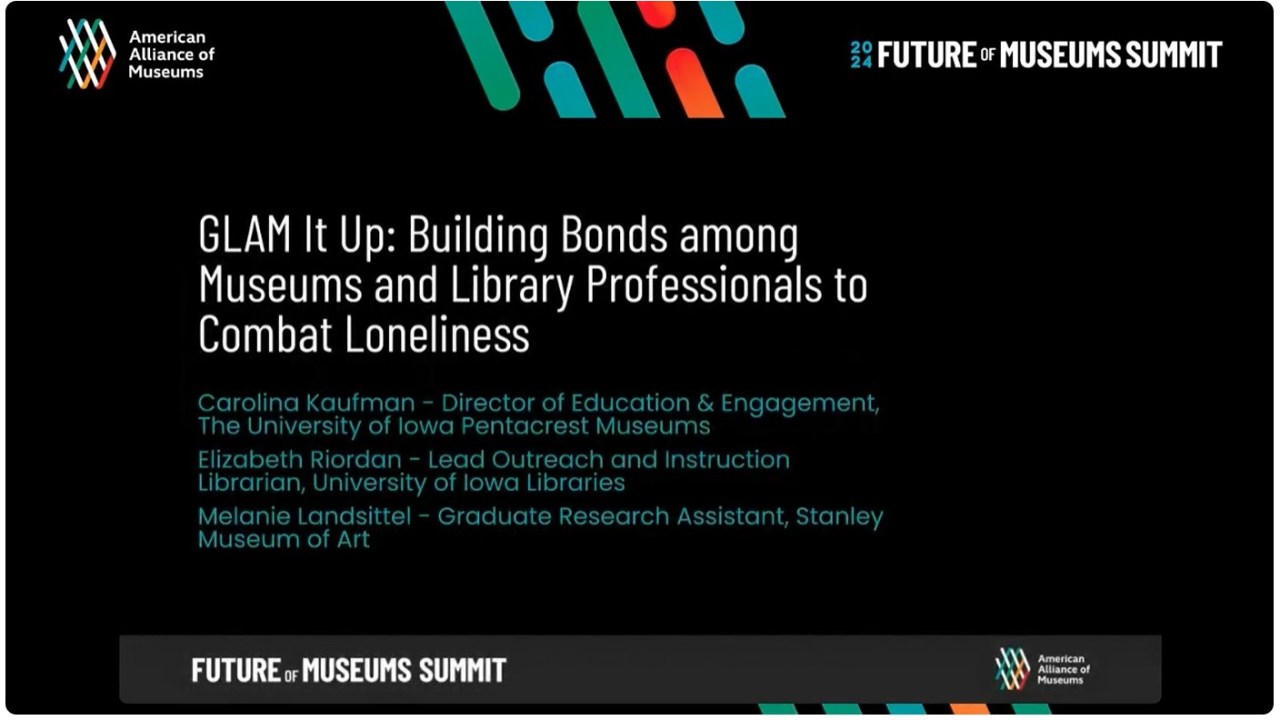
This recording is from the Future of Museums Summit held October 29–30, 2024. This session explored how cultural institutions can act as community lifelines to heal isolation.
Presenters:
Carolina Kaufman, Director of Education & Engagement, The University of Iowa Pentacrest Museums
Elizabeth Riordan, Lead Outreach and Instruction Librarian, University of Iowa Libraries
Melanie Landsittel, Graduate Research Assistant, Stanley Museum of Art
Transcript
Carolina Kaufman:
Hello and welcome. Hi everyone, and welcome to GLAM-It Up. We’re so glad you could join us. Today we’re going to be exploring how galleries, libraries, archives, and museum staff are working together to build connections that combat loneliness and support wellness within the workplace. Museums in particular play a critical role in fostering community engagement and addressing social isolation. Before we begin, just a few quick notes. This session will be recorded, and you can enable captions at any time using the settings below. We’d love for this to be an interactive session. We encourage you to participate in the activities, engage in the chat, and ask questions during our Q&A. To get started, let’s do a quick icebreaker. If everybody could just share three emojis that best describe how your week has been going so far.
Afterwards we’ll ask and few to explain why you chose the emojis, and this is a fun way to get everyone comfortable and make some personal connections right away, so let’s see what emojis people are feeling this week. You can put your emojis in the chat. Thanks, Elizabeth. Excellent. They’re coming in. Ooh, I like that one, the cat. Very nice. Please continue to share. Just something fun to do quickly. My name is Carolina Kaufman, and I am the director of education and engagement at the Pentacrest Museums at the University of Iowa. We encompass both the Museum of Natural History and the Old Capital Museum at the University of Iowa, and I’m proud to present my colleagues today who will introduce themselves.
Elizabeth Riordan:
Hi, I’m Elizabeth Riordan. I’m the lead outreach and instruction librarian here at Special Collections and Archives at the University of Iowa Libraries.
Melanie Landsittel:
Hi everyone. My name’s Melanie Landsittel. I’m a graduate research assistant in the department of learning and engagement at the Stanley Museum of Art.
Carolina Kaufman:
Great, thank you. And now that we are starting, I’m going to kick off with a question for everybody. This will be a two-part question. We want to get a sense of what words or emotions come to mind when you think about loneliness in the workplace and what words or emotions you associate with a sense of belonging in the workplace. Melanie will be kind, or we’ll have a link in the chat for a Mentimeter for a word cloud.
Melanie Landsittel:
Thank you.
Carolina Kaufman:
Great, thank you.
Elizabeth Riordan:
Everyone click on the link and fill that out for us real quick.
Carolina Kaufman:
We are starting to see some words come in. And as this word cloud changes, we’ll notice that for words that are appearing big, that seems to be a common feeling. For words that are smaller, they’re equally important, it’s just showing the differences in the way we think about loneliness in the workplace. This is great. Isolation is a big word. Disconnect. I see another disconnect.
Melanie Landsittel:
I like that someone a cubicle. I can relate to that. I’m now in a cubicle.
Elizabeth Riordan:
Dog and cat, to be honest. They keep us company.
Carolina Kaufman:
Dark. That’s an interesting one. Thank you so much for sharing that. Frustrated. Slow day. That’s interesting. I really appreciate hearing all of these different emotions and words and as I think people are still responding, we’ll just give it another second or two.
Elizabeth Riordan:
Several versions.
Carolina Kaufman:
Great.
Elizabeth Riordan:
Agreed.
Carolina Kaufman:
Sad. Another big connected one. Now keeping these in mind let’s shift to belonging. We’re going to also do the same. Please share words or feelings, emotions that you associate with feeling of belonging.
Melanie Landsittel:
It should be available on the same link. There we go.
Elizabeth Riordan:
Supportive.
Melanie Landsittel:
I like meaningful, appreciation, energetic.
Carolina Kaufman:
We can definitely see a shift here with words. Connected is a really big word, still centralized. There’s smaller words-
Elizabeth Riordan:
I was going to say there’s a lot more variety of words with this one too.
Melanie Landsittel:
Peace, together.
Elizabeth Riordan:
Motivated.
Carolina Kaufman:
Fulfilled. I love all of these. Even smaller words, again, give us insight to different ways that people are experiencing belonging. These two word clouds highlight where we are and where we want to go. Interesting to see that there’s a lot more of where we want to go. And as we continue the session, let’s think about how we can move from feelings of loneliness towards feelings of belonging and connectedness. Thank you for participating in those polls, in the word cloud. We’re going to talk a little bit about the session outline today and what you’ll be expecting. We’re going to explore the loneliness epidemic, building greater understanding in the dual perspective, both its broader implications for society and specific relevance to museum and library professionals. This understanding, I think, will help us recognize the implications for well-being and productivity and help us identify and address the gaps or the challenges that might exist in our workplace cultures. Next, we’re going to take some time to look inward and reflect on the unique challenges our institutions face, especially during and after the pandemic.
We’ll discuss how isolation and disconnection can show up in our professional lives and affects the feelings that we have on our teams. By reflecting on these experiences, we can identify the gaps further that may exist. And finally, we’re going to build a culture of connection. We’re going to share examples from our GLAM team at the University of Iowa in implementing multimodal strategies to promote connection, collaboration, and internal support which are going to be replicable for anyone to try themselves. And then we’re going to open up the floor for everybody to share their ideas. Again, no ideas… Whatever effort you have matters, any kinds of experiences or experiments you’re doing, we’d love to hear from you. And that just supports breaking the silos and supporting one another. Overall, we move towards the session we’re going to aim to empower you within your roles, inspire you to champion wellbeing creatively with humor, compassion, and a sense of adventure.
By investing in yourself and each other, we can help foster a culture of support and resilience, knowing that together, despite the challenges that we will learn about today and already know about, we can ensure that the show will go on. And now I’m going to pass it to Melanie.
Melanie Landsittel:
Alrighty. Now I’m just going to quickly mention a snapshot of a few figures about the impact of the loneliness crisis to provide a little bit of context for our discussion today on the need for working to facilitate belonging in our workplaces. According to a study done by Harvard in 2021, 36% of US adults report serious loneliness, frequent or almost always feeling alone. It was called an unprecedented public health crisis in 2023 by US Surgeon General Dr. Vivek Murthy, citing its significant physical and mental health consequences. He emphasized that loneliness not only affects personal health, but also the productivity and engagement levels in the workplace and schools diminishing overall societal wellbeing. And that solution’s why in strengthening our social connections to one another. Could you move on to the next slide, Carolina? Thank you. In the workplace, loneliness can lead to reduced engagement, reduced productivity and job satisfaction.
And additionally, the WHO reports that burnout and chronic stress increased globally after the pandemic, which I’m sure many of us felt with many employees experiencing isolation, especially from remote work and a lack of workplace social interaction. To combat loneliness, Surgeon General Murthy recommends investing in community institutions like our libraries and museums and parks and fostering workplace and personal relationships, and even small actions like regularly checking in on your friends and colleagues. And this is really a call for a culture of connection like Carolina mentioned, where people make intentional efforts to engage and support one another, especially in professional settings where the effects of isolation can be felt so deeply. I’m going to pass it back to Carolina to talk more specifically about the museum world with respect to that.
Carolina Kaufman:
Looking inward and as we dive on the impacts of museum and library professionals, it’s clear here in this slide showing the multiplicity of influences and pressures like economic strain, social expectations, post-pandemic realities that have caused the cultural sector to juggle many different challenges. It might feel like we’re almost living out Queen’s classic song, Under Pressure. From job insecurity to burnout we’re constantly balancing these demands and it’s a lot to handle. For example, job insecurity remains a significant concern in 2022, The International Council of Museums survey showed 53% of museum employees worried about layoffs or salary cuts and financial strain adds to the mounting stress. Burnout continues to be a widespread issue with 67% professionals feeling the effects and 53 expressing anxiety about jobs according to the American Alliance of Museums. Reopening and the hybrid work challenges that we had coming back from trying to balance between digital programming and in-person engagement, we noticed that there were lots of different ways that we were trying to juggle what was important and what to do when.
An example also comes from the American Library Association that surveyed 59% of librarians feeling anxious about dealing with disruptive patrons. For example, resisting to mask mandates or engaging with challenging behavior. And let’s not forget, librarians often face societal issues such as homelessness and mental health and even violence. DEI, as we’ve heard in several sessions during this summit, and the rise of book bans have added complexity to the work of our cultural institutions. And we’re tasked to make these spaces culturally reflective, relevant, and welcoming to all, an important but challenging goal. Navigating the diverse community perspectives, the shifting organizational priorities and evolving regulations can sometimes leave staff feeling a mix of emotions, everything from being isolated to feeling overwhelmed and even discouraged. But on the other hand, there are also staff that are feeling determined and committed to supporting DEI initiatives. These issues are just part of a broader societal conversation about which narratives to include in the public spaces, which has significant implications for the well-being of our staff and the mission of cultural institutions overall to serve diverse audiences.
And so this, along with the pressures of leadership and challenges in funding, they contribute to a lot of different things that a lot of us may be familiar with, for example, imposter syndrome, self-doubt, the lack of support, which has left many staff feeling alone. And though we might feel under pressure, today’s session is about finding ways to alleviate that weight and build more connected supportive teams. And that’s what we’re going to focus on next. I’m excited to pass it on to Elizabeth who will help change the narrative.
Elizabeth Riordan:
Thanks Carolina. I’m going to talk a little bit about Iowa here and together as a GLAM cohort and how we’ve responded to loneliness to foster both a culture of connection externally and internally. Carolina, next slide please if you could. As my introduction, let slip, I’m not actually from the museum world, I’ve infiltrated you all today. I’m actually from the library’s realm and I’m lucky though to be here today because of the University of Iowa’s growing commitment to GLAM. On our campus GLAM is represented by the Stanley Museum of Art, the Pentacrest Museums, which Carolina said includes the Old Capital Museum and the Natural History Museum, and then the University of Iowa Libraries, which has seven different libraries plus special collections and archives which is where I work. Next slide please, Carolina. GLAM has been around at the University of Iowa for several years now, but it functioned more as a check-in during the early years. We would all get together and go, what are you up to? Oh, we’re doing this. That’s cool. It was more of that feeling, just making sure we all knew what we were up to.
We really didn’t hit a stride as a collective group until 2020. And I guess it took a global pandemic really to bring us together. In spring 2020 the CARES Act provided opportunities for federal agencies and organizations to award emergency grant funding to provide technical support and capacity building for digital inclusion and engagement. Instead of competing for a single university slot for this grant, our friends at the Office of State Archaeology came to GLAM and said, “Hey, let’s collaborate instead of compete.” This was the first of its kind collaboration between these units and it was definitely seen as a great experiment, one that was thankfully successful. Our shared goal was to create virtual content for older adults and senior living communities throughout Iowa, populations, especially vulnerable to COVID-19 and isolated during the pandemic. We called this project Connected for Life, and we provided virtual presentations about our collections or themes that we had discovered from around across all of our units to these senior communities. And through assessments with these folks we found that 74% of people who attended our virtual talks felt closer to their own community after coming to one of our programs.
And over 90% felt closer to the University of Iowa after our talks, which that’s because we were so charming and engaging, I’m sure. But during this two-year grant, we also learned a lot about each other and our respective units, and we really grew closer as colleagues. For me personally, this was a project that was a game changer. At the time I was the only one really doing this kind of outreach in my department, and it did feel like I was facing this uphill battle during COVID. But I was able to connect with folks in the museums and hear about their outreach attempts during these difficult circumstances and they really became a lifeline during a difficult period, so I consider myself very lucky that I got to be a part of Connected for Life. Next slide, Carolina. GLAM at U Iowa has since applied a lot of these lessons that we’ve learned from our two-year grant on how we approach events today, but also how we view and approach our own relationships with our peers.
We’ve broken down some of these lessons into a few categories and that we’re going to talk about with you today. And so the first is curating and storytelling. What we discovered, number one with the folks at the senior community centers where through our virtual presentations, not only did they like to hear our stories, but they loved to add their own stories to what we were talking about. Storytelling and making sure others can share not only provides audiences with a voice, but a sense of ownership in the narrative and a place at the table with those around them. And with that lesson, I want to turn it over to Carolina to talk about a really great project the Pentacrest Museums are doing with the community. You’re still on mute, Carolina.
Carolina Kaufman:
Thanks Liz so much. This may sound familiar to some people in the room. MY Collections is an initiative at the University of Iowa’s Pentacrest Museum’s Museum of Natural History. It was actually inspired out of two former MY Collections related programming or opportunities at the Art Institute of Chicago. They used to have a MY Collections where you’d curate your collection of the Art Institute’s collection online, teachers would take advantage of that. And then at the Field Museum when I was working there, they had a children’s display at the Play Lab of children’s collection, which my daughter participated when she was just four. That inspired me to bring that idea to the University of Iowa but think of it more of the way to bring personal stories in terms of what collecting means to people and how the project supports the notion of community-driven collections and interpretation and curation, bringing it at the same level of importance as our regular permanent exhibits just nearby.
By offering this opportunity for the community, MY Collections highlights the significant individual stories fostering inclusive environment where participants can express their curatorial voice and allows for a diverse range of voices. In fact, what I found very surprising about initiating MY Collections and hosting, inviting people to apply for being exhibited in this program is I found over 66% of those that wanted to showcase their collection were staff and faculty from the community. That said a lot in terms of how they wanted to participate and use their voice in a unique way through collecting. And so that in turn supports a sense of well-being and invites dialogue and ensures that the museum remains a space for inclusive engagement, both for permanent collections and new narratives. This shifted my interest to try to bring additional engagement, and we had a collector’s day program where I invited the existing collectors, all 18, to come and actually showcase their collections in person. And invite them to find ways to not just engage with the audience but find thematic activities that they can extend their love of collecting with the community, with curation and creativity in mind.
For example, we had this lovely couple both working at the university that invited all audiences, really the whole community, to create a Lego city and then which they took their Lego minifigure collection and inserted it within the city, making the audiences feel that they were part of their collecting experience as well. Others brought their geodes and had the opportunity to crack geodes so they could take one home or design a plate as Elizabeth Riordan, who’s with us was one of our collectors showcasing her butter practices. Again, just other ways, and I think what came out of this was just this beautiful synergy of community engagement, staff and faculty involvement and storytelling in a very personal way. And I’m showing this picture because I love these two collectors having a moment with our youngest collector of geodes outside, just having a beautiful conversation about their love of collecting. And so that has been something that has inspired me to think of ways of how I can expand this and something that other museums I think around the country are experimenting with. With that in mind, I am going to pass it along to Melanie.
Melanie Landsittel:
Awesome. Thank you, Carolina. The next project we’ll be sharing under this category of curating and storytelling is called Recipes for My Coworkers, Art and Food among Friends at the Stanley Museum of Art. This is a book that I edited and designed and printed. The project really simply started with a casual conversation of like, “Ooh, what are you having for lunch today? It smells so good,” up in our offices. And up here we have this throughway that has a tall table, which is kind of its stomach height and it’s really perfect to lean on and talk to your other coworkers as you’re walking back from the kitchenette to your office or cubicle in my case. And this table is actually; it’s not meant to eat on or be doing a lot of other things on. It’s really meant for object file viewing, but we mainly use it for puzzling. We usually have a string of puzzles going that are kind of art related there.
And sometimes we’ll even do this thing called puzzle meet where when we have a meeting, but we don’t have to look at our computer, we’ll be like, “Oh, do you want to puzzle meet?” And we’ll meet at that table. This is just meaningful break time from our screens and something that is very important to our office culture. But to get back to lunch, when I started at this position, I really loved how people from the office would stand in this area and take time to rest and share their recipes with each other on what they were bringing for lunch. And they might explain in detail how they might their favorite recipe or why they made something so quickly that day because they had a really busy weekend and what they were up to. And it really just showed me how we can get this really great window into each other’s lives through our food. And from my experience, I really started thinking about how what we share is lunch and how this is a very personal and beautiful thing.
In lots of countries lunch is the most important and largest meal of the day, and for me, that’s personally my experience and what I’m used to. And so I decided to make this book as a thank you to all of our staff for sharing lunches with me. And I was originally just planning to make it, throw my own recipes in there, write some little essays, and I just wanted to give them out to people, kind of like a zine. But to my great joy, many other staff members wanted to participate in it, and it grew to a slightly larger project. Next slide, please. I include this page because it gets to the meat of the project and its sincerity and its silliness. This is right after the title page and in a lot of books there’s some lofty quote in this position.
And I took a look at a lot of structures and layout designs of community cookbooks in our special collections with the help of some of my GLAM colleagues at the library while I was doing this project just to get a nice design that I was proud of, to give out to everyone that represented their work. And the quote that I ended up with here is attributed to Aristotle that says, “Pleasure in the job puts perfection in the work.” And I added this because it made me think about… I found it in my notes, and it made me think about how sometimes we just need these types of simple but inspiring ideas to propel us forward and bring us to optimism. Next slide, please. Awesome. After all these recipes from our staff members were collected, from learning and engagement to collection staff, to curatorial teams, I ended up making this book that you can see a few snapshots from here. On the right side we see the ingredients list and the beginning of the instructions for a vegan snickerdoodle cookie.
I also made a lot of drawings and two other colleagues of mine sent me some drawings that they wanted in the cookbook as well. On the left side, on the upper corner, we have a drawing for our museum director’s matzo ball soup, and then in the bottom left corner we have the little drawing and some ingredients to the Galupski soup from our curator of learning and engagement. We had just about half of our staff actually participate in this project with only the broadening of two sporadic emails. One was like, “Hey, are you interested in this? If you are, just send me an email, let me know before break.” And then in the spring I sent another email that was like, “Hey, you told me you were interested in this, but I haven’t got your recipe yet. Please send it to me ASAP. I don’t want to forget about this before the summer starts.” And I really encouraged everyone in their submissions to just write in a non-academic tone, write in the first person, be telling your friend about the recipe that you want to share with them.
And all that said, it was a really relatively short-term project. It ended up being an edition of 50 books that I designed and Rezo printed, and coil bound because I, for some reason, have a coil binder. It was relatively short-term; it wasn’t very expensive to produce since I printed it on campus. And as I gathered these recipes and the book started to come together, another purpose of the book became clear to me, which is basically just to unfold the complexity and inaccessible nature of the art museum in a small way by illustrating its lesser-known persona as a lighthearted office environment. It became apparent to me how essential maintaining this lightheartedness is to our functioning.
As museums and library workers we’re dealing with a heavy burden of stewarding these incredibly valuable objects, deciding how the public gets to see them and interact with them and a whole myriad of other difficulties as Carolina mentioned earlier, so to have moments of silliness within the context of a simple American office can remind us that work is just work and that we are all just people and in this case and in all cases, people who need to eat and sharing those essential needs with each other, similar to how Carolina mentioned collecting, it’s like a very simple thing that people need to do and that we can all share and bond over. Next slide, please, Carolina. To reiterate, in the cookbook we all get to be the voice of authority and the voice of wisdom and share what we know and love and giving your staff those opportunities to share these perspectives and physically create something together fits along into our next category, which is collaboration and creativity. And for that, I’m going to pass it off to my colleague Elizabeth.
Elizabeth Riordan:
Thanks, Melanie. Next slide, Carolina. One thing I’ve started doing in my department is celebrating random holidays or special occasions, so holidays like National Pickle Day or International Snail Day or celebrating the birth of Poppy, a giraffe that was born at Blank Park Zoo here in Iowa. My coworker Paula and I plan these events and sometimes we get the help of another colleague in our department, but we keep it secret from everybody else in the department until the day of. Then when folks walk down the hallway and to their are spaces, their offices, they’re going to see the walls are decorated with lots of pictures and fun facts about whatever subject we are celebrating because we got to keep it educational, so of course we have fun facts there. We’re librarians after all. There’s crafts for them to do that fit the theme. There’s even themed snacks and stickers and little toys that we get for them. Next slide, please. And why I do this… Oh, let’s talk about the pickle wall. I’m really proud of the pickle wall, so I just want to take a moment to talk about it.
Here you see a wall that says, “We relish working with all of you,” for pickle day. And yes, I may pickle people for all the staff and students in our department and grant, I don’t expect people to spend hours making pickle people while they watch TV at night. You all have lives and just because I don’t, doesn’t mean you should be doing this as well, but I just happened to really love doing this kind of crafting, so I will say I was really proud though after pickle day was done, a lot of people kept their pickle people and they’re up in their offices or on their book carts or somewhere in their spaces, and that makes me really happy when I walk by and see it, so it does have a lasting impact on the people that you work with too like, they really appreciate the effort that goes into some of this kind of stuff. And I have had student workers who feel like they get intimidated sometimes working in special collections.
And when you have something as ridiculous as a pickle person, it lets them laugh and then let them enjoy the moment and want to talk to more curators, want to talk to the librarians. And it opens up this path of discussion, which I really enjoy. Next slide, Carolina. And what I really enjoy about it is the absurdity of it all. That’s why I do this. A lot of my thinking actually stems from the photo that you see on the screen here. U Iowa has the papers of journalist Tom Brokaw, and while I was processing the collection, I came across the photo that literally made me laugh out loud. I was taken by the fact that you had these three news reporters, John Chancellor, Roger Mudd, and then Tom Brokaw in the far right there who spent their career having to deliver really bad news to the nation or having to cover some wars and famines and all of these really serious situations. And then you get this moment of levity with them, this moment where they let their silly side show.
And I scammed the photo, and I wrote a message at the bottom to remind myself that it doesn’t always have to be serious, and it still hangs in my office today just to constantly remind me. And I feel like it’s a good reminder for all of us, in fact, things can feel really heavy in the GLAM world right now. As we mentioned earlier, libraries are facing an unprecedented amount of issues right now, including issues of book censorship and threats towards public and school librarians. According to the American Library Association, in 2023 public library saw an increase of 92% for the number of titles targeted for censorship since the previous year. And titles representing the voices and lived experiences of the LGBTQIA plus community and BIPOC individuals made up 47% of those targeted and censorship attempts. Next slide. What I’m saying is that we shouldn’t ignore these facts, we shouldn’t turn away from them. What I’m saying is that when you spend half of your year calling legislators, going to town hall meetings, answering angry emails from patrons, absurdity becomes a really great pressure release.
I noticed that in my department, everyone was just moving slower, dragging their feet. And then I was like, all right, we’re going to another national holiday and it’s going to be pickle day or it’s going to be snail day, so when I notice when things are getting really bad, I know it’s time for a holiday. The Dada’s knew it, the Fluxus artist knew it, the surrealist knew it, there’s power to be had in the absurd. And I like to think that these little holidays offer a reprieve to my peers. And what I like about them is that my coworkers can be as involved as much as they want or as little as they want, so they can eat the snacks and do the crafts. You see one of my coworker’s hand giraffes for Poppy Day, they can laugh and do all of that stuff, or they can just simply make a plate of snacks and go to their office. It doesn’t matter. We don’t hold them to anything.
We set up all the stuff in the hallway right outside the offices, which I really enjoy because I can hear people gathering around the snack table. They’re laughing at pictures on the wall, complimenting each other’s crafts, going, “Oh, I didn’t know this fact.” Or daring each other to eat the pickle flavored cupcakes that I made, which they were delicious. Okay, I don’t care what people say. What I’m saying is when it’s been a tough year, you have to find things to celebrate. You have to make room for levity so that you are light enough to keep moving forward. Next slide, please. And this really all ties into our third and final theme here, stepping back and stepping Out. I’ve heard in a few other presentations at this conference about getting stuck in your own bubble, and it’s so easy to get caught up in our worlds, our problems and our frustrations. These little holidays are okay, but we’re still just within our department and we’re still just dealing with our own coworkers and things like that, so we’re still wrapped up in our own little world.
How do we pop these bubbles to learn new perspectives or even just look at things with fresh eyes? Next slide please. In the last year and a half we’ve been working hard to learn more from each other through things like a GLAM Crawl that we did last winter. Every unit in GLAM invited the whole group to visit their building where we showed off our spaces, talked about successes and struggles we were having, and brainstormed ways we could collaborate on events or outreach using our distinct collections. These were also really fun because the units came up with fun activities for all of us to do like, there was a scavenger hunt at the Stanley Museum of Art. Carolina created a bingo card for all of us to do at the Natural History Museum, so it was a way to be playful as well. It also gave us a chance to see some of the big hitters on campus, so at the Natural History Museum, the giant sloth, Rusty is there, which Carolina, that was on the very first slide that we showed.
Here you see up in conservation at the libraries, my coworkers Bill and Zoe showing off some of our Sackner visual concrete and poetry items, which was fun. The GLAM Crawl was such a great moment of discovery for all of us. It was fun, enlightening, and such success we went a step further and decided to set up field trips over the summer to visit museums and libraries off campus that are here in eastern Iowa. We went to the Czech and Slovak museum and library in Cedar Rapids, Iowa, as well as The Theatre Museum of Repertoire Americana in Mount Vernon, Iowa. Visiting these places were not just great for our own learning, but we received positive feedback from these institutions as well. At the theater museum, we learned about their struggles with outreach that many of us had our own experience with, so we had this great brainstorming session while touring their spaces and coming up with strategies that they could attempt to get their word out that they were there.
And they expressed actually as we were leaving, they were like, “We’re so grateful you decided to drive out here and see us. It was great talking to you about some ideas.” The Czech and Slovak Museum, which you see in this top picture here, it’s staff showing us their creepy doll collection, that’s not what it’s called, but it’s creepy dolls, actually mentioned they were surprised and happy when we reached out for a tour. They were grateful we showed interest and care to learn from them. They had to rebuild their space after the floods of 2008. And it was fascinating to hear from them on what rebuilding looked like and how well and not so well some of the decisions they made went. As the libraries are in need of renovations really bad, I found this particularly interesting, and I know I gobbled away all the things that they were saying into my head. The Czech and Slovak Museum has also mentioned that they would love to come down to see our spaces next and just continue a lot of the discussions we started over the summer.
With these field trips we were able to create more connections with others in the field, develop partnerships with community groups, and just show one another that we care about each other’s work. It was nice to be reminded that you aren’t alone in what you do. It was also refreshing to talk about issues with peers who understand your work but aren’t actually part of your department. Sometimes you just need to leave that space and complain about something that’s happening with people who are also facing it, but in a different area because it’s like we see you and we appreciate your work, and we understand. Now I’m going to turn it over back over to Carolina to talk a little bit about some nature tours that she did with people.
Carolina Kaufman:
Yes, thank you, Elizabeth. And I also want to kudos to the folks on the chat. They’re putting in some interesting imagery, some interesting comments. Glad to know that you have a Giant’s Law, Marshall, thank you very much for adding. We want this to be a community of connections, so if you have anything to share, please do. This will be our last example. Ever since the pandemic… I was actually a pandemic hire, and when I got here one of the things that I was impressed with was just the beauty of this campus. We have over 18,000 staff that work at the University of Iowa and over 30,000 students coming as well. And a lot of the times that students choose campuses is for their nature and beauty. But during the pandemic, many people may recall that people went out a lot in nature, especially just after things were starting to get lifted. There was more interest and more drive to be connected in a disconnected world and go out in nature.
And revisiting that connection with nature was something that I was very interested to think about how we were going to invert the museum experience when people were already hesitant or unsure to come into our spaces. And we were trying to figure out, again, that balance between in-person and digital programming. The tree tours came to mind. Our arborist, our university arborist has given tours but when I found out that we were going to get the Anne Frank Sapling tree to the University of Iowa, there’s only 13 in the world, and this is the seed from the original Anne Frank Tree that was standing outside of her house while she was hiding and looking out and contemplating freedom and nature, and of course writing. And the University of Iowa is actually the UNESCO World Heritage Site for writing, so all of these interesting ideas started coming to me about resilience, about writing, about nature, about thinking about our relationship with the natural world. And I wanted to create a multimodal experience for audiences with all the senses in mind to think about the trees on campus.
I partnered together with our university arborist and facilities management to create these tours and not just talk about the trees and why they were important or what makes that tree a tree in terms of the natural scientist piece, but I wanted to provide a cultural lens of these trees. What did these trees mean to different societies and cultures around the world? What stories do they bring that have been passed down from generation to generation, from our indigenous cultures, for example? And what health and wellness benefits have trees provided for us? And with the University of Iowa known for its healthcare, I was very interested in partnering with our wellness services group called liveWELL. This partnership started evolving into something very big and very popular at the university in terms of thinking about how people were trying to find themselves and appreciate campus and learn about what we had here. And therefore, the tree tours were born. Regarding medicinal properties, yes, nature is very big medicine for time and memorial societies have known how to use, I take advantage of trees and plants for their medicinal purposes and for spiritual purposes.
In Japan more recently, there was a prescription movement to go into the forest prescribed, and it’s known as shirin-yoku, which actually means forest bathing. Forest bathing has become a popular practice here in the United States and has been something that has provided more evidence towards health and wellbeing in terms of the compounds and chemicals that trees release to defend themselves called phytoncides. And these phytoncides, which we breathe in, doesn’t take a long while for us to breathe that in and then for us to develop stronger immune systems, raise our killer cell levels, which actually help fight disease and viruses and improve mental health, lower our cortisol levels, which cause stress and other ailments. And so we have a wonderful doctor here that graduated from the University of Iowa and is a forest bather. She’s certified in forest bathing, and she recommended that only five minutes outside, including urban forests, five minutes outside under a tree, can help reap some of these benefits.
And so with that in mind it made me think a lot about wellness identity and team building and how this partnership, which was campus-wide and included folks like in our human resources department, the College of Pharmacy, the UI libraries, and many, many others to come in support of this multi interdisciplinary experience that involved all the senses in support of health and wellness. And so now I’ve been doing team building within different teams that want to have a private tour to think about how they might relate to identity development, workplace culture, and what we can learn from trees. Because this whole idea, and actually I heard this at the AAM, the 2022 AAM conference when Thomas Friedman spoke, the author of The World Is Flat, talked about that in order to thrive in society, you can’t just think about survival. We have to think like trees. We have to think about open systems and forming complex adaptable coalitions. That really struck a chord and felt that we were doing the right thing with these tours and with these experiences.
That said, that wraps up a lot of different ideas that we provided and multimodal engagement. We hope that this sparks interest in the way you might think about collaboration, wellness in your teams, and we want to invite people to share their ideas. Anything, if you’ve experimented with something or if you’ve done something that you’ve done with your team that you’re really proud of, we would love people to share.
Melanie Landsittel:
Please share in the chat.
Elizabeth Riordan:
And I know we have some questions too, so we can talk a little bit about ideas and questions at the same time, if folks are okay with that.
Melanie Landsittel:
If people want to trickle ideas into the chat, and then we can address the Q&A things that are pending in the Q&A now.
Carolina Kaufman:
Why don’t we, while people are hopefully adding some of their ideas, let’s check a couple questions? We’ll start with the one at the top, “How would you suggest navigation?”
Melanie Landsittel:
Oh, there’s one more above that.
Carolina Kaufman:
Oh, excuse me. I’ll read the one that’s on the screen, “How would you suggest navigation for new projects, directions of the museum, while not ending up being the leader of every project you think of? We have a supportive director for new ideas, but engagement across staff is difficult.” Great question.
Melanie Landsittel:
That’s such a good point.
Elizabeth Riordan:
I do become, when I get ideas, they’re like, okay, do it. And I’m really bad at this. I’m not going to lie. I do take on a lot. Carolina or Melanie, do you… I think.
Carolina Kaufman:
Go ahead.
Elizabeth Riordan:
When you get other people excited though about certain things, you can do a partnership, so I think one of the things that I run into here is that people are like, “Oh, but you’re so good at doing it, I’m scared to not do as well,” or something like that. And I’m like, “Well, let’s partner for the first one and I’ll guide you, and then you can…” Because I work with a lot of people who are new to the field, and so I think they need a little bit of encouragement to get the confidence to run something, a new project or anything like that. And so sometimes it’s just offering a lot of support for the first time that they do something and then the next project that comes along, they feel a lot better, at least that’s been my experience. I’ve stepped back on a lot of projects that I was running because I’ve now got people who are willing, who feel more confident taking it on.
Melanie Landsittel:
Liz, I think that’s such a good point. Whenever I came to the museum, one of our instruction librarians that worked here, she was like, “Hey, I know that you’re excited about things and I think you have energy that could go towards this. What do you think?” And she would give me a lot of… When I started, she would give me a lot of… We would have just time and resources from her, just a little lunch or something like that, and that would get me riled up to do the project. You know what I mean? I think it’s good to have… Even if you have an idea of maybe there’s another person like other people on your staff that also might be able to be riled up. But I think Liz, the way that you put it was perfectly right.
Carolina Kaufman:
I think I’ll add to that because I think one of the things that we have is the fact that we have GLAM itself, the fact that we have a cohort of galleries, libraries, and museums, and to support one other and manage the weight or distribute the weight a little bit. If somebody wants to host like a coffee together or something related to an upcoming common thing that everybody sees like, they have the Tuba concert in front of the Pentacrest. This year our social media coordinator had a Ghostbusters car come into the front of the museum, and it was a student experience, but a lot of people from the staff community came out too. And that was a very interesting way to, again, lighten up the load through these fun experiences. And if you do have, I would recommend if you do have a student community or student intern, student employees take advantage of them helping to support your social engagement with each other.
Maybe that’s something that they’d be interested in, whether it’s recognizing staff on a staff board and doing those pickle portraits sort of thing, or taking advantage of somebody writing down some fun holidays that you might want to chime in on. Low hanging fruit, low-key sort of things. And then as you establish maybe a network of libraries, museums, or even within your different departments at your institution, you can think about things that you might want to say, hey, let’s invite this department to see if they want to go check out the Museum of Science and Industry down the road, for example, and see what’s possible. I think it’s just a matter of, yes, taking a little time to brainstorm and think about what are some easy first steps towards wellness and engagement amongst your staff. Did anybody want to add anything? I think we saw something in the chat here-
Melanie Landsittel:
I think there’s two more Q&A questions that we should-
Elizabeth Riordan:
The next question in the queue is, “Do your organizations have a budget for these celebrations, staff field trips? How do you talk about why these things are important for staff within the conversation about budget?” Oh, money, isn’t it so fun to deal with? When it comes to my little staff holidays, when it comes to the food, I do pay for that myself or my colleague Paula and I… Because baking it myself, and I’m making my coworkers try my crazy experiments that I wanted to just try anyway. But like I said in my presentation, I don’t expect everyone to do that. The other thing we do with budgets though, because we’re printing and making crafts and all of that stuff, anything for crafts, we actually take out of the budget for office supplies because we are counting it as it’s needed for the office, so we use-
Melanie Landsittel:
And it is.
Elizabeth Riordan:
It is. It is 100%, and a lot of it… I’m very much a paper person, so it’s a lot of card stock or construction paper or things… We pick crafts specifically that we could get at OfficeMax that we can order things through. And so we do use the office supply budget for part of the holidays. Now, when it comes to the field trips, now, when we were doing the GLAM Crawl, that was free because we were just going to each other’s space and we made time for that, and it was part of our job. When we had to drive to other places, they did not charge us. We talked to them, and they didn’t charge us to come to their museum or anything like that, which was very generous of them.
We did tell folks that they wanted to donate some money towards them for taking their time. They were able to do that. The only thing we had to pay for was the transportation, which we have fleet services here on campus, so we had to rent the car, but the library did have a budget for that, and because it went through our professional development. We are lucky enough to still have professional development funds here. I know that’s not the case for everybody anymore. And so we were able to use funding for that to rent cars because I think we needed two cars to get everybody up, two vans to get folks up there. And so that’s how we paid for the traveling expenses for everything.
Carolina Kaufman:
We also try to report on relevant experiences, both for our student employees and for our staff that align with our institutional five core values or missions. And that’s something that we pay attention a lot to, so if you have a strong mission statement that includes wellness or includes some aspect of staff support development through wellness efforts, take advantage of that and see where you might go with it. And another small tip, especially for small museums or community or areas where you’re in the community, our local Blick store provided a little just by submitting a donation request form. It’s provided a little money towards community building with our art program.
Now, while that wasn’t towards staff, it could be something you could ask towards supporting staff wellness. Insomnia Cookies was a great giver of cookies. We were trying to recognize some of our student docents that work at the visitor services here, and so they gave us some free cookies that we could give out, so little things like that. I know that there are a lot of people that are very creative with those kind of things when budgets are tight, so we welcome people to enter ideas in the chat as well on that.
Melanie Landsittel:
Go ahead, Liz.
Elizabeth Riordan:
I was going to say, Melanie, do you have anything to add? We’ve got five minutes left, so I won’t-
Melanie Landsittel:
No, I think that maybe that question was best handled by you two, and I could also comment on the next question.
Carolina Kaufman:
Go for it.
Elizabeth Riordan:
The next question is, “Can you speak on navigating how some of these ideas maybe different coming from an established professional versus an emerging newcomer, either by seniority or by career experience?” Yes, Melanie.
Melanie Landsittel:
I’d say I’m a newcomer by all of these accounts as a grad assistant. I’ve worked at the museum for about a year and a half now. And I’d say that being a newcomer gives you a little bit of… Obviously you don’t have the seniority to be like, this needs to be part of the budget because X, like I have no engagement in the budget, which is why I didn’t say anything in the last question. I don’t have authority to make any decisions but when you come in and you’re excited and you have ideas about… The first semester when I came into the staff meetings, I would interject quite a bit, maybe more than I’m supposed to, but that was because I knew that things go a certain way. The reason to bring in new people is that you want to shake up the way that things are to make things better, so just acknowledge that as a newcomer, you have valuable ideas to contribute to improving your institution, and people want to listen to your ideas.
Like the director of our museum is always very, and my supervisor, our curator of learning and engagement, are super receptive to ideas that I have. And I’m just always super thankful for that because they’re very kind and it might not always get to whatever level, but I think just being persistent and being excited is something that, in my experience, has allowed my ideas to come into reality. That’s my answer to that question. And I also want to say thank you to Rachel in the chat for putting the link down there to your product. And I have clicked on it and I’m going to take a look at it, it’s very interesting.
Carolina Kaufman:
Thank you for doing that. If we could go quickly back to our slide, we’re just going to show a last slide to just wrap it up. And again, the show must go on right in the spirit of Queen, we want by intentionally stepping out and stepping back in the business of our lives and of our work, find ways to find moments of connection and make real strides towards dismantling the silos that separate us. And this includes embracing vulnerability and embracing doubt in our work, how do we lead when we’re in doubt?
And so thinking about that, it’s okay to fail, that it’s not a sense of personal flaw, but something that we can build as an opportunity. And ultimately, we are combating loneliness in our institutions because if we do it with a multimodal engagement approach, with collaboration in mind and thinking about the ways that we already do well in our work of storytelling and through our collections that connect us all, we hope that you can go forth and get creative and not be afraid of coloring outside the lines with belonging and wellness, so thanks again everyone for attending the session today.
Melanie Landsittel:
Thank you.
Carolina Kaufman:
We will provide the slides, and we’ll have all the resources as well linked to anything that we presented. Thank you again.
Melanie Landsittel:
Thank you everyone.
Elizabeth Riordan:
And if you have thoughts that you think we should explore, I want to hear them, I’m always up for new ideas.
Melanie Landsittel:
Please. Send us an email. Send me an email.
Elizabeth Riordan:
I want to hear from all of you.
Carolina Kaufman:
Let’s put our emails in the chat. We’ll put our emails in the chat.
Melanie Landsittel:
Do we have time?
Carolina Kaufman:
[inaudible 00:59:11]. Thank you. Thank you, Shayana, Dave. I love to see where you’re coming from. I noticed a couple of people that I knew.
Elizabeth Riordan:
Specimen of the month. Ooh, I like that. Yes. Yes.
Carolina Kaufman:
Ooh, specimen of the month. That sounds great.
Elizabeth Riordan:
See another… Oh, we need another hour, guys. Sorry. [inaudible 00:59:31].
Melanie Landsittel:
We’re going to get cut off.
Carolina Kaufman:
March Madness is a fun one with mammals. Yoga with the dinos. Has anybody tried yoga in their institutions? That would be cool. Oh my God, there’s so many-

Upcoming Events
-
Creative Museums Summit
Event Date:Presented by: MuseumNext -
-
-