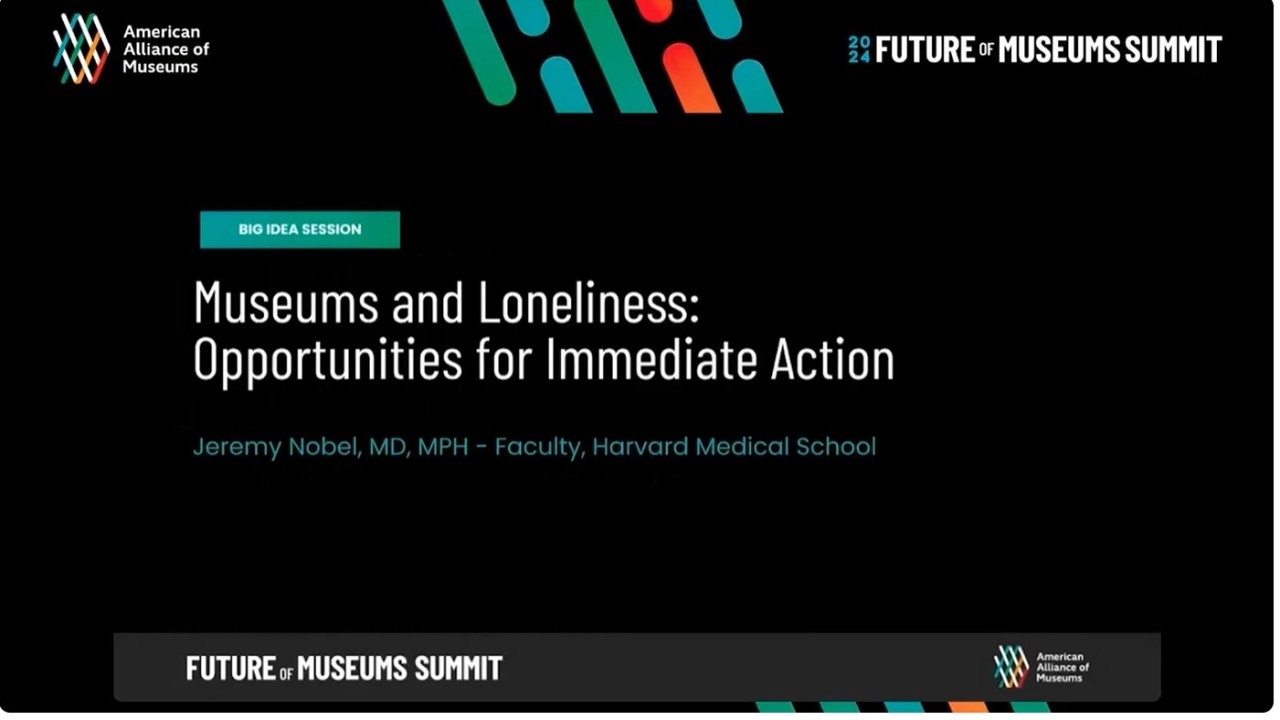
This recording is from the Future of Museums Summit held October 29–30, 2024. In this session, Jeremy Nobel, Founder and President of The Foundation for Art & Healing explored how cultural institutions can act as vital social infrastructure to combat the U.S. Surgeon General’s epidemic of loneliness. Key takeaways and actions included reframing loneliness, the power of art, and reimagining the museum’s role.
Transcript
Jeremy Nobel:
Welcome. I’m Jeremy Nobel. It’s a pleasure to be with you. I’m the President of the Foundation for Art and Healing and its Project Unlonely initiative, and also on the faculty of the Harvard Medical School and the Harvard T.H. Chan School of Public Health. But you may be wondering, who is this guy? Really? Well, I get up way too early. That started during the pandemic. I’m not sure why, but it certainly persisted. I’m a lifetime worrier. I’m sometimes lonely. I love coffee and bike riding, and I love museums. Here’s what we’re going to cover today. Loneliness, a growing public health crisis. We see it around us in our communities. We might see it even in ourselves. But then, we’re going to explore some fresh approaches to addressing loneliness, leveraging creative arts expression to engage, activate, and connect. And then, we’re going to put the puzzle together and look at opportunities for immediate action for museums of all sorts.
Let’s start with where we are right now five years into COVID, not the COVID crisis anymore, but the COVID era with community loneliness as a challenge accelerated. Now, what’s driving that? Well, a big factor is continued uncertainty at work, at home and in our communities. And as a result, many are struggling financially with political divides, growing community violence, particularly in some parts of the country, fear and distrust. And for those most impact and most vulnerable, loneliness and its consequences are at unprecedented level, so it might have you asking, is there any good news?
Here’s the good news. More people are aware of loneliness as a personal and public health challenge and are trying to address it. The surgeon general, as you may know, put out a call, an alarm call in 2023 in May, but there’s much we can do about loneliness. I’ve done what I thought would be a helpful contribution, made a helpful contribution on my part with a book that came out recently with three goals.
First is to demystify and humanize loneliness to reduce the stigma that still surrounds it. Second is to provide some useful observation and frameworks for the designers, which includes each of us as individuals of our own project on loneliness, so we can better navigate this very human experience of loneliness. And then last is to introduce what surprises many until they participate in it themselves creative expression as a way to engage, inspire and connect. And my hope with this book and even with our time today, is that individuals and organizations can have the confidence and the motivation to design their own Project Unlonely.
Here’s more good news, museums. I would invite us all to think about museums as a kind of lighthouse. Lighthouses, they’ve been around for several centuries. I love this quote by George Bernard Shaw. “I can think of no other edifice constructed by man as altruistic as a lighthouse. They were built only to serve.” Now, of course, museums have an important history, and many of them had lots of reasons for being founded other than to serve the community, to serve our future collective positive circumstances together. But that’s clearly changing. In a recent article put out by the American Alliance of Museums, I think some of this vision was captured quite nicely about museums as a source of well-being. Not just that the theoretical level, but in how it feels to be who we are and how we navigate the world. And within that, loneliness is a major opportunity.
Now, what is loneliness? It’s not the same as being alone. It corresponds to the gap we feel between the social connections we want to have, we aspire to, sometimes we even dream about and what we actually experience. This gap, when it gets larger, this subjective feeling that we don’t have what we need socially, can have some significant consequences, particularly in health. It doesn’t surprise people that loneliness has a major challenge to mental health. It’s probably the biggest preventable risk factor for a classic triad of mental health diagnoses, depression, addiction, suicidality. But it also impairs physical health, more on that in a minute. Mostly because loneliness as a brain state increases inflammation, it reduces the immune system response, and so it actually contributes as a risk to many diseases, notably heart disease, metabolic diseases like diabetes and immunologic disorders.
But it’s also important to know that there’s more to health than the absence of illness. Even if loneliness didn’t cause significant mental and physical disorders, the fact that it holds back, that it keeps us from experiencing our full potential, it keeps us from thriving, flourishing, collaborating, that would make it a public health opportunity in its own. Let’s go back to the physical just for a minute. Many of you may have heard this soundbite that loneliness can be as toxic as smoking 15 cigarettes a day. That got a lot of people’s attention 10 years ago when the early research came out. It certainly got mine as a medical doctor and a public health practitioner. It’s now beyond debate that this is a serious issue. The American Heart Association came out with a major science statement in August 2022 pointing to loneliness as having a risk for heart attack, stroke, or death from either by 30%. This is a very, very common disorder. Half Americans will die a cardiovascular death. An association of this magnitude is something that demands not just our attention but our response.
But here’s another reason why loneliness matters. It actually drives lonely behaviors. As we get lonelier, our brains change. Three important ways arise out of that as a consequence. First is, we start seeing threat around us everywhere, a kind of vigilance, things that may not have seemed threatening in the past, start seeing more and more threatening individuals. Environments we’re in, these kinds of daily human experiences seem threatening. The second thing in our lonely brains is we start acting more emotional, less rational in how we engage with the world around us. And finally, related to that is we’ve become more impulsive. Without loneliness we can often slow down, think through challenging situations, the lonely brain often acts impulsively. And if you look around what’s going on in the world, everything from discord, political discord, to, in some cases, tragic violence in our communities, you begin to see how this increased sense of threat, emotionality and impulsivity might be impacting us in negative ways.
I’m also going to share information real quickly here from my book if you want to go deeper. It’s surprised many people how useful some of these distinctions are, so I’m going to share them with you. It certainly has been very important to our own work at our foundation in public health. The first kind of important idea, new idea, is that there are different types of loneliness, so many people, and here they are. The first is a kind of psychological loneliness. Does someone have my back? Is there someone I can tell my troubles to? This is what most people think of when they think about loneliness. But there are other ways loneliness emerges. The second type, societal loneliness or organizational loneliness, is what I sometimes call the loneliness of systematic exclusion. Because of race or color or disability or other people recognizing these superficial characteristics and as a result, not fully including us. I often describe this situation as asking people to imagine a room filled with people that they have to enter, and then, they’re asking themselves as they’re about to enter the room, is there a arrival anticipated, welcome and safe?
And if it is, you’re going to have one mood of positive energy going get to that room. But if it’s not, it’s a kind of loneliness. It’s a kind of uncertainty about your safety and going into that room and their consequences to that. And then, the last type of loneliness, which I think is increasing dramatically, particularly in the younger demographics we know are the loneliest, 18 to 28, is a kind of existential loneliness. Does my life matter? How do I connect to the bigger universe? Or am I disposable? Does my life have consequence? And if you don’t feel this sense of connection to a bigger human story, and we’ll talk more about that during our time together, then it is a very important type of disconnect that could lead to a deep loneliness and despair with all the consequences.
I’m also going to talk briefly about where loneliness appears in our society and how it emerges. These are all territories of loneliness that we recognize. We’re in many of them ourselves; I’ll go through them in a minute. But it’s important to understand that they interoperate with each other, and that you can be experiencing or navigating more than one territory at a time. Let’s start on the left side with trauma.
Trauma is persistent painful experience. We all have a sense of what trauma is. People think about major categories of trauma like military violence, domestic violence, or even weather-based disruption of our lives because of climate fragility now. These are all traumatic experiences, but they’re also just daily traumas. Painful experiences that we have to encounter, so that pushes people away as they don’t want to be hurt. They tend to withdraw, isolate, and so on. Trauma is a very important territory of loneliness.
Going around this circle here, this pentagram, if you go to the top, illness. Almost any serious illness, whether chronic or catastrophic at the end of life or a rare illness, can marginalize us, make us feel like we’re different than people. And other people often don’t know how to relate to us and they back away. This is often true in mental health challenges, where people are just uncertain about how to deal or deal with or support someone who, say, may have a serious mental illness. But it also is illness of all kinds, cancer, neuromuscular and so on, or even very common chronic illnesses like diabetes or art disease. You tend to be in a very different mindset and often very, very lonely.
The next territory is aging. We know that the baby boom demographic, of which I am part, is moving towards even older experiences. We know that while the loneliest demographic is 18 to 28, that there’s quite a bit of loneliness in older adults also. Why is this? It’s because aging, while it can be a time of great discovery, almost spiritual rebirth for many people, can also be a time of great loss. We lose mental and physical capabilities. Even things like hearing acuity or visual acuity isolate us from the world around us, but we also lose family, friends, they die. Then, if we are not vigilant in maintaining connection to the world, we often feel more disconnected to it. Aging is certainly a territory.
Then, bottom left, difference. I mentioned that type of systematic difference that we have because of some superficial characteristic or trait, race, class, disability and so on, it’s this sense of being separated because of some, sometimes what people feel is a superficial characteristic, like not adhering to the conventional beauty narrative in any particular culture that you don’t feel as welcome into integrating into social situations as you otherwise might.
And then, last certainly not least, is the territory we’re all navigating. We’re navigating it right now, modernity, which brings wonderful things to us. The ability to participate in knowledge experiences like this one virtually from the comfort of our own homes. But there are negative sides too, particularly in certain vulnerable demographics, like adolescents, who often use social media in a very performative comparative way that erodes their sense of self-esteem, their sense of self-worth. We know this through very good research. These are our territories. The question is, what can we begin to understand? What can we do as we navigate these territories?
That’s the background really of loneliness, and there’s more to it. As I said in my book, I’d invite you if this is an interesting topic to dig deeper, but let’s summarize it with loneliness in the community. First, obviously, it’s a diverse group of individuals at circumstances, a complex set of overlapping concerns, drivers and no surprise, solutions. There is no silver bullet. We’ve got to be as creative as we can be. One of the important things I’ve discovered that’s helped me think about loneliness is how we just basically frame it in our own thinking.
I’ll invite you to think about loneliness, not as a sense that there’s something missing, that we’re inadequate, that we’re imperfect, that we’re flawed, but just think about loneliness as a signal, as a biologic signal that we need human connection. Just like thirst is a signal that we need hydration, and that drives us seek hydration. Loneliness drives us to seek human connection. We don’t know many people who are embarrassed about being thirsty, why are we embarrassed about being lonely, and the answer is, it’s a social and cultural construction to feel embarrassed about loneliness. Here’s the good news. Anything that’s socially constructed can be socially reconstructed. I’ll get to that because that actually, I think, is one of the big opportunities to reconstruct how we make sense of loneliness, so we can begin to take the strides to address it.
If loneliness is the signal that we need human connection, how do we connect? How do we move from lonely? These images on the left that I’m sure we could all recognize, maybe even relate to, and feeling connected. And again, connected in all those ways, psychologically, societally, and in some ways, even spiritually. How do we make that leap forward? Here’s what I hope really captures your attention from this talk, the not so new idea that I’ll start with some questions, why has there never been a culture without art? And if you look at this graphic, it’s some really remarkable hand images on the wall in Spain, 20,000 years old. What was going on? Why would people take the time to make these images? Again, another question. Possibly, this creative making and the thoughts and feelings and storytelling, because these hands kind of tell a story to me, maybe to you also, maybe it’s the storytelling that it offers connects us, and maybe it’s that connection that helps us survive, and even more than survive, and thrive.
You could imagine how challenging the environment was 20,000 years ago and how you didn’t want to face it alone. I would argue that we’re in that same need to face our challenges collectively right now. And I believe, and there’s growing research, I’ll share some in a minute, that the arts offer a unique way to do four things. First, to engage our attention. I think we all know this. You hear a music melody that we even have a word for it, turns into an earworm, because we can’t become disengaged with it. But the arts do more than just engage our attention. They often bring us to a higher state of motivation, I’ll call inspiration.
What is inspiration? It’s not just the daily motivation, like I’ve got to clean my closet, I’ve got to go grocery shopping and so on, but the inspiration to do something bigger, something that captures more of our sense of what’s really important. But the arts do more than just motivate us towards that bigger, grander, sometimes spiritual sense of possibility. It gives us a sense in ways that we don’t fully understand, but there is some early brain science around it that we can actually get it done. That we’ve got the capacity, the agency, the skills to fulfill our inspiration, this empowerment. And in this process, I believe the arts connect us. I’ll talk more specifically about that, connect us not just to ourselves, but to those around us and to the bigger human story.
What art? Okay, well, there’s the traditional four, music, visual art, language arts and dance. But I want to point the audience’s attention to the creative imaginative activities we do on a daily basis. Cooking the culinary arts, textile arts, knitting, sewing, crocheting, quilting, been going on for centuries as a way to be in place, express, connect, and then, of course, gardening, which brings infinite pleasure, not just to the gardener, but those around witnessing and what I sometimes call the world’s slowest performance art form.
How does it happen? I think the powerful underlying principle to all of this, and again, principles we employ in our programs and projects and our workshops, is that the arts rewire our brain. They stimulate thoughts, moods, and feelings that change our brains structurally, how they actually work and how the neurons fire, connect, grow, change, reinforce, and so on, in ways that alter our ability to make sense of the world, changing our physical nature, our mindful nature, how we see the world as threats or opportunities, and then ultimately, and this is very important, how we behave out in the world. That’s what it comes down to.
Again, more detail on all this in my book, but I just wanted to point out that there’s emerging brain science about the arts. This has really been made possible because of new research techniques, functional brain scans, functional MRIs and so on, that shows that the arts impact three major areas of brain function. First, what’s sometimes called the neuroendocrine outflow. This is hormonal regulation. You may have heard of the hormone cortisol, that’s the fight or flight hormone. The arts actually calm down our brains, but they also, if you look at the interesting neuropeptide outflow, serotonin, dopamine, oxytocin, that the arts also improve our mood, give us this wonderful glow and positive sense of the world. And at the same time, our autonomic nervous system, this is the regulatory mechanism that drives blood pressure, heart rate, respiration, this is altered too, sometimes in ways that really reduce risk for illness, like reducing blood pressure, reduces risk for cardiovascular disease.
Let’s summarize how the arts make us less lonely. I mentioned the impact on the brain. The next area that I think is incredibly relevant to museums because you can program around it, is the arts encourage us to share our stories, and often provide a context for doing that through music, through dance, through language arts and so on. And then lastly, but part of the bigger picture, is the arts take us out of ourselves. They invite us to feel part of the bigger human story. Whether it’s with a mood of awe or wonder or celebration or discovery, it’s clear that there are positive benefits to all three of these things, but particularly, feeling that we’re not alone in this bigger human story.
How do we actually get there at a tactical level? Well, there are three important ways structurally that what we do in the arts actually move us in this direction of connection. First is just the making of art itself. The creating of you’re in the moment, you’re in touch sometimes with difficult thoughts and feelings, but you sense ways to make choices, make objects, and navigate through that incredibly complex world of emotionality. And it allows you to often make an artifact, an object, a doodle, a drawing, a six-word poem that you can then share with others. In this act of sharing your emotions or perspective with others, something changes in our brains and then in how we make sense of the world. And last, the chance to reflect on art, to think about its meaning. Its deeper symbolic relationship to things we struggle with, things we feel victorious about and move forward.
In summary, what does the creative expression offer? And it’s a wonderful portfolio of opportunity. It’s fun too and non-threatening. It engages people of all ages and at any circumstance and activates them emotionally and intellectually and socially, giving them a chance to express who they are, what matters to them, and have that sense in how it connects with other people. While it does that, it promotes a general sense of well-being. We feel better doing it. Tremendous opportunity.
I’m just going to talk very quickly, so practical, some of what we’re up to at Project Unlonely. Project Unlonely, we’ve been at it about 10 years. It’s a multifaceted initiative with three real goals. One is to increase awareness about loneliness and its toxicities. I’ve shared much of that with you already today. But the second is to reduce the stigma around it. I’ll share more about that, but a big part of reducing stigma is to normalize what you’re trying to de-stigmatize. And so, if we normalize loneliness, for instance, by reframing it as a signal rather than as a flaw, then people are less afraid of it, they’re willing to engage with it, talk about it, and then, last thing we do, we build and test and distribute very, very simple arts-based programs that can be delivered in a wide variety of circumstances, community-based organizations including museums, as well as libraries, as well as schools, universities, faith-based groups, community organizations, healthcare, workplaces and so on. That’s what we do.
You have to start with awareness, that’s the major goal, and we harness the power of film for that. We’re quite fortunate that the noted actor-director, Steve Buscemi, has joined us recently as an ambassador to our film work. We’re now in season eight. Those films stream at no cost to the community. You could find them on our site. And then, organizations use those films, as well as individuals use those films, to better understand loneliness, but then also to stimulate the conversations that allow us to connect around. But I also want to focus on what we do in our workshop models that actually give people the experience of creative making in a way that has very positive benefits, and it’s organized around these three principles, really, activities that I hope you all resonate with and hopefully participate in.
The first is to be curious. Think about something that intrigues you, inspires you, and so on. Make something, again, could be a doodle, could be a piece of creative writing, it could be a garden. And then, have conversations. That’s the critical thing, is to not just make but make and share. In that sharing is often where the magic happens. In our programs, we use some very well-tested modalities. There are years of evidence-based behind each of these. Creative expression is a health-enhancing modality. Mindfulness is a health-enhancing modality. And then, social-emotional learning is a way we can actually fully interact and embrace with new knowledge in mechanisms and models, where it actually changes how we make sense of the world and consequently our behavior.
As you might imagine, our programs, which are delivered in, as I said, through community organizations across the world at this point, change our attitudes, people gain confidence, they feel much better at managing emotions, but also in finding meaning and quality in life and feeling they could better handle what they’re being asked or need to navigate. This is often called resilience. We also can measure behavioral changes. People connect more with their community. They engage with other programs and activities, not just the arts-based ones. It’s almost like it kickstarts them into a creative, curious pursuit of more social activities, and they start taking better care of themselves. Very important at any age, but particularly as you get older, to make sure you’re mindful of the things each of us can do to be healthy and well.
We’ve built this as a very purposeful public health expansion model. That is my background. I’m a public health practitioner, and so we’ve developed our programs with an eye towards scaling. Critical to that is to make it very easy for them to be delivered by others. You’d see some of the community organizations here that I’ve already mentioned. I will talk about one of the areas we’re most excited about, because I mentioned that the loneliest demographic is 18 to 28. We’re doubling down on reaching this population.
Now, we’re working really with partnerships with colleges and universities. We’re now at almost 50 campuses, several of which used our workshops as a mandatory part of orientation for all incoming students this year. Very exciting to us to see social connection and connection with oneself, being integrated into the other elements of pedagogy of education and learning, so that it’s not off to the side to focus on things that solidify mental health, self-confidence, self-efficacy, but fully integrated into the educational experience. You see these very positive outcomes, 96% of our participants would recommend it to others. They feel more connected to their peers, 84% feel more in touch with their emotions, and 80% of them feel less long.
Now, it’s also important to realize, we can reach this demographic in other channels other than colleges and universities. I think a lot about museums as a channel for this, because we know because of how attractive and stimulating the collections in museums are, it can often bring people in out of whatever environments they’re in and then explore those collections in a way that make changes. Last thing I’ll say before we move on to that opportunity for museums is, let’s not ignore some of these new technologies like artificial intelligence. We’re starting to develop some interesting programs that use AI to personalize the art making experience. This is with caregivers for older adults with dementia and I’m seeing some very exciting early results.
What does all of this have to do with museums? You’re asking. Well, I hope at this point you can already begin to see some possibilities, but maybe this will help give you more context for those imaginings and maybe even some practical ways to get started. I mentioned the opportunity to move from collection. Whether it’s objects or music or I know there are zoos that are members of the Alliance, the collection of animals, to connection. And again, remember that metaphor of museums as lighthouses. How does museums function that way?
I’ve had the great honor and privilege of speaking to several museums and convenings of museums since my book came out. I am just so delighted, overwhelmed sometimes by how the museums already see themselves as catalysts for connection. Many are trying to accelerate their activities for doing this. It’s very exciting to see these activities. Again, as a public health practitioner, I see it as a set of overlapping Venn diagrams or overlapping concentric circles here, and to focus on all the stakeholders for museums. We often think of our patrons if you’re running any kind of organization, but they’re also the people who make the magic happen, museum staff. But there’s also the broader community that might not yet be fully aware of how the offerings of the museum, the opportunities to engage in connect could be relevant to what they’re trying to do, the problems they’re trying to address, navigate and solve.
But I also wanted to make an extra plea given how challenging the current experiences are for anyone who’s interacting with other humans, stressed out, distracted, disconnected humans, to make sure that we pay extra attention to the health and wellbeing of museum staff. This is something very easy to put on a PowerPoint slide. Obviously, it requires tremendous focus and dedication and tolerance, really, of the discomfort of change to really double down on what’s really required to make all of the internal environments healthy and well. Again, in the conversations I’ve had with museums, I think there’s very high understanding of the need for this and also some very creative and courageous activities. I just thought it was very important to mention.
I’m going to close this part with just these opportunities for immediate action. You folks are participating in a major conference on the future of museums. I think there is no future of museums that doesn’t include the full embrace of some of these opportunities. I think many museums are doing it already. I think there’s ways to accelerate. First is educational awareness. I think, primarily, that loneliness is not something to be afraid of, to feel guilty or ashamed about. It’s a signal. It’s not a person’s fault or a sign of inadequacy. That’s critical. Otherwise, you’re not going to get people to engage.
And then, second is to be creative about what’s going on in your museum’s collection, and can they be a catalyst for personal story sharing? Inviting people to, for instance, view an object, learn that object’s history, and then think about how that object’s history might intersect, collide, resonate with their own history or histories they care about and their own story and share those stories through a wide variety of modalities for personal story sharing. And in that exchange, some very vital brain-minded behavior amplification occurs.
And last, to go back to our metaphor, be a lighthouse. Be that altruistic source of care and comfort at a very, very critical time. Promoting this non-judgmental culture of connection, we’re here to connect. We don’t have to be afraid of each other. We can explore differences, we can find commonalities and move forward. And to do that at every opportunity and across the lifespan and where you can to do that intergenerationally and cogenerationally.
Again, opportunities for immediate action. Again, I wrote this book thinking it might be useful to people like you who want to design some of these things that could make our communities and ourselves healthier and well, I’ll close with this quote. Your habits of personal creative expression are just as important to your health and well-being as your diet, exercise, and sleep. Art is a medicine that requires no prescription. I often add, also no copay and an opportunity to design your own Project Unlonely, both personally, but then organizationally. I’d love to hear how it’s going. For any of you, I’d love to be in touch. Here’s my email, jnobel@artandhealing.org. I hope this has been a helpful tour through the land of loneliness, but also the incredible opportunities of creative expression to engage, inspire, activate, and connect us. Thanks so much, and I wish you all the best of luck in navigating these opportunities to be better connected.
Chris Doucette:
Hi, everyone. I am Chris Doucette, the Executive Director for the Foundation for Art and Healing. It’s great to see everyone so active in the chat and the questions and answers. I hope I can provide some good answers for your questions as we end this session. I believe a question will be popping up on the screen, so let’s see if we can see that question.
What films from Project Unlonely films would be good for a college-age crowd? Thank you so much, Jennifer, for that question. If you missed it during his presentation, we have over 125 short films in Project Unlonely Films. We are, essentially, at the Foundation for Art and Healing, we have become the Netflix of Loneliness and Social connection. We have over 125 short films on the themes of social connection and loneliness from diverse perspectives, there are action videos, there are from dramas to comedies, live action to animation. There’s all sorts of short films in our Project Unlonely Films database.
We have created a website, and I think we can paste in the chat a link to Project Unlonely Films, and you’ll see that we’ve organized it with tags. If you’re interested in films for younger adults, like the college-age crowd, just click on the button that says College-Age Crowd, and you’ll find a collection of films. I’ll give you one just off the top of my head. It’s called, I Forgot My Phone. It is a short film about two or three minutes long, and it’s about a young woman who forgets her phone at home, and she goes through her day interacting with people, but not really because everyone else is on their phone. She’s kind of in a bubble of not having her phone to rely on, and she just felt very lonely in a crowd, lonely throughout her day because everyone’s on their phone except her. That is one great film to watch for a college-age crowd, since we are also defined by our smartphones these days.
Another film I would recommend for college-age crowd is a film called My College Transition. This was done by, I believe, a freshman or sophomore at Cornell University, who found that college life was not as social as she thought it would be. She thought that her transition to college would just be a transition into a whole bunch of friendships and relationships and connection, but she found the college transition to be a pretty lonely one. She created a documentary about that experience, and it got a lot of traction, and we included it in Project Unlonely Films. The title of that short film is called My College Transition, so I hope that’s helpful.
Okay. Do we have another question? Let’s see. Maybe I can look at the Q&A. Are programs that Project Unlonely create for distribution in-person, digital, hybrid, or some of each? Thank you, Megan, for the question. Let me look at that again. The programs for Project Unlonely incorporate, there are a number of different silos, basically, in Project Unlonely. There are different initiatives. One initiative, for example, is Project Unlonely Films. We talked about that. One initiative was Project Unlonely, the book that you saw from the earlier video. Programmatically, we have identified three major target populations for a Project Unlonely. We serve younger adults ages 18 to 28, older adults and a stressful workplace environments. Workers on the front line. This could be healthcare workers, librarians, anyone on the front lines of public service in high stress environments. And then, number four is Community Unlonely. This is a general awareness and campaign in order to help people navigate loneliness. Those are the four key target populations.
They are mostly, they are a mix of in-person and digital and hybrid. You’ve got them all, and you’re correct. Originally, of course, most of our programs were designed to be small group experiences, workshops in person. And then, of course, the COVID pandemic happened, and we all had to move to digital. And luckily, we found that our model actually does translate online. We move from a group of 12 to 15 people in a workshop, and we made that into a digital experience, and the digital experience did really work pretty well. The breakout sessions are really important for that. When you have a group of 15, 20, or 25 people in a room, our model in the workshop model is to eventually so that everyone can share their artwork, we pair up people. If we have 20 people in a workshop, once you’re done the creative making, we pair people up and that one person can share their story and then another person can share their story, and so everyone gets a chance to share and talk and then listen.
The breakout sessions are an important part of that, in terms of a virtual environment, so we can pair people up virtually and they can have that social emotional learning that is so important to that workshop experience. Thank you for your question, Megan. Let’s see. Thank you for that question, and let’s see. Next question. Curious how you might strategize helping the 18 to 28 demographics, see the value in connections and signs of loneliness? That is a great question, and I would say that it’s to help any demographics see the value in connections and signs of loneliness, the most important thing is general education, and that’s true for everyone.
Everyone has a certain loneliness illiteracy. We all think of loneliness as a monolith, and we don’t see it as the very subtle and nuanced complicated thing that it is. For example, in this presentation, you may have heard that there are three types of loneliness, psychological, societal, existential, and you have to know what kind of loneliness you’re experiencing in order to engage in the right intervention for it. And so, the most important thing is general education for all people, not just people 18 to 28. I think Dr. Nobel may be on the chat. There he is.
Jeremy Nobel:
Well, I don’t know if you can hear me or not, Chris and others, but there are some great questions that have just popped up. Chris, I don’t know if you can see them. But one of them-
Chris Doucette:
Hey, guys. Hey, everyone. Unfortunately, we are out of time today, so we’re going to have to close up here and go on to our next sessions for today.
Jeremy Nobel:
Okay, well, I hope you enjoyed this presentation, and we look forward to following up with anyone who may want to pursue this in their own institution.
Chris Doucette:
Thank you all.

Upcoming Events
-
Creative Museums Summit
Event Date:Presented by: MuseumNext -
-
-