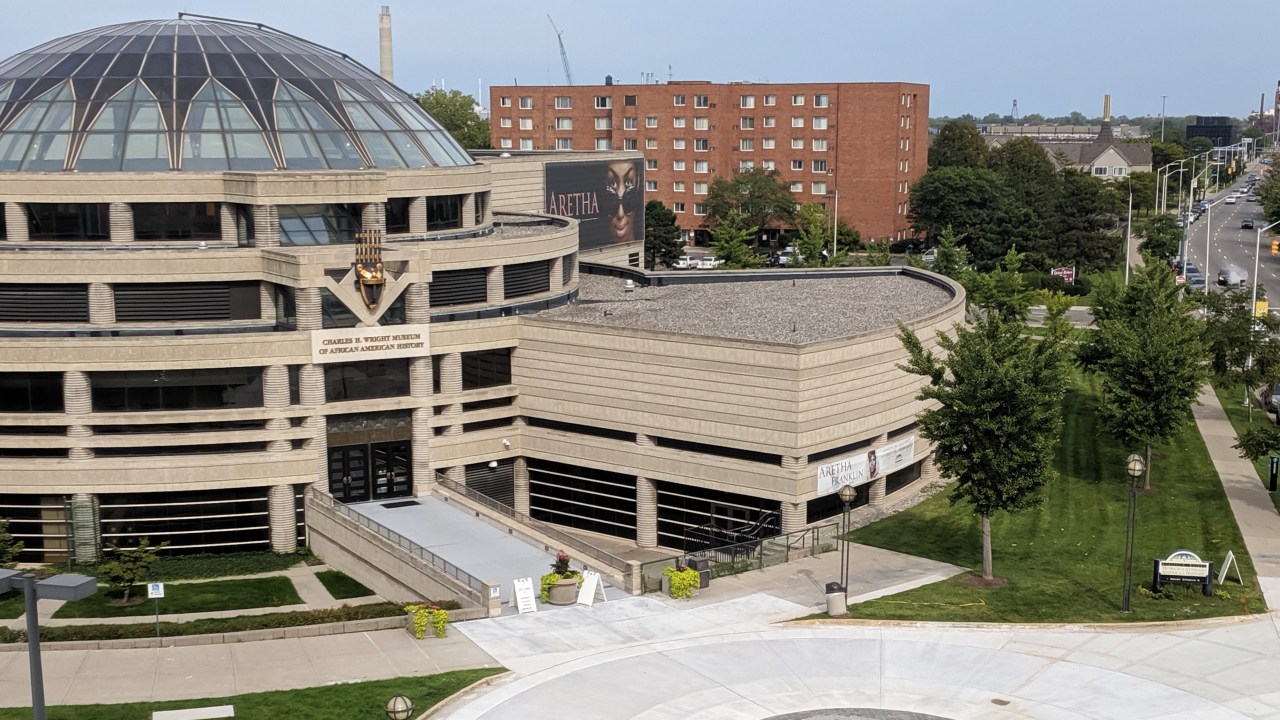
The Charles H. Wright Museum of African American History is developing a museum-led model for people, planet, prosperity, and programs.
At The Charles H. Wright Museum of African American History (The Wright), our mission is to “open minds and change lives through the exploration and celebration of African American history and culture.” Today, our 125,000-square-foot facility serves as the physical manifestation of that mission.
This article originally appeared in the Mar/Apr 2026 issue of Museum magazine, a benefit of AAM membership.
» Read Museum.
Built in 1997, it is home to more than 35,000 artifacts that preserve community legacy for the next generation. This was the vision of our founder, Dr. Charles H. Wright, an OB-GYN who delivered more than 7,000 babies in Detroit. We believe that to preserve history, we must also preserve the planet. This is especially true in the context of African American history, where heritage, justice, and environmental wellbeing are inseparable.
Many museum professionals are familiar with the sustainability framework known as the triple bottom line: people, planet, and profit, first coined by entrepreneur John Elkington in 1994. At The Wright, we expanded this framework to better reflect mission-driven museum work by reframing“ profit” to “prosperity” and adding a fourth dimension: programs.
We call this expanded approach the Green Museums of The Future, which positions museums as climate actors and community stewards that embed sustainability across buildings, landscapes, collections, and partnerships. This occurs through the 4Ps Framework:
- People—Centering community, environmental justice activists, elders, climate creatives,staff, youth, researchers, and lifelong and intergenerational learners.
- Planet—Embedding climate resilience, sustainable materials and infrastructure, and smartbuilding and site systems across our campus.
- Prosperity—Focusing on holistic long-term institutional commitment, cross-departmentalignment, and community thriving—not merely financial profit.
- Programs—Translating environmental sustainability into experiences, exhibitions, data-driven stories, and community engagement where the environment is a partner.
The 4Ps Framework, scalable to museums of all sizes and contexts, has helped The Wright navigate aging infrastructure, climate pressures, collaborator buy-in, and community expectations.
People: Human-Centered Sustainability
In 2019, we held our first Green Museum Town Hall and asked various environmental community groups: What does it mean for The Wright to be a green museum? More than 100participants—including elders, youth, children, environmental justice advocates, designers, academics, and neighbors—co-authored our Green Museum Guiding Principles, which we now use to evaluate partnerships and grants, and imagine exhibitions and capital plans.
This single shift from designing for the community to designing with the community changed our institutional culture. Trust increased. Silos decreased. The public became co-authors of our environmental future.
By our second Green Museum Town Hall in 2025, the 4Ps were embedded in most major projects. Returning and new partners explored how African American history, culture, and heritage can inform and inspire climate adaptation and stewardship. The program featured a screening of Threads of Mother Earth, a short film exploring the connection between ancestry, land, and cultural practices that grounds climate action in cultural memory and intergenerational responsibility.
Additionally, more than 130 in-person and virtual participants joined a participatory design method called a “gallery walk” that gave staff and community members input on our green initiatives site plan, linking infrastructure, ecology, and the museum’s mission to extend learning and engagement to the natural environment. The gallery walk included eight-foot display boards designed by students from the University of Michigan School for Environment and Sustainability.
Building the Conditions for Climate Actions
- Leadership Alignment. Executive and board-level commitment is essential, as top leadership sets priorities and drives institutional buy-in.
- Resource Commitment. Sustainability requires both human and financial resources, ensuring the vision is supported by real capacity.
- Clear Communication. Using accessible, nontechnical language helps collaborators understand climate and justice concepts that may otherwise feel overwhelming.
- Strategic Partnerships. Success depends on choosing mission-aligned partners and clearly defining roles early to avoid confusion and misalignment.
- Narrative and Context. The institution actively shapes how its stories are told within the contexts of the natural environment, city, state, and region—strengthening accessibility, credibility, funding, environmental policy alignment, and long-term impact.
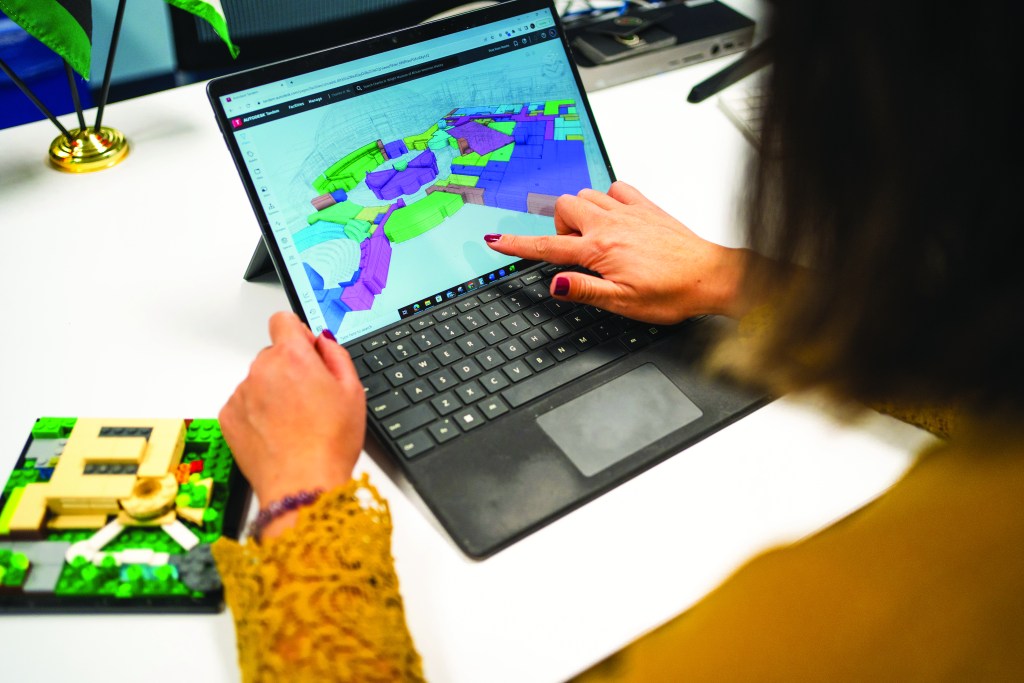
The Wright Museum’s digital twin model.
Community feedback centered on three themes: connection, inspiration, and legacy. One participant reflected: “I envision feeling curious about the connections drawn between African American culture and nature at The Wright Museum, feeling the ties to ancestors before us and responsibility to the future.” This affirmed our belief that museums must operate with more voices, transparency, and shared authorship rather than in seclusion.
Leadership alignment has been essential in this work. When President and CEO Neil Barclay joined The Wright in 2019, he recognized that environmental sustainability is both a facilities and values issue. Along with Executive Vice President and COO Jeff Anderson, Barclay’s collaborator in designing the 2006 LEED-certified August Wilson Center, museum leaders continue to champion sustainability in The Wright’s strategic plan. In 2020, our Board of Trustees formally adopted “embracing environmental systems” as one of our core institutional goals, legitimizing cross-departmental collaboration and situating environmental stewardship at the heart of our mission.
Planet: Smart Systems and Ancestral Grounding
A major pillar of our climate strategy is our digital twin, a 3-D, data-rich, 1:1 digital model created with Autodesk Tandem. The twin allows us to model and transparently monitor energy use, carbon emissions, thermal comfort, and even water leaks. As most of our building systems are reaching their end of life, the twin has guided a seven-phase mechanical systems upgrade and supports ongoing maintenance planning. The twin also helps us track materials and reduce the carbon footprint of exhibitions and events.
The power of the digital twin is that we control all our data, enabling autonomy, transparency, and long-term learning through tools that help us make sense of information related to our people, site landscapes, built environment, and exhibitions and events. In doing so, we deepen our understanding of building and site performance while opening new possibilities for visitor-facing interpretation.
At the same time, our work on green stormwater infrastructure (GSI) reflects both ancestral wisdom and practical innovation. GSI refers to nature-based and engineered systems to manage rain where it falls using soil, plants, and permeable surfaces. GSI helps water slow, filter, cool, and infiltrate naturally rather than burdening Detroit’s aging combined sewer overflow (CSO) systems.
With support from the Fred and Barbara Erb Family Foundation, and in partnership with the Michigan Science Center, we installed several GSI facilities across our seven-acre site. Today, the museum’s combined GSI system manages more than 190,000 gallons of stormwater by allowing it to naturally soak into the ground. This reduces CSO strain, lowers drainage fees, and serves as a visible teaching tool about water, flooding, and environmental justice.
In our more than 10 community listening sessions, we learned from African-centered elders about the Sankofa, a West African Adinkra funerary symbol that depicts a bird looking back before moving forward. This represents the idea that learning from the past is essential. Elders guided us in designing a 70-foot-diameter Sankofa, constructed with permeable pavers in contrasting colors. The bird’s head points to The Wright’s main entrance, signaling that the “journey of learning” begins at the museum’s doors, and sustainability is part of our journey.
In our staff parking lot, we replaced failing concrete pavement with permeable pavers that allow stormwater to infiltrate naturally. In a small but innovative move, we used contrasting paver patterns to delineate parking spaces and stall numbers, eliminating the need for paint(and repainting). This reduced long-term maintenance costs while reinforcing a sustainable materials approach.
Prosperity: Making Something Out of Nothing
In 2017, several mature Zelkova trees on our campus were dying. Rather than treating them as waste, we asked: What did the Detroit trees see? To find out, in 2021, we partnered with our neighbor, the College for Creative Studies (CCS), to create the d.Tree Studio, a woodshop course and community learning lab. Six CCS students and seven local community makers to whom we offered scholarships studied Detroit’s tree canopy, redlining, and neighborhood histories. They also hosted a virtual #Treeposium where landscape architects, storytellers, and elders shared their perspectives and helped facilitate Detroit tree conversations with over 900participants. The information shared also informed the narrative objects carved from the urban lumber salvaged from the Zelkova trees.
The resulting “d.Tree” exhibition at The Wright in 2023 guided more than 20,000 visitors through Detroit trees’ past, present, and future. This exhibition doubled as a community hub where Detroiters could sign up for free street trees through partnerships with Greening of Detroit, the city of Detroit, and American Forests.
The Wright was one of the first signatories to the mindful MATERIALS Museum Exhibition Materials Pledge, and we used the Sustainable Exhibition Design & Construction Toolkit to help staff reduce the “d.Tree” exhibition’s carbon footprint to 1.8 tCO₂e. We also sourced materials locally and walked student work across the Detroit Cultural District to reduce our carbon footprint. The “d.Tree” received the “Impact to Society” International Service Design Award, affirming that museums can combine material reuse, storytelling, and community engagement to build hyper-local programs that benefit both the environment and participants.
Programs: Off-Grid Imagination and Energy Literacy
Programs bring the 4Ps Framework to life. In 2023, through an Arts Midwest GIG Fund grant, we partnered with artist Ash Arder, The Wright’s 2017 artist-in-residence, to explore off-grid programming during April. Arder’s solar-powered sound sculpture, Whoop House, anchored our Earth Month programming. After carefully measured energy use, we learned that the louder our sound equipment, the more energy it uses. Instead of scaling back, we redesigned our programs to operate off the electrical grid.
Highlights of the programming included a solar-powered Third Thursday Late Night at The Wright conversation with King Wayne, founder of East Side Riders, a Detroit-based community organization known for custom-built bicycles, youth mentorship, and neighborhood-based creativity that merges mobility, culture, and self-determination. The program also featured a solar-powered world premiere performance by Detroit musician SuperCoolWicked (now Cecille) in the museum’s rotunda. We paired these anchor events with solar-powered community broadcasts that combined filmed conversations, musical performances, and live screenings; food trucks; and talk-backs hosted in three historically African American neighborhoods turned resiliency hubs: Avalon Village in Highland Park, Bailey Park in McDougall-Hunt, and the Manistique Community Treehouse in Jefferson Chalmers.
Together, these programs demonstrated that sustainability can be joyful, creative, and deeply relational while extending our museum beyond its physical walls. Every element, from sound and video to filming crews’ camera batteries, was powered by the sun. Rather than learning about renewable energy in theory, participants, vendors, and staff experienced it in practice: through music, dialogue, place-based storytelling, and collective gathering. In this way, clean energy became not just an infrastructure solution but a cultural medium for connection, expression, and community resilience.
Recognition, Voice, and a Climate of Hope
The Wright’s sustainability work has been recognized by the American Institute of Architects Detroit, Autodesk University, Crain’s Detroit Business, Detroit 2030 District/2030 District Museums Network, American Society of Landscape Architects, the city of Detroit, various universities, and AAM’s former Environment & Climate Network. Each award, presentation, and article has strengthened our internal alignment and helped establish museums as essential community partners in regional climate strategies.
We offer the 4Ps not as a finished model but as an invitation for museums of all kinds to adapt and extend this work, honoring their own communities, histories, and lands in the process. Museums do not just preserve the past—they shape the future our communities will inherit.
Resources
Robert Nieminen, “How The Wright Museum’s Digital Transformation Is Leading the Way for Sustainability in Museums, ”Buildings, August 28, 2024
Leslie Tom, “Why Museums Matter in the Climate Crisis,” Dichotomy, no. 28, 2025, School of Architecture and Community Development, University of Detroit Mercy
Leslie Tom, Neil Barclay, and Jeff Anderson, Green Museums Summit hosted by MuseumNext, February 27, 2025.
mindful MATERIALS, “Museum Exhibition Materials Pledge”
Upcoming Events
-
Outdoor History Walking Tours 101
Event Date:Presented by: American Association for State and Local History (AASLH) -
I’m In Charge of A Museum Store. Now What?
Event Date:Presented by: American Alliance of Museums -
Gettin’ To Know You: The Art of Networking
Event Date:Presented by: American Alliance of Museums -
Environmental Monitoring for Collections of All Sizes
Event Date:Presented by: C2C Care/FAIC