What does it mean to build a truly human-centered museum?
This webinar supports staff at all levels in understanding their active role in advancing accessibility as a strategic, organization-wide process. Based on the methodology introduced in Museum Accessibility by Design (Rowman & Littlefield, 2022), the session adopts a broad understanding of accessibility that addresses the full spectrum of barriers: physical, cognitive, linguistic, social, and organizational. The workshop combines a concise theoretical framing with interactivity. Participants will explore biases that limit inclusion, identify concrete priorities for change, and learn how accessibility can evolve into a shared, new mindset across the institution.
Transcript:
Ariel Waldman
Hello, everyone. Thank you for joining us. Going to let, people file in here. But thank you so much for joining us today. My name is Ariel Waldman. I’m the manager of learning content and engagement at AAM, and we want to thank you for joining us for Accessibility by Design, Empowering Staff for Human-Centered Change.
Today’s webinar supports staff at all levels in understanding their active role in advancing accessibility as a strategic organization-wide process. We’ll be using a broad understanding of accessibility that addresses the full spectrum of barriers: physical, cognitive, linguistic, social, and organizational. You’ll be asked to explore biases that limit inclusion, identify concrete priorities for change, and learn how accessibility can evolve into a shared new mindset across your Closed captions can be turned on using the CC button at the bottom of your browser window, and you’re welcome to drop questions into the q and a tab which is on the right as we go. And also feel free to upvote any questions you’d like to be answered. There will be time to answer some of these at the end. We are recording this for registrants and members to access in the coming days.
Now I’m going to introduce our speaker, Maria Chiara Ciaccheri. Maria Chiara is a senior museum accessibility and designer with over fifteen years of experience in accessibility, visitor studies, and Cultural Policy. She has collaborated with museums, archives, and cultural organizations across Italy and abroad on accessibility policy and organizational change. She is the author of the book, “Museum Accessibility by Design: A Systemic Approach to Organizational Change”. Which was published with AAM and will be the foundation for the webinar today. So with that, I’m going to welcome Maria Chiara to the stage.
Maria Chiara Ciaccheri
Hello. Thank you, Ariel, for this introduction.
Ariel Waldman
Of course. I’m going to turn it completely over to you.
Maria Chiara Ciaccheri
Okay. Well, thanks so much for having me, and thanks to AAM for us in this session. I’m Maria Cara. I’m in my mid-forties, white woman with brown hair and blue eyes. I’m wearing a striped shirt. And I’m in my living room. Actually, I’m in Italy, so it’s seven in the evening in Turin.
And I forgot to say that my pronouns are she/her. Well, a little bit about me first. I’ve been a consultant and a researcher for museum and culture organization for over fifteen years, with a focus on strategy, organizational change. Well, the book that Ariel mentioned is the same one that my son is biting, in the in the photo.
However, he has the map for the next hour. The idea is to talk about different topics. First of all, the whole visit for everyone. Because caring for every visitor is a is a mindset, definitely. It’s about, we’ll talk about empowering staff what people need day to day to actually act Accessibility as a workplace because it’s not only about visitors, and moving from individual actions to institutional change. So it doesn’t depend on just one person. And each part ends with a quick question for you, sometimes in the chat, sometimes, as a poll, to understand who we are and, what challenges we’re facing as a group of colleagues tonight.
So, I’ll start from one idea, a big framework. And, accessibility. I think, like, it’s not an aim in itself. It’s a strategy for cultural participation And, you perfectly know it doesn’t happen only after the door. It’s a network at work aim at impact, which lasts longer. And, I’ll try to bring you inside this possible perspective. Culture participation is the goal and it matters because it isn’t right. Well, UNESCO consider it access to culture as the same of education, without existing inequalities keep repeating and repeating. It builds citizenship and strength belonging and community, which means just think about the shared exhibition which become… Become something, our neighborhood, can talk and talk about together. And it’s a good for physical and mental health, of course, at certain conditions.
Well, we’re still talking about the use frame. And I would like to share with you something that’s for me, really looks like about participation. And there is in the in the screen, a photo, with, there is a leaflet the sky blue one printed both in English and Spanish. And they say things like, well, welcome first of all, and then don’t try to see it all. Twenty minutes to one hour is a good visit. Have a seat. You can sit on the floor. Ask your kids what they see about the art. And, well, it was given, in front of the LACMA in the… In, LA twelve years ago. I don’t know what’s happening now. It was given to families during a hands on activity, at the entrance of the museum. It was a Saturday morning. And I took this photo while I was researching in the US, I ended up mapping over 100 institutions. And I think it… This is really about culture participation because it’s, it’s sharing the dress code when you organize the party because you don’t want people to feel uncomfortable. And this has been a great inspiration, I have a since for me. So coming back to the bigger picture, if cultural participation matters, and we know that it does, we need to make access easier for everyone. And here, now we can start talking about accessibility.
Cultural participation is related to democracy, is getting in, and having the experience, what we usually call accessibility, means, seeing yourself represented like walking into a gallery and recognizing a story, a face, a person as well, and contributing. Like being asked to help shape an exhibition rather than just consuming it. You probably call it inclusion. And, well, it’s definitely the starting point of our this this course. Culture participation is about democracy. Is about democracy, well beyond legal compliance. However, well, in the USA… In the US, ADA was such a definite
even worldwide. And, but and, this is the starting point. I like the floor. And there is an essential book entitled Universal Design, Creative Inclusive Environments, which reminds how this is a starting point. At the same time, to consider, however, a side effect, when accessibility gets framed mainly as a regular regulatory matter, it also starts to like something only x can handle. And that’s true in part since the stake expertise. But, can be a issue to reflect upon because it means everyone else stop feeling responsible for it. And, well, we need the contrary. Because the more people who know how to be access into their own role, there that is to undo. And this is particularly urgent in this historical moment when it seems easier to take a step back on the rights and the progress we’ve made we need to find strategy for continuity and sustainability. And so spread the competencies around helps to survive changes in leadership, in funding, or political, direction. And is probably the biggest issue to consider. This talk so far, we talk about why culture compliance carries in a room like this one, and sometimes about the risk that’s us to be aware from this, from here, this talk, however works, on two levels. The first one is the stuff. And the staff is made of employees and volunteers. What people need to actually act on accessibility day to day. And the second level is the institution. The structures that made that action last not just for one project or one especially motivated person. And there is a tension between the two. Because empowered staff with our institutional support burnout or get overridden, and, why institutional policy without empowered staff stays on paper. And, one more thing before we dive in. Of course, we’ve, always we’re always with the people we want to reach. Designing with them and sharing power with them. And a great book, I share a few through in this presentation, A great book for going deeper is, definitely just from inclusion in museums, the power of collaborative inquiry again. From AAM.
So let’s start for… With the part one. The work visit for everyone. And, here, there’s a things that makes it hard as mentioned No single role can be responsible for all of it. When we talk about accessibility, we mean everyone with their needs and their interest in this photo, we see a group of people crossing the street people who move, see, hear, process information differently. People who speak different languages, who are different ages, come from different places, culture, Russian backgrounds. People who have different amounts of money and time, whose body tolerate different things on different days. Well, this is every… Everyone. And, of course, right now, some people face more barriers than others. And, people like those having limited formal education other adult… Adults, communities of color, LGBTQ plus community people with disabilities. But also people who speaks, language other than English, neurodivergent people. Together, these groups are most people. And for many of them, access and representation are urgent needs. Which do not find space in museums. And, well, that’s exactly the point. When we design with the people who face the most barriers, the experience gets better. For everyone who walks through the door. And, accessibility professionals often call this the curb cut effect. So the audience for this has to be defined from the very start with everyone we just saw in that photo and with the people facing the most barriers. At the center. And this is what drives real institutional change. And, the ADA gave us the foundation and from there, accessibility became a shared practice. Across the world institution. So let’s follow through the whole visit. Looking at where goals of accessibility and goals of the visitor experience sometimes overlap. The quality of experience depend depends on what happens before, during, after. We know that when especially when we talk about the visitor journey. And, it means, a lot of stuff. It means clear information, like knowing before you arrive whether, the elevator is working. Simple procedures like booking an accessible tour with a single phone call. My preferred staff who knows what to do. And, who knows inclusive language, clear way finding so you can find your way on your own. Flexibility when a specific needs come up. What I’m mean to say that no single role can be responsible for all of it, and it has to be everyone’s job. In other words, barriers show up across the whole museum and experience. And we can, as well on… Understand of anytime. We, visit. Not just museum, but different place. When we find barriers, what happens that… It’s probably this… The part that most people miss. That it’s the invisible barriers. The ones that met most. The one visitors ride… Run into, like, a a step, a small print, even missing representation are usually the result of choices made behind the scenes, in the museum’s vision, in whose representing that vision, in who gets to participate in shaping it. And this internal barriers, which are about the governance, the policy, the low budget. But assigned to this. Topic’s processes. These internal barriers are where the visible ones start, and so they deal also with training, with the culture. And the kind of collaboration, we set up. We said the whole institution needs to be part of the work, and every department ends up touching access one way of another. Certainly, with coordination from, whoever leads accessibility. And that’s because the goal is cultural participation we send, and everyone needs to work toward it. We, need this discipline not to stay there alone. If we now we flip that around, the small museum, what happens? One person, we know very well, might hold several roles. Fewer layers, faster decision, but it often gets complicated. And the same person might be running the front desk, answering visitor emails, handling accessibility requests, all in one morning, with no time to become an expert of in any of them or very few time. And whether it’s one person juggling all of that or the whole team, accessibility needs a clear owner. Someone who can also point to data and clear requirements not just their own judgment. And whoever leads it needs authority to make decisions, like being able to delay an exhibition opening over an access issue, a mandate to work across departments. So curatorial and facilities both answer to the same plan. A seat at the table from the start of every project and a dedicated budget and time, a realign item no kind of leftover in the end of the year. So
I have a first quick check-in for you, and, I would like to launch the poll. I have a question, for those who comes from museum. Does your museum have someone risk responsible for accessibility? Yes or no? I know that not all of you have a museum behind. There are many, students also connected. So I suppose that some missing votes are probably also from you. Wow. Kind of half enough. But, slightly more no votes, but, well, in the middle.
I have, another question. For you, a second one, for those who said yes. And, and the question is, does that person responsible for accessibility have relapsed authority over other departments, or can they suggest Yes. A, yes. Real authority. B, only able to suggest other departments still decide, c, it depends on the department. D, not at all. E, not sure. Okay. Well, Okay. Well, 50% of those ones are yes when them… Who have are responsible for accessibility said that they’re only able to suggest other departments to decide There is, 20 almost 29% of votes, for whom it depends on the department. Over ten percent’s yes real authority over other departments. And, not at all. Not at all as the minority.
Well, thanks for sharing. And, well, it’ll oh, that was part one. It was about the work busy design for everyone with someone clearly responsible for it. And all the staff involved, sharing, hopefully, a common mindset. The point is that I often do presentation usually, in most of time in in Italia. And, what happens that, there’s a lot of, interest and passion toward our topics. But at the same time, there is very small authority. So what is really… We would like to push is empowering staff and, this this second part, we have the same question but zoom in. What do people need day to day to act on accessibility in their own work. I share with you, some pattern we observe quite often. The first one is at access is usually handled by one person. And there is no clear policy or shared direction. Another one is that one, of having one of projects that then when the funding does? And, a third not clear criteria for designing what come first in term of in terms of, solution. And intervention. And these three patterns, have one, route and common cause. There is no shared structure behind good intention. And here is what looked like, instead when someone builds that structure anyway. Even with very little to work with.
And I share with you an example. A small museum with almost no budget Well, spend one month mapping every barrier in the building, with the support. Of, outside community, of course, with, re… Retribution from the front staff to exhibition labels. And, instead of trying to fix everything at once, they built a three-year plan. The cheapest fix is in year one. Harder one ties to a grant application in year two, and a fully policy update. But year three. So none of that information needed much money, of course, a few, but it needed especially someone willing to look closely and structure to keep going for three years instead of, well, one lucky year as we usually do. And the question is, what would it take to make that the normal way of working, having kind of at least a three year vision and plan. And this is considered a different size and leadership support. Well, when the support is limited, we need to start from the ground up, which means, first of all, find your allies. Among colleagues, the ones who already care about this. Maybe that’s the educator who already mentioned cap captions without… May ask or the facility person who already knows every sticking door. Something else you could do is start with what’s already within your role. If you leave tours, that might mean, reading labels aloud. Or if you enter visitor emails, it might mean writing them in a plainer language. Test with real visitors, not just in a planning meeting. Try it with the next family that walks through the door and teach to a colleague. This is definitely important. It can’t leave only in your head and in your experience. Because then in in the practice is when an educator, for instance, starts reading object labels aloud on her own tour, without waiting for a policy to tire… And tell her to do. And six months later, other colleagues are doing the same things because she showed them how it work, and this is, a real story.
Once support is there, life is easier if you have, leadership from your sides. And what we need is to build structures that last So to name a lead, someone with a title and a mandate, not just a volunteer, to push for diversity across every role, not just, in the person in charge of accessibility, but in curatorship, in event management, in the governance itself. We need to spread it all around and distribute authority across more than one person. So that the whole effort doesn’t collapse when that person change jobs, and built into existing processes.
This sometimes, is a common mistake adding a new one on the top And so the suggestion here is a folded accessibility check, into the exhibition planning template you already use instead of creating a separate approval step. And, and this could mean, for instance, a working group that means monthly with someone from the collection, someone from the visitor service, or from the marketing. On the table. So accessibility decisions don’t get made in just one office. Put altogether, all of that adds up to six conditions. And the point of all six is continuity. Each one is built to survive, to departure, a cut in the budget, a change in leadership, and rather than depending on one person, stay in that role forever. And they are about positional authority. Accessibility sits before other function in the organizational chart. With real decision making power. So its leads can say no to a layout that doesn’t work. Is about shared decision making. Accessibility joins the planning table from day one. So not blowing into review of finished flow plan. Time and budget to experiment is not about being asked to work until during a lunch break. But is to have a, resources for small pilots a small pilot budget. A few pay hours, a share ownership, actions are distributed across the team, so not nothing is lost to turnover. And, if the access coordinator leaves, well, other people already know the plan. Participatory policy. Policies are built together with the staff and the communities they serve. And the upward feedback, what frontline staff notice reach leadership, and gets real answer.
Now I have, another question for you. A visitor who’s a wheelchair asks your front desk staff about the accessible routes to the 2nd Floor. And nobody has ever told them the answer. What actually happens next? Well, I I ask you to write your answer. In the chat. Thank you. And we’ll read a few of them. Mhmm. Okay. Well, most of you are saying, of course, call in the supervisor That is, the most honest, answer. However, sometimes that exactly the part… The problem when even the supervisor doesn’t know what to do. And, apologize also. Yes. Well… And, and the problem is when the solution depends entirely on who happened to be there on that day. Well, this was part two of the structure that lets staff actually day to day… Actually act day to day instead of guessing. And part three, shipped There is a shift in who we are talking about. What about your staff? I accessibility as a workplace too? Well, a museum that takes accessibility seriously extends the same care inward to the people who keep it running, not just toward those who are visiting. And, but most of our staff carries stays invisible since some needs are rarely announced, out loud. And that’s exactly why the workplace it’s itself need to be designed with everyone in mind. As well.
Concretely, here’s what that looks like. What staff need to is accessible internal tools like a staff Internet that actually works with a screen reader equal career paths, sustainable pace, like I schedule that doesn’t assume everyone can work a six hour shift on their feet, a clear accommodation process one four one five, not a different conversation with every new manager, and inclusive hiring, like a job posting that states that accommodation process upfront, instead of waiting for someone to ask. And, I have an example as well. A staff member needs a flex flexible start time for a chronic condition, and she files one accommodation form in her first week. And it stays on record. And two supervisors later she still hasn’t had to explain it again.
Another quick check-in. If a new colleague needed an accommodation tomorrow, would I know who to ask? Or you as well? You can answer in the chat. Yes. No, not sure. Okay. Well, Of course. Wow. Good news from here. Of course, they should especially large institution, federal institutions. Okay. This is most probably an issue to be solved by small museums. But, well, good to know about this side.
And, that was part three. Making the workplace itself accessible from hiring to accommodation. We can’t forget. And part four, the last one, this is where everything comes together. From individual actions to institutional change. And, where, here is where the tooth threads from earlier meets treating compliance as a floor to build rather than a ceiling, and, can keeping access… Disability, even access central while also making room for everyone else. And, an institution that keeps learning all… Both at once. Museums are open systems, and the ones that keep learning from people they serve keep getting better. We know it’s about co-design. It’s about listening. It’s about evaluation. And, think it’s as a feedback loop. These documents, and also staff observation flow in and something really can change because of them. And, and the next round of feedback shows whether the change actually worked And a museum that keeps that loop open just keeps getting sharper. And, while… One that closes, close it often ends up making the same mistakes or repeat. So, picture a spectrum. And, the solution we observe from isolated to institutional. There are… The most common practices are, adult actions. Consider a place with, just compliance only solution and is related to the initiatives. Frontline training, addressed all of to frontline staff. Inclusive design only, accessible, just the spaces again. Compliance. As it matures, the institution practices became much more integrated, and so we observe barrier mapping, not just around the building, but around educational activities and, website understanding. It’s co-design. Universal design became that is applied by default. The trainees is addressed to all the staff. Accessibility training, communication is involved. Creatorship, events, accessibility. Take part into all the structure of the institution. And when the, well, there’s a… When the institution became mature, but we observe, share value returning to onboarding, not just a slide in a in a deck, interpretation became the topic, and, a diverse staff distributed across every department. Evaluation and monitoring made policy, that’s full maturity. Accessibility is written into the mission. The organizational model is rethought, and the strategic plan itself. This shift can take years when it happens. And is sap from a drug to structural means, that the work is shared by more roles. Leadership, of course, makes the difference, but many easy urgent fix fixes can still happen right away. And, in the sense, well, we just can start by funding them. You can ask your office staff to go on to the museum floor for a while. A day is probably too much, maybe, one hour. To start. And so whatever they notice, and put it into the matrix. This matrix is called as an hour matrix. And, how… Here is how it sort Easy means zero budget, no technical skills, one per person, short time, you can done on your own. And difficult is something expensive, need high skills, collaboration, requires permission, takes a lot of time, Urgent means it blocks the visit, and as real impact, and not urgent is not essential to the visit. And I bring you some example, something that is easy and urgent, can be… Of course, it depends from every institution, but can be having print tools more to read. It’s definitely easy. It’s not that expensive. And can be imported because there are some people who can otherwise get into the content. Something that is not urgent and, as well as difficult is to improve the museum hub, which is already working, but can be redone.
So this grid, this, give us sense of a map and order. We have four possible moves, one for box. Because the suggestion is what is easy and urgent is would be better to do it now. We can do it. As well as what is easy and not urgent. As we could do it when we can. When we can. And those quick quick wins are only the start. The barriers and the solution in the box three are those which need leadership on your side, those for which we need to plan and to ask for support, and, those which are difficult and urgent well. Life. Life is short and dense of activity probably. We won’t have time, to solve that. Which is which is… This is the last check-in, which is the barrier in your do it now box, which means what is urgent and easy. That you can do now. Not just the example. I put even other ideas you have. You can take a minute. Okay. Well, lot of ideas. Thank you. And this useful suggestions for everyone. Mhmm. Great. Great. All these are your starting point, I would say. And, and, well, to wrap up bringing accessibility to the next level takes leadership on your side. And, it’s worth the effort to get there. So to get the leadership on your side, sometimes you need to speak their language. And it’s about risks. Reputation, revenue, and bringing a fire… Finish a pilot before you ask for the budget. And be ready to name the cost of doing nothing. And, that cost might be a formal complaint, a grant up application turned down because, the accessibility section was left blank. And, well, for instance, instead of us came for a five year accessibility budget upfront, bring one completely low cost fix, $200 senior change, say, and show the drop in complaints or the rise in return visits maybe produced because we’re monitoring, and that’s a stronger opening line than, any policy memo. And once you have them make a plan.
Whether you start from the ground up or broad leadership. The same rule applies here too. Make sure more than one person carrying it goes steps owner, deadlines, obstacle, and the workable version of the plan might read as simply as this. Fixed entrance ramp by June, owned by facilities, budgets already approved, with a backup owner name in the case that person moves to another job. And, well, this is illustration comes from. As a poster, I met within a group international group, within e com. Full of small things of accessible, easy situation in museums. And is, collected by asking people all over the world to send in their own, And, when everything looks like they success visible on the survey, usually, it means there’s pre collaboration happening underneath, making it work. But when something doesn’t work, looking at the surface isn’t enough. You have to go deeper and fix the tip without touching what’s, underneath and it just grows back. And, yes, almost often audits, we do only measures the tip, how many ramps never, how many, decisions were made with accessibility in the room. And that’s the gap we talk. Not whether the ramp gets built, but whether accessibility is a central topic. In the room where the budgets are decided. So all this brings us back to where we start. The more people who know how to build access into their own role, the harder it is to do. Especially your own staff and, this, when a new director arrives, when a budget gets cut, when, the political mode shifts, and accessibility suddenly feels optional again. And, well, that’s what it means to build accessibility into how the museum works. And from the start by design. And, if you want to go deeper on any of these, here is list of books. I start. I will read through the list now, but I’m happy to share it half the word. And, well, thank you so much for your patience, for my rusty English. And, and I generally love to hear your questions and your consideration and experiences. So let’s open it up.
Ariel Waldman
Thank you, Maria Chiara. This has been great. I’m going to make us a little bigger now. Thank you so much. This has been great. I loved your analogy at the beginning about like, a dress code. I thought that was great, and I saw some comments in the chat that agreed. Let’s see if we have any questions. So, we do have one.
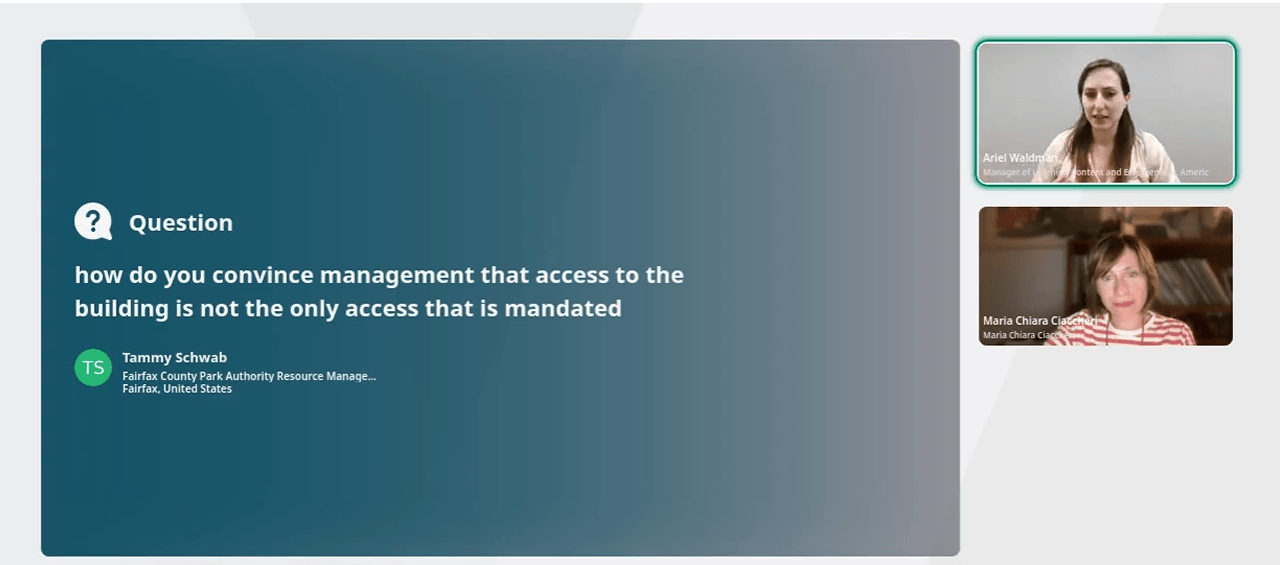
So this question is from Tammy. How do you convince management that access to the building is not the only access that is mandated?
Maria Chiara Ciaccheri
Oh, just to say… Okay. Here. To the building. Yes. It’s a huge and very common point. From one side, I would say that, we are in the middle of kind of cultural change. Something is happening and in terms of awareness, this part of our willing. And, and, well, usually, if we allow people to observe how even little improvement made a difference. Well, sometimes, it definitely works. And, it means, all… Oh, and… Well, different strategies, of course. Promoting testing solution in the spaces. And work how they work, and at the same time, invite the management to, even just a consultation, talking to people, And I feel like that, in my experience, there is nobody that doesn’t want to work in terms of making places more comfortable, more accessible. It just… They don’t know. That’s the point.
Ariel Waldman
Great. Yeah. Kind of it sounds like you’re saying kind of educating them by bringing them into kind of what people are experiencing, so they can kind of experience it for themselves.
I see another question here. From Kirsty, and this is a little bit of a long one. But do you have effective ways or example that communicate the ways that improved accessibility elevates the experience for every visitor, not just subgroups. This feels like a lived reality to me, but it can be hard to convey succinctly.
Maria Chiara Ciaccheri
Why it’s I mean, for me, my experience may make the difference to show how powerful it can be universal design, which allow everyone to feel, that that… If we overlap accessibility with the visitor experience itself, We can see how powerful becomes the flow and, again, it’s like, effective ways to… Or example that communicates sometimes is also bringing benchmark The example of a very well, you… Huge museum I’ve been working with. Over… Was kind of, resistant toward any kind of change. And, with the group of colleagues, and when I was talking about the allies well, was, was, that as well. We made a huge benchmark of cases of similar museums, same position wonderful places, really wonderful places, And, well, whereas, that was, kind of impactful. And was able to convince. And now that plays is a great place where the user experience is very high in the lever, accessibility. They are working on it. It’s a process, we know. But, yes. It is another case. In which, about… Is again about knowledge.
Ariel Waldman
Great. If anyone has any other questions, please add them either to the chat or the q and a, function out somebody is, responding also to that question in the chat. They said, for example, curb cuts in roads were used those with mobility limitations, yet nowadays, many of us benefit from that curb cut. People with strollers, people with luggage, different things like that. So that’s one example.
See, I see another question here. How can management support a healthy work environment for their staff who may have accessibility needs that are not visible? Accessibility is a concern for those who work in a museum, not all accessibility needs are the type that you can see.
Maria Chiara Ciaccheri
When we talk about accessibility, and, disability also, we also always refer to those invisible, and they’re also a great book suggest is not in my list, but it’s another one from the series of AAM about, invisible barriers and disabilities. The point is that, again, the mindset here as to put a policy, define a policy, which your disability have not to be visible to be real. And, again, it’s something that can be done in another way. And, that’s where we need to break out. That that that that wall and, this, there is a huge for instance, discussion in Italy and Europe around welfare topics. In museums. And we talk about welfare for the visitors but we rarely work about welfare and well-being for the staff. It’s exactly the same. And we won’t be able to be excellent in accessibility for our audiences and people we want to serve. If we want be able to put ourselves the right questions, I would say again, as a board, as a governance, Right question. And, in term of, how am I able to listen and to open up the dialogue? With people I’m working with? And, every… All these works when there is coherence. In the highest level, when there is a coherence and there is a shared vision.
Ariel Waldman
Great. Thank you. And then I think we might have time for one more question. So please add your questions in the chat. We have Maria Chiara who is an expert. So anything that you may be wondering, please please add it.
Is there anything else that you’d like any parting words you’d like to share, Maria Chiara?
Maria Chiara Ciaccheri
Well, I… I’m seeing that someone wrote about training. That is a huge, topic on how we support, not just understanding because it’s, but it’s again about skills and the soft skills. And is, having, health all the organization, not just to count on those who are more sensitive or have a bigger motivation. Sometimes we say that, and that’s probably one of the other troubles we find, in setting accessibility as a high thunder to put on the ground and to have as a reference for everything we do.
Ariel Waldman
Well, thank you so much. This has been absolutely great, and I think has given hopefully, attendees a lot of food for thought. I was absolutely just enraptured by your presentation and, I just I am really excited to share it with colleagues. And start having some of these conversations. I want to thank everyone for attending today, and then I’ll also share a couple of our upcoming events.
So, we have, a four-week course starting, on Wednesday, October 21. Called Interpretive Planning for Museum Programs: Creating Meaningful Visitor Experiences. Then on Thursday, October 22, we have a one-hour webinar Tracking to Traction: Making Informed Social Media Content Decisions. And then very excitingly, at the end of the month, at the end of October, we have AAM Member Week. This is our inaugural, first member week to say thank you to all AAM members. It is Tuesday, October 27, through Friday, October 30. Each day is focused on a different pillar of AAM’s work, so we have community, advocacy, museum practice, and learning. And we really hope you’ll be able to join us. It is free for AAM members. And, please continue to stay up to date with all of our events, through our event web page, which I just put in the chat. And I want to just thank Maria Chiara again. This has been so wonderful and we appreciate you sharing your expertise with us and hope to see you again soon.
Maria Chiara Ciaccheri
Thanks to you. Thank you very much.
Ariel Waldman
Bye, everyone.

Upcoming Events
-
-
Understanding the U.S. History Sector
Event Date:Presented by: American Association for State and Local History (AASLH) -
-
Industry Showcase: Innovative Digital Solutions
Event Date: