This critique first appeared in the journal Exhibition (Fall 2026) Vol. 45 No. 2 and is reproduced with permission.
Dolly Parton: Journey of a Seeker
Country Music Hall of Fame and Museum, Nashville, Tennessee. May 20, 2025–October 4, 2026.
Website: https://www.countrymusichalloffame.org/calendar/dolly-parton-journey-of-a-seeker
Author’s note: Dolly Parton was one of one—a remarkable storyteller and generous philanthropist whose work dreamed of a better world. We will always love you, Dolly. This review was written and edited before Dolly Parton’s passing on August 25, 2026.
Beloved by many, Dolly Parton has been a mainstay in country music and American popular culture for the last seven decades. In 1964, the 18-year-old Parton moved to Nashville, Tennessee, and has made it her home ever since. The city now honors the superstar through Dolly Parton: Journey of a Seeker, a retrospective exhibition at the Country Music Hall of Fame and Museum (fig. 1).
The museum describes the exhibition as focusing “on turning points in Parton’s life and career through the decades, where she overcame obstacles and ignored naysayers to become one of the most beloved and widely recognized celebrities across the world.1 From her initial struggles to break through as a solo artist to the criticisms she received from record executives about her appearance, Parton has faced her share of challenges. Rather than a straightforward career retrospective, Journey of a Seeker focuses on how she overcame these obstacles. The museum centers Parton’s resilience and generosity as a means to cut through today’s cultural divides, curating an exhibition with a familiar message of hope that aims to connect with visitors from all walks of life.
Parton has always been a dreamer. As she explains in Dream More: Celebrate the Dreamer in You, “My desire to pursue my dreams has always been greater than my fear of not accomplishing them.”2 The exhibition frames Parton’s journey of seeking by highlighting how she consistently dreamed beyond the limits others placed on her. Journey of a Seeker invites visitors to reflect and connect through Parton’s personal stories of compassion and strength.
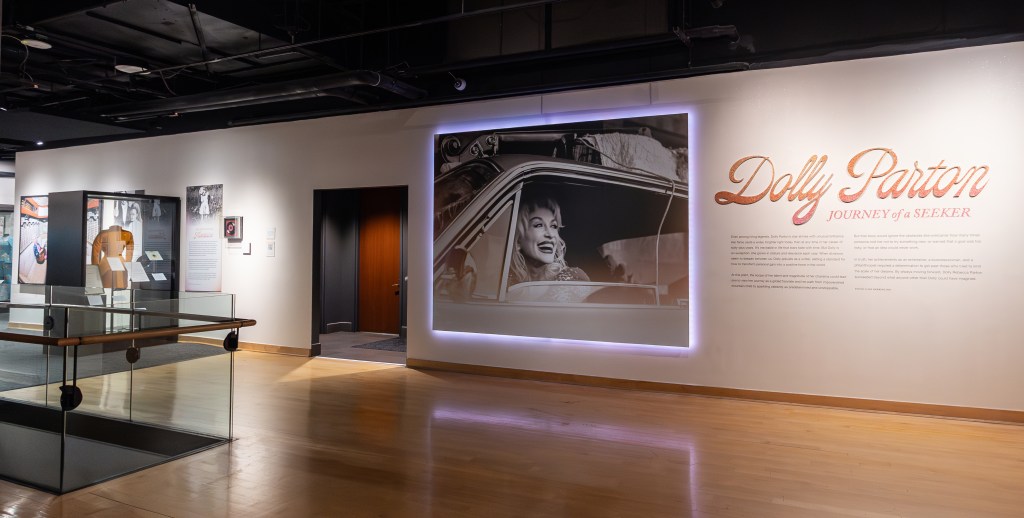
Before entering the special exhibition gallery, visitors encounter introductory wall text (fig. 2) arguing that Parton’s “fame casts a wider, brighter light today than at any time in her career,” noting how “when divisions seem to deepen between us, Dolly prevails as a unifier.”3 Eschewing a rags-to-riches narrative of her success, the exhibition chooses to focus on not only Parton’s resilience but also her power to cut through the noise and create connection across difference.
Beginning with her early career, the exhibition unfolds chronologically. Moving from her childhood years growing up poor in the Great Smoky Mountains to challenging the music industry as a female solo performer, the linear structure reinforces the exhibition’s central journey metaphor and guides visitors as fellow travelers.
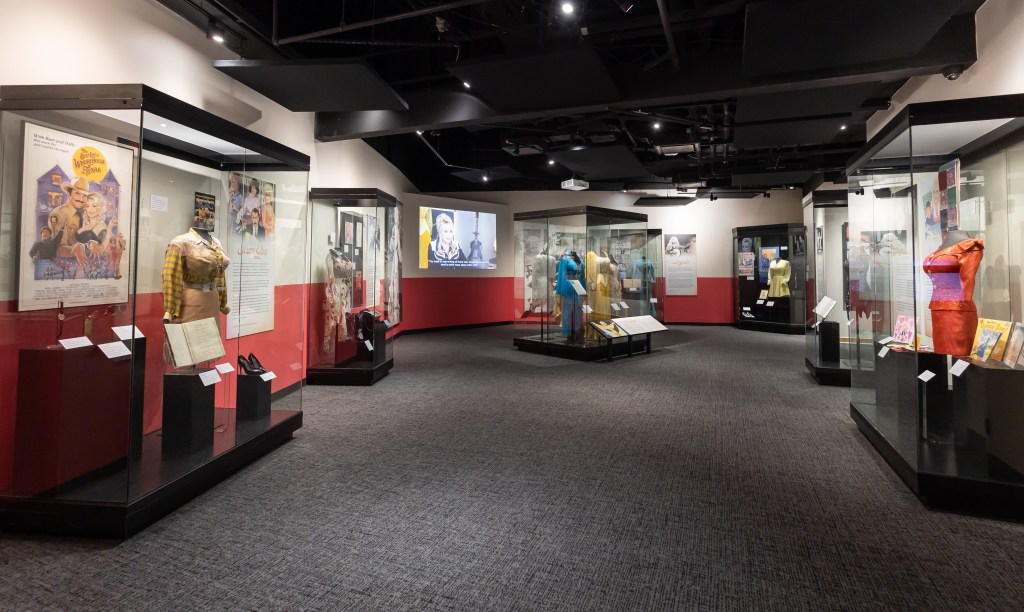
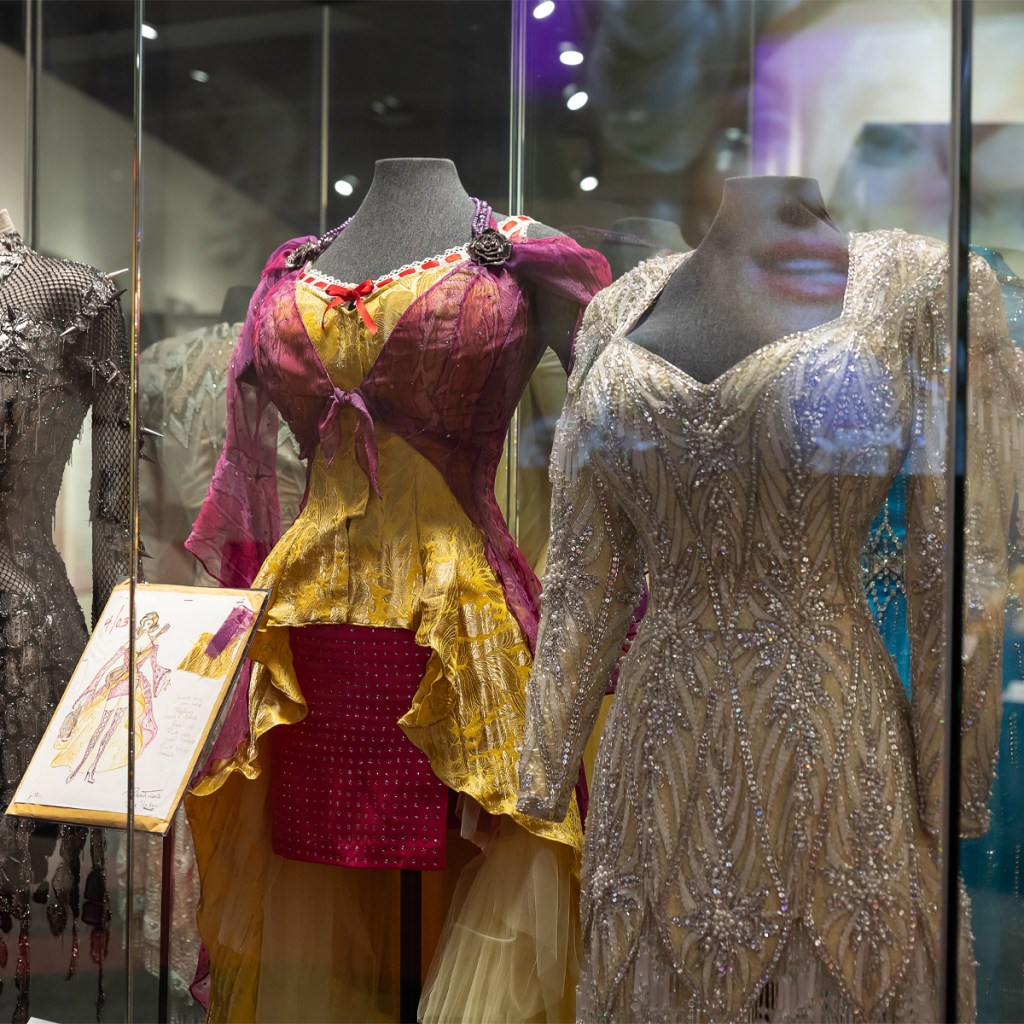
Occupying a small corner on the top floor of the museum’s permanent galleries, the exhibition space presents this chronological narrative through a series of glass display cases lining the walls, flanked by large panels of interpretive text underscoring pivotal moments in Parton’s career (fig. 3). Condensing seven decades of Parton’s career into a single, small room requires careful curatorial selection. From “Puppy Love,” her first vinyl record released in 1959, to the Kennedy Center Honors medallion she received in December 2006, the exhibition’s cases are filled with costumes, memorabilia, and archival press materials. At the center of the room stands a large glass display case featuring six of Parton’s signature sparkly dresses (fig. 4).
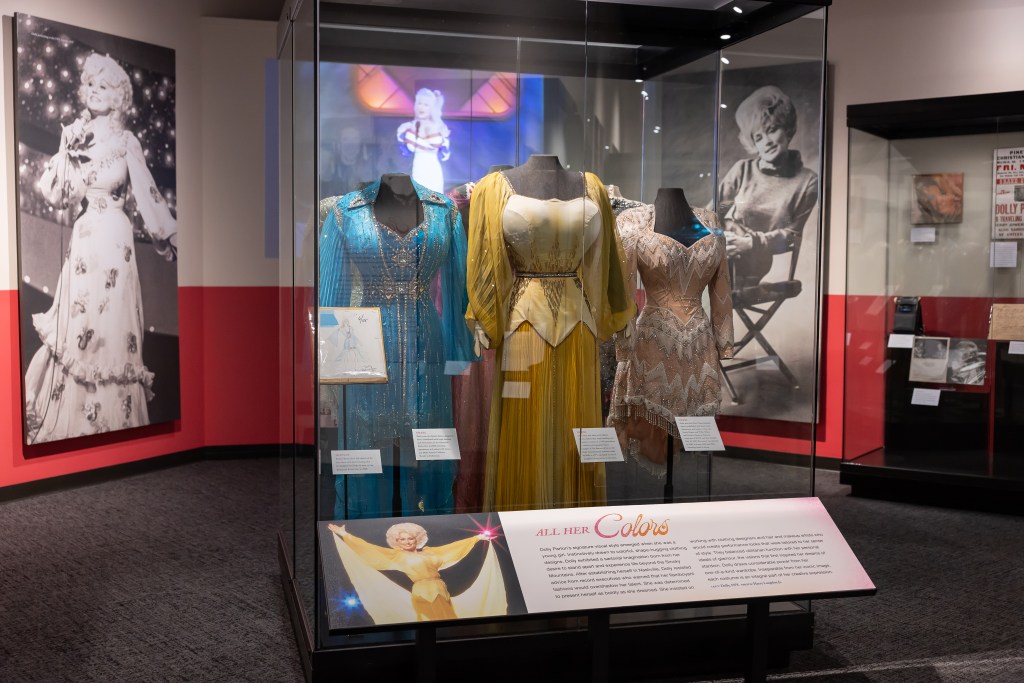
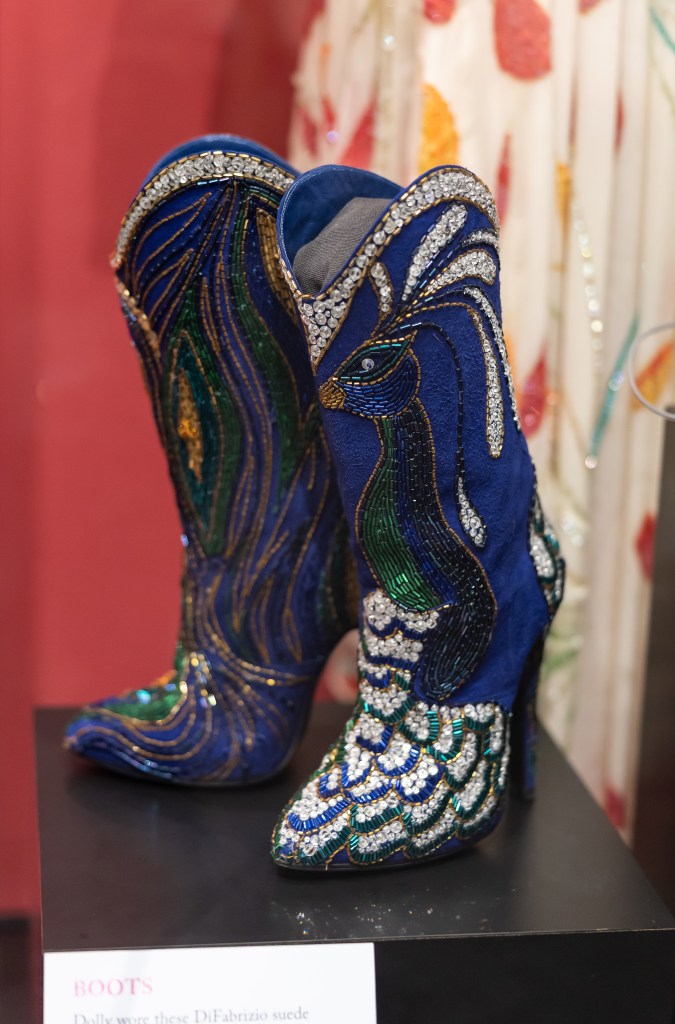
Using these dresses as visual anchors immediately introduces glitter as one of the exhibition’s main themes. As sequined boots (fig. 5) and rhinestone-studded accessories punctuate the exhibition’s display cases, Parton’s style and glamour become indistinguishable from her journey and are centered as an integral part of it. It is unclear whether the exhibition is simply celebrating her unmistakable style (following in the footsteps of her recent 2023 large-format coffee table book, Behind the Seams: My Life in Rhinestones) or using these objects to support the narrative of triumph over adversity. Whatever the case, the glitter functions as an attention-grabbing device that draws visitors straight to the central display case and interrupts the exhibition’s otherwise linear, chronological progression through Parton’s life. With many visitors arriving dressed for the occasion in pink cowgirl hats, rhinestone-studded denim jackets, and matching “Dolly” graphic T-shirts, the magnetism of the central display case comes as no surprise.
For an exhibition centered on one of country music’s most influential voices, there is surprisingly little sound. The wall behind the display of Parton’s dresses features a video montage of interviews and television performances playing on a loop. After hearing this media piece run through a few times, its sound becomes almost unrecognizable, like ambient noise playing in the background. There is also a small, easily overlooked interactive media station relegated to the back corner of the exhibition. Aside from these audiovisual components, Parton’s music is largely absent from the visitor experience. Instead of engaging aurally with her music, visitors see artifacts central to her music career, such as a handwritten early draft of the lyrics to “Jolene.” The museum, however, does encourage listening to the exhibition’s official playlist before or after visiting. Accessed through the museum’s website, the extensive playlist features 50 songs representing “turning points” in Parton’s career, from 1966’s “Dumb Blonde” to 2023’s “World on Fire.”
The loudness of the glitter in the display cases serves as the central noise of the exhibition, complementing a quieter environment that encourages slower engagement with the interpretive panels centering Parton’s resilience.
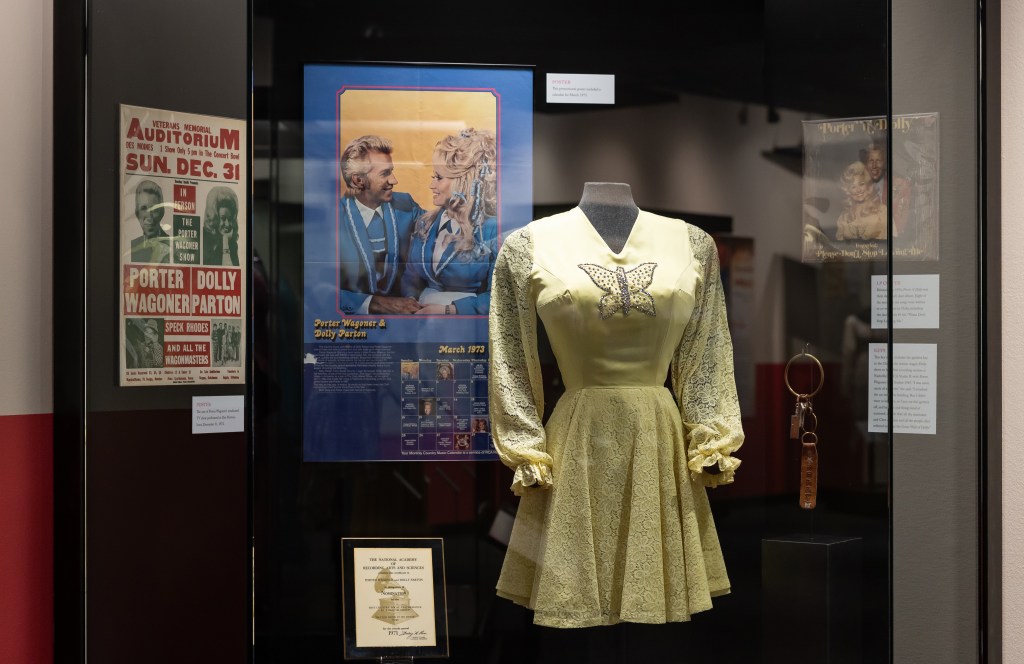
If the objects supply the glitter, the interpretive panels supply the grit. The interpretive text acknowledges the many challenges Parton faced through the years, including her decision to end her partnership with country superstar Porter Wagoner in 1974 to pursue a solo career. The exhibition’s linear nature does not allow visitors to dwell on these obstacles; the forward momentum of Parton’s career becomes practically preordained through both the exhibition’s chronological nature and the curatorial choice of displaying success alongside struggle.
While Parton’s essence permeates the exhibition, it is easy to lose oneself in the artist’s belongings without recalling her indelible wit and signature charm. The exhibition is at its best when Parton’s own words interrupt the narrative. One notable instance of this is through the contextualization of her keyring (fig. 6, to the right of the image) with the key to the Chevrolet station wagon that she famously crashed into RCA Studio B while driving to her first studio session. The object’s label quotes Parton, underscoring her down-to-earth relatability and bringing levity to the exhibition’s narrative. Parton jokes,
I was never much of a driver . . . I smashed the car into the building. But I didn’t want to be late, so I just cut the ignition off, and bricks and things kind of scattered. After that, all the musicians and Chet Atkins and all the people, they referred to it as the Great Wall of Dolly.4
Examples such as this, where Parton’s quips and personal storytelling propel the exhibition, best demonstrate how the superstar is deeply human and undeniably relatable. Parton’s own sense of humor allows her to laugh at her mistakes and failures, and the keyring demonstrates just one of the many ways she continuously got back up and dusted herself off along her journey. Given that many of the objects on display were loaned by Parton herself, it would have made interpretive sense to include her own voice alongside her possessions. Incorporating more of Parton’s own words and flamboyant “Dollyisms” might have helped bring the glitter and grit together, demonstrating Parton’s ability to find joy and laughter in failure and inspiring visitors not to take things too seriously.
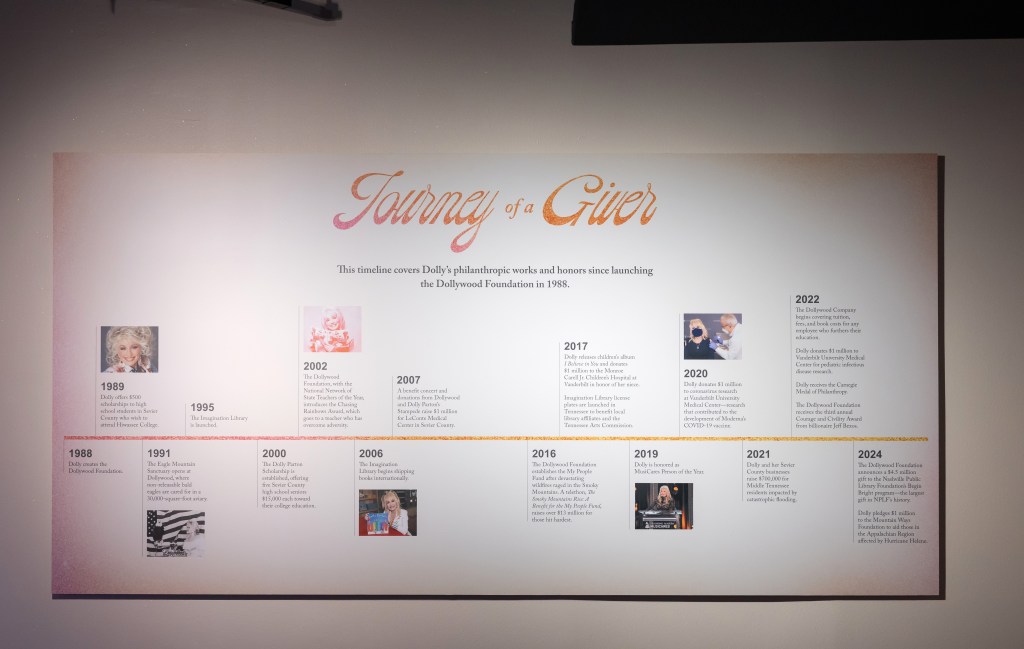
Over a quarter of the exhibition focuses exclusively on Parton’s philanthropic efforts, centered by a large interpretive timeline titled “Journey of a Giver” that chronicles Parton’s philanthropic efforts since the launch of her Dollywood Foundation in 1988 (fig. 7). Major milestones include her support of natural disaster relief, global literacy, and medical research. Underscoring Parton’s selfless acts of humanity, the timeline favors grit over glitter and provides visitors with a sobering narrative of personal charity alongside glimmers of hope. It is in this section of the exhibition that Parton’s two journeys collide, and the seeker becomes the giver. This intersection suggests that seeking and giving are not separate processes but intertwined ones. Without Parton’s ability to overcome challenges, she would not have arrived at the level of philanthropy she has been able to achieve. Her personal journey of extending kindness and supporting communities of all kinds affected by circumstances beyond their control offers a counternarrative to the vitriol spewing across social media and provides visitors with a hopeful respite from the nation’s cultural fractures.
Dolly Parton: Journey of a Seeker places Parton’s style alongside a chronological narrative demonstrating her dreams and resilience. Rather than competing with the noise of distraction and division rampant in today’s culture wars, the exhibition cuts through it, creating a space for visitors to appreciate a popular celebrity and connect through a shared story of resilience and generosity. The rhinestones punctuating the exhibition serve as beacons of connection in a noisy world—guideposts marking the journey of a cultural icon who has made her career balancing success with struggle and glitter with grit.
William J. Bonfiglio is a PhD student in American Studies at Saint Louis University in St. Louis, Missouri. He has taught at Webster University’s Sargent Conservatory of Theatre Arts and Washington University in St. Louis, where he designed and instructed a course on the performance and politics of Dolly Parton.
- Dolly Parton: Journey of a Seeker,” Country Music Hall of Fame and Museum, accessed March 23, 2026. ↩︎
- Dolly Parton, Dream More: Celebrate the Dreamer in You (G.P. Putnam’s Sons, 2012), 19. ↩︎
- Introductory text to Dolly Parton: Journey of a Seeker, Country Music Hall of Fame and Museum, Nashville, Tennessee. ↩︎
- Quoted in “Keys” object label in Dolly Parton: Journey of a Seeker. ↩︎
Upcoming Events
-
Museum Store Sunday
Event Date:Presented by: Museum Store Sunday/Museum Store Association -
What’s Next? Post 2026 Election Round Up
Event Date:Presented by: American Alliance of Museums -
Beyond the Gallery: Shops, Cafes, and the Museum Mission
Event Date:Presented by: Ohio Museums Association -
Museum Evaluation: Measuring Impact and Improving Visitor Experiences Course
Event Date:Presented by: American Alliance of Museums