Last week, I was on a Zoom call with a Development Director who looked ready to scream.
We were screensharing…staring at the familiar, gray, windowless interface of a legacy donor database. I spend half my life staring at these screens. You know the one. It looks like it was designed in 1998 and costs as much as a two-bedroom house in Wichita.
She was trying to figure out why a Board Member, let’s call him David, had received a generic “First Time Visitor” automated email after buying tickets to the holiday gala in December.
Now, David isn’t a first-time visitor. David has been a member for fifteen years. The exhibition hall is named after his grandmother. His family’s checks practically funded the museum’s new HVAC system.
She was clicking furiously through the tabs. “I know he’s in there. I can see his check from 2019 right here. Why didn’t the marketing email know that?”
The answer is one I give almost every day.
The marketing email didn’t know David because the marketing system doesn’t talk to the memberships and fundraising system. And neither of them talks to the ticketing system.
David isn’t one person to the museum. He’s three.
He is Ticket ID #88291.
He is Constituent #4022.
He is Subscriber #99.
And none of those Davids have ever met each other.
It’s complete institutional amnesia. It reminds me of Memo, my beautiful but truly empty-headed Vizsla. He greets me with unbridled joy, walks into the other room, comes back ten seconds later, and barks at me like I’m an intruder. He has no object permanence.
Just like a marketing database. Isn’t it exhausting?
The Lie of the “All-in-One”
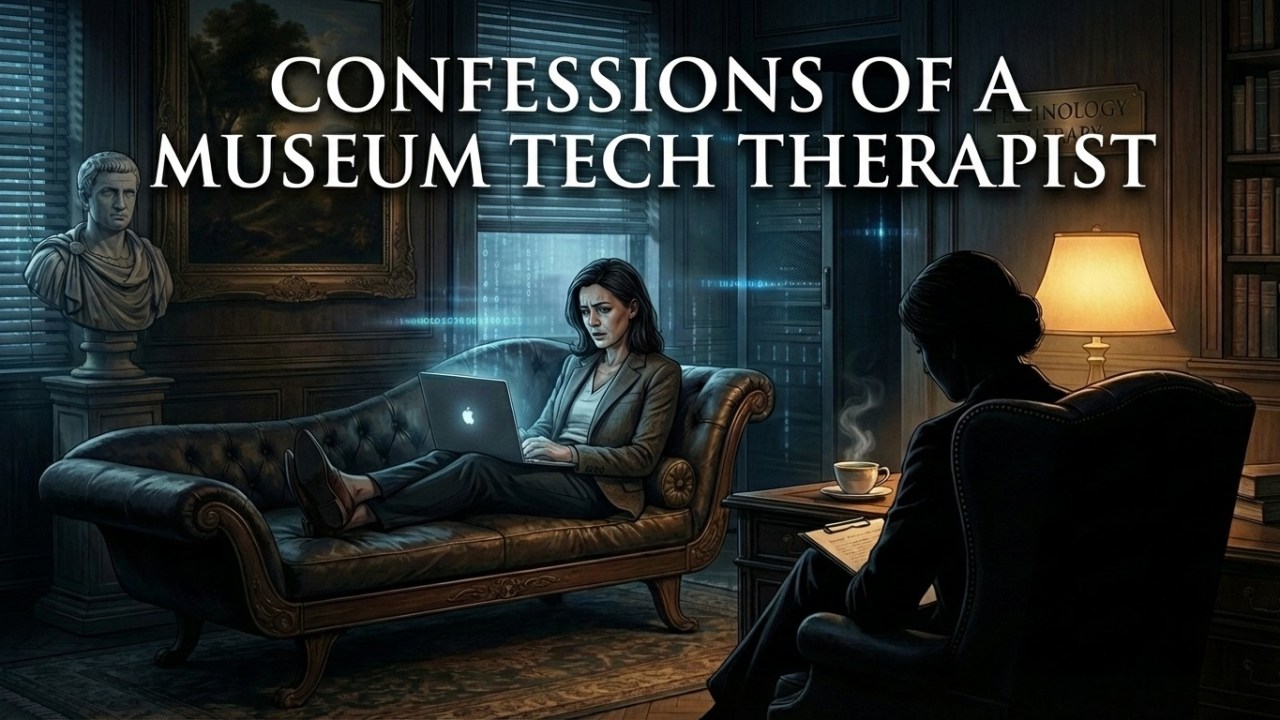
My title is CEO, but some days I’m a couples counselor for people in abusive relationships with their software. I’ve had dozens of Executive Directors lay down on my figurative couch, stare at the ceiling, and admit they feel betrayed. I sit there. I nod. I tell them their feelings are valid. Because for twenty years, the museum sector has been sold a specific lie.
The lie was that if you just bought one massive, expensive, ERP system, it would do everything. It would sell the tickets, track the donors, send the emails, and manage the gift shop inventory.
But here’s the dirty secret we all know but rarely say aloud: the “all-in-one” systems do everything, but do they do anything well?
Look, I don’t want to call them bad. They aren’t bad. They function. But can we really look each other in the eye and call that email editor that crashes when you look at it wrong best in class? Can we say with a straight face that the e-commerce checkout flow is delightful? No. We cannot.
The ticketing works, but the checkout flow looks like a DMV form. The fundraising module holds data, but you need a PhD in SQL just to get a report out of it.
So, teams do what teams always do. And they improvise.
They buy Mailchimp because they wanted emails that didn’t look like ransom notes. And they buy Shopify because they wanted to sell merch online without a headache. They buy standalone auction software for the gala.
And then, they hand the problem to staff.
I call this the “Franken-stack.” Tools stitched together with manual exports, duct tape, and hope. It’s alive! It walks! But it ain’t pretty.
So What’s the Cost?
If you want to know the real cost of this architecture, don’t look at your software license invoice. Look at your staff on a Tuesday morning.
I know Membership Managers who spend the first four hours of every week downloading a CSV from the ticketing system, cleaning the columns in Excel, and uploading it to the email platform just to send a “Welcome” series that is already three days late.
I know Gift Officers who walk into the lobby blind. They have no idea that a major prospect is currently scanning a ticket at the front desk because that scan data won’t hit the fundraising database until the nightly batch job runs.
We are asking brilliant, mission-driven people to act as human middleware. Hired to build relationships, but instead wrangling spreadsheets and fumbling through Excel macros.
The Cure for Amnesia
For profits? They figured this out a long time ago.
When I buy a latte at Starbucks, the app knows everything. It knows my name. It knows my balance. It suggests a Pup Cup for Memo before I even ask. It made me buy a branded mug the other day. I don’t need a mug. I have twenty mugs!
It doesn’t matter if I buy it at home in Albuquerque or Seattle. The data is fluid. It flows.
Museums deserve that same clarity. But you won’t get it by doubling down on the closed, legacy systems of the past. The future of museum tech isn’t a monolith. It’s an ecosystem.
It’s about admitting that ticket software should maybe just sell tickets. E-commerce should focus on selling things. And your CRM should be the brain connecting them.
But this is usually where my clients start to panic.
They realize that if they move away from the “all-in-one” museum software, their only other option is a big, commercial platform. A HubSpot or a Salesforce. And that terrifies them.
“HubSpot can’t run a museum!” they tell me. “It doesn’t know what a member is!”
I guess they’re half right. It’s true that off the shelf, a world-class CRM like HubSpot doesn’t know the difference between a ‘General Admission’ ticket and a ‘Capital Campaign Pledge.’
But then the breakthrough comes. It is infinitely easier to teach a world-class CRM how to speak “Museum” than it is to force an old guard nonprofit-specific database to speak “Modern Technology.”
You don’t need to bend your legacy tools until they break by bolting on a hundred different point solutions. You need to take the most powerful CRM on the market and simply teach it to speak your language.
Niche software had its run, but that era is over. If you can muster the strength to break out of your walled garden, you get the power of a tech giant with the nuance of a specialist.
Stop Fighting Your Tools
I spent years handing tissues to burnt-out directors before realizing we couldn’t just fight the symptoms, we had to cure the disease. And that’s why we built MuseumHub. It is the escape hatch this industry needs from the Franken-stack.
The solution exists. Give your staff their evenings back. Give your visitors the recognition they deserve. And finally give your database a little object permanence.

Mandy is the CEO of Nonprofit Tech Shop, a digital transformation partner that helps museums and cultural institutions replace legacy, nonprofit-specific tools with modern architecture. By implementing HubSpot, the market’s best-in-class CRM, and enhancing it with their specialized operational layer, MuseumHub, they eliminate data silos and the need for manual exports. This unifies every touchpoint, from ticketing and fundraising to membership and events, into one seamless ecosystem. Explore the platform at http://nonprofittechshop.com/museumhub.