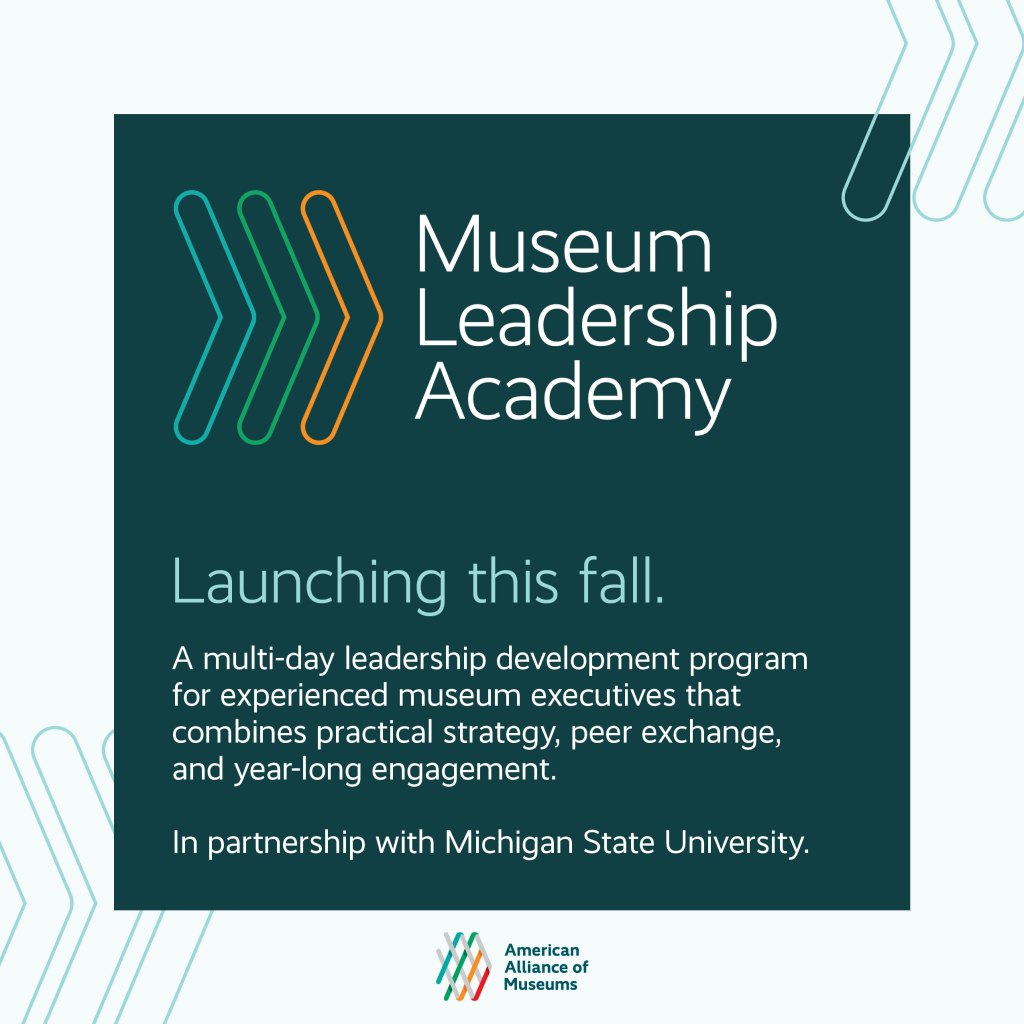
Museum Leadership Academy
A New Kind of Leadership Experience
The Museum Leadership Academy is an intensive, cohort-based accelerator for museum leaders ready to move beyond managing day-to-day operations and lead sustainable institutional change.
Developed by the American Alliance of Museums in partnership with Michigan State University, the Academy brings together a small group of senior leaders to step back, think strategically, and navigate the complex challenges shaping museums today.
This is not traditional training. It is a focused, high-impact experience designed to strengthen leadership at a critical moment for the field.
Key Details
Dates & Location
October 5–9 | Detroit, Michigan
A 4.5-day immersive experience featuring:
- Adaptive leadership and systems thinking
- Financial strategy and resource alignment
- Leading people through change
- Innovation, foresight, and future planning
- Experience design and community relevance
Who Should Apply
- Executive Directors, Deputies, and C-Suite leaders
- Senior leaders preparing for executive roles
- Leaders navigating growth, change, or complexity
Cohort Size: 40 participants
Tuition: $2,500 for the 2026 pilot year (travel and lodging not included), made possible through generous support from E.A. Michelson Philanthropy. Please note that the cost of tuition for future years is expected to increase.
Application Deadline: June 22, 2026 (the application period is closed)
Should we receive more applications than space allows, AAM Members will be prioritized.
Applicants will be notified of their application decision by July 16, 2026.
Program
The Museum Leadership Academy was developed in response to the growing need for leadership development and camaraderie as museums face some of the most complex and compounding challenges in recent history.
- Cohort-based
Learn alongside a group of peers facing similar challenges who can become your sounding board beyond the program dates. - Real-World Focus
Work through practical issues in strategy, workforce, and sustainability. - Academic & Field Expertise
Renowned thought leaders, including the author of The Experience Economy, Joseph Pine, Partner at IDEO, Rachel Young, and Founding Chair of the Association of Professional Futurists, Andy Hines, among others.
Museum leaders are being asked to do more than ever while facing real constraints around funding, workforce, and public trust. The Academy is designed to help leaders navigate complexity and uncertainty with confidence; align mission, strategy, and financial sustainability; and position their institutions for long-term relevance and impact.
Participants will:
- Develop a clear, actionable leadership agenda aligned with institutional priorities
- Strengthen their ability to lead complex, organization-wide change
- Build confidence in financial, strategic, and people leadership decisions
- Apply foresight and innovation frameworks to real institutional challenges
- Expand their capacity to design meaningful, mission-driven experiences
- Join a national network of peers for ongoing exchange and support
Program Schedule
Monday, October 5
9:00 am – 12:30 pm: Welcome & Orientation
This opening session sets the foundation for the week, bringing participants into a shared exploration of leadership at a moment of profound institutional and societal change. Through facilitated dialogue and cohort-building, participants will examine the evolving role of museums at the intersection of civic, cultural, and organizational transformation, while reflecting on their own leadership approach and aspirations.
12:30 – 1:30 pm: Lunch
1:30 – 5:00 pm: (Module 1) Becoming a Change Leader
Effective change leadership requires balancing bold organizational vision with often-overlooked realities, including routine change, individual readiness, organizational culture, and workplace dilemmas. Grounded in research and best practices, participants will gain practical tools to navigate transformational change through vision, planning, implementation, and continuous evaluation—ensuring that learning translates into sustained performance.
Facilitator: J. Kevin Ford, PhD is a professor in the Organizational Psychology program and currently serves as Chair of the Department of Psychology at Michigan State University, with a focus on workplace learning, leadership development, and organizational change. He has consulted with private companies and public sector agencies on training, leadership, strategic planning, and organizational development, and has published more than 100 articles and chapters, as well as six books, including Learning in Organizations: An Evidence-Based Approach. He is a Fellow of the Society for Industrial and Organizational Psychology (SIOP) and a recipient of its Scientist–Practitioner Award.
6:00 – 9:00 pm: Evening Reception & Dinner, Hosted at the Detroit Institute of Arts
Tuesday, October 6
9:00 am – 12:30 pm: (Module 2) Museum Finance: Aligning Mission with Margin
Sustainable leadership requires financial fluency. This module focuses on how leaders can model revenue streams, make strategic financial decision-making with mission, and build resilience through financial scenario planning.
Facilitator: Brent Ott is Chief Operating Officer at The Henry Ford, where he oversees all aspects of the institution’s business operations, including facilities, security, guest services, IT, food service and catering, sales, experience design, and strategy, while working closely with the executive team and Board to guide long-term planning and organizational alignment. Beyond his leadership role, he serves as Chair of Henry Ford Academy and Culture Source, sits on several additional boards, and teaches accounting at Wayne State University. Brent joined The Henry Ford in 2000, became Chief Financial Officer in 2013, and was named Chief Operating Officer in 2022.
12:30 – 1:30 pm: Lunch
1:30 – 5:00 pm: (Module 3) Leading People in a Changing Workplace
Workplace expectations are shifting rapidly, and museum leaders must respond with clarity and intention. This module explores how to lead evolving complexities of multigenerational, hybrid teams, while addressing staff burnout, restructuring, and organizational change. Participants will explore how to design people-centered HR practices that reflect the values of mission-driven institutions, maximize employee engagement, and unlock the full potential of their teams.
Facilitator: Angela Paccione, Chief Impact Officer at Versus Global, began her career in education after a brief basketball career, earning a PhD and teaching for 18 years before entering public service. She served in the Colorado General Assembly, spent 12 years at Verus Global working with more than 2,500 leaders across 20+ countries, and later joined the Colorado Governor’s Cabinet as Executive Director of Higher Education, where she was named the 2026 Colorado Leader of the Year.
Wednesday, October 7
9:00 am – 12:30 pm: (Module 4) Mission-driven Innovation: Creating Value Through Purpose
Innovation is most powerful when grounded in purpose. This module examines how museum leaders can harness innovation as a strategic tool for deepening relevance and impact. Participants will explore how to design programs that authentically meet the needs of the communities they serve, while clearly defining public value through the lens of stakeholder engagement and mission alignment.
Facilitator: Rachel Young is a Partner and Director of Research at IDEO, with over 20 years of experience helping nonprofits, government agencies, and Fortune 500 companies stay relevant as audience expectations rapidly evolve. Before joining IDEO, she spent a decade as a nonprofit leader, where she developed a deep understanding of how to balance mission, innovation, and organizational sustainability. Her public sector clients include the San Francisco Unified School District, Los Angeles County, the Association of Science and Technology Centers, the National Science Foundation, and the South Bend, Indiana library system.
12:30 – 1:30 pm: Lunch
1:30 – 5:00 pm: (Module 5) Leading with Foresight: Strategy for an Uncertain Future
In a rapidly changing environment leaders must anticipate—not just react to—emerging trends. This module equips museum leaders with strategic foresight tools and frameworks, including STEEP analysis and emergent strategy, to anticipate change, navigate uncertainty, and position their institutions for long-term civic relevance.
Facilitator: Andy Hines, PhD, is an Associate Professor and Program Coordinator for the University of Houston’s Graduate Program in Foresight and leads Hinesight, where he facilitates workshops, speaks, and consults. With more than 30 years of experience as a professional futurist, he has worked in-house at Kellogg and Dow Chemical and consulted with firms including Coates & Jarratt and Social Technologies/Innovaro. He is the author of Imagining After Capitalism and several other books on futures studies, and was Founding Chair of the Association of Professional Futurists, with research focused on integrating foresight into organizations.
Thursday, October 8
9:00 am – 12:30 pm: (Module 6) Mission-driven Innovation: Creating Value Through Purpose
Museums are uniquely positioned to create transformative experiences. This session explores how intentional experience design—grounded in the Experience Economy and principles of transformative learning—can deepen visitor engagement and lasting impact. Participants will examine the roles of emotion, memory, and immersion in shaping meaningful encounters, and apply leading frameworks such as Pine and Gilmore’s experience design model and transformative learning theory to rethink how their institutions connect with audiences.
Facilitator: B. Joseph Pine II is an internationally acclaimed author, speaker, and management advisor. He has addressed the World Economic Forum, the original TED conference, the Consumer Electronics Show, and South by Southwest, and is a Lecturer in Northeastern University’s School of Business. He cofounded Strategic Horizons LLP to help businesses design new ways of adding value to their economic offerings, and is the author of The Transformation Economy: Guiding Customers to Achieve Their Aspirations, which argues that the greatest economic value lies in helping customers become who they want to be, as well as The Experience Economy, Infinite Possibility, Authenticity, and Mass Customization.
12:30 – 1:30 pm: Lunch
1:30 – 5:00 pm: (Module 7) Applied Workshop on Creative Aging
This module introduces the growing field of creative aging, grounding participants in the major demographic shifts reshaping U.S. museum audiences and the compelling evidence for arts engagement as a driver of health, connection, and vitality among older adults. Participants will apply these insights to practice by addressing institutional ageism; engaging an intergenerational and age-inclusive mindset; and designing programs and age-friendly spaces for older adults, that honor the full range of lived experience and expand the museum’s role as a community anchor for people of all ages.
Facilitator: Brian Kennedy, PhD, is a leadership consultant and adviser to philanthropists and arts organizations, known for his work in visual and multi-sensory literacy and creative aging for older adults. Since 2021, he has advised E.A. Michelson Philanthropy on Vitality Arts, a major initiative advancing creative aging and addressing ageism in American art museums. He previously led major institutions—including the National Gallery of Australia, the Hood Museum of Art, the Toledo Museum of Art, and the Peabody Essex Museum—and is an Atlantic Fellow at Trinity College Dublin, where he worked with the Global Brain Health Institute in 2024–25.
6:00 – 9:00 pm: Closing Reception & Dinner, Hosted at the Detroit Historical Museum
Friday, October 9
9:00 am – 12:00 pm: Reflection & Commitment
The program concludes with structured reflection and forward planning. Participants will synthesize key insights, define clear leadership commitments, and identify immediate next steps for applying their learning within their institutions.
The Museum Leadership Academy is made possible with generous support from