Greetings! This is Sage and I am excited to announce that we are reposting this great article because I am about to fly to Manchester, England to attend the Museum Association’s conference and be on a panel with these wonderful authors speaking about the “museum schools movement” in the UK and US. It will be refreshing to be able to meet these scholars, educators, and innovators in person and ask them questions.
Please follow along with our presentation on social media at: @Museumsp12 (my AAM Ford W Bell Fellow handle) @CulturalKings (TheCultural Institute at King’s College London) #schoolsinmuseums (the hashtag for the project), #museums2017 (the Museums Association conference hashtag)@MuseumsAssoc, and @heritageinsider. Our session will be about “moving beyond the one-museum visit and establishing cultural residencies, with classes located in museums for extended periods of time. Discover how to address practical issues and learn from the experience of the Museum-School movement in the US. Participants are invited to share ideas on innovative practice and explore further opportunities for museums to be an integral part of children’s learning.” For those of you who happen to be in Manchester on Thursday, November 16th come by from 16.50-17.50 in room Charter 4. I will be writing another post shortly with follow up on my adventures in England learning from the other side of the pond!
Thanks and enjoy this gem about how an architect helped start excellent museum preschools and their evolution and evaluation.
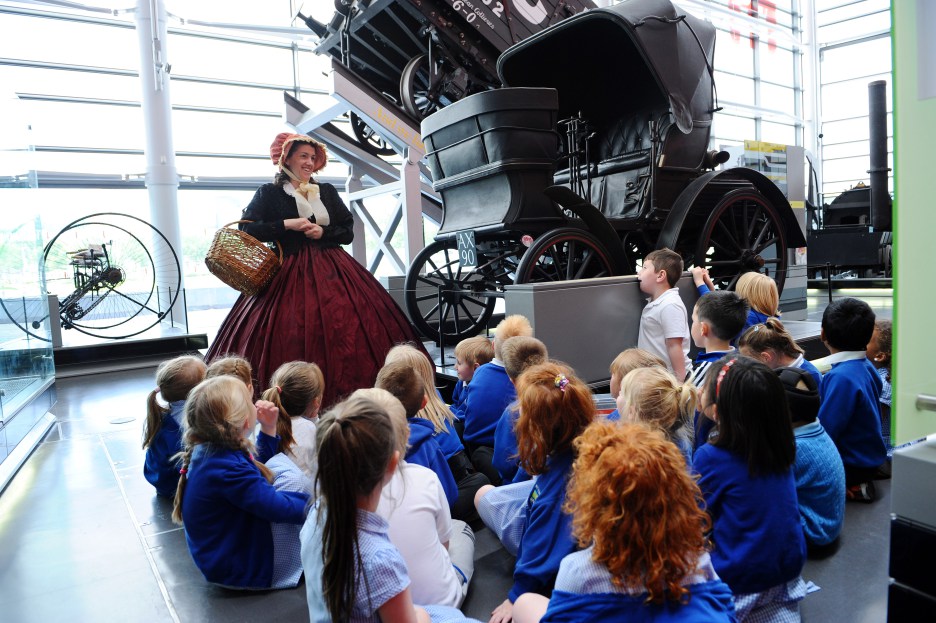
Just one year ago I felt I was still dreaming about the idea of running a proof of concept project to examine whether or not it could be a good idea to co-locate primary schools, or even nurseries, with neighborhood museums. Collections can say so much about local life, but especially in the context of our wider world. I had visions of children understanding and becoming the explorers and collectors that had assembled the collections, finding inspiration and perhaps a helping hand to discover themselves and what might float their boats in life to come.
It had been quite a long haul until that point; the idea had fallen from the sky into my architect’s head, rather as an “egg solution” in the context of both a dramatic shortage of primary school places in parts of the UK, as well as the current economic situation imposing serious pressure on the continuing viability, and so sustainability, of far too many of our truly wonderful museums. As a partner in an architectural practice, we happen to specialize in public cultural projects, especially museums and education…
And so, back to the future that last year promised …I had been very lucky to come across the Cultural Institute at King’s College London and they were both highly interested and supportive of the idea. We created a feasibility partnership involving the School of Education, Communication & Society and a fund was made available to establish an action research project on the basis that I could find and “arrange some marriages” between interested, and indeed brave and inspired, schools and museums, to run the proof of concept work.
By autumn 2015 we were well on the way to finding a selection of possible willing partners, and this time last year we were on the final straight “designing” each of the four projects in reality and establishing the operational frameworks to run them.>
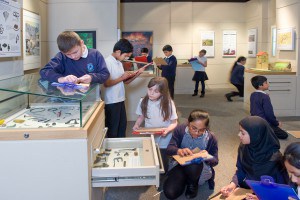
We opened the first doors on 7th January up in South Shields, Tyne & Wear, near Newcastle-On-Tyne in northern England. The museum is called Arbeia Roman Fort & Museum, and it was a very substantial fort overlooking the strategically placed south east bank of the river Tyne Estuary, not far from the eastern end of Hadrian’s Wall; the Roman border between the England and Scotland of the day. Supplies came in to resource the whole of the wall’s operation and today it is an amazing archaeological site with a small museum and a team of live resident archaeologists too. A very excited class of 9 and 10 year olds from the neighborhood Hadrian Primary School were given a classroom there and the opportunity to settle; a roman fort, their new school home!
A total of 4 projects ran until this last summer, extending to Liverpool in north-west England and two in Swansea on the south coast of Wales (see full details of all partnerships below). It was marvelous as we had a Roman Fort, a modern and contemporary art museum and a museum mostly concerned with industrial technological and local social history. We had children aged 3 to 10……. so all in all a wondrous mix.
I wrote my first blog! ……. This gives more of the background.
And of course a picture is worth a thousand words; perhaps moving picture even more? The Cultural Institute also commissioned a filmmaker to visit and record in each of the locations. Here’s the link, where you will get a great picture of the varying scenes!
(Film by The Service Communications Co-operative, with additional footage from Jake Ryan, for the Cultural Institute at King’s College London.)
These variations underscored for me the fact that there may be a national curriculum, but by the time you teach or learn that through the almost inexhaustible range of filters that would be available in using local museums’ collections, the children would have a veritable kaleidoscope of experiences, yet maintain a unifying thread. This is how I imagined regional, cultural and community differences could become more present, even celebrated. This could perhaps provide a rather more developed basis from which to approach learning matters of citizenship and cultural respect for so many other conditions in life.
Now, in autumn 2016, we have reached another very exciting moment in time.
Not only did all the projects successfully run in line with the planned frameworks, but the Cultural Institute also appointed Kate Measures from Heritage Insider to do a major piece of evaluation work. Kate got beneath the skin of all the major players, immersing herself in the activities of the children; meeting the parents; interviewing the teachers and head teachers, as well as the wider King’s partnership team, including ourselves.
Heritage Insider’s work considered many aspects from learning and how well the national curriculum “fit” in such an alternative model, to social and behavioral assessment as well. Perhaps unsurprisingly, the live projects showed significant impact on the wider families as a whole.
The Cultural Institute now holds an extensive report and a short summary report, including both practical and policy recommendations from all players, including the Institute’s overseeing specialists in primary education, about to be published. Without wanting to steal anyone’s thunder, or in any sense prejudge the final reading, it is very clear that there have been some major successes.
I visited quite often of course (in between my daily life fixtures in the Studio and on building sites!) Anyone could see how in every case the children’s sense of engagement, communication and vocabularies began to soar. I also met two groups of parents and it did feel as if the children’s experience integrated the families more closely, with some children bringing the family back at weekends.
Nearly all challenges seemed to be logistical in nature, and also the result of the classes being temporarily placed, rather than having the rest of the body of the school with them. The classes and teachers were out on a limb to some degree, and indeed needed to return to the school on some occasions. On the other hand the “escape” also seemed to bring attributes of focus and lack of interruption, rather in the same way as restorative retreats can sometimes work!
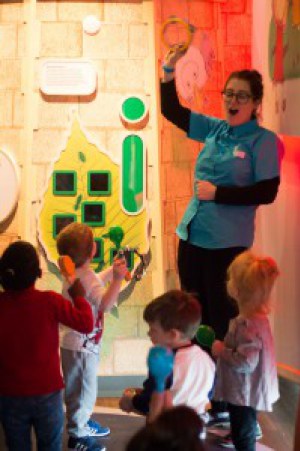
A good point to end with for now, however, might be the strapline “start as you mean to go on”. With nursery and primary children involved, there is an almost implicit consequence that the wider families and caregivers get more involved in the museum. There is a larger constituency of folk who can become involved in local cultural institutions, when they may never have done so before. Actually, this could be seen as a potential seam of cultural richness in areas of recognized poverty in some cases.
So I’m waiting to devour all of the final reports and will be able to let you all know a little more scientifically exactly what happened.
There will be a launch of the summary publication almost within days; an exciting chance to explain all at the upcoming Museum’s Association Conference in Glasgow next month, and a symposium planned in the new year, aiming to present the whole project to date to further interested parties, potential partners, and policymakers.
2016 has flown by with so many wonderful pictures of adventuring children hard at work in their newly found treasure troves. Now I’m hoping, indeed still dreaming, that 2017 will soon generate and embrace an even wider call to action!
Here, below, is a summary of the core partnership team so far:
Wendy James, Partner, and Jo Spittles, Project Assistant, Garbers & James
Museum / School Partnerships:
- Arbeia Roman Fort & Museum with Hadrian Primary School, South Shields
- National Waterfront Museum-with St Thomas Community Primary School, Swansea, Wales
- Tate Liverpool with Kensington Children’s Centre/Nursery, Liverpool
- The Cultural Institute at King’s College London–
- Katherine Bond – Director of the Cultural Institute
- Sophie Branscombe – Innovations Manager at the Cultural Institute
- Dr Jennifer DeWitt – School of Education, Communication & Society, Research Fellow
- Dr Heather King – School of Education, Communication & Society, Research Fellow
- Heritage Insider– Kate Measures – Evaluator
Wendy James is reachable at e-mail: wendy.james@garbersjames.com and she would be so delighted to hear of further related experience and projects on the other side of the Atlantic.
Upcoming Events
-
AASLH History Hour: Civic Practice
Event Date:Presented by: American Association for State and Local History (AASLH) -
What It’s Like to Participate in Museums Advocacy Day
Event Date:Presented by: American Alliance of Museums -
From Idea to Acceptance: How to Submit a Winning Annual Meeting Session Proposal
Event Date:Presented by: American Alliance of Museums -



The very cool article, I am very glad that for children there are such good places where they can learn a lot useful for themselves, in particular, history. My child really admires museums, what things were before and how the world was arranged. She finds so much interesting information that sometimes I wonder how smart my daughter is, once I even wrote an article on how useful it is to take children to a Museum on this website.
You provided great knowledge information.