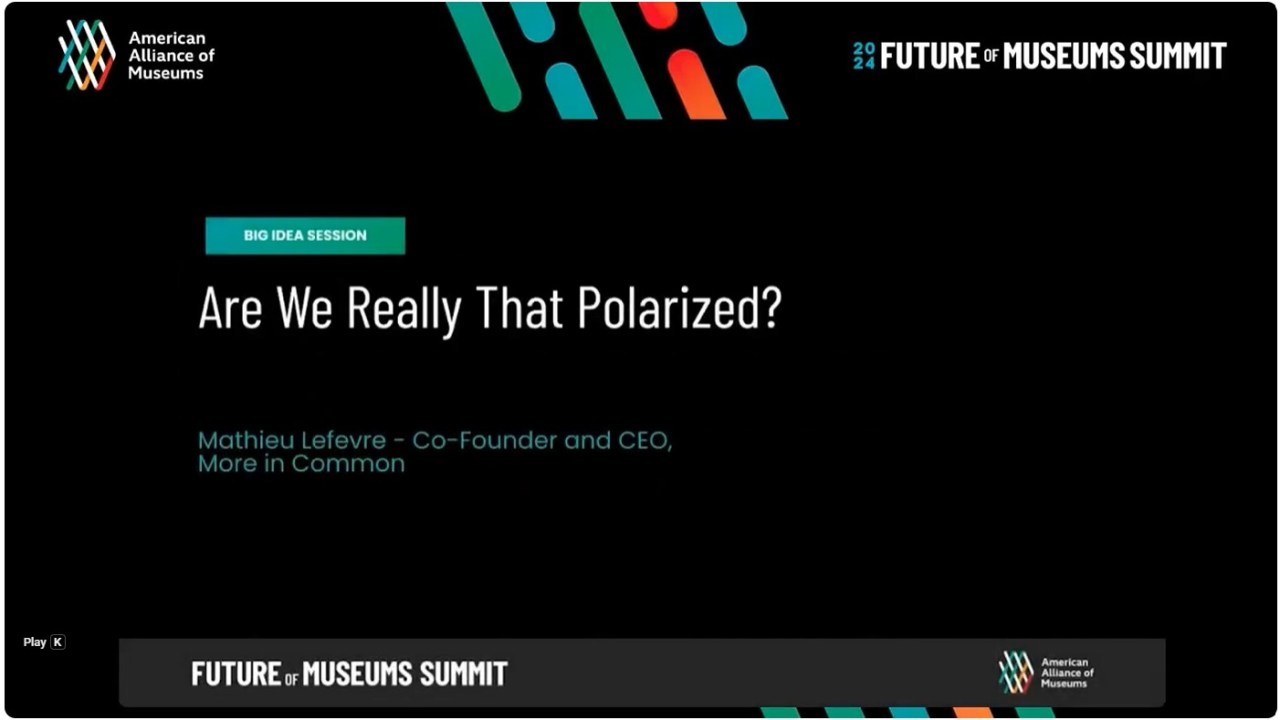
This recording is from the Future of Museums Summit held October 29–30, 2024. Explore the difference between ideological divides and shared values, and strategies for museums to remain trusted community spaces and bridge partisan divides without compromising their missions with Mathieu Lefevre, Co-Founder and CEO, More in Common.
Transcript
Mathieu Lefèvre:
Hello everyone. My name is Mathieu Lefèvre. I am the co-founder and the CEO of an organization called More in Common, which I’ll tell you all about in a minute. I’m also a big fan of museums and regular museumgoer, and I also believer in the power that museums and other places of convening have to overcome the toxic polarization which we see everywhere. Before I get started, let me tell you a little bit about More in Common. More in Common is an organization that I helped start in 2016. In the wake of a tragic assassination, there was a young British member of parliament whose name was Jo Cox, who was murdered in June 2016. She was somebody that the co-founders of More in Common knew, and in her first speech to the British Parliament in the Houses of Common in London, she said that she believed that people have More in Common than what separates them. So that is the origin of our name. It’s also kind of our mantra and our philosophy.
We essentially do two things. The first thing is we do quite a lot of research to explore different perspectives. You don’t need to worry about this graphic on the screen. I’ll return to it in a little bit. It’s some of our research on the United States called Hidden Tribes. What we try to do in our research is to try to understand less what people think about polarization, about politics, about climate, about abortion, about immigration. So less what they think, their opinion about these issues and more why they think that what in their psychological worldview explains their opinion. So we’re less interested in what people think and more interested in the why people think it. And we conduct research, but we also do quite a lot of designing of interventions. So we’re not a traditional think tank in that way. We really try to understand what interventions can be designed in order to reduce feelings of division and polarization.
We’ve published lots and lots of reports, but I’m going to draw on a few during my talk. One is a study called Hidden Tribes, and the other one is called the Perception Gap. You might look them up after this talk. I’m also going to draw from a specific study that we did, which was called Diffusing the History Wars, and it’s really about how Americans perceive their history or more specifically, what parts of their history should be taught. So that’s another resource that you might look into. More in Common works in seven countries. So we essentially do the same thing we do in the U.S., but we do it also in Brazil and also in Germany, in France, in Poland, in the UK and in Spain. We’ve worked with a lot of partners. We’ve been cited in the media quite a bit, and we’re a wonderful team of 50 people. We’re very passionate about finding common ground.
Now in my talk today, and I’m very honored to be invited to speak to this fantastic group, I’m going to try to do two things. I’m going to try to answer the question, is political division worsening in the United States or does it just feel that way? Then I’m going to try to look for reasons to be hopeful because yes, there are reasons to be hopeful, and that feeds into my third point, which is really about what we can do about this. And specifically the fourth point is what specific role can museums and places of convening play to reduce feelings of division? And we’ve done some research in the United States and also in other contexts, specifically on museums. So I’m going to try to do that in not too long and I will be very glad to take some questions after that. Right, first things first, is political division getting worse? It certainly feels like it’s getting worse, and I’m sure you agree with me there. If you look at social media, if you look at the news, it feels like everything is more divided, but is it really?
Well, on the one hand, yes, it is. Studies such as this one show that hostility towards the other side, in this graph it’s presented in political terms, has grown over the last decades from a place of sort of neutrality about the other side in the late ’70s to a place of, as you can see here, pretty much hostility towards the other side. So in that immediate reading of the data, you could say that yes, political hostility and political division has increased and that has been accompanied also by widespread feelings of distrust. This graph presents feeling of trust in the government, which as you can see is a sort of plummeted to where we are. And feelings of trust or rather feelings of distrust are a really, really important kind of background and context setting for those feelings of division. So you can see those two graphs that I’ve presented.
Trust goes down, feelings of political division increase. When it comes to institutions like the federal government, corporations, the national media, you can see that feelings of trust are fairly low. We’re at an average of between 10 and 20% of trust. And feelings are pretty low among all groups when it comes to the federal government, and there’s quite a lot of disparity when it comes to the national media. Broadly speaking, institutions are not trusted. But it’s not just institutions that are the sort of underpinning of our feelings of division. It’s not just distrust in the system, which is clearly pervasive. It’s also quite personal. In this graph we asked Republicans how they would describe Democrats on the left side, and we asked Democrats how they view Republicans. And here we used more personal terms. How do you personally view the other side? And as you can see, overwhelmingly, it’s the negative qualities that have much higher scores than the personal attribute.
So for the number of people who think that, of Republicans who think that Democrats are reasonable, you see that there’s much, much a much bigger group who thinks that they are brainwashed or hateful or racist or arrogant, and that is true for the perceptions of one side to the other and vice versa. So it’s not just the system that is encouraging this feeling of institutional distrust, it’s kind of feelings of division are very personal. And what we can see, and I know that many of you as well as this group has worked on cultural divides. I read with great interest the last copy of your magazine on this. It’s really cultural divides that are driving political conflict, and this is quite significant. It’s not sort of disagreements on economic policy, which used to be the sort of crux of division possibly in the 20th century, it’s really sort of cultural divides that are driving that feeling of political conflict.
And you can name lots and lots of examples I am sure, which you’re experiencing every day in your museums. But worse, I think that you’ll all be familiar with the phrase of the military industrial complex or the defense industrial complex. I think that what we’re witnessing here, and this is particularly true in the United States, but also globally, is that there are certain funded individuals, corporations, social media companies through their ad algorithms that are actually benefiting from this polarization. That’s who we’ve called the polarization industrial complex. There are some pundits, media organizations and so on that benefit from putting out more extreme content into the world. Lots of research has been done to show that if you post more extreme content on social media, it will get more likes or retweets, reposts, whatever you want to call them, and that is beneficial. That turns into financial gain. And there are members of the polarization industrial complex on many sides of the equation.
If you think of YouTube stars, if you think of social media pundits and so on, you can see that that polarization industrial complex is really at play. So where does this all leave us? Well, it leaves us that worry about America’s future is widespread. And as you can see, everybody’s worried about America’s future, left, right, white, Asian, African-American, Hispanics, Gen Z, male, female, so on. Everybody has very high levels of worry about America’s future. So to sum up, is political division getting worse? Yes, it is. There is an objective reality that it is. But also this context of distrust, misaligned incentive creates an environment that amplifies conflict through distortion, through caricature, through kind of parallel realities. And here I think there’s a really interesting connection between the sort of perception of division and division itself.
Arguably, as I’ll show later on in my talk, there’s more of a perception of polarization than the reality of polarization, but history and particularly a history of tragedies like genocides, if you look at the conflict, the genocide in Rwanda for example, shows there’s a clear parallel between perception of polarization and how the other side is perceived that then becomes a reality. And arguably, we’re at that stage where perception of polarization is turning into real life polarization. It’s not a surprise that one of the hits of the box office last year was a movie called Civil War. I don’t know if you saw it. I thought it was a very good movie, but it was a big success because people know that that fiction is closer to reality than perhaps ever before. Now, are there reasons to be hopeful?
Yes, I think there are. There are many reasons to be hopeful, and part of the solution I think is to put polarization in perspective, take a better look at ourselves to understand where we are. And one of the things that might be interesting to you as you think about your work, but also as you think about your life as a citizen, as an American citizen going into an all important election in a few days, Americans, we find in our research have a deeply distorted understanding of each other through that kind of hall of mirrors effect that I was talking about. We’ve called this America’s perception gap. Now, bear with me for a couple minutes while I try to explain this perception gap because once you’ve understood it, I find that it’s really sort of enlightens the world around you. So overall, in our research, democrats and Republicans both imagine that almost twice as many of their political opponents on the other side as reality hold views, they consider extreme.
So as I’ll show you some examples in a minute, even on the most controversial issues in the national debate in the United States, Americans actually are much less divided than they think. That is the perception gap. So it’s good news for all of us because when you worry about the character of this country by looking through this hall of mirrors, actually the reality is that most Americans agree, and they hold views that are not so different from their own. That’s what we call the perception gap. But let me show you some examples. I hope those will make them a little bit more concrete.
First example is that Republicans underestimate Democrats’ commitment to celebrating American achievement and the overall story of progress. What do we mean by that? When we ask the question, all students should learn about how the Declaration of Independence and the Constitution advanced freedom and equality, 92% of Democrats actually agreed with that statement. So 92% of Democrats said that they agreed with the statement, but only 45% of Republicans estimated that Democrats agreed with that statement. That is the gap, 47% between that 92% of reality and 45% of the perception of Republicans. Second example, George Washington and Abraham Lincoln should be admired for their roles in American history. Only 42% of Republicans estimated that Democrats would agree with that statement. The reality was 87%, a gap of 45%. So I hope you’re starting to understand the mechanics of perception gaps. Now, of course you can flip it around and if you’re interested, we will make sure to have the links available to you for all of this research.
But when we ask the question, Americans have a responsibility, learn from the past and fix our mistakes, 93% of Republicans actually agreed with that statement, but only 35% of Democrats estimated that Republicans agree, massive perception gap of 58%. Martin Luther King and Rosa Parks should be taught as examples of Americans who fought for equality. 93% of Americans actually agree, only 38% of Democrats agree, creating a perception gap of 55%. So the perception gap I think is a really helpful way to sort of put polarization in perspective, but also to look at our own views and our own role in amplifying polarization. And the bigger our perception gaps, the more we dislike the other side. As you can see here, there’s a close correlation between the size of the perception gap you hold and the negativity of character judgments about your political opponents. Now in our research, we look at different components of the American public.
And one of the things we find is that component segments of the population that are what we call wing segments, so on the extremes of politics, whether it’s progressive activists here on the left or devoted conservatives here on the right, those poll ends of public opinion, they have the largest perception gaps. That it’s actually people who are more disengaged, who have smaller perception gaps. They misunderstand the other side less, which is slightly counterintuitive in some ways because for example, when you think that progressives and conservatives, the most progressives and the most conservative segments consume the most news, so you would think, “Well, they’re better informed.” It actually turns out that they’re not. They have bigger perception gaps.
Now, another component of this is that feelings towards groups of Americans, if you look at gender or race, views towards other groups, show variations when broken out by gender or race. So for example, supporters of Joe Biden have a generally warmer opinion of Black Americans than do some of the other groups. So there are variations, but really, it’s ideology and feelings among the most partisan segments where we find the strongest opposition towards political groups. So it’s less things like demographics, race and gender, which explain division. You see these lines are relatively flat in terms of feelings towards other group, but it’s more by looking at ideology. So it’s really ideological tensions that are harsher towards other Americans.
I want to come back to this. So this is research that we did, which was called Hidden Tribe. And really what this showed is that there’s a lot to say about this and Hidden Tribes have become one of the widely quoted study in our field. But really, I want you to focus on three groups. There’s two groups that are called wing segments. One is progressive activists, well-known, you’ll understand who they are. They represent 8% of the American population. And then there’s a sort of more conservative block, which is about a quarter, which is made up of two distinct segments, traditional conservatives and devoted conservatives, which are slightly different. I won’t go into what the difference is, but they have common attributes which explains why we put them in the same category. So you have 8% on one side and then 19 and 6% on the other side.
But really what you have is this overwhelming majority in the middle, which we’ve called the exhausted majority. The exhausted majority is composed of four distinct segments, and I’ll invite you to read all about them and try to see if you recognize some of your co-workers, members of your family, maybe members of the public who visit your museums. But what these four segments have in common is that they are exhausted. They are exhausted about the yelling of one wing against the other wing, and they really want to overcome political divisions.
Now, the exhausted majority is a term that we coined, which has been used hundreds and hundreds of times by political candidates and many others who claim to be fighting for this exhausted majority. But the key insight is that they are the majority, but the distorting hall of mirrors that I was talking about earlier means that the voice of the exhausted majority is kind of on mute, but it’s useful to remind ourselves that they are the majority. And the exhausted majority represented here kind of by the cluster on the top right, they show complexity, sometimes ambivalence on their views on many, many issues, for example, on their views on speech.
So on the bottom axis is a question that we asked which was, is political correctness a problem? And you see that at a hundred percent you’ve got agreement 0% people think it’s not a problem. And on the vertical axis, the question is hate speech a problem? Now you see, for example, look at those wing groups. The devoted conservatives, a hundred percent agree of them, agree that political correctness is a problem, but only 50% of them agree that hate speech is a problem. The reverse is that progressive activists, about 40% of them think that political correctness is a problem, but almost a hundred percent agree that hate speech is a problem. But look at where the exhausted majority is. They have a complex view. They hold two thoughts at the same time. They overwhelmingly agree that political correctness is a problem, but they also overwhelmingly agree that hate speech is a problem.
That kind of complexity and nuance is very characteristic of the exhausted majority. Now, one of the problems, of course, is that doesn’t make for great TV nuance and complexity is not great. People who book speakers on shows want one view against the other view, but that also contributes to this distorting hall of mirrors. Now, all this research isn’t theoretical, it isn’t about made-up people, it’s about very real people. The New York Times a few years ago did a great piece of reporting based on this research, and these are real quotes from real Americans on conversations with them were used to build this research. I won’t read you the quotes, but you can see, and hopefully you can recognize some of those sentiments in people around you.
This gentleman is saying it’s like World War I, a kind of war of the trenches. Everybody is going back and forth over the same quarter mile, and nothing happens. So what can we do about it? Well, are there reasons to be hopeful? Yes, there are reasons to be hopeful. By becoming aware of perception gaps, we can correct those perception gaps. The exhausted majority, if you start to understand them and listen to them and see the world through their eyes and understand how they see the world, they can be reached and conflicts over ideas and culture wars can be diffused. We do a lot of testing of interventions and message testing. We find that messages like the sentence on the right is really highly appreciated by all of the groups on the right. We don’t need to be ashamed to be American, but we do have a responsibility to learn from our past and fix our mistakes.
That is a sentence that gets thumbs up from Republicans, Democrats, Hispanics, white men, independents, women, et cetera. Building a shared identity is possible, but it requires that nuance. And then we also do concrete interventions to correct perception gaps. I won’t go into the details of this, but we do kind of A/B testing on interventions. So we show people a message and then we show people some statistics. And what we see is that, and this is treatment D, is that when you’ve got a video condition featuring statistics out-group member interviews, but also people of the opposing group, the in-group reacting on the screen to say, “Oh, I didn’t really understand that perception.” “Oh, that’s kind of interesting. That’s not what I would’ve expected him to say.” That works really well. You don’t need to worry about the details of this intervention; the message is that they are possible.
We can see that we can reduce perception gaps and misperceptions through those interventions, sometimes by quite a lot just by changing the way we say things, by changing who says it a little bit. And so maybe there are ways that you as museums can modify your intervention. So this brings us to the last part of this topic, which is what specific role can you, museums and other places of convening play? Well, I think quite a lot. We’ve worked with the British Library in the UK as well as other museums. So I just thought I’d share a little bit of what we learned working specifically on museums. So first we looked at who is accessing museums. And our research indicates that museums are more likely to be older and more financially comfortable. This won’t come as a surprise to you, but we did research to look at who’s going to museum and it won’t surprise you, but on the top right there you can see that people who can’t afford their basic costs are much less likely to go to museums than people who say they’re financially comfortable.
And then the general population we found of museumgoers tends to be quite a bit older than others. This will not be news to you, but specifically what we did is we asked the question of what role do the public want museums to play on issues of social justice? And what we found is that the British public really think that museums have a role to play in educating everybody about history, about questions of diversity, even about very sensitive topics. But getting the balance right on social justice is key if museums are going to be unifiers rather than increase divides.
Now we also looked at the question of what do the public really want museums to do on their own controversial topics such as controversially sourced items? Well, the British public prefer a retain and explain position to controversially sourced items rather than removing them from display. So they’re not for extreme measures, but they want explanations. They’re also very supportive of returning foreign items provided that explanations are given to why those are being returned to those countries. The British public aren’t polarized on museums, but they want museums to take a common ground approach to help them contribute to social progress whilst bringing the public back together again.
And so for example, we ask questions such as this and we’ll be happy to share a much more extensive version of that research with you if you’d like. But we asked questions, do you think museums should spend more time taking parts in debate about equality and diversity issues, don’t know, or less time to taking part in those debates? Now what we see is that broadly speaking, more people think museums should spend less time taking parts in those rather than more, although younger generations are more likely to want them to take part in those debates. But there’s an enormous bit there of people who don’t know, and I think those people can be engaged in a constructive way. So we think broadly speaking that museums have a unique opportunity to play a role, correct perception gaps. You could maybe work with your team or your audience to reflect on their own misperceptions.
Easy interventions can be designed to do that. You can contrast people’s perceptions with reality, show statistics, make people think about their own perception, but also emphasize those notions of shared identities, unpack what are called stacked identities, which kind of imprison people, but rather emphasize shared identities, shared purpose, more in common, I would say that, wouldn’t I? And create space for civil dialogue and connection among the lines of difference. We talk about building a culture of light and not heat. Culture of light is more calm and considered meeting people where they are. It’s really important to understand that foundational stuff, the why people think they think what they think rather than just confronting them on their emotion, taking time to educate people but also listen deeply and be willing to compromise, rather than stand firm and confront an issue head on. We had the privilege of taking part in some of your publications, and so we’ve published some tips about dismantling silos for museums and they kind of go back on that stuff, encourage perspective giving and perspective taking, deep listening is so, so important.
I think deep listening is the skill of the 21st century but also make it personal. Focus on personal experiences when you can and include an open participation to share personal stories. Research finds that when people start sharing personal experience, it really bridges sort of moral divides, and it lowers intolerance better than sort of hard facts or hard convictions. Emphasize those shared identity, build dialogue skills and listening, employ moderation and facilitation. But I am not telling you anything you don’t want because we really enjoyed reading the AAM’s TrendsWatch 2024, which had that excellent chapter on civic, on culture wars and kind of museums role in building that civic culture. So all of these insights are in that 2024 copy of the TrendsWatch magazine, which I thought was great. Thank you so much for listening. I greatly appreciate this opportunity. You can find all of our research on moreincommonus.com. And with that, I will stop, and we will have an opportunity to have a conversation. Thank you.
Hi everyone. Thank you very much for listening to all that. It was indeed a pre-recorded talk, but I appreciate you listening through all that. So I would love to take questions from anyone. So if you have any questions, please put them either in the chat or the Q&A section. I see that there’s a couple there. I will also post some links to all of this if you want to follow up. I’ll also put my email in there if you ever want to reach out, we would welcome continuing the conversation. So let me take a question that was posted. The question was what are some examples of what it looks like when there isn’t a perception gap between issues and political party members? I’m curious what we should be comparing this gap to. A question from, was it grace or maybe it was reposted by someone. Anyway, well thank you very much for the question.
So I’ll answer in two parts. I just want to re-emphasize a concept that I talked about in my talk, which is the concept of the exhausted majority, which More in Common coined in its research and which has been used quite a lot because that is a place of agreement. So it’s about 7 in 10 Americans are part of this exhausted majority, and one of the things that they have in common, as I was saying in my talk, is the fact that they are exhausted from all the polarization and certainly as we near the end of this election season and close this election, I think the exhaustion is on full display. So one of the things where there isn’t kind of a disagreement or a perception gap is about the fact that everybody’s very exhausted. Democrats know that Republicans are overwhelmingly exhausted by the polarization. Republicans know that.
So I would venture to say that there isn’t a large perception gap. But digging in a little bit more specifically, there are certain issues where there’s a much smaller perception gap. Climate change is somewhat surprisingly maybe to an issue where there isn’t a wide perception gap. So when we ask the question, is climate change a problem? We find quite a small perception gap. On questions like guns getting into hands of bad people I think is the way we phrase the question, there is a small perception gap. On questions such as minorities still experience prejudice in America, there’s a small perception gap. And not wanting to get into any kind of politics, but it is a fact that the question where we found the smallest perception gap is on statements such as Donald Trump is a flawed person. That had a very small perception gap. I don’t want to comment about that, but that is true that that was an area where we found very small perception gap. But again, I will post all the links in the chat right now.
So there’s another question which is will we have access to this lecture after the conference? I’m going to let the organizers respond to you, but I think the plan is for you to have access to all of these talks after that. But I may be wrong, and I’m not the conference organizer, so maybe somebody from the team can answer that. There’s a question here that I’m reading live. So how does using discourse like culture wars and setting up dichotomies with people being described in terms of others or sides amplify feelings of division rather than show those perception gaps? Yes, I think that is a totally good point from Elizabeth. And what I was trying to show there with one of the charts about speech is that one of the things that is I think really important to understand is how the way we have conversations today assigns people to sides and suppresses kind of nuance. I was talking about TV, TV show producers booking one person representing side A against one person representing side B when most people, particularly those in the exhaustive majority, have nuanced views here.
And I realized that by using research instruments that try to understand the gap between one side, Democrats and the other side Republicans or wherever, we’re falling into that trap a little bit. But I think if you look at our research, what we try to do is we try to show that people have very different identities and we try to sort of unbox people’s identity so that they’re not assigned to one feature of that. But I think you’re totally right that even the word culture wars, I would tend to agree on that. So yes, very good question and a good point.
Okay, there are lots of questions here. Yes, there’s a point from Tyler here saying current established media and social media seems to avoid long form nuanced opinions perhaps because that is what the consumer are seeking. What vehicles do you foresee turning that around, if any? I mean this also goes to this point about the sort of suppression of nuance. I think by becoming aware of our own role in this, maybe making people think just for a nanosecond, making each of us think for a nanosecond before we click on links or share social media points to say, “Well, what is the consequence of all that? Am I contributing to that polarization industry that I was talking about? Am I contributing to perception gap? Am I doing that?” I think just becoming aware of all of that is a really helpful first step. And I think every one of us as a citizen, as a reader, as a consumer of media has a role to play, but all of our institutions have roles to play. Certainly museums have a big role to play.
There’s a question from Juan Pablo about how could museums face the challenge of not promoting polarization but also avoiding to be perceived as aiming to a neutrality that could generate a backlash? Are non-polarizing approaches the same as being neutral? I think this is such a good point. I often get asked about is all polarization bad and what is the link between polarization and disagreement? And I think this is super, super important area to get right. There’s a wonderful Washington Post journalist and author called Amanda Ripley. Maybe some of you are familiar with her work. She has a really helpful distinction there, which sort of distinguishes good conflict and bad conflict. We’ve also worked on an initiative that was carried by the governor of Utah called Disagree Better, and those initiatives kind of make a distinction between neutrality, polarization, disagreement. We are not promoting neutrality, certainly not. Rather we’re promoting more sort of healthier disagreement, but maybe disagreement that’s less sort of tribal in a way.
Some of you might be familiar with the term effective polarization, which is quite useful I think if there is good and bad polarization, like there’s good and bad cholesterol, effective polarization is the bad kind of polarization and effective polarization essentially describes the state of affairs when it’s more important to win against the other side than what you’re discussing, what you’re winning, what the issue is you’re winning. But I think Juan Pablo, that’s a really, really good point about the relationship with neutrality reality. Similar question to previous one from Jesse. Is there evidence or research that supports the efficacy of your tips? Yes. So there is evidence of that and I’m happy to share the details if you’d like, but we have tested on fairly large scales, sample sizes of people before and after tests. And for example, the video intervention that I was showing, when you’re looking at people reflecting on the impact of their own actions live, that seems to draw to lower polarization.
So there’s a lot of research done by lots of wonderful people. Our team is just a small part of that, but there is a lot of evidence and research that supports that some interventions tend to work to work better than others. Let me see, what, are there examples in museums that you’ve identified as already closing the perception gaps? I can’t say that I have great examples aside from the work that we did with the British Museum in the UK that I was referring to. But I’d be really, really curious if any of you, you’re the ones who will have the best data and information about this. If any of you have seen really interesting kind of interventions on the perception gap, that would be fantastic. I think I have covered most questions, but let me just look at, yes, that is the disagree better initiative that I was talking about.
Yes, I think I have covered all the questions. So I think all that is left for me to do is to thank you all very much for your attention. I’m going to post right now in the chat some links as well as my email. And we would love to stay in touch about all this, and I really mean it. I think that visits to museum can change people’s mind, can change people’s view on the world. And so I thank you very, very sincerely for all the work that you do. I know visits to museum shaped my thinking and my life, so really thank you very much. And again, thank you for your invitation to join. Thank you very much.

Upcoming Events
-
-
Industry Showcase: Innovative Digital Solutions
Event Date: -
Getting Started in Local Advocacy
Event Date:Presented by: American Association for State and Local History (AASLH) -
Creative Museums Summit
Event Date:Presented by: MuseumNext