As the National Coalition Against Censorship (NCAC) points out, “every generation of Americans faces new and significant challenges to free expression.” The White House’s escalating attacks on the Smithsonian can be seen as part of a larger effort to exert federal control over museum content and co-opt the trust the American public places in museums as sources of information about the world. But museums don’t have to face these challenges alone. Today on the blog, Elizabeth Larison, Director of Arts and Culture Advocacy at the NCAC, briefs us on how museums can respond to censorship using the organization’s resources.
–Elizabeth Merritt, Vice President Strategic Foresight and Founding Director, Center for the Future of Museums, American Alliance of Museums
While federal efforts to censor the Smithsonian are currently dominating the news, the truth is that museums of all types and sizes can experience the pressure to censor their programs. Here’s the hard truth: censorship doesn’t always happen at the hands of morally bankrupt actors who are looking to suppress the exchange of ideas or expression. It can happen at the hands of people who are quite simply overworked, overwhelmed, and who see censorship as the easiest way through a stressful situation. Often, the censorship of cultural programs is hidden behind pretexts such as security concerns, HVAC issues, concerns that an artwork constitutes a campaign finance violation, concerns that artists will “politicize” a given program, or that the display of a given work would constitute a violation of nonprofit law. In museums, censorship often happens when there has been little to no institutional preparedness for controversy or censorship pressures.
If you have not considered how you or your museum might respond to censorship pressures, I am here to say: you should, and the National Coalition Against Censorship is here to help. Since 1973, we have worked to uphold the freedom of speech, thought, and inquiry within the United States. Since 2000, we have maintained the only national program dedicated to defending artistic freedom and cultural independence. Our Arts and Culture Advocacy team provides direct, confidential support to artists, curators, and cultural institutions facing censorship pressures. We also track and respond to censorship trends, produce resources, lead fieldwide advocacy initiatives, and present online programs and in-person curatorial workshops in support of art and cultural freedom. Our newly formed legal department tracks key threats to the First Amendment and files amicus briefs, as we did for Rhode Island Latino Arts et al v. The National Endowment for the Arts1.
Responding to Censorship with NCAC Resources
NCAC helps build solidarity and knowledge-sharing across the cultural sector in support of creative and intellectual freedom.
In late summer of 2025, the National Coalition Against Censorship and the Vera List Center for Art and Politics launched Cultural Freedom Demands Collective Courage: A Nationwide Statement of Values and Principles for Art and Culture. The Statement, a culmination of months of input from over 40 co-authors and co-editors, is an expression of solidarity and a commitment among its signatories to resist pressures to abandon pre-established cultural programs and missions in service to the public. To date, 283 cultural institutions and 909 individuals working across the cultural sector have endorsed the Statement. Nearly a year later, we stand by its words and welcome additional signatories.
What you can do: read and sign onto the Collective Courage Statement.
Building off the momentum of the Statement, NCAC launched the Collective Courage Conversation Series, an online series of events exploring the challenges and possibilities of upholding free expression in the arts and culture today. Each discussion examines urgent topics and offers information and strategies for preserving artistic and cultural freedom at a time when it is under threat.
What you can do: join the conversation series. To get notified of upcoming events, sign the Statement or subscribe via the Collective Courage website.
NCAC works to develop best practices and tools to support artistic, cultural, and intellectual freedom.
Museum Best Practices for Managing Controversy was developed in 2012 and updated in 2019 in collaboration with the American Alliance of Museums, Americans for the Arts, Association of Academic Museums and Galleries, Association of Art Museum Curators, College Art Association, Vera List Center for Art and Politics, and endorsed by the International Committee for Museums and Collections of Modern Art. This resource offers guidance to institutions concerned about or confronted with accusations of inappropriate, objectionable, or offensive content.
What you can do: familiarize yourself with the Museum Best Practices for Managing Controversy.
As the Best Practices note, one key step museums can take to prepare for pressures to censor content is to establish a Statement of Artistic/Cultural Freedom. This can help audiences understand the museum as a space wherein they can encounter divergent perspectives, and create a buffer of protection for the museum if one of its featured exhibits attracts controversy.
What you can do: create such a statement, publish it online and display it at the museum entrances.
NCAC’s Guidelines for State Arts Agencies, Museums, University Galleries, and Performance Spaces emphasize that formalized selection policies and procedures are important in defending decisions, and suggests implementing positive criteria for evaluating exhibition proposals.
What you can do: create policies and procedures for exhibitions linked to the museum’s mission, clarifying who has the authority to make specific decisions, and who does and does not have the power to intervene if controversy arises.
NCAC works to empower curators who know the importance of bringing complex and sometimes challenging exhibitions to the public
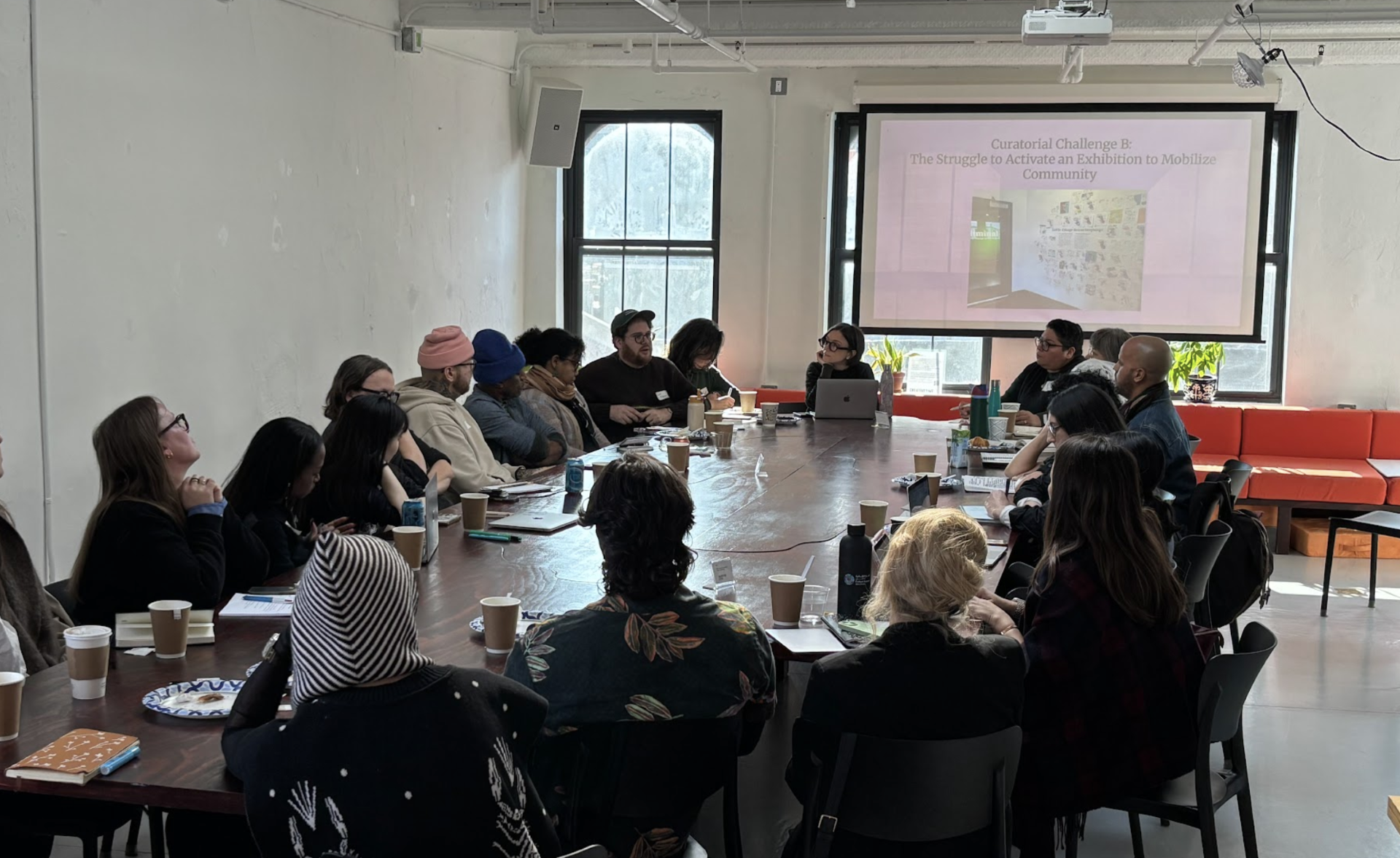
We initiated our Curatorial Workshops in 2015 to present urgently needed opportunities for curators to candidly discuss the issues they face in presenting challenging or controversial works and equip them with tools to present such works successfully. These participatory workshops help curators resist the pressure to self-censor by identifying strategies and tactics for upholding creative inquiry and expression in the arts and by expanding upon existing professional support networks. As a whole, the workshops contribute to a culture that emphasizes nuance, education, openness, and a diversity of ideas.
What you can do: curators my apply to join us for a future workshop. Our next workshop will be announced in August 2026.
We’re here to learn how we can best support your own work to uphold free expression values.
Whether you are seeking feedback on how your exhibition criteria can maximize artistic freedom while protecting your institutional oversight, drafting a policy that limits board interventions on museum programs, or grappling with how to present a challenging object in your museum, NCAC’s decades of free expression expertise can offer helpful insight.
What you can do: contact us for a confidential consultation, by either filling out a censorship report form, or emailing our team directly.
The Importance of Museum Resistance
Museums are cornerstones of liberal democracies. They are one of the few trusted spaces where audiences can encounter historical, scientific, artistic, and/or cultural programs that transmit the knowledge of experts as much as they lay bare the messy contradictions and complexities of human life. Even in a country that famously underfunds its cultural sector, museums wield immense influence because they promote inquiry, investigation, curiosity, creativity, and discovery. They empower their audiences with tools that help them understand and interrogate the world they live in. Because of their diverse areas of focus in service to the heterogeneous population of the United States, museums have an important role to play in democratic society. And now, more than ever in recent history, is the time to protect their independence from censorship pressures.
Though we are fortunate to live and work in a country that has strong First Amendment protections, the First Amendment alone does not prohibit government actors from unconstitutional attempts at suppressing protected expression, nor does it prevent private actors from censorious activities. In a time of single-party political control and increased pressure to conform to a singular ideological position, it is essential to uphold cultural diversity, and artistic and intellectual freedom. We can do it together, by upholding freedom of speech, thought, and inquiry in our own communities and institutions.
______
Elizabeth Larison is Director of Arts and Culture Advocacy at the National Coalition Against Censorship.
- In this case, NCAC filed in support of the plaintiffs—a group of non-profit arts organizations—arguing that new NEA grant stipulations requiring applicants to certify they will not use federal funds to “promote gender ideology” were a violation of the First Amendment and Administrative Procedure Act. If the NEA were permitted to favor certain organizational views over others in making funding decisions, arts organizations will be pressured to either compromise their missions to gain favor, or forgo NEA funding altogether. Though the lower court sided with the plaintiffs in ruling that the grant stipulation is unlawful, the government is now appealing that ruling and our team continues to monitor the case. ↩︎
Upcoming Events
-
AAM Member Week
Event Date:Presented by: American Alliance of Museums -
AASLH History Hour: Is This Place Haunted?
Event Date:Presented by: American Association for State and Local History (AASLH) -
Disaster Preparedness for History Organizations
Event Date:Presented by: American Association for State and Local History (AASLH) -
From Informational Interview to Real Connection
Event Date:Presented by: American Alliance of Museums and National Emerging Museum Professionals Network