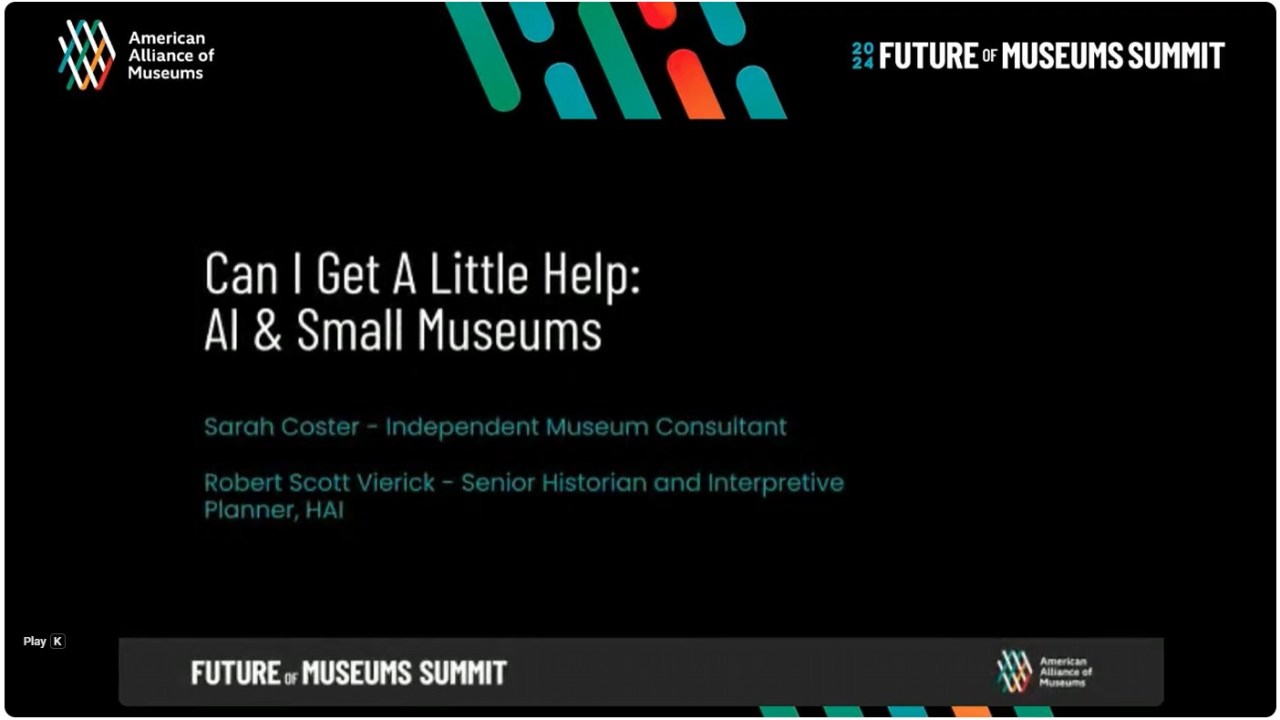
This recording is from the Future of Museums Summit held October 29–30, 2024. How can a small museum leverage artificial intelligence? This session focused on practical, cost-effective AI applications to streamline daily operations, improve accessibility, and stretch limited marketing and administrative budgets without needing large technical teams.
Presenters:
Sarah Coster, Independent Museum Consultant
Robert Scott Vierick, Senior Historian and Interpretive Planner, HAI
Transcript
Sarah Coster:
Hi, welcome. We are here to present Can I Get A Little Help: AI & Small Museums. My name is Sarah Coster. As we introduce ourselves, I’d invite you to introduce yourself as well in the chat. I’d love to hear who you are, where you’re from, and one word to describe how you feel about AI. So I’ll start and introduce myself. My name is Sarah Coster. I’m a museum professional, 20 years of experience working both as a director of a small historic house museum and currently as a… Sorry, I’m getting a little feedback. As an consultant for small museums. I first got interested in AI, I wanted to share a little bit of a meme, how it started and how it’s going. And I’d love to hear from you all. Scott’s going to share his story too.
My journey with AI started when my kids and I were playing Dungeons and Dragons and I wanted to create my character and I thought, what would this character look like? I’ve got a picture of him in my head; I would like to draw it. And we used AI to both draw our characters and create stories for them. I thought, that’s cute, but this isn’t life-changing. How it’s going. Last night I uploaded 50 pages of research I’ve been doing on a Victorian suffrage woman, and I had Notebook from Google create an 18-minute podcast and it blew me away. It was honestly able to come up with the themes that I had already come up with. So that’s my how it started, how it’s going story. I’m going to turn it over to Scott to share his.
Scott Vierick:
Yeah. Thank you, Sarah. And hi everybody. I’m Scott Vierick. I’m a senior historian and interpretive planner at History Associates Incorporated. We’re a historical research and consulting firm working with museums and historic sites, large and small. I’ve been with the company for about eight years at this point. In addition to my work at History Associates, I’m also on the board of the Alexandria Historical Society. We’re a small all volunteer nonprofit, and when it comes to my, how it started, how it’s going with AI, my first interaction with AI wasn’t quite as inspiring as Sarah’s was. I, like many of you, heard about ChatGPT. I decided to check it out. I asked it for a biography of a man named David Humphreys, who was a soldier and a diplomat in the 18th and early 19th century, and it gave me a write-up that was full of errors. And when I tried to push back on some of those errors, it started to argue with me.
And then when I asked it for sources, it gave me a lot of sources that did not exist. And then when I pointed it to a source on the Mount Vernon website, which I knew existed because I wrote it, it acknowledged that source existed. But then it gave an entirely different person as the author. So not the best start, but since that time, I found that it’s been very helpful with creating the first draft of form letters. So grant applications, nomination letters, rejection letters, unfortunately. I found it to be very helpful to create that first draft and then I can edit it into my own voice. I found that to be a major time saver. So, very excited to be a part of this session with you all, hear about how you all are using AI and making it work for your institutions.
Sarah Coster:
Thanks, Scott. Next slide. So as we go along, use the chat please. We going to be trying to make this super collaborative. This was inspired by me attending an AAM session on AI in Baltimore this spring, and we all wanted to talk to each other, but there was no time. So this is our time to talk to each other as small and midsize museums to share, to learn from one another, discuss our concerns, and be open and honest. When I talk to my colleagues about AI, I sense a lot of shame, embarrassment to admit that they’ve used it or they’re curious about it.
This is a no judgment zone and I’m loving all your one word responses. Intrigued, dubious, worried, curious, motivated, hopeful. So I think that there’s going to be a lot of great discussion. The way it’s going to work today, we’re going to do some polls so we can learn from one another. Then we’ll break out into a 10-minute breakout room. So hopefully you’ll be willing to come turn on your cameras and your microphones and start chatting with each other. Totally optional, but we encourage it. And then we will end with some Q&A. So the Q&A is a different tab. Go ahead and put questions that you want answered at the end in there, and you can all upvote other people’s questions so that Scott and I can get to the ones that people most want to hear the answers to. All right, next slide.
Scott Vierick:
All right, before we dive into the polls and the discussion, we just wanted to go over some definitions really quickly because AI, depending on who you’re talking to, it can mean many different things. So we want to put out these definitions so that we’re all kind of in the same place when we’re talking about this emerging technology, this new technology. So starting off, artificial intelligence. AI refers to the development of computer systems that can perform tasks that normally require human intelligence, such as recognizing speech, learning from data, solving problems and making decisions. So while we think AI, and most of us will think of ChatGPT, platforms like Grammarly, Canva, PowerPoint Slide Designer, they all use AI in some shape or form to improve the user experience.
Now, the next definition is machine learning, and that is a subset of AI that allows systems to learn from data and improve their performance over time without being explicitly programmed. And that can be really helpful in that these platforms are dealing with so much information that by allowing them to learn by themselves, so to speak, that makes it easier for the humans interacting with them, in theory. Now, when it comes to large language models, that’s the ChatGPT’s of the world. So those are advanced AI systems designed to understand, interpret and generate human-like text by analyzing patterns from vast amounts of written data. It can perform tasks such as answer answering questions, summarizing information and generating coherent, most of the time, context-aware content.
So that’s the key point about these is that they’re looking for patterns of the documents it’s been used to train on of the materials it’s been used to train on. So that’s why, going back to my earlier example, it didn’t list me as the author of the article because the content it had previously been trained on listed somebody else as the author of a lot of that content on that website. So that’s always important to keep in mind when it comes to features like ChatGPT. Now, a lot of them have started to integrate search into their answers, so that continues to evolve, but it’s always worth keeping in mind when you get an answer that doesn’t make sense because they’re looking for patterns.
And sometimes that works, sometimes it doesn’t. And that’s where we get to AI hallucinations. And that’s when the AI does something really goofy. So it gives you an information that maybe sounds plausible, but is incorrect, something that’s misleading or just sometimes doesn’t flat out make sense. So when Google rolled out its AI answers, you got a lot of really interesting answers, and I want to be mindful of our time, but after the session, if you want to see some fun ones, you can Google AI, Google AIs, Google AI’s answers funny, and you’ll see what we’re talking about. There’s a lot of very interesting responses. Definitely don’t go to Google AI for any medical questions. We’ll just leave it at that.
Sarah Coster:
All right, thanks, Scott. I saw in the chat some people are enjoying my AI-created images. These are generated by ChatGPT 4.0 with no… I did not ask it to change anything. I just gave it a very prompt, and this was show happy museum workers using AI. They’re very happy. This slide is about whether we think AI can make us happier at our jobs. I’m seeing in the chat a lot of concern. Might this take away our jobs? Especially those of us that work in interpretation and writing, as both Scott and I do. That is one of the things that these LLMs are excelling at, but still sometimes failing.
So one thing with small and midsize museums is most of us are doing a lot of jobs at once. So when I think of AI, I’m hopeful that it can be a tool instead of a replacement, a tool to make our workload lighter. Hewlett-Packard did a survey, and they found that 69% of knowledge employees are using AI for productivity. And that’s up quite a bit from just a year ago. Those that use AI at work report being 11 percentage points happier than those who don’t. But there’s a flip side Scott’s going to tell us about.
Scott Vierick:
Yeah, by contrast, the freelancing platform, Upwork did a study, and they found that 77% of workers surveyed, and that included everyone from entry-level positions to C-suite executives, they found that AI had actually increased their workload. In the study, they looked at, a lot of people were complaining that their directors were getting worse, “Oh, use AI for this,” but without any consideration of, well, what are you trying to accomplish with AI? What’s the goal? Can AI help you meet the goal?
And as a result, that was causing a lot of employees to feel overworked because they’re trying to fit a square peg into a round hole, and they were really struggling with that. So that kind of gives you a sense that AI, to make it work, you need to have an understanding of its capabilities, its limitations, and also how you want it to help reach your organizational or personal goals. There’s also been some research on AI and museums. By and large though, I found those tend to really focus on the bigger museums. So I haven’t come across anything about smaller museums and how they’ve been incorporating AI, and that’s one of the reasons Sarah and I wanted to do this study. And as someone who’s worked at a number of small museums, I’m going to turn it back over to Sarah.
Sarah Coster:
Great. We’re going to move on to polls now so we can start hearing more from you about how AI is impacting your work, maybe infecting your work. And I want to encourage you, continue the chat. There’s a lot of good discussion going on about what some of our concerns are and some of the reactions we’re having to AI. So next slide, Scott. And then also Amy, if you can pull up our poll number one, which is about AI usage, and you can enjoy this last ChatGPT image of us all taking polls at a museum.
How often do you use AI tools for your work? And to get to the polls, you’ll see a little bar graph. You can click to that tab, and you can answer the poll. Do you use it daily, once or twice a week, a few times a month, never or other? And apologies for the typo there. We’ll give everyone a second. I can’t start to see until I vote, so I’ll vote. All right, so we’re getting some responses here and it seems like a few times a month is winning but daily is actually quite there as well. So I would say adaption has been quick with AI and it’s changing constantly. So it’s something to keep considering as we move forward.
Scott Vierick:
Absolutely. And it’s interesting to consider how different this poll would’ve come out if it had been a year ago, or how different it would look if we did the poll a year from now. Yeah. Amy, if we could go to the next poll. So for those of you who have used AI, kind of going back to that previous slide, do you feel that it has made your job easier and/or saved time?
Sarah Coster:
And this is a tricky question I saw in the chat, and Scott and I have been talking about it too. This can change. Even using the same AI platform, I found I’ve taken notes using Otter.io and one time it saved me so much time to recap my meeting, create action items, quickly send it out to the team. And then I used it yesterday and I spent an hour trying to clean up what Otter sent me to get it to actually reflect the meeting. So a real tough question to answer I think because I think it changes frequently depending on what you’re doing and even the day you’re using it.
Scott Vierick:
And I’ll echo that. I’ve seen a couple things in the comments about concern about interpretive content writing and whether AI is going to take that away. And I think one of the biggest marks against AI is that you can have it write content really fast and really quickly, but you can’t trust that content at this point. And I found if I have it write a block of content, I need to fact check literally everything in it.
So that’s a big mark against AI where if you try to do that, you might end up spending just as much time as if started from scratch and did it all through your own research and writing. Whereas again, as I said earlier with the form letters, having AI write the first draft and then I edit it to make it in my own voice, that’s been a valuable time-saving tool. I think we’re ready for the next poll.
Sarah Coster:
So the next poll addresses what platforms you all are using in your work. Now, there’s so many platforms and they literally change weekly. Perplexity… Sorry, not perplexity. Which one was it? I can’t even remember. Some platforms that Scott and I discussed last week have been replaced by updated platforms, but for our purposes-
Scott Vierick:
Illuminate is now Notepad, I believe.
Sarah Coster:
Yes, that’s the one. Illuminate is now Notebook. So we’ve got the big ones, ChatGPT, GPT-4 and DALL-E, which are all under OpenAI. Gemini, which is Google’s LLM. Copilot by Microsoft. Perplexity, another LLM, Grammarly, not a full AI but AI-assisted tool and Otter.ai, which is just an example of a note-taking AI tool. Go ahead and if you’ve used any of these, and we will let you choose more than one answer.
All right, we’re getting some responses in. And seems like not surprisingly, ChatGPT, which has been around the longest and is currently the most robust, is the clear winner. Of course, Grammarly has also been around for a very long time and is very good at advertising, so I know I’ve used it my fair share as well. Next poll, please. All right, this poll is about ethical concerns to using AI. What ethical concerns around AI in museums do you find most important? Privacy and data security, bias in AI-generated content?
Funny little bias story. I asked ChatGPT to create an image of me based on our interactions with one another, which have been entirely work-related for me, and it made me a male, a white male. So the bias is there that if you’re a person doing work in your business, then you’re probably a white male. So that’s I think a very real concern. Inaccuracies, Scott has talked about. Plagiarism. Job displacement for staff, and transparency of AI decision-making, and you can choose more than one on this as well.
Inaccuracies. I think that makes a lot of sense for a lot of museum employees where facts, data is very, very important for us. And AI, even when you’re just putting in your own research, will often come up with incorrect content. It’s not just when it’s scraping the internet. The client I’m working with, she had a Boy Scout troop as a woman in the turn of the century, and they didn’t know she was a woman. Then they discovered it and told her she couldn’t be a Boy Scout leader. AI took that and assumed that she had dressed up like a man to pretend to be a Boy Scout leader. Not really what happened.
So you just have to be, again, like Scott said, you have to be very careful with those inaccuracies. I know, our time is going so fast. I think we can do one more poll if Amy can pull it up, which is what aspects of your work have you used AI for? It’s museum work uses, and the options are collections management, accessibility, visitor services and interpretation, research productivity and marketing and development. And by accessibility, that can be translation services, writing visual descriptions, et cetera.
There’s a great mixture of what people are using AI for at their institutions. We’re going to transition into breakout rooms next. So keep this particular poll in mind and when you’re in your breakout room, I’d love if people could share maybe some of their favorite uses or least favorite uses currently. Looks like marketing development. I know I’ve seen in some of the other sessions today, a lot of people having great success with the wording for their marketing campaigns, tweaking the wording, getting things short. That can go to our interpretation, although I’m seeing that’s not winning as much. And general productivity.
Scott Vierick:
And it makes sense that research is also up there too. And for all the drawbacks of these platforms in terms of generating content, they can be very valuable for coming up with ideas, brainstorming, finding ways to kind of direct your thinking and figure out rabbit holes that you might want to go through. So it makes sense that research is up there.
Collections management. I know there’s a lot of things that are in the works relating to collections management in the AI space, but it seems that they’re all still fairly early on. So I’m curious to see how that continues to develop moving forward. And accessibility, I was at one of the earlier sessions and there’s some really cool stuff happening in the accessibility space. So I’m encouraged and excited to see how that continues to develop moving forward. All right, should we move on to the breakout rooms?
Sarah Coster:
Yes. So next slide for Scott. So this is your chance to share your stories, hear from other people at small and mid-sized museums who are currently using or not using AI. The sky’s the limit on what you talk about. We’ve given you a couple of conversation topics to think about. What are some significant changes to your work? What’s a tool you think everyone should be using or one you hate? Something a larger institution, we’ve heard from a lot of larger institutions today doing some amazing stuff. What’s something that could be scaled down for a museum of your size? And something maybe you wish AI could assist you with in the future?
So we’re going to go ahead and ask Amy to break us out. We’re going to randomly break you out. If you’re willing to, we encourage you to turn on your cameras and unmute yourself and we’ll take 10 minutes to discuss.
All right, welcome back. Scott, if you can put our slides back up.
Scott Vierick:
Yes.
Sarah Coster:
As you’re returning, hopefully you got some good conversation going. I know my room had some really interesting discussions on how we’re using AI tools, some concerns. Also, the interesting way that people are using it as therapy. Recording meetings, putting in pages of research, helping with grant. I think we’ve covered a lot of these useful tools.
Scott Vierick:
Yeah, and likewise, we’ve also covered some of the drawbacks of AI, whether it’s ChatGPT copying text, completely with no attribution, no author listed or the wrong author listed, Google AI answers providing inaccurate or misleading information. Again, we’re probably not at the point where we can trust AI for medical information. ChatGPT digging in its proverbial heels when it presents an inaccuracy.
And Illuminate, which we haven’t talked too much about, but it’s a platform where you can upload documents and data and it creates essentially an eight-minute podcast. There’ll be two AI voices talking back and forth summarizing the materials uploaded. So potentially very valuable, but the voices just always sound very uncanny valley to me, which maybe that’s a personal problem, but I don’t know. It’s prevented me from getting too much into it. Oh, Sarah, you’re on mute.
Sarah Coster:
On the flip side, that’s one of my favorites, and that’s actually, they’ve released it at a larger scale called NotebookLM, and I’ll add that into the chat. I love the idea of being able to create a podcast about my research and listen to it on my commute to help me get in the mindset of what I’ve been working on. And they do say kind of silly, uncanny valley-like stuff, but… So now we’ve got just a couple more minutes left for Q&A, if anyone wants to post a question. And I’m sorry if you did before, it might’ve disappeared during our breakout sessions, but feel free to go over to the Q&A and post a question or into the chat and we’ll check the chat as well. This is the last chance for anything we didn’t discuss, anything you’re curious about.
And while you guys are doing that, I’m going to add some of these different… All right, we did get a question. Do any museums use AI in exhibits? We actually have someone in the room, I don’t know if she’s still here, from the Nasher Museum, hopefully I’m saying that right, who created a whole exhibit using just AI. They had AI look through all their collections, pull out objects and write the labels. And if you search Nasher Museum, you’ll probably come up with that. Summer is adding an article where they’ve used it at a zoo. I just got off… Some of you might’ve been on an earlier session with the Met and there were a couple other… The Georgia O’Keeffe Museum. So I think more and more honestly, month by month, we’re seeing more museums using it.
There you go. Thank you, Diana, for putting that into the chat. A really interesting article. I highly recommend everyone read that from Diana. So I think museums are more and more using it. I think there’s opportunities for small museums to incorporate it into their work, to take a load off, and also to challenge our visitors, challenge ourselves to kind of think about this, again, the future of museums and how can this artificial intelligence augment our work? How can it hold us back? Particularly I think with bias is one of the things we’ve touched on, but also how can it help take a load off some of our busy lives. Any other questions?
Scott Vierick:
Yeah, Sarah, we’ve got a couple in the Q&A right now. I don’t know, we’ve got about a minute left. So I guess we can try and answer real quickly. I am not aware of any AI program that can be used to analyze artwork provenance in conservation. I imagine though, as more collections managers engage with the technology and discussions continue about how AI can be used for collections management, provenance and conservation will absolutely factor into that, so that’s certainly something that I think we should continue watching the space for.
In terms of customizing a chat box to answer simple FAQs, the best advice I can offer for that is just keep training it. The best advice I got about AI was that it’s like you’re getting a brand new college intern. They can be a really great benefit to your organization, but you need to make sure that you’re spending the time and the effort to make sure that they’re properly trained, that they know what to do. So I think it’s just one of those things where you’re going to have to work on it, run a lot of tests, run a lot of trials. But I unfortunately can’t say more to that. But certainly that’s something, I’ve seen a lot of large corporations use chatbot answers, and so hopefully that technology will filter down to museums eventually, if they haven’t already.
Sarah Coster:
Thanks, Scott. One last question by Leslie. “I’m concerned about whether the biases of those who make AI models alter or mold model’s results.” Absolutely. And for most LLMs, they’re taking an unimaginable amount of information, so they’re getting the bias of the human population at large, especially those who use computers. But I did, in another session that I went to today, they pointed out, so do museum employees bring their bias to their exhibits and research and public programs and educational programs. But certainly, this is something to be concerned about, who’s involved in the role of creating these models. So thank you for that question, Leslie. Yes, like teaching a child or a baby.
Scott Vierick:
Absolutely.
Sarah Coster:
That’s a good way to put it. Well, I think that we are out of time now, so thank you all so much for coming. I’ll put for Scott and I, our websites in the chat, and you can also find us in the directory for the Future of Museum Summit, if you need to contact us. We’d love to follow up and continue this conversation. We hope you enjoy the rest of your time at the Future of Museum Summit.
Scott Vierick:
Thanks, everyone.

Upcoming Events
-
-
Industry Showcase: Innovative Digital Solutions
Event Date: -
Getting Started in Local Advocacy
Event Date:Presented by: American Association for State and Local History (AASLH) -
Creative Museums Summit
Event Date:Presented by: MuseumNext