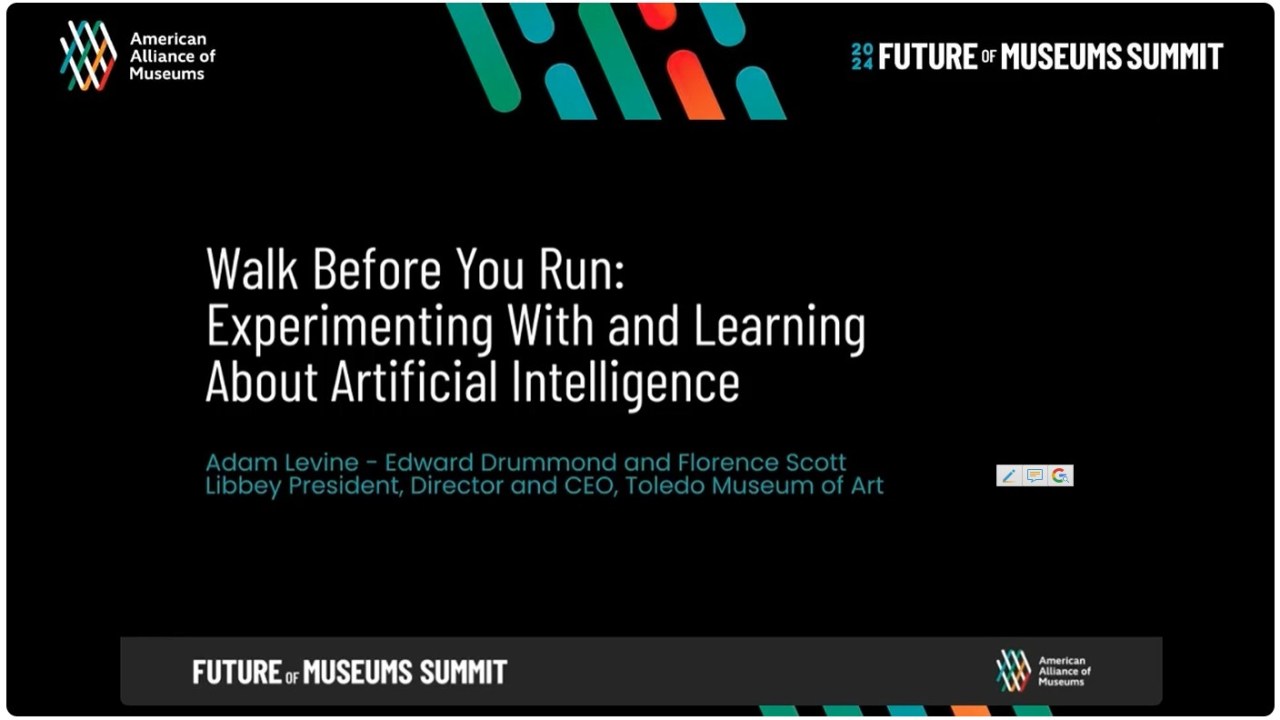
This recording is from the Future of Museums Summit held October 29–30, 2024. In this session, Adam Levine, Edward Drummond and Florence Scott Libbey President, Director and CEO, Toledo Museum of Art explored both the practical applications and ethical challenges of using AI in cultural institutions.
Transcript
Neal Bilow:
Hello everybody, I’m Neal Bilow, CEO of Terentia. I want to take a moment to express our excitement about being a sponsor for this year’s Future of Museums Summit, and specifically the AI adolescence trek. We’re thrilled to be supporting the important work of museums and to be part of this inspiring gathering of leaders who are shaping the future of our industry. At Terentia, we’re passionate about helping cultural institutions thrive in the digital era. Our innovative solutions, including a cutting edge digital asset management system, and a collections management system, both are designed to help museums better engage their audience, streamline operations, and to make the most of their collections.
Our artificial intelligence tools are designed to provide deeper insights from collections and create new opportunities for storytelling. We’re here to help museums harness their advancements in ways that elevate their mission and sustain their impact. The Future of Museums Summit is a crucial space for dialogue on how museums can continue to evolve in today’s rapidly changing environment. At Terentia, we share your vision for preserving cultural heritage, while embracing innovation and technological progress. We believe, with the right technology, museums can bring history and culture to life in ways that inspire and educate generations to come. As part of this ongoing commitment, I want to personally invite you to visit our virtual booth during the summit. And while you’re there, don’t miss up the chance to sign up for our upcoming webinar series on responsible AI for museums.
I’ll be joined by two amazing thought leaders, Catherine Devine, the former global head of Microsoft’s Museums and Libraries, and Nik Honeysett from the Balboa Park Online Collaborative, to explore how museums can responsibly leverage AI to enhance their experiences. This will be a three-part webinar series where we go into the insights of how you can use AI and how it’s being done today, along with things that your organization should be thinking about from a policy standpoint when it comes to the use of AI. We look forward to engaging with you during the summit and continuing our shared journey to build the future of museums together. Thank you again for the important work you’re all doing. Be sure to stop by our virtual booth and sign up for that webinar series. We’re excited to see you there and keep pushing the boundaries of what’s possible. Have a great summit.
Adam Levine:
Great. Hello everyone. Good afternoon, or good evening from where I am and from where Ian is. Welcome to our session Walk Before You Run, experimenting with and learning about artificial intelligence, in which we hope to provide some insights into our experiences thus far at the Toledo Museum of Art. Trying to figure out how artificial intelligence affects and can be integrated into our business model, paying forward lessons learned, and also hopefully celebrating some of the positive things that we’ve done. I’m Adam Levine, I’m the, that’s what the title says on the screen, the director and CEO, but more specifically the Edward Drummond and Florence Scott Libbey director and CEO of the Toledo Museum of Art. Edward Drummond Libbey was a glass industrialist who actually made his first fortune and luxury wear, highly trained artisans cutting glass being sold at very high margins. But he very quickly realized his business was going to be disrupted by automation and invested in the patents that resulted in some of the creation of the earliest fiberglass, as well as the automated glassblowing process that resulted in glass bottles and glass jars being made.
It was a global monopoly that he and his company has had for about 10 years between 1904 and 1914. In that sort of same period, there was other rapid technological disruption, something that Ian has spoken at length about with our staff. And while the rate of change that we are experiencing today is significant, it is not unheard of in human history. As organizations that preserve that history, all of us, it’s important to bring that perspective dialogue that we are about to have. Ian and I have our own history, I will let Ian introduce himself in just a minute, but he and I have now known each other for more than a decade and it has been an incredible and fun ride. This is just to say that he and I, we think of a pretty good shtick and can probably fill a whole hour, but we hope that you will be active participants in the chat, and we will do our best to integrate questions as they come in.
We think this will be a topic of great interest. We hope that we will deliver on that, but that means that lots and lots of questions may come in, we may not be able to get to all of them. Ian is the thought leader on this panel, I am the straw man/moderator, so I will do my best to get your question into the queue. If your question doesn’t get addressed, you get to blame me, not Ian. So with those ground rules set, I’m going to ask you, Ian, to maybe introduce yourself to the audience, share a little bit about your background, and maybe through the prism of your background, talk a little bit about how your thinking on artificial intelligence has changed over your many decades of engaging with technology and futurism.
Ian:
The many decades bit is the clue to everybody that I’m an aging geek. So I started way back in New Zealand as a student of mathematics and computer science, and then promptly spent the next 10 years taking photos for a living because there were no girls in the maths department at Auckland University. That period of being a photographer wasn’t completely out of the blue, my father was a journalist, my mother was an art collector and gallerist, so I had an interest in general in the arts. And that became formative for the rest of my life as I became more interested in visual arts than I had been while at university. After university and photography, I went to business school, and then some friends of mine were working on a magazine in Holland, in Amsterdam, which was called Language Technology at the time. Which was talking about the sexy subject of machine translation, but they were doing it in an interesting way that made the articles fun.
Then we expanded it into something called Electric Word, and then it launched in January 1993 in San Francisco as Wired magazine. So the three of us built this magazine with a wonderful team of people and eventually sold it to Condé Nast, who own Vogue, GQ, Architectural Digest and various other magazines. And we sold the digital bits to a search engine, which no longer exists, called Lycos, if people remember that which then sold itself to Terra, the Spanish telco, and that gave us liquid assets because Terra was a public company, which was helpful just before the crash in March of 2000.
Since then, I’ve been partly an investor and partly a supporter of both social ventures and for-profit ventures, both in Switzerland, in China, and now back in Europe. I think one of the reasons that I find myself here with Adam on this panel, apart from being an aging geek, is that I was always interested in the relationship between software and intelligence. Aside from obviously learning to code with punch cards in the 1970s, I also read a book called Gödel, Escher, Bach by Douglas Hofstadter, which came out, I think in ’79, just after I graduated or just after I left university. And it examined the relationship between mathematics, visual arts, and music in a way that, essentially, was an approach to thinking about what the relationship was between the software algorithms being developed at the time, and actual sentience, actual conscious creative intelligence.
So that’s way back in 1979. So if I come screaming forward to today, a lot of the same issues that were tackled by Douglas Hofstadter at the time and others in the late 70s and early 80s are still being talked about today. The difference is that we have a great deal more computing power, and we have a source in an absorbable form of data in quantities we couldn’t have dreamed of back then. The internet allows everything to be compiled, and also everything to be hoovered up by appropriate technologies, and that’s been used, of course, to create the large language models of today. If I were to compare then and now, a lot of the same philosophical issues arise. You still have that difference between those people who feel that the language models of today, supported by neural networks, which by the way is just a fancy way of saying that the algorithms have been designed to compare, and collate, and check data with multiple nodes in a similar way to the way the brain works.
It’s analogous to way the brain works but obviously isn’t exactly the same. And they gave it the term neural networks to make you think it was a living being, but it really is just software. But what the software does is matches patterns. And there are those who believe, like Geoffrey Hinton, the former Google data scientist who recently won a Nobel Prize, that we are on a path to actually creating real intelligence that we would recognize as a conscious sentient being at some point in the near future. But there are others who feel that the nature of conscious sentience is more than simply analysis of existing data and then drawing conclusions from that existing data.
I’ll finish by describing, in essence, what the difference is between the two sides. If you ask ChatGPT, in any of its forms, a question, what it’s doing is learning or it has learned from a huge amount of data that’s been placed into it, based on what the producers and creators of the LLM could find, to give it a basis for trying to understand the questions it’s asked. What it’ll do is listen to your question, or if you update an image, look at the image, and then go back into its memory of everything it’s seen to try and work out what it’s like, and then look at answers that are associated with the image or with the question that have worked in the past, and then give you that response. It isn’t originating thought, it isn’t creating thought, it’s matching the words that you placed in, in pattern form, to what it has in its memory.
So if you’ve asked a question, which has been asked many times before, it’s pretty easy for it to come up with the answer. If you ask a question that’s been asked a few times before, it’s a little bit more difficult. If you ask it a question that’s never been asked before, it struggles. It hallucinates, in the current terminology. And sometimes it can reach an interesting answer, but it’s a guess. Now, Hinton on recent interviews suggests that’s very similar to the way humans work. That all we need is more computing power and more data, and the AI, the machine learning algorithms of today, could become sentient in some near future.
And as I said, there are others that believe that that leap into creation, origination of ideas, exploration of future concepts, requires something else, and there’s a lot of science fiction that covers this, including mixing biology of some form with the technology in a way that’s not yet been sorted out in real life. And maybe we’ll get there, but at the moment there is that interesting dichotomy between those people that think we’re very close to AGI, artificial general intelligence, in the near future. And those that think it’s many, many decades away because that great leap into actual creation is another step that we haven’t reached yet. So that’s me, I’m a guy who’s been playing with computers for far too long. I like thinking about where things go. I like watching what’s happened in the past and trying to work out whether there are analogies for the future from that. And I think the time we’re at now is absolutely fascinating.
As Adam hinted at, there was a period before when we had almost as many new technologies arriving on our doorstep, and the world was totally transformed by that. He referred to the period, end of 19th century, beginning of 20th century. The 19th century was characterized by buggies, horse-drawn buggies, and candles in homes. In the next 20 years, we had electricity, the telephone, and the automobile, and the world was never the same since. Many have said, I’m not the first to say it, that we’re at a similar stage right now, that you might not recognize the world, that you’re unlikely to recognize the world in 20 years time. And I just wish I was 30 years younger and taking part in it more, just to be able to do it all over again. But that’s a quick summary, I’m sorry that was a long summary. Adam, I’ll take it back to you.
Adam Levine:
No, and I thank you, and I think it also sets the stage so beautifully for the rest of the conversation, because of course, when it comes to artificial intelligence/machine learning. Because as you just articulated there are differences in opinion on how intelligent the artificial intelligence truly is, which then necessitates questions about what intelligence really is, et cetera, et cetera. So we can spend a lot of time on philosophical issues in a panel on artificial intelligence, but it’s actually your business background, which I think confers an awful lot of value for us at the Toledo Museum of Art, and hopefully for the other panelists here, because there are pragmatic concerns as well, namely around when you engage with new technology, how you engage technology, and in what ways you engage new technology. And a lot of that also has to do with some future casting around what solutions are likely to win, and what solutions are likely to scale, and at what point you have sufficient clarity to believe that it’s worth the investment?
And that will change depending on your institutional risk structures, it will change depending on your budgets. But we are all engaging in similar calculus, and I think your experience, seeing companies through their entire life cycles, from seed investment to exit, from two people in a garage, proverbially, to publicly traded company, also allows us, as a field, that sort of expertise will allow us to figure out when and how we engage. So to that end, because there’s a practical component to this, you now, among other things, run TMA Labs at the Toledo Museum of Art. So could you explain to the folks attending this panel what exactly it is that TMA Labs does?
Ian:
So TMA Laboratories is essentially an insurance policy for the museum. It’s thinking about the future of museums in general, and the future of the Toledo Museum of Art in particular. And in doing so, we look at what changes are happening in society, principally due to technology, but more broadly as well, so we can understand the context for anything new that arrives in technology form, to work out what the museum should be doing with it, and at what point, and in what way. So there are three basic strands to what we do, we have, obviously, a program working with digital art, digital artists, and digital art collectors, which allows us to work with the bleeding edge, if you will, of what’s going on in the art world.
We tend not to use the label digital, art is art, but it is a new platform, it’s a new media, just as video was before it, sculpture before that, painting before that, photography. So it’s another media that we look at, and we very much enjoy working with artists directly. We have a digital artist in residence program that happens every year, we’re currently in the process of deciding on who that is for next year. And I think that allows us to work with both the arts community, and the collector community, and observers around it in ways that create dialogue that help us understand where things are going. The second strand of what we do is more about how technology might be used within the museum itself, so obviously things like ChatGPT and helping people develop brochures, or write praises on a work of art, or produce presentations for fundraising, or anything else. Those are things that everybody is currently doing with technology, but it’s more broad than that.
And as Adam quite rightly says, we could have a playground, and we could have a playground where there are all sorts of tools and toys that people could work with, but everything has to be done within the context of, does it make sense now? Is the technology S-curve at the beginning of the curve, in which case it’s hard to invest because you don’t know where it’s going? Is it in full development mode, in which case maybe you buy rather than rent, but at what pace and for how long? Or is it settled down to a point where you have some sense the technology is stable and it’s worth investing time and money in? Then, of course, it has to be mapped onto the business problem itself. If we don’t have a clear sense of what it is we’re trying to do, then the experimentation is just play.
And what we’d like is that the trial of any new way of doing things, technology-based or otherwise, is based on being able to clearly identify the need in the first place. So if we’d like to do something better within the museum, at any session, at any stage, whether it’s curation, or storage, or building maintenance. If we’re going to think about different solutions, we first of all need to be clear about what the problem is and then try to identify that. So helping colleagues within the museum work out what solutions might help them do what they want better, and they come to us with questions, which is great. That’s the second strand of what we do. The third strand is outreach. It’s not just putting art on a website. Technology enables conversations, dialogue, exchange, exposure to anywhere in the world on just about everything in the world.
And our involvement with artists in Nigeria, Ethiopia, Europe, and elsewhere, and therefore collector bases for those same artists in those countries, mean that we have a reach for the museum, which goes beyond Toledo and beyond the US. And that doesn’t just mean that we go there, or we present the art there, but we’ve had a couple of events recently where people traveled to the museum in Toledo, because of what we were doing and the way we were doing it. If I’m going to be slightly rude in front of my employer for a moment, people often ask me what I’m doing in the middle of nowhere, and I say to them that A, obviously, the museum itself is a jewel. Well-funded at the beginning of the 20th century with foresight in design of its buildings and a great deal of effort put into curation through the hundred years since its founding.
It also has, having teased him a bit, a decent director who does a halfway good job at trying to think about the future, and managing his people, and carrying them forward. And in so doing, it’s opened up a space where we can think about how things might be done, and not just the way things are already done around here. I think the openness of management, the openness of the staff to thinking about the future of museums for their audiences and for new audiences, I think, is what attracts me to the place, and what has attracted new audiences to fly into Toledo to spend time with us, looking at what we do. So those three things basically, so digital art, artists, and collectors, working with colleagues to help improve processes that directly impact business elements of the museum’s work, and then outreach to work with people from beyond the borders of Toledo.
Adam Levine:
Your raise is approved, and thank you for the kind words. So I think one other thing I’d just add from my perspective, as the director of the organization, we made the intentional decision that TMA Labs does not report through IT. And we made the intentional decision that Ian reports directly to me, which is not because IT is not a vital function, but it’s because in most of our organizations we are not able to accommodate a structure in which the level of software experimentation, which must cut across the organization, can also live within what is largely still a network administrative and hardware-oriented function. So we can come back to that, but we made the very intentional decision that TMA Labs will be positioned more as an internal consulting shop, to this point about driving business process, business efficiency.
And actually, the reason that’s important isn’t to sound corporate, it’s because the more efficient we are, the more we get to achieve our missions. The more we get time back or maybe money back to invest in, in our case, integrating art into the lives of people. So our imperative isn’t to repay to shareholders, our imperative is to do better for our communities with and through art. And if we think that technology isn’t a part of that, then we’re really doing a huge disservice to our audiences, and frankly, to our staff. So that’s a bit of how we decided to structure it, which that is a very Toledo Museum of Art specific thing, I suppose, but I think it’s probably more similar at most of our scales. We are a mid-size museum, our footprint is large, but we own the fact that we’re a mid-size museum that serves a predominantly regional audience, in fact, we think that’s one of our superpowers.
So Ian mentioned a little bit, I alluded to it slightly earlier, and then Ian spoke about this idea of S-curve shaped adoption, which is something I’m sure anyone who opted into this panel knows. But just as a reminder, it’s this idea that things move slowly, because in geometric compounding, returns can look linear for a while. And then as they inflect, you can end up with a very rapid technical elaboration and/or adoption, usually concomitantly followed by a flattening thereafter. And one of the big questions for us is, “Well, when do we jump in?” And one of the things that we’ve discussed and written about, so there are things out there that you can find a publication in IMD Magazine, for example, we’ve decided that the Toledo Museum of Arts positioning would be as a fast follower. And what that means is it means that we don’t do things first, because we can’t afford to and/or because we don’t want to take the reputational risk if it goes sideways. But we do feel comfortable integrating something or trying something when we see it working elsewhere.
And I think one of the traps we sometimes fall into, which is not the case for the Future of Museums, and certainly not the case behind the summit, it’s so laudable what AM is doing in this instance or in these instances, is we don’t really look to museums necessarily. We love benchmarking against our peers, but when it comes to technology, and the research and development expense that’s required to really drive these things forward, most of the work is, by definition, going to happen outside of the nonprofit space, and certainly outside of the museum space.
So we look at adjacent industries that have overlaps, say, around the visitor experience or visitor services, and that allows us to see, “Well, what’s trending there?” Because those are the folks who are putting in the R&D dollars to get products to scale, that then we can just bring in to our operation. Not perfectly, with some modification, but at least we don’t have all those upfront costs to get an idea to a product. So that’s how we think about it at TMA, but that’s conceptual. That’s very different than thinking about how it’s translated into our approach to artificial intelligence. So Ian, I just wonder if you could talk a little bit about what it means for Toledo and our thinking about being a fast follower in relation to artificial intelligence. And this, for all of you, is the last tee up question, and then we’re going to get into some more nitty-gritty.
Ian:
So as we said earlier, the first thing to do is make sure we know what problems we’re trying to solve. There’s no point in trying to play with a solution on this, we’re absolutely certain that will help us do something we would like to do better. There’s also a question about whether a technology’s ready, as Adam just said, and then there’s the question about the direction that people think about the technology. If I could use an analogy for a minute, I don’t know if people remember, at the beginning of CGI, so computer graphics and 3D animation, I remember going to a presentation by a team at a university here in Geneva, which was the world’s leading team at the time at a university, unusually, because Switzerland is not a big place.
It was trying to create a 3D simulation of Marilyn Monroe. The number of polygons required to deal with a real human face and represent that, and this was 30 years ago, it’s a task that was impossible for the technology at the time. It’s also still very, very difficult, even the artificial images we see today created by Midjourney and the movie version, Sora and others. But the time being, the resolution isn’t quite strong enough. Pixar, when it animated a little lamp playing with a ball, was able to generate emotions and impact in a story without doing a direct line progression of the technology at the time, to increase the polygon rate and generate a better image to imitate a person. They realized that the important thing was the emotion and not just trying more polygons. Much of the development in AI today is the same. The large language model producers are working towards AGI because that’s considered the next logical step in the quality of what’s out there for general use.
But actually, if you’ve looked around, and coming back to the question itself, if you look around, there are a whole bunch of people producing specialized apps for specific purposes, and those are the things we look at when we try to work out whether it can solve a problem for us. So it’s not general access to large language models, but specific applications developed specifically for creating a PowerPoint presentation, or developing a new website, or building a web task manager. So when we think about using technology, we think about where it is in the development cycle. Whether the development cycle’s working in the right direction, and whether where it’s going looks like it’ll solve a problem for us. So we had a presentation the other day from a team doing very interesting things. And what they were doing was trying to produce something which worked across a large number of different industries, because they had a software program which they needed to use across wide areas, enough industries, to make sure that they could make enough money for the program.
What we required though was a level of granularity within the functionality that we were looking for to answer questions that we’re already asking ourselves. So in this case, one of the questions we have to ask ourselves is, is that the right partner to work on in technology? Because their development path, if they’re trying to do this, may not suit us if we’re trying to do that. So if I give you something specific so you can grab onto, we’d like to know when people walk through the museum, what path they take. We’d like to know if the path they take is different if they’re older or younger. We’d like to know if that path, they take varies depending on exhibitions and short-term shows that we put on or individual items that have come in for short-term learn.
Information about travel through the museum, who passes by the store, who goes to the restaurant, what time of day this changes, over time do people come back and change the way they travel through? Does weather or temperature change the way they work through the museum? Are there elements of understanding that we can gain from examining patterns of behavior, all anonymously, just in groups of people, and individuals that we recognize as person A without a name or anything? Can we therefore design museum experiences in a way that suit people in different ways? And can we affect that experience? Is there something we can do that changes people behavior, and can we measure that and watch it? That level of granularity is more complicated than the technology is currently at a state to do. Our job is to try and work out, will it get there, or do we need to change the way we’re trying to answer these questions?
And that’s, by the way, the change in the way you answer the questions, the Pixar Toy Story example is one where the development of the technology is working one way, and then someone thought of a different way of answering the same question, entertainment, by removing some of the technology barriers to allowing that to happen, so that they could do something that was simple, and yet, still have the impact people wanted. So that interplay between looking at where technology is developing and who’s offering solutions for different types, mapping it onto the things we currently do, and then trying to work out whether the technology is likely to get there or whether we need to rethink a different way of solving a problem, is part of what happens in the museum. So if we can personalize an exhibit because someone signed on to our app and has expressed wishes or has expressed through looking at things, more of an interest in this area than that area, can we offer them a personalized path through the museum for every individual that comes in and then opts in for that service?
For those people who haven’t opted in, can we understand enough about why people go to museums today to enrich that experience, and to know how it’s different across ages? We’re all facing in the museum world, the fact that the average age of visitors seems to be rising, and that getting anybody under 30 into a museum usually involves either a teacher or a parent pulling them in, or that they’re an out student, which case they do it voluntarily. And forgive me, I’m being slightly unfair, but the characterization of changing museum visitation and demographics associated with that changing visitation is part of what we’re trying to solve by doing pattern matching with AI. Does that help answer the question, Adam?
Adam Levine:
Would then be helpful for the audience to see, so hopefully you can hear me and see me.
Ian:
You’re fine. Yeah, you froze for a minute, but now you’re fine.
Adam Levine:
Now, I’m back. I’m back. At 8:05 PM in Nigeria, I’m back. So if I freeze out again, I will be back with you. No, Ian, I think that was helpful and I think what would be nice for our audience is to see us game this out a little bit, like we would in a TMA Labs working session. Because you’ve now introduced this idea of individualization and personalization as an opportunity for applications of artificial intelligence within the museum setting. I don’t think that that is something that is a unique insight of the Toledo Museum of Arts, but I think that we sometimes think about a tool like a ChatGPT, or a Llama, or one of these other foundational LLMs, and we think of it as this magical piece of software that appears on our phone.
And there is a strategic decision there right out of the gate, which is do we want to build our experience with and through these apps or these models? Do we think we can partner or do we think that there’s a future in which… Do we think there’s a future in which we can actually keep up with companies that have the capacity to fund $10 billion off of their own balance sheet or raise $7 billion? I mean, these are real questions, but let’s just assume for a second that there is some degree of expectation that a museum AI experience that delivers you personalized, individualized content in ways that deepens your engagement with art, art history, science, whatever the nature of the museum. Let’s assume that the expectation is that the experience or the digital experience will operate as well as, if not powered by, one of these foundational LLMs. What type of hardware is going to be required to deliver that type of experience?
Ian:
It’s a question we’re all asking ourselves at the moment. I’m not even sure that we can identify what the nature of that interaction with the art is going to be in 10 years time, never mind 25 years time. And as we go through an installation at TMA over the next few years, trying to decide what we can plan for isn’t a straightforward question, it’s a non-trivial question. I think what we can say is we’re likely to have a need for more bandwidth because there’s going to be more technology running something. Even if we look at what currently happens for exhibitions of large AI-based visual presentations with large screens or large multiple screens, you’ve got bandwidth, and computing power, and heating issues straight away. If you imagine that we’re at year one of, say, a 25 to 50 year development, again, projecting forward is dangerous because it’s very hard to know exactly what it’s going to look like.
But we do know we’re going to need more computing power, we’ll need more bandwidth, we’ll probably need cooling everywhere for the museum. We’re going to need greater capacity to visualize data, present data at the desk for museum staff. There’ll be a creation process that involves communication with people outside the museum, maybe outside Toledo, maybe outside the US, in much greater bandwidth than currently exists. And so what we can do is prepare for capacity, but we really can’t project too far forward to work out what the interaction’s going to be. I remember Nicholas Negroponte was the former director of the media lab at MIT, was a personal investor in Wired magazine in the early days, and wrote a column for us on the back page, and he was fond of saying that…
He acted as a futurist of his time, and he used to say that he was never wrong in his predictions, he just sometimes got the timing off a bit. Some things happened a lot sooner than expected, some things happened a lot later, but change happened. I alluded earlier to the beginning of the 20th century, end of the 19th century, but you don’t have to go back that far to see how different the world looks. When I left home in 1980s to go off and do my first book on the people of Indonesia as a photographer, my parents didn’t hear from me for 18 months. They didn’t know where I was, we had no voice contact. If I booked a phone call, it took me… I had to do it three or four weeks in advance, it cost me two weeks rent, and I had it for exactly three minutes at a particular time of the day. Imagine then 30 years later, mobile phone, everything we can do on the phone, computing, ubiquitous.
It’s a very, very different world, in the same way that the world shrunk when we had electricity telephones in the car, the world is going to shrink again over the next 30 years. And so projecting, making plans, budgeting for this stuff is really, really tough. So capacity, we need to make sure we have the computing power, we need to make sure we have the cooling, we need to make sure we have the wires. Not everything will be wireless simply because the capacity for wireless and the conflicts that arise. So we need to think about the picks and shovels side of the technology, even if we can’t draw the room as it will be or think about too clearly what the interaction is going to be like. Having said that, remembering Nicholas’s point, some things won’t change. I think one of the joys of a museum is the works themselves, the physicality, the genuine object in front of us.
The Mona Lisa is the object with the most, apparently, visual copy images in the world. There are more reproductions of the Mona Lisa on digital form, on cups, on napkins, on everything else, and yet it doesn’t stop people wanting to go and see the original thing. I think there is always going to be a magic to seeing something that was created by someone for a particular purpose, with a particular impact, 300 years ago. I think the museum doesn’t lose that, and I don’t think it’ll all be digital at all. I do think though, we just need to be prepared for different ways of relating to art.
Just one last thing on this, it’s not just in the museum. Yes, there’s going to be differences between someone who’s 20, someone who’s 40, someone who’s 60, but there’s also going to be experiences before people arrive at a museum, while they’re inside the museum, after they’ve left the museum, and when they’re back home or a long way away. Our ability to maintain a relationship with people who love what we do is going to be dependent upon technology, and we need to be thinking about not just in the museum, but everything about the relationship between our mission and the interests of the various customers we have.
Adam Levine:
Thanks, Ian. Yeah, and this aligns really well with a question that was submitted in the chat. But before getting to Shayna’s question from San Francisco, just to say from my point of view, so Ian alluded to the fact that we are reinstalling our whole museum for the first time since the 1980s. It’s an incredible opportunity. And as we all know, whether it’s technology related or not, it is easier to undertake change management when you’re changing things anyway. So the easiest time to make capital investments is when you’re making capital investments. So it’s very clear that this is an opportunity for us to build some tech infrastructure into our overall CapEx plan. So we’ve been really trying to think about what that is. And actually, we can look to the Toledo Museum of Art’s history for inspiration, because the Toledo Museum of Art opened its Beaux-Arts building in 1912, founded in 1901, opened its Beaux-Arts building in 1912, and then expands into parts in 1926 and 1933.
But by 1926, the gallery footprint has the current footprint that it had in its Beaux-Arts building. And when it opened that 1926 edition, only 40% of its galleries were full. It intentionally overbuilt, so that from that point forward, understanding the expense of the expansions it had just undertaken, it would not have to expand again. And those galleries were only finished; the last gallery was only repurposed as a gallery in 2017. Incredible foresight to not know what was going to be in the galleries, but that the galleries would be filled in due course. So clearly, we’ve been thinking a lot about compute, about capacity for computation as something which whether we’re just driving more and more digital art because it will become an increasing part of digital arts production, we’re going to need to be able to support. But the other thing that we have clearly been giving some thought to is location awareness.
And I think one of the things that I would encourage all of you to talk about in the museums is one of these paradigm shifts I have not necessarily heard that many folks talking about in the museum world, which was I feel like we have spent 10 to 15 years realizing we were a bit behind the eight-ball on web two. And sprinting to get as much information as possible publicly available because it’s our educational mission to do so. And of course, that is precisely the type of thing that once it’s out there becomes the feedstock for the models. So I think it’s also important for us to think about, what are the things that these foundational LLMs will need? And how do we not just individually as museums, but as a field, also start thinking about what can we aggregate together, that we could collectively build some moats around, that give us some leverage and conversations to be able to ethically and justly protect data of our patrons, but also build these experiences that people will be undertaking?
People will just take out their phone and use ChatGPT to try and figure out how to navigate a museum, and we’ll never be able to invest as much as they will, but we can provide access to data which is essential to providing the very best experience. So that’s something that we’re clearly working through. But embedded in that, so Shayna, to your question, is you could argue that at its extreme, I’m arguing for the obsolescence of interpretation. That what’s the point of having an interpretation team if people are just going to get their label copy from an LLM? And even if it’s not up to any of our standards, if it’s good enough for 80% of our visitors, isn’t that the writing on the wall?
And I would submit two things. One, I would submit, no, it’s the writing on the wall for a portion of that person’s job. And I think there are many studies that demonstrate. There are definitely roles that are more easily automated than others, and by the way, CEO is one of them. But as long as you have a good team, which I’m blessed to have. And it’s true, if you look at actually some of these studies by OECD and Accenture, the CEO is actually not that far from the top of the list. But I’m not terribly concerned about that personally because it’s actually still just a share of the job. And I think we have two ways of looking at this future, one is full of doom and gloom, and the other is, well, how are we going to repurpose that share?
And I don’t have all the answers, but I think your question, and I’ll read it for those who can’t see it, AI will eventually make roles like admins and project managers obsolete. Do you see museum staff sizes shrinking accordingly, or do you feel headcount should remain the same, but with more human-centric roles? So I think, I don’t know, but I think the question actually operates as an administrator from a somewhat maybe mistaken premise, which is the question is, what’s the best way to use the resources you have to achieve your mission? I may be too stuck in the past, I don’t think that’s a decrease in headcount, but you’re also talking to a director that’s increased full-time employees by 50% over the past four years. So I think that people will be doing different things, and I think that some people whose identities are bound up in a hundred percent of their time doing one thing are going to need to pivot to 30% of their time doing that thing, 30% of their time doing another adjacent thing, and 40% of their time doing a third complementary thing.
But I don’t see a future for museums that has less headcount, per se, but I do think that there are going to be museums that, for whatever reason, decide that they can reduce headcount by 20 and reinvest that money into, I don’t know, some outside service. If it executes the mission more effectively, the management decides that the board supports it, I think you will see some of that too. But I’m not as fearful of that, I think owned expertise is usually better than rented expertise, so that would be my answer to your question. Ian, I don’t know if you have anything you’d want to add.
Ian:
You’re not alone in that, certainly. Jensen Huang, who’s the chief executive of Nvidia, said a couple of weeks ago that, in answer to a similar question, he doesn’t expect AI to be taking people’s jobs, he does think people using AI may take some people’s jobs. So there’ll be this difference between those who learn how to use the technology in ways that are helpful for their task and those that don’t, and I think that’s an important thing. I think it’s also-
Adam Levine:
Sorry, Ian. I do think we should acknowledge though that Jensen Huang has a vested interest in people not being afraid of that.
Ian:
That is true. Although, I would argue that both Jensen and the owners of Meta, and Google, and elsewhere also have a vested interest in suggesting that the technology can do more than it can. There is an exaggeration at the moment in the marketing speak of all of these companies, which generates the fear, because it helps them sell more tech. So I think both of those things are happening at the same time. The other thing I would say is that I generally think of most of the tools that are there today as augmented humanity, not synthetic humanity. I think all of these things are things that allow us to do things better. If you look back at the technology that’s washed over us over the last 30 years, if anything, the hours in the day that everybody works have increased, not decreased, because there’s more that we can do.
And also, the technology, unfortunately, the work follows us home now that there’s a mobile phone, you can’t leave the office. In the old days, when there was no mobile phone, you left the office, no one could contact you. Now, unfortunately, everybody’s available at all times, and we ourselves check our email on the phone constantly, so that we’re constantly available. So I don’t think work gets taken away from this, I think work gets increased, and people get to do more, and people generally get to do more. Yes, I agree though, there will be some jobs lost by those who don’t embrace technology by those who do. A little bit of that will happen because it’s just like anything, we need to learn new skills. In the same way that someone who learned how to be a typist, my father was a touch typist, he was a journalist for the New York Times, but he learned to touch type. When computers came along and it was easy to…
And it was important by the way, pre-computers, because if you made a mistake, you made a mistake. You had to get white paint out and change the letter on the piece of paper. And I remember watching him do it, and it was quite interesting to see how far the world has come. The moment you could correct anything, and it didn’t matter if you made mistakes, and now we have self-correction, the old skills of typewriting became less useful, and everybody needed to learn how to use a computer. So there’s a little bit of that happening with any arrival of a new technology, but I’m generally an optimist, not negative on what this will bring. I do, like some, worry about a human being making a mistake with the technology. I worry about that much more than I worry about Terminator six. I worry about people making mistakes with technology because they assume it can do more than it can, because it really is just a pattern matching engine for the moment. A clever pattern matching engine, but only a pattern matching engine. I see there’s another question.
Adam Levine:
So I think this raises to maybe what’ll be our last question, Ian, because I think that segues so nicely. Another way of thinking about Shayna’s question is to think about where we’ve seen similar transformations historically. And the one that gets bandied about by the more utopian or optimistic crowd is the transition of agricultural labor share in the United States, which went from 40%, and I think I’m getting these stats right, I don’t have them in front of me. Went from 40% in 1870 to 4% in 1970, and of course, with significantly more jobs added. But of course, that also happened over a century. So while I think if we were to look back on the ingenuity of humanity, there are reasons to be optimistic. I think there are no two ways about it. The rate of this change, as this report by the most recent features watch report made clear, we are in a period of accelerated change, so that’s not to say it won’t be messy.
And I think the thing that we should all make sure that we’re doing for the field and for each other is being proactive and thinking about how we’re going to navigate these things. So again, even better than Shayna’s question is thinking through what type of policies we’re going to put in place about how we think about roles. Certainly, we have already done that at the Toledo Museum of Art and thinking about how every time there is natural attrition, we hold on posting that role until we have thought about how that role can be augmented with technology. And the benefit of that is that we make sure we’re hiring for the roles we need, rather than some role that’s going to be disrupted and contribute to someone feeling like the type of person imagined in Shayna’s question.
So given that this is going to happen quickly, and there was a new question in the chat, so we’ll try and answer this one and then get to Patrick’s question, and that will be our last one. Given that this is going to happen quickly, Ian, mistakes are going to be made. We’re going to be forced to make decisions no matter what, at the Toledo Museum of Art or elsewhere, that we’re not going to get right, and we have to be comfortable with that. I just wonder if there’s anything thus far, we’ve done that you’d like to share with the audience, things that we maybe made a mistake around that we could have done a little bit differently or more thoughtfully. I certainly have something that comes to mind, but I’ll also, as you’re thinking about it, tell you that we also need to look to each other more fully, because we always like…
Everyone likes to feel like they know what they’re doing, but as we sought to figure out what our internal AI policy should be, we rightly decided, “Well, let’s see what policies are out there.” And the very first policy we saw was from the National Gallery of Art in Washington, DC, and we read it, and our first response was, “Wow, that’s really good.” So it’s not like we’re thinking of these things alone in our space, so also making sure that we’re doing everything we can to create clearinghouses with best practices, I think will also help us navigate this disruption with minimal mistakes. But Ian, is there anything that you’d like to share?
Ian:
So over the last few years, I haven’t seen anything that I would characterize as a mistake. I do think your characterization at the beginning, when you convinced me to become involved, was that this would be a playground, but with a purpose. So it wasn’t just playing, it was playground to try things out, and that therefore, some things would work, and some things wouldn’t. Inevitably, if we’re working in a space where we have to work with technologies from new suppliers, as well as existing suppliers, so companies that have been around maybe a year or two and are on their way up. We may love what they’re doing, it may fit a need we have, and then the company may disappear because that’s the nature of the venture space. So I can’t point to anything, I think, that jumps out at me as an error in that sense.
I do think if we’re taking lessons from elsewhere, and I’m not saying this to worry people unduly, but in the past, adaptation to new technologies has not been easy for a great many industries. The life cycle of companies on the Fortune 500 used to be, what was it? 75 years on average around the turn of the 19th, 20th century. It was down to 50 by the end of the second World War. And the last report I saw on it about three years ago was it was under 20. And that’s partly due to the rate of change in the environment, and the context, and also the business processes of any industry that we’re looking at. From my own, most of my background is in media and technology.
There isn’t a book company that became a newspaper company. There isn’t a newspaper company that developed a successful radio network. There is not a radio network that developed a successful television station. And there isn’t a television company that created one of the new internet companies. Now, that doesn’t mean museums will follow the same route, that just happens to be the industry I’m in, but I am viscerally conscious of how hard it was for existing industries to change, to adapt, to try something new. Many years ago I was responsible for a company called Aztec, which developed BBC News online for the BBC. We weren’t just building a website, we specified what it would do, thought about what the internet was, this is the late 90s.
We hired the people, bought the computers, set up the rooms, and handed a working group over back to the BBC at the end of it, even though the BBC at the beginning thought that what we do is created technology environment, into which they would pour television journalists. But the television journalists were used to writing two and a half minute clips with a video feed and 500 words once a day. The 24-hour online network news organization was doing, in the beginning, pre-video, because video was difficult online for most people, photo-based, 2,500 word stories, eight or nine times a day. It turned out it required different people, because even if the nature was still news provision, the processes involved in doing that were very, very different. Now, again, I’m not saying that we’re going to replace museums because something new will come along, I’m illustrating how it’s incredibly important to embrace and try things, even if mistakes will be made, because our users go elsewhere if we don’t. People go elsewhere.
There are other ways to learn. There are other ways to… I’m in the media business, I grew up in the media world, my father was a journalist. I have two girls who have never bought a newspaper in their lives. And the only subscription… They do buy magazines because magazines have a feel to them, and a texture, and a color, and a density of the photography that’s different from newspapers. But it is interesting how, as people change and as the context of their lives change, their habits change. And if we as museums want to be relevant in 20 years time, 30 years time, we need to at least be thinking about how other people gain their knowledge, gain their understanding about art, and culture, and think about the world.
Adam Levine:
Well, certainly not just through technology, but sounds like you’re saying the biggest mistake would be not being afraid of making mistakes, so I think that’s a lesson for us all continuously. So we’ll let you out of here on this one, the second question to come into the Q&A, from Patrick, I’m sorry, I can’t see the full names or the full titles. But saying, what initial resistance or challenges did you face in adopting AI within a museum setting, especially from both staff and visitors? And how did you address them? It’s a good one to end on because it relates to one of the mistakes that I think we made.
Some of you may know that the Toledo Museum of Art it’s a historic building, I just told you about our 1912 through 1933 Beaux-Arts building. We’re also one of the greenest museums in the United States. Something we take very seriously and we’re very proud of. And part of this capital project is also a total upgrade of our HVAC system, which is probably the single biggest thing that you can do, from an energy intensity perspective. So we’re very green and we’re only going to get greener. But part of the way we managed this change, Patrick, was by trying to build a base level of understanding in the power of these tools to be helpful. So rather than seeing AI as being something as an imposition, we wanted AI to be seen as something that could be helpful to certain job functions, certain areas of people’s jobs, and we endeavored to let them experiment.
So we really encouraged experimentation across the organization. And with the absence of thinking through, “Do we need a license for everyone? How’s that going to work? What exactly is the budget for this?” And I would say the biggest mistake though wasn’t around budget, wasn’t around license, it was around not providing guidance about what AI tools we would prefer be used. And for that reason, I think we probably ended up with an array of different tools being used, some of which were less sustainable than others.
And while everyone learned, and it actually helped onboard people and generate acceptance across the organization, it wasn’t until relatively recently that we decided that our emerging AI policy should also include default to use the greenest possible AI solution, which has to do with the supply chain of the energy powering the servers, as much as anything else or more than anything else. So that combines one of those lessons learned and mistakes made, with something we did that I think very successfully helped people to, and our organization is about 150 full-time people, help them believe that AI was not something that was being imposed as a bright, shiny object from above, but was in fact a tool to help them do their job better. And we wanted to support them in using that tool to get better balance, be able to focus on the right things, be more efficient, etc.
And that framing, which is authentic and true, I think, helped. Now, just like Jensen Huang has a vested interest in making it sound like AI will be perfect and utopian, I have a vested interest in making it sound like it was totally seamless. It was not, but I would say we’ve all been through change management in our jobs. This one was pretty easy and pretty good in the scheme of things. People really were game. And a lot of it had to do with giving space for experimentation at the individual level. So we’re coming down the homestretch here, we’ve got two minutes left, and I think in that time I’d like to give Ian the last word, and then I will wrap up with a thank you to you all. But Ian, anything you’d like to add as we wind down here?
Ian:
I think the only thing I would say is I’m not sure where I fall on that question about whether we’re going to reach a sentient computer in five years time, or whether it’s going to take 200 years and we’re nowhere near it. I don’t think it matters. I think it matters that a lot of the software-based tools that are coming out that make life easier for many of us because of the targeted solutions they give to specific problems, I think those are fascinating. And I do think everybody should think about this as a tool in the same way they think about their phone as a tool, or Microsoft Word as a tool, or anything else they use.
The notion that somehow this is a ghost in the machine that could cause us problems going forward is, I think, a red herring. There are wonderful things that will come out of our ability to do things more easily than we did in the past. I think one of the things as managers, we need to do is make sure that it doesn’t consume everybody’s time in the same way that it’s possible to take computing everywhere you go, and therefore never leave your work behind. I think that’s a management issue, and a self-management, and a managerial staff issue that I think we should try and handle well, because people can get caught up in these things. But I’m generally super optimistic about specific tools, using AI in specific circumstances, and I don’t tend to worry about Terminator very much, much as I enjoyed the films.
Adam Levine:
Well, thank you for joining us at Walk Before You Run. We’ve experimented and learned from AI. We are nowhere near experts. Well, Ian might be, but I’m nowhere near an expert, but we’re on our way. And I hope that you too will experiment, and learn, and don’t be afraid to make mistakes. Have a great day and thanks for being with us.

Upcoming Events
-
-
Industry Showcase: Innovative Digital Solutions
Event Date: -
Getting Started in Local Advocacy
Event Date:Presented by: American Association for State and Local History (AASLH) -
Creative Museums Summit
Event Date:Presented by: MuseumNext