A succession plan is a key element of organizational risk management and sustainability planning that should be discussed and put in place long before it’s needed, whether for a planned transition or an emergency. So much hinges on the executive director, from funder and community relationships to staff morale, to bringing the museum’s strategic vision to fruition. Hear from colleagues in the field about the importance of having a leadership succession plan in place; how it’s personal but not to take it personally; how to approach/navigate creating one; different types; examples of putting one into practice; and other best practices. Leave with strategies and resources to get the conversation and process started with your board.
Transcript
Julie Hart
Welcome, everybody, to the leadership succession plans and planning webinar. It’s 2 o’clock, so we’re going to go ahead and get started. Before we dive in, though, I would like to do the due rigor, ad and plug upfront. And since we have a community of executive directors and leaders at this event. I want to tell you about a new and exciting program that AAM is offering. We have partnered with Michigan State University to launch the Museum Leadership Academy. And it is a new program designed for museum leaders navigating today’s complex challenges. It’s an immersive experience. In person experience. That’s very important, and it brings together participants to Detroit, for four days of in-depth learning, peer exchange, and real-world strategy building focused on helping you lead with confidence. And this program is going to have distinguished faculty from business, design, future studies, and the museum field. And if you’re thinking about your next step as a leader, I encourage you to check out the link that is going to be in the chat fairly soon that will take you to a site on the AAM web page to tell you all about it.
So let me, give you a quick overview of what we’re going to do today. And introduce our speakers. So today, you’re going to hear from your colleagues about the importance of having a leadership succession plan in place, both a short-term emergency situation and a planned transition and director departure. You can hear about how it’s personal, but not to take it personally, how to approach and navigate the process and the conversations, and very, most importantly, you’ll hear from your colleagues about their real experience implementing this type of the implementing the transition plan and you’re going to hear about some best practices, and we want you to leave with strategies and resources to get the conversation going at your institution. And we will be providing quite a robust list of resources for you. We will have a document that you will be able to download, and it’s got copies you know, it’s got, blog posts, articles, books, links to recorded webinars, etcetera, all kinds of good stuff. And we’ll have also a compilation document of some takeaways, from our presenters that are a little bit more robust than I could fit on a single slide. And, of course, this is being recorded, so you will have future access to these slides.
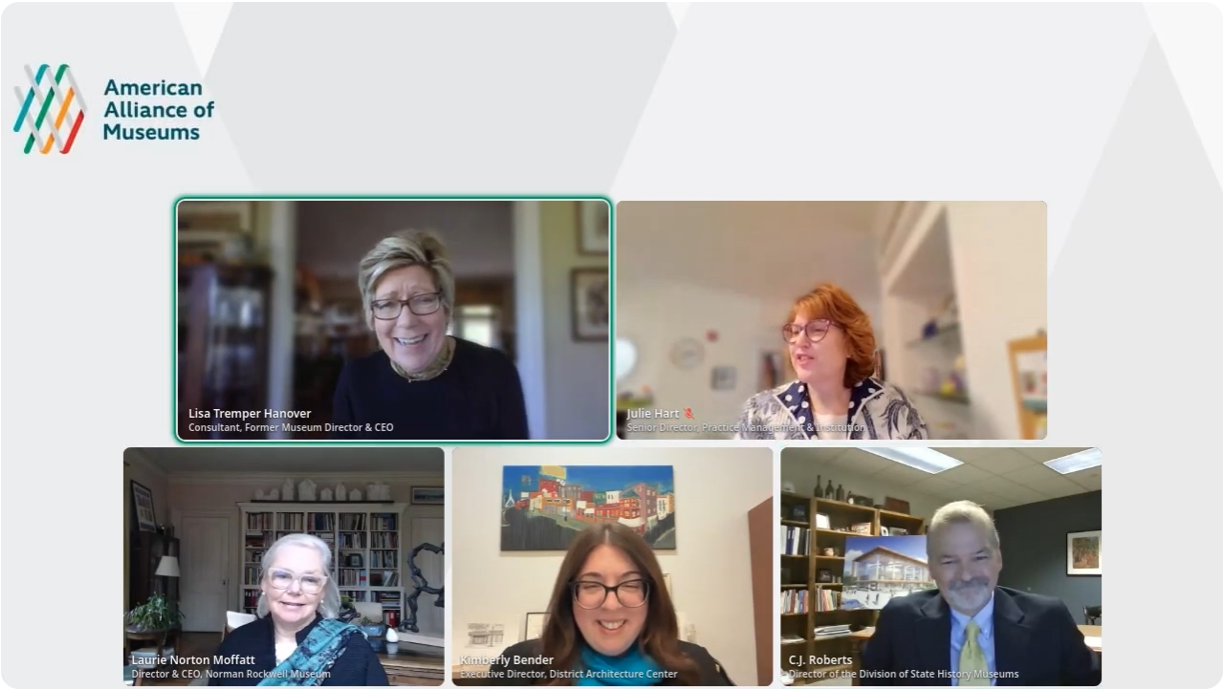
So let me introduce our speakers today. We have Kimberly Bender. She is the Executive Director at District Architecture Center, and she is the Former Director at the Heurich House Museum in Washington, DC. And one of the angles that she brings to this conversation is somebody who was the director at a smaller institution. We also have Laurie Norton Moffatt, she is the Director at CEO at the Norman Rockwell Museum, and she is in the middle of a transition process herself of leaving that institution after a forty-year career there. And is someone who is a leader who is very tied to the identity of that institution and vice versa, so she brings that perspective to us. We also have C.J. Roberts, who is the Director of the Division of State History Museums at the North Carolina Department of Natural Resources and Cultural Resources, and he is relatively new in that position after having a, planned transition from his last position at the Tampa Bay History Center, and he was there for twenty years, so he can bring a perspective to somebody who as sort of a mid-career transition. And finally, Lisa Tremper Hanover, who is, wears many hats. She is the, 1. she is the board chair for the Bowman Hill Wild Flower Preserve. She has been an interim director. She has been a CEO and director. She has been a consultant or is a consultant. She has worked with wide variety of institutions, primarily academic museums in her career, so I think she brings an interesting perspective of somebody who works within a larger parent organization. So I hope this is kind of a well-rounded group that gives you a variety of different perspectives. And, behind the scenes, I have my colleague, Ariel, who will be posting a chat, monitoring the chat, the Q and A, and things like that. And, of course, let me introduce myself. I’m Julie Hart. I’m the Senior Director for Museum Practice and Institutional Learning at AAM, and that all also includes our excellence programs like MAP and Accreditation.
So, of course we’re going to kick it off with a few statistics to set the stage and the context for today. So AAM did a national report on boards, in 2024, and it turns out that only 13% of museums had a written succession plan for the director. And there was also a report from BoardSource, they do this periodic survey called Leading with Intent. The last one from 2023, said about one third of nonprofits that they surveyed had a written succession plan for the leadership. So these aren’t really high numbers, and it’s a bit dispiriting and this is such an important document to have. Ergo where we’re having this webinar. So I do want to, turn it over to Lisa and ask Lisa if, since this is a pretty low number, and that is a real liability, could you talk a little bit about the value and the need for having one of these kind of plans?
Lisa Tremper Hanover
Sure, Julie. Thanks, and welcome everybody. We’re so delighted to have your interest and participation in this very important protocol that museums need to codify. A succession plan is a key element of organizational risk management and sustainability planning, and it should be discussed and put in place long before it’s needed. Whether for a planned transition or an emergency situation. No matter the scale of your organization, so much hinges on the executive director from funder and community and board relationships to staff morale, and to bringing the museum’s strategic vision to fruition. The museum field is undergoing a huge wave of leadership transition, particularly as long tenured directors are retiring. So on top of routine turnover of shorter terms, career patterns change and so we institutionally need to be prepared for both of these eventualities. Our museums don’t operate without an emergency plan, a collections management plan, to deal with situations that can imperil our staffs, our facilities, our visitors, our collections, so why do so few of us have written leadership succession plans, in place to address something that is inevitable. And it can be destabilizing and it can be a crisis if we’re not equipped. So, hopefully, today, we’ll give you guidance and tools to help establish this kind of protocol for your institution. Thanks, Julie.
Julie Hart
Thanks, Lisa. And I think that’s an important point is this is a 100% chance that this is going to happen at every institution. And I have seen also these plans referred to in, sometimes in this sort of more umbrella of risk management of not just a succession plan, but think about it as an organizational sustainability plan or part of your sustainability plan and your business continuity, and you know, enterprise risk management, essentially. So think about it as a piece of that.
Alright. So we’ll just jump into our main discussion with the presenters. And I want to start we’re going to talk a little bit about context and plan development, talk about implementation of the plan. We’ll talk about communications, which is super important. And, we’re going to wrap it up today with a slide that has some key elements of what should be in the plan and some just key takeaways from our panelists.
So let me start with context and plan development. So I’m going to ask Kim, C.J., and Laurie if they will all weigh in on this. To really talk about their plan and their process for developing the plan, essentially, and then we’ll talk about implementation in a second. You know, when was the plan developed? Who initiated the conversation? How often does it get revisited? And any tips that you might have to 1. normalize the process, and you know, how did you have the conversation? How did you map your risk? What was the process like to develop it? So let me start with Kim.
Kimberly Bender
Thank you, thanks for having me. So as you mentioned before, I was the executive director of a small museum in Washington DC, and it was, I think at the most, we had eight full-time staff members. We had a bunch of part-time. And I think that really, you know, when I started, it was almost like I said we were a museum in planning, but we were doing it in front of the world because we were inventing ourselves live. And it also was something I was learning how to be an executive director live. So almost from the beginning, I had some kind of thought in my head of I need to figure out how to make this something we can pass on to somebody else. And I always had a staff member who knew, like, a little bit about like 80% of what I was doing as well, so that was sort of a built-in succession plan. And then we hired a professional succession planning consultant to help us through a grant in 2018. And that was our first real plan that somebody gave us. And then the true succession plan of me leaving happened around two years before I left. Where the board adopted it and we were really thinking about how to move into a world where I wasn’t the executive director anymore.
Julie Hart
Great and Kim, how far into your tenure there did you start this conversation and create the plan?
Kimberly Bender
Yeah, so that’s a great point. So I was there around the 2018 consultant plan was around six years into me being there.
Julie Hart
Okay.
Kimberly Bender
Yeah and I was there for fifteen years.
Julie Hart
Ok, great thanks. Let me turn to you, C.J., and ask you a similar set of questions. Tell us about your process to get this plan in place and conversations with your board and staff about it.
C.J. Roberts
Sure. Well, in the in the interest of full disclosure, the Tampa Bay History Center was my fourth institution to direct and the first time that I was ever involved in putting together a succession plan. And we put that together at about year 10 into my tenure there. And it was really driven by the board. And it was a board that was very focused on being proactive, not reactive. And it coincided, I think, with an extension of my contract, so I didn’t take it personally. I didn’t feel like they were trying to tell me something. And we worked together to create a plan that would essentially be a road map for guiding us through the process when the time came. And as you, Julie, as you pointed out, earlier, it is going to happen. Whether it’s a planned departure or unplanned, it is inevitable. And so we put together a document that I think turned out to be a very good document when I did leave, then ten years later. Of course, when I called my board chairman and, let him know that I had another opportunity and the time to move on had arrived. And, I submitted then to him my letter of resignation along with a copy of the plan, which I knew he had somewhere in his files, but, nice to have it at his fingertips. And so it it really was a good tool then for him to be able to immediately implement the transition process and move forward.
Julie Hart
Great, thank you. Laurie, how about you? Tell us a little bit about how this came about at your institution.
Laurie Norton Moffatt
Thank you, Julie. Hello, everyone. I’ll share a two layered process because for many years, we’ve had what I would consider more of an emergency succession plan, if something were to have happened to me unexpectedly and the board was faced quite suddenly with addressing museum leadership. And for that, it was a fairly simple process. I, amongst discussion with trustees and, with leadership team, we identified a pair of our leadership staff who would serve in an interim, to help make decisions, work with our- we’re very decentralized and really work as a full leadership team, but sometimes somebody has to make a final decision on something. And these candidates or these individuals had the expertise to understand both the mission, the curatorial side, and the solid financial management of the museum. And so that was something that was in place for a very long time and I would say this would come up and be refreshed in the ordinary process of performance evaluation or compensation setting. It took place with the personnel committee, and it was a reminder, as C.J. said, “by the way, here’s the plan remember?” because it gets buried in people’s files, and it was always something we kept current. And it had some indication of you know, important decisions and where to find information.
Parallel to that, was, what I would update periodically, a list of search firms so that if the board, you know, needed to move on into, more permanent successor placement had I not been able to come back, for example, they knew who to contact. And contact a range of the cultural search firms who do this work for museums and other cultural organizations. We never had to execute that plan. And moving on to my current situation, I, as Julie noted, I’ve served my institution for a very long time. And I found it very helpful to have periodic conversation with my board. We would check-in again through that annual performance eval or in an executive committee meeting, executive session meeting, just an affirmation that I’m committed here three to five more years. I’m going to see this major project through or whatever was on the horizon, so there was a comfort level between the board and myself that we recognized my leadership would continue. I would say about three years ago is when I began in earnest the conversation with my board that I no longer felt I could give that three to five year runway. And I recognized that was my time to indicate that I wanted to begin to initiate succession planning. And we spent the better part of two years in quiet conversation with just the highest-level board leaders, but it became a very open dialogue and a communication together and at a certain point shared with our full board that this was on the horizon. And I’ll just wrap up at this stage, I made my announcement a year ago, May, and it’s taken, our board the better part of that year to run their search and, identify my successor-
Lisa Tremper Hanover
Ooh!
Laurie Norton Moffatt
Which we will be announcing in about a week. So it was a very orderly process, and, I have to say it gave a good sense of comfort to know we could be in open candid dialogue together. Respectfully and not worrying was the board thinking? Or having them not know what I was thinking. I think it is part of that risk management that everyone’s in the know and working very collegially and collaboratively.
Julie Hart
Great. Thank you. I think it sounds like you all had very, healthy relationships and conversations with your board and I think this normalizes it because I think that’s a that’s a word that I heard in many of your comments that you shared with me earlier and that we’ll talk about. And I think we’ve seen some institutions that like, for example, through the accreditation process, we do see a lot of institutions come up with the they’re having institutional capacity and crisis and leadership struggles, and a lot of it is from the need for a longer term director to have a succession plan and they’ve pushed back against it because I think a lot of institutions just may be in denial about it. And like we said it’s going to happen regardless, especially if we have a long-term leader in place. You need to be ready. And it’s part of like, your own individual will and estate planning and thinking ahead for your future, you got to do the same thing for the organization because it’s going to continue without you, so you want to make sure that you have everything set up for a successful transition of power forward to the next director.
Alright, so let’s talk a little bit about the implementation of these plans. I’m going to ask you, C.J. and Kim first if you could talk a little bit about the actual once you made your decision to leave, how the pieces fell into place in terms of the implementation and particularly I think both of you if you could comment on the importance of building the internal capacity pipeline in creating the bench internally so you know, you’re not the only person that knows everything of how everything works.
C.J. Roberts
Well, I’ll jump in and say I think we all have an obligation to nurture our staffs and help them develop and be ready to be those leaders when the time comes. I take a lot of pride in the fact that over the course of my career, I think I’ve had five or six staff members who have gone on to lead other institutions, so I just think that’s something we all need to commit to, and I’m sure most of us do. But that helped, during this transition because we had several folks on the team who could step into this role. And, I think you do need to, though, think about sort of what are their other responsibilities. So, for example, you even though your CFO might be a logical person to step into this role, are there appropriate separations between financial internal controls and all of that, particularly when you have a smaller staff? So you have to kind of keep that in mind. But in our case, we had somebody who was ready to go. I did have a four month transition period. Which we could talk more about. That’s a long time. There are pluses and minuses to that, but that did give me an opportunity to continue to work very closely with her, making sure that she was comfortable, had the information that she needed, and, I think overall, it it it went very well. One of the in anticipation of this program, I reached out to her and I said, you know, what could we have done differently? Is there anything we could have done to help prepare? What did we do right? And from her perspective, we did things right for the most part. But one of her observations was it was really helpful that she was named early. Because when you make this kind of announcement, there’s a lot of anxiety on the part of the staff. They may not even like you, but it’s what’s going to come next? And so being able to say, well, this person is stepping up and serving in this role. I think really provided a calming effect for the entire staff. So that was, you know, that was kind of our experience there.
Kimberly Bender
So I think that I tried to operationalize succession planning in a way for a long time before I thought about leaving. In that you know, I kind of think succession planning is something you need to do across the entire organization. So it’s not just planning and thinking about things for when I left but planning for when individual managers left or directors left within my staff. So if somebody was creating something new, like, really trying to integrate into the culture of the organization that it was our job to create SOP documents and make sure whatever we were doing could get passed down to the next person in the role. So it was a constant, part of how we built our annual plans, of working together, we were always talking about that. And that really allowed me to talk about it more openly generally, with the board and the staff. And I know I think we’re going to talk about that a little bit later, but I, you know, I so in in many ways, I was sort of prepping, as I said, like, from the beginning. Trying thinking about the future, how could we be stronger through succession planning for everybody. But when I actually decided to leave, I talked to a colleague who had also been sort of in this found- well, she was a definite founder, I was a, like, a pseudo founder. And asked her advice because the way she left her organization for ten years was really successful and similar sized and within the same community. And she gave me really good advice, which was, to sort of do my own planning quietly by myself for a year. I mean, she had a three-year plan, which sort of sounds maybe similar to Laurie’s plan. But, be quiet about it for a year with myself and do what I needed to do to set things, set the stage. Tell the board in the second year and work with them for a year. Quietly. And then in the third year start to move towards actually exiting. And that’s essentially what I did. I thought about it really hard and started doing quiet things myself for a year, and then last year, I told with my board in January so last, um 2025. And then I thought I was going to have this whole year, but things changed a little bit at the beginning of the year. And they started doing the search for my successor at the beginning of this year. We told the staff at the 2025. And, hired a really great search firm that was interested in also including the staff in the process, which I think for us was a very important part of the process, especially because of the type of museum that we are. And they’ll be announcing someone next week. So I’m really happy about how it all went. I think that everyone involved seems to have been you know, not too upset about anything as it went down.
Julie Hart
That’s great.
Kimberly Bender
Not traumatized.
Julie Hart
Laurie, let me turn it over to you. I know you’ve had a very thorough process. And could you talk a little bit about what, like, kind of what happened when it’s like, okay. Here’s my resignation. And, we’re, you know, we’re ready to go and pull the trigger. How did all the pieces fall into place? Who did what? How did it kind of unfold? And maybe you could also highlight what the division of the responsibilities was, like, where you involved and then kind of where the handoff was to where then the board took the leadership role and you stepped back.
Laurie Norton Moffatt
Thank you, Julie. I’ll try to condense all those into concise narrative, because it was more or less as Kimberly just described, a three year process. I really spent a year readying myself. It was, an emotional year, a real internally realizing, yes this has to happen and the time was starting to feel right. I was in communication with my board leaders, but there was no sense of pressure. It was let us know when you’re ready. And I would say in that second year, I began to map out that plan, a calendar. I literally you know, month by month, what was going to happen. And I did another project. I felt we needed to be ready for the communications very quickly once I announced and shared with our team and that there wouldn’t be time really to pull together the press release and some of the communications and layering to all the different constituents. So I worked, independently with a writer who’d actually been on our communications team at an earlier juncture. And had a lot of documents ready. So when I took the final decision to my board, my board leaders, and I did write a formal letter because I felt they might not you know, I felt I needed to formalize it and say, I am ready now to take this step. We then were able to map it out. I brought my lead communications person in on the conversation. I took her to breakfast and I said the time has come, and I need your help. The museum needs your help to map out the strategy, how we’re going to manage the communications across all of the museum’s constituents. And that began careful planning of working toward a date. I had to coordinate with my board leaders and, of course, we weren’t at a- we decided we would hold a special meeting by Zoom not wait for an in-person board meeting, quarterly board meeting, so we did hold a special meeting. I think everyone knew because they were informed. Please join this meeting for a special announcement, and so pretty much everyone was anticipating that. And the rollout itself followed, immediately thereafter with an in-person meeting with our whole staff. And then we had a series of communications ready to roll out to lead donors, our members, key community leaders, ultimately, the media. And everything was staged and ready to just cascade one group after another, so that there was a universal announcement. And we were successful to avoid, you know, one group hearing you know, long in advance of another group. We really wanted the whole community to hear at the same time. We’re in a rural region. Lot of cultural activity in this region, but it was important that everybody felt they had heard the information, pretty much at the same time. Did I jump over any other questions you had asked me there, Julie? (29:18)
Julie Hart
Maybe what is also kind of where you took the lead onto this and where was kind of the hand off when you decided to say, “okay, now I got to step out of it and the board takes the lead.”
Laurie Norton Moffatt
Oh, yes. Thank you. Yes. Yes. That was almost, was another chapter. So once it was public, you know, my role, my intention is always to help serve my board and help make their jobs the easiest it can be. My board is national. They’re all over the country. They cannot easily convene in person. And so we have many different time zones. We have a challenging time getting everybody together. So I had organized a list of the search firms, we decided we would have a project coordinator to actually serve the search committee. It was the board chair’s job to appoint a search committee, but I communicated about that with our board leaders and helpe them identify a committee that could represent all facets of knowledge of the museum from collections to learning and engagement to finance to audit. A group that deeply, deeply knew and could communicate with prospective candidates just about as well as a leadership staff member could about their area of expertise. Our board did not involve staff on the search committee. That was a decision that they felt was important. It was a full national search after having a leader serve for such a long time. And I helped them through the process of issuing request for proposals to the firms, helping secure those proposals, and by then our project coordinator was on deck and she was handling the administrative aspects of that with the committee. And I met with the committee for a month or two and then I asked to step back from the process. I felt they were all set to manage it on their own. They had a good strong administrative coordinator. And that it’s really the board’s responsibility. I was not part of the search committee, and that felt appropriate, both to me and I think to them. And I think, you know, I just have an awareness as being a long time leader to really make space for my successor, so that they come in and they’re able to lead and know that you know, this is a joyful handoff for the future success of an institution that I love and have served for so very long. So I would say it was a gradual if you were to look at a graph, you know, I was involved maybe for the first third of it. Maybe, not quite half of it and then it turned over to the board and the project coordinator. Now we’re getting ready to announce and of course, it’s all back to the staff doing the work at you know, the various institutions to prepare and ready everything. So I hope that was helpful.
Julie Hart
Yeah, and actually, Kim and C.J., do you have anything to sort of add in a way of kind of where your role was in this and where you stepped back? Do you have any thoughts on that?
Kimberly Bender
I mean, I feel like my process was a bit parallel, but just on a smaller scale. And the only difference is that once I sort of handed the search off after helping operationally get them up and running, I also did step back and then this role that I’m in now came up faster than any of us anticipated. So, I think the probably the back end of what Laurie was talking about with her role there has ended up being an interim director for the Heurich House Museum. And that was my Assistant Director who stepped into that role. And so it was fairly seamless because I was able to- she knew so much to begin with and then I was able to build a training for her that got her up and running, and that included writing an executive director handbook that was, like, you know, every single thing that I could possibly imagine linking out to and, giving her the basics. And we did, like, a month-long intensive training, and that I think helped her get on her way. And then she sort of just stepped into my shoes. But yeah, that’s my only real difference, probably.
Julie Hart
Great. C.J., anything you want to add to the process and implementation aspect story?
C.J. Roberts
I wish my predecessor had left me an executive director’s handbook. That’s pretty nice of you. I would say my process was very and it sounds like my plan was very similar to Laurie’s. Identifying within the plan who those key stakeholders are: our partners, our donors, local government partners, all of that. And so, because mine was a planned departure, I took the lead in reaching out to all of those folks and letting them know what was going on. And had I not been able to do that, that would have fallen to the board chair or organizational leadership. I did reach out to the search firms asking them to prepare proposals, but then that was it. I stepped away. I think all the search firms did interview me, but beyond that was not involved in that process.
Julie Hart
Great, so you’re all very in on laying the groundwork to sort of, so the board has what they need to move forward. And I think you both mentioned, we’ll talk about this in a minute when we get back to communications. But really kind of identifying all the stakeholders that need to be informed at some point or that you might need to talk to, gathering up, and I assume that, you know, having a current position description for the executive director. And things like that to really tee up the process. And I think what I have seen, a good tool as institutions are going into this is to think about sort of mapping organizational risk, like, what and not just what does the institution need now in terms of its next executive director? But also, you know, so you don’t just oh, I just want to hire the exact same person we had before. You know, it’s really time to think strategically about where are we going, what’s in place now, and it may go in a different direction or be slightly different. But really looking at kind of that traditional SWAT type thing, like you do in strategic planning, which I know this is sometimes an opportunity during strategic planning is also the time to think about succession planning and the plan.
So I have seen kind of doing an organizational risk mapping exercise as part of thinking about you know, what’s the next iteration of the institution look like under new leadership? So you guys have shared all these really lovely, these were great thought-out plans. You had a long runway. Everything worked smoothly. There are, of course, situations where you don’t have that luxury. The director has an emergency situation, short- term leave of absence needed, maybe they’ve actually died or they have a serious illness, they have to step away immediately. You know, so there’s the emergency situations. So I want to shift to that a little bit and talk to Lisa. You know, in terms of short-term succession plans, I know you have a a nice example that you have shared. I think Ariel put it in the resources. Maybe to talk a little about how these are sort of very operationally different, and kind of your experience with these, what kind of practicalities do they need to address.
Lisa Tremper Hanover
Right. Yeah. You know, intuitively, we as leaders all know the steps that need to be taken and reactions and proactions. But, having these, our knowledge base and our protocols codified and getting all of your constituents on board with these procedures is really what we’re talking about here. So should there be an emergency, the most catastrophic, of course, would be the death of your executive director. But most common are illness, accidents, temporary leaves of absence, with the intention of coming back. So you need to have protocols in place for interim leadership and that could very well parallel the long-term planning of perhaps mentoring and training internal candidates to eventually take on a leadership role. Your board needs to be very much involved in all of this. And in fact, sometimes board leadership is qualified to take on this interim status. So, I think that what needs to be done is communication on all levels at all times. Transparency, all levels, all times. There will be a fear. There will be people nervous about you know the person we have trusted, who has been our leader is no longer immediately, not in the next day, is not in this place. So there are, obviously, we have knowledge transfer documents. We have protocols to communicate again with the constituents that need to know what is happening. And, again, we have templates for this to share, with all of you. I think the interim is not there to make any drastic decisions. They don’t change the course of the institution. They are much more in a stability role, ensuring continuity and again, being prepared that should the ED not return from this emergency, situation that they then instigate the protocols for the long-term, succession planning. Does that answer the question? And I must apologize to everybody. I have a cold. And it’s not helping me think very clearly because I took a lot of medicine to be able to be present today. So excuse me.
Julie Hart
No, that’s great. And I think that also, like you just alluded to the role of the interim or the acting, because I know you’ve been in positions like that. You know, what exactly is that role? Because, you know, it is kind of somebody who’s you know, just bridging things. And they may or may not be the person that ultimately moves into the role.
Lisa Tremper Hanover
That’s true. In fact, but like Kimberly, I was the founding director of a museum, an academic museum. And after twenty-five years, I moved on to another organization. And being at an academic institution, you have additional layers in your succession planning, which worked beautifully with my transition. But after a few years, the Berman Museum asked me to come back in an interim role, specifically to search for the successor at the Berman Museum. So I had not been there for eight years, but they brought me back to institute the succession planning protocols and we were able to do that, and that took a good year and a half. So I was back in a familiar environment at an academic institution. Nobody ever leaves. So, there was no learning curve for me and the faculty, and the academic leadership. But as an interim, as I said, you were there to provide stability, to keep the momentum, the trajectory of the institution moving forward, but not to make drastic decisions and hiring and firing and strategic vision. Those areas really are not the purview of an interim, except now let’s think about it. C.J. had intentionally mentored someone within his staff who could conceivably have taken on the directorship role. And so, certainly, if you’re an internal candidate and you’re named interim, those conversations have to be very clear about the respect that you’re given and your opportunity to interview on the same plane as other candidates, external candidates. Right? And, again, when you’re an internal candidate, you are a known quantity, and that could work for you or not work for you.
Julie Hart
Great, great. And from your perspective, also, you are a board chair at an institution. You know, if you could just talk about the perspective of somebody who’s on the board and you know, the perspective on leadership transition from the board side?
Lisa Tremper Hanover
Listen, you know, board succession planning is every bit as critical as an executive director. It’s our duty of care, obviously. We are fortunate in that boards should have functioning governance nominating committees who do a lot of the work in identifying candidates for board service skill sets, different disciplines, etcetera, philanthropic, of course. But also it’s the board’s role to create opportunities for some of these leaders to take on executive chair committee chairs and to move into executive committee roles. And boards do a good job when they name a chair or a president and a vice chair, vice president. It’s usually the vice chair that is being groomed to take on. So there is certain succession planning in the very tight role of the executive committee. The treasurer of the board I currently chair announced last week that he was resigning that position and was also resigning from the board. We had protocols in place to communicate immediately with the board as a whole. The governance committee immediately identified an interim. We had to, of course, the treasurer position there are key outside alliances that are protocol, that are, you know, signature reliant. And so we had to very quickly arrange for the interim to take on those duties. But we had everything written down and everything in place. And the governance, committee had already been thoughtful about the next in line for some of these positions.
I’m not sure what else I have on that front, but, you know, boards, I think, are pretty cohesive when it comes to thinking about succession planning and broadening their skill set. And, of course, term limits. That’s what I was thinking about. Term limits really help boards not only identify and retain good leadership, but also the ability to send some people on their way and bring in new talent.
Julie Hart
Yep, and I think, yeah, you make a really good point of, there’s obviously a succession and capacity building within the board, so that you have a strong board and so they can step when the director leaves, planned or unplanned, they also have the skills to take on some of those operational aspects that need to be sort of legal and financial sometimes that need to be handled. In addition to the larger strategic things like the search firm, etcetera, and that type of thing.
Lisa Tremper Hanover
Correct.
Julie Hart
And, you know, the board’s having conversations as we heard with the director when performance reviews come up or compensation conversations come up or just kind of the regular touch points about succession planning.
Lisa Tremper Hanover
Right.
Julie Hart
Great, thank you. And I want to close out this part by emergency situations by asking Kim to tell us a little bit about the unexpected implementation of your emergency succession plan.
Kimberly Bender
Yeah. So, you know, I mentioned we always sort of had this internal operational succession thought process happening all the time. And we actually called it the getting hit by a bus rule. So I’m sure lots of people use that term, but so whenever somebody would do something that needed to be documented, I would say, you know, get hit by a bus rule. And then in 2024, I got hit by a car. So not quite a bus, but a car. And, we did have an emergency succession planning document policy that we had passed and my Director of Operations at the time was named as the person to step in for me and she did. I was in the hospital and it it was a couple months of me not really being- I was partially available. And, I think, you know, having that plan in place was very important because it had all of the most important information written on it, like, you know, our bank account numbers and who to call from the insurance broker. But really, again, like, I in addition to that, I think what kept us going seamlessly when I came back, it was like my accident was a blip actually in our path because of all of the day to day structures that we had put into place so that people could just keep going. It was sort of a machine that was operating without me. For a small museum, I think that can be unusual. And a lot of it had to do with you know, project management software and the way that had always done strategic planning and making sure people just knew what they were supposed to be doing, so they just kept doing it. And the board you know, of course, the board stepped in and was making sure everything was going smoothly. But, you know, really, at the end of the day, I would say the Heurich House Museum nothing changed because of my accident, which was my sort of test run for, oh, I think I could actually leave, this seems like it could work. So.
Julie Hart
That’s great.
Kimberly Bender
Yeah, not that I would’ve chosen that to be the way I figure that out, but-
Julie Hart
Yeah. You don’t want to have everybody try that as a test run mechanism.
Kimberly Bender
No.
Julie Hart
Yeah. I think in plans you want to be, when you have to write plans, be very specific about who, what person is taking on what responsibilities, so you’re not scrambling when something unexpected happens.
And just briefly before we kind of go into our wrap up phase. You know we’ve talked, sprinkled through, conversations and comments about communication and the importance of communication with staff, stakeholders, donors, board, everybody, and the transparency. And I know, you’ve kind of all talked a little bit about identifying those, you know, who are your top stakeholders and constituents that you need to talk to. Let me just open it up to any of you who want to comment on how that process went or how you made that list or anything or sort of the triage level of communications anything like that.
Laurie Norton Moffatt
Well, I’m happy to jump in. You know, I think any of us in these roles have a portfolio of patrons, donors with whom we regularly meet and are in communication and who are very generous patrons that keep our institutions going. And so that’s I think, a first and easy group, after your board of trustees and staff. To be sure you want to have them know before they read about it or hear about it and have had a special communication. We also thought about groups in our community with whom I work closely or for whom the museum is important and tailored special communications to them. It was essentially the same message, but it recognized you know the political leaders or business leaders. Certainly members had a special communication, but we had all of these ready to go. And there was a phalanx of us who were getting the messaging out. There were some people I was calling and some people the board was calling, the board chair was calling. So I think if you know, map out your important relationships, you’re almost, doing a mapping. And you have a basic core message, but you can tailor it for that level of recipient and then have a plan depending on what your communication tools are of how they will roll out and that’s where a team was needed. We worked with my executive assistant, our communications office, our communications assistant, our media coordinator. There were many people who helped: the development office, our philanthropy team, so that we could take care of all of our constituents.
Julie Hart
Great. Continue to steward those relationships. Anybody else want to chime in?
C.J. Roberts
It underscores the need that this document should be evergreen and frequently revisited. Right? Because those stakeholders change. Ten years ago, the Tampa Bay History Center stakeholders were a little different than they are now. Ten years ago, there were different search firms that were in business than now. Two of the search firms I had listed were no longer active businesses. So, it’s something that needs to be visited frequently and updated regularly.
Laurie Norton Moffatt
I think that’s right. And Kimberly, I was struck by you noting you even had bank accounts and the signatories and you’re a smaller institution, so there were fewer of you execute all of that work. And so passing that on to a successor would be very important. You know, we have little more depth of staff, so there usually are redundancies, two or three people who are aware and know, and can manage each other’s work. But I thought that was a very interesting point you made that especially in a small institution, some of that very high-level confidential detail would be hugely helpful for someone stepping in quickly or in an orderly way. Signature cards, the bank account. You know? I haven’t thought about that. I’m sure my CFO is.
Kimberly Bender
That was a template that was given to me as part of the succession planning process that we did with a consultant. And I thought that, I’m sure that there are other templates out there, you can just Google them, and it was really- I don’t know if I had really thought about it in that formal of a way. So, it made it very easy to just, you know, fill out the form and have it available, make sure, you know, somebody knew where it was and keeping it updated regularly. I was just going to say, can I say one thing about the communications plan?
Which is like, maybe this goes without saying, but I think it is important for us to really talk about how the communications plan was an opportunity to you know, it’s not just announcing that I’m leaving, but it’s an opportunity to set the stage for the next set you know, the next person to come in and to really show the community that this is like a, as I think Laurie said, it’s a joyful occasion. It’s a time for growth and, like, a way of making sure that there’s no weakening of the organization by the transition, through this communication of, like, you know, the board expressing their hope for the future and their vision for the future in that communication plan. So that to me was, like, a very important part of making sure that it was a strong transition.
Julie Hart
Great. And I think one of the things, you know, we’ve talked about, a supportive system and a successful process, but you know, those situations when maybe there is a- the director’s involved in an accident or they die or something, they get terminated and they’re just gone tomorrow, things like that. There is the staff. You got to manage the staff’s emotions and situation, and so there’s a lot more than just operational aspect that’s going to go into the communication. So I think that is an important thing that the boards will need to take into consideration and it’s just the emotional impact of the staff if something has happened to their executive director. So, we want to make sure that that is also and I think that may be true, you know, there’s also transition anxiety in a planned situation, but, I think we don’t want to forget the sort of mental health and support of staff if there is an unexpected situation.
So alright. So I think, Kimberly, it’s a good segue. You mentioned there are a bunch of templates from your consultant and you can Google them. And maybe if Ariel could put up the slide, the next slide. In the resources document that’s in the resources tab here that you can download, I have put, you know, a dozen or so half a dozen resources in there of articles and blogs and other things like toolkits and templates that you can go to, to kind of find the structure of these. And if you start to look at these, we also have a sample document library at AAM that’s available as a benefit to Tier 3 members, and we currently have six sample succession plans in there from a wide variety of different types of institutions. And, this is kind of high level. This is not everything, but some of the key elements you’ve probably heard of, you know, we want to have a summary of the key functionality or the key functions of the director, things that have to be replaced essentially. You’re going to need a summary of the detailed steps and the process of what happens when the decision or the need arises to implement the succession plan including the assigned responsibilities. So you want to have the short-term absence situation, the emergency situation, and the planned transition and departure. You want to talk about internal succession and chain of command, we did talk a little bit about the financial and legal authorities and sort of that transfer of authority to do some of those transactions as well as operational responsibilities. You want to outline the search process and who’s going to be involved. You need to have a communications plan and talk about who you know, where’s the authority and the compensation and the oversight of an acting or an interim director, kind of what their role is. How and when the plan is updated. And I’ve seen a number, and C.J. alluded to this having a- or one of you said there was a new director handbook. You know, what is the onboarding so you have a smooth structured entry for the next director. What are some key things. And so it’s always good to make sure you have an up-to-date job description for your executive director, that list of key constituents and stakeholders, and a list of possible search firms.
And on the next slide is just some very high level couple slides here takeaways that the panelist shared, and I actually put a more robust version of these in a document that you can download. But, you know, don’t wait. You should have this plan in place the first day of a new director’s tenure. You need to normalize the process and the topic. You can’t over communicate. Communicate, communicate, communicate, communicate, be transparent with staff, board, community, etcetera.
And on the next slide, Ariel. I have put here director take the lead, but then some of you actually said the board took the lead. So I think it’s sort of a joint responsibility, and it may be different in different institutions based on your relationship and your size, etcetera. But you do have a joint responsibility to develop this plan together, instead of the board just doing it and handing it to the director, it needs to be a joint process. And, you know, you’ve got to consider extra layers if you’re in an institution with a parent. And somebody mentioned this, everybody knows where to find a copy of this. It’s not five years old and in their drawer somewhere, that nobody knows where it is. And it’s easier to leave when you know where you’re going. Not only, like, you as a director is going to go for your next step, but also where you’re going in terms of having a road map for this process.
So I think we’re at time, but I know there were a just a few questions in the chat. And, Ariel, I don’t know if you want to chime in if we want to stay five more minutes and answer some chat questions. That’d be okay? Okay. One I thought was really interesting here was what happens when the board thinks it’s time for a change in a succession, a leadership succession, but the director is not necessarily ready or for that change. How should the succession planning proceed? And, of course, there should already be a plan in place, you know, at that time. But does anybody want to comment on that?
C.J. Roberts
It’s the same plan. The plan should cover planned and unplanned departures. And so it’s just a matter of who’s taking the lead in what areas, I think, if the director’s out picture. But same plan covers both.
Julie Hart
Right. Yep. Right.
Kimberly Bender
It shows the importance of really building it out ahead of time.
Julie Hart
Exactly. Exactly. So.
Lisa Tremper Hanover
You know, it would really be a surprise if all of a sudden the board decided this director wasn’t working anymore and terminated them. So one would think that conversations would have taken place.
Julie Hart
Yeah. That’s the one you have a performance, yeah, like, nothing should be a surprise.
Lisa Tremper Hanover
Right.
Julie Hart
Has performance reviews done regularly, etcetera, etcetera.
Lisa Tremper Hanover
But it could happen. Listen. It could happen.
Julie Hart
Let’s see if there’s anything. Somebody asked if the Tier 3 membership that accesses the sample document library is available to individual members and currently is not. It is only for institutional members.
Let’s see if there’s anything else. We talked about term limits. We kind of covered most of these. Does anybody just want to have any closing remarks or closing comments they’d like to make?
Laurie Norton Moffatt
Well, I’ll just share, I found it very reassuring to be in conversation with my board so that there were no surprises. I think it can seem fearful or people maybe don’t make a plan because they might think, well, does the board want me to step away, or does this mean I’m exiting? And I liked what Lisa said at the beginning. We have plans to handle emergencies of our facilities, to take care of our collections in a moment of emergency. We have all kinds of risk management policies. We take out very expensive insurance policies for our plants, our collections, our liability. And it’s really important to think of succession planning similarly, as something just essential to mitigate risk for your museum, a place that you love, and you work really hard to take care of and do a good job, and turning it over to, your next generation of museum goers. And so thinking about your role and helping the board know that there’s a good strong plan in place so that there’s always quality leadership at the helm, just is very reassuring and makes good sense.
C.J. Roberts
Well said.
Julie Hart
Thank you. Well, thank you all again for your comments and we’ll see all of you, and to everybody in the audience, we hope to see you at our conference in Philadelphia, later this month. Thank you, everyone.
Laurie Norton Moffatt
Thank you, Julie.
Lisa Tremper Hanover
Thank you, Julie.
C.J. Roberts
Goodbye everybody.
Laurie Norton Moffatt
So long everyone.

Upcoming Events
-
-
-
Industry Showcase: Innovative Digital Solutions
Event Date: -
Creative Museums Summit
Event Date:Presented by: MuseumNext