In this moderated discussion with two senior museum leaders working to reimagine a national museum dedicated to American Jewish history, focusing on ways they are using digital technologies to reconfigure public engagement for multiple audiences. Established in 1976 and situated on Philadelphia’s Independence Mall, the Weitzman National Museum of American Jewish History is dedicated to exploring and interpreting the American Jewish experience in the context of American History. The Museum was originally founded by the members of historic Congregation Mikveh Israel, which was established in 1740 and known as the “Synagogue of the American Revolution”. Under new leadership, the Museum is reimagining its core exhibitions and experiences, many employing cutting-edge digital tools and technologies. The new Colors of Creation family gallery, for example, inspired by the seven days of creation, is a highly immersive, interactive, and colorful digital environment for all ages that explores the colors of the natural world through a foundational story shared by the three major monotheistic world religions.
This webinar was sponsored by the David Berg Foundation, supporting the conservation of Jewish artifacts, manuscripts, texts, and art; exhibitions about Jewish culture and heritage, the advancement of Jewish museums and libraries; and initiatives that combat the rise of antisemitism. This webinar is presented in collaboration with the Council of American Jewish Museums (CAJM).
Transcript
Cecelia Walls:
Hello, everyone, and welcome. Thank you for joining us for digital innovations and public experiences at Jewish museums. Reimagining the Weitzman. My name is Cecilia Walls, and I’m with the American Alliance of Museums. Before we begin, just a couple of quick logistics. You’re welcome to drop questions into the q and a as we go. We’ll gather those and leave time for discussion toward the end of the program. We’re also recording today’s session, and it will be available to registrants and AAM members in the coming days. If you’d like, feel free to introduce yourselves in the chat and share where you’re joining from.
Today’s session is a moderated discussion with Marsha Semmel featuring Dan Tadmor and Josh Perelman from the Weitzman National Museum of American Jewish History. And they’ll be exploring how digital technology can reimagine public engagement for multiple audiences. Before we get started, I’d also like to extend a quick thank you, this webinar is sponsored by David Berg Foundation and presented in collaboration with the Council of American Jewish Museums. And now I’m pleased to pass things over to my cohost, Greg Stevens, who will help guide us in today’s conversation.
Greg, over to you.
Greg Stevens:
As Cecelia mentioned this program is, of course, being brought to you by the American Alliance of Museums sponsored by the David Berg Foundation and in partnership with the Council of American Jewish Museums. It’s part of a series of webinars AAM is producing as well as a conference session that we will be presenting at the annual meeting in Philadelphia next week. And all three of these programs will be wrapped up nicely in an article that will appear in museum magazine later in the fall.
I’m very excited to sit in on this conversation. I’ll be monitoring the chat for questions and comments that come in throughout. And at this point, I’m delighted to welcome my colleague Marsha Semmel to the stage.
Marsha Semmel:
Thanks so much, Greg. It’s a pleasure to be here. I am, you know, really privileged to be part of this project and also thankful to the David Berg Foundation. And especially thankful to our two, discussants, Dan Tadmor the president of the Weitzman National Museum of American Jewish History, who joined the staff, as president, in January 2025. And longtime Weitzman leader and contributor and curator, Josh Perlman, who’s now the senior adviser content and strategy at the Weitzman.
I know I visited the Weitzman on many occasions, and now given its twenty-year run, I it’s, at a point where it’s ready to move to a lot of new reimagining. And that reimagining is making liberal use of digital tools and technology. So I think that this conversation is going to be very important.
Cecelia, can you bring Dan and Josh on stage?
And we can I just wanted to, start by asking Dan to say a few things about coming to the Weitzman? He came to he joined the museum from going through a complete reimagining of Anu, that means Behat Fustat in in Israel. And, he’s got a big challenge, but he’s got a tremendous vision. And I was wondering, Dan, I know when I talked to about 17 different Jewish museums and asking about digital tools and technology, I felt when I talked to Josh, I think it might have been few months ago, I felt like I’d struck gold because he was the person who said more than anybody else yes. We’re deeply into thinking strategically, about, immersive digital technology and tools and that was news to me.
So, Dan, would you say a few more things about your vision for the Weitzman? What you bring to the table, and how you seethe the use of digital tools and technology enhancing the impact of what you do both I would assume, both locally and nationally since you are a national museum.
Thank you.
Dan Tadmor:
Sure. You. And it’s great to be here.
Marsha Semmel:
Oops. We can’t hear you. You’re on mute.
Dan Tadmor:
How about now? No. Can you hear me?
Josh Perelman:
Yes.
Marsha Semmel:
Oh, I can’t.
Dan Tadmor:
Okay. Off. So I’m gonna so long as most of us can hear me, I’m gonna still go. Okay? Josh, not to tell me that you can still hear me. Yeah. Alright. Great.
Marsha mentioned the previous museum I was at which used to be called the Diaspora Museum or Beit Hatfutsot and is now called Anu Museum of the Jewish People. It’s a museum in Tel Aviv, on the Tel Aviv University campus. It opened in 1978.And was a wonder but, museums age. Thematic museums age, and they don’t necessarily age gracefully. And it’s just the destiny of thematic museums to reimagine themselves. If you’re lucky every couple of decades, that is what we did back in Tel Aviv. Employing some of the most cutting-edge available technologies and now that at the Weitzman, we have begun a process of reimagining. We are now once again employing those technologies that can help us tell stories.
We’re opening three brand new exhibitions this year. Going to be phase one of our renewal. And once we’re done with that, we go on to phase two, which is, the complete reimagining of the core exhibition. The first of the three opened a couple weeks ago, called the First Salute. And it tells a little-known story about Jews and the American Revolution.
The next one opens on July 4; it’s a children’s, kids exhibition intended for kids and families. A highly technologically advanced immersive space called Colors of Creation. Which tells the story of creation, it loosely follows the biblical story of creation. Then later on this year, we opened an exhibition consisting of testimonies of anti-semitism. And, yes, we’re employing technology in all, three exhibitions. I think Josh can say more about the First Salute and the technological aspect of it.
Marsha Semmel:
Great. Josh, you wanna chime in?
Josh Perelman:
Sure. I will second, Dan thanks for inviting us to participate in this. It’s, I think it’s fascinating and important discussion. I will say in advance, I’m gonna try to show some things but it’s a new platform for me, so we’ll see how this goes. But in developing the First Salute, which tells, I would say, a generally unknown story about the American Revolution. A story both about how a tiny island in the Caribbean had a tremendous impact on the revolution’s outcomes and the connections between that tiny is land its Jewish population, and Jews both in North America and Europe. How those networks likewise contributed to a victory that eventually happened and our independence. And certainly that is in celebration of our two hundred and fiftieth anniversary of the declaration of independence. I’m happy to answer all sorts of questions about that story because it is a very deep, rich and exciting story but in terms of technology, again, as Anne and I started to discuss this exhibition even before he physically arrived, in Philadelphia there were two things that we were we were pretty clear about.
Number one is we wanted to look and feel differently than, you know, kind of what do you call a quote unquote normal colonial era history exhibition. And number two, we wanted to keep our minds open to how technology can enrich the experience and provide opportunities for storytelling, when the material culture would not necessarily convey what we were trying to introduce our visitors to. And so I’m gonna show a couple images of the exhibition and then I will say to the audience, we are experiencing a little challenge with audio to go with video. So I’m also gonna show some video, but you may not get the audio to it. That’s fine. In some sense, seeing it is part of our discussion here today.
Give me one second.
Marsha Semmel:
Thanks, Josh.
Josh Perelman:
And that’s the first question, which is, can you see my screen? Because I can’t see you. Someone please verbally say yes.
Dan Tadmor:
Yes. We can see your screen.
Josh Perelman:
Amazing. Great.
So here’s an image from the opening of the First Salute.
This is the entry to the TDD exhibition. And one thing you’ll see for those of you who know the museum is where the location is located is new. One of the things that we decided to implement as Dan came into the museum in which lead the development of was as part of the kind of general reimagining of the institution, creating a large dedicated special exhibitions gallery and so what you’re seeing here is the entrance to the 2nd Floor of the museum. Which some of you who have been at the museum before might recognize as was our kind of 1945 to the present this is now a special exhibitions gallery. Here’s an image of the interior of the exhibition, and it gives you a sense of the visual style of the exhibition. It’s an open floor plan. It’s deeply colored. The colors reflect the Caribbeaness of the exhibition. There’s elements that point to waves, water, horizon.
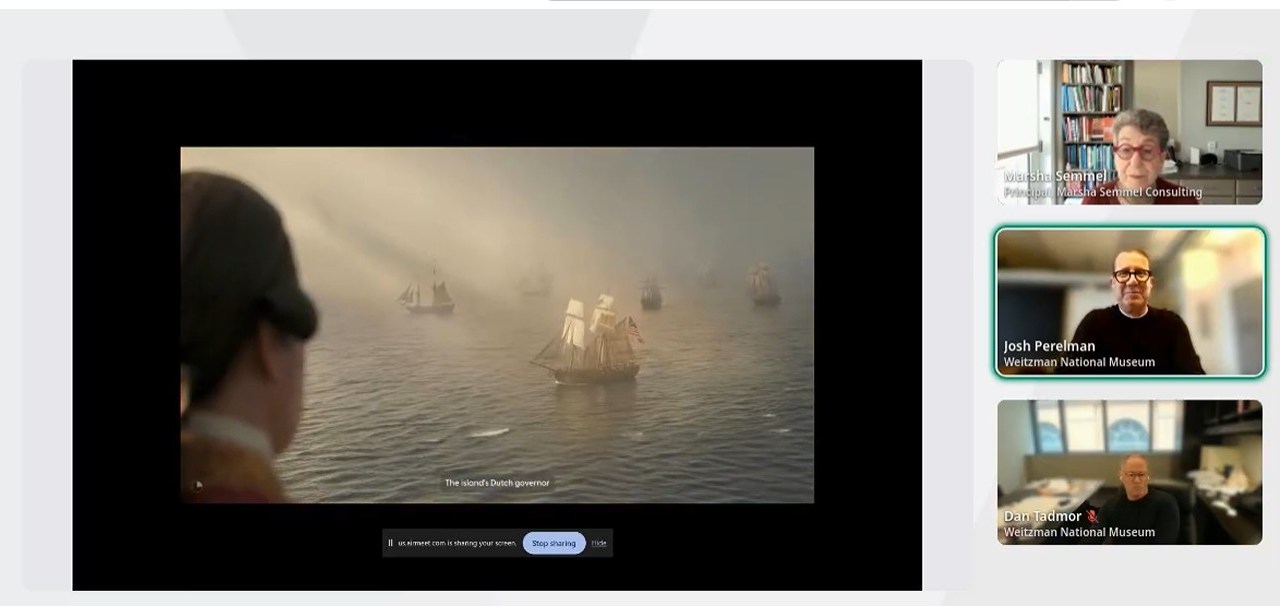
And I will show you on the right, you will see a screen with a woman on it. And I’ll introduce you to her one second. But that is a notable use of technology. And this, which is one of two one of three, excuse me, major films in the exhibition, is a film that captures one of the climactic and pivotal moments in the story we tell. So now I’m gonna show you a brief piece of the introductory film. Because the audio is not there, I may not show the whole thing, but this will give you a sense of some visuals. And I will go in to show you one other thing.
This film is done in an introductory theater. So as soon as you walk into the entrance of the exhibition, and then it’s very large and immersive, both from a physical sense as well as audio. This gives you a little bit of the taste of the visuals of that exhibition and the nature of it. Cannons play a very important role in our exhibition. I’m sorry you can’t hear them. This gives you a sense of individuals.
I’m gonna pause this and move on. Remember the portrait that you saw that was on the screen? Looks like a portrait, it’s framed like a portrait. There were characters in our story and in the case of history, this is no surprise. Women who we very much wanted their stories to be included in the exhibition, but the documentary record, which is to say the material culture of their lives, was few and far between. So this is a woman who came to the small island featured in our exhibition, St. Eustatius, is a widow. From Amsterdam, and we wanted to describe why she came what her circumstances were and what she found on this island of St. Eustatius both in terms of a new life but to be part of a Jewish community in the Caribbean and one central to the experience of the revolution. So let me give you a taste of what happens to her.
As you can see, the begins in what we call corporate mode and transforms into a more lifelike figure. I’ll show you a snippet of the film that you saw people watching. So you can get a taste of that. Nope. Wrong film. Right, film.
You’ll see this, as a flat triptych, on your screens, but as you saw in the image, it’s actually quite a large triptych is part of the exhibition experience.
And this film describes the invasion of St. Eustatius by the British in 178. And what ensued after that invasion, we number one, the admiral who invaded St. Eustatius targeted Saint Eustatius’ Jews first and foremost, and looted their bodies, their property, their cemetery, and greed led him to loot the entire island. And, one of the unknown pieces of our the story we tell is that because Rodney stays on or overstays on St. Eustatius, you absolutely miss his opportunity and the opportunity to do his real job was to intercept the French fleet and prevent it from coming to North America. In this case, the French fleet, he failed to intercept was the French fleet coming to resupply Washington and Yorktown. So this is the fleet that barricaded the Chesapeake, resupplied Washington at Yorktown, and that becomes although it’s not the formal end of the war, that is the last battle of the revolution and the moment where independence is achieved. And as you see, these are Jews standing in line waiting to be imprisoned by Rodney. And the reason, and I will go back will now go to our last film to show you,
Dan Tadmor:
Be before you do that, can I interject here for a second?
Josh Perelman:
Yeah. I’m burying the lead. I understand.
Dan Tadmor:
I don’t know if you’re familiar with me, but I wanted to zoom out I wanted to zoom out a little bit and talk about our approach to technology.
Marsha Semmel:
That would be great.
Dan Tadmor:
And start by saying is that the approach is that technology is an enabler. It’s not an end in itself. And you don’t think that people you don’t expect people to come in because of the technology. You look at technology and what’s available to you and you think, how can it help us tell the story? And I think the films that Josh has, has shown, unfortunately, with no sound, are two very different examples of how technology enables us. The bigger films, and here’s the spoiler, the larger films, the ones with the ship, etcetera, etcetera, they’re all AI.
If you saw them and by the way, the voice isn’t AI, but the but the, the audio is not AI. It’s voice actors, but the but the video is AI. And it doesn’t look it. And, unless we tell people they the only way they can guess it’s AI is when they do the math and they say, wait a minute. I’m looking at a $2,000,000 film, you’re a great museum, but you don’t have $4,000,000, $6,000,000 to invest just in media and a special exhibition. So, it’s gotta be AI. It doesn’t look like AI. And so I’m calling it an enabler because, quite honestly, we would not have been able to create such wonderful films without AI. They would have been animation. They would have been a slideshow. They would have been something else.
But they would not have been a moving four-minute Hollywood film. Okay? The, the life stories, these speaking portraits are a different example of AI as an enabler. When we started working on the exhibition, the first challenge that we talked about was how do we make a story that happened two hundred and fifty years ago in a in a faraway place. How do we personalize it? How do we make people identify with what’s happening? And the way you do that in our profession is through personal stories. That’s not new. That’s that that are the tool of the profession is personal stories. And so we set out to research the lives of real people who had bearing on the story. Most of them either they lived on St. Eustatius or there were there were merchants who traveled to St. Eustatius, etcetera. And they were supposed to be audio stories. They were supposed to be one stations where you put on your headphones and you listen to a story. Quite honestly, we ran out of budget. I mean, this is a very well-produced exhibition. But even this, ultimately ran out of money, ran out of budget. And then at the very last minute, we said, wait a minute.
What would it take to make these audio stories video through AI? And it didn’t take it did not take a lot. It’s not the same production value as the bigger films, and it didn’t take much. I mean, we’re talking 5 figures. High 5 figures, but 5 figures. Now here’s the most surprising thing. As we all know, exhibitions are funny in that until they open, you don’t really know what you’ve got. Right? You know what you’ve prepared, and you know that the various elements are excellent, but the way the whole thing works together on an audience that hasn’t seen it, is that moment of mystery. People actually start coming in. And to our amazement,
Marsha Semmel:
Mhmm. Great.
Dan Tadmor:
what they love the most is these four portraits. They love them. And the second piece of the amazement is that they like the fact that it’s clearly AI. Right? And the reaction is, oh, it’s wonderful that I’m walking into this historical exhibition. But it makes use of cutting-edge technology. It makes use of AI. Nobody thinks that we’re trying to trick them. We’re not. But they actually get a kick out of the fact that it employs cutting edge technology. So that’s the that’s the zoom out of how we arrived at these technological solutions.
Marsha Semmel:
Thanks so much, Dan. I’m really glad that you added that to Josh’s presentation. And, you know, ultimately, it’s you know, we hear a lot right now about awe, about and, you know, people’s emotional connection to something like a story. I know when I heard Josh give another short presentation about the project, he was talking about the fact that, you know, everyone now is talking about the Declaration of Independence and the two hundred fiftieth anniversary And in some ways, Philadelphia is like ground zero for this whole story. But as Josh reminded us, none of the ex-other existing projects in the city are really telling the Jewish a Jewish part of that story and personalizing that incredibly important aspect of our history. With real Jewish stories. And so I find that you know, one, a very incredible and wonderful contribution that the National Museum of American Jewish History is making at this time. And I think it’s great. I wanted to ask you about the reaction. So I think it’s really interesting that you’re getting people who are applauding, looking at history using these new tools.
Dan Tadmor:
I would add one more thing, and that is when we when we prepared ourselves for, certain criticism and pushback. There were several topics that we thought people might ask us about. And we thought that we’d be getting pushback, we might get pushback on the use of AI.
There is, there are some voices mainly speaking to does it take does it take people’s jobs and whatever now. So we so we were we prepared ourselves for questions about this. In this case, the answer is simple. One,
Marsha Semmel:
Mhmm.
Dan Tadmor:
we’re not taking away anybody’s job because we wouldn’t have done these things in in in a real production. You could not have afforded them. So no actor, makeup artist, whatever, lost their job here because we simply this would not have happened. This we would not have done it. But the other thing is we’re also not misleading anybody because had we had the budget for that would have been actors portraying something that haven’t nobody thinks that we’re showing them real people to wanna fifty years ago. Video did not exist then. So but to our,
Marsha Semmel:
Right.
Dan Tadmor:
I would say, relief we nobody’s coming at it from that perspective at all. People are actually happy to be immersed in something that is technologically advanced.
Josh Perelman:
I would add to that,
Marsha Semmel:
Terrific. You know, go ahead, Josh.
Josh Perelman:
would just add to that.
Marsha Semmel:
Thank you.
Josh Perelman:
I think both in the galleries and anecdotally, I’ve heard a lot of number one, I didn’t know AI could do that. And number two, oh my God. Here is a here’s actually a positive application. You know, there is a lot of trepidation about AI in society right now. And I don’t think we set out in any way to make any statement about AI or AI’s efficacy, but I think as we’ve learned through the process and working with, we worked with a media production firm called Lorem Ipsum who are magnificent people based in New York. And as we’ve learned through working with them, you know, there are certain conversations about AI happening in society but in terms of museum environments, AI allowed us to do something emotional of scale visually, you know, visually stimulating that we never would, as Dan has said, we never would have been able to achieve through traditional methods. And there seems to be an appreciation of that
Marsha Semmel:
Yes
Josh Perelman:
from our visitors. And as Dan said, the portraits and just like a little behind the scenes, we went back and forth a lot about whether the portrait should, quote unquote, come to life. And, you know, pro and con on both sides. I have to say now as you as Dan said, those portraits a real attraction, and they are the sleeper. And to walk people as that those milliseconds as the portrait comes alive, everybody’s there’s just this, like, joy. This moment of, like, oh, wow. And then people get a great story. And that’s the that’s the payoff.
Dan Tadmor:
Yeah. There is one film of the seven that are in the gallery that we produced that is not AI.
It was filmed on location in St. Eustatius.
Josh Perelman:
Enterprise Gold.
Dan Tadmor:
And let’s show a clip. Although, again, it has it has music, so you’re gonna see it without new music, which is very significant. But let’s take a look at it.
What you’d be hearing is Leonard Cohen, if it be your will. Performed by these artists in the synagogue. And if you could yeah. Great. Move forward to where the rotoscopy comes in, Josh.
Okay. I think we get the oh, okay. Let’s just wait for this when the synagogue gets painted it’s glorious original color.
Right.
Alright. Thanks, Josh.
Marsha Semmel:
Thanks, Josh.
Dan Tadmor:
So what I what I what I wanna say about this film is that once again, technology is an enabler.
And in the case of this film, technology would have underserved we wanted to do. When you watch this film, it’s evident is that it was filmed on location at St. Eustatius’s it’s real. And there’s meaning in the fact that it’s real. I’m if you’d heard the music, it would have been even more moving. These are real people in the real synagogue. This is the real Jewish cemetery of St. Eustatius. It have been cheaper to do it in AI Of course. But here, there is added effect. People know that we were there. They were we’re bringing them there physically.
The etching that you saw or the enhancement that you saw, it’s not CGI and it’s not AI. It’s called the rotoscopy. It’s a very old technique of etching on film. So even that, we chose a technique, an artistic technique that’s old school. That’s low-tech, not high-tech.
Because we felt that this is the best way of bringing out the story that we wanted to tell. So it’s not always about technology. You’ve gotta pick and choose. You’ve gotta be very selective about where you employ it and where you don’t.
Marsha Semmel:
Yeah.
Dan Tadmor:
The most moving object in in the ex yeah. Go ahead, Marsha.
Marsha Semmel:
Well, I’m I was just gonna ask you a little bit. I wanna make sure that we talk about Colors of Creation. But I think one of the things I’m sure is on some of the people’s minds are not only your point about the right technology for the right ideas and the right presentation. Who were how did you find the right technology partners to work with you on all of this stuff because, you know, I’m sure that you don’t want something you there are a lot of people out there selling their wares, especially technology and design and experiences. What are the things you look for in finding those partners? And maybe then, you, Dan, you could sidle in a little bit to the, colors of creation project. If that works for you.
Dan Tadmor:
Sure. So I’ll say something brief, and then Josh will talk more at length because he actually brought in those partners. What you’re looking for is a soul.
Marsha Semmel:
Good.
Dan Tadmor:
That’s what you’re looking for. You’re looking for people with a soul. People with a creative soul, maybe with a Jewish soul, people with that will bring their heart and soul into the project. Josh, you can say more.
Josh Perelman:
Honestly, like, I think that is exactly the answer. There are plenty there are a lot of people out there
Marsha Semmel:
Mhmm.
Josh Perelman:
with technical skill. No doubt about that. People who are very good at doing these kinds of installations. What’s unique, and I think both projects that that we’re showcasing share this because we found people who work with us, who find personal meaning in the project itself. And so they are invested not just from a professional standpoint, but they’re invested because it touches them either intellectually, emotionally, or both. And that’s what brings the best, I think, out of all of us in the projects we do when we are personally invested.
Dan Tadmor:
They have a name.
Josh Perelman:
Yeah. I said it earlier and I’m gonna say it again. The AI was done by firm called Lorem Ipsum. And I was saying people who involved in exhibitions will know this well. I’ve known Abby from Lorem Ipsum for a number of years. And I’ve wanted to work with them for a number of years. And in the world of exhibitions, you know, you interview someone for one project, it doesn’t happen, you know, you keep talking to them over the years. And then the right project happens where everybody is the right, you know, it’s the right place, the right time and the right people and we’re very lucky that for this project, Lorem Ipsum ended up being absolutely the best partner we could have had.
Dan Tadmor:
They actually, we actually started with another firm. And that firm who shall not be named was so transactional and soulless that we simply said, you know, guys, take what you’ve earned for your first conceptual interpretive whatever, and go away. We don’t wanna work with you.
And then we hired Lorem Ipsum.
Marsha Semmel:
I think that’s so important, you know, to find that that right person and to be in sync with them so that you’re you can be experimenting. You can try to figure out again right what is the right format and medium. For the ideas that you’re looking at. How long is the exhibit going to be up? The, First Salute?
Josh Perelman:
2027. So about a year.
Marsha Semmel:
Great. So will you be maintaining the technology, or do you still have ongoing relationships with some of the people that you’ve worked with?
Dan Tadmor:
Yeah.
Yeah. They nobody has disappeared. And there are service agreements with everybody. One of the challenges of technology is what happens fine the day after you open. And so what happens is, a certain, a service agreement that maintains a high level of continuity. If there are malfunctions and there always are, if there are glitches, there always are, but they’re addressed quickly, etcetera. It’s one thing you need to know about technology. It doesn’t end. And in fact, at some point, it begins to deteriorate.
So what you pour into it at some point look looks like an avalanche. That’s one of the drawbacks of technology.
Josh Perelman:
I think so. And I think you know, picking on what Dan said,
Marsha Semmel:
Yeah. I I’m involved with oh, I’m sorry, Josh. Please go.
Josh Perelman:
is just gonna say picking up what Dan said. From a strategic standpoint. You know, when you enter into a project, and you know you’re gonna be bringing a significant amount of technology into it or new technology, or anything like that. Part of the planning process has to be what happens after opening day. You don’t just budget for getting it getting to opening day, you budget because
Marsha Semmel:
That’s right.
Josh Perelman:
you know, like anybody, you know, here’s my, you know, here’s my Like, here’s my iPhone anybody who has any technology in their lives you know, there are days when it just doesn’t wanna work. And that’s why you maintain the relationship so that as a public institution, you can look your best. Certainly, you wanna do it all the time, but at least as much time as possible.
You wanna talk, Dan, maybe just give people a taste a little bit of something that gonna take technology a whole step further.
Dan Tadmor:
Yeah. So, on July 4, we’re opening the family gallery or children’s exhibition. It’s called Colors of Creation.
Which as I said takes you very loosely through the days of creation. Day one is pitch black with rays of light, and then day two, the skies and the seas are introduced, and the colors of, the various shades of blue. And then day three, four, five, etcetera, day seven is quiet.
And all of this through emphasis on color, and on interaction. The, the space has two subspaces. One of them is a is a is a is an immersive space, in which everything
Josh Perelman:
I’m showing the floor plan, Dan, on the screen.
Dan Tadmor:
right, so at the center, marked purple is the immersive space.
Where whatever you do, every gesture, every everywhere you walk, everything interacts. When the seas are introduced and they’re fish, you can move schools of fish. When the trees are introduced, you can make the trees, make the trees grow and leaves fall, etcetera. So it’s very interactive. Some of us have been inside these kind of, spaces. But here, there is a definite sequence. It’s a twenty-nine-minute show. So approximately four minutes per day in which you do different things that are associated with that day. And their underlying message is of sustainability, stewardship of the planet, let’s take care of this gift that we’ve been given.
Etcetera. The other half of the exhibition the complete opposite. Is it’s what can we do with color that is tactile, low tech, analog? So there’s a whole we call it the lab. There’s a whole workshop of stuff that you can do around the theme of colors. All in all, we’re talking over 6,000 square feet, The immersive space is about 3,000. And that opens in under two months.
Marsha Semmel:
Wow.
Dan Tadmor:
Yeah. Here, you see some of the stuff that you’ll be able to manipulate with your gestures.
Read your bible again. You will not see dinosaurs, but I said very loosely follows the story of creation.
Josh Perelman:
I’ll tell you here. This is this is a little inside view, this is a very early prototype. This is working with; you can see another example. I, Dan, can talk about how we got there that’s Ariel Efron, who some of you may know because he is a veteran of both local projects and Gallagher Associates and now is part of a new collective called Phelps. And working with Phelps, like I said, this was an early prototype just to see about look into human interaction with some of the elements of the exhibition.
Marsha Semmel:
Fantastic. This is July 4. Did you say this is opening?
Josh Perelman:
As a yeah.
Dan Tadmor:
Yep.
Josh Perelman:
I will say, you know, as I’ve described it, I
Marsha Semmel:
That’s fantastic. You know, I wonder, Dan, when you arrived as part of rethinking the museum,
Josh Perelman:
There is
Marsha Semmel:
was the family audience, like, high on your list? It was of something that needed to be prioritized.
Dan Tadmor:
Yeah. I took a page out of the playbook that we had at Anu. Anu opened in two phases. Phase one in 2016 and phase two in 2021. And phase one included a kid’s gallery called Heroes. That was very successful from day one. So yes, I plagiarized myself.
I guess if it’s if you steal from yourself, it’s not plagiarism. But, yes, that was the that that was aa plan that I that I that I came with. Exactly how it will be executed, you know, Josh and I and then Ariel and whatever. That it the whole process that we know and love so well But, yes, it was clear that we wanted to make this a destination for kids and families.
Marsha Semmel:
Yeah.
Josh Perelman:
There is for those people who know Philadelphia, there is no real destination like this for families in the historic district. There are other museums, of course, which you can go to. There is the Liberty Bell, there’s Independence Hall. But there’s less of an opportunity for families both to dwell and play and learn together. And this installation number one, from a technology standpoint, there’s nothing like it in Philadelphia. Like, the immersiveness, the vividness, the sense of place and being, the awe, will all be very new, but
You know, understanding that all sorts of people need different types of experiences People learn very different ways. Having both the immersive and the hands on gives families a real opportunity to say, participate and enjoy and experience together. And should we be so lucky to see the rest of the museum?
Marsha Semmel:
It’s very, very exciting because at this point, you’re move you’re gonna then move on from this. Right, to redo a new court exhibition. So, you’ve signed on. I hope I hope you’re very happy where you are, Dan. And it’s clear that you and Josh are a real dynamo as a team. And it’s exciting because these stories are really, really important. And as you both pointed out, the emotional dimension of connection with real stories, real people, and some, you know, fun and awesome experiences, I think is what it’s gonna be what it’s gonna be about. You know, and I’m hoping that a number of people on this webinar will be in Philadelphia this coming week. And we’ll stop in and see the museum.
I wonder, as you’re thinking about the museum, and we’ve talked about what’s on-site at the museum. Are there other ways you’re thinking of digital tools and technology outside the museum? Are there things that you have rethought or you’re in a rethinking frame of mind about ways in which to get the stories and experiences of the museum out to a broader world, especially since you’re a national museum.
Dan Tadmor:
Yeah. That’s a very good question. Thank you. So because we’re a national museum, the other two areas of activity that any good museum has, which is educational programming and public programming, at the Weitzman, we’re doing them with an eye towards a national audience. So our educational programs are administered are administered throughout the country.
Obviously, our public programming is livestreamed, so you can enjoy it from you know, wherever you are. That’s one way in which a museum transmits its content on a national scale. Another theoretically could be virtual tours, etcetera.
I’m not a huge fan of virtual tours; I’m a great believer in the immersive experience and it is such a downgrade to experience a museum remotely is that, I guess, my instinct is not to bother. Josh doesn’t fully agree with me. It’s fine. We don’t agree on everything.
Marsha Semmel:
Mhmm.
Dan Tadmor:
That’s okay. I can imagine, for instance, we didn’t talk about the third exhibition that we opened this year. Which is not technologically advanced. It consists of testimonies of victims of contemporary antisemitism.
Marsha Semmel:
Yeah. Mhmm.
Dan Tadmor:
It’s a media exhibition. A media travels very easily. So I can imagine for instance that that exhibition can either travel as files and be open simultaneously in a lot of places or just allow people to tap in from wherever they are and enjoy it. But something like what we’ve showed you now with Colors of Creation, but also the first salute.
We tried to with the first salute, we tried to make it immersive. We invested a lot of energy and creativity in making it a capsule. And I don’t know that a remote experience can give you even, a semblance of that.
So, the other thing I wanted to say about technology though two important things. One, it isn’t it is it’s again; it’s just a means, it’s not an end. When we looked for a theme, for the kids exhibition, we were looking for a biblical theme. Because on the one hand, it has to be tied in with the fact that we’re a Jewish museum. On the other hand, we wanted it to appeal as widely as possible. Well, one very good example of somebody who does that well is Noah’s Ark at the Skirball in LA. That is an evergreen that’s been up for, I don’t know, fifteen years, maybe even more. And it’s as effective today as it was when it opened. It’s just it’s a very, very good kids’ exhibition, which is low tech. Right?
So the fact that we chose cool.
Marsha Semmel:
They just updated it, in fact.
Dan Tadmor:
I wasn’t aware. But I’m a big fan. And so the fact that we chose to go in the route of technology doesn’t mean that it is the only route.
The other thing that I wanted to say is that technology one of the criticisms is it’ll age so quickly, what you do today will be obsolete. So my experience is not so fast.
There are things that we opened at Anu ten years ago and are still very effective. It was cutting edge technology then. It’s no longer cutting edge maybe, but it still works. It’s effective, and people still enjoy it. So technology doesn’t age as quickly as we suspected it would.
Marsha Semmel:
Yeah. You know, it’s interesting. I’m have been involved with Planet Word, museum about language here in DC that’s largely a digital a set of digital experiences. And we’ve been open five years, and you’re absolutely right. Some of the experiences have needed updating, and some of them so far are really evergreen and have become the kinds of exhibits that people tell their friends about. They wanna come and see them.
Josh Perelman:
Most right.
Marsha Semmel:
So it looks like we have about ten more minutes. Cecelia or Greg, are there any questions that have come up? That we can
Josh Perelman:
Marsha, I’m gonna say one thing. Actually, two things.
Marsha Semmel:
address?
Josh Perelman:
Marc, I’m gonna say two things. I know you can’t hear me.
Marsha Semmel:
Okay, Josh. Please
Josh Perelman:
To piggyback on Dan,
Marsha Semmel:
Thanks, Josh.
Josh Perelman:
two things. Number one, for those of us who’ve done those of us who’ve done exhibitions, People love a button. I mean, people ask, like, some people ask how do you start the portraits? You start them by pushing a button. You can put a whole wall of buttons in an exhibition, the most low tech interactive ever, and people will go push every single one. So i think Dan’s right. There’s it’s not about the tech itself. It’s about the meaning the tech brings to the experience.
And number two, I think the museum are in a real transitional space in terms of kind of quote unquote virtual and long-distance pro you know, you know, programming and offerings and learning, etcetera. And I think that’ll be one of the fun things about as we move into phase two and plan the new core exhibition there’s a longer process and there’s a process we can really think through how does this have an expression inside the walls and outside the walls, even if that is not the same thing?
Marsha Semmel:
Yeah. Yeah. Thanks so much. I and, thanks to both you, Josh, and Dan, for enabling me to participate.
Josh Perelman:
Greg, we can’t hear you.
Marsha Semmel:
I’ve been having some technical difficulties myself. And if I’ve interrupted you in inappropriate moments, they weren’t intentional. It’s been really, really interesting to hear about your vision and the process and, you know, all of the very specific issues that you were able to share with us and address as well as the previews of these of these new experiences. Greg, are there any questions out there that people are raising
Greg Stevens:
Well, the yeah. Thank you, Marsha. And Josh and Dan, thank you so much. A couple of comments came in, and I had a question for you, Josh. And Dan, when you were talking about virtual tours or virtual exhibitions and not being the same, of course. And I’m wondering, do any of the interactives, any of the AI or any of the filmic experiences would they stand on their own outside of the exhibition?
Josh Perelman:
A 100%. And the education department is working Again; it’s not a virtual tour as in there are virtual tours on our website. Like, you can virtually go through current and past exhibitions. What they’re working on is what I would call more virtual experience. Whereby the films can be embedded in that experience and you’re experiencing them obviously from a distance instead of in the visceral space. But they enhance a learning experience that we might do. You know, in Wisconsin or California. And so they serve a different role in that. But they serve an important role.
Greg Stevens:
Nice. Thank you. And I was, as I was listening to you all describing your work, a couple of things really struck me. You had me at what you described as the soul and the heart the partners that you worked with to create this technology that really struck me. And that you acknowledge that the first firm that you worked with was very transactional. And you decided to part ways. So I think that’s a pretty key message, and I just wanted to re, reiterate that.
And then the other thing, of course, and we all know this for all museum colleagues. It’s about storytelling and the stories that you have captured and chosen to tell. What about the stories that you’ve chosen not to tell or haven’t told yet? Why these stories? Now?
Dan Tadmor:
I think, specifically, the First Salute why not is pretty easy to answer. We are on the cusp of the Semiquincentennial on Independence mall. And we’re here for a reason. And so it would have been a disgrace if we didn’t have something to say, for America’s 250.
The specific story we were fortunate to have a story that is both dramatic and relatively unknown.
To so you know, we joke internally that it should be called the First Salute, who knew. Because that is the common reaction that we get from people about the story. Going forward, when we start thinking about the new core exhibition, there’ll be some serious deliberating on what is what are the stories, what are the core stories. When do we begin? Does the, the National Museum of American Jewish History does it begin in the year 1654 when the first 23 Jews arrived in New Amsterdam, or does it begin earlier because people need to know where Jews came from?
Okay?
So chronology we’ll be we’ll be debating chronology we will be debating themes. What are the themes that we need to address? Jewish values, Jewish excellence and contribution. So gonna be some serious, some serious conversation.
But whatever we do, we will employ the technique of storytelling. Quite honestly, it’s be because that’s how we’re all hardwired. The human mind prefers to receive information and retain it when it’s in the form of the story. And so whatever we do, there’ll be a lot of storytelling.
Greg Stevens:
Thank you. One quick question since you’re talking about chronology Dan, and difficult stories. We had a question that came in earlier. How do you address enslavement of Africans in your exhibit?
Dan Tadmor:
First of all, we address it.
There is a section in the exhibition that talks about the fact that, for every European on the island of St. Eustatius, there were enslaved Africans.
And the Jews of St. Eustatius no more probably less than others, owned slaves. I’m saying less than others because Jews were merchants and not, farmers. They didn’t do agriculture. Which is the prime employment of enslaved, persons.
But, yes, Jews owned slaves. And so we absolutely acknowledge this and it plays a part the exhibition.
When we opened, on opening day, there was a delegation from St. Eustatius’s here, that participated in the opening ceremony. And it was led by the governor of St. Eustatius Alida Francis, St. Eustatius is still a Dutch territory, but it’s locally governed. And Governor Francis spoke very eloquently about the first salute being part of the now, St. Eustatius now has about 3,400 people all descendants of enslaved people.
Right? There are hardly any, Europeans on the island. But they take very seriously two things. One, their role in American history in the first salute, and they take very seriously their role as custodians of the Jewish heritage on the island.
Josh has been there twice. It’s very evident. That the way that they view it is a relationship of stewardship and being custodians of the story. So the short answer is yes. That element plays a part in the exhibition. We’re very open about it.
Greg Stevens:
Thank you so much. And, John, I wonder if you might type into that chat box the name of the song that is played in that video about, I don’t know, the same Eustace’s and I think we probably have time for one more question.
And that is, was AI used to create the Colors of Creation videos as well?
Dan Tadmor:
Yeah. It is it is all AI induced.
That that there is nothing that is photography.
It’s all computer generated.
Josh Perelman:
Like, it it’s a yes and I think of this as also true with lesser extent than the First Salute because they really were AI driven. You know Felt is a is a digital production firm. They do a lot of different kinds of digital media. And the Colors of Creation is certainly AI driven. But there’s artistry to it as well. Right? There is there is hands on animation There is touch of an artist to those films even if they are generated and expressed using certain AI environments.
Greg Stevens:
Great. Thank you so much, Marsha, anything that you would like to close with? We’re, just about the end of our time together.
Marsha Semmel:
No, I just want to give my profound to both Josh and Dan for the generous time you’ve just given to us and for you know your candor in discussing all of those different dimensions of this complicated project. It’s, I think it’s really on the forefront it seems to me you’re really there on the frontier especially in terms of the Jewish museums that I know. We’re really grateful for your time. And I hope lots of people come to see the First Salute once they get to Philly in the next few weeks.
Greg Stevens:
Great. And speaking of Philly, Marsha, you and I will see each other…
Dan Tadmor:
Yeah. So let me use this. Yeah.
Greg Stevens:
next week. But, hopefully, some of you all will join us for our next session in this series that is sponsored by the Bergh Foundation. Once again, Josh and Dan, thank you so much for sharing your experience. And as one of our colleagues pointed out, stimulate me with soul. So thank you. Thank you so much.
Marsha Semmel:
Thanks so much, everybody. Thank you, Greg and Cecelia as well.
Dan Tadmor:
Thank you.
Josh Perelman:
Thank you all. Take care.

Upcoming Events
-
AAM Member Week
Event Date:Presented by: American Alliance of Museums -
AASLH History Hour: Is This Place Haunted?
Event Date:Presented by: American Association for State and Local History (AASLH) -
Disaster Preparedness for History Organizations
Event Date:Presented by: American Association for State and Local History (AASLH) -
From Informational Interview to Real Connection
Event Date:Presented by: American Alliance of Museums and National Emerging Museum Professionals Network