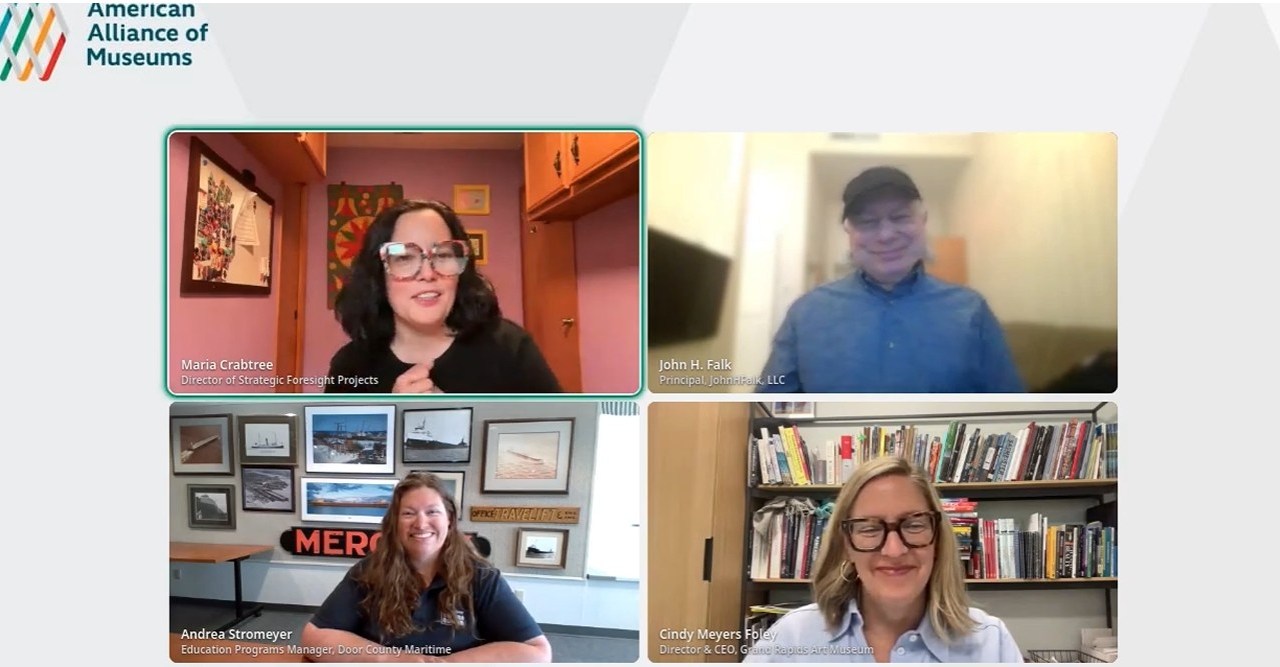
As education systems face unprecedented disruption, from climate challenges, AI developments, and social fragmentation, museums stand at a critical intersection of learning, community, and cultural stewardship. This panel will explore how museums could navigate and shape the futures of education outlined in Charting a New Course for Education, KnowledgeWorks’ most recent forecast. Drawing from KnowledgeWorks 20 years of strategic foresight research and their latest forecast, panelists from across the museum field will reflect on how their institutions are grappling with the drivers of change impacting education over the next decade: Integrating with AI, Everyday Disruptions, Eroding Public Institutions and The Relevance Gap, and what they might mean for the context of museums today.
Transcript
Ariel Waldman
Hello everyone, and welcome. Thank you for joining us for Charting a New Course for Education: Museum Edition KnowledgeWorks. I’m Ariel Waldman with AAM, and as we get started, feel free to let us know where you’re joining from in the chat. Today’s program is a panel discussion exploring how museums can navigate and shape the futures of education as outlined in Charting a New Course for Education, which is KnowledgeWorks’ most recent forecast. Our panelists will be discussing some of the drivers of change impacting education over the next decade: integrating with AI, everyday disruptions, eroding public institutions, and the relevance gap, and what they might mean for museums. You’re welcome to drop questions in the Q&A tab on the right as we go. There will be time to answer some of these at the end. We are recording this for registrants and members to access in the coming days. With that, I’ll turn the stage over to Maria Crabtree, who is the Director of Foresight- Strategic Foresight Projects at KnowledgeWorks.
Maria Crabtree
Hello everyone, thank you for joining us today. We are really excited about this conversation, and I’m just going to take these initial few minutes to give you a little bit of an overview about our forecast, and then we’re going to jump right into the conversation with our amazing panelists.
So with that, without more to add, I’ll jump in. So KnowledgeWorks, just a little bit of a background there, it’s a national education nonprofit based out of Cincinnati, Ohio. That has been working for over twenty years in education transformation. And so part of what we do is that we look into the future of learning and provide those insights to the broader kind of learning ecosystem. Totally available on our website for free. So they can strategically plan for the future a little better, and then in that way serve students and communities better.
And then, as Ariel mentioned, recently, we published our most recent forecast called Charting a New Course for Education. And if you go to the links available for this session, you’re going to find there the link and the resource. But for this forecast, we were really focused on exploring a little bit of what’s going on now. So in that sense, we felt like that we needed to address why today feels different from the past. And look around before we could really, like, go further. Or look ahead. So just to mention and acknowledge the context in which we are all very much like living today and how that’s impacting our forecast of the future. So the current context, we tried to summarize in three major forces we’re seeing present around us are very much already happening, going on, there’s a lot of change, and even some uncertainty in not knowing how these three aspects are going to unfold. So, one is climate crisis, for a couple of decades now we understand a little bit more and more how it impacts different communities, different latitudes, and geographies, and understanding a little bit more the expansiveness of these impacts. And how they might impact communities disproportionately, so there’s also the aspect about environmental justice, but also, something related to the eco anxiety that it might be creating in specific groups. So it is a really complex and wide kind of force, and that’s one of the reasons why we brought it into this conversation.
Second, artificial intelligence. It’s all that you can hear about. It’s everywhere. It’s already here. Yes, people are interacting with it, specifically, generative artificial intelligence. And so we wanted, again, just go ahead and acknowledge it. Yes. Mention it as an important force. But put it in the same kind of equal footing as climate crisis and the social fragmentation. So we can have, like, a more complete picture of what’s going on and not focus solely on the tech chain, to this, like, tech aspect that’s so dominant right now. And, yes, part of that conversation is also kind of like the backlash of it all that we are also starting to see more and more in the headlines. In reports and in research. So and we’ll mention it again because it is something that’s happening, but it also has very much of a future. So that’s where kind of, like, the next mention of artificial intelligence will be about.
And last, social fragmentation, not only from the political perspective, but even in how like markets have been segmenting society into more and more, like, niche markets. And so we’ve seen, you know, how each of us gets, like, personalized Google results and personalized recommendations for what to watch and what to read, what news are relevant to us, and all of this is creating this, yes, very personalized experience of life itself. So we are a little bit losing on those, like, common experiences that used to bring people together. So we need to be a little bit more intentional about, like, where we can find a common ground. Going forward.
So part of what we do when we, work on the research for forecast is that we focus on drivers of change. Which are kind of clusters of trends, plans, projections, forces of change that we organize in different buckets just to try to make sense of them and offer them to you, so you have an easier way to look forward without feeling too overwhelmed about, like, well, you know, if I open this, like, Pandora’s box of the future, then, like, lots of things could happen. And so in this way, we want to help you by, like, narrowing and recommending these, like, four areas, four drivers of change for you to, like, pay attention to.
And let’s start with integrating with AI. I promised artificial intelligence would be here again, and this is what I was referring to. But in this part, since we’re not looking around anymore, we’re looking ahead, we made the decision of focusing on what we’ve called “Next Generation Artificial Intelligence”. And this could be yes, general artificial intelligence, but also effective artificial intelligence, which we are starting to see in more like a nascent stage. But, in which it’s really trying to emulate and connect with humans into more of the, like, thinking and feeling. And then as a result, what we are anticipating kind of over the next ten years is that it’s really going to challenge our own understanding of what makes us human, what kind of, like, skills and development, opportunities we see for us as humans. How we interact with each other and with the technology, as well as kind of reevaluating some of our teaching and assessment approaches. More directly related to teaching and learning. Now for the next one, we’ve called it “Everyday Disruptions” because we were trying to encompass small and large scales, kind of like these things that it just feels like even when there’s a lot of change happening that this rate of change, how interconnected, how overlapping these disruptions are, are really becoming so hard to even, like, take a moment to, like, fully digest them. That then are changing how we need to prepare for these disruptions, how we need to see ourselves reacting to these disruptions. Especially as we are trying to be, like, more proactive. And so, what that means is that education providers would need to be more adept at, like, exploring more diverse types of disruptions into their everyday operations and also, like, not disregard those that might feel a little bit more like a rock on your shoe that it’s just like, well, it’s a little bit. It’s probably fine. Fine. Fine. Until, you know, if it happens long enough, then it can become, like, a true disruption. So that’s kind of like a way to keep it in mind. And then in looking forward, a way to respond might just, like, not be enough to, like, look for best practices. But more for adaptive strategies or a new way to really lead in the time where there’s so much change and so the so much of the disruptive change.
Next, we have eroding public institutions and this goes kind of like in a broader public institution, not necessarily only for public education as it relates to teaching and learning. But we’ve seen numbers in declining confidence in the economic constraints, and that is not really, like, something that has happened overnight. But it’s this kind of, like, intentional effort over decades, really. That as maybe the market has expanded and there’s more competition, then the role of what we have considered public goods gets diminished. And so over time then, it creates this erosion in public institutions at large. Over the next ten years, for public education, we can see how then this is going to challenge the relationships that public offerings would have in serving their learners and their communities. And where trust is going to be a critical area of focus.
And then the last one, it’s the relevance gap. It might be the one that you might find more relevant. And it’s really touching on how young people are feeling very disconnected of what’s happening in school. Because what they’re learning in school it’s not really reflected in their lives. And it’s not reflected in their lives because there’s so much change, there’s so much disruption happening, and they’re trying to grapple, and again what they’re, like, experiencing and learning about in school, it’s just, like, not there, not at the same level. So education providers are going to need to kind of reconciliate this gap that exists and try to find ways to integrate a little bit more of what those interests and emerging needs are, and in doing so, being a little bit more responsive to what that can look like.
Now another important section of the forecast, and I won’t go into as much detail on this one, it’s, what we call provocations, which are these really fascinating, just like glimpses of the future. So it’s almost like playing, like, a what if game. It’s like, what if this happens? What if this, you know, changes in this way? What if public education looks this other way? What if museums do this? What if? And so in doing that, what we are hoping is that readers can get a really broad idea of the different possibilities for the future. And that then they can pull from them, the ones that they might feel a little bit more relevant. So to organize them, we created provocation areas. And so we have learned experiences and environments. We touch on AI driven personalization, climate-resilient school design, and alternative assessments, and how that all kind of, like, reshapes how and where learning happens. But we also have one on providers and structures as you heard me before, I was talking about competition and markets. And how that can be something that we are going to see more and more in the future of education. And so that then presents, like, different challenges that can look in very different ways. So what if we have more modular public education or one that is maybe offering fluid options? So you can, like, jump in and out of public and private and museums and nonprofits all at once. Or, you know, more critically, maybe, like, what does, like, a minimally funded education look like? And if we get there, then, like, how can we seize the opportunity to, like, try different things or really be in a position to think about this proactively. And then lastly, governance and administration. So exploring what if, you know, we would be able to share power with our constituents or if then maybe that authority is actually not that clear, so it’s maybe causing more trouble than what we thought. Or in as we’re seeing AI being integrated in decision making. They’re like, how could that look like? In how schools and other learning offerings incorporated in their governance and administration.
And, lastly, the forecast closed with six strategic considerations that are, really, like you know, if you want to take something back into your conversations as you’re looking ahead as you’re, like, working on your strategic plan. Maybe these are the six things that we would ask you to consider. So, positioning public education in an emerging marketplace, thinking a little bit more about, like, how that, private education market is emerging and it’s projected to reach $200 billion in the next ten years. And what that’s going to mean for public education, but really for, like, the expansive options of education providers. And then we also have number two, which is facilitating informed choice. So, like, yes, there are going to be all these offerings, but now how do people even choose? And we’ve all been there in that we’ve asked for more choices. But then when there’s too many, we also complain of having too many choices. And not only that, but, like, when you are making decisions regarding teaching and learning, it’s often something that’s kind of like a lifelong decision. Right? It’s like, you’re maybe committing to a pathway. Or you might feel like, you know, once you’ve invested this much in this learning experience then it might not be worth, like, changing majors, changing areas of concentration. So it it it could be a really, important area to spend, like, a lot of time. Also, because, for those decisions then it would be probably on parents and caregivers to make those decisions for their children. So there’s all this, like, choice of kind of more the considerations that that you would need to, like, suss out. With number three, then again, with considering that there’s an emerging economy around education and that then there’s going to be a lot of options, then what about equity and access? How do we ensure that even when there is market that is governed by capitalist principles that we are still making sure that it is providing the opportunities and access that every student needs and would benefit from. Number four, cultivate a network of networks. This also it’s touching a little bit on, like, how to, a possible way forward in, like, navigating disruptions and remaining kind of flexible adaptive, it’s been built in these partnerships. Also, a way to respond to the erosion of trust would be to, like, really focus on cultivating networks and networks of networks just because then there’s an argument to kind of maximize resources as we coordinate more and more what we can do together and, like, finding that there might be more than we have in common than not. Number five, the central developmental impacts. It’s always remembering our audience in that, especially in working with, like, young people, while they might be amazing people, they are also going through a very specific time in their developmental life. Biologically, mentally, emotionally. And so everything that they’re experiencing, they’re also experiencing at the same time. So there’s kind of like this- often as adults and I include myself in there. Right? It’s like, you feel like or you forget that how that experience kind of shaped you and how maybe the things around you that you’re experiencing and how you’re dealing with, like, what you’re reading in the headlines and all that, Okay. Like, now add to that, like, all the hormonal changes, for example. And just to make something. Right? So, like, when we talk about artificial intelligence, for example, and more specifically effective ones. It’s not the same to talk about having a therapist- an AI therapist for an adult than having an AI therapist for a young person. So that’s the kind of, like, considerations that we need to keep in mind as we are making decisions about the future. And lastly, number six, they are develop new skills and adaptive strategy. This is, again, kind of building on, like, maybe what we’ve done it’s not going to prove as useful as it has been. So we need to start maybe, like, pushing things a little bit, figure out what are those new skills that we need learn. Learn a little bit more about how to respond from an adaptive strategy. Versus, like, having something written down and just, like, sticking to it.
And truly, the last kind of message from the forecast is that yes, we are experiencing very challenging times. But the challenge is the opportunity. So now is the time to build a future where education is a powerful inclusive force for good. Like, the fact that so much feels kind of, like, up in the air it also, means that it’s the opportunity to take those things that fill up in the air and do something different with them. So, that is our invitation to really engage with it and not kind of let go and shy away from it because it is a very critical time. So, I hope that that has been a brief enough overview of the forecast. And at this point, I would love to invite to the stage my panelists. So we have John Falk, Andrea Stromeyer, and Cindy Foley joining us today. Thank you so much. And, to get us started, so first, I’m going to ask you a question in which I think you can also use to introduce a little bit of yourselves the organizations that are you’re working with right now and all that. So, I know you’ve all had the chance to read the forecast and I was wondering what did you find more useful provocative, insightful, and how did you see that it kind of related back to your role, your practice, your organization? Let’s start.
Cindy Meyers Foley
I can start.
Maria Crabtree
Awesome. Thank you.
Cindy Meyers Foley
Hi, everyone. My name is Cindy Foley, and I’m the Executive Director and CEO of the Grand Rapids Art Museum. We’re a midsize Midwest museum that focuses primarily on the folks who live and work in West Michigan. I think, you know, the KnowledgeWorks forecast has a lot for museums to chew on. For me, it’s the relevance gap, which you’ve already alluded to. It’s a key moment for us to just take an account that we’ve been talking about this for almost twenty years and now we’ve hit the point that John Falk was, like, you know, screaming about twenty years ago, but we’re here now. And the relevance gap isn’t just something we’re concerned about. It is here, and it is actually a crisis. And so I think right now the question is how are museums- how are we going to lean into this crisis moment? And how do we use the strategic forecast to help us not only think about what’s coming but actually address the needs that are here now? I’ll hand it to you, John.
John H. Falk
Okay. Well, I’ll take that. Thank you so much, Cindy. Yeah. So I’m John Falk and I’m an independent these days. I’m based in Oregon. Though I give you greetings, I’m at the moment in Warsaw, Poland attending and speaking at the annual meeting of the Association of European Jewish Museums, who are feeling definitely in crisis these days.
As for the report, I was struck by the opening paragraph. Having and I quote, “having functional educational systems requires, among other things, a stable social, economic, legal, and political order that values and protects their existence. It also requires a skilled workforce, comprehensible and controllable technology, enough energy and water and hospitable climate, and none of these conditions is guaranteed over the next decade. In some cases, they are actively being undermined.” And, yeah, welcome to our world. And we as outlined in the report, we do face an array of challenges including environmental, economic, and disruptive nature. And I wholeheartedly concur with the four key drivers highlighted by the KnowledgeWorks forecast: integrating with AI, everyday disruptions, eroding public institutions, and relevance gaps. And I think they equally apply to the future work of museums. I will say, although in my work with museums of late, there’s a lot of conversation and angst around AI, the first of these, but I agree with Cindy that, personally, it’s the last of these four, the relevance gap, that is ultimately the most perilous for museums. And, ironically, I think much of that relevance gap is self-inflicted. It’s a case of museums’ inability to embrace the actual value that they create for the public. Which I have suggested is rather than seeing themselves as in their historical role, as repositories of knowledge and collections of stuff, basically about information. These days, we have no shortage of information. Information is at everyone’s disposal. But what we lack is the value that museums can uniquely create or not uniquely, but specifically create the being awe inspiring spaces, safe and secure, places that allow people to enhance their personal, intellectual, social, and physical well-being, and that in other words, unlike schools, the museums, the goal of museums should be to support learning, not primarily for education, in other words, as we decide what the goals are that people need to know, but primarily as places for people to freely choose how they want to learn to advance their own personal growth, well-being, and health. And, I know we’ll have an opportunity later to talk about some of these challenges and how we can distinguish ourselves from schools and other formal education institutions, but I’ll stop there.
Maria Crabtree
Thank you, John. Andrea, would you like to introduce yourself?
Andrea Stromeyer
Good afternoon. Yeah. Sorry. Yes, Maria. Good afternoon. I’m Andrea Stromeyer. I am the first ever Education Programs Manager at our very small museum, mall museums represent woo hoo, the Door County Maritime Museum. I’m up on the Door Peninsula in a tiny little town of right around 10,000 folks in Sturgeon Bay, Wisconsin. And I have to say, the thing that I really really resonated the most with the forecast and I totally agree with what John and Cindy have said the relevance gap is definitely a thing that, you know, museums in general need to be aware of and focus on. But I have to tell you, for the everyday folks, that visit the museum and engage in my education programs, it’s everyday disruptions. Sturgeon Bay has a lot of families that fall into the ALICE category, A-L-I-C-E, which stands for asset limited, income constrained, employed. And these families are able to make ends meet but only just. So, one small problem: one flat tire, one kid out of school sick is going to be enough to topple their household economics for the month. And living in a community as small as mine, I need to be able to respond very quickly to those everyday disruptions and to those pressures that both the families of the students coming in experience every day. So, I would say that every day disruptions is definitely the one that resonated the absolute most with me in our little community because when something is disrupted, we really feel those ripples massively here in our little town.
Maria Crabtree
Yes. Thank you for sharing that. And for the audience I wanted to also make sure, like, that we’ve, you know, put together this amazing, panel and we are very lucky to have them all here because we truly think that they kind of come from different perspectives, different geographies, different size organizations, and different types of organizations. And that is only going to, like, enrich the conversation more and more. So, if at any point you hear, like, you know, things that are not kind of resonating up across all three of our panelists, that is exactly the point because it’s not all kind of experienced in the same way. So thank you, Andrea, for sharing that experience with local families.
So, John, you have, you know, storied experience of like, working in and around museums for a little while, so you’ve seen some things, you’ve experienced other things. So from your perspective, where do you anticipate museums and schools might converge and where might they diverge, while navigating the future of learning?
John H. Falk
Sure. Yeah. I’d like to say it’s a little while. It’s, I’m embarrassed to say it’s a half a century and more now. So certainly, where they converge is they are both focused on learning issues. But I think the critical difference is that I think what’s important is there are opportunities for these two types of institutions to try and emphasize what they do best and from the framework of museums what they do best is that they’re first and foremost free-choice learning institutions. Which means they are not driven by- they should not be driven by what someone believes others should know, or their own standards or some mandate. They should be driven by how they can support people to learn what they want to learn, when they want to learn, and with whom and how they want to learn. And in particular, the strength of museums is that they support learning across the entire life span. And dare I say, over the course of a lifespan, less than 10% of our waking hours, you know, a tiny percent, 3% of our total waking hours are ever spent in any kind of formal classroom. The vast majority of our learning happens outside of school, and museums can be places that support that kind of learning. But, again, I think the opportunity at the moment is to shift the kinds of learning that we want to support. You know, historically, information was at a premium for much of human history, but certainly over the past hundred years. And places like museums and schools and libraries were the gatekeepers of knowledge. And we’re no longer the gatekeepers of knowledge. So our role no longer needs to be to provide the information to people, in theory, should need to know, What we have to get better at is attuning ourselves to how learning, as I said earlier, can support people’s needs and interests in particular their health and their welfare and their exploration of their personal identity and their self. And, I mean, again, apropos to this conference, that I’m at. There are a lot of museums that are really good at helping people find their niche in life or understand other people’s lives. And this is a really important and unique function that we can play. And as Frank Oppenheimer at the Exploratorium once said, “no one ever flunked a museum”. We don’t need to be those kind of providers. And seizing the moment in terms of AI, again, I think the promise of AI, as actually outlined in the KnowledgeWorks report, is the opportunity to help create more personalized and customized experience for people. So we don’t have to be the places that do one size fits all. And this is also a way that we can differentiate ourselves from the formal education system. We can try to be places that really create choices and opportunities for people to explore the things that they specifically are interested in.
And I could go on, but, again, the bottom line is I think what’s really important is we are different than formal education and it will behoove ourselves in the coming years to accentuate that uniqueness. And to be frankly rather militant about the significant value that we play in the broader learning landscape and how that value is equally important to that of formal education, but also that it’s different. And that it should be as equally supported in a world where lifelong learning is increasingly important.
Maria Crabtree
And, thank you, John. We have a few questions to have popped up in the chat, so we’re going to capture them, and towards the end, luckily, we’ll have some time to go back to those questions. But, John, and what you were mentioning, right, it’s like, as the role of museums is changing, a lot of organizations are having to reconsider maybe, like, their vision, their mission. And I know, Cindy, that you’ve been using strategic foresight and some of the KnowledgeWorks resource to go through that process. Review and kind of figure out you know, what is the role of Grand Rapids Art Museum? And, can you tell us a little bit more about, kind of, like, how that process came about, how you’ve been using foresight to rethink Grand Rapids Art Museum’s vision, mission, and impact statement?
Cindy Meyers Foley
Sure. I think the first thing I’ll say is that I am a former museum – no, no, no I’m going to take that back. I am a museum educator. I’m just a museum educator who happens to be wearing a different hat these days as the Director and CEO. So I think that’s one context you have to know about me and my institution at this moment, that we are working on a new vision and mission. And, what we’re really looking at is what are the changes that are happening to the world and how do we prepare to be the best institution at the scale and size that we are for our community? And number one thing for me and I think our team is we’re going to no longer dance around the fact that we’re a learning institution. We are a learning institution. Here’s the other thing we’re not going to dance around: we’re not going to dance around this idea that we’re in servitude, maybe, to the K-12 system. We actually feel we can lead in this ecosystem of learning. We can actually demonstrate and model in kind of dramatic ways. So our vision and mission actually needs to mirror these beliefs that we have. So, it is still in draft. By the way, my board has not approved our vision and mission, so I’m going to be- I’ll share with you all right now, our vision statement. But I’ll read it really quick. And I’m not going to share the rest quite yet, but the vision is to be a leading force. There’s the key. In shaping a more curious, creative, and connected West Michigan where individuals and communities flourish. So what it says there is that we’re going to take a leadership role, but then the most important part, I think, of the work for our leadership team and our collective community as we worked on this was not articulating, you know, and wordsmithing that mission and vision. It was actually coming up with our impact statements. And for us, what those are are those are those outcomes. So what are the outcomes we’re going to work towards that helps us be better in this future that we see coming? So for us, those outcomes need to focus on social connection, creative thinking, well-being, and meaning and purpose through art. And those four areas are really can almost you can overlay them to what we see coming with the strategic foresight and especially those problematic things we’ve got to think about, you know, the areas of concern, that’s where museums can lean in. And we can actually be a foil to many of those you know, whether it is social fragmentation, we can we can be the foil, but we have to be really intentional about what that looks like. And that starts with your primary documents. And having a clear purpose of what we do as an institution. So I’ll stop there.
Maria Crabtree
No that’s really like- I appreciate how you’re also going to, like, lean in. And even in the draft of the vision, that it’s already mentioning some of these outcomes, right? It’s the curiosity, the creativity, the connection. And that’s something that I think, Andrea also has an interest in, like, in her organization because you were sharing Andrea, a little bit about what do you think that museums can do in rebuilding that community connection especially when, like, people feel that social and cultural fragmentation that we mentioned in the forecast. So if you don’t mind sharing a little bit of that experience as well.
Andrea Stromeyer
Yeah. Absolutely. So our organization, also for some context, we have eight anywhere between eight and ten full-time employees, and we’re very, very seasonal. So in the winter, especially, it gets cold, it gets dark. I know Cindy and John both know exactly what I’m talking about very well. And that is when we notice the again, like I said, the disruptions and the ripples affect the community. And when people start to really really kind of get away from a community focused mindset, so we did here at the Maritime Museum is we gave them a rallying point. We tried really hard to speak to the community and find out what they were interested in learning and interested in talking about. And then we put together some winter programming that is specifically designed to bring people together around that one kind of central focus point.
This last winter, it was the sinking of the Edmund Fitzgerald. It was the fiftieth anniversary of the sinking. We are the Door County Maritime Museum. While education is central to our mission, definitely, so are things that primarily occur in, on, or around the Door Peninsula in the Door community. The Edmund Fitzgerald was a Lake Superior shipwreck, and we kind of thought, you know, what are we going to do to bring people together around this? We found two folks who were on the vessel that night that unfortunately perished in that storm and that is what our community needed. We had several people calling to ask us what we were going to do to honor the Fitzgerald and it was because we were able to sort of co-create a program with the community that they all came out. It was very unifying, actually. They rallied around the one, you know, the one anniversary of the wreck And it was really great because all of a sudden, all of the, you know, societal pressures of the last few months sort of weren’t even a problem anymore. We were all there for the one cause and the community is really great. When we give them a topic, when we work together with them to build something that they want to see, they come out to support that cause, that mission, that exhibit. And we really love giving the community a point around which to build more connectivity amongst you know, our like I said, our town’s very small, it’s right around 10,000 people. I can go to the grocery store and see everybody. So I would really like to have a community that is as close-knit, and we at the museum have really given them an opportunity to do that. We want to create a space where people learn and then maintain a lifelong learning thirst. And we really do a good, I think museums do a really good job of that, especially in our little town.
Maria Crabtree
Yes and in that example, right I can also see that your museum then was leading, really. Because you were the one kind of, like, creating this opportunity for people to come together, but you were still the one kind of initiating.
Andrea Stromeyer
Exactly.
Maria Crabtree
Like, it, you know, it responded to something that the community was asking but, in a way, they were asking for your leadership. Because they see your organization as able to play that role. So I think that’s also important to recognize and kind of highlight there.
So I would love to turn to some of the questions from the audience now. I see that we have one, so I’m going to jump into that one, but also I want to let everyone know that just below the icon for the chat, there’s a Q&A button. and you’re welcome to submit more questions there. But I’m going to start with the one that I see at the top. So what museums do you think do free-choice learning opportunities best?
Andrea Stromeyer
I’m sorry, Maria. Can you repeat that?
Maria Crabtree
Yes. So, like, the question is and this is open for all three of you. What museums do you think do free-choice learning opportunities best?
John H. Falk
I, at the sake of hyperbole here, I’d say every museum does free-choice learning best and every museum at the same point could do better at supporting free-choice learning. I mean the- in fact, the place where museums do free-choice learning worst typically is with school groups when they’re trying too hard to be prescriptive. As far as the wonder of museums for most casual visitors who are self-selecting to go there is they get to choose what to look at and what to think about and what to talk about. And so really, without working too hard, if museums just create those opportunities for people to find what they’re interested in and support that. They’re doing they’re doing a good job.
Andrea Stromeyer
When we bring-
Cindy Meyers Foley
I-
Andrea Stromeyer
Oh.
Cindy Meyers Foley
Go ahead, Andrea.
Andrea Stromeyer
Sorry Cindy. When we bring field trip groups here, what I do is I introduce the space: we’ve got four main galleries and then a tower of 10 floors, each one with a different theme. And I introduce the topic and then I let them explore. Because it’s not for me to decide what they want. I’m here to build the warm and fuzzies. Right? When they come see me, I want them to say, “I had a great time at the Maritime Museum, Mom. Let’s go back and learn some more things.” And so I don’t want to do a stop-by-stop tour for my for my K through 12. I want them to see the space, and I’m picking up on what they’re engaging with. I don’t want to ever tell them what they must go see or must go look at. Unless there’s an educator who’s like, we have to come out and I really need them to see this one thing, in which case I’ll make sure everybody gets to see it. But I really want them to sort of explore and learn on their own and then come ask me questions. And every time I’ve done a field trip tour like that, I learn so much just from the questions they’re asking. That means I know what they’re interested in learning about and I can start to put together some more interesting in-depth sort of “did you know?” type trivia things about those topics. And, I mean, I agree with John I think every museum does free-choice learning and I think every museum could learn how to do it better. That’s why we, you know, go to conferences to swap ideas about how to make sure everybody gets to come in here and learn what they want to learn. I agree with you, John, about the field trips, which is why I don’t run my field trips that way.
Cindy Meyers Foley
I would say the yeah. Yeah.
John H. Falk
I put my thumb up all the way, I don’t know if you can see that.
Cindy Meyers Foley
I think the question should be flipped around. I actually think all museums have the, you know, this incredible potential. I think the culture and the mindset of the individuals who work there and kind of the belief systems that those institutions have can actually have a very positive impact on free-choice learning or negative impact. And the best way to frame that is do folks think of themselves as experts, or do they too think they are lifelong learners? And I think that is the question we need to be asking is: are we are we the experts to deliver content? Are we the folks who are learning alongside? And that’s a culture that actually produces the best, you know, lifelong learning and free-choice learning.
John H. Falk
Absolutely.
Andrea Stromeyer
There’s also something to be said with being honest. When I don’t know something, I’m not going to try to make it up. First of all, the students will always know if you’re trying to make it up. And two, it’s a great opportunity to say, “oh, I don’t know. Let’s go learn that together.” To really enforce that it’s okay to still go and explore and be curious and look things up, and we don’t always have to know. Even though we work at the museum, we are not the world’s foremost expert on all things, you know, maritime.
Maria Crabtree
Absolutely. And there are some follow-up questions related to this, but I’m also going to jump in into a slightly different topic. So when talking about the overall availability of information today, how do you see museums combating misinformation and fake or misleading AI content that is also freely available?
John H. Falk
Well, I again, I might ask is it even possible for museums to play that role? I mean, there’s in learning theory, there’s this wonderful idea called constructivism. That basically people make meaning based on their prior knowledge and their prior experience. In fact, I would say that all the hundreds of people listening today the wonder of it is if we asked everybody to summarize what they heard at the end of this webinar, we’d get as many different answers as there are people attending and listening to this webinar because everybody is constructing meaning in their own way.
What that implies is that people are going to make the meaning they’re going to make from whatever information they receive. We aren’t in control of of the hallucination of AI. We think we’re in control of the information we provide and our institutions, but the truth is we’re not. And that’s true of school too. I mean kids learn what they think they- make the meaning that they think they- that whatever the teacher said is not necessarily the meaning they take away. And so, I mean, I think in some ways, I know that this is a concern, but I think it’s not a concern that we should be overly concerned about because it’s not something we can really control. There are things we can control and things we can’t. This is one of the things we will find it difficult to control.
Cindy Meyers Foley
John, I’ll add that I think the big difference is that the world of the Internet is one channel. It’s one directional. It’s information, right, that comes and is delivered, and then you take that as truth. The role of the museum is to be multichanneled. Complexity is where we flourish. And so I think we can’t shy away from complexity. But we also shouldn’t be in that, you know, delivery of content as truth. We should- this is why I’m such a huge fan of Project Zero’s thinking routines is because so much of what those are about aren’t about what is the truth. It’s helping us think more deeply, more critically, complexifying our thinking. And that maybe is the ultimate goal that museums, is to help us become better thinkers. So-
Maria Crabtree
Yes. Absolutely. Andrea, do you want to add something?
Andrea Stromeyer
No. I think Cindy. I think Cindy got it.
Maria Crabtree
Yes. I had the same feeling I was like, I think we’re good. So let me jump and I think we have maybe time for one more question for the audience and then we’ll go into our closing question. So from the audience, the upvoted question is recent studies show that overuse of technology may contribute to cognitive decline amongst Gen Z and younger. With that in mind, how do you recommend implementing AI in ways that don’t hinder learners who are falling behind?
Cindy Meyers Foley
So I guess there’s an assumption that we should or and/or will be using AI with students.
Andrea Stromeyer
I won’t be.
Cindy Meyers Foley
Yeah. I think AI is a fabulous tool.
Andrea Stromeyer
Yeah.
Cindy Meyers Foley
It is not going to necessarily be a tool that we are, you know, it’s kind of like as schools move off screens and are banning screens, I think the, Andrea and I, you know, our, the poorer smaller museums that have never had a ton of technology to begin with we’re right in place to be, you know, kind of these digital you know, you know…
Maria Crabtree
Like safe havens or something?
Cindy Meyers Foley
Yeah. Yeah. Exactly. And it’s not that, man, are we using AI here? Absolutely. Are we going to use it as a tool with students? That is to be determined and that will be some of the work we do with educators as we move forward in more of our, like, our teen-based programs. Maybe. But I don’t think the gallery experiences we will ever want-
Andrea Stromeyer
No.
Cindy Meyers Foley
To swap out kind of that vitality that happens in a, you know, in a space where we can imagine with things that are directly in front of us.
Andrea Stromeyer
I think part of the problem is that I’m really trying to build an education department here that focuses on connection and growing with the community, and at this time and I’m going to reserve the right to say because the forecast is for ten years into the future, right? So I’m going to reserve the right that for, you know, 2036, once we circle back and have this kind of conversation. Actually, that’d be kind of fun Maria, I’m going to talk to you about that afterward.
Anyway, I, at this moment, I really don’t see how I would be integrating AI into anything, especially definitely not content wise, definitely not program wise. Just because I haven’t been able to process and sort of come to grips with how to involve AI while still fostering a community connection And given the constituents of my community, I’m not sure that that’s going to be something that they would respond to real well. So I’m not planning on using it, it’s certainly something I’ve been thinking about, and I need to sit down and think about it further. But for now it’s opposite of what my goal is, so I won’t use it for now. To put it plainly.
John H. Falk
Yeah. And, again, I think that as museums strive to, as pointed out by both Andrea and Cindy, to be co-creating and bottom-up community centered. I think AI will become a tool to the extent it makes sense for it to be a tool. So, again, it’s not about imposing this top down, it’s about being responsive, and if it is helpful, let’s use it, if it’s not helpful, let’s not use it.
Maria Crabtree
Yeah. And if I might add from my perspective as kind of like a researcher, in the education world. First, like, there’s not going to be, like, one way in which people do it. And now we have, like, a couple of historic events that a lot of social science researchers are kind of, like, trying to learn from those in the past to see how that relates to implementation of AI in the future and that is social media and screens or phones in schools. And so they are now trying to do a little bit more of, like, a forensic analysis because each school, each school district had, like, totally different policies, if they even had policies, about this. And so, they’re trying to understand kind of, like, what had been the impacts of those, to then see if there are any kind of lessons there to apply to implementation of AI. So, I would recommend to, like, kind of keep an eye on those studies that are now coming up as a way to keep up your thinking going forward in relation to AI in young minds.
So, we only have a minute left so just to kind of round up, and if you can tell us, like, super quickly all our panelists what do you think is the one thing that your museum colleagues need to, like, take away from this conversation as they are looking into responding to their changing landscape. And if it can be just a sentence, that would be great. I know it’s hard.
Andrea Stromeyer
I’ll go. I think my colleagues as fellow educators in the museum field, we need to think about co-creating with our communities getting together focus groups, getting together committees, and really working with your community to put something together. Because the days of you will build it and they will come are kind of behind us now. So definitely look at working with your community to see what their needs are and putting something together that everybody can love.
John H. Falk
And consistent with that, I would say whenever possible, try and be asset based. Think about what you do well, what works within that museum context, in terms of how you’re supporting people’s needs. And thinking about that, how can you get better at supporting people’s needs? Because if you are relevant to them, they will come and want to be part of the community that you’re creating.
Cindy Meyers Foley
I’m going to ditto almost exactly. I think where we can really make systemic and kind of cultural changes are the partnerships and in particular the partnerships that fall out of the typical norms. It’s how are we working with immigrant and refugee communities to create, you know, something dynamic that together we’re leading around what learning in those areas across our disciplines can look like. How are we thinking differently about our civic role? And are we partnering with civic organizations? And how does that look? So I believe that’s where it’s going to get really interesting for the future is that we’re going to actually build an ecosystem that maybe starts to really support and surround our K-12 system in a very different way than it has in the past. So,I’m hopeful.
Andrea Stromeyer
Me too.
Maria Crabtree
That is the whole point. Right? Like, as I said, the challenge is the opportunity. So injecting that hope into the field and, like, yes, there is work to be done and, yes, going to be hard, but that’s what’s going to make it so fulfilling.
And so thank you so much, John, Cindy, Andrea, for the conversation today. We’ve gotten a lot more questions, unfortunately, that we didn’t have the time to get to, but this has been an incredible conversation, and I’m really glad that you took the time to participate to share your insights from the forecast, and I really hope that the people in the audience are also finding our chat insightful. Thank you. Thank you. Thank you so much and hope everyone has a a good day.
John H. Falk
Thanks.
Andrea Stromeyer
Thank you, everybody.

Upcoming Events
-
-
AAM Member Week
Event Date:Presented by: American Alliance of Museums -
AASLH History Hour: Is This Place Haunted?
Event Date:Presented by: American Association for State and Local History (AASLH) -
Disaster Preparedness for History Organizations
Event Date:Presented by: American Association for State and Local History (AASLH)