This is the third entry in CFM’s summer series on the perils and promise of artificial intelligence.
Having bounced from one side of the Cone of Plausibility—an optimistic future—to the other—an AI dystopia—today we are going to explore a potential future that lies between the two extremes. Our third scenario, dubbed the Muddled Middle, envisions a mishmash of attempts at the individual, company, local, and national level to develop, control, and implement AI. It describes a future we may be headed towards, without someone taking intentional action to change our course.
To misquote Yogi Berra (which seems totally appropriate), “If you are not sure about your destination, you are likely to end up where you are going.”
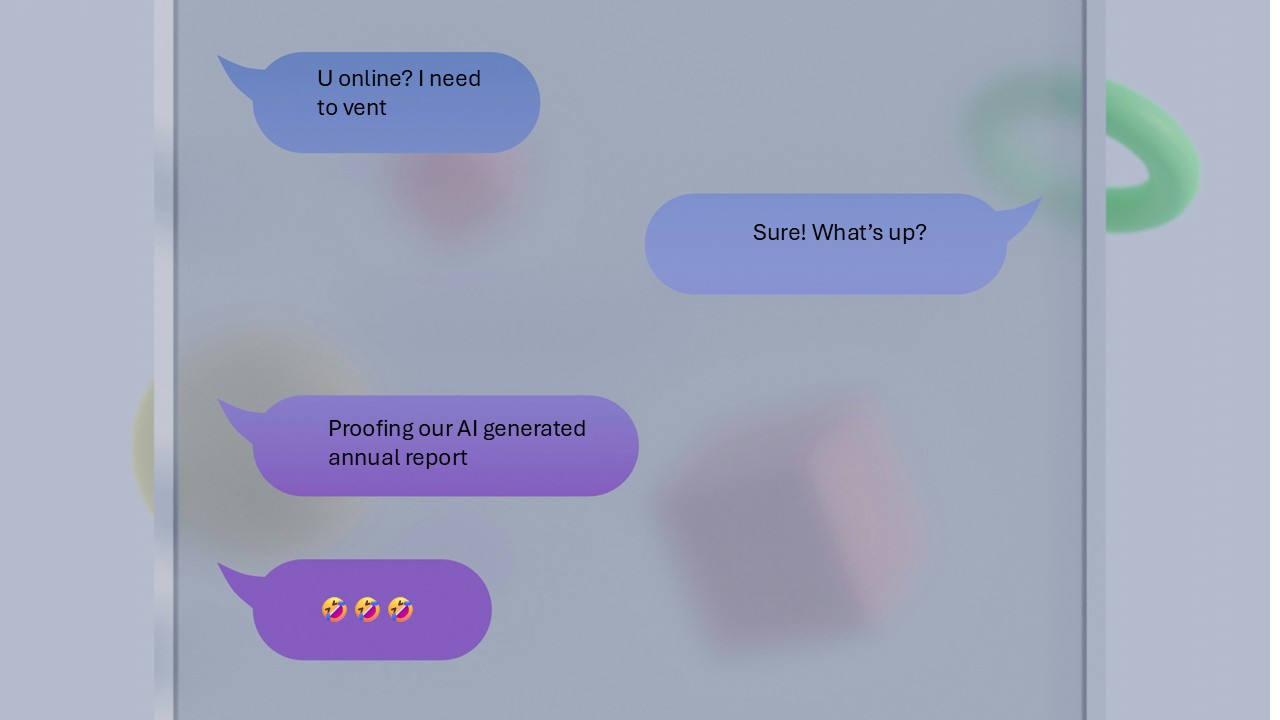
A Text Exchange Between Museum Colleagues in July 2028
U online? Time for our weekly round of vent or repent.
Vent: I just spent 6 hrs proofing the AI slop generated for our annual report.
Bot straight-up invented a bunch of things we didn’t do, along with getting last year’s financials wrong.
Swear it would have been faster to do it myself from scratch
but NO, my manager thinks it is more “efficient” to use AI.
LOL. I’ll repent—I just used AI to create all our social media posts for the next month.
Weren’t you going to hire someone to manage yr socials?
Leadership team decided it was cheaper to use AI.
Jokes on them—the AI company stopped offering free accounts
and we didn’t budget for the subscription.
Yup. We stopped using AI to crunch our audience research data, same reason.
But no one on staff remembers how to do it, either.
I can’t complain, tho. Made a mint on Nvidia stocks.
THAT joke’s gonna be on u if the AI companies don’t start turning a real profit.
What if ppl aren’t willing to pay the real cost of using the bots?
True that. Especially since my state passed a law forcing the data centers
to ACTUALLY COVER THE COSTS of the electricity they are sucking up.
On the bright side, I’ve got a fun new assignment
writing a call for proposals to landscaping firms to green up our campus.
Yr director suddenly into botany?
Nah, it’s to offset the heat and noise generated by the
data center they built a ½ mile from the museum.
Yr luck your state banned new data centers.
Luck had nothing to do with it, we lobbied our ###s off.
Ok, let’s do our usual wrap-up
one thing you are grateful for, one thing that makes u sad.
Happy = I finally have some good advice about managing my mystery illness
using the HealthChat app. Figured it out when my doctor couldn’t.
Sad – I just found out that my daughter’s new “best friend” is a chatbot. Upside/downside.
Happy = my team won an award for our citizen science/history project
crowdsourcing photos from the community.
Sad = we’ve had to shut it down because so much fake
AI generated content was being fed into the data that the model collapsed.
#Sorry! It was great while it lasted. Touch base again next week?
Sure! Have your AI message my AI to set up a time.
(I love finally having my own personal assistant :P)
Is This Scenario Plausible?
It is, arguably, the most plausible of the three scenarios in this set, representing, as it does, “where we are going if nothing changes.” It differs from the AI-pocalypse in not assuming the worst. Financial collapse may still be a possibility, but it hasn’t happened yet. Jobs may be affected, but have not resulted in mass unemployment. But we also haven’t achieved the best possible outcomes of AI, which even the tech titans agree will only happen if governments and companies collaborate to establish guardrails around deployment. In this mainstream future, AI is both a help and a hindrance.
Much of the data supporting elements in this story appear in the last two posts—how AI can support healthcare, what impact it may have on entry-level positions. Some data in support of plot points that are new in this scenario:
- Research shows that use of AI can erode critical thinking skills.
- AI companies are beginning to charge for services that were introduced as free. (As they have to, if they are to become profitable.)
- Some state legislators are beginning to attempt to regulate AI, including:
- State bans or moratoriums on the building of new data centers
- Attempts to charge data centers for the real costs of the electricity they use
Rubber, Meet Road: Why Should You Care?
This scenario dramatizes the ways that AI can creep into operations, when museums don’t create a long-term, big-picture framework around decision-making. For example, absent an organizational policy about AI:
- There may be unresolved tensions between generations and between individual staff about ethics and values around the use of AI.
- Staff may feel pressured to use AI to increase their productivity, only to find their time is spent checking AI results rather than doing the work themselves.
- There may be growing inequity between staff who become proficient in AI tools on their own and others who need (but are not provided with) training.
- The organization may reshape its staffing and work processes around tools that are free, for now, without factoring in the long-term costs as AI companies begin to recoup their lost profits.
The vast majority of museums have not yet created the kinds of clear, unified policies regarding the use of AI that could mitigate these risks. A 2025 poll by MuseumWeek magazine found only 9 percent of museums responding to its survey had a written AI policy. In 2026, only 15 percent of the museums participating in a Terentia webinar had a formal, actively used policy.
What’s Next
My next essay will outline issues museums might want to address as they create policies around the use of AI, with particular emphasis on ethical and values-based decisions.
Also in the pipeline, essays exploring some of the absolutely killer applications museums have created to use the power and scale of AI in thoughtful, responsible ways to do things that would have been impossible without this tech.
If you would like to contribute to this series, sharing examples of beneficial uses of AI in museum work, or museums working through decisions regarding AI, or “future fiction” exploring how AI might impact our world and our work, please reach out to me at emerritt (at) aam-us.org

Upcoming Events
-
Creative Museums Summit
Event Date:Presented by: MuseumNext -
-
-


Please share your essay on museums and AI when it is ready for circulation.
Thank you for your interest, Faith. Watch the blog for additional installment in this series.