Transcript
Cecelia Walls:
Can I give everyone just a few minutes to get into the room here? Please introduce yourselves in the chat. Thank you. Alright. Let’s get started. Welcome. Thank you for joining us for today’s webinar, transit insurance in practice for Traveling and Co-organized Exhibitions. When museum collections travel beyond our institutions, managing risk becomes just as important as managing logistics.
So whether you’re coordinating a single object loan or overseeing a large traveling exhibition, understanding traveling insure transit insurance is a critical part of protecting collections and supporting successful partnership. Today’s session will explore key considerations for ensuring objects in transit, including insurance requirements, policy terminology, alignment between loan agreements and coverage provisions, and practical risk management strategies that can help safeguard collections throughout their journey. We’re fortunate to be joined by two experts from Huntington Hee block Insurance Agency, Isabel de Saint Antoine, advises museums, universities, collectors, and other fine art clients on insurance coverage and risk management solutions for exhibitions, loans, and collections. Erin Cain specializes in fine art underwriting and has extensive experience structuring coverage for museums, universities, collectors, and complex loan arrangements.
Before we begin, a few quick reminders. Today’s webinar is being recorded. Closed captions are available and can be enabled using the CC button in the webinar controls, and we will share the slides after the presentation as well. We ask that you please submit your questions through the Q&A feature on your right at any time during the presentation, and we’ll reserve time at the end for discussion.
Thank you for being here. I’ll now turn it over to Isabelle and Erin.
Isabelle de Saint Antoine:
Hello. Hello, everyone. And thank you for joining us today.
Erin Kane:
Make sure that our slides are up.
Isabelle de Saint Antoine:
We’re excited for today’s program, fine art insurance. Essential for museums. During this session, we will discuss transit insurance and its importance when artwork goes on loan, with a focus on traveling and co organized exhibitions. We’ll then open it up for a Q&A.
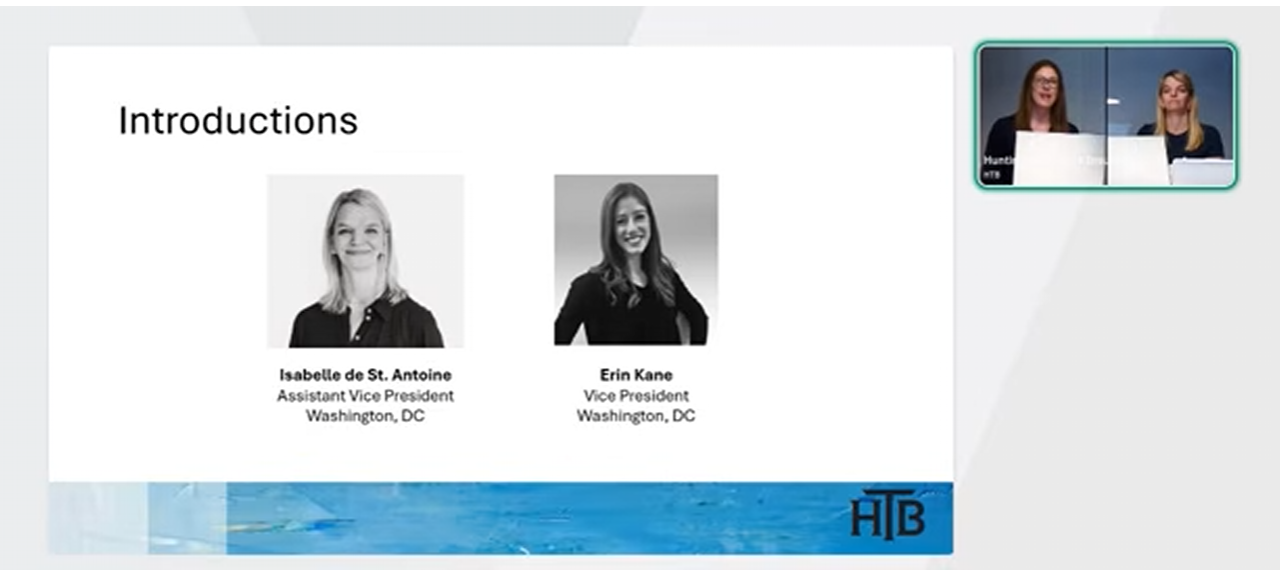
We’ll start with introductions. My name is Isabelle de Saint Antoine. I’ve been in the insurance industry for over fifteen years. I’m an assistant vice president at Huntington T. Block. Advising finer clients, including collectors, museums, universities, municipalities, and dealers on fine art insurance coverage and risk management best practices.
Erin Kane:
And good afternoon, everyone. My name is Erin Kane. I’m very excited to be here today with you. I have been specializing in underwriting for fine art since 2009. And I currently assist in overseeing HTV’s in-house underwriting capabilities in placing fine art business that includes assessing and structuring coverage for museums, universities, and colleges.
Isabelle de Saint Antoine:
A little bit about Huntington T. Block. We are the oldest and largest signer insurance broker in The United States. We were founded in 1962 by mister Huntington T. Block. Then acquired by Aon, our parent company, in 1992.
We are endorsed by the American Alliance of Museums. Thank you for hosting today. And the American Institute for Conservation of Historic and Artistic Works. We have staff in New York City, Washington DC, Houston, Philadelphia, Atlanta, and London.
Our staff is made up of a team of brokers, underwriters, and claims professionals. So now before we jump into transit coverage, let’s see how transit coverage fits within a finer insurance policy.
By looking at what property is covered and whose property is covered under a fine art policy.
Erin Kane:
So I’m gonna begin with a question that we received often is what is covered under my policy? What is fine art? Fine art can encompass many things, as I’m sure all of you on the call here today, Paintings, sculptures, rare books, video artwork, historical artifacts, packing crates, that’s just named a few.
The policy has a very broad definition as you will know right here. A copy of policy.
It is important, I think, to look at the last underlying bolded portion which says that fine art
should be of a rare, historic, or artistic nature. And this is how your policy should respond.
Isabelle de Saint Antoine:
Now let’s talk about whose property is covered.
It’s property owned by the insured, so that’s your permanent collection. Property of others in your care custody and control, property offered as gifts for sale or awaiting acceptance, and the insured’s interest in residuary gifts and jointly owned property. So effectively, coverage is extending to all artwork in the care custody, and control of the institution for which they have agreed to insure. Erin, let’s look at how property just described is covered under the policy. Especially during transits.
Erin Kane:
So many cultural institutions such as all of you on the call today carry an annual fine art policy that provides all risk coverage, for physical loss or damage on a wall to wall, or nail to nail basis. This is coverage that continuously follows an item from the moment it leaves its usual location through transit and display until it is safely impacted its final destination.
As you will see here on this slide, this is a snapshot of a deck page of an annual policy limits. Which includes the highlighted portion that says in transit, on any one conveyance worldwide. You will additionally note the deductible. Which notes that items should be it should be only applying for owned items on premises only.
So this pretty much means the deductible should never apply for transits. So, if you apply this into a real-life scenario, let’s say you need to send an item out for conservation, you take it from its location in your gallery.
You ship it to the conservator; it is for two or three months. And then you ship it back to yourself it is covered the whole time. Up to those limits that you have, noted here or on your policy. So it means that you need to be aware of these limits, and you need to check them. Because if you are transiting a very high valued item, multiple items, or even a high valued exhibition, you wanna get in touch with someone like Isabelle or your fine art broker, who will be able to help you structure the coverage as you need.
Isabelle de Saint Antoine:
That’s great. Thank you, Erin. And what are the key points to look out for in making these insurance arrangements when transits are involved?
Erin Kane:
I think the very first key thing you wanna do is check who is responsible for that conveyance. Regardless if it’s a single item, an exhibition, or a standalone exhibition, you wanna make sure you know who is responsible. Next, what is the total value being shipped? Who are you shipping it to? Is it a domestic or is it international? Because both have their own complexities. After you figured this all out, who are you gonna use to do packing and shipping? And always make sure you’re doing a condition report at any point of transfer.
Isabelle de Saint Antoine:
So when arranging shipments of artwork, how do we make sure the various agreements match the insurance policy? This slide is essentially a checklist for registers. To use when reviewing loan, exhibition, or shipping arrangements to ensure that there’s contractual alignment across all documents. So in other words, the key idea is that the loan, exhibition, shipping, and insurance agreements all tell the same story. Here are the insurance key contract terms to look out for. First, look at the insurance terms. When does coverage actually start and end, and watch for gaps. Which policy responds at each stage of the exhibition or loan? What is the extent of liability? It limited or absolute? And what is the jurisdiction?
Next, confirm who’s actually indemnified and insured under these agreements. Is it your institution?
Co organizers, lenders? Who is listed as a named insured, additional insured, and loss payee? And finally, watch out for certificates and waivers. So are you required to provide certificates of insurance? Is there a waiver of subrogation in a favor of a venue, shipper or lender? That you should be aware of? For international loans, make sure that all documentation including customs documents, manifest, international shipping, and courier documentation is included in your planning.
If your loan, shipping, and insurance documents all say the same thing, Claims should be much smoother, and you’re less likely to face surprises after a loss in transit. And if you have any questions regarding the insurance sections of these documents, don’t hesitate to reach out to your Fine Art insurance broker. Now let’s do a deeper dive and go through key insurance terms that come up in these agreements.
Erin Kane:
Most loan agreements and shipping contracts request a COI, or a certificate of insurance. So what are these? Certificates of insurance are snapshots of your insurance policy. These don’t just amend or change the coverage you currently have in place.
And certificates are usually not needed in order for coverage to be in place either. What is important to remember is that COIs support your loan agreement. The contract between the lender and the borrower. Providing only evidence to a lender that you have the proper limits in place to take on their loan. The loan agreement is the legal contract, and it is the most important document. I will say that again. The most important document contract, ding or borrowing an artwork.
Isabelle de Saint Antoine:
So now let’s talk about subrogation. Subrogation is the right for an insurer to legally pursue a third party that caused an insurance loss to the insured.
A waiver of subrogation is where you waive that right to pursue the third party. So parties that may ask for a waiver of subrogation are anyone that is handling, transporting, or borrowing artwork that they are not responsible for ensuring, including shippers, art handlers, exhibition venues, and borrowing museums. A waiver of subrogation must be agreed upon in advance in writing prior to any loss or damage.
Most policies already grant you this ability to waive subrogation in advance of a loss. Again, in writing. So how does subrogation apply to you? Let’s run through an example. A museum borrows a painting valued at $500,000. An art handling company hired by the museum drops a crate while loading, and the artwork is damaged. The museum’s fine art policy pays the claim to the museum. Where subrogation comes in, is having paid the claim, the insurer now steps into the museum’s shoes and pursues the art handler. The parties whose negligence caused the loss, to recover that claim amount. Now where the waiver comes in is if the museum agrees in writing prior to the loss to a waiver of subrogation against the art handler. Effectively, the insurer gives up the right of recovery in advance. This means that the insurer still pays the museum for the loss, but they cannot go after the art handler negligent party, to recover that claim.
Erin Kane:
So next, we are gonna move on to additional insured and loss payee. Usually, you find these two terms intertwined and used interchangeably in a loan agreement. However, Isabelle and I are going to talk about these separately. They are in fact two different things with different definitions and intentions. So first, additional insured is a person or organization not automatically insured under your policy, but who is included or added at the request of you, the named insured.
Usually due to a financial interest in the policy. Lenders often require that borrowers add them as additional insureds because the lender wants to confirm that they are covered and able to access policy in the amenable loss. So that means, yes, an additional insured lender can make a claim on your policy. And the key question for additional insureds is to ask, if they have a financial interest. Which, if a lender is owning the work that they are lending to you, they do.
Isabelle de Saint Antoine:
Now let’s talk about loss payee. So loss payee is a person or entity that is entitled to all or part of the insurance proceeds in connection with the covered property in which it has interest. The lender’s objective when asking to be added as loss payee on a museum policy is to make sure that they’re able to access the borrower’s policy in the event of a loss. The loss pay would get paid directly in the event of a loss. Again, it’s important to verify when someone is asking to be added as lost payee. If that party has financial interest in the artwork and or ownership.
Erin Kane:
And I think a good point to make right here before we move away from additional insured and lost payee is to say that your policy should outline that any lenders or owners are automatically added and recognized as both additional insured and loss payee. So this way, you’re not having to make requests to your broker all the time. Or make changes to your policy. As you have loans coming in.
Isabelle de Saint Antoine:
Okay. Let’s now jump back into transit. Let’s look at the typical transit timeline for artwork and insurance coverage. We said earlier that insurance coverage should be wall to wall. Here is what that should look like across the life of a shipment. So a typical transit timeline is up here. Packing, transit, installation, on display, deinstall, return transit, and unpacking. The insurance policy should run continuously underneath all of these stages. Erin, what are some red flags or potential gaps that you’ve seen that we should walk out for in loan agreements?
Erin Kane:
So I think the first one, as you will see, I think on your left-hand side of the screen, should be the pickup. When does the insurance responsibility start? This is where I have to say loan agreements can be a little vague. Or they just tie to a calendar date. The problem is that packing happens usually at a lender’s premises before a truck arrives, and objects as we know, are at their most vulnerable while they are being hand handled and created by the shipping company. If your coverage starts on collection, and the lenders ends when packing is complete, There is a window in between that nobody owns. And if the crate is dropped during this time, there could be an argument on where the coverage lies. The second red flag is at the end.
Return and unpacking. This also gets missed because by the time a loan has been returned, mentally, everyone has kinda closed it down. But coverage that ends on delivery ends possibly while the work is still in the crate. So damage found at unpacking then falls into a gray area. And without a condition report at this point, it’s going to be hard to prove when the damage happened. So when you consider the transit timeline we just talked about, we wanna think on best practices for transit.
And we’re going to start with your best practices with packing. The preexisting condition of an item. Before packing for transit, it is important to establish the preexisting condition of a work. This is important because if there is damage to the work, while in the crate, during transit at any time, with unpacking, the condition prior to the damage has already been established. This report should include complete object identification details. Comprehensive photographic record, showing as many sides of the object as possible, and any existing kind of areas of wear or damage or something that might be of a curiosity to you.
You then want to have a detailed assessment of the work’s physical condition. And you should evaluate the structure, the surface condition, the paint layer, the frame, the mounting support, and any evidence of changes, let’s say, deterioration or repairs or maybe a stain or maybe a little nick on the side. You wanna make sure your notes are specific rather than general. And you wanna identify the exact locations and make any observations at this time. The best practice is to document whenever artwork changes custody. Location, or responsibility. You wish is essential for when you’re establishing the preexisting damage the preexisting conditions, excuse me, for damage of your peace so that you avoid the he said, she said disputes. If there is any damage.
Isabelle de Saint Antoine:
So now let’s talk about transit best practices. And evaluating shippers. So we know that everyone in this call already has shipper relationships with whom they trust and work with. But when you’re considering someone new or taking a fresh look at a relationship you’ve had for years, these are questions we recommend asking. Experience. So how long have they handled fine art specifically? General freight experience is not the same thing as fine art. What about their truck features? Are they climate controlled? Do they have GPS tracking? Do they have air ride suspension. Dual drivers.
For high value or long-haul shipments is our second driver, so the vehicle is not left unattended, and the schedule doesn’t depend on one person’s hours. How about overnight stops? So are there any? And if so, where are they? The answer you want, if there are any overnight stops, that it’s in a secure fine art storage facility rather than a truck stop or an open parking lot. How about crate security? How are the crates secured inside the vehicle, so they don’t shift in transit? And is it a dedicated or is it a shuttle? On a shuttle, ask how many how long the route takes. What are what are the stops along the way? And does your item come off the truck at any point during the transit? Each removal is another handling event and another chance for damage.
Erin Kane:
So we often get asked about the insurance that packers and shippers carry. Is it adequate for covering my item? Items, or even full exhibition? So most shippers carry what we call a daily policy. And this is coverage for items, physical damage, loss or damage, for items only in their care custody control. Shippers then, as many of you are aware, limit their liability in shipping contracts I know you have all seen these, and you must sign them if you’re going to work with them. And this limits their liability, and usually the standard is 60¢ a pound. So if you are agreeing to this, yes, you will only get 60¢ per pound from the weight of the item you are shipping.
Let’s take this down a little bit further. If you are shipping your $1,000,000 piece, with a weight of 50 pounds, and it is damaged by the shipper during transit, and you have accepted their insurance. The amount you will be paid out is $30. Significantly less, I am aware, than the million dollars that you have for your item. So this is why it is extremely important to speak with your broker and review your fine art policy. These policies were created to cover the full value of pieces, all pieces traveling without limits up to their conveyance limits.
Isabelle de Saint Antoine:
So the time when transit insurance is most relevant is when you’re planning major exhibitions or long So let’s start off with traveling exhibitions. Generally speaking, a traveling exhibition often develops by one primary organizer tours to a series of host museums under individual loan agreements, with those hosts having limited input in the core content of the exhibition. So for traveling exhibitions, we commonly see two models. Model one is a centralized logistics. The organizer makes all packing and shipping arrangements to and from each venue and back to lenders. With the organizer’s courier overseeing installation at each venue.
Model two is venue to venue handoff. The organizer ships of the first venue then each venue is responsible for shipping to the next one. The final venue arranging the return shipment. Erin, an underwriting perspective, for traveling exhibitions, what would you recommend that registers look for when arranging the insurance?
Erin Kane:
So when we look at these types of bottles, regardless of the model you use, because you can use both, the model that you elect should match what your loan agreement says about your insurance. That way, there isn’t a gap in coverage as responsibility shifts between venues, lenders, Or maybe organizers. You wanna make sure you are discussing with your broker early and reviewing the options. As you see, there are two models here because you can cover your transits in a multitude of ways.
Isabelle de Saint Antoine:
Alright. Now let’s talk about co-organized exhibitions. Co-organized exhibitions are jointly developed and produced by two or more partner museums. Here, partners share responsibilities. For loan agreements, creating, shipping, condition reporting, and courier oversight. The exhibition may then travel to additional host venues which are not part of the co-organizing group.
Erin, for co-organized exhibitions, what would you recommend that registers look for when arranging the insurance?
Erin Kane:
I think when you’re doing a co-organized exhibition, it becomes an especially important to confirm upfront who is ensuring each leg of transit and at what point does that transit begin? You then wanna talk about what is being shipped overall, the total value, then how many conveyances are going to be needed to ship that amount. What is the value or limit per each conveyance? You wanna know who is packing and shipping. Should be someone with profession like we talked about earlier. And then you wanna confirm that condition reports will be conducted. Thank you.
Isabelle de Saint Antoine:
And, Erin, from an underwriting perspective, what should registrars check to make sure they have enough transit insurance when arranging artwork shipments.
Erin Kane:
I think the first thing is the limits and the values. As we noted at the beginning with the copy of the deck page, every policy has a maximum per conveyance limit. If you put too much on one truck, you may accidentally exceed that limit unknowingly. So for your traveling and co-organized shows, it’s really important to confirm upfront how works are gonna be distributed across shipments, flights, trucks, conveyances to avoid overconcentration. So let’s set this up in a real-life example. You are the next venue for a traveling exhibition a total value of $75,600,000. In your annual policy, carries a transit limit of $10,000,000. This is seven times more than your transit conveyance. The question, do not fear, is not whether you are covered but how you are going to structure the transits to you. So how do you handle it? First, remember that the limit applies per conveyance. Per shipment, not to the exhibition limit as a whole.
So you can split the works across multiple trucks or flights if each conveyance stays within $10,000,000. Second, we realize that splitting the shipment into multiple conveyance may be impractical So talk to your broker. Because your annual limits, these annual limit of 10,000,000, can often be increased for this incoming exhibition or transit, with the proper information. If you review options that you have early, you can structure your shipments to properly align with your needs.
Isabelle de Saint Antoine:
And, Erin, beside limits and values, what else should registrars look out for?
Erin Kane:
I think the next thing to look out for is the valuation and the exclusions. Because these don’t just apply to the items when they’re on your premises. It also extends to the items when they are being transitive as well.
So first and foremost, loaned items should have a valuation of agreed value. If there is a loss this will make it much more straightforward. Some common exclusions or things to look for maybe in a loan agreement. Or in someone else’s policy. Could include preexisting damage found on an item or maybe insufficient packing not to withstand transit. Next, unfortunately, the world we live in right now, war and terrorism are becoming exclusions that you really need to be looking out for. For certain regions, high profile shows, especially internationally, I would say. Lenders are starting to have explicit requirements on these points.
So it is key to know what is excluded under your policy and what is being requested. An example of this. A lender returns the loan agreement to you with the value section left blank. I’m sure we’ve had many here on the call that have experienced this before. So what happens?
First, do not fret. The object is still covered. It just the policy you have reverts back to current market value at the time of loss. The problem with this could show up if there is a claim. With no agreed value that adjuster now has to commission an appraisal to establish what the work is worth. And, unfortunately, when lenders see that value, they don’t think it’s correct. So now you have a dispute. For a damaged artwork and a lender who is a little bit distressed about the damage to their work.
So what do you do? I would say push as much as possible to get a number on that object before it ships. Explain to your lender that agreed value is what guarantees what they know and you know. What they will receive if something happens. There will be no argument and no appraisal process. If the lender is unsure of the figure and we know this happens, suggest an appraisal or that they speak to others. With similar items.
I think the next thing to look out for and, Erin, are there any levers that registrars can control? I think there are.
Erin Kane:
There are quite a few levers because I think what you need to remember is your policy is yours. So the first thing and you get to make the decision on how you use your policy. So the first is
who packs and ships? You should be using a professional fine art packer and shipper. The next one is for large and unusual moves. An especially over your annual limits. You wanna share the shipment details early. The dates, and the routes because it’s important if there are stopovers, warehouses, or regions that are high profile that your broker and your underwriters are made aware. And next, the maximum values that you’ll be shipping. Again, that is something within your control. That you can review.
So last example I have. A lender insists that Eichen’s moving handle the shipment of an incoming loan to you. I’ve never heard of them. I’m sure many of you on the call have not heard of them either, but you look and there is no website, no references, no contact information. Nothing suggests that they’ve even handled fine art. So before you get too nervous, I say ask for some evidence. Ask for proof of fine art insurance or fine art experience. Just like Isabelle had said about shippers. Ask for a certificate of insurance or liability limits. Ask if they have climate controlled and air ride trucks. Do they use dual drivers? If this information still doesn’t come back as ideal, I would say, how do you handle? So I realize what I’m gonna say is maybe not straightforward, and it always isn’t. My apologies. But one of the options is if the lender insists on Aikensons. You should probably outline to the lender that they need to be using their own transit limits to have the item shipped to you. If they choose the carrier that you are not aware of, they should have their insurance policy respond. Option two, you insist that you need to cover it so that you can cover the transit to you. A professional carrier is vetted, and therefore, you are in agreement to cover it under your policy. What you want to avoid here is the middle ground. You don’t wanna be opening up your policy to be covering something that you don’t know or something you did not. Really a 100% agree to. As a reminder, we’re not talking about claims right now, but 65% of claims come from packing and transit. So this is a key lever within your control.
Isabelle de Saint Antoine:
Okay. Now let’s discuss when things go wrong. We’re gonna look at three scenarios. And then we’re gonna learn lessons learned. So scenario one is the handoff gap. So a crate is damaged during a venue-to-venue transfer. Both institutions assumed the other’s insurance policy was responding at that moment. The loan agreements mean the date of transfer of insurance but not a time or triggering event. What’s the lesson here, Erin?
Erin Kane:
So I would say the lesson here is name the moment, not the day. The date alone is sometimes not enough for a loan agreement. It could leave hours where both parties look like they might respond to what’s going on. So you wanna write a triggering event into your loan agreements such as responsibility passes on delivery at the receiving dock or upon signature of the condition report. Then you want to make sure you’re using this same convention across loan agreements, and shipping contracts so that everything says the same thing.
Isabelle de Saint Antoine:
Scenario number two, the overloaded truck. So a last-minute schedule change consolidates two shipments into one vehicle. And now the combined value goes over the insurance policy’s per transit limit. Nobody reran the numbers. And informed their insurance broker and the truck left the premise. What’s the lesson here, Erin?
Erin Kane:
I would say here, every change that you make with these is an insurance decision. Nobody was reckless. We understand that these things happen. In consolidation, was really the sensible operational fix. So the it’s just that the overall value was simply never rechecked. So make this recheck a step that is required whenever values or routes or schedules change for your shipments. And know by heart if you can, along with everything else you need to know, your per conveyance limits as a working number. And reach out to your broker, sorry Isabelle, early and as often as needed because they are here to help you. And scenario number three is the missing condition report.
Isabelle de Saint Antoine:
So damage is found at unpacking. But there was no condition report at the last transfer, so there’s no way to establish when the damage actually happened. What’s the lesson here, Erin?
Erin Kane:
So I hate to say this, but if there’s no condition report, there’s no timeline for the item. And without a timeline, we can’t prove when the damage happened. So a lot of finger pointing starts. So condition report condition report at every point of transfer regardless of insurance responsibility, venue, or lender to borrower handoff, is key. It’s if you’re timing these triggers right, you will make sure that they line up with your agreements as well.
Isabelle de Saint Antoine:
So let’s finish off with what to do when you discover damage or loss. Even with the best plan in place, things do happen. These are recommended steps to help you ensure a smooth claims process. One, photograph artwork with high resolution images. Camera phones are wonderful resources for this. Do not throw anything away. Missing or stolen art report to the police department immediately. You should save all your documentation and packing as evidence. Immediately notify the shipper of damage and follow up with a letter putting them on notice of the loss. And report the loss immediately to your fine art broker. So finally, if you remember nothing else from our presentation, please remember these key points. One, close the gaps. Define the exact moment when insurance responsibility transfers. Two, align the paperwork. All contracts and insurance policies should tell one story.
Erin Kane:
Three, watch your limits. Most policies cap per shipment or per vehicle. So avoid over concentrating with high value works on one truck. And always make sure to rerun those numbers after every change. And then fourth and final, Document. Just like Isabelle said, your iPhone is great. But condition report to condition report without at every transfer. Is really key.
Isabelle de Saint Antoine:
Thank you for your time. We’re now gonna open it up for a Q&A. We’ve also included our contact details along with QR codes if you’d like to stay in touch or connect with us for any follow-up questions. Thank you.
Erin Kane:
Okay. So thank you, everyone, for your questions. In the chat. I’m gonna go through them. And for the ones I hope we’ve already answered, I might gloss over them, but you can yell at me here if I’m not answering them. What are some reasons why an organization would choose not to have a wall-to-wall perk? Policy? Purely financial, or are there other reasons? You want me to take a stab at this? Oh my god.
Think if you don’t have a wall-to-wall policy, it could be because you have your policy or your coverage under your commercial policy, which probably doesn’t give you the proper limits you need. So a wall-to-wall policy for almost every standalone fine art policy is standard. I would say if you don’t have a wall to wall, it’s more than likely that you’re not you’re not currently insured under a standard, standalone fine art policy. Next question. For traveling exhibitions that are covered by the organizer for the full length of the tour, should this be made as a separate policy? Or an adjustment to the main? Great question.
Isabelle de Saint Antoine:
That’s a great question. So it’s really up to you. You can cover it under your annual policy and temporarily increase those transit and premise limits as you need to, or you can do a separate exhibition policy. The separate exhibition policy covers you wall to wall, for that exhibition, which includes the transits to and from the exhibition venues and then ultimately back to final destination.
Erin Kane:
If you wanna add anything I think sometimes if it is your items traveling with an organizer, you do have a little bit more say in how you would like to have this hopefully structured. But I think Isabelle hit the nail on the head. It really is how you feel comfortable with structuring the coverage. You can either do a fully standalone policy, which would encompass hope three, four, or five venues. Or you can always increase your limits as well. In advice where we can access slides. Slides will be sent to you. How do we handle the insurance for an artwork that is added for one particular how do we handle the insurance for an artwork that is added for one particular venue in a tour and is not traveling with the rest of the exhibition.
That is great question. I think I’m I think I’m reading this correctly. For one artwork that is added So this can come on and off very easily. If you take a separate exhibition policy, this should be reviewed very quickly and easily by your broker and your underwriter. To, put it on and then to take it off for the specific venue. And they would pay a little bit more premium because of the value of that piece. Mhmm. As a reminder, exhibition policies are agreed per the checklist that has been received. So if the venue a has90 pieces and venue b only has 89, that is exactly how the coverage would respond. I hope I answered that Yep. For you. Sorry. I’m just trying to toggle through here. How do you my apologies, everyone. How do you recommend covering an object That has a small financial value but has a very high personal value to a lender? For example, someone loans their grandma’s glasses to a history exhibition Great question. I would say that it is for the vet. It is for the value to replace them. So, unfortunately, the policies that we fortunately and unfortunately, I guess you could say, depending on whose shoes you’re in the policy responds to make you whole, not to make you more than whole, or to pay out for sentimental value. So maybe the glasses from the grandma are actually by someone famous, and we could get an appraisal on them. But, yes, I would say they would have to be insured for the value that they are. Worth. Mhmm.
Isabelle de Saint Antoine:
And I think to add on that, Erin, I think that another lever for museums is you’re going back and forth with a value, you can always ask the lender to insure the peace themselves. Absolutely.
Erin Kane:
Yep. Absolutely. Here’s another one. What do you do with discrepancies with total versus individual object valuation? In the case that the lenders are not communicative or it’s difficult to get an answer, would you advise going with a higher evaluation? Oh, this is a great question.
Isabelle de Saint Antoine:
So is that for individual values versus a total value of a collection? Discrepancies with total versus individual object. So, we always recommend to get individual values for each item as much as you can. It comes back to the agreed value per item. What I would say.
Erin Kane:
Yep. And then discrepancies with total versus an I don’t know that I’m understanding this properly. My apologies. Marilyn, if you can give me a little bit more My apologies. It’s difficult to get an answer.
Would you advise going so I would say if it’s difficult to get an answer, going with the higher valuation is okay. That is you can do that under your policy. However, remember at the time of loss, which is the amount that will be paid and it will be reviewed you know, how was that determined that the higher value was the one that should have been Mhmm. What was agreed to? So you have that ability to agree to a higher value if needed. It’s just a reminder that it if there is a loss, it is that higher value that could possibly be paid out because you’ve agreed to it.
Isabelle de Saint Antoine:
And I think if you’re in a scenario where there are several items that are being lent to you and the lender is able to give you a total value, but not individual values, you can go back to them and just ask them for more content context of how they got to that total value. And usually, that can help kind of break it down you can also ask for documentation of how did they get to this value if it’s seems a little bit different to other values for similar items part of that exhibition.
Erin Kane:
If three trucks are leaving one location, at the same time, is there is that one truck or three transits from an insurance perspective?
Isabelle de Saint Antoine:
What would you say, Erin?
Erin Kane:
What would I say? I would say where they’re leaving from one location, but are they going to the same destination? So if they are all leaving Quavo, Long Island, but they are going to Boston, to Philadelphia, and to Jersey City. It has three separate conveniences. If all three are leaving at the same time and going to Boston, it is one conveyance.
So make sure you know the destination. Mhmm. And then also make sure that you are if they are to all go to Boston, that you are having a little bit of time between all of them leaving so that if God forbid there is a very bad storm, they’re not all impacted by that bad storm coming up. Ninety-five. Does anyone have experience with the art loss register? Is it legit worth it?
Isabelle de Saint Antoine:
I think you just had experience with this, didn’t you?
Isabelle de Saint Antoine:
Yes. I would say it’s legit. Yes. Absolutely. I think it’s a very good resource.
Erin Kane:
Yeah. I think the more people can report items being lost to the world or stolen to the world, and everyone can be aware the better. Because somebody will see let’s say it gets resold somewhere, We’ve had plenty of items come up. Yep. FBI involved to note the piece has been found twenty years later. If exhibition crates are stored temporary layer, temporary cannot say that word. At a fine art storage facility, do you recommend condition reporting at receipt of the storage site? That would seem to introduce more vulnerability and handling. So I guess my question would be how short term would this be? I would agree with you that opening crates, if they are only going to be at a storage facility for, let’s say, a week. Between transfers or maybe even a week and a half or two, maybe even three, it will introduce more vulnerabilities for sure.
Isabelle de Saint Antoine:
Yeah. I agree. Agree? Do you have anything else?
Isabelle de Saint Antoine:
No. I think it comes down to how long is temporary. If it’s a few months, it’s quite different to just a few weeks to a few days. And it’s ultimately talking to your broker to discuss the vulnerabilities and added risk of opening crates and looking at them. Yep.
Erin Kane:
What benefits do these kinds of policies provide without requiring a claim?
Isabelle de Saint Antoine:
Oh, so why purchase, for example, a standalone exhibition policy if you don’t think you’ll have a claim?
Isabelle de Saint Antoine:
So, if you if you have a stand-alone exhibition policy, the advantage of that is if you do have a claim, that happens under that exhibition policy, it is not gonna affect your annual policy. It is a standalone exhibition policy. And that is one of the reasons why a lot of institutions do go that route. I would say. Yep.
Erin Kane:
You are mitigating the risk under one policy. Mhmm. If the artwork remains created after leaving lender but the crate is stored in temporary art storage facility, Then is it necessary to uncrate and condition or check the artwork before it eventually gets transported to the borrowing museum? I think I would go back to the temporary. How long is temporary? And how long has it been in the crate for?
Isabelle de Saint Antoine:
Yeah. I would exactly.
Erin Kane:
Yep. You wanna just know when did it go in? Was there a conditional report before it went in? And how long will it be staying there? We understand that there’s a lot of transits, and you know, storage of items between venues that occurs, and understand that that’s not possible. There’s actually we’ve done somewhere storage is two or three months at a storage facility. We understand that that’s just not feasible. I think condition reports when done, when fee when feasible is what we really recommend.
Isabelle de Saint Antoine:
And I think you can also do a middle ground if items are temporarily in storage. At looking at the outside of the crates. So seeing if there’s any pretty obvious damage to the crates. And if there is, then you may want to make a decision to open the crate at that point. But when we’re talking about condition report to condition report, it’s also taking into consideration not overhandling items either. When not necessary.
Erin Kane:
Yeah. Oh, Marilyn, thank you. You said for your individual values not equaling the total. The hat was $25. The book was $50, but the total was $90. Would say that’s an error. I hope. Maybe it’s a maybe it’s a math error. I might push back. I mean, the difference is not huge. But if it could be huge, I might push back. Because it would be what is in the agreement for each individual item not the items as a total. Right. So it would be$25 for the hat, and $50 for the book.
Isabelle de Saint Antoine:
Mhmm.
Erin Kane:
I think. Did we get them all? If one panel of a triptych worth $50 k in total is damaged to the extent of a total loss, is the owner owed all $50 k? If so, what should be the disposition of the remaining two triptychs?
Isabelle de Saint Antoine:
Oh, so pairs and sets clause. Yes. I will let you, Erin, take that.
Erin Kane:
So it would depend on if every so more than likely, this is a pairs and sets situation. So hopefully, a loss adjuster would explain to your lender first and foremost that if they are to be paid a total loss, they would have to give up all panels. That is what happens with the total loss. The lender or even you, the cultural institution, gives up the piece to the insurance company that paid the loss. So in this case, if they were paid a total loss, they the remaining two triptychs would be handed to the insurance company. Sometimes salvage can be negotiated, but it just depends on the type of loss that it is. And if living artists are involved, etcetera.
Isabelle de Saint Antoine:
Yep.
Erin Kane:
In what circumstances a waiver of subrogation needed? Is this often initiated by the insurer, or is this something I should look out for on the policy?
Isabelle de Saint Antoine:
I’m trying to under initiate on the pa, so you have a waiver of subrogation is already granted automatically for anyone handling the items, packers/shippers. As long as agreed to in writing. Yep. So I would just ensure that look at your other agreements to see are there requests for waiver of subrogation.
Erin Kane:
Yeah. I would add to that that in our experience, excuse me, many, many, Baileys, as we like to call them, auction houses Mhmm. Galleries, shippers, packers, conservators, are asking for waivers of subrogation before handling your pieces. And this then, as Isabel said, is already granted to you. In your policy because we know in order to do what you do every day, you need this. So no hesitation. It’s already granted to you. If you agree in writing prior.
Isabelle de Saint Antoine:
Yep.
Erin Kane:
I hope I’d answered that enough for you. Natasha. What else? My apologies. It’s hard to scroll down here.
Erin Kane:
Do insurers have issues with bookend couriers if you still if you are still following condition report to condition report?
Isabelle de Saint Antoine:
And there’s nothing in the policy that know, specifies what type of courier you have to have. There’s a condition that says that items need to be packed and shipped by competent packers and shippers. Is what I would say. To withstand transit.
Erin Kane:
I would also add to that that I am not gonna question if you feel a book in courier is better for your piece than a courier the whole time. You know your items much better and much more intimately than Isabelle and I do. So if you are comfortable with bookend courier, then please use that Just make sure that the bookend couriers, like you said, are doing conditional reports at the end. I think book in couriers versus full time, you know, full present couriers, it really is about where it’s going, the value of the piece, fragility of the piece, and it’s really, I would say, up to you.
Isabelle de Saint Antoine:
Yeah.
Erin Kane:
Sorry. It’s hard to scroll down. What is common practice for museums that don’t have preparators on staff but hire same contractors on a regular basis. Art waiver of subrogation. For art handling on premises and who could be covered under the museum’s policy.
Isabelle de Saint Antoine:
Most common practice.
Erin Kane:
Oh, meaning how does a waiver work for those, I think. If you waive subrogation against fees, entities that are handling, then it would be agreed per policy. But if you have to do it in writing beforehand, I think I answered your question, Christa. But if I didn’t, please let me know.
Isabelle de Saint Antoine:
We have a few minutes left. If there’s any additional questions I’m gonna do learning questions that have come.
Erin Kane:
I’m gonna do two more. And if we don’t get to it, please reach out to us. Yeah. So if a lender does not itemize their loan of multiple items but just provides a blanket value. Very good. What happens if one of those items is damaged in transit?
Isabelle de Saint Antoine:
Well, you would most probably get a loss adjuster involved. Yes. Who would then himself or herself determine the current market value of the individual pieces that were damaged.
Erin Kane:
Yes.
Isabelle de Saint Antoine:
And the trouble with that is lender is already usually distressed. Mhmm. When their items are damaged, especially if it’s not under their care capacity and control. And going down the route with an adjustment process takes a little more time with appraisals, although fine art appraisers are very quick. It just makes it a bit longer. So that’s why I think it’s, you know, very important as much as you can to get those agreed values upfront and these discussions, we understand, can be difficult. With lenders. And so it’s you know, to try to put them at ease that it is in their advantage to have an agreed value up front because if there is a claim, then it just makes everything easier because everyone knows what the agreed value of the piece is ahead of time.
Erin Kane:
Yep. Oh my goodness. I don’t think we’re gonna get to all these. Apologies.
Isabelle de Saint Antoine:
Well, we have our contact details here if you wanna email us.
Erin Kane:
With any additional
Isabelle de Saint Antoine:
We can do one, two, or three
Erin Kane:
Offer exhibitions specific policy that only covers on premises and the lender covers the transit. So not wall to wall. Yes. We do. This is possible. Very possible if someone else is covering the transit. We would just note that the coverage is for on premises, and you would not have any transit coverage. Apologies if I did not get to your question. But thank you all. We really appreciate you being here with us today. And I didn’t get to it, please, please, please, please, please, please, please, please, please, please reach out. Isabel and I are more than happy to continue answering questions. So thank you all.
Isabelle de Saint Antoine:
Thank you, everyone.

Upcoming Events
-
Creative Museums Summit
Event Date:Presented by: MuseumNext -
-
-