This article first appeared in the journal Exhibition (Fall 2026) Vol. 45 No. 2 and is reproduced with permission. If you don’t read the journal, become a member to receive your digital copy of the full upcoming issues.
My love, I was so wrong. Dying is the opposite of leaving. . . . I am more here than I ever was before.
—“Love Letter from the Afterlife,” by Andrea Gibson, Colorado Poet Laureate
We are in seemingly contradictory times when it comes to technology. People and communities around the world are more connected and aware of one another than ever before. However, when we step back from the screen, there is a feeling of emotional apathy and exhaustion that comes along with digital overconsumption and saturation. Research shows how prolonged technological connectivity can lead to physical and emotional exhaustion and desensitization.[1] This isn’t a call to abandon technology, but a recognition that museums can offer something different.
How can those of us working in exhibitions, interpretation, and programming offer alternatives for meaning-making and emotional engagement that reduce digital noise rather than adding to it? In 2025, during Día de Muertos at the Denver Art Museum (DAM), we attempted an answer through a participatory activation across all the museum’s exhibition spaces. This activation, called Momentos de Memoria, sought not to compete with digital platforms but to offer what they cannot: embodied experiences and contemplation through a cultural framework for holding emotions. Moreover, it was an experiment in collective exhibition-making. It was a means through which grief, memory, and joy could be seen as legitimate forms of knowledge, and a method in which visitors, not curators, determined what the museum meant.
Developing Momentos de Memoria
In the spring and summer of 2025, five Mexican and Mexican American DAM employees, including myself, met to discuss the needs and possibilities around Día de Muertos at our institution. While the museum has offered and presented Día de Muertos–related displays and programs in the past, these were often led by artists and required visitors to attend a specific event. Additionally, while artist-built ofrendas (offering altars) engaged meaningfully with the holiday’s themes, they could feel disconnected from the rest of the museum.
After several meetings, our group made two decisions about how to move forward. First, we decided to create a staff ofrenda, designed by a commissioned artist who guided employees in making and placing offerings to honor deceased colleagues and loved ones. It was intentionally limited to staff to provide space for employees, as a community, to express grief and memory. This was organized by the DAM’s Learning & Engagement and Talent & Culture (HR) Departments.
Second, we chose not to continue offering artist-led ofrendaactivations for visitors. Two factors influenced this decision: reduced staff bandwidth did not allow for it, and, after consulting with leaders of Latino cultural centers and organizations doing this work with local artists, we felt the DAM should add to the cultural ecosystem rather than duplicate existing work. Because the DAM is the largest art museum within our region, the issue of overshadowing community-based organizations was front of mind for our group. Additionally, since visitors had not come to expect annual ofrendaactivations from the DAM, this was not a withdrawal from something familiar. But it did raise an immediate question: How could we engage visitors with Día de Muertos and its themes in a way we hadn’t before?
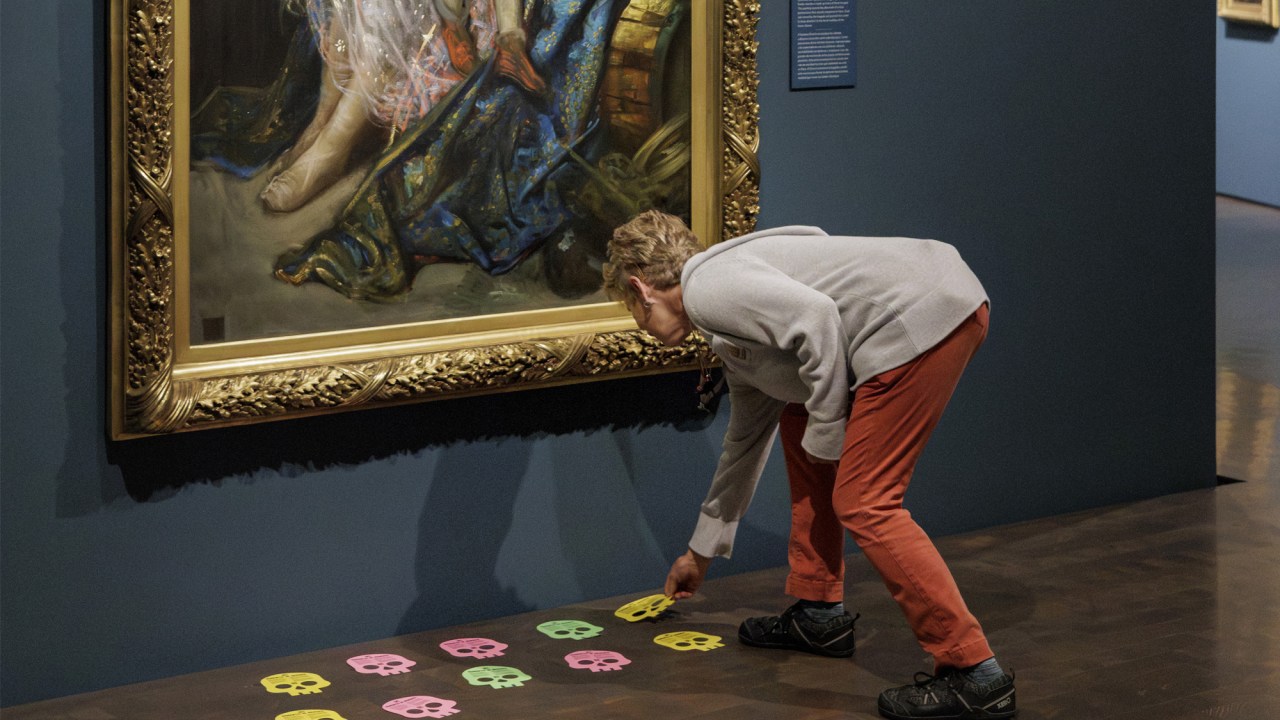
As the Interpretive Specialist for Latin American Art and Arts of the Ancient Americas, I recognized an opportunity: rather than offering didactic education about Día de Muertos, we could invite visitors into the practice itself, trusting them to engage authentically with themes of grief, remembrance, and joy. And, since ofrendas are inherently participatory, the entire museum could become a community ofrenda, allowing all visitors, regardless of background or knowledge of Día de Muertos, to engage with and visibly center emotion and memory. This led to the creation of Momentos de Memoria, an activation of the DAM’s spaces that invited visitors to place colorful paper skulls near artworks anywhere in the museum that reminded them of someone or something they had lost (intro image). The cultural underpinning that allowed for this conceptual leap was possible because staff working on both projects —the staff ofrenda and Momentos de Memoria— had personal experience with Día de Muertos.
Design
Turning the museum into an ofrenda required deliberate design choices that balanced freedom with cultural grounding. We chose vividly colored paper skulls that were unmistakably connected to Día de Muertos yet open enough that visitors could project their own meanings onto them.
The invitation was intentionally simple: This skull is part of Momentos de Memoria. As an act of remembrance, place it near an artwork that reminds you of someone or something you have lost.
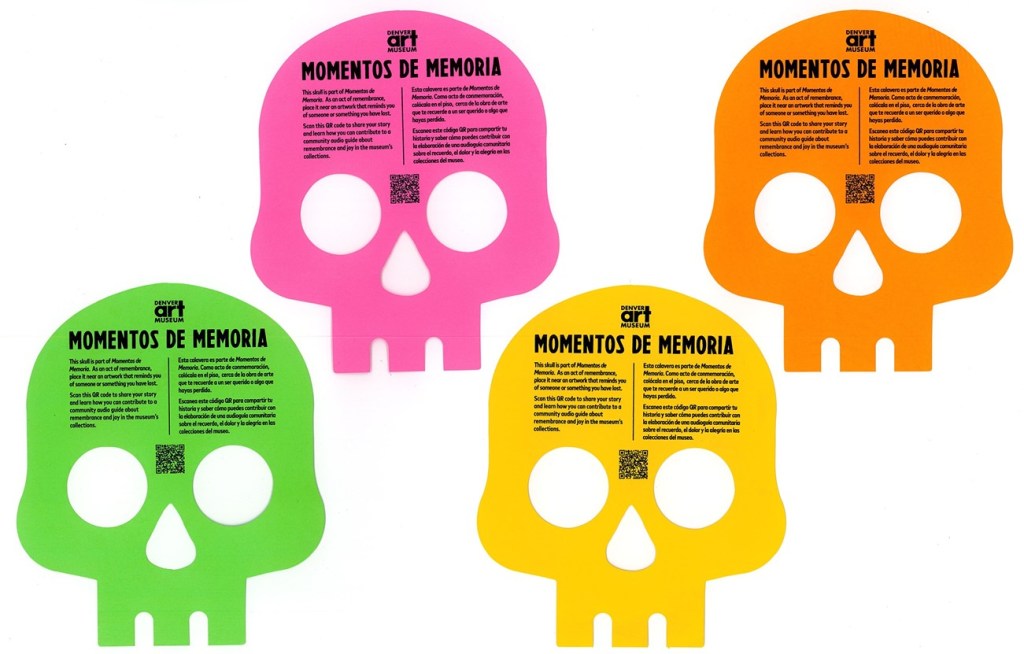
Presented in English and Spanish, this text appeared at stations throughout the museum and on the skulls themselves (fig. 2). The prompt, skulls, and ofrenda tradition provided material and cultural scaffolding. Visitors understood what to do without extensive instruction, whether familiar with Día de Muertos or not.
The only digital element was a QR code that linked to a form where visitors could opt to share which artworks they chose and why. This served two purposes: gauging interest in a future community-generated audioguide and acknowledging visitors’ potential need to share stories that required more space than the paper skulls allowed. The digital component remained supplementary, never a requirement.
Implementation
Momentos de Memoria ran from October 27 through November 2, 2025. We decided to extend the program beyond Día de Muertos itself to allow more visitors to participate and to allow time for the skulls to accumulate throughout the museum, mirroring how traditional ofrendas function through layered contributions.[2]
We placed five stations throughout the museum’s three buildings, allowing visitors to encounter Momentos de Memoria organically during their visit. This distribution integrated memorial practice directly into art engagement. Visitors moved freely, placing skulls without staff mediation beyond the initial prompt. This was a form of institutional trust: by relinquishing control over outcomes, the DAM allowed emotion and memory to enter the museum unpredictably.
Remarkably, the program generated no significant institutional resistance. Initial concerns about visitors placing skulls directly on artworks never materialized, and visitors honored boundaries without enforcement. I believe this is due to the DAM having a history of interpretive activations and installations that have built institutional trust in visitor behavior. Additionally, I suspect that a significant factor was the emotional context of Momentos de Memoria itself. Visitors engaging with grief and memory were not approaching the experience lightly. The emotional weight of the subject seemed to invite its own care.
If a visitor were to place a skull on an artwork, there were established protocols the museum’s frontline staff could fall back on—politely reminding guests to be mindful of the art, not to touch artworks, and reporting any tampering. For institutions considering a similar program, there is a need to manage risk, but the deeper lesson may lie in building trust with visitors.
Data and Observations
Through a constructivist perspective, learners actively construct knowledge rather than passively receive it. This means that what a person takes away from a museum visit is shaped by what they bring to it, such as prior knowledge and experience, cultural background, and the particular conditions of their visit.[3] Viewed through this lens, Momentos de Memoria reveals how culturally grounded meaning-making can transform the museum from a place of passive consumption into a space for active memorial practice.
Numbers and Distribution
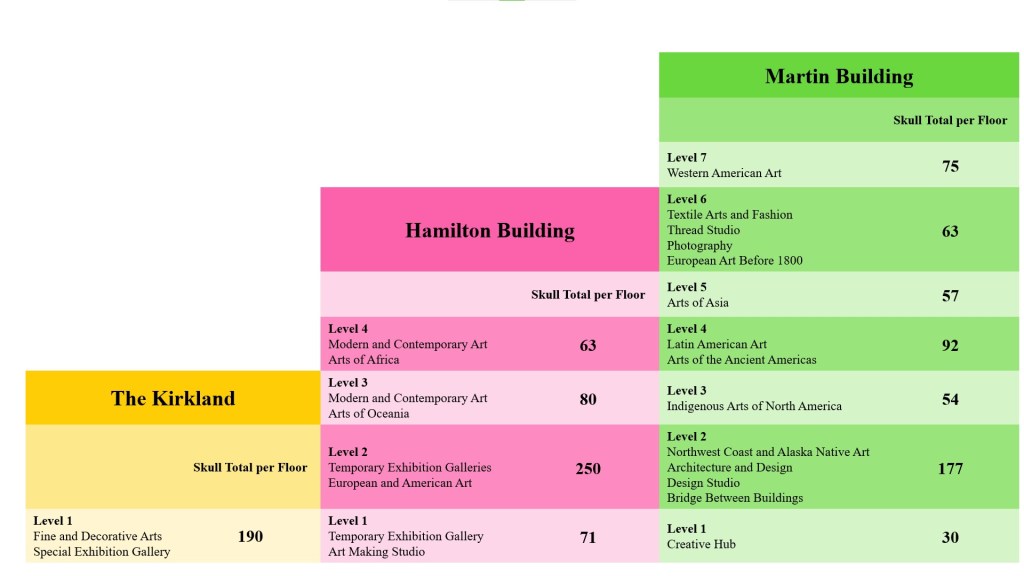
Over the course of the week, visitors placed approximately 1,200 paper skulls at roughly 600 artworks and exhibits across the museum’s three buildings (fig. 3). Skulls appeared in nearly every gallery, evidence that visitors carried them considerable distances, either knowing exactly where they wanted to place them or holding on to them until a work resonated. Distribution followed predicted visitor flow: starting on upper floors, moving downward, and concentrating in high-traffic areas. The only exception were the Latin American Art and Arts of the Ancient Americas galleries, which showed a slightly higher skull placement than their positions in a typical visit would predict. This suggests the possibility of a cultural affinity felt by visitors who may have sought out spaces that aligned with the Día de Muertos memorial practice.
Embodied Practice and Visitors as Co-Curators
The accumulation of skulls functioned as a type of “visitor-curated exhibition” that changed continuously as new participants added contributions. The specific placement of skulls was striking, ranging from solitary acts of remembrance—219 works had only a single skull placed beside them—to communal expressions of grief. Gustave Doré’s The Family of Street Acrobats: The Injured Child (1873), shown in fig. 1, drew the most offerings, 29 skulls, hinting that some works carry a particular resonance for grief that transcends individual experience.[4]
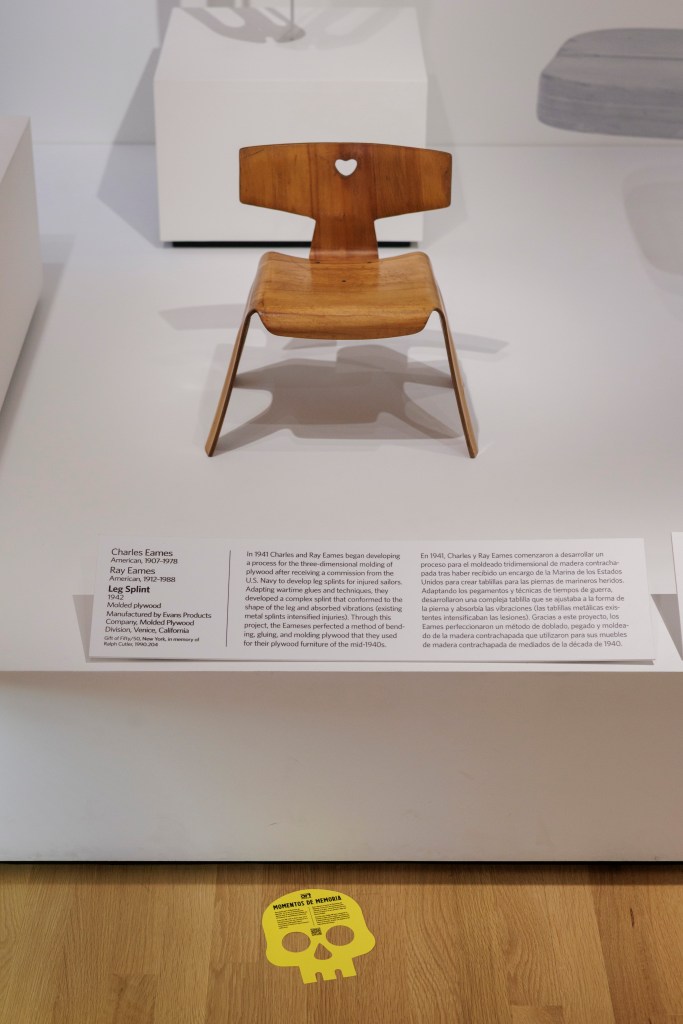
This emergent exhibition transformed how visitors moved through space. Rather than following wall text or audioguides, visitors oriented themselves through others’ placements. In an informal conversation, one visitor working in childhood trauma care shared that she used the skulls as a guide, allowing strangers’ offerings to draw her toward works that connected to her profession, such as a child’s chair (fig. 4). Others expressed curiosity about what prompted specific placements, initiating spontaneous conversations about art and loss. When the institution relinquished its control, visitors created a museum-wide exhibition about grief and memory that no single curator could have designed.
Qualitative observations revealed rich layers of visitor engagement through embodied actions. In-groups of visitors participated together, discussing skull placement and sharing memories. This collaborative meaning-making reflects familismo,a Latin American cultural value that emphasizes interpersonal relationships and unity.[5] Additionally, visitors often carried multiple skulls and were seen lingering in galleries before finally deciding where to place one. As the museum became an ofrenda, it transformed from a space of individual viewing into a collective landscape of shared emotions and memories where visitors could compare their experiences with others while maintaining distinct perspectives.[6]
The number of Momentos de Memoria participants, as well as their various forms of engagement with the activation, validate museums as spaces that provide energy, room for emotional expression, and the opportunity for different forms of companionship. This potential holds true even in times of grief when the desire for such experiences may intensify while the strength to act upon one’s needs diminishes.[7]
Four Factors of Success
The success of Momentos de Memoria emerged from four interconnected factors:
- Using cultural practice as an interpretive framework by leaning into the ofrenda tradition;
- Positioning skulls as boundary objects that were simple enough for universal engagement yet capable of carrying profound personal meaning;
- Embracing the analog as a refuge to create space for embodied experiences; and
- Centering affect as knowledge; validating emotion and memory as legitimate forms of art engagement rather than secondary outcomes.[8]
1. Cultural Practice as Interpretive Framework
Momentos de Memoria is rooted in Día de Muertos as a memorial practice with its own deep cultural logic around maintaining bonds with the dead through material, embodied offerings.[9] This situates the activation, as an act of collective exhibition-making, within scholarly conversations about museums and memorialization. Research has shown how objects and spaces can become conduits for collective grieving, and how the act of bringing private grief into public institutions transforms both the individual and the institution.[10] What distinguishes Momentos de Memoria from the larger memorial museum tradition is that it does not ask visitors to remember or grieve a shared historical event. Rather, it invites participants to bring their own losses into direct, visible dialogue with the art on display, making the memorial practice expansive through its connections to the deeply personal.
The ofrenda tradition already contains what museums strive to create: participation and meaning-making through personal knowledge. Traditional ofrenda practice requires selecting offerings based on the deceased’s tastes, an active practice demanding embodied engagement.[11] The practice welcomes personal interpretation while maintaining cultural resonance. Momentos de Memoria worked because it facilitated rather than explained cultural practice. A didactic exhibition might display photographs, text about Indigenous and Catholic syncretism, and objects behind glass. This teaches visitors about the tradition while maintaining authority. Instead, we invited visitors into the practice, trusting them to enact forms of remembrance according to their own understandings and needs.
This approach required navigating questions of authenticity and appropriation. We never aimed to recreate home altars or cemetery vigils, but rather to extend ofrenda logic: if traditional ofrendas create sites where the living honor the dead through material offerings placed with intention, the museum could become an ofrenda where visitors placed symbolic objects near artworks resonating with memory.
2. Paper Skulls as Boundary Objects
The term “boundary object” was coined by sociologists Susan Leigh Star and James R. Griesemer in their 1989 study of collaboration between amateur and professional naturalists at Berkeley’s Museum of Vertebrate Zoology. They describe boundary objects as “both plastic enough to adapt to local needs . . . yet robust enough to maintain a common identity across sites” being “weakly structured in common use” while becoming “strongly structured in individual use.”[12] The paper skull embodied this dual nature. In communal use, the recognizable form of a calavera (skull) requires no specialized knowledge. Visitors unfamiliar with Día de Muertos can grasp its commemorative function intuitively. In individual use, each skull became invested with specific memory and meaning.
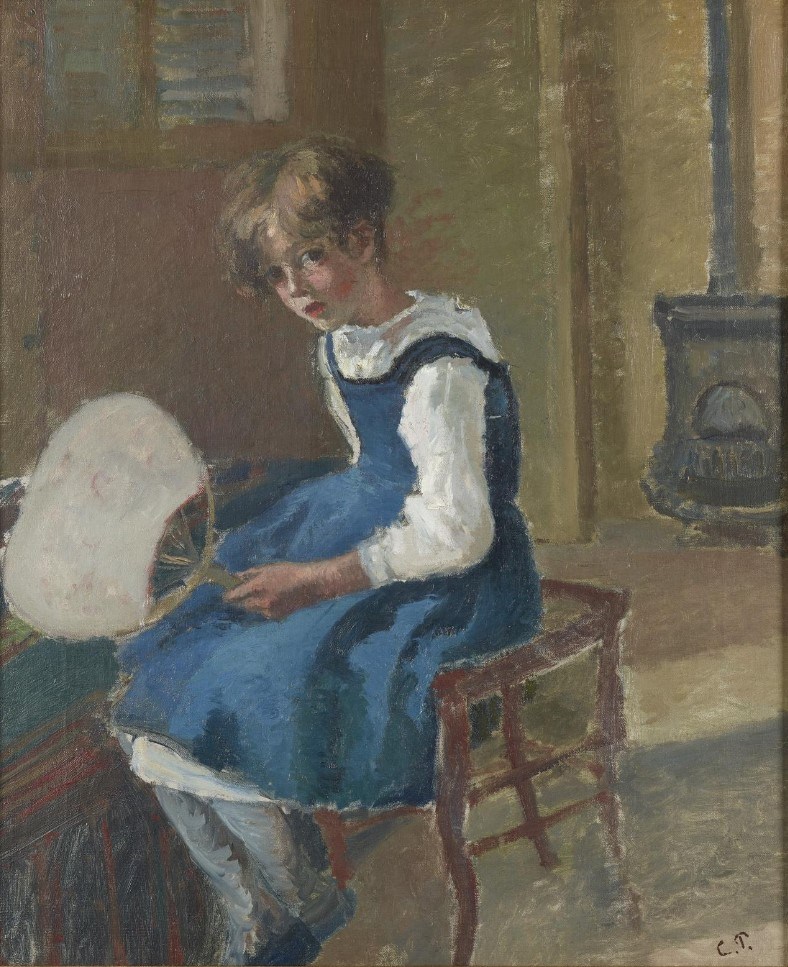
The skulls’ capacity to hold diverse meanings became evident in visitor testimonials shared via the QR code. One visitor who placed a skull at Camille Pissarro’s Jeanne Holding a Fan (fig. 5), shared:
This painting reminds me of . . . taken from our family at the hands of. . . . Her loss remains the worst tragedy of my life, and I hope to never feel such despair again in this lifetime.
The connection between artwork and memory here is entirely personal, Pissarro’s gentle domestic scene resonating with a violent loss. The skull’s simplicity as boundary object enabled this visitor to project profound grief onto an object that could hold it without prescribing how. Visitors valued their own personal meanings as they connected art to their lives, and the skull facilitated rather than constrained this meaning-making.[13]
Boundary objects enable cooperation without consensus.[14] Visitors did not need to agree on a shared understanding of Día de Muertos, the “correct” way to remember, or have identical beliefs about death. The skull allowed all participating visitors to cooperate in creating a collective ofrenda despite holding different interpretations.
The skull also navigated cultural specificity and universal accessibility. Its design is unmistakably rooted in Mexican and Mexican American iconography, yet its function transcended cultural boundaries. While specific practices are diverse, grief and a desire to honor and remember the dead are universal. Boundary objects bridge these worlds because their structure is common enough to more than one experience to make them recognizable.[15]
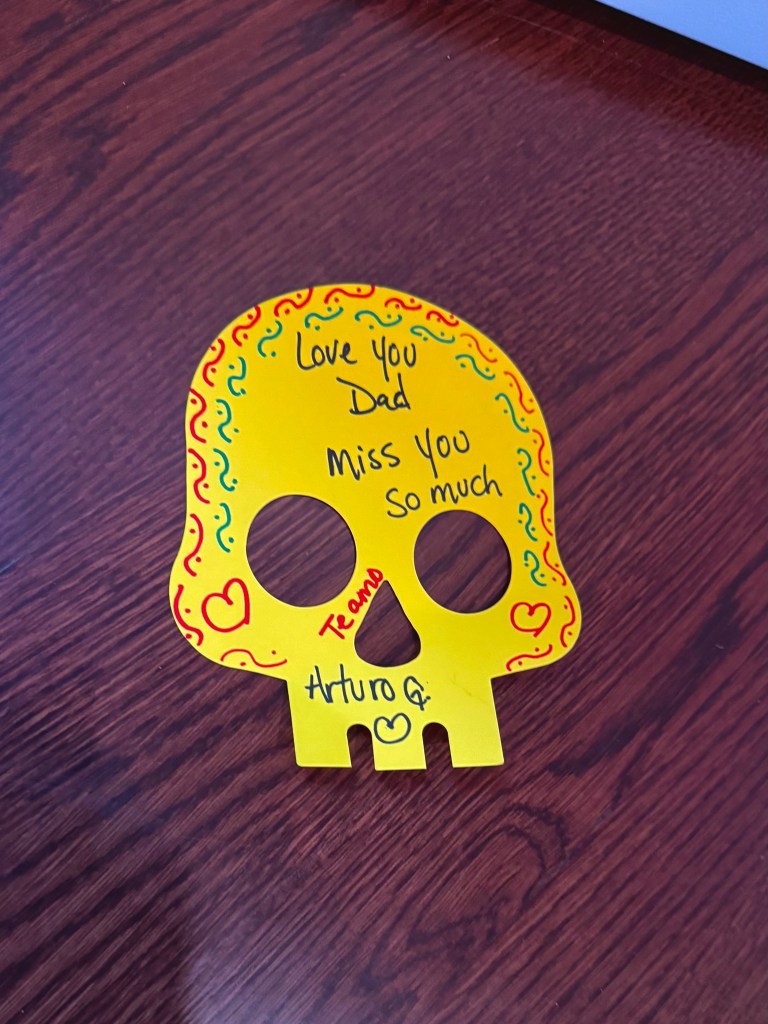
Evidence of this plasticity was made visible through visitors’ emergent practices of spontaneously writing and drawing on the skulls. This was perhaps the most instructive surprise. No materials were provided and no invitation was extended, yet, across every gallery, visitors found ways to inscribe personal messages, names, and images onto the skulls (fig. 6). These practices appeared across galleries with no clear pattern, suggesting individual need rather than environmental cue.
3. Analog as Refuge
In an era when museums are investing heavily in digital interactives, Momentos de Memoria’s analog form provided a refuge from technological overstimulation. While digital strategies offer educational and entertainment potential, overprioritizing them risks undervaluing what physical spaces uniquely provide: sustained, embodied experience and contemplation.
As tangible objects, the paper skulls offered opportunities for embodiment, slowed pace, tactility, and permanence. Physical things, like photographs in albums and frames, gather emotional resonance through spatial and social practice.[16] As skulls accumulated throughout galleries, emotion and memory gained a physical presence. We intentionally preserved contributions in situ, allowing visitors to see their own offerings reflected in a collective context.[17] A digital “memory wall” may capture more data, but it cannot replicate an embodied encounter with others’ grief. Thirty skulls clustered around an artwork communicates something visceral about shared experiences that a screen displaying “30 visitors selected this artwork” does not.
Writing and drawing embrace different processes than typing on a screen. Sourcing writing tools, accepting errors, and creating permanent marks slowed inscription, making it more deliberate. Furthermore, one visitor was observed tenderly kissing a skull, exemplifying how physical objects create powerful connections.[18] Holding the skull, feeling its texture and weight, transformed it from a symbol into a tangible carrier of memory and affection.
Crucially, the only digital element was entirely supplemental and not a requirement. People could participate fully without accessing this component, sustaining analog primacy while acknowledging some might want to share more. The digital served the analog, not the other way around.
4. Affect as Knowledge
Perhaps most fundamentally, Momentos de Memoria validated affect—grief, joy, pain, love—as legitimate forms of art engagement and knowledge production. The skulls functioned as conduits for affect, mediating relations between visitors and artworks, the living and the dead, present grief and ongoing memory. They became objects embodying human purposes and experiences and inviting us to act toward them in ways that may give us what we desire[19]—in this case, the desire to maintain bonds with the departed.
Museums traditionally privilege cognitive learning outcomes—factual knowledge, “correct” aesthetic understanding—over emotional intelligence and responses. Yet research shows visitors value not only the messages and meanings intended by museum professionals and artists but the personal, affective meanings they create themselves.[20] Three visitor testimonials demonstrate how affect functioned as knowledge.
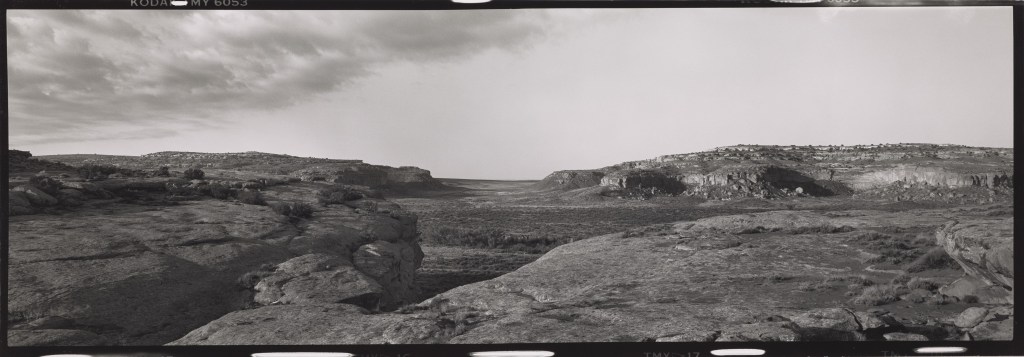
At Mary Peck’s Chaco Canyon, South Gap from North Mesa (fig. 7), one visitor reflected on how memory extended beyond grief to encompass joy, adventure, and an ongoing relationship mediated through the museum’s physical space:
This piece reminded me of when my deceased husband and I went to Chaco Canyon on a camping trip many years ago . . . we often went on camping trips . . . the more rugged the adventure, the more he enjoyed it. . . . [He] passed away in 2003, but I’m often reminded of our adventures in our Photography gallery!
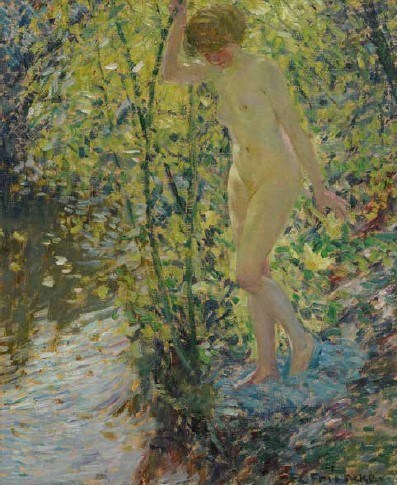
At Frederick Carl Frieseke’s Autumn (fig. 8), a visitor recalled memories of a loved one and their wisdom:
This painting reminds me of my late. . . . The dappled sunlight and femininity of the figure are breathtakingly beautiful and gentle but also strong. Autumn recalls change and reminds me of her wisdom in that “this too shall pass.”
Here, visual qualities connect to personal ones, creating meaning through affect’s generative capacity.[21]
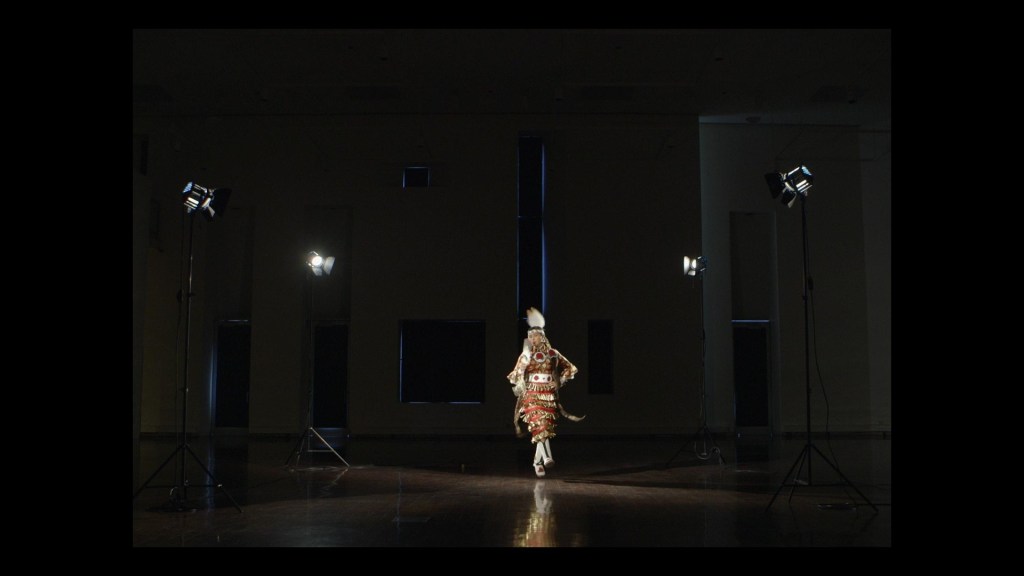
And, at Jeffrey Gibson’s one becomes the other (fig. 9), space was created for “historical unresolved grief”[22]—for ancestors and missed cultural knowledge and experiences:
This artwork reminds me to think not of those that I’ve lost in my immediate family or in this lifetime but my ancestors. I dream of the chance to have known them and their lives. It also makes me mourn the cultural experiences I missed out on not being in touch with my . . . heritage until recently.
This visitor and all the others were not failing to appreciate artistic techniques or content; they were engaging in equally valid meaning-making through emotion and memory.
Conclusion
Momentos de Memoria demonstrates a method for culturally responsive programming that reconceives exhibition-making as a collaborative, emergent process. Rather than explaining cultural practices, museums can provide space for communities to enact them directly, and, in doing so, co-create spaces that reflect visitor meaning-making rather than curatorial authority. This shifts museums from authorities to platforms.
The DAM plans to continue this activation annually in the format previously described—staff ofrenda alongside Momentos de Memoria for visitors. The emergent practices of writing and drawing on the skulls will be explicitly invited and supported in future iterations, and the DAM will provide support to local cultural organizations that wish to adapt Momentos de Memoria within their own institutions. However, replicability lies not in recreating materials but in understanding community practices and needs. What cultural practices already exist in your communities? How might you create conditions for those practices within your museum?
Museums seeking to replicate this approach must center cultural insiders in program design and implementation. My positionality as a Mexican American museum professional with personal knowledge of Día de Muertos was essential, not as an “authenticity” validator, but as someone who could navigate between institutional norms and community practice without reducing either.
Momentos de Memoria required no specialized technology, expensive installations, nor months-long fabrication. Material simplicity enabled rapid deployment and modification. The paper skulls’ limitations became strengths. We could not update them digitally nor track analytics automatically, yet their tangibility encouraged a slower pace, the contemplation of others’ experiences, and bodily engagement with shared cultural practice.
This suggests a reframing of questions: Instead of, How can we use technology to engage visitors? What should we teach visitors? and, How can we compete with digital platforms? we can ask, What practices do our communities already engage in? How can we create space for the knowledge visitors possess to flourish? and, What does an embodied, analog, and collectively held space make possible that the digital world cannot?
Perhaps the most innovative thing we can do is not to leap into technology as an assumed form of progress but to recognize that communities already possess embodied practices that can transform the museum.
[1] Ran An et al., “Digital Fatigue and Academic Resilience Among University Students With Grit and Flexibility as Mediators,” Scientific Reports 15, no. 1 (2025): 45407; Katherine N. Kinnick, Dean M. Krugman, and Glen T. Cameron, “Compassion Fatigue: Communication and Burnout Toward Social Problems,” Journalism & Mass Communication Quarterly 73, no. 3 (1996): 687–707; Andrew Hoskins, “Media and Compassion After Digital War: Why Digital Media Haven’t Transformed Responses to Human Suffering in Contemporary Conflict,” International Review of the Red Cross 102, no. 913 (2020): 117–43; Charles R. Chaffin, “Compassion Fatigue,” in Numb (Wiley, 2021); Taruni Gupta, Rahul Bodhi, and Mohd Salim, “The Intersection of Information Overload, Emotional Exhaustion, and Social Media Fatigue: A Comprehensive Literature Review,” Academy of Marketing Studies Journal 28, no. 4 (2024): 1–6.
[2] Regina M. Marchi, Day of the Dead in the USA: The Migration and Transformation of a Cultural Phenomenon, 2nd ed. (Rutgers University Press, 2022).
[3] George Hein, “Museum Education,” in A Companion to Museum Studies, ed. Sharon Macdonald (Wiley-Blackwell, 2008), 340–52.
[4] Notably, most skulls were placed at works with no obvious connection to mortality or loss, suggesting that visitors established deeply personal connections between art and memory—relationships that typically remain invisible in museum spaces but which are profoundly important to individuals.
[5] Adriana Briseño-Garzón and David Anderson, “A Review of Latin American Perspectives on Museums and Museum Learning,” Museum Management and Curatorship 27, no. 2 (2012): 161–77.
[6] Bryony Onciul, “Engagement Zones,” in Museums, Heritage and Indigenous Voice: Decolonizing Engagement (Routledge, 2015), 71–89; Nina Simon, The Participatory Museum (Museum 2.0, 2010).
[7] Lois Silverman, “Solve et Coagula,” in The Social Work of Museums (Routledge, 2010), 70.
[8] Using cultural practice as an interpretive framework, embracing the analog, and centering affect as knowledge were intentional from the earliest conceptual stages. The understanding of the paper skulls as boundary objects came into focus during development and was confirmed through visitors’ engagement with them.
[9] Regina M. Marchi, Day of the Dead in the USA: The Migration and Transformation of a Cultural Phenomenon.
[10] Paul Williams, Memorial Museums: The Global Rush to Commemorate Atrocities (Berg, 2007); Elizabeth Edwards, “Photographs and History: Emotion and Materiality,” in Museum Materialities: Objects, Engagements, Interpretations, ed. Sandra Dudley (Routledge, 2010), 21–38.
[11] Stanley Brandes, “Sugar, Colonialism, and Death: On the Origins of Mexico’s Day of the Dead,” Comparative Studies in Society and History 39, no. 2 (1997): 275.
[12] Susan Leigh Star and James R. Griesemer, “Institutional Ecology, ‘Translations’ and Boundary Objects: Amateurs and Professionals in Berkeley’s Museum of Vertebrate Zoology, 1907–39,” Social Studies of Science 19, no. 3 (1989): 393.
[13] Lois Silverman, “Solve et Coagula.”
[14] Susan Leigh Star and James R. Griesemer, “Institutional Ecology, ‘Translations’ and Boundary Objects.”
[15] Ibid.
[16] Elizabeth Edwards, “Photographs and History: Emotion and Materiality,” in Museum Materialities: Objects, Engagements, Interpretations, ed. Sandra Dudley (Routledge, 2010), 21–38.
[17] Nina Simon, “From Me to We,” in The Participatory Museum (Museum 2.0, 2010).
[18] Elizabeth Edwards, “Photographs and History: Emotion and Materiality.”
[19] Lois Silverman, “In the Service of Society,” in The Social Work of Museums (Routledge, 2010), 1–22.
[20] Lois Silverman, “Solve et Coagula.”
[21] Andrea Witcomb, “Remembering the Dead by Affecting the Living: The Case of a Miniature Model of Treblinka,” in Museum Materialities: Objects, Engagements, Interpretations, ed. Sandra Dudley (Routledge, 2010), 39–52.
[22] Amy Lonetree, “Introduction: Native Americans and Museums,” in Decolonizing Museums: Representing Native America in National and Tribal Museums (University of North Carolina Press, 2012), 25–51.
Manuel Ferreira is an Interpretive Specialist at the Denver Art Museum in Denver, Colorado.
Upcoming Events
-
From Informational Interview to Real Connection
Event Date:Presented by: American Alliance of Museums and National Emerging Museum Professionals Network -
Understanding the U.S. History Workforce
Event Date:Presented by: American Association for State and Local History (AASLH) -
TrendsWatching: To Live or Die in AI Webinar
Event Date:Presented by: American Alliance of Museums -