This review first appeared in the journal Exhibition (Fall 2026) Vol. 45 No. 2 and is reproduced with permission.
Noise: A Flaw in Human Judgment
Daniel Kahneman, Olivier Sibony, and Cass R. Sunstein
Published by Little, Brown Spark, available in hardcover, paperback, Kindle, and audiobook, 2021, 452 pages.
When you are working on an exhibition, do you tend to meet with your team in the morning or afternoon? Have you had your coffee? Eaten lunch? Has an earlier meeting affected your mood? What about the weather; is it sunny or rainy? How are your colleagues feeling? The answers to these questions may seem irrelevant, but they all contribute to noise, and they may play a bigger role in the decisions you are making than you think.
While bias is a known contributor to skewed judgments, noise, defined here as “unwanted variability,” is the often forgotten but scandalously present cause of human error in decision-making. Noise: A Flaw in Human Judgment details where noise comes from, its impacts, how it can be measured, and how it can be reduced.
Authors Daniel Kahneman, Olivier Sibony, and Cass R. Sunstein hold professorships at world-renowned institutions with expertise in economics, strategy, and public policy. Kahneman is the author of Thinking, Fast and Slow (2013), a bestseller which differentiates the two modes of thinking into System 1 (fast, emotional, and instinctive) and System 2 (slower, logical, and calculated). The thesis of this book makes its way into Noise;perhaps it could be further reading should your decision hygiene need a little more maintenance.
Noise: A Flaw in Human Judgment is not about museums, cultural institutions, or any particular field at all. Noise, the authors inform us, affects every industry at every level. The book addresses noise in medicine, the law, forecasting, patents, and more to illustrate this point. By cataloging the vastly differing sentences judges have issued on the same cases and diagnoses among doctors on the same patient, the authors demonstrate the tremendous variability that is present in places where the tolerance for error should be slim. Trends in single judgment decision-making fluctuate based on the weather, whether the local football team won the night before, and how close it is to lunchtime: “Judges have been found more likely to grant parole at the beginning of the day or after a food break than immediately before such a break. If judges are hungry, they are tougher.” While bias is often thought of as the star of the show in flawed decision-making, noise is the culprit behind widely varying judgments despite the same conditions.
Structure of the Book
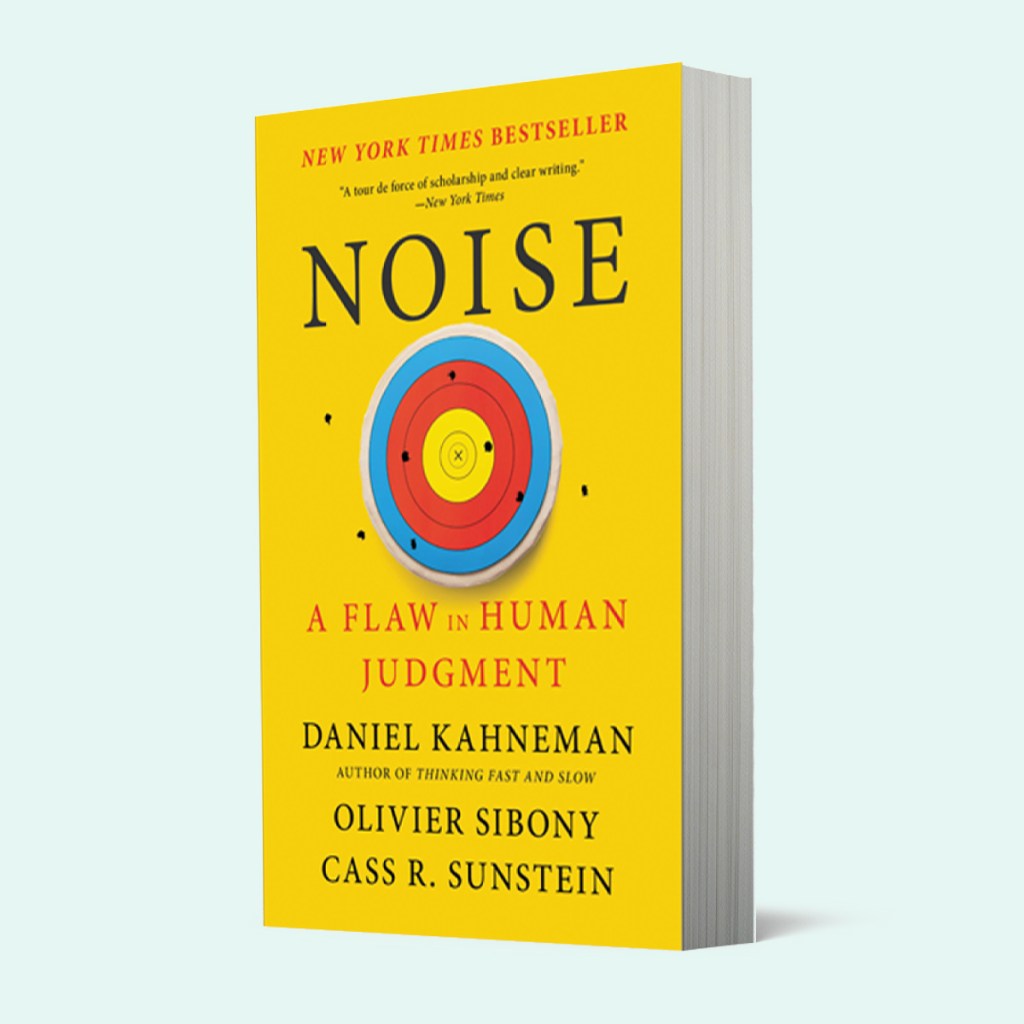
The authors open with an explanation of the book’s cover image: a shooting-arcade target riddled with holes, none of which have hit the bull’s-eye—and some of which have missed the target completely. This is a noisy target: the bullets have scattered wildly. In an ideal world, the shots would have been tightly clustered around the bull’s-eye. If the shots were tightly clustered but skewed away from the bull’s-eye, that would be a biased target; some external factor is skewing the shooters from the center. The noisy target, with its wide variability between shots and no noticeable skew, is a recurrent metaphor for noise throughout the book and a useful visual for what the authors mean when they describe something as “noisy.”
From here, the book is divided into six parts and three appendices. Part One expands on the difference and relationship between noise and bias: “wherever there is judgment, there is noise—and more of it than you think.” Part Two examines human judgment and how to measure accuracy and error. The discussion of occasion noise is particularly salient. The authors illustrate what occasion noise is by looking at different sentencing decisions made on the same case by the same people but on different occasions. Many factors can influence occasion noise; the book points out the weather, time of day, mood, and order of decisions made, stating, “the chance that an asylum applicant will be admitted into the United States drops by 19% if the hearing follows two successful ones by the same judge.”
Parts Three and Four are perhaps the densest, describing predictive judgment and human psychology as they relate to noise. The authors make use of various exercises and scenarios to illustrate their points, and these are effective in enhancing the reader’s understanding of more complex statistical principles. In the discussion of predictive judgment, we learn how poorly humans perform in long-term forecasting, and that computer models do not fare much better. The importance of causal thinking—reasoning through the potential chain of events that would cause a particular outcome—is also explained. While many of the statistical analyses are slightly beyond my level of comfort, even I am familiar with the warning “correlation does not imply causation.” Causation, however, does imply correlation. Once we understand the cause of something unexpected, the occurrence has an explanation and no longer seems so unpredictable. Causal thinking is rife with errors, but it’s also how individuals make sense of the world, which is why we must also consider the statistical view of an event. Part Four, centering on human psychology, describes the interpersonal relationships and idiosyncrasies that contribute to noise on the human level; the next time you and your coworker disagree on a judgment, be sure to check whether you’re using the same scale.
Part Five offers practical approaches to improving judgments and preventing errors. The authors describe the importance of using shared guidelines and scales in group decision-making settings, though guidelines for individual decision-making probably wouldn’t hurt either. The Mediating Assessments Protocol, a framework that adds as much decision hygiene as possible into a decision-making process, is also introduced. Notably, the emphasis is on process, not content. While a focus on process may feel bureaucratic, the goal of this protocol is the development of a structure that prompts debate rather than stifling it with false consensus. Coming from the government, I found this to be thrilling.
Part Six discusses the optimal level of noise, which is, unsurprisingly, not zero. Decisions need room for the human factor. As the authors write, “No one is marching under a banner that says, ‘Algorithms Now!’” Removing noise can be a costly endeavor, financially and, more importantly, in its effects on human dignity. In the creation of constraints to reduce noise and increase fairness, we also potentially constrain creativity, morality, and human-to-human relationships. The reduction of noise is an exercise in balance achieved through the creation of standards that promote fairness while also leaving room for humanity.
The appendices offer practical tools for those looking to reduce noise within their organizations, describing how to conduct a noise audit, a checklist for decision observation, and prediction correction.
Noise can be horribly unfair. Your life should not depend on which doctor, judge, patent officer, hiring manager, or social worker is assigned to your case. Awareness of noise, as an equal or greater contributor to flawed judgments as bias, and the enactment of standards for its reduction, is a path toward a more just world.
Museums as Noisy Spaces
While I was familiar with noise within the statistical context, “unwanted variability” is not the immediate definition that comes to my mind when considering noise. Rather, I think of the constant influx of content, news, and distraction that is omnipresent in our modern world. But that noise causes this noise: the constant chatter distracting and subtly influencing us in ways we may not even be conscious of causes the unwanted variability. A person is not capable of System 2 thought (slower, logical, calculated) when constantly inundated with noise. Through the development of structures and protocols to reduce noise, we may be better equipped to collaborate more seamlessly and creatively with less worry about the unknown.
Museums are noisy spaces, and for those of us who work in exhibitions, it can feel like we are at the center of it. Our timelines and budgets are often tighter than we wish, and the pressure to perform is high. One flawed decision can have lasting impacts throughout the course of a project and beyond. Moreover, each project brings its own special challenges, making a standardized approach complicated. I am interested in considering how a framework such as the authors’Mediating Assessments Protocol (Part 5, chapter 25) could streamline some decision-making within exhibition development. Consider, for example, the potential impacts of establishing independent assessments upon which a decision would be made. These assessments would be investigated independently of one another and the analyses provided to the decision-making committee in advance of a meeting. Once the group has gathered, the assessments would be summarized and, through the use of an anonymous polling app (to remove the effects of staff hierarchy), the group would be polled and the distribution of individual decisions projected. Sometimes this will reveal consensus; other times, significant division. A discussion would follow to address the dividing viewpoints and then the group would be polled again.
This should reduce noise, as the discussion would reveal the sources of variability within the group and give individuals time to assess their colleagues’ differing points of view. At the conclusion of the meeting, final judgments would be made, delaying but not removing intuitive judgments. Would the final group decision necessarily be the correct one? That is unknowable.
Within Noise, the authors caution against confusing unwanted variability with wanted diversity. In the museum sector, that distinction is incredibly important. Museums are filled with purposeful noise. Within exhibitions, it is our job to offer visitors a variety of objects, perspectives, and interpretive strategies to choose from in order to develop their own understanding of the subject matter—which, if we’ve done our jobs the way we hope, will align with our key messages and visitor takeaways. The exhibition content, including the objects on view and the different histories surrounding them, as well as visitors’ experiences of these elements are places of wanted diversity. Decisions about what that content is, how it is displayed, how it is interpreted, and what timeline this all happens on, on the other hand, may be areas where noise is less tolerable. Development and adherence to structures and protocols that standardize these decisions could reduce strain on staff and allow for a more targeted workflow where responsibilities and expectations are clear and fair.
As discussed above, Appendix A offers instructions for conducting a noise audit. I am curious not only about what a noise audit within a museum context would reveal, but whether it would even be possible. A noise audit requires a great deal of planning and resources. It also requires all qualified professionals to participate by offering a judgment on a standard case within the organization; the examples described within the book are court case judgments and insurance underwriting. In a museum, “standard” is a complicated term. I struggle to think of a situation so standardized that my colleagues, with all their varied expertise, could offer a judgment on it. Perhaps the degree of preparation needed to officially move forward with an exhibition, or if an exhibition element needs further evaluation with a focus group? Conservators, curators, designers, visitor experience associates, educators, etc., have different goals and different purviews. The range of subject matter expertise adds to the noise, but it also adds to the specialness of museums. By combining the strengths of all this varied expertise with their different, often competing, priorities, we offer visitors multiple points of entry to the mission of an institution.
At a moment when museums and their exhibitions face enormous challenges, awareness of noise and the practice of decision hygiene are extremely important. By decreasing noise, we increase our accuracy and make better judgments. Noise: A Flaw in Human Judgment clearly defines noise and its impacts while offering practical approaches to its reduction. Unwanted variability turns decisions into lotteries and increases unfairness for everyone. However, the reduction of unwanted variability can never result in the reduction of wanted diversity, especially within a museum context. By increasing our awareness of noise and resolving to decrease the amount of it we contribute to, we are more likely to hit the target with each decision we make.
Claire Caverly is Exhibitions Project Manager at Cooper Hewitt, Smithsonian Design Museum, in New York, New York.
Upcoming Events
-
From Informational Interview to Real Connection
Event Date:Presented by: American Alliance of Museums and National Emerging Museum Professionals Network -
Understanding the U.S. History Workforce
Event Date:Presented by: American Association for State and Local History (AASLH) -
TrendsWatching: To Live or Die in AI Webinar
Event Date:Presented by: American Alliance of Museums -