This article first appeared in the journal Exhibition (Fall 2026) Vol. 45 No. 2 and is reproduced with permission. If you don’t read the journal, become a member to receive your digital copy of the full upcoming issues.
Audiovisual (AV) technology in museums is often associated with stimulation: motion, sound, spectacle, and sensory intensity designed to capture attention.
Screens glow. Speakers hum. A voiceover begins on a film. A touch screen chirps while a child fiddles with it. None of it is particularly loud, but together the effect can feel like a quiet cacophony that steadily demands, and sometimes exhausts, your focus.
Museums rely on AV because it works. It animates history, gives voice to people who would otherwise remain silent, and transforms objects into narratives. Through sound, projections, or interactive media, it helps convey complex ideas and evoke emotion, turning static galleries into immersive environments.
But when too many of these systems share the same space, they begin to compete. Visitors, already arriving with digital fatigue and information overload, are pulled in multiple directions. The result isn’t deeper engagement, but acceleration: scanning, sampling, and moving on.
There’s a common assumption in exhibit design that effectiveness requires command: movement to catch the eye, spectacle to create a “wow” moment, interaction to deepen content. And while these tools have their place, AV doesn’t always need to perform so loudly. It can be quieter.
When designed with intention and restraint, AV technology can cut through the noise, slowing visitors, reducing cognitive load, and creating space for calm, meaningful engagement. Sometimes its most powerful role isn’t to create the noise, but to soften it.
Reframing AV: From Content Delivery to Pace-Making
In the 1970s, psychologist James J. Gibson coined the term “affordances.” It’s a fancy way of saying that environments drop hints about how we should act. A chair affords sitting. A staircase affords climbing. We don’t study a chair to figure it out; we intuitively know what it affords, so we just sit.[1]
Museums rarely describe AV this way, but they should. Screens, speakers, and glowing “Press Me” buttons are all digital affordances. A large LED wall says, “Look at Me.” A looping narration says, “Stand Here and Listen.” Combined, these cues suggest an exhibition’s pulse: how visitors move, where they linger, and when they give up and go home.
In that sense, AV does more than deliver content. It affords pace.
This is where the concept of ambient AV comes in. Ambient AV often refers to audiovisual systems whose purpose is to shape the mood of a space without being the primary object of attention. It treats media as infrastructure rather than attraction. It may create atmosphere instead of narration, respond to presence rather than loop endlessly, and remove the urgency of timed cycles. At its best, it’s barely noticed.
Exhibit designers already choreograph physical space through sightlines, transitions, intro graphics, and seating. AV should be part of that same choreography. Cognitive science reminds us that attention is finite, and many museum environments overdraw it.[2] As noted by arts journalist Manuel Charr in MuseumNext, the rise of “Quiet Hours” in museums isn’t just a trend for specific groups; it’s a response to a universal need for “stress-free environments” where visitors can “explore at their own pace without the pressure of sensory redirection.”[3]
Ambient AV supports that need. When audiovisual systems regulate tempo instead of competing for attention, they become part of an exhibition’s sensory architecture, subtly guiding movement, inviting stillness, and creating conditions for deeper engagement with collections, personal histories, STEM concepts, etc.
From Concept to Practice
The role of AV as pacing infrastructure becomes clear when grounded in real spaces. Museums are increasingly moving away from screen-saturated environments toward audiovisual design focused on atmosphere, tempo, and choice.
This article highlights five AV strategies that shift media from content delivery to pace-making. Though varied in scale and technology, each shapes atmosphere, guides tempo, and supports more intentional forms of engagement.
- Decompression Thresholds: Entry environments where transitional AV resets the nervous system and signals a shift in tone.
- Reflective Pause or Immersive Calm: Spaces of intentional stillness that offer relief within content-rich galleries.
- Endless Media: Continuous, nonlinear visuals with no clear beginning or end, removing pressure to catch a moment.
- Ambient Soundscapes: Audio environments that build emotional architecture without narration, reducing competition for attention.
- Intimate Proximity-Based Activation: Media that responds to presence, encouraging engagement while minimizing background noise.
It’s easy to read these as “simple” AV, but they are anything but. These experiences rely on tightly coordinated systems, precise tuning, and intentional restraint, all of which require AV expertise—an AV designer and integrator—to be embedded early in the creative process. The softness is engineered. The calm is constructed. Effective ambient AV doesn’t happen by accident. It requires a highly precise blade shaped as much by technical rigor as by creative intent.
Decompression Thresholds
Some of the most powerful uses of ambient AV in museums unfold before the story fully begins.
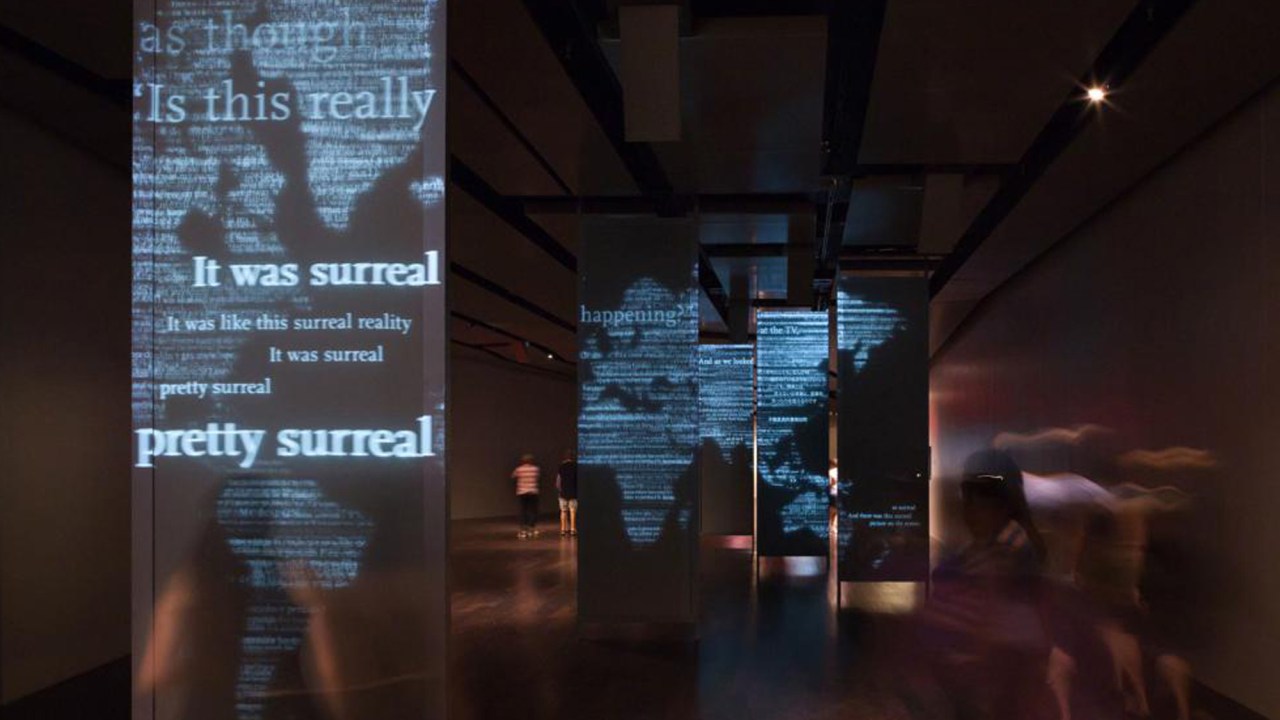
At the 9/11 Memorial & Museum, the long descent ramp into the museum functions as a kind of emotional and sensory threshold. Along the ramp, six floor-to-ceiling column-like forms carry memories. Ceiling-mounted video projectors cast fields of text across their surfaces, filling them with fragmented phrases and recollections. A tapestry of firsthand audio accounts can be heard—layered voices sharing what they saw, heard, and felt on September 11. The effect is less like listening to a story and more like moving through collective memory. There is no single focal point, and the space is meant to be experienced as visitors stroll slowly down the ramp (intro image).
A similar approach can be found at the Legacy Museum in Montgomery, Alabama. The long introductory space evokes the transatlantic crossing as both history and atmosphere. A central path is flanked by rows of sculpted heads by artist Kwame Akoto-Bamfo, representing the more than 12 million African men, women, and children who were kidnapped and sold into slavery in the Americas, including 2 million who perished at sea. Along both walls, ceiling-mounted projectors display slow-moving ocean waves that cascade downward and wash over the sculptures. The sound of surf is present but understated. The video projections are immersive but restrained.
In both spaces, AV encourages visitors to shift from the world outside the museum to the one within it, from distraction to attention, from movement to reflection. It does not push content so much as establish tone, preparing visitors for the serious subject matter that lies ahead in these museums of hallowed ground.
Reflective Pause or Immersive Calm
The exhibits at the Mississippi Civil Rights Museum are organized in a hub-and-spoke layout, meaning that the seven galleries are accessed via a primary central space. Because the subject matter in the surrounding galleries is emotionally challenging—topics include slavery, lynchings, and the violence of 1964’s Freedom Summer—the hub is designed as a place of respite.
In This Little Light of Mine, as this multistoried cylindrical space is called, colorful lighting softens the walls. A flowing “ribbon” of stretched fabric and LED lighting hangs overhead. Dedicated seating is provided. And an ambient soundscape of civil rights hymns fills the air. “Visitors are often shaken when they emerge from the galleries,” explains Alan Hoff of Monadnock, the firm that designed and produced the media experiences at the museum. “It’s comforting to sit there with other humans. The music is immediately healing. People stay for 5 to 10 minutes before resubmerging themselves into the horrors of the next gallery (fig. 1).”[4]
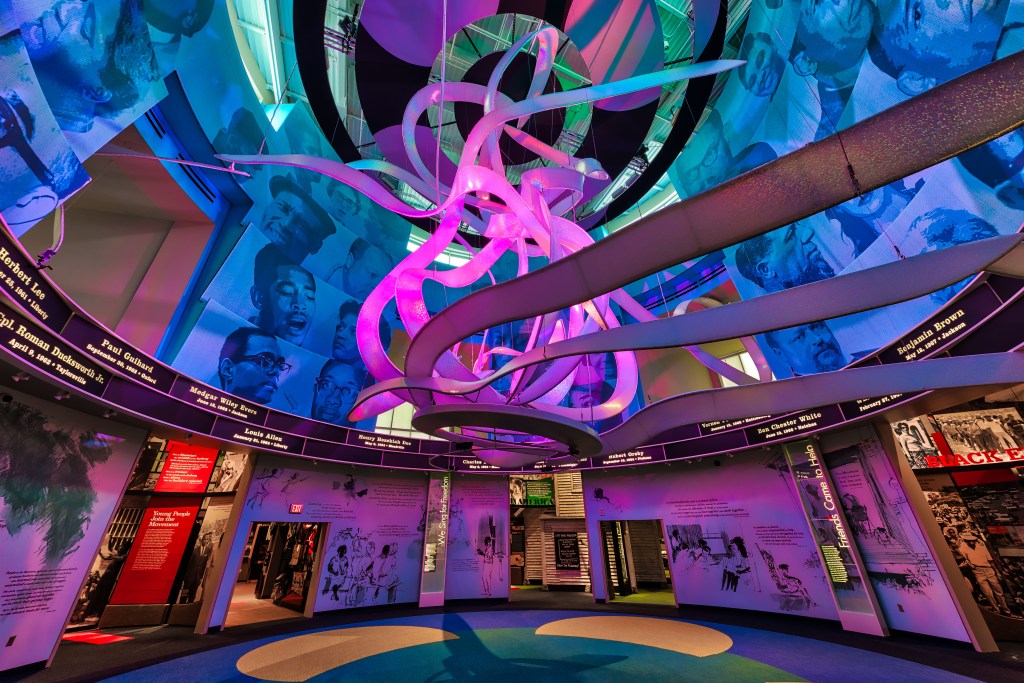
After the hard-hitting content-dense galleries, this space acts as a kind of reset. It rests the mind and body while allowing the themes of the exhibition to settle. The impact is immediate. Visitors regulate their own engagement: sitting briefly, remaining for extended periods of time, or returning again and again to reset.
AV fills the space, but to the visitor it’s more of a soft blanket than a show, which raises an important question: Are museums willing to dedicate resources to AV that is quiet and space to places where visitors have permission to simply be present? In This Little Light of Mine, the answer is clear. The technology recedes, and in doing so, allows the experience to deepen.
Endless Media
Endlessly looping media may be a counterpoint to the triggered beginning/end of many AV experiences in museums. AV can set the tempo, not just provide content, affording the visitor stillness. From 2022 to 2023 at the Museum of Modern Art (MoMA) in New York, Refik Anadol’s temporary piece, Unsupervised, did just that (fig. 2).
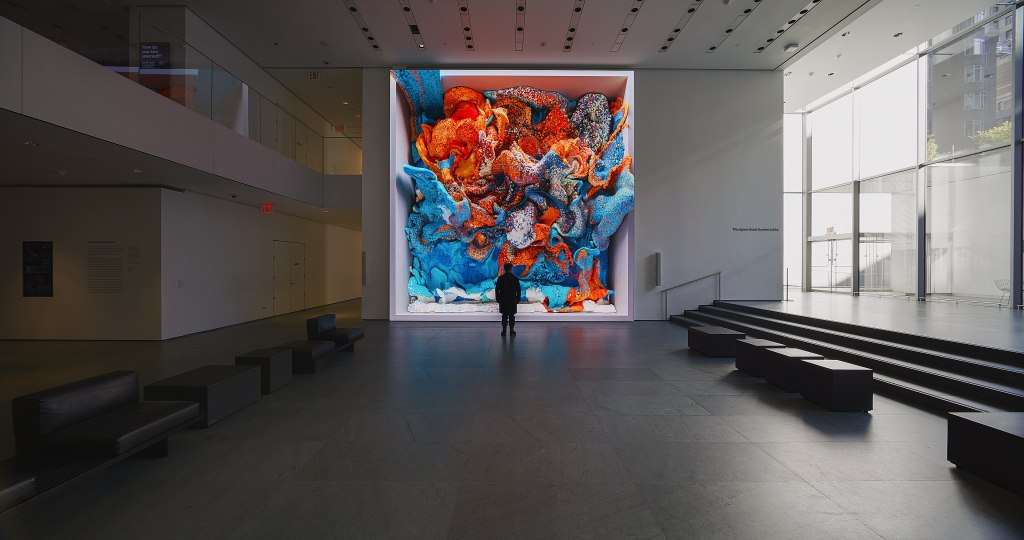
Presented on 625 square feet of LED, with more than 15 million pixels,[5] the installation pulled metadata from MoMA’s collection database and used AI to generate fluid, continuously evolving abstract visuals. There’s no beginning and no end. Visitors arrive when they arrive, stay as long as they choose, and leave without feeling they’ve interrupted or missed part the experience.
The impact is measurable. In an episode of 60 Minutes, MoMA reported that visitors spent an average of 38 minutes with Unsupervised, whereas 28 seconds is the average time spent in front of “traditional” works of art like oil paintings or sculptures.[6] The technology doesn’t demand attention; it sustains it.
There’s a similar vibe in Christian Marclay’s The Clock (2010),[7]which was on view at MoMA from 2024 to 2025. The Clock is a montage of thousands of film clips that runs for 24 hours. There is no correct entry point. Whether a visitor stays for five minutes or five hours is guided by their own curiosity, not the media’s structure.
Both works suggest that when every AV/media experience in a museum has a start time and reset, visitors are subtly trained to move on. Endless media offers another approach, where a guest is allowed to settle rather than chase the next cue. Most museums will never commission an Anadol or a Marclay, but the underlying lesson is still applicable: through choices that are entirely within the control of exhibition design teams, such as whether content loops continuously or waits for a trigger, AV can influence not only what visitors learn, but the pace at which they engage. Sometimes the most valuable design decision is not adding more content but removing the sense of urgency around consuming it.
Ambient Soundscapes
In the Welcome Hall of the Christian Science Publishing House’s How Do You See the World? experience in Boston, sound shapes the environment without stepping into the role of narrator. The Hallcomprises three distinct AV exhibits—a 14-screen projection, an interactive touch table, and an orientation film—but what binds them together is a carefully composed sonic architecture (fig. 3).
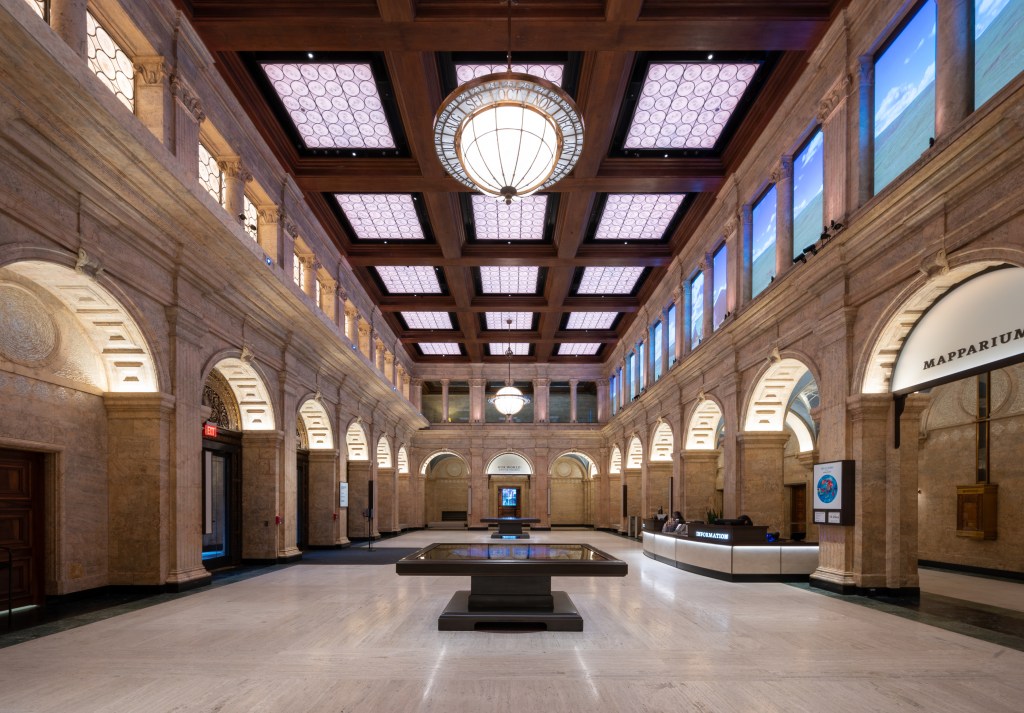
A two-hour-long looping custom soundtrack by composer and cellist Rebecca Foon blankets the entire space. It’s tonal, spatialized, and sets a calm, welcoming pace. “We had to find the right style of ambient music,” says Ken Winikur of Winikur Productions, which developed the media for this museum-like environment. “It’s not intended to be front-and-center but designed to be tuned out. It’s like mental insulation, allowing you to focus, rather than demanding that you focus on it.”[8]
This is sound as infrastructure, not instruction.
The Welcome Hall is acoustically challenging. It’s an open space with stone surfaces. In addition to tourists, employees bustle to the nearby elevators. The space is bouncy and busy. Sound remediation was done, and the music plays through a 7.1 audio system, an eight-channel Surround setup often used in movie theaters.
“The goal was to add an ambient soundscape that would make the space feel quieter,” Winikur continues. The audio softens the edges of the Hall, allowing the projections and exhibits to coexist without competing for attention. It is transportive without being directive, and present without being insistent.
Not all museum audio needs to explain or dramatize. Sound can simply create the conditions for presence. In the Welcome Hall, presence is enough. And the experience is stronger for it.
Intimate Proximity-Based Activation
The National WWI Museum and Memorial, in Kansas City, Missouri, is widely regarded as one of the world’s leading military museums. Yet even amid its dense array of artifacts, graphics, and immersive theatrical experiences, visitors still seek quiet, focused moments. The museum’s Encounters exhibit succeeds at exactly that.
Across four stations, each presenting four personal stories, visitors meet individuals shaped by the First World War: a soldier, a nurse, and a young boy, among others. The experience is deeply character-driven, and while the AV is layered and sophisticated, it rarely calls attention to itself. “The goal was to make the technology imperceptible to the storytelling,” explains Chris Conte, Executive Consultant at Electrosonic, the company responsible for the AV design and integration. “We created a guest experience that’s truly intimate (fig. 4).”[9]
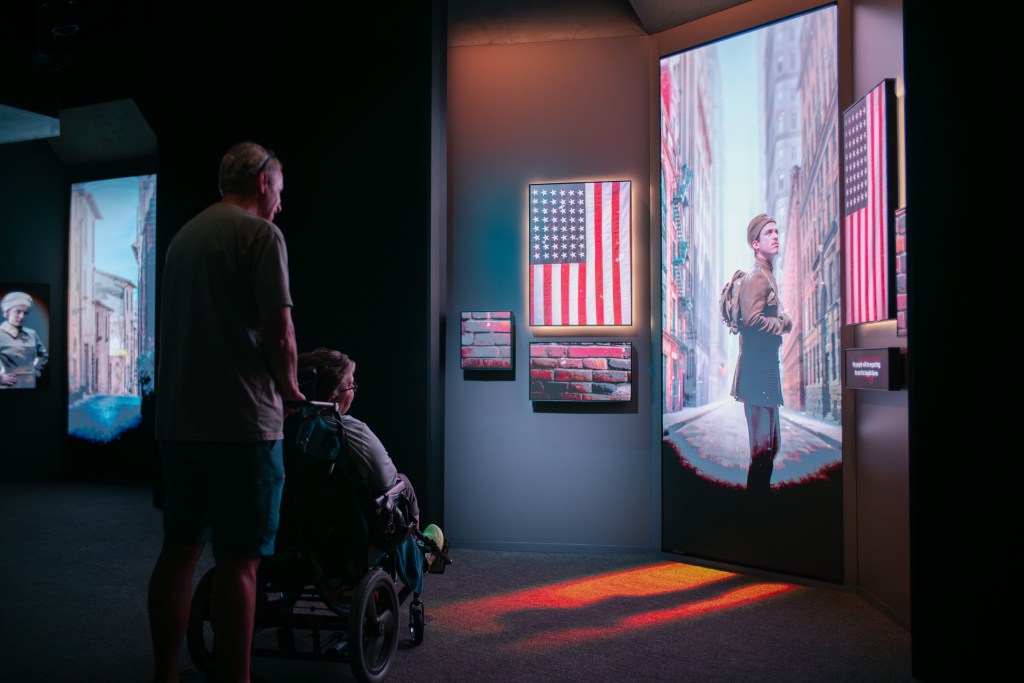
As visitors approach, sensors activate the scene. A life-size figure appears on a central LED display, moving toward the viewer with a painterly realism that obscures the underlying pixels. Supporting LED elements provide captions and contextual imagery, while a ceiling-mounted projector extends the figure’s presence through a dynamic shadow on the floor. The result is a subtle spatial illusion; what Conte describes as the eye “stitching the experience together into something almost three-dimensional.” Directional audio further reinforces this intimacy, creating a contained listening zone that fades quickly beyond its edge.
The strategy is deceptively simple: remove the usual layers of optional interactive content and instead create a single, focused encounter. Without menus or prompts to “dig deeper,” visitors slow down. They are not instructed to engage; they are invited. The result is a quieter, more human experience. It trades sensory competition for attention, and spectacle for connection.
Each encounter is activated by presence and sustained by choice.
AV-Calm as Inclusive Design
Who truly benefits when we reduce AV noise in museums? It’s not just visitors who prefer peace and quiet or those seeking a moment of mental rest. The audience is broader, and more significant, than that. We’re talking about visitors with sensory challenges: people on the autism spectrum, individuals with ADHD or PTSD, and aging adults experiencing cognitive fatigue. For these folks, a typical high-tech gallery isn’t “exciting;” it’s a sensory minefield.
The numbers support this. Research shows that roughly 90 percent of autistic children experience atypical sensory processing.[10] For them, overlapping audio, flickering screens, and unpredictable media cues aren’t engaging; they’re barriers. These conditions can quickly shift an experience from compelling to overwhelming.[11]
This isn’t just about discomfort. It’s about whether people show up at all. One published study suggests that nearly half of neurodivergent individuals avoid museums altogether due to sensory overload.[12] When environments become acoustically or visually chaotic, visitors don’t just move faster, they opt out entirely. The impact extends beyond individuals to groups and families, too. Parents, grandparents, and caregivers often scout environments for potential triggers. What might feel dynamic and interactive to an exhibit design team can feel unpredictable and risky to an individual or group managing overstimulation.
Consistency Is Key!
This is where ambient AV becomes more than an aesthetic preference or a trend for minimalist turtleneck-wearing designers. It’s a strategy for accessibility and Universal Design. When museum AV systems behave predictably, without sudden audio spikes or competing narration, visitors can orient themselves with confidence. Reducing sonic competition allows those who struggle to filter background noise to focus more fully on the content.
None of this diminishes the power of AV in museums. It expands it.
Cutting through the noise isn’t the absence of an experience. It’s about designing museum environments with AV technology where more visitors remain present longer, and where it creates the conditions that allow experience to happen.
Measuring Success: Beyond the “Wow” Moment
If AV technology is shaping pace and attention, how do we know it’s working?
Museums often rely on familiar metrics: attendance, shareability, or the presence of a “wow” moment. These are useful for reporting and cost justification, but they reward what’s easy to count rather than what’s meaningful to the person standing in the museum.
At the same time, museums are adept at formative evaluation: observing visitor behavior and translating it into evidence-based design. Yet even dwell time, often treated as the holy grail of engagement, can mislead. As Beverly Serrell notes in Paying Attention: Visitors and Museum Exhibitions, the clock doesn’t tell the whole story.[13] A visitor may linger because they’re deeply moved or because they’re disoriented. Another may move quickly yet carry a lasting impression.
If AV is regulating tempo and reducing cognitive load, we need a more nuanced yardstick.
Instead of counting clicks or observing dwell time, we could look for voluntary engagement, where visitors choose to stay rather than feel compelled to keep moving. Comfort becomes a meaningful indicator: Are visitors settling in, rather than skimming past?
This is where the Dimensions of Visitor Experience (DoVE) framework is particularly useful. DoVE shifts evaluation from isolated metrics to a holistic view of the visitor journey, considering physical comfort, sensory input, emotional resonance, cognitive load, and social interaction together.[14] In the context of ambient AV, it offers a way to assess not just whether media was noticed, but whether it fostered calm, sustained attention, reduced fatigue, and created space for reflection. These qualities are subtle, but central.
Ambient AV is hard to see from a distance. A calm gallery can look underused to someone who equates success with activity. But when evaluated through attentional continuity—whether visitors remain present, undistracted, and willing to linger—it becomes clear that the most effective AV is not the most conspicuous, but the most supportive of meaningful engagement.
Applying DoVE to ambient AV would require museums to prioritize visitor-centered outcomes over technology-centered ones. Rather than asking, Did visitors activate the experience? evaluators might ask, Did visitors appear comfortable? Did families converse? Did guests report feeling overwhelmed or at ease? Answering these questions doesn’t require sophisticated analytics. Simple observational studies, short intercept interviews, comment cards, and post-visit surveys are sufficient. What matters is a willingness to treat comfort, attentional continuity, and emotional response as outcomes worthy of measurement alongside attendance and dwell time.
Conclusion: AV Design for Human Pace
For better or worse, our culture is obsessed with acceleration. Information comes at us fast, and our attention spans move even faster. Many of the spaces we live, work, and play in, both physical and digital, are built to reinforce that frantic speed.
Museums have a rare opportunity to do something different.
As museum curator and art critic Hans Ulrich Obrist famously put it, “Speed is a form of blindness.”[15] Museums, at their best, should be the antidote to that blindness.
This shift begins with asking different questions during the exhibition development process. Instead of asking only, What information needs to be delivered? designers might also ask, What emotional tone are we trying to create? and, Where are the moments of pause? In some cases, the best AV decision may be restraint: fewer simultaneous channels, more ambient layers, softer transitions, or experiences that visitors can enter and leave on their own terms.
Adopting this approach may require a cultural shift within institutions. AV has traditionally been evaluated by visibility, novelty, and the quantity of content delivered. Thinking of AV as an environmental and emotional design tool means accepting that some of its greatest successes may be nearly invisible. That can feel uncomfortable to stakeholders who expect a dramatic “wow” moment or easily measured outcomes. There are tradeoffs. Quiet experiences can appear underused; subtle media may be overlooked by visitors seeking spectacle; and the benefits of reduced cognitive load are harder to quantify than attendance numbers or social media engagement. Yet museums have long balanced education with atmosphere, interpretation with aesthetics, and objects with architecture. Audiovisual design deserves to be considered part of that same ecosystem.
This isn’t a call to dumb-down museum storytelling or to minimize AV/media. It’s an encouragement to rethink its fundamental purpose. The most radical thing that museums and exhibit developers can do with audiovisual technology isn’t to drown people in more content. It’s to use that technology to give visitors permission to slow down long enough to actually feel something.
[1] James J. Gibson, “The Theory of Affordances,” in Perceiving, Acting, and Knowing: Toward an Ecological Psychology, ed. Robert Shaw and John Bransford (Lawrence Erlbaum Associates, 1977), 67–82.
[2] Stephen Bitgood, “Museum Fatigue: A Critical Review,” Visitor Studies 12, no. 2 (2009): 93–111.
[3] Manuel Charr, “Stress-Free Museum Visits? How ‘Quiet Hours’ Are Changing the Game,” MuseumNext, November 25, 2025.
[4] Alan Hoff, Monadnock, interview with author, March 24, 2026.
[5] Dana Michaelis, NanoLumens, interview with author, March 19, 2026.
[6] “AI Art Divide: Revolutionary or a Gimmick?” originally aired on 60 Minutes, February 22, 2026, Youtube video, 13:19.
[7] “Christian Marclay: The Clock,” Museum of Modern Art, on view November 10, 2024–May 11, 2025, accessed March 16, 2026.
[8] Ken Winikur, Winikur Productions, interview with author, March 21, 2026.
[9] Chris Conte, Electrosonic, interview with author, February 20, 2026. Note: The author of this article is employed by Electrosonic.
[10] Luigi Balasco, Giovanni Provenzano, and Yuri Bozzi, “Sensory Abnormalities in Autism Spectrum Disorders: A Focus on the Tactile Domain, From Genetic Mouse Models to the Clinic,” Frontiers in Psychiatry 10 (2020).
[11] Charlotte Coates, “Making the Museum Autism Friendly: Best Practice from Around the World,” MuseumNext, November 17, 2019.
[12] Kate Holmes, “Beyond the Minimum: Designing for Neurodiversity in Museums and Galleries,” Archnet-IJAR: International Journal of Architectural Research (Emerald Publishing, 2020).
[13] Beverly Serrell, Paying Attention: Visitors and Museum Exhibitions (American Alliance of Museums, 1998).
[14] Jan Packer, “Issues in Measuring Visitor Experiences: Refining the DoVE Adjective Checklist,” Visitor Studies 28, no. 2 (2025): 245–71.
[15] Hans Ulrich Obrist, quoted in Elina Zuzane, “The Paradox of Speed and Stillness: An Interview with Hans Ulrich Obrist,” Art Territory, May 10, 2013.
David Whitemyer is Director of Partnerships: Museums & Culture at Electrosonic, with more than 30 years of experience in exhibit design and museum planning.

Upcoming Events
-
From Informational Interview to Real Connection
Event Date:Presented by: American Alliance of Museums and National Emerging Museum Professionals Network -
Understanding the U.S. History Workforce
Event Date:Presented by: American Association for State and Local History (AASLH) -
TrendsWatching: To Live or Die in AI Webinar
Event Date:Presented by: American Alliance of Museums -