
When the Center for the Future of Museums imagines the cultural institution of tomorrow, we often point to a world where museums are not just repositories of history, but engines for human possibility, civic imagination, and the skills needed for a flourishing future. If we in the museum field take that future seriously, there’s an audience we must center today: teenagers. In today’s guest post, Tess Benoit, Lead of Learning Ecosystems, at History Co:Lab, introduces a new Toolkit she has co-authored, designed to help museums do just that.
–Elizabeth Merritt, VP Strategic Foresight and Founding Director, Center for the Future of Museums, American Alliance of Museums
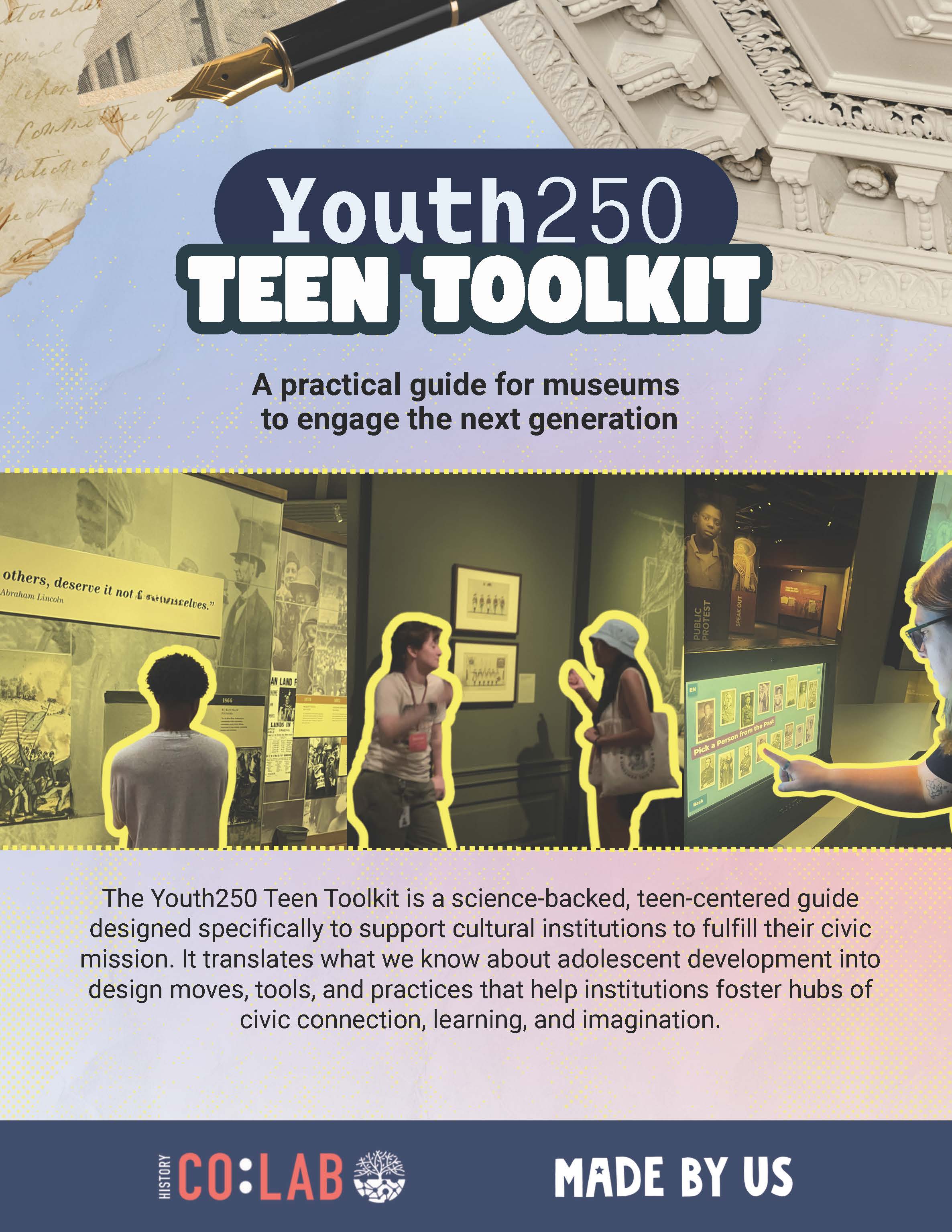
This month, Made by Us and History Co:Lab launched the Youth250 Teen Toolkit, a practical guide to help museums build environments where teens can belong, be seen, and help shape the future alongside us. The Toolkit is powered by learning science, co-designed with teens, and aligned with the civic needs outlined in CFM’s recent futures thinking on community, trust, and democratic resilience.
The Toolkit poses a question that sits squarely inside CFM’s mission: What if museums became trusted places for young people to imagine and practice the future of our democracy?
Why Teens, Why Now?
Our field is at an inflection point. Rising polarization, widening social fragmentation, and a national youth mental health crisis are reshaping the landscape young people are growing up in. Research shows communities are fraying under polarization and mistrust and that teens are experiencing unprecedented levels of loneliness and declining mental health. Yet neuroscience tells us adolescence is a magnificent developmental window. It is the brain’s second most significant period of growth since infancy and it finds the brain primed for learning, identity formation, and civic imagination.
A recent white paper by History Co:Lab, Teen-Centered Civics for Human Thriving reinforces this, “When young people feel seen, connected, and purposeful, they don’t just thrive as individuals—they become citizens capable of shaping just, connected communities.”
Museums sit at the intersection of memory and possibility. We steward stories of the past and invite people to imagine who they can become. This makes museums uniquely suited to support teens not only as visitors, but as thinkers, creators, co-designers, and innovators.
As one collaborator told us, “If you’re not leaving a museum with a new idea or of something you want to do… you kind of missed the mark.”
Museums of the future grow with their young audiences and help teenagers cultivate their voice, see themselves in history, and carry forward the work of shaping their communities.
What Teens Told Us They Need
The clearest insight we heard while co-designing this Toolkit with teens was this:
Teens don’t want to be treated as problems to manage or future audiences to cultivate. They want to be partners.
Kaelyn, 16, shared how, “It can be hugely empowering to see ourselves and stories from our heritage reflected in museums.” And Audrey, 16, connected directly to the Toolkit’s purpose, “This Toolkit… allows for connection; for people to better understand how to uplift teens, communities, and so much more. This has the ability to change lives!”
Young people are telling us who they are: curious, empathetic, justice-oriented, creative, civic-minded. And they are asking us to believe and trust them.
Introducing the Youth250 Teen Toolkit
The Youth250 Teen Toolkit helps museums shift from outreach to teens toward authentic partnership with teens. It translates learning science, youth insight, and cross-institutional practice into something actionable and joyful.
Inside the Toolkit, cultural professionals will find:
A developmental blueprint – Seven domains that shape teen growth and can be uniquely met by museums: Belong, Be, Become, Connect, Learn, Do, Lead.
A science-based foundation – How the teen brain explores, takes risks, and seeks meaning.
Playful design prompts and facilitation tools – To spark co-creation and loosen adults’ “resistant mindsets” toward more playful, generative approaches.
Real-world case studies – From institutions across the U.S. leading the way in robust and authentic youth partnerships.
The Big Shift: From Programming For Teens to With Teens
The museum field has long acknowledged the need to better engage younger generations. But the next step requires trust. As one Toolkit collaborator said, “Museums must become places where young people feel they truly belong, are safe, and are believed in.”
This means not asking teens to fit into our systems, but reshaping systems with young people, where they can show up fully and be curious, brilliant, messy, and in motion.
In practice, this looks like:
- A whole-hearted and authentic welcome for young people
- Youth advisory boards with real influence
- Teen-curated exhibitions and tours
- Play-based co-design sessions
- Opportunities for teens to lead messaging, dialogue, and storytelling
- Shifting evaluation toward belonging, agency, and creativity
This isn’t simply youth engagement work. It is an institutional transformation. It is future-shaping work.
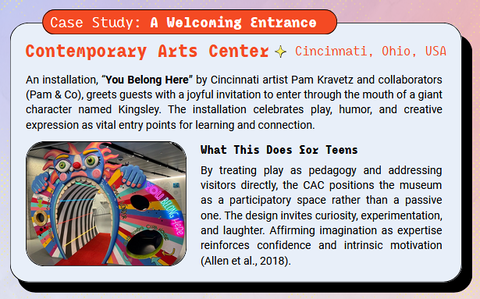
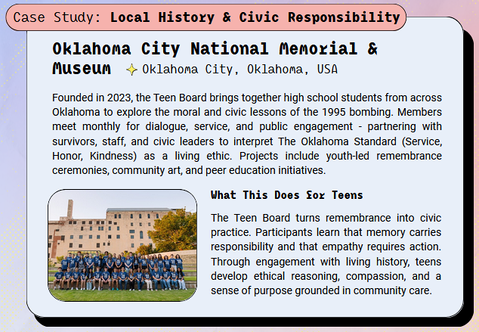
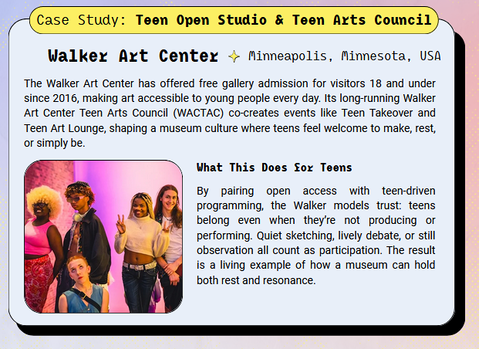
Museum Case Studies
An Invitation
The Youth250 Teen Toolkit is for institutions ready to build museums that teens see as:
- A place to belong
- A place to be taken seriously
- A place to grow into their civic selves
- A place to imagine and build the future
As we look ahead to the nation’s 250th anniversary and the years that follow, our field has a choice: to continue serving teens as audiences or to stand alongside them as co-architects of a thriving future.
At a time when resources are tight and attention spans are short, partnering with teens may feel like one more task. But in reality, it is one of the most renewable resources museums have.
If you are wondering where to start, ask the teens around you, and use the YouthSync Rubric as a quick way to see where your institution is already emerging, developing, or thriving in teen engagement.
Upcoming Events
-
AASLH-NCPH Joint Conference
Event Date:Presented by: American Association for State and Local History (AASLH)Providence, RI -
Digital Collections Summit
Event Date:Presented by: MuseumNext -
The Federal Grant Landscape: What Museums Need to Know
Event Date:Presented by: Ohio Museums Association -
Accessibility by Design: Empowering Staff for Human-Centered Change
Event Date:Presented by: American Alliance of Museums


Is there a way to get the teen toolkit canva presentation sent as a PDF so I am able to take notes? The current platform does not allow me to print.
Hi Angelina, if you click the link to the toolkit: https://historymadebyus.org/youth250/toolkit and scroll, you can enter your email to receive a PDF version.