While we can’t predict the future, we can explore ways it may unfold by looking at the world around us. As author William Gibson observed, “the future is already here, it is just not evenly distributed,” and I’ve been in search of “case studies of the futures” that might illuminate challenges facing U.S. museums in coming years. Today on the blog, Yelena Litvinov and Tatyana Margolin, co-founders of STROIKA, an organization building the resilience of anti-authoritarian movements globally, share some observations on what we can learn from cultural organizations in other countries that are navigating government pressure to align with one official version of history.
Yours from the future,

Elizabeth Merritt, Vice President, Strategic Foresight and Founding Director, Center for the Future of Museums, American Alliance of Museums.
A Cautionary Tale
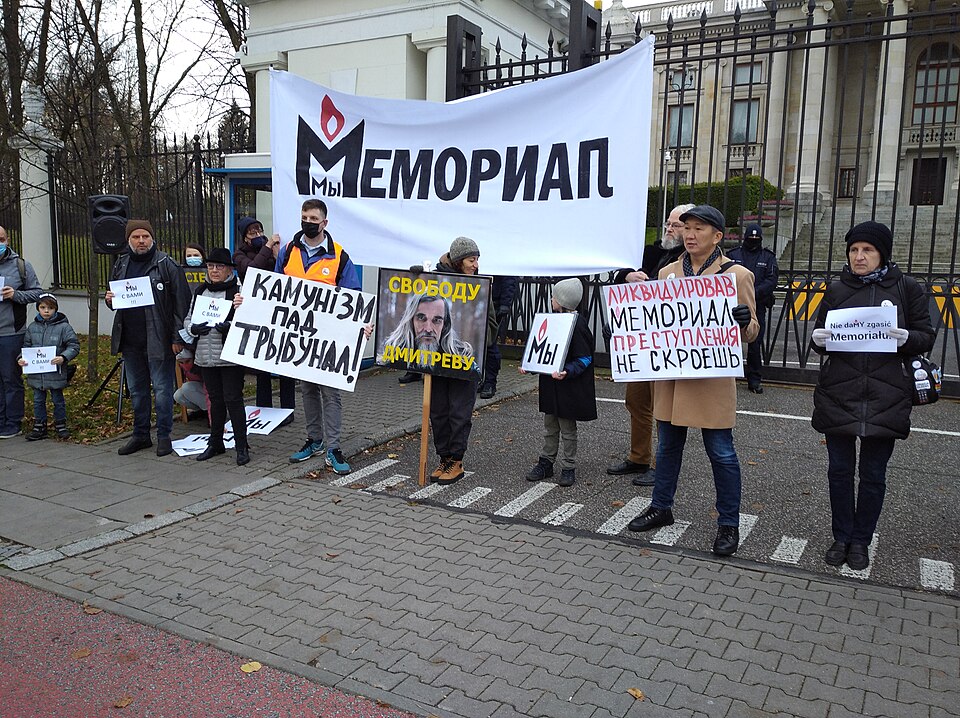
There is a storied and celebrated non-profit organization in Russia called Memorial. Over the years, its staff and volunteers painstakingly built an extraordinary archive of oral histories, letters, and journals — a uniquely important record of the unimaginable atrocities that took place within the vast system of forced labor camps known as Stalin’s Gulag. Founded in 1989, as the Soviet Union teetered on the brink of dissolution, Memorial became the country’s first human rights group.
Memorial’s searchable database has over 3 million records about victims of state terror, allowing anyone to uncover family histories that would have otherwise been lost. People from countries across the former Soviet region have made use of Memorial’s archives, searching for answers to questions that plagued their families for generations. Countless stories about finding photographs of parents and grandparents and correspondence from the Gulag era made the organization a household name, a true institution in a country where there were so few. Memorial not only made memory accessible by providing step-by-step guidance to navigating archives and finding details of families’ histories, but it for the first time placed value on memory itself in a country where the past routinely gets rewritten by whoever is in power. As a result, Memorial became an important and well-respected organization not just in Russia, but globally.
Most were shocked when Memorial, whose work and mission were apolitical by design, became a target of the state. But in autocracies, there is no such thing as being “apolitical.” To further his own geopolitical ambitions, Vladimir Putin needed to retell the history of Russia, Ukraine, and the Soviet Union in order to justify his invasion of Ukraine. Memorial’s commitment to historical memory and to truth directly threatened this new version of the past.
In 2016, the organization was named a ‘foreign agent.’ It became subject to endless audits, fines, and police raids. One of its founders, Yuri A. Dmitriev, received a three-and-a-half-year prison sentence after a highly politicized trial, which his supporters believe was intended to punish him for challenging the Kremlin’s idealized portrayal of Russia’s history. In 2022, Oleg Orlov, a co-chairman of Memorial, was also jailed, this time for “discrediting” the Russian army by his anti-war stance. In late 2021, Russia’s Supreme Court ruled that the organization should be “liquidated.” After an unsuccessful appeal, Memorial was ultimately shut down–on February 28, 2022, only four days after the full-scale invasion of Ukraine.
Lessons for the United States
Though the United States is not Russia, the transformation of Memorial’s status from a venerated institution to a pariah in a matter of a few years is instructive. Authoritarians have an aversion to a narrative that in any way deviates from their own, and historic and cultural institutions should consider themselves on notice. Once these organizations begin to be pressured, they will be expected to comply, and preferably in advance, with the dominant state narrative. Less than one year into this administration, there are already clear signs of politicization of national cultural institutions—from the takeover of the Kennedy Center’s board and leadership, to reports of pressure on the Smithsonian to align its exhibits and leadership with government-approved narratives. The rest of the cultural sector at large is meant to see these as warnings, and not very subtle ones, of what will happen to them if they do not comply (and that resistance is futile).
This is why, in times of rising authoritarianism, the distinction between “high risk” and “low risk” work becomes increasingly irrelevant. Civil society as a whole is under threat, and this includes our cultural institutions, archives, and media. As Natalia Kaliada, the founder of Belarus Free Theatre (the only theater company in Europe banned by its government and operating from exile), has aptly observed, “morality and creativity together create that particular mix, which puts dictators into a panic mode.”
The Authoritarian Toolbox Takes Aim at Nonprofits
There are many tools to be used against the non-compliant, which we have seen deployed in places like Russia, Hungary, Uganda, and Turkey–including legal and administrative attacks that have paralyzed the work of even the most well-respected nonprofits. Nonprofit organizations, in pretty much any geographic context, are asked to be more transparent than their private sector counterparts. This makes it easy for the government to subject these groups to extra scrutiny and limit their ability to operate. Shutting down an organization is not even necessary, as the authoritarian toolbox has many other ways to slow your nonprofit operations to a halt: onerous audits that take up all your staff time; frivolous lawsuits that drain your resources; doxxing and reputational attacks; weaponizing the banking system to freeze or stop payments; and targeting your donors and fiscal sponsors to remove your funding base.
Regardless of how “low risk” your work might seem, now is the time to conduct vulnerability assessments and plan for a range of future challenges, paying particular attention to legal and financial security. Review data retention policies and your digital footprint, including how much you share about your staff on your website. Bolster digital and physical security preparedness for your teams. Continue to invest in strategic communications, to tell positive stories about the impacts that your organization–and all museums in the United States–have on our local communities, to counter future reputational attacks. And stand in solidarity with nonprofit organizations who are already under threat: our international partners can assure you that “staying silent will not protect you.”
In the worst-case scenario, we need to consider that the traditional nonprofit structure might become too risky for continued operations. Now is a good time to explore modes of diversifying the legal and financial entities that can further your mission, even if your current organization is under threat. This might include establishing for-profit entities, maintaining multiple bank accounts, and identifying fiscal sponsors and other operational partners who can help make payments on your behalf.
A Call to Action
Despite the unrelenting attacks from the Russian government, Memorial continues to operate to this day. It does so without formal offices, legal status, or bank accounts in the Russian Federation. By operating as a “decentralized movement”–a network of allied organizations and individuals working both inside of Russia and abroad–Memorial has managed to continue pursuing its mission, advocating against political repressions and providing access to archival materials for all. For those of us in the United States feeling discouraged or fearful, our international peers can serve as a source of inspiration, as well as valuable lessons learned. Memorial’s perseverance, adaptability, and creativity in its steadfast pursuit of its mission is a bold call to action for all of us.
Upcoming Events
-
-
Industry Showcase: Innovative Digital Solutions
Event Date: -
Getting Started in Local Advocacy
Event Date:Presented by: American Association for State and Local History (AASLH) -
Creative Museums Summit
Event Date:Presented by: MuseumNext

I believe we need to deep dive and honor the only truth our Land will ever know and that is the stories and artifact relatives of our Native American people who are still here. Their stories of empowerment and resilience will give us clues how to survive. This is our legacy which can parallel any story in the world by uplifting our own truths and history. Please watch Marlena Myles “Realms of Resilience” and share and discuss and learn. Marlena has single handedly begun her own rematriation projects to give back to her Spirit Lake Dakota tribe and is constantly uplifting her community. We lost this during settler puritan cult takeover and manifest destiny but it is still out there believe me.