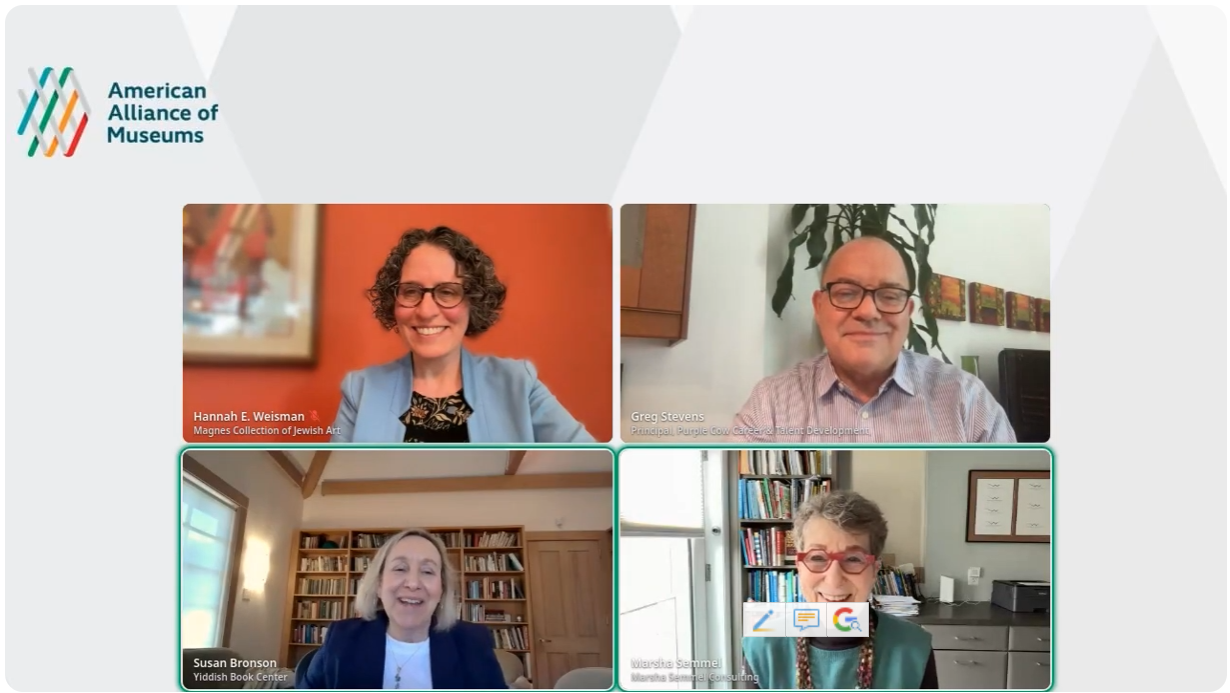
This is a moderated discussion with two Jewish museum leaders who have used digital tools and technology to support collections stewardship, greater collections access, and rich public and educational resources that highlight Jewish culture. Since its founding, the Yiddish Book Center has evolved from an organization focused on recovering and preserving books to an institution that creates access to Yiddish resources and culture through digital initiatives, curation, educational and public programs, publications, and translation. The Yiddish Book Center is at the forefront of book digitization and recently has launched a new website, the Universal Yiddish Library, that enables users to search the catalogs of four partner institutions through a single portal and provides full access to thousands of Yiddish books. In the years to come, additional partner collections will be ingested and made accessible. This model holds promise for other types of collections and institutions, enabling the public to access collections of multiple institutions through a single site and enabling smaller institutions to make their collections accessible.
The Magnes Collection of Jewish Art and Life at the University of California, Berkeley, connects people of all backgrounds with the history, vibrancy, and diversity of Jewish life around the world through its collections-based research, exhibitions, and programs. The Magnes Collection of Jewish Art and Life is establishing a foundation of digital infrastructure and leveraging campus resources to enable the development of public-serving digital projects, including the online publication of the Roman Vishniac Archive. With security, accessibility, and discoverability as guiding priorities, the Magnes will be able to launch new mission-driven and revenue-generating initiatives.
This webinar was sponsored by the David Berg Foundation, supporting the conservation of Jewish artifacts, manuscripts, texts, and art; exhibitions about Jewish culture and heritage, the advancement of Jewish museums and libraries; and initiatives that combat the rise of antisemitism. This webinar is presented in collaboration with the Council of American Jewish Museums (CAJM).
Transcript
Marsha Semmel:
…AAM annual meeting in Philadelphia. And also a forthcoming article in Museum Magazine. So although museums have been working in the digital realm for years and decades in fact, …
Cecelia Walls:
Marsha, I’m sorry to interrupt. We need to restart our introduction again. The session did not start…
Marsha Semmel:
yes.
Cecelia Walls:
Quite on time.
Marsha Semmel:
Oh, I’m sorry. Okay. Alright.
Cecelia Walls:
No, my apologies. Start again. Start fresh.
Marsha Semmel:
That’s fine.
And I oh, me.
Hello, everyone. I wanna thank Cecelia and Greg for their introductory remarks. And tell you how pleased I am to be moderating this discussion today around the use of digital tools and technologies in collections management and stewardship. I’ve had a long association with both AAM and CAJM, and it’s always a pleasure to see two professional organizations working together to explore an important museum-related topic. We’re grateful to the Burke Foundation for its support of the webinar today and another that’s going to follow on April 29, in the afternoon. That session will focus on ways in which museums are using digital tools and technologies for programmatic goals. And it will feature Dan Tadmore and Josh Perlman of the Weitzman National Museum of American Jewish History. Talking about how that museum is leveraging cutting-edge digital technologies, specifically in immersive digital environments.
The Burke Foundation has also supported an on-site session at the upcoming May AAM Annual Meeting in Philadelphia. A forthcoming article in Museum Magazine and there is no doubt in my mind that the topics and discussions that we have in these programs will carry over when CAJM has its annual meeting in Detroit, Michigan, in mid-June.
So, although museums have been working in the digital realm for years, this is still an area, especially regarding documentation, access, and stewardship, that can be challenging, expensive, and raise a whole lot of questions for everything from who you work with to what platform you use to when you have to revise the platform. And we may dip our toes in the water of what happens with AI.
So, this afternoon we have two great speakers to talk about their own experiences with their collections. The first speaker is Hannah Weismann, executive director of the Magnes Collection of Jewish Art and Life at the University of California, Berkeley. And she’ll make a few remarks, followed by Susan Bronson, president of the Yiddish Book Center in Amherst, MA.
So, here we go, Hannah take the stage.
Hannah E. Weisman:
Hello. Good afternoon. It’s a real pleasure to be here. Thank you, Marsha, and Greg, and Cecelia, and thank you, of course, to the Berg Foundation, AAM, and CAJM for making these conversations possible.
I wanted to talk a little bit about establishing digital infrastructure, sort of the basics, before launching into big projects. And for a little context, I’m happy to share a little bit about the Magnus. We’re a museum and research center at UC Berkeley, and the collections here represent life across the Jewish diaspora. We’re dedicated to generating new knowledge of Jewish life and cultures, and we envision a society that seeks common ground while honoring cultural differences. And one that embraces the diversity of Jewish life.
As a museum that started in the community and became part of the university later, we have a dual mandate to serve our campus and academic community as well as our public community. In equal measure.
In 2018, the Magnus acquired the Roman Bishniak Archive, as a gift from Mara Vichniak Koen, the photographer’s daughter. The archive has about 30,000 images across photographic media. So we’ve got slides and negatives, prints, glass plate negatives, as well as papers, ephemera, some audiovisual material, and a few objects. So this is an immense collection for us. A very important one, historically speaking, and one that we knew, that we would need to make available publicly, by digitizing it and publishing it online.
But in order to do that, we needed to assess the tools that we already had to make sure that we would be able to do that. And our assessment revealed that in fact we were not ready for that digitization project. And so we are taking the steps necessary to build the infrastructure that will support the creation and publication of probably about a 100,000 digital assets as well as support the management of our other collections materials as well.
We were already experiencing some struggles with our existing collections management system, both for our staff and our public users. Here, we see a couple of different error messages. There’s nothing like hearing when you’re searching a museum’s catalog. Oh, sorry. Got tired. Please be a sport and search again. And we don’t have a dedicated digital asset management system. We’ve been using Flickr to share collections materials publicly, and we’ve been using this also to share installation photos, photographs of events. It’s a little bit of a mishmash. And Flickr comes with its own challenges. Their own search feature hasn’t worked in about two years properly.
We also have had multiple platforms where we’ve been collecting and sharing collections information both internally and publicly. So we’ve been using our collections management system. Of course, we have hard copy files. We have Excel spreadsheets on department servers and Google spreadsheets. And we have Flickr and also even our own website to share information. So our solution to make ourselves ready for digitization for the Bishniak Archive was to adopt Maven. Which is our iteration of an integrated content management system and digital asset management system from a vendor called Terenceia. That offers a collections online portal for public access.
Here, we see the back end, the staff view of the digital asset management system, and here we see the in-progress collections online view.
We are still a few weeks away from launch. This is a really transformative and exciting moment for us, but you’re seeing work in progress.
This investment in Maven supports mission. Maven will allow us to do this specific project of publishing the Roman Vichniak archive, but it’s also going to improve collections management across the entire collection. With improved public access to our catalog, no more timed-out searches, public access to digitized collections with proper metadata, and it will allow us to engage students and classes here on campus more efficiently. Our student undergraduate research apprentices will be able to do research and work directly in the content management system with limited set of permissions and ability for us as our core staff to review that work before it is ingested and published in the CMS. And it also allows our museum educator and curator to more easily work with faculty to identify and sort materials for class visits.
It’s going to set us up to be able to offer online exhibitions and other digital arts and humanities projects in the future.
Importantly for us, we’re a small museum. We’re a full staff of eight. This investment in Maven is also supporting our business operations. So this is going to create more efficiency in our workflows. Of course, as a small team, any efficiency we can find is helpful so that we can free up staff time for other projects. And it’s going to also create opportunity for generating earned revenue. Mara Vichniak Cohn very generously donated the copyright for Vishniak’s work along with the archive. And through licensing, Maven will give us the tools we need to be able to license, those images generating revenue that can go back into the care and stewardship of that collection.
Our next steps are to connect Maven with hands on collections management work. We have a physical inventory happening now, so we’ll wanna reconcile the data in the CMS with the data our collections team is finding in storage.
We’ll also use Maven to support records management, not only for collections, but also across the organization.
We anticipate building a new website that will connect and integrate with Maven and then also in the future add a module from Terenceia to allow us to develop online exhibitions.
And it will offer us opportunities to jump into collaborative projects with other collecting institutions.
A lot of this is very straightforward. There’s nothing groundbreaking about what we’re doing right now, but it is very much important building block, and I think, the assessment of the need when we had a specific project that we wanted to undertake was an important piece. And as a small museum, you know, a lesson to take away is that doing something, you know, upgrading our collection management system, bringing in the digital asset management system is really transformative for an institution even if it isn’t breaking new ground within the field. I’m gonna leave it here because I know Susan is gonna talk about collaborative projects. And I look forward to the wider conversation after her presentation.
Thank you.
Susan Bronson:
Hi, everybody. I’m just trying to get my screen organized here. Happy to be here. Thank you, Hannah. Thank you, everybody, and thank you to the David Berg Foundation once again for making all this possible. I’m gonna try to share my screen.
Hold on a second. I’m sorry. I’m… Do you see my screen?
Uh-oh. Oops.
No.
What happened to … I’m sorry. Something, something went wrong here.
Cecelia, can you share my screen if it’s not showing up?
Cecelia Walls:
Hi, Susan. Give me just a moment to get that up.
Susan Bronson:
Yep. Apologies, everybody.
Cecelia Walls:
No worries.
Susan Bronson:
For some reason, it backfired on my end.
Cecelia Walls:
There we go.
Susan Bronson:
There we go. So the Yiddish Book Center was founded forty-six years ago with primary mission of recovering Yiddish books, which were being discarded by the children and grandchildren of Yiddish speakers who couldn’t speak the language. Since that time, we’ve rescued more than a million and a half Yiddish books, and at the same time, our mission has evolved, and we now seek to recover, preserve, teach, and celebrate Yiddish literature and culture for diverse audiences.
We have a beautiful forty-five thousand square foot home in Amherst, Massachusetts, and we’re a museum with on-site and virtual public programs and exhibitions. We have educational programs for visitors of all ages. We train translators and publish Yiddish literature in translation. And we collect oral histories from around the world.
But the foundation of everything that we do are the books that we’ve recovered. And preserving and providing access to Yiddish literature has always been a centerpiece of our work. Next slide.
We were relatively early in creating a digital library. We launched the Stephen Spielberg digital Yiddish library in 2009. That library currently consists of more than 12,000 titles, which are available and can be downloaded for free. The majority of Yiddish titles are either orphaned works or out of copyright, so we can create free access to those. We also present a number of other digital collections, including archival video and audio, and our Wexler oral history project, which currently consists of more than fifteen hundred one-to-two-hour interviews from around the world, and all of that is available on our web Next slide, please.
Next slide, Beth. So all of our collections are searchable through a single interface, which we made possible our by categories, themes, places, names, and dates. The keypad is available to search in Yiddish or in Romanized characters. And website content and collection search is available in that single interface. Next slide, please.
We’ve also created Yiddish optical character recognition, OCR, to enable full text search of all of our titles, and launched in 2019, this was the first large-scale Yiddish OCR project. The collected OCR has also been used in various projects by researchers in linguistics and in data mining. Next slide.
So searching with OCR, you can search the titles of works inside collected volumes. You can search words and topics in books without an index. You can search names across all the books, and you can search phrases across all the books. So it’s really a transformative search tool for anyone who wants to access content within Yiddish books. Next slide.
So the Universal Yiddish Library is a project we began about ten years ago. With the vision of trying to scan all Yiddish books around the world, process them with OCR, and make them all accessible with a single full-text search, regardless of the owning institution. We engaged with three other partners, so there’s four of us, New York Public Library, the YIVO Institute for Yiddish Research, and the National Library of Israel. These, we believe, were the largest other holders of Yiddish book collections. Next slide, please.
The Universal Yiddish Library went beta this past year. And, after a decade of work in 2025, and this is the web interface for the Universal Yiddish Library, which includes the collections of all four institutions. Next slide, please.
So to date, we have over 67,000 book records from all four institutions. Nearly 20,000 are scanned and processed with OCR. And we’re actively recruiting other institutions to share collections, and we’re also actively developing the search interface. So we’re looking for partners both large and small. On deck, I think the next partners will probably be Stanford University. On the one hand. On the other hand, the National Library of Finland, which has a small Yiddish book collection, is interested in joining with us as well. Next slide, please.
So in the Universal Yiddish library, you can search for phrases and snippets of full text. You can search within one book. You can search Yiddish characters and transliterated. You can do a full text is available for nearly 20,000 books. You can find books in all the institutions. And all the books link back to the owning institution. So in other words, this is a standalone website, but the books when you go to any particular book, you will know which institution owns the book and you will link back to it when you open the book. Next slide, please.
So we have other collaborative projects other digital collaborative projects. We worked with New York Public Library to scan over 650 Yisker memorial books which are memorial books of Eastern Europe, and those are accessible on our website. We partnered with Cornell to scan newspapers from the historical Yiddish Labor Union. We partnered with the Jewish Public Library in Montreal to offer over 600 recorded programs from their collection through our website. Next slide, please.
We’ve also our own our own Wexler oral history project, which I’ve mentioned earlier, is another area where we’re building partnerships to make the collections of other institutions accessible. Since we have expertise and have built the infrastructure, the search engine, etcetera, we can offer to ensure that other existing collections are made are preserved and made available. For example, there are small oral history collections that other museums have that we can then hopefully make assess through our website, and they’ll be searchable, and the tools will be available.
So, in conclusion, I just wanna suggest that our work with books and libraries can be a model in several respects. We’re creating broad access-related materials through a single web portal, we’re enabling each institution to retain ownership, and our willingness to do this through a new portal and through our in instead of through our own website means that in institutions are more likely to want to become part of the project.
We’ve created open-source access to the corpus, and to the soft still ourselves are building on this model and beginning to do something similar that we’ve done with Universal Yiddish Library. We’re trying to do something similar with the oral history project. So, you know, I like to think that other museums can use this kind of model if you’re a larger and you have an infrastructure, you might be able to partner with smaller institutions and make collections accessible through one single web portal while still allowing each individual institution to have ownership of the collection and for anybody accessing particular objects within the collection through that portal while linking back to the owning institution.
So, in other words, we’re not absorbing the institutions. We’re making their work accessible and available. So with that, I hope you will find us at the yiddishbookcentre.org and at universalyiddishlibrary.org. Come visit us in Amherst. And I look forward to the conversation.
Greg Stevens:
Great. Thank you so much, Susan, and thank you, Hannah. A couple of questions came in. I’m just gonna tackle a few of them. But a couple came in for you, Hannah, regarding Maven and accessibility. Does Maven come with accessibility options? For those who are low vision.
Yes. So Terenceia has been working with us to make sure that we’re meeting WCAG guidelines at the double a level, which is what we are required as a part of UC Berkeley to meet. So I don’t know the specific accessibility features that we have, but I do know that that is the standard that we are working towards and that Terenceia, the vendor we’re working with, has been really helpful in making sure that we’re meeting those benchmarks.
Greg Stevens:
Great. Thanks, Hannah. And a question also came in for you regarding new AI capabilities. What are you all thinking about with work you’re doing regarding AI?
We are well, sometimes, like,
Susan Bronson:
Go ahead, Hannah.
Hannah E. Weisman:
Joke that we’re still in the twentieth century, so we’re not ready for AI yet, but that’s not entirely true. We are working right now. We have a small project started with a graduate student who’s gonna be using some AI to help us match materials between digital files and physical files. And match, within the archive, working locally so that we’re not feeding AI models or training any models but working locally using machine learning to be able to identify which images are from the same place, from the same photo, shoot, from feature the same people.
So we’re starting to work with it. We have been dipping our toe pretty cautiously, and I’m sure there are new opportunities down the line. And I know Terenceia is working on places where they can integrate AI into the CMS DAMS so that it’s local only working with our data, not feeding, but that would help us in the future.
Greg Stevens:
Great. Thank you. And, you know, Hannah, when you were, when you started your presentation, and you were talking about the evolution of your institution as a discrete entity and then as part of the university. Can you talk a little more about that and that integration first public and academic influences or has influenced some of the decisions you are making about this platform that you’re using?
Hannah E. Weisman:
I think all of it comes down to usability on the public side. So we know that we’re serving researchers who might be somewhat fluent in catalog searching. But a lot of the folks who are interested in and have a stake in these collections may not be as fluent or may not be as familiar with library catalogs and museum catalogs. And so we really focused on the user experience and making sure that the tools that we have are intuitive. And one of our stages before launch is some user testing so that we can make sure that we are making it as user friendly as possible.
I think the other piece around that balancing act will come when we start to research and interpret this collection. And all of our collections is making sure that you know, we maintain intellectual and academic rigor in all of our work. And nothing I’m saying is unique to this institution. This is kind of what we do across the field, of course. We’ll maintain that academic rigor while recognizing that we have public audience who may not be specialists. In what we do. And so making sure that we are creating points of entry for all of those communities.
Greg Stevens:
Thanks. And Hannah, I’m struck by one other point that you made that you’re a very small staff. You have eight people. Right?
Marsha Semmel:
Yes. Now can you hear me folks?
Greg Stevens:
It this all seems a bit herculean. Right? Sort of like, wow, this is a lot for this tiny organization.
Hannah E. Weisman:
Yes.
It does. It feels that way some days, but I think that’s the importance of having the right tools and why the investment in this system was so important. We could not have
tackled this project with the tools we have in place now. This may our iteration is Maven. Is really gonna make this work possible in a way that we couldn’t have done before. So for me, the takeaway is not that a small museum can’t do big projects. It’s that we need the right tools in place at the right time. In order to make it happen.
Greg Stevens:
Yeah. I think that’s a really useful message for any of our colleagues who are listening in on this program, who may be in small or mid-sized institutions or even larger institutions, but having the right tools to do the job, if you will. Susan, I wonder if you would jump in here on that, on that point, really. Having this rate tool, this right platform
Susan Bronson:
We’re working with is using AI to improve that program. I would say that that you know, we’re otherwise at the beginning stages also of using AI much as Hannah is in a larger sense. In terms of being the size of the organization and having the right tools, you know, when we started scanning Yiddish books, like I said, we were really early on. It’s like, believe it or not, when we started scanning Yiddish books, I mean, we were working with Xerox in the beginning. And we were much smaller We so, you know, we’ve grown a lot. But we have relied on working with, a web firm that’s based in England that had a lot of experience working with digital library collections and building search engines that would work for what we were trying to accomplish.
So that I would say figuring out what you need and the best partners to work with is absolutely critical. We couldn’t have figured this out our We had to find we had to find the partners who really knew the field so we wouldn’t have to invent the you know, in invent the wheel ourselves.
Greg Stevens:
So what do what would your takeaways be for folks who are listening in on our conversation? Yeah.
Susan Bronson:
What would my takeaways be?
Well, you know, as I said, I mean, I think you know, we’ve talked about this a lot in the Jewish museum community. A lot of Jewish museums are small. They may not even be full-fledged museums. They may be historical societies or other small community organizations. They have important collections. Some of which are at risk, and they’re completely inaccessible. So, you know, my takeaway or the message that from the work that we’ve done at the Yiddish Book Center, I think, is that collaboration can be an important way to make these collections accessible. And that a lot of small organizations might not be able to do this on their own. I think it is imperative that we find ways to create collaborations and that large organizations say, hey.
Let’s band together and let’s create a consortium and bring some of these smaller organizations in and use the tools that we have to make sure that these collections are accessible and available, and not just for those institutions that have massive resources to do so. And I think the key to making that workable is if you know, as I said, I mean, the organization spearheading it can’t have a big ego. In other words, you have to be willing to say, look. This doesn’t have to be our website. We have to make this something that stands alone and that look you know, enables everyone to have skin in the game. So I think know, that’s a big part of what I would what I would bring to the table from our experience.
Greg Stevens:
Thank you, Susan. And, Marsha, I know that you, long association with CAJM and the Jewish museum community, I saw you nodding your head a bit when Susan was talking. What are your thoughts on this?
Marsha Semmel:
Well and I’m sorry. I had some technical difficulties before, but, I this conversation and the conversations that I’ve that I’ve had with Susan and Hannah previously, this idea and this, potential of collaboration just, you know, it rings really loudly for me. And I was thinking that, I recently, in the last couple years, was involved with a collaboration between the National Museum of African American History and Culture and five HBCU museums and archives. And the whole idea was to and each of those collections in the five HBCUs was at a level and stage of digitization.
But the project, which kind of was, this sort of strategized by the big guy, which was the Smithsonian museum enabled all five of those different institutions to digitize, their collections, their holdings, no matter what stage they were in. And part of it also involved training for some of the students and staffs at those museums.
And libraries so that that’s created now a whole network. And, actually, there’s an exhibit that just opened with sort of the treasures of those five museums. So when I think of in the Jewish museum field, we have a number of very small institutions. We have museums that are parts of synagogues. And wouldn’t it be interesting? And, you know, the treasures and, historical and cultural significance of the collections are important. So wouldn’t it be interesting to create some sort of collaborative where bringing some of those materials together with the stories that they tell that can be local as well as national or international could be really exciting.
We haven’t gotten to that point yet, but I think it’s both Susan’s experience and that notion again about establishing trust and none of these things are fifty/fifty, understanding what each entity brings to the table. And providing resources and a process where they all can, can learn. So I think that that’s really important.
I wondered, and maybe I missed this, but what about the biggest challenges? Or what are the things that are key keeping you in review up at night unless you both sleep soundly every night? And we can keep it with collections. We can, you know, there may be.
Susan Bronson:
I mean, you know, for me, it for me, it’s simply resources. Right? I mean, I don’t think this would be surprising to anyone. I mean, most of the challenges we’ve confronted, you know, people, it’s amazing what smart people can do. And it really is always a question of having the money and the resource is to be able to move to the next stage of a project.
I mean, the same thing. I mean, I will say, you know, of the reasons another reason this project has succeeded with these other partners is that we’ve paid the bills. We’ve raised the money. We took responsibility for it.
So, you know, I do think that, you know, that is a challenge. I’m sure Hannah’s was has been dealing with that challenge all along as well. Although I will say that I do think consortial projects are appealing to funders. So, you know, I think, I think it is it it’s important to, you know, hold that banner up when you’re trying to raise money. I mean, obviously, there’s tons of technical challenges. And I’m not on the weeds on the technical side, so I’m the wrong person to ask about that. I mean, I you know, that’s not my that’s not where I live, but I think I think there are plenty of answers to these questions that we’re dealing with. I do think that the resource challenge is the biggest one that probably most of us face in making these things happen.
Marsha Semmel:
Well and your point is well taken because I happen to be at the National Endowment for the Humanities when this HBCU project came up. And we were able to be the largest entry funder for that project precisely because we saw how this one project was gonna benefit six different institutions and communities around the country. So well said. Hannah, how about you?
How’s your sleeping these days?
Hannah E. Weisman:
I would echo the concern around resources. That’s always a challenge. And also, sort of cosign this idea around collaboration. One of our benefits of being part of the university environment is that we are right now having some conversations with colleagues on campus in special collections at the library around might there be opportunities to collaborate, to they hold some materials that are of interest to the audience’s that we serve. Could we share the expense of some digitization work? We’re into the early stages of those conversations, but I think you know, sometimes looking in your own backyard for partners is just as helpful as looking for partners who are far field.
And to Susan’s point earlier around the smaller institutions have important collections that need visibility. The other piece is that not only can we do need our collections to have visibility but we often have collections that talk to each other in different places. So, for example, the Yiddish Book Center and the Magnes both have holdings related to the same Yiddish press and we’re on opposite sides of the country so a researcher feasibly, that’s a lot of research funding to do work, right? So, if we had a way to bring those resources together into one digital space, it creates better access for our the communities we serve.
Marsha Semmel:
Do you do either of you have track certain kinds of analytics that you need to share with your respective boards or other funders or stakeholders, and what are they like? I mean, you know, as they’ve evolved over time.
Susan, you wanna go first and then Hannah?
Susan Bronson:
Sure. Yeah. I mean, we we track; we track some there’s a lot that we don’t track because we do not make people sign up to access our digital Yiddish library.
We do make people sign up to use OCR. So we’re and part of that is because we ask people to engage with us in improving the OCR. But we track know, we track what the most popular hits are. We track what the most oft visited parts of the collection. You know, all of this is of interest mostly to us. I have to say, I mean, it’s you know, the board doesn’t really get in the weeds on you know, what specifically is of interest. They just wanna know that our books have been downloaded more than 5,000,000 times from all over the world. That’s something they wanna know. You know, the big picture
Marsha Semmel:
Yeah.
Susan Bronson:
Sort of information.
Marsha Semmel:
Great. Thank you. Hannah?
Hannah E. Weisman:
I think with Maven, we’ll be able to better collect those analytics. The tools that we have now are not very good at giving us that data. You know, we can track how many people have looked at something on Flick but you know, if I look at it three times, I’m inflating our numbers. So I think that this new tool this is another example of how having a new up to date tool is going to improve what we can do. And be more responsive when we look at those that analytical data, be able to make decisions about how we’re presenting information to the public and adjust accordingly going forward.
Marsha Semmel:
Good. Thank you. How about issues of security? Is there does that come up? And what form does it come up? I in some of the conversations I had, before we put all these programs together, some people talked about that in terms of how images or documents could be used in ways that, you no one would want. Certainly nobody in the museum would want. Do you have to deal with that?
And, Hannah, you wanna start how are you thinking about that with Vishniak material?
Hannah E. Weisman:
Absolutely. We’re thinking about it in terms of public access to the images, so we will set it up so that people can view online but not download without permission. So that’s the sort of very basic front-end security, but we’re also thinking about the security of the data itself where it’s stored. And that was part of the assessment process for determining which new system we would go with. We weren’t a 100% convinced that the content, sorry, collections management system that we were using that their data storage was as secure as we wanted.
Our data was essentially being stored with other institutions’ data.
This new system that we have, our data will be stored by itself.
Like Susan, I’m not as technically in the weeds, so my colleague could describe that better. But I do know that was part of our assessment process. And part of the reason we chose the product we did.
Marsha Semmel:
Interesting. Thank you. How about you, Susan? Says I mean, your stuff is out there, and you’ve got all these different collaborators.
Susan Bronson:
It’s out there. We also you know, our we have several…We store the images of the books you know, in a variety of places, one of which is the Internet archive, which was the original repository.
Marsha Semmel:
Right.
Susan Bronson:
For our digital library, and it remains so. And we have a lot of concerns about the Internet Archive because they’ve had a lot of issues themselves. So we are, you know, looking at other options to make sure that you know we’re not compromised. But in terms of we can’t control I mean, we offer free downloads of the books. So, you know, you can download the book. We offer free access to the oral histories. Unlike the Shoah…
Collection, which is, a more limited access, you know, we do have concerns about, you know, misuse of some of these ongoing issue. We have always leaned to open access, and, you know, we continue to do so. Recognizing that there are risks inherent in that.
Marsha Semmel:
Yeah. It’s really interesting because between memes and all sorts of other ways. I you know. And this is sort of the darker side of AI maybe.
Susan Bronson:
Yeah. Yeah. Well, I it really is. I mean, I think, it it’s a problem we’re gonna have in larger in spades going forward and one we’ll probably have to deal with in ways that we’re not doing so right now.
Marsha Semmel:
Yeah. Yeah. And you know, in terms of your audience, and Susan, maybe I might have missed this because I was having trouble with your PowerPoint here, but how, you know, how does this see, here you are in Amherst. Amherst, Massachusetts. I mean, in terms of, like, if there was a pie chart and you’re talking about all the ways you’re meeting people is the digital way it taking over? Would you is that, like, more than 50%, more than 75%?
Susan Bronson:
Oh, app…
Absolutely. I mean, that’s you know, we are I feel like, you know, yes. We are an international organization. Our website and collections are the primary way that most people engage us.
Marsha Semmel:
Yeah.
Susan Bronson:
And, you know, although we have this incredible on-site facility and we welcome visitors, it the on-site the web, the digital is the primary way most people engage with us. And I think, you know, that probably accounts for why, you know, we’ve been involved with digital projects for so long and why we also, you know, try to create new models in terms of working with partners and advancing digital collections work?
Marsha Semmel:
Yeah. And, Hannah, is that something that you envision as well, or maybe even experience now with your current location? Yeah.
Hannah E. Weisman:
We definitely need to focus on digital as we move forward.
We have relatively light on-site visitation, but my concern or I think the, the mandate for moving into digital space more than we have been is that our collection represents life around the world. And so the communities who are represented in our collection are not necessarily local, and they have the right to deserve to have access to these materials as they are from their own communities. So I think for us, it’s not just about isn’t it nice to be able to provide access, but I think we have a requirement to get there.
Marsha Semmel:
Thank you. And I’m also wondering, and Susan, I’ll just go back to you just with this issue of collaboration. You know, we hear about collaboration and partnership all the time. But I think often it’s sort of a surface thing. I mean…When you choose to, approach a partner, and maybe, Hannah, you can talk about this as well. I mean, you know, what are some of those initial steps? As you said, you know, in the case of the big collaboration you’ve done, you were the big institution, but how do you assess, the prospective partners And I would say for that in in terms of organizations as well as the digital you know, some of the programs as well as your digital resources. I mean, what are those things that tell you if this should be a go or not? Because it’s not necessarily the contract, I think. That’s why I feel like
Susan Bronson:
Yeah.
Well, yeah. I mean, well, first of all, I’ll say with the Universal Yiddish library, we weren’t the largest of the institutions, in fact. The National Library of Israel is way bigger than the Yiddish Book Center. But, you know, we were the ones concern you know, for us.
Marsha Semmel:
Interesting.
Susan Bronson:
You know, it’s almost symbolic or what you know?
Here our mission was built on rescuing Yiddish books. And we’re gonna make all Yiddish literature discoverable and preserved through creating this universal Yiddish library. So we had this vision, and we went the our the first people we went to were the National Library of Israel and said, you know, are you interested in joining with us? I mean, there was a lot of back and forth with all the institutions’ drafts of MOUs, and so forth and so on.
Right now, it now we are happy we’re looking at smaller institutions and part of the calculus here is going to be you know, the cost of ingesting their into our digital collection and how we’re gonna make that happen. But I think, you know, in terms of thinking of this as a model, I mean, I think…
Know, you’re starting with the mission of what you’re trying to accomplish. And then you’re saying, well, who are the who are the key people that we should be working with? I mean, so that’s how I mean, that’s how I would think about it. And now I think we’re saying, well, who else has collections that are little known or that are undiscoverable? And how can we make them discoverable?
In a way that that that fits our mission.
Marsha Semmel:
That’s so helpful. Thank you. How about you, Hannah? Because you’re as you talked about, you you’ve got the university community, which is ginormous, and you have the public, who are international, and you have your local public.
Hannah E. Weisman:
Yes.
I agree with Susan that going back to mission as the starting point or and or your strategic priorities, if you have a strategic plan or some sort of business path, really looking at what your established priorities are, why you wanna do something, and then going from there One of our challenges is that we are often asked to partner especially programmatically, and we would love to say yes to everything and everyone, and we simply don’t have the capacity to. So we wanna be sensitive when we’re asking partners to join us on something. And also look back towards our strategic priorities around what we say yes to, why and really know why we’re going forward. So that when we’re investing those limited resources that keep us up at night, we’re sure that it’s the right way to go.
Marsha Semmel:
Great. And, you know, and I’m sure that that means people resources too, tracking these partnerships. Right? They don’t just you know, I would assume that as they develop you guys have means of communication and course correction if necessary to get the ship righted if it’s if it steers a little bit off course.
Susan Bronson:
Yes.
Marsha Semmel:
So I don’t know if I can’t any questions. I or any questions, Cecelia or Greg, that have come up that we’ve not addressed?
Any other questions that people wanna put in the chat for our last few minutes?
I don’t see any here, but but we can keep going. That’s fine.
Susan Bronson:
I just wanna say that, I anyone who’s listening in and wants to know more or wants to has very specific technical questions or wants to know anything more, that I’m happy to either connect myself or connect you to my digital team that is much better equipped to get in the weeds on more technical questions, I’m happy to connect. And so feel free to be in touch with me here at the Yiddish Book Center. My email is just my first initial, last name, at Yiddish Book Center dot org. So feel free to be in touch.
Marsha Semmel:
Thank you. Thank you.
Susan Bronson:
Yeah.
Hannah E. Weisman:
Would say exactly the same. And I see that there is a question here about researching Maven online.
Maven so the Magnus’ version of Maven is soon to come. We’re launching in about a month. But if you’re interested in Terencia, which is the vendor, and the products they offer, I’m happy to put you in touch with them also.
They’re just at terentia.io. I can put it in the chat.
Marsha Semmel:
Great. Thank you both. Greg, were there any other questions that came up?
Greg Stevens:
One, yeah, one question that, that came in and maybe not the right answer from either one of you, but the, access, to allow for use of Hebrew or Yiddish in your systems.
I know it’s sort of technical, but can you either one of you address that?
Marsha Semmel:
Great.
Susan Bronson:
Do you mean so in our system, I think one question was worth I mean, you can search in our collection using using either Yiddish or we can search in Yiddish because the books are in Yiddish. Or transliteration or Roman. So you can search our entire website you can search specifically the Universal Yiddish library. In all of those forms.
Hannah E. Weisman:
And the ability to handle non-Roman script or alphabets was part of the criteria we were considering when we were looking a new con collections management system.
I can’t speak to the technical abilities of the product to do those searches, but I know that that was part of our we had that need to support Hebrew, Yiddish, Russian, other Cyrillic alphabets. Or languages. So that has been part of our research process too.
Greg Stevens:
Great. Thank you.
Marsha Semmel:
Thank you.
Greg Stevens:
I’m also, I I’ve loved hearing from all of you. But especially struck by Hannah and Susan that you’re self-described nontechnical folks, if you will, spearheading these very technical challenges for your respective institutions.
Marsha Semmel:
Well, I guess it comes from picking the right people. Right?
Hannah E. Weisman:
I was just gonna say, I am just grateful every day for my colleague who is leading that work for us. Tina has been, you know, the number one person leading that charge and has been, you know, overseeing migration. So I get the updates. I get to help make some decisions, but she’s really the one, leading the effort.
Marsha Semmel:
Well, I know he, oh, go ahead, Susan. Go ahead.
Susan Bronson:
Well, I’m sorry. Go ahead. I was gonna say that I think, you know, part of this whole question of digital innovations and collections stewardship I mean, obviously, the technical people are key, and they can make things happen and can tell you often what’s possible, what’s not possible. But I think you know, really, your entire staff needs to be involved in talking about what you wanna do because it’s visioning what is it you wanna make possible? What do you wanna create access to? What does that mean? And those are not technical questions. Those are questions of vision and imagination and, the whole
Marsha Semmel:
Yes.
Susan Bronson:
Museum team or library team, whoever’s involved, should be part of those conversations. And then you work with the technical people to say, well, you know, how do we make this happen? But I think it’s a question of imagination. And not just mine. I’m saying I’m you know, it’s a team, it’s a team effort.
Marsha Semmel:
I couldn’t agree with you more. I was just thinking that I was in a webinar yesterday where the keyword was mindset when they were talking about, systemic partnerships, and it was you know, having the mindset that would allow for imagination prior prioritizing issues, and then and I would assume that that has you know, comes, about also with how you even identify and describe physician descriptions. No matter where they are on the institution, which I think is another thing that’s really important because these lines are not hard lines between the digital piece and all the other parts of a of a museum.
Greg Stevens:
Great. Thank you all so much. It looks like we’re just about a couple of minutes till the end of our program. So I just want to say thank you again to Hannah and Susan for sharing your wisdom with us. And, of course, Marsha, thank you for moderating the conversation. I’ll go ahead and turn it over to Cecelia, who can offer a few closing remarks about this program and the next program coming up in April.
Cecelia Walls:
Thank you, Greg. Thank you so much Marsha, Susan, and Hannah for a truly engaging discussion. The recording will be coming out soon keep an eye on your emails. And don’t forget to join us on April 29th for Digital Innovations in Public Experiences at Jewish Museums: Reimagining the Weitzman. Have a great rest of your day!
Marsha Semmel:
Thanks, everybody.

Upcoming Events
-
-
Industry Showcase: Innovative Digital Solutions
Event Date: -
Getting Started in Local Advocacy
Event Date:Presented by: American Association for State and Local History (AASLH) -
Creative Museums Summit
Event Date:Presented by: MuseumNext