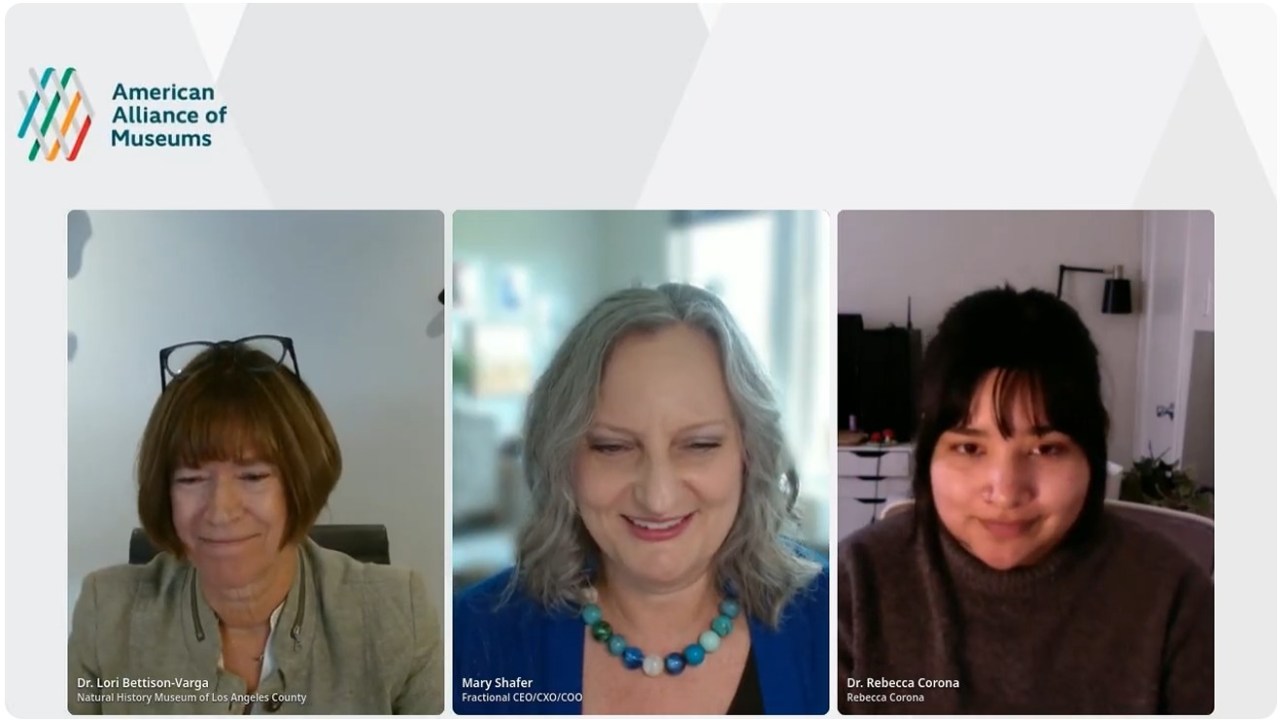
Watch this online workshop about the science and emotion of awe. Led by postdoctoral scholar and awe-focused program evaluation and development specialist, Rebecca Corona, Ph.D., along with Dr. Lori Bettison-Varga, President and Director of the Natural History Museum of Los Angeles County, and moderated by fractional museum executive Mary Shafer, explore how to leverage awe to design museum experiences and open minds. Whether it’s been at a National Park or watching a hummingbird, we’ve all experienced “Whoa-moments” encountering something in a new way that shifts your perspective and sparks curiosity. Learn how to add eight “awe types” into content and programming to inspire and unite communities. Plus, discover techniques to enhance your well-being and resilience.
Transcript
Cecelia Walls:
I’ll give everyone just a moment to get settled.
Hello, everyone, and welcome to the Awe Advantage. I’m so glad you’re here with us today. I’m Cecelia Walls with AAM. And it’s a pleasure to be joining you alongside so many colleagues who care deeply about creating meaningful, memorable experiences in museums. In your work, you spend a lot of time thinking about engagement, interpretation, and impact. But at the heart of all of that is something more fundamental. How do we create those ” whoa ” moments that spark curiosity and change the way that people see the world?
Today’s conversation is all about that. We’ll explore the science and emotion of awe and how we can intentionally design experiences that don’t just inform, but generally move people, open their minds, and bring communities together. I’m happy to introduce the incredible group guiding us today. Doctor Rebecca Corona, who brings deep focused program evaluation and development. Doctor Lori Bettison-Varga, President and Director of the Natural History Museum of Los Angeles County, and Mary Shafer, whose work continues to push our field toward more creative, connected, and human-centered practice.
There are a couple of quick notes before we begin. This session is being recorded. And you’ll be able to access it later. Live captions are available if you would like to turn those on. Can look at those at the bottom of your screen.
With that, I’d love to turn things over to Mary to get us started. Mary, welcome.
Mary Shafer:
Wonderful. Thank you so much, Cecelia.
We’re so excited to be here with you today to share a conversation about the science and the practice of awe. And thank you to our friends again at AAM for hosting us.
A little bit about me. My name is Mary Shafer. I’m currently consulting as a museum as a fractional museum executive in our field. And over the years, I’ve had the privilege of serving in executive roles at both Space Center Houston as well as the Perot Museum of Nature and Science, and also spending fifteen years in senior leadership at the Natural History Museum, and also at the La Brea Tar Pits, as well as at NASA’s Jet Propulsion Laboratory at the Great Lakes Science Center. So before we get to why awe matters, I’d love for to introduce our speakers, and I’ll let Lori, would you start us off.
Dr. Lori Bettison-Varga:
Yeah. Sure. Hi, everyone. As Mary said, I’m Lori Bettison-Varga. I’ve been the president and director of the Natural History Museum for over ten years now. I’m a geologist by training. And before coming to the Natural History Museum, I was in higher education. So my last post was this president of Swiss college in Clermont. And, I have loved the museum field. And I’m very a very proud member of the AAM board. And supportive of all of your work. So thank you.
Mary Shafer:
And, Rebecca, would you go ahead?
Dr. Rebecca Corona:
Yes. Hello, everyone. Thank you so much for being here. I am a consultant and postdoctoral researcher at UC Berkeley working with Doctor Keltner. I do work on implementing on museums and also assessing where on naturally occurs in museums. And mainly trying to help museums and other public organizations the psychological impact of their programs. So I’m very excited to be talking to you a bit about that today.
Mary Shafer:
Great. Well, thank you so much, and whether you are new to the, the emotion of awe or you consider yourself to be an awe aficionado, we hope that you will find something insightful here today. Just wanted to share a little bit about my journey with awe.
I first became aware that all was something that we were that could be actively researched after I saw super bloom of poppies, California poppies. There were so many in 2019 that you could actually see them from space. Lori’s nodding her head. It was kind of poppy madness. That year. And there was, not beyond the flowers that were blooming and the mountains and mountains of them, that, like I said, you could see them from space, what I noticed was that strangers were talking to strangers. And that it had this awareness of, like, oh, this is this is what happened at the Eclipse party that we’d had at the Perot Museum in 2017. And a few days after I went out to see the poppies, a friend posted an article about Awe research. And I brought that to my team at the Perot Museum. We incorporated an awe researcher into our Valentine’s Day date night party that we had that sold out and got rave reviews.
So that was how I first discovered that awe was a lever that we could pull in museums and use it for good. And that’s really what brings the three of us together, of course, today is we’ve all been really impacted and deeply influenced by Decker Kelner. He’s the researcher that Rebecca has worked with. He had his book that came out in 2023 called, “Awe, the new science of wonder”, and it became a common bond for Lori and I. I one of her staff told me that she’d pass it out to her staff, and I had done the same. So we talked about it at an AAM workshop. Kinda fast forward to today, she met Rebecca and here we are because we all deeply care about having more in the world. And, obviously, museums being able to leverage that for good.
So we hope that you’ll leave here as a strong awe ambassador. So here’s how we’re gonna do that today is Rebecca is gonna give us an overview of awe, and then Lori is gonna talk about Awe and action, specifically how that’s informed the labyrinth tar pits redesign that’s getting ready to kick off very, very soon. And then we’ll invite some participation and to explore how you might want to apply these principles to projects that you’re working on. So we’ll do a group activity here. And then we’ll wrap up with a couple of practical ideas about how you could increase your own online set with some ideas. Then we’ll do a quick breakout group to harvest those insights of how you want to maybe apply these things both per personally and professionally. Then we’ll come back. This is all in an hour. We’ll come back, and we’ll share some resources and we’ll also be sharing out Rebecca’s slides at the end. And Lori is giving us a confidential sneak peek, so we won’t be just distributing those beyond here. But thank you, Lori, for letting us see what with a little sneak peek of that. And then we’ll wrap everything up.
So sound good?
Okay. So, Rebecca, we’re over to you for an overview on awe.
Dr. Rebecca Corona:
Awesome. Let’s go. Alright.
Can one of my co presenters let me know if you’re seeing my slides? Okay. Wonderful. And are you seeing me as well?
Mary Shafer:
Yes.
Dr. Rebecca Corona:
Okay. Great. Awesome. Hi, everyone. We’ll be talking about the science of awe both in the lab and in seminal research, but also just identifying it, what it looks like, and why we should care about identifying on implementing it into our spaces.
So first off, we will start with what is awe for anyone that’s unfamiliar, or just to learn what the definition is that we usually use in research studies. This is the most widely used definition of awe here, which is an emotion which encapsulates the feeling of being in the presence of something vast and mysterious. That transcends your current understanding of the world. To help understand the complex nature of this emotion, because it can be a little bit different and unique for different people. We’ll walk through its different facets, and also the most common triggers of awe next.
The first common trigger and you’ll see, here, kids are a really great example. At least for this first facet of awe, which is physical vastness. Because they’re small and the world is literally so big. In fact, they seem to be in a constant state of awe based on at least these first two and most primary facets of awe.
The perception of vastness is one of the two main appraisal dimensions to described by the original founding Keltner and Hite paper. Fastness can mean something that’s literally vast, like a giant dinosaur skull or something that’s perceptually vast. Like thinking about a big idea or the meaning of eternity, for example. This can sound like I feel like I’m in the presence of something greater than myself, or I feel small in relation to something that’s seemingly endless.
Next, we have the need for accommodation. This is often referred to or experiences of awe often referred to as a childlike wonder. So back to the example of children, they’re always learning new information. Which requires them to update their schemas or set ways of thinking about the world around them. And awe does this very thing. It changes our existing mental schemas and makes us mentally process and integrate them into new ways of thinking.
Other components that are correlated with the need for accommodation are a need for cognitive closure. So needing less closure about an experience often primes us more for this mind shift that happens during our experiences. And it can also rely on a degree of novelty and violation of expectations happens during awe experience. So the more novel or the more it goes against your current ways of thinking, the more you need to accommodate an awe experience.
The next facet is time. All has been shown to temporarily alter time perception In one study in which all was induced in participants by asking them to describe past experiences in writing, participants reported that time had moved more slowly than did participants who did not write about awe. This perceptual change marks a distinction between awe and other emotions, as alterations to such fundamental faculties of consciousness are not common in other emotions. Flow can be thought of as one mental state, not an emotion that is associated with time but in flow, time is usually speeding up whereas in experiences of awe, time is usually reported to be slowing down.
The next facet we’ll talk about is self diminishment. This is basically just focusing less on one’s own being and goals and making us think a bit more about our place in the larger picture, larger scheme of things of the world. In terms of one’s subjective sense of self, all has been shown to reduce one’s own cares about their being goals and is connected to prosocial behavior or increasing the desire to help others. This specific facet of awe has also been shown to mediate the relationship. Between awe and humility, where awe experiences which induce self diminishment promote greater humility.
Next is feelings of connection or connectedness. Connectedness to other people in the environment beyond oneself is another common feature of all experiences. When Oz induced in lab or surveys studies, participants frequently report a deeper sense of connection with the world around them.
What one connects to can include a number of different entities, though often they are considered somehow greater than oneself. So like one’s culture, all of humanity, religious or spiritual entities, or even all of existence. Interestingly, this aspect of awe has been found to increase collective engagement, across both traditionally collectivistic and individualistic cultures alike.
Next and last but not least is the physical, responses to awe. So freezing has been shown in both psychophysiological and behavioral measures, goosebumps and chills. And lastly, in the tradition of the facial action coding system, which is really just looking at the muscles and better activated in the face and expressions. To develop this sort of expression of awe, which is a widened eye, and drop jaw just like this. As you can see here, awe moments can be identified by a time when your face looked like this.
Now we’ll go over the eight wonders of awe, the most common elicitors law. These elicitors were found through a study of over 2,600 narratives of all experiences collected from people from 26 different countries around the world that were then analyzed to reveal these eight most frequently occurring elicitors of awe.
To start us off, we have mystical experience and spirituality. Experiences that cannot be explained by science as we know it often but not always related to religiosity and can also be found in experiences with psychedelics, for example. Next, we have big ideas, like creation, eternity, quantum physics that can make people feel awe when they simply sit down and think about them. I can’t say for sure if I’ve ever had this type of law experience myself, but maybe some of you curious and scientific minds have.
Next is nature, of course. Has emerged as a major subject of people’s awe. In fact, for the first decade or so of our research, most stimuli that we use to prompt feelings of awe in the lab or in experiments have relied on nature to inspire awe.
A very common awe story that comes up is the birth of one’s own children, and my own doctoral adviser, Doctor Decker Keltner, has written and shared candidly in his book, awe, his search for awe following the passing of his beloved older brother Wolf.
Moral beauty is a particularly beautiful source of awe. This is the awe that comes from witnessing, thinking about, or participating in helping other This can look like volunteering and organized actions, or just holding the hand tightly of someone who is afraid of getting their blood drawn. Moral beauty is all about humans being kind to each other in big ways and small.
Next up is visual design. A very aesthetic eye is usually your required here. This is awe that is inspired often by patronicity and beauty of not only built structures and architecture, like the artwork pictured here, but it can also look like finding awe outside on a misty day noticing the patterns of rain droplets strewn across the grass.
Collective effervescence comes from Durkheimian thinking about the intense, shared energy, joy, and unity felt when people gather for some joint meaningful experience, like a sports game pictured here.
And last but not least, music as an auto listener has the power to transport us to another time and place simply by listening.
Now we’ve talked about the most common signs and triggers of awe, but that doesn’t mean that awe are one size fits all experience. It can look very different depending on who is experiencing it and what is inspiring it. Research has demonstrated a lot of common variables like I’ve just told you about. But most importantly, it has demonstrated that all is high dimensional, highly variable, and uniquely yours.
To illustrate this concept, we will now do a quick exercise using some things that inspire on me. First is a beautiful and majestic flying squirrel. For me, this activates the need for accommodation because seeing squirrels fly is not normal occurrence for me. And, when I see them, I think, woah, look at them go. Nature is so intriguing. How does that little body achieve that? How are they so fearless? And I’m wide eyed and captivated by this adorable little creature.
And here we see the beautiful and majestic Alysa Liu, the odd feel of watching squirrel documentaries is much different from the awe I felt when Alysa won gold for her women’s free skating program at this year’s Olympic Winter Games. It gave me goosebumps, and I was in a heightened state of awe, which for me as an avid figure skating fan comes with the degree of thrill and danger associated with this sport or the feeling that anything could go wrong or incredibly right at any second. And, of course, by the end, I found myself in tears, marveling at the unique juxtaposition of perseverance, incredible skill, and joie de vie to be demonstrated in her performance.
So now we’ll pause for a second and ask ourselves why talk about awe? Why think about awe and implement it into our spaces? Simply put, we are living through times of great duress, upheaval, and disconnectedness, and this can leave us feeling unwell holistically in both physical, spiritual, and mental ways. And awe can help us build the tools to feel better and be better in the ways that I’ll show you just coming up.
First, brief experiences of awe. Even very brief activations have been shown to make us more ultra and less entitled. All has been identified as a potentially strong mediator to ones connected into nature. So and it also helps us recognize the strengths of others by increasing our own humility and even helping us see moral conflicts as less polarized.
Physiological benefits of awe include elevated bagel tone; vagel tone is important because the vagus nerve controls the parasympathetic response or the rest and digest functions of the nervous system. Having high vagal tone is related to a host of positive physical and mental health markers. Such as better and faster recovery from stress and better emotion regulation. Low vagal tone is associated with chronic stress and slow recovery from acute stress, and greater inflammation in the body.
A disfluidional tendency towards awe being someone that frequently experiences awe is more open to all experiences, has been associated with significantly lower levels of pro inflammatory cytokines, when compared to other positive emotions such as joy, love, or pride. Finally, of the brain. These three brain areas are associated with self-referential thought and are most active when one is focusing deeply on internal thoughts about the self rather than the external environment. And can be linked to excessive thinking patterns such as rumination.
Now I briefly spotlight two landmark studies in the awe literature, The first study by Andersen and colleagues in a partnership with the Sierra Club took a group of 80 Oakland teens and 20 veterans with active PTSD diagnosis, on a White River rafting trip. After the trip, the participants took surveys detailing their experiences, especially of awe, mental health, and well-being daily for one week. In this week, the veteran group reported reduced PTSD symptoms including flashbacks, sleep disruption, and feelings of intense anxiety. And veterans and teens alike reported greater satisfaction with life and well-being.
In the next study, my very own undergraduate research adviser, Doctor Paul Pippe, cleverly experimented with awe and prosocial behavior. This experimental study had UC Berkeley students either bask in the awe-inspiring eucalyptus grove right on campus. You can see a picture of it here. Or, stare at the side of a gray boring building. As a built environmental control. Students in the nature condition compared to the building condition reported decreased self-importance and entitlement and accepted less payment for their participation when asked how much they thought they deserved to be compensated for doing the study. And finally, my favorite result of all, when the confederate researcher or someone that’s in on the research experiment walked by and pretended to spill a bunch of pens on the ground students in the nature condition picked up more pens to help them on average than those in the building condition.
Now I’ll breeze through some of the work that I’ve gotten to do with our museum so far. The first being with the National Gallery of Art. We work together along with my Berkeley colleague, Lou Daringer, who’s still in the program, to develop and evaluate a new ninety-minute workshop series, Finding Awe. This workshop consisted of all stories, slow looking, and other activations, Each workshop focused on a specific piece of art that comes from their gallery. Upon leaving the workshops, participants reported calmness, gratitude, and feeling present. They also valued the community that they found in these workshops and had a desire to seek more awe in daily life after the workshops.
We also worked together on adding a few awe related items to their existing visitor survey, And visitors who report felt on felt wonder after their visit in their exit surveys also reported greater satisfaction with the visit and feeling more mentally and emotionally engaged in these ways.
Another museum I’ve worked with recently is the California Academy of Sciences on their swamp talk and exhibit and big picture exhibit. The Swamp Talk exhibit, I got to spend this summer with Claude the albino alligator, to work on creating actionable change towards sustainability through awe. Through this work, we were able to uncover and center a message of empowerment when thinking about climate change and other actions. And implement recommendations to strengthen the swamp talk program.
For the big picture exhibit, we ran a study focused on inspiring off through conservation photography and then using that felt awe to motivate pro environmental actions. Early results show strong correlations between reported awe due to the exhibit of the photographs and greater connectiveness to nature and greater intent to commit pro environmental actions.
To close off, I think we should end with a couple of takeaways from the awe science and the awe work in applied settings. The most important part of building something for awe in your institution is a careful selection of which all practices, stories, themes match the content that would be taught or go with these types of sessions or programming. The fit has to be seamless in order for it not to feel tacked on or to feel inorganic. Why I believe it’s important to focus on identifying naturally occurring sources of awe and learning deeply about them first to then be able to educate and enhance those already existing experiences.
The next point comes from, one of my favorite results from the Finding Awe workshop project that I did, that people on average most reported that they signed up for the workshop to learn about art and artists. So more focused on the content. More than anything else. But overwhelmingly, respondents ranked social connection and community as the most important thing of their experience. This goes to show that anyone that has a self-perception of not being an art person or being a museum person doesn’t really matter because as long as you’re a person, you can connect and engage with something that’s emotionally impactful.
Finally, we see that cultivating an awe mindset can promote well-being in times of crisis. This is something that comes from the literature, the Broaden and Build Theory, which shows the positive experiences of emotion, help us then build tools or broaden ourselves to have resources for wellness in times of stress. And finally, habituation is normal. All practices, like any other practice is a practice. And one should allow themselves breaks in their practice and try a new approach. If it ever feels like it’s getting stale or not powerful anymore.
Alright. And that is everything that I have for you now. Looks transfer over to Lori.
Dr. Lori Bettison-Varga:
Alright. Hi, everyone. I’m going to share with you a little bit about, the journey that my team has taken with awe, and I wanna start by saying that, you know, anytime there’s an exhibition done, we have an entire team that works on it. And this is no you know, just simple exhibition this is actually an entire museum those of you that have been to La Brea Tar Pits, you know. And the whole kind of beginning of this exhibition design working with Cosmo De Young has been around awe, and that’s partly because the topic well, I think awe is just something we should always be thinking about in natural history museums, but the topic itself, of La Brea Tar Pits can be you know, could be a little depressing. It is about extinction.
So, let me first start with just a little bit about, what this place is. So next slide. It is the La Brea Tar Pits, if you haven’t been there or don’t know about it. And I think you’re gonna need to move the slides for me, Rebecca, or someone. Right?
Yeah. Because I’m not controlling, I’m not gonna be able to thank you very much. Okay. So for those of you who’ve never been there, I haven’t heard of it. La Brea Tar Pits is the richest ice age fossil deposit in the world. We have over three and a half million specimens, 600 species, and it’s the only actively excavated site in a major city anywhere. It was named in, International Union of Geological Sciences’ geological heritage site in 2022, but it’s chronically misunderstood. The visitors think excavators are actors or that the science isn’t real. They also think because there are big animals that are represented that they’re dinosaurs.
So as my, chief scientist says, there are no non avian dinosaurs at the La Brea Tar Pits. These are all ice age animals. And the large megafauna, ones that we think about, the mammoths and mastodons, Sabre tooths, they all went extinct around thirteen thousand years ago. So to actually bring this to life, this extinction message to life without having it be, you know, depressing is an important goal for us.
And so, what we have done, I think we’ll go to the next slide, and in this re-envisioning, as Mary said, we’re closing the museum and it’s closing last day is July 6, And we are gonna be working on this project for two years. And along with our, fantastic team here, Chris Weisbark, ADP for exhibitions, and our two curators, Wright and Dun and Emily Linsley, the team at Cosmo De Young, our educators, Matt Davis, exhibit developer. Like I said, a whole team. They’ve been working on the idea for the visitor journey. And the exhibition is laid out as a hero’s journey.
So they’ll enter in on the upper left of this diagram. You see this kinda dotted pathway. It’ll go down to the bottom of the diagram. And up around to the right, and then over to the top, and then people will come around the left, that’s a courtyard in the middle, and they’ll go out the same way they came in. The museum itself is completely underground right now, and we are opening up the west side of the museum, which you see in the next slide.
With this idea of really bringing people into a day in the life of La Brea. And to help people understand that these animals were real and that they lived here. And so in order to bring this, like, experience of awe, we can’t just start with the skeletons. Right? We have to have people standing there thinking about these animals that are, you know, lot bigger than the animals you see today on the African Savannah. That they were actually roaming around Los Angeles you know, up until thirteen thousand years ago.
So bringing the display that has sounds, immersive qualities to it, the trees, as well as these fleshed out dynamic life-sized animals says they’re here, is a moment for people just to kind of put themselves in the context of what this place, Los Angeles, used to be like. And in fact, we’ll have some, animals there that people are surprised. Camels indigenous to North America. Most people don’t know that. So we’ll have an opportunity to surprise people, but also give them a sense of, wow. This is incredible. That these are all from this location. This museum has to be here because they’re from this location.
And so as we go into, the first portal, so the idea for each of these portals between these different hallways is that we have an awe moment. And so each hall will culminate in a transition moment. And this first one is gonna be a massive media display that brings a dramatic entrapment event to life. So visitors are gonna discover how these prehistoric moments served as a gateway moment to future discovery. They’re gonna learn a little bit about how, the La Brea Asphalt seeps for thousands of years and preserves the fossils, and how the animals got trapped to begin with.
And so we’ll move from that first transition into, the first steps of discovery. And the awe moment here, and you see this on the right side of the diagram, is this idea that you gonna see a cross section of one of these pits that are excavated on the site. And this, this pit, and this hall is all gonna be about the fossils that we’re finding, what we can learn from the fossils, and what else, might be, beyond the large fossils that you think of, the fact that there are plants, beetle wings, I mean small microfossils all the way up to, things like these, you know, almost a complete skull of a mammoth. So it’s a pretty, diverse, and interesting set of fossils that are found there. We want people to get a sense of what these cross the cross section looks like.
So, as we move past that 15-foot wall of asphalt with real fossils embedded in it, that awe moment, we move into a signature moment, the next slide, which is understanding that, you know, we have a lot of these fossils. So, I think we should be on the one with the dire wolf. If we’re not there, the yeah. Okay. Next, the one previous to that. Rebecca. There you go.
Yeah. Anybody who’s been to the Tar Pits remembers that we have this incredible wall of fossils, dire wolf skulls, and we have an incredible number of dire wolf specimens in our, collection. There are 420 skulls. We have 4,000 individuals. And we, in this repositioned opportunity, is to help people understand that there’s a reason why we have all these collections. Right? It’s amazing that we have these many skulls. What do we learn from these skulls? So reframing what the collection is and how it can be displayed in an artistic way, but also helping you know, the visitor understand that each one of these has a clue and that collectively, they tell us about changes in the morphology of these animals over time.
The next transition, the second transition, we’re gonna enter into the collections, and this really again is a moment of awe as we go into that idea of the collection being the heart of this museum. Fossils of every size. We’re gonna overlay them with animation to create an invitation to cross into the archive. And the message here is every fossil adds value. We have a lot of them. You can’t see them today because they’re behind the walls. But as you move into the next hall, we hope that people are gonna have a sense of, you know, awe when they see into the collections, which you kinda get a glimpse of on the left side of this people looking in. We are opening up and having a state-of-the-art collections center, and people will be able to see scientists working in the collections with the collections behind them. And the fossil mounts on, that you see on the right side of this. Quality, quantity, and diversity. These are the three pillars that make the science here possible. And the visible archive is the antidote to, is this even real? Visitors watch the scientists, and they the scenes actually help you people understand what was happening. We have, these two, mammoths that are in battle, basically. You don’t see it in this image. But we know that we have a specimen that passed away from a battle. So we’re going to bring, the actual, moment of that to life through the way in which we’re presenting the mounts.
And then the third transition is okay, there’s the lab. And these are actually all scientists working. We are the original fishbowl, fifty years ago when the museum opened. We were the first place that had real scientists working on fossils and people could see them. So giving, that interaction with the scientists, there’ll be a mic that lets visitors and scientists talk to them, people will be able to see the meaningful work this the patient I have to say, the microfossil sorting, you gotta have a lot of patience for that. I find that pretty awesome. So all of the work that’s going on there, will be visible to the visitor.
Life in the ice age follows that. Now, we wanna immerse our visitors in, the environment that would have been there. So next slide.
What was the landscape like 50,000 years ago? From closed cone pine forest to juniper oak woodland, drying stream sides, and ultimately, a landscape that was scarred by fire. So along the way, the trees that we’re, having in this part of the exhibit will be peppered with mounts and taxidermy models and interactives. And the North Hall choreographed loss as a felt experience. The climate will shift as you walk through, the lands will open, and the plants will thin, and the megafauna start to vanish. This is all a part of the La Brea story, and it is a relevant story for SNLA, and of course, all around the world. As we see the human induced interact, effects of fire on our landscape.
And that transition four, the next slide, is the immersive theater culminating experience that really helps, bring the visitor face to face with what we call our end lanes. These are the last known fossils of specimens anywhere in the world of things like our dire wolves. And, this is a moment for us to reflect on what extinction, the weight of extinction, but also, because it’s not just about extinction, it’s also about resilience. Because we have fossils of animals and fauna, flora and fauna that are alive today. For example, coyote. What can we learn from coyote who survived these fires that took away, the environment that allowed these large animals to thrive.
So the next that is the next, step into 13, slide 13, next one, which is the West Hallway, surviving and thriving. And in this, moment, it’s really opening up into a day lit hallway focusing on the stories, like I said, of resilience. Extinction is only half the story. Resilience is the other half. So all matters here. It restores the sense of belonging to a living web that endured cataclysm. So here, we’re gonna have folks meet the survivors, the coyote, the burrowing owl, the condor, the mountain lion, fire adapted plants, And the dynamic displays of taxidermy will invite empathy not distance.
Survival includes the human story, specifically indigenous fire knowledge and land management, and that humans have the power to shape a landscape towards life. And then finally, the last transition before they go back out to the entry call, the final reframe, we are the megafauna now. We shape the ecosystem, and what we do affects every species in it, including ourselves. And we can shape ecosystems differently by learning from La Brea’s twin of extinction and resilience. There’s still so much biodiversity to protect. We’re hoping that this sense of awe throughout this journey widens the self and turns the feeling toward action. That’s what Decker Kelter’s book speaks to. The goal is to send people home engaged and convinced that they’re so much more worth saving and that they can help.
So visitors will leave back through the welcome hall. They’ll pass sculptures of these extinct animals that they first met. They’ll look out into Hancock Park the vanished world on one side, the living world on the other. The visitor between them as a species that decides what is next.
So that’s a very quick summary of what we’re doing, and we obviously is those of you who do this know that we have a huge deck. That we’ll be bringing to life, as we go through the renovation process. And again, I just wanna give a nod to Cosmo De Young and the incredible team at NHM and La Brea Tar Pits that has been working so hard on this storyline for a couple of years now.
Thanks.
Mary Shafer:
Wow, Lori. Thank you so much for that sneak peek. I don’t know if you can see all of the rounds of applause that are popping up in the screen. But it’s very exciting to see what is under be underway and how awe was woven into this. Thank you. Thank you.
Rebecca, do you wanna kick us off for the interactive portion that’s next?
Dr. Rebecca Corona:
Yes. Absolutely. So now we’ll be transitioning into a Miro board activation. I’m posting the link in the chat now. For those of you that have done Miro before, please feel free to hop in. I’m going to also switch to presenting the Miro board instead of our slides. Here we go. Hello? The password is going to be awesome work, all one word. All lowercase. Oh, if I put it in the chat as well, it was on our on my slide, but now we’re in the Miro board. And so the way that this works to give you a quick orientation is that we’re going to be picturing awe in your institutions here. So I can see all your little, arrows floating around here. So come and look through the different questions that we have posed here.
Let me see if I can just over here.
Okay. Okay. Ouch.
The first question being what mission could awe help your institution accomplish? Then, what would an activation of awe look like in your institution? And finally, what are the potential benefits of awe for your audience, your staff, the larger communities around your institutions. So the way that this works is that you can click on one of these little Post it notes here that are already present on any of these questions. Or you can go to the corner here and drag a new Post It note out of there to add your thoughts. So once you have a Post it Note yourself, you can include your answer to any of these questions, and it can be as fully flushed out as you feel ready for. It can be just a few words or phrase. Or it can be more of an idea. And, so, yeah. Just have fun with it.
Mary Shafer:
We see lots of people getting oriented.
The password is “awesomework”. It’s posted just above that.
We get people in there. Let’s see. Is anybody populating things yet?
Dr. Rebecca Corona:
Yes.
Mary Shafer:
Inspire more minds is our mission.
How could that how could, let’s I can’t see whose that is. It just says Visiting Maker.
Could help with membership renewal and retention, help people calm down from the hectic city outside.
Somebody’s responding. One of our main missions is to illuminate the wonders of our world. And wonder go hand in hand, I think.
Helps people feel welcome.
Making our collections more accessible.
I love seeing all of these bright minds collaborating all at the same time.
Dr. Rebecca Corona:
Yes.
Dr. Lori Bettison-Varga:
It’s really fun. I’ve never done one of these. It’s really fun.
Dr. Rebecca Corona:
It might look a little bit chaotic now, but it’ll turn into a beautiful board that will then be shared with you as part of the slides so that we can all be inspired and look through these different ideas and thoughts later on.
Mary Shafer:
Yeah. Well, we can share this one out too. Can’t we, Rebecca?
Dr. Rebecca Corona:
Yes.
Mary Shafer:
Yeah. There’s one that says increase staff mission focus. Alignment, and passion. For sure. I think when you have a team that is experiencing these awe moments, then it becomes something that front of mind and definitely underscores the purpose of why we’re there.
Being a mindset to grapple with difficult topics,
Dr. Rebecca Corona:
Absolutely.
Mary Shafer:
Combining science with art using a microscope to look closer
Dr. Lori Bettison-Varga:
Yeah. I like that one.
Mary Shafer:
added artwork on material. Mhmm.
Dr. Lori Bettison-Varga:
That’s great.
Mary Shafer:
Lori and, Rebecca, feel free to I’m I can my screen is only so big. I’m scrolling.
Dr. Lori Bettison-Varga:
No. You should get I it’s kinda wild looking at all See the impacts of human environment and playing music in an art gallery. Yes.
Mary Shafer:
You are awesome. Oh, that wasn’t even I didn’t even mean to be funny there. This is great. We’ll do this just for a couple more minutes here.
Dr. Rebecca Corona:
Good see you’re not on in this.
Mary Shafer:
Again, we can share this out. Getting to sit in a real plane Mhmm.
Dr. Lori Bettison-Varga:
Yeah.
Mary Shafer:
For sure. The real thing is something that is so important and critical these days too.
The real fossils, of course.
Feeling like an aviator without leaving the ground.
This is great.
Dr. Rebecca Corona:
Yeah. Regardless of number of visits or time seen, still in inspires and elicits wow.
Mary Shafer:
Mhmm.
Dr. Rebecca Corona:
That’s very important.
Slow looking and attending to your own and response to art.
Mary Shafer:
Improve retention and comprehension.
Dr. Rebecca Corona:
Yeah. I really love the mix that we have here in the activations where a lot of it could come from your already existing program and galleries and collections. It’s just about applying that different lens to it.
Mary Shafer:
For sure.
If somebody says nature’s an hour, mindfulness force bathing, yoga, meditation in a quiet gallery before or after hours.
Dr. Lori Bettison-Varga:
Bringing historical documents to life in a way where visitors understand their power to create change in the modern era.
Mary Shafer:
It’s great.
This gives us a north star for experience goals.
It’s such a powerful why.
Dr. Rebecca Corona:
Alright. And now some little ideas for benefits, positive social impact, build capacity for empathy in visitors. That then in turn benefits the whole community.
Dr. Lori Bettison-Varga:
Increases hope community bridges divides.
Mary Shafer:
K. I’m gonna give this
Dr. Rebecca Corona:
Getting to make art just like children.
Dr. Lori Bettison-Varga:
Yeah. Not mine.
Yeah. I like that.
Dr. Rebecca Corona:
Absolutely. Have to activate that childlike sense.
Mary Shafer:
I still see a flurry of things going, so I’m gonna let it roll for a minute here.
Even though we’re at our time to move on, there’s so many good ideas.
Dr. Lori Bettison-Varga:
Increased sense of belonging, satisfaction.
Dr. Rebecca Corona:
You know what? And I can also keep this link active, after we wrap with our, program that we have here for you today. So if you think of something right after the workshop and you still have the link up, you will still be able to populate it. We just won’t be walking through it together. But we’ll give it a little bit of time after we wrap up the program today. Before we finalize the board.
Mary Shafer:
That sounds great.
Well, while this we can just actually leave this up. And going. People can keep populating ideas while we talk about the next one rather than just having a blank slide up. So feel free to keep at it. Keep adding ideas.
The next section, now that we you know more about, you’re actually populating ideas. You’ve heard what Lori and her team have been doing at the La Brea Tar Pits. You know, one of the things we’d like to do is to talk about increasing your own awareness, and this will be just very brief. With some examples. Some of them we’re seeing up here too but wanted to share some ideas for everyday living. If you know, if you’re increasing your own capacity and awareness of awe, that allows you to then carry that forward with our with your guests and with your staff. So awe walks are a really wonderful way to do that. I know that in the resources that Rebecca is gonna share later, there’s some links on there about guiding you through an all walk of Redwood Forest.
But it doesn’t have to be a big product I wanted to share, I’ve actually led Houston at Houston Arboretum here where I’m at, with friends. I’ve done an awe walk and done that a couple of times. But I’ve also done a mini-awe walk from my car to the building that I’m going and just take an intentional moment to just pause, breathe, pay attention, kind of turn up my senses, And I spent just a couple minutes with some roly polys the other day, just looking at and just getting into their little world, and it did. It I felt kind of lost in that vast moment.
I take photos to remind myself of these everyday moments. So that it increases my capacity in those brain pathways that I’m just having more awareness of them. I have my own awe it’s called awe moments Instagram account that I post them more for myself than anything. They’re not like a aesthetic photos at all. It’s just to remind myself. And I’m also just gonna hold up my little my family has an awe jar that we have sitting at our kitchen table. And we this is our second year doing that. And we kind of pulled them together and dropped them in. We did it on a, a full we did an awesome spring break, and I got my teenage son actually at the end of the day every day to write down Awe moments with the different categories, and we hit almost eight all eight categories over the course of that. And he actually asked to do that
Dr. Rebecca Corona:
Awesome.
Mary Shafer:
after we were on vacation too. So that all awareness and that all primary think, it can be really lasting. And I would just say be open to new ways to experience awe. I am not traditionally a sports fan, but my husband took me to a Texas A and M game, and it happened to be a comeback game where it was unbelievable collective effervescence. And I feel that at concerts, but I’ve never felt that at a sporting event like that. So definitely be open to that. I know, Lor, you’ve got a story about hummingbirds. I have one too, but I’ll let you tell your story about hummingbirds first.
Dr. Lori Bettison-Varga:
Yeah. I mean, I have this little this palm tree near my near my front door, and I walked out in December, and I saw a tiny little nest. It looked like a little nest, and I thought, what is that? I you know, I’d only seen hummingbirds in flight. But then I saw this hummingbird incredibly still sitting on that nest. And it I was so captivated, I started taking pictures. Try not to bother the hummingbird. It was really just about a foot above my head, when I looked out. And I was very worried that our gardener was gonna disturb it, so I put a little sign on the tree and then over the course of a few weeks, I started to notice, oh my gosh, the bird was gone. I thought the bird had left because I don’t know anything about birds. A geologist, everyone. So then I saw a little tiny beak. And then I saw two little, tiny beaks stick sticking up out of this nest. And then, I mean, every day I was captivated by that by the hummingbirds, the babies. And the mom would not be around when we would when I was out there looking. My kids, you know, who live in different places were asking me to send photo updates every day. And then one day, I walked out and they were both these two babies were proudly sitting upright, and I thought they’re ready. And I looked out again and one was gone, and I came back later in the day, and the other one was gone. And I just I don’t know. It just happened in such a short time frame. It was such a surprise. It was such a daily thing for me. It and it made me feel happy. And I thought that is just that awe, that sense of, you know, nature, of course, the well-being of being invested in something that’s happening that is totally outside of you. And yet it’s right there at your home and you can witness it every day. And just made me very happy.
Mary Shafer:
Oh, it’s wonderful. I love hearing that. Thank you so much for sharing that.
So those are just some quick everyday awe things that you can do to cultivate your own awareness. We are going to actually go to our commitment and wrap up so that we can harvest some of you know, we saw all of our colleagues’ ideas that were on that board. But we’d like to do Cecelia, if you can help us with a breakout session, and we’ve got a prompt for you for once your one takeaway that you can apply this week or maybe next week because we know we’re coming up to a holiday. Both professionally and personally. So what’s a small little step in both of those you do? We’re gonna go into breakout sessions, and you can meet some of your fellow faces and colleagues that are on this chat with us If you need to peel off, I know that we have a couple of people saying goodbye. But we’d love to and Lori and Rebecca and I will pop into some of them. So and then we’ll be back for a quick one-minute wrap up, and we’ll end at the top of the hour. Okay. I’m Okay. So, Cecelia, I think we’re gonna all disappear for a minute.
Cecelia Walls:
I’m opening the breakout rooms now.
Mary Shafer:
Okay. Great. Think we’re back.
Dr. Lori Bettison-Varga:
You’re back.
Mary Shafer:
We’re back. We made it back. Wonderful. And Rebecca, I think, is gonna share our final slide. Boy, things were just starting to get juicy in the room that I was in. So
Dr. Lori Bettison-Varga:
No.
Mary Shafer:
hopefully, we’ll continue the conversations. We’ll share out Rebecca’s slides. You’ve gotten this amazing, opportunity to see a sneak peek with the tar pits. And, Rebecca, do you wanna quickly talk about, more resources? And also,
Dr. Rebecca Corona:
Yeah. Yes. Please do. As for resources, we’ve all spoken the praises of Doctor Decker Keltner and the book, Here Are, the new science of wonder. This is what it looks like. This is what he looks like, just in case you ever run into him in the wild. He’s all over the world these days. But
Mary Shafer:
connect with all of us on LinkedIn if you have more questions too.
Dr. Rebecca Corona:
make sure to check out the book. And then also, the Greater Good Science Center, out of UC Berkeley, here’s the link, has a whole page of everything that you could want to learn and practice about awe. So sign scientific writing and articles, practices that you can include in your daily life and a blog or awe in the media. And how it’s shown up in popular media. And that’s all for today, I think. Thank you so much, everyone.
Mary Shafer:
Thank you, everybody. We’re a minute on the top of the hour. Clearly, we needed more time. That’s what I’m hearing in here. But thank you all so much for getting the awe taster. And we hope that you will join us in being awe I like to say, I like to be an Awe conductor, ambassador, whatever adjective that you would like, we welcome you into the fold, and we can’t I we were in the breakout room that I was in where you’re getting people were already thinking about how to just make some tweaks about how to inspire more awe, some make exhibit design, and we hope that this is what the point of the conversation has been. So thank you to my fellow presenters, Lori and Rebecca, Thank you again to AAM, and thank you all for joining us. We’re so grateful to be in the conversation with you.
Dr. Lori Bettison-Varga:
No. Get the book. Yep. Yep. Thank you. Thanks, everyone. Thanks, Mary and Rebecca.
Dr. Rebecca Corona:
Thank you. Thank you both. It was a pleasure to do this with you all and with everyone here.
Dr. Lori Bettison-Varga:
Alright. Have a great day, everyone.
Mary Shafer:
Thanks, everyone.

Upcoming Events
-
Creative Museums Summit
Event Date:Presented by: MuseumNext -
-
-