This visual Data Story is based on findings from the 2025 Annual Survey of Museum-Goers, a national survey of American museum visitors from AAM and Wilkening Consulting. Every year, the survey partners with individual museums to research their audiences and yield insights about their behaviors and preferences, both on an institutional and national level. (Learn more about the purpose and methodology of the survey here.) The 2026 edition is currently fielding; stay tuned for new data and updates on enrolling for 2027!

“I think museums are one of the last places that a broad spectrum of people trust to have truthful information.”
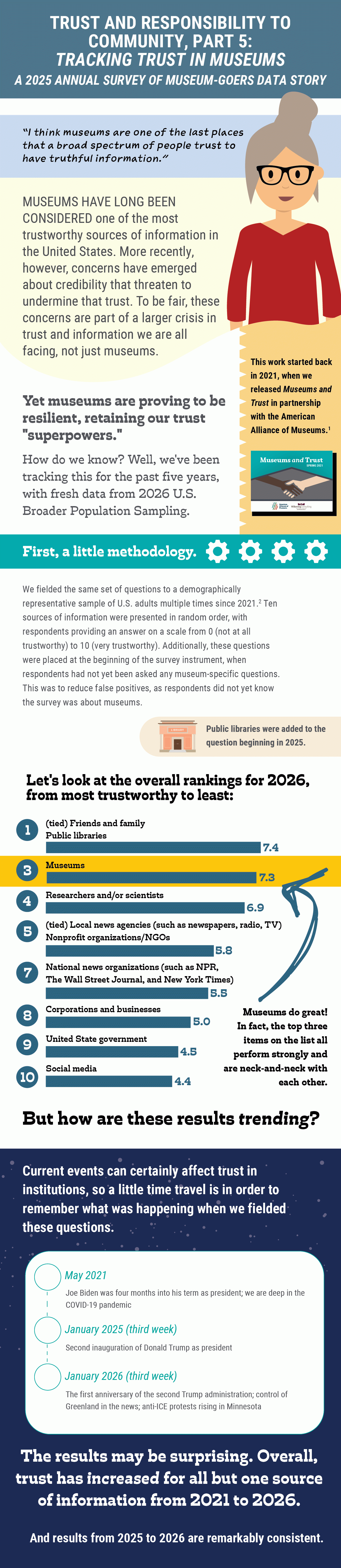
Museums have long been considered one of the most trustworthy sources of information in the United States. More recently, however, concerns have emerged about credibility that threaten to undermine that trust. To be fair, these concerns are part of a larger crisis in trust and information we are all facing, not just museums.
Yet museums are proving to be resilient, retaining our trust “superpowers.”
How do we know? Well, we’ve been tracking this for the past five years, with fresh data from 2026 U.S. Broader Population Sampling.
This work started back in 2021, when we released Museums and Trust in partnership with the American Alliance of Museums.¹
First, a little methodology.
We fielded the same set of questions to a demographically representative sample of US adults multiple times since 2021.² Ten sources of information were presented in random order, with respondents providing an answer on a scale from 0 (not at all trustworthy) to 10 (very trustworthy). Additionally, these questions were placed at the beginning of the survey instrument, when respondents had not yet been asked any museum-specific questions. This was to reduce false positives, as respondents did not yet know the survey was about museums.
Public libraries were added to the question beginning in 2025.
Let’s look at the overall rankings for 2026, from most trustworthy to least:
- (tied) Friends and family
Public libraries — 7.4 - Museums — 7.3
- Researchers and/or scientists — 6.9
- (tied) Local news agencies (such as newspapers, radio, TV)
Nonprofit organizations/NGOs — 5.8 - National news organizations (such as NPR, The Wall Street Journal, and New York Times) — 5.5
- Corporations and businesses — 5.0
- United States government — 4.5
- Social media — 4.4
Museums do great!
In fact, the top three items on the list all perform strongly and are neck-and-neck with each other.
But how are these results trending?
Current events can certainly affect trust in institutions, so a little time travel is in order to remember what was happening when we fielded these questions.
May 2021
Joe Biden was four months into his term as president; we are deep in the COVID-19 pandemic
January 2025 (third week)
Second inauguration of Donald Trump as president
January 2026 (third week)
The first anniversary of the second Trump administration; control of Greenland in the news; anti-ICE protests rising in Minnesota
The results may be surprising. Overall, trust has increased for all but one source of information from 2021 to 2026.
And results from 2025 to 2026 are remarkably consistent.
The exception?
Trust in the US government.
Let’s first take a look at the institutions with the lowest levels of trust.
AVERAGE:
Social media
May 2021: 3.8
January 2025: 4.5
January 2026: 4.4
United States government
May 2021: 4.5
January 2025: 4.9
January 2026: 4.5
Corporations and businesses
May 2021: 4.4
January 2025: 5.0
January 2026: 5.0
In 2026, corporations and businesses, as well as social media, have both climbed by 0.6 points from 2021. While that was enough for corporations and businesses to reach that middle score of 5.0 (on our base-10 scale from 0 to 10), it wasn’t enough to keep social media from remaining the least trustworthy source of all (4.4).
The only item on the list that deviated from the pattern of increased trust was the US government. In 2021 and 2026, it scored an average of 4.5. But who gave the US government high or low scores shifted quite a bit.
In 2021, conservatives were less trustful of the government, averaging 4.3. Their trust has increased with time, rising to 5.1 in 2025, and 5.4 in 2026.
Liberals have shown the opposite trend, starting at 5.4 in 2021, falling slightly to 5.1 in 2025, and plummeting to 3.6 in 2026.
Moderates, however, have been more volatile. In 2021, they averaged 4.6, rising to 4.9 in 2025. But their perspectives seem to have changed since then, as they have dipped to 4.4.
The middle of the pack
AVERAGE:
National news organizations such as NPR, The Wall Street Journal, New York Times
May 2021: 4.8
January 2025: 5.5
January 2026: 5.5
Nonprofit organizations/NGOs
May 2021: 5.3
January 2025: 5.9
January 2026: 5.8
Local news agencies (such as newspapers, radio, TV)
May 2021: 5.1
January 2025: 5.8
January 2026: 5.8
Three other sources of information clustered together in the middle of the pack, but all climbing over half a point since 2021 (and holding pretty steady since 2025). These include national news organizations (with three relatively mainstream, legacy news organizations provided as examples); local news agencies, and nonprofit organizations.
The trust “superpowers”
AVERAGE:
Researchers and/or scientists
May 2021: 6.1
January 2025: 6.8
January 2026: 6.9
Museums
May 2021: 6.4
January 2025: 7.2
January 2026: 7.3
Friends and family
May 2021: 6.6
January 2025: 7.4
January 2026: 7.4
Public libraries
January 2025: 7.3
January 2026: 7.4
In 2026, there was a tie for the most trusted sources of information: friends/family and public libraries. But take a look at museums. Museums are consistently right on their heels (and to be fair, this is within the margin of error).
Researchers and scientists are a little lower, but just a little bit.
Overall, this reinforces a theme we’ve been seeing throughout the findings from the 2025 Annual Survey of Museum-Goers: when things feel uncertain nationally, people look to local institutions for stability…and both public libraries and museums appear to fall in that category.
Museums and Trust: It’s Bipartisan
There’s another piece of good news.
Trust in museums is not political!
Regardless of political values, museums come in strong with the other trust “superpowers.” Conservatives and moderates showed strong trust, and liberal trust was even stronger (a similar pattern can be found for public libraries).
Additionally, across the political spectrum, the trendline is towards greater trust, not less.
AVERAGE:
Conservative
May 2021: 6.2
January 2025: 7.2
January 2026: 7.3
Moderate
May 2021: 6.6
January 2025: 7.1
January 2026: 7.2
Liberal
May 2021: 7.5
January 2025: 7.8
January 2026: 7.8
What emerges most clearly from this data is not a collapse of trust, but a shifting of it. People are becoming more selective about where they place their confidence, and many continue to see museums and public libraries as credible and reliable, whether or not they are actively visiting.
That’s an opportunity to increase our relevance and effectiveness…as long as we uphold rigorous standards of transparency and truth telling.³
That work is not easy amid disinformation, misinformation, polarization, and funding with strings attached to content. No one said being well-trusted would make anything easier in the short-run. But museums are in the forever business, as we like to say, and sticking up for our values matters more than ever when times are challenging.
“Especially in an age of misinformation and AI, I find that places like museums and libraries–core civic institutions in our society–are as critical as ever. Museums are uniquely suited to let people draw their own conclusions about a topic, which is critical in an era where information is being blasted to us constantly via social media.”
Annual Survey of Museum-Goers Data Stories are created by Wilkening Consulting on behalf of the American Alliance of Museums. Sources include:
- 2025 Annual Survey of Museum-Goers, n = 98,904; 202 museums participating
- 2025 Broader Population Sampling, n = 2,079
- 2017 – 2024 Annual Surveys of Museum-Goers
¹ See Museums and Trust (Spring 2021, AAM + Wilkening Consulting)
² For this Data Story, we are sharing our results from 5 years ago, 1 year ago, and last month:
• Museums and Trust (Spring 2021, AAM + Wilkening Consulting), n = 1,206
• 2025 Annual Survey of Museum-Goers and U.S. Broader Population Sampling
• January 2025 broader population sample of U.S. adults, n = 2,079
• January 2026 broader population sample of U.S. adults, n = 2,045
³ Trust and Responsibility to Community, Part 3: Supporting Credibility and Trust in Museums, January 22, 2026
Data Stories share research about both frequent museum-goers (typically visit multiple museums each year) and the broader population (including casual, sporadic, and non-visitors to museums). See the Purpose and Methodology (Update) Data Story from September 11, 2025 for more information on methodology.
More Data Stories can be found at https://wilkeningconsulting.com/data-stories/.
© 2026 Wilkening Consulting, LLC

Upcoming Events
-
Creative Museums Summit
Event Date:Presented by: MuseumNext -
-
-