This article first appeared in the journal Exhibition (Fall 2026) Vol. 45 No. 2 and is reproduced with permission.
The music is not in the notes, but in the silence between them.
—often attributed to French composer Claude Debussy
Ostensively about music, this quote resonates with the work of environmental designers: While the primary moments of an exhibition are essential, so are the spaces between them that shape the emotional rhythm of the experience. Like a musical composition, exhibitions require peaks and pauses. Without attention to these transitions, experiences can feel disjointed, overwhelming, or—at worst—like a series of unrelated moments rather than a coherent journey.
Liminal design is the deliberate treatment of spaces of transition, rest, and functionality (e.g., entrances, corridors, stairways, waiting areas, thresholds) not as residual voids, but as integral components of the visitor experience. These spaces function as physical and psychological thresholds, mediating movement, emotion, and meaning as visitors pass from one environment to another.
The concept of liminality originated in the early 20th century with Arnold van Gennep, an ethnographer who identified transitional states within rites of passage as moments of heightened meaning and transformation, when the individual was no longer one thing but not yet what they would become by the end of the ritual.[1] Cultural anthropologist Victor Turner later expanded the concept of liminality to encompass broader social contexts, emphasizing its potential to dissolve hierarchies and foster communitas —a temporary but powerful sense of shared humanity.[2]
Applied to exhibition design, liminality offers a framework for moving experiences from the transactional toward the transformational. Rather than encouraging visitors to consume information and move on, liminal design cultivates curiosity, empathy, admiration, and understanding. Through intentional pacing, sensory modulation, and spatial sequencing, liminal spaces within exhibitions can create the mental and physical conditions necessary for reflection, processing, and reconnection—both with the content and with others.
Constructing Compelling Journeys
Over my 20-year career designing museums, theme parks, and immersive environments, I have discovered that the most effective teams deliberately design these in-between spaces, enabling visitors to move between stimulation and pause. This rhythm supports both intellectual comprehension and emotional processing.
Theme parks offer a clear illustration of this principle. In that context, thresholds—entrances, tunnels, transportation systems, and main streets—carry visitors from the “ordinary world” into an imagined one. These liminal spaces signal psychological transition, allowing guests to shed everyday concerns and prepare for transformation. Crossing the threshold marks a transition from the familiar into a new environment, signaling the beginning of a psychological and emotional shift.
Intentional Pacing
Ask the question: How quickly or slowly does the experience unfold?
Intentional pacing in theme-park and immersive design shapes how visitors psychologically and physically transition between environments. By controlling movement, sensory exposure, and moments of reveal, designers can create liminal experiences that prepare visitors to enter a new narrative world.
In designing Star Wars: Galaxy’s Edge for Disneyland, the creative team had to solve a unique liminal design challenge: How do you transition guests from three completely different themed lands into a remote outpost on the fictional planet of Batuu that is compelling and believable? The goal was not simply to create entrances, but to design transitional experiences that gradually separated visitors from the familiar environment of Disneyland and prepared them psychologically to enter a galaxy far, far away. Designers often referred to these spaces as “palate cleansers” or moments of sensory and spatial transition that would help suspend disbelief and support immersion.
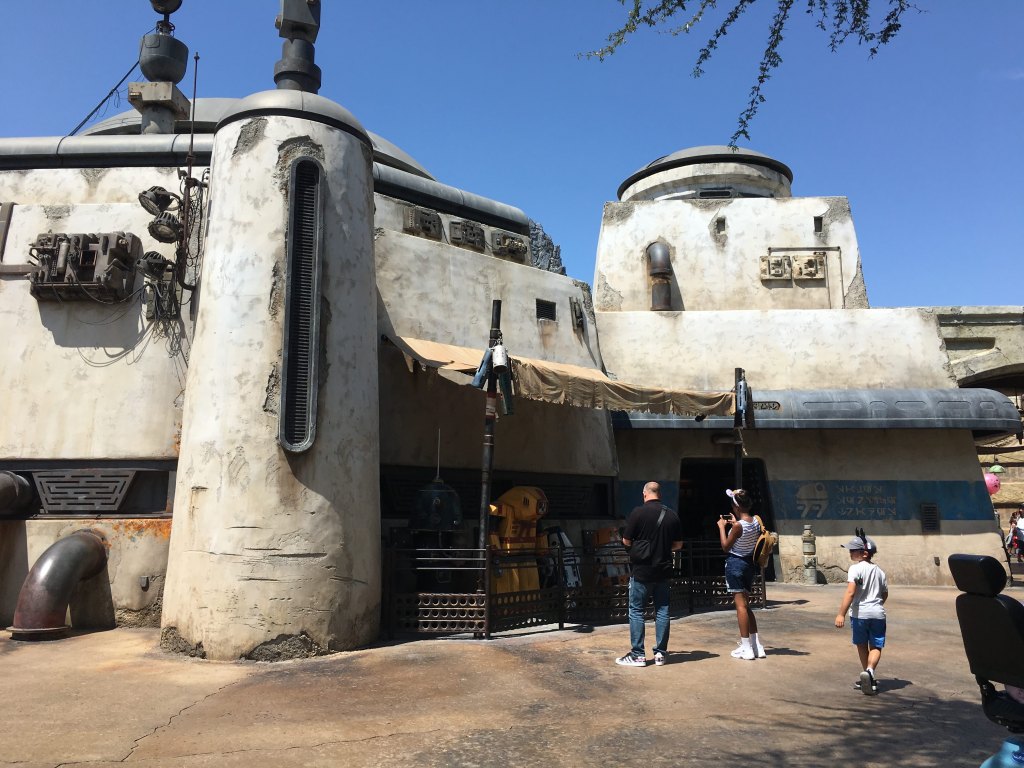
Each entrance approached this challenge differently based on the story of the fictional Black Spire Outpost. One pathway moved guests through a dense forest environment filled with mysterious animal sounds, unique foliage, rocky ruins, and unusual animal tracks embedded in the ground before revealing a X-wing starfighter and makeshift rebel base hidden among the trees. The intention was to slow guests down and gradually replace the visual and auditory language of Critter Country with the ecology of Batuu. Another entrance used a winding path that restricted sightlines and concealed the village until guests passed beneath a laser-cut tunnel framing their first view of the Droid Depot (fig. 1), one of the establishments at the edge of the outpost. This sequencing created a deliberate moment of reveal, allowing the transition into the land to feel cinematic and controlled. Theme-park designers often borrow principles from cinematic storytelling to guide the guest’s viewpoint and choreograph emotional responses. A third entrance led guests under a rugged trading post archway lined with weathered banners and unique architectural details, signaling that they were crossing into a different cultural and spatial environment.
These transitional spaces required close collaboration across disciplines. Landscape designers questioned what kinds of plants could plausibly exist on Batuu and how unfamiliar flora might subtly signal to guests that they had left Earth behind. Sound designers debated what insects, animals, and ambient noises would feel authentic within the Star Wars canon. Even seemingly minor details, such as the texture of pathways, the placement of rockwork, or the direction of guest sightlines, became important tools in shaping perception. Just as critical as what guests saw was what they did not: designers carefully blocked views into neighboring lands to prevent visual reminders of Disneyland from disrupting immersion.
Imagine if guests moved directly from Frontierland or Fantasyland into Star Wars: Galaxy’s Edge without any transition at all. The experience would feel abrupt and disorienting because guests would not be psychologically prepared to encounter something so dramatically different. The time and distance required to assimilate to new surroundings helps alleviate sensory overload and cognitive fatigue. Allowing guests the space to gradually enter a new environment builds trust, creates a sense of safety, and strengthens their willingness to suspend disbelief. In practice, intentional pacing becomes a method of orchestrating sensory, spatial, and narrative thresholds that guide visitors from the everyday into the fictional world of Batuu.
Sensory Modulation
Ask the question: How does the sensory environment shift emotional and psychological states?
Sensory modulation refers to the intentional control of sound, lighting, movement, texture, scale, and atmosphere in order to shape how visitors emotionally and psychologically experience a space. In liminal design, sensory modulation is important because it helps guide people through emotional thresholds without relying solely on explicit narrative or instruction. Rather than overwhelming visitors with constant stimulation, liminal environments carefully alternate between intensity and stillness, familiarity and unfamiliarity, allowing moments of reflection, anticipation, and emotional transition to emerge. By designing not only for content but for the full arc of a visitor’s experience from arrival to departure, designers signal that attention and care extend across the entire journey.
I experienced this firsthand during The Cortège, a participatory theater production conceived by artist Jeff Hull and his studio Visomnia and presented at the Los Angeles Equestrian Center in September and October of 2025. Structured as a contemporary funeral procession, the production unfolded not from a fixed stage, but across a large open environment activated through movement, music transmitted via wireless headsets, drone choreography, robotics, lighting, and elaborate, large-scale puppetry and costuming. The audience was guided through a sequence of emotional thresholds that functioned almost like chapters in a ritual.
The first threshold occurred upon the performance’s start. Audience members were separated from the outside environment through the use of wireless headphones that immediately isolated them from ambient noise and immersed them in a shared sonic atmosphere. This transition moved participants from the distractions of everyday life into a focused collective experience. As the performance began, music, lighting, and choreography directed attention toward slow ceremonial movement across the space. The scale of the environment, combined with the measured pacing of performers and machines, encouraged curiosity and contemplation rather than passive observation.
As the performance progressed, transitions between acts were marked through deliberate sensory shifts. Music would gradually diminish, lighting would soften or darken, and movement would slow into stillness before the next sequence emerged. These pauses created moments for emotional processing and anticipation, guiding the audience from curiosity into reflection and eventually toward participation. Although the performance contained no spoken dialogue, guests pieced together a dreamlike narrative through sound, gesture, procession, and symbolic imagery. The production relied on sensory modulation to communicate emotionally rather than intellectually.
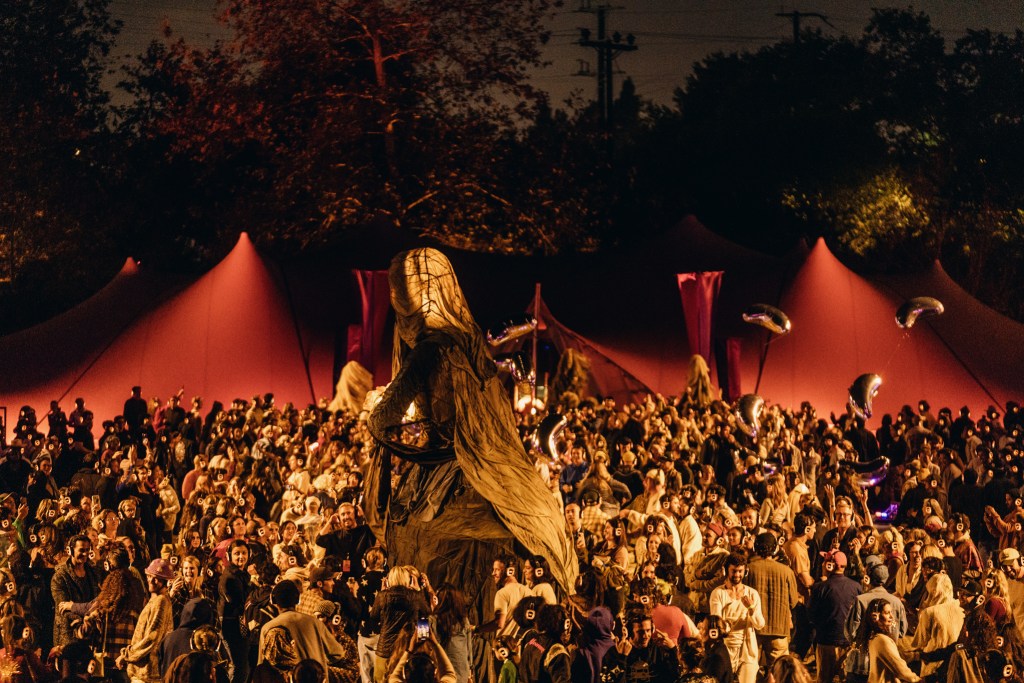
One of the most significant thresholds occurred near the end of the performance, when audience members were invited to leave their seats and step onto the central runway where much of the production had taken place (fig. 2). Up until this moment, participants had remained observers. Crossing onto the stage transformed them from spectators into active participants within the ritual itself. Guests danced alongside towering puppet-like figures and robotic dogs while music swelled through the headphones, dissolving the boundary between audience and performer. The experience shifted from observation toward communal participation and collective release.
Following the performance, participants were invited into a tent for a tea ceremony that served as a final transitional space. After the sensory intensity and emotional crescendo of the performance, the subdued atmosphere of the tent—with its slower pace, intimate scale, and ritualized hospitality—allowed guests to decompress, reflect, and connect with one another. Rather than abruptly returning participants to ordinary life, the tea ceremony functioned as a gentle reentry point, extending the liminal experience beyond the performance itself.
The narrative felt ancient and instinctively familiar, like a ritual drawn from a shared cultural memory that participants had never personally experienced yet somehow recognized. By willingly suspending disbelief, participants accepted the premise that this temporary gathering constituted a community. This sense of communal participation, an instance of wish fulfillment,[3] speaks to a deep human longing to belong to something larger, shared, and meaningful, even if only briefly. Ultimately, liminal design reminds us that meaning often emerges not through spectacle alone, but through carefully orchestrated sensory transitions that allow people to feel, reflect, and connect.
Exhibition designers can learn from this production-based approach. When exhibitions are conceived not as static containers of information but as journeys with emotional arcs—stories told in chapters—liminal spaces become essential narrative devices. In exhibition contexts, these moments of transition, pause, and reflection support both intellectual comprehension and emotional processing, acknowledging that learning is not solely cognitive but also embodied.
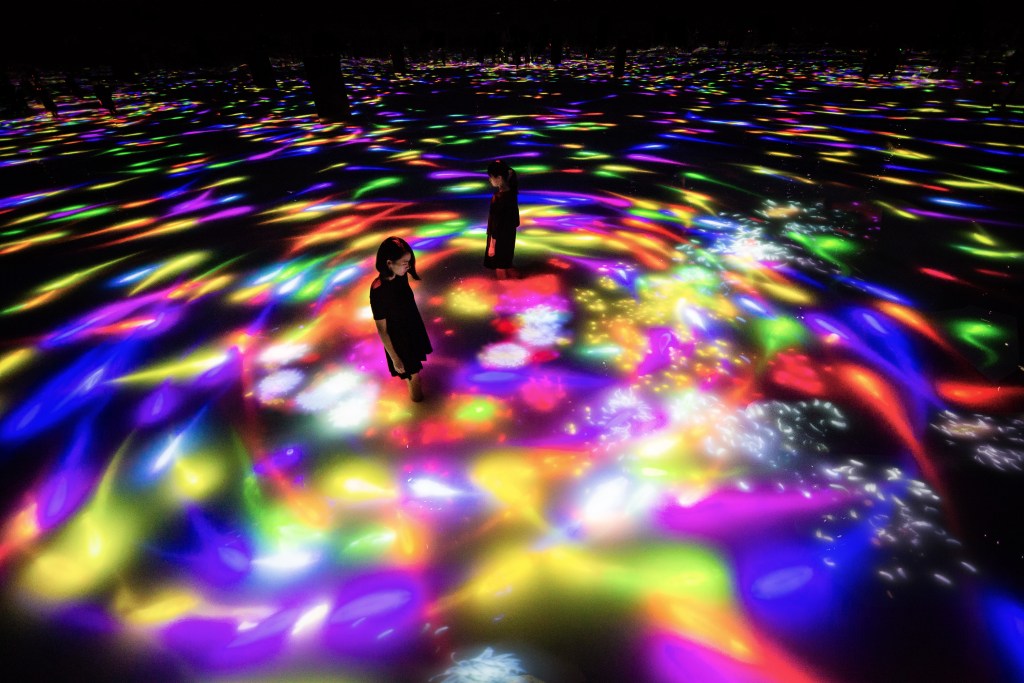
The immersive installations of the international art collective teamLab provide another contemporary example of sensory modulation in liminal design (fig. 3). Through ever-changing digital artworks that respond to visitor presence and movement, teamLab creates environments that oscillate between sensory saturation and moments of stillness. Rather than presenting visitors with static objects to observe, the exhibitions require physical and emotional participation, encouraging guests to become aware of their own bodies, movements, and relationships to others within the space.
This modulation begins before visitors even enter the artworks themselves. Before the first installation, guests are asked to remove their socks and shoes in a locker room before stepping into shallow water environments. This simple ritual slows the pace of entry and signals that the experience will operate differently from a conventional art museum visit. Other transitional moments involve navigating darkened corridors, passing through dimly lit aisles, drying off in towel rooms, or carefully balancing across unstable surfaces and horizontal bars. One installation that has recently closed and which was often referred to as a “soft black hole,” asked visitors to move cautiously through a sinking cushioned floor that destabilized balance and altered bodily awareness. These transitions moved guests from states of certainty and control toward heightened sensory awareness, vulnerability, and presence.[4]
Within the installations themselves, shifting artworks, mirrored surfaces, soundscapes, and responsive digital imagery create a constant interplay between immersion and pause. Visitors frequently slow their movement, watch others interact with the environment, or instinctively collaborate to navigate the space together. Reflection is embedded throughout the experience rather than positioned as a singular endpoint. By alternating intensity with quieter transitional spaces, teamLab uses sensory modulation to sustain liminal states that encourage mindfulness, curiosity, and collective engagement.
Spatial Sequencing
Ask the question: In what order are spaces, objects, and experiences encountered?
Spatial sequencing is the intentional arrangement of scenes, objects, and spatial elements to structure how visitors move through and interpret an environment. Whereas intentional pacing determines when something is encountered, spatial sequencing determines what is encountered next. By choreographing the order of spaces, reveals, and points of focus, designers guide visitors through an experiential journey in which meaning unfolds gradually through movement and discovery. In practice, designers working with spatial sequencing ask questions such as: What should visitors encounter first? Where should emotional intensity build or release? When is a pause necessary before introducing new information?
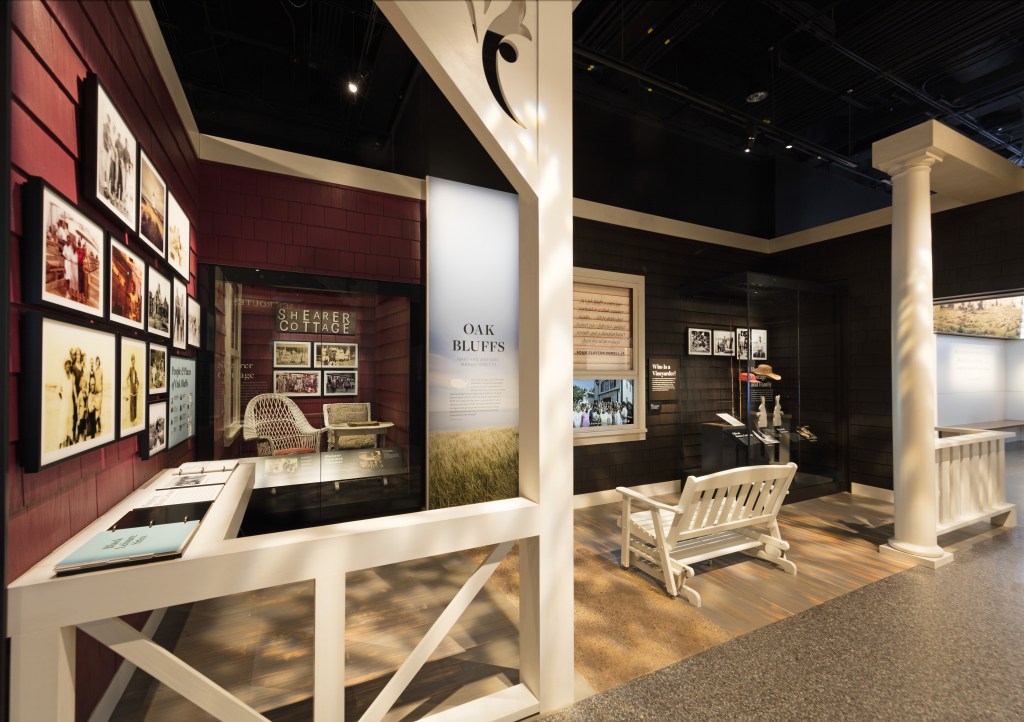
At the Smithsonian Institution, National Museum of African American History and Culture, liminal design is used with particular intentionality (fig. 4). The museum’s descending and ascending spatial sequence—moving from compressed, darker galleries addressing enslavement toward lighter, expansive spaces celebrating cultural resilience—uses thresholds, ramps, strategically placed seating areas, and transitional zones to mediate emotional intensity. These interstitial spaces function as affective buffers, creating pauses for emotional regulation and meaning-making that vary according to individual perspectives and lived experiences (fig. 5).
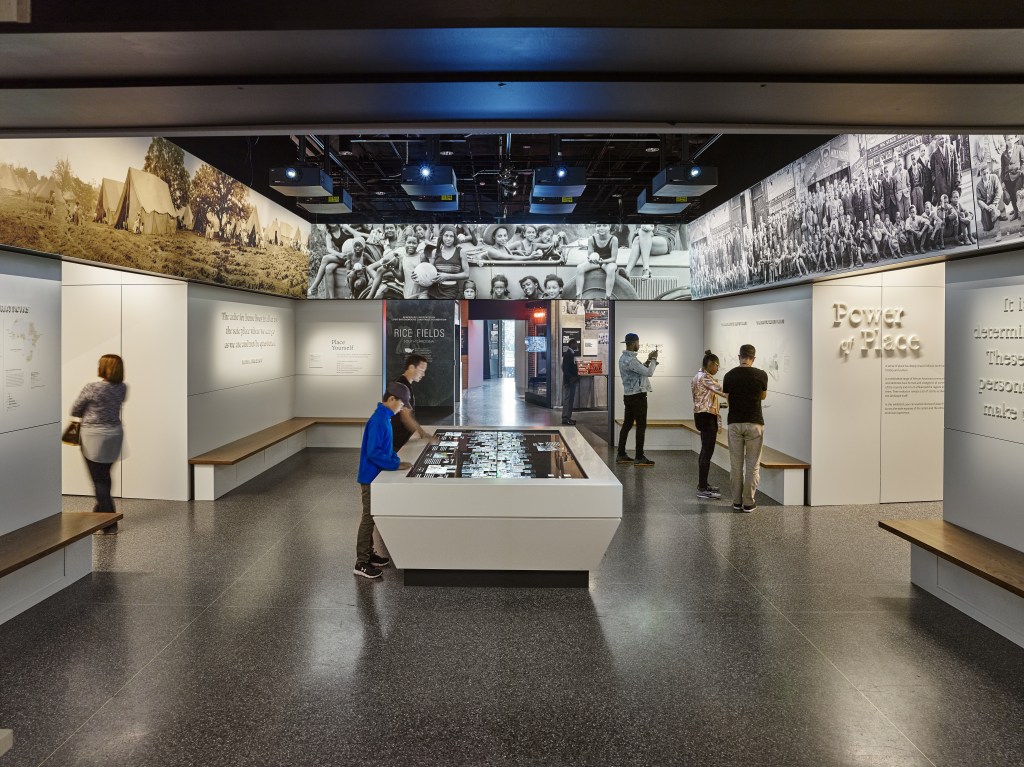
In my personal observation, I was struck by how often other visitors, while engaging with the same exhibit, would turn and begin a dialogue with me—more conversation with strangers than I have ever experienced in any other museum. In this context, reflection becomes an act of care, acknowledging the psychological weight embedded in historical narratives. It also reveals an innate human need to connect, to make sense of what we are experiencing, and to engage in dialogue with others as part of that process.
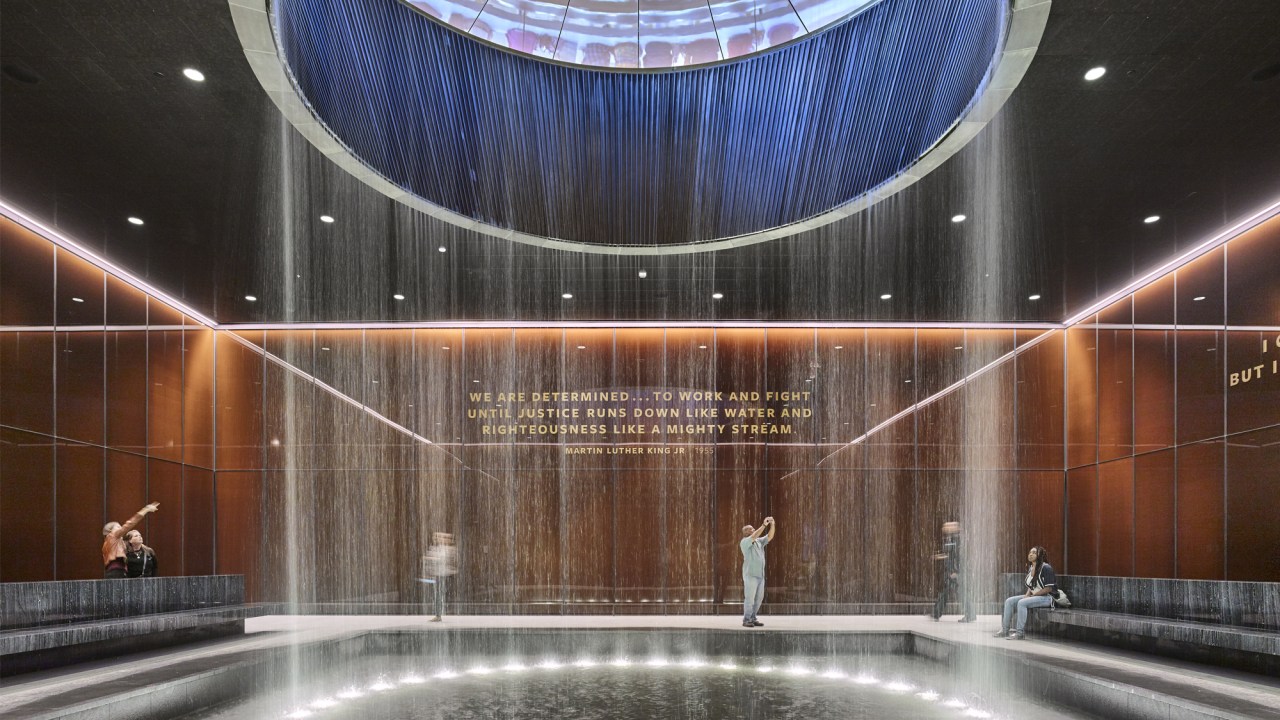
One of the more memorable spaces is the Contemplative Court (intro image), a quiet room with benches designed for reflection and processing. Here, guests discover a cylindrical waterfall cascading from the ceiling into a pool at its center and four inscriptions placed across the surrounding walls, each offering a moment of pause and emotional grounding. Musician Sam Cooke’s Civil Rights-era lyric, “A change is gonna come,” invites visitors to sit with history, struggle, and hope. A quote from a 1955 speech by Dr. Martin Luther King Jr., “We are determined to work and fight until justice runs down like water and righteousness like a mighty stream,” reinforces the call for equity and shared humanity. Nelson Mandela’s reflection, “I cherish my own freedom dearly, but I care even more for your freedom,” extends the ethical frame toward collective responsibility. Frances Ellen Watkins Harper’s poetic lines
I ask no monument, proud and high
To arrest the gaze of the passers-by;
All that my yearning spirit craves
Is bury me not in a land of slaves
anchor the space in a profound refusal of oppression and a longing for liberation. Together, these inscriptions structure the room as a thoughtful environment, offering visitors a space for reflection as they move through the museum.
Communitas
Returning to the concept of communitas as defined by Victor Turner, liminal spaces not only create conditions for individual reflection but also enable forms of collective experience to emerge. As Turner writes in The Ritual Process: Structure and Anti-Structure, “Essentially, communitas is a relationship between concrete, historical, idiosyncratic individuals.”[5] He used the term to describe the unique bonds that can arise in liminal situations, where participants encounter one another outside of fixed social structures. In these moments, hierarchy is temporarily suspended, allowing people to relate to one another more directly than through predefined social roles.
When transitional moments and rituals are designed with intention, their impact extends beyond the individual toward shared experience. Through careful attention to movement, interaction, and environmental cues, visitors are invited not only to engage with content but to become aware of one another within the same experiential field. These orchestrated moments can foster a temporary yet powerful sense of togetherness, as strangers share attention, participate in common activities, and experience meaning collectively.
In exhibition and environmental design, the value of communitas lies in its ability to transform a collection of individual visitors into a community of participants. While people may arrive with different backgrounds, motivations, and perspectives, well-designed environments can create opportunities for shared attention, dialogue, collaboration, and reflection. As designers, the goal is not to manufacture connection, but to create the conditions in which it can emerge organically.
Conclusion
For designers seeking to incorporate liminal design thinking into their work, the process begins by thinking holistically about the visitor journey rather than focusing solely on individual exhibits. What is the emotional tone set for visitors when they first arrive, and how should that tone evolve as they move through the experience? Where do they need moments of anticipation, orientation, reflection, conversation, or rest? What sensory cues signal that they are entering a new phase of the journey? Just as importantly, where are the opportunities for visitors to connect with one another rather than only with content? Theme parks, theater productions, and immersive experiences offer valuable lessons in this regard. They routinely map emotional arcs, curate transitions, design reveals, and create intentional thresholds that prepare audiences for what comes next. Exhibition designers can adopt similar practices by treating entrances, corridors, waiting areas, seating zones, and other transitional spaces not as overlooked square footage, but as essential components of meaning-making. When these in-between spaces are designed with the same care as the primary exhibition content, they become powerful tools for learning, reflection, and connection.
In conclusion, by giving visitors the time and mental space to reflect, question, and consider multiple perspectives, liminal moments encourage audiences to evaluate information thoughtfully, recognize context, and engage emotionally with narratives, whether historical, scientific, cultural, or artistic. In doing so, exhibitions can cultivate not only empathy and understanding, but the habits necessary for informed participation and connection in a complex world.
I encourage curators, designers, and cultural institutions to reconsider the purpose of exhibition space itself. By valuing the in-between moments as much as the objects and narratives on display, we can create experiences that move beyond information toward transformation, spaces in which visitors leave not only with knowledge, but with insight, empathy, and a renewed sense of connection to the world around them. In doing so, we shift the fundamental question of the exhibition visit from, What did you see? to, How did it make you feel and what did it change?
[1] Arnold van Gennep, Les rites de passage (Nourry, 1909).
[2] Victor W. Turner, The Ritual Process: Structure and Anti-Structure (Aldine, 1969).
[3] For more on my discussion of the importance of wish fulfillment, see Margaret Chandra Kerrison, Immersive Storytelling for Real and Imagined Worlds: A Writer’s Guide (Michael Wiese Productions, 2022), 86.
[4] Soft black hole has been replaced with Body of Waves.
[5] Turner, The Ritual Process.
Margaret Chandra Kerrison is Founder/Creative Consultant of MCK Creative, LLC.
Upcoming Events
-
From Informational Interview to Real Connection
Event Date:Presented by: American Alliance of Museums and National Emerging Museum Professionals Network -
Understanding the U.S. History Workforce
Event Date:Presented by: American Association for State and Local History (AASLH) -
TrendsWatching: To Live or Die in AI Webinar
Event Date:Presented by: American Alliance of Museums -