Claims about integrity, benevolence, and sincerity are at the heart of many internal organizational conflicts.
This article originally appeared in Museum magazine’s May/June 2025 issue, a benefit of AAM membership.
In an increasingly polarized world, contentious issues—and discussions of contentious issues—are an ever-present workplace challenge. Trustworthy relationships between museum staff and leadership are more essential than ever. While much research has examined public trust in museums, trust between museum staff and museum leadership remains largely unexplored—and increasingly tenuous.
In collaboration with the Innovation Resource Center for Human Resources, the Association of Children’s Museums, and the Association of Science and Technology Centers, we’ve launched a project called “Culture of Trust” to analyze the leader-staff trust dynamic in museums. With this project, we aim to develop strategies that will help museums address contentious issues in ways that build, maintain, and restore trust between staff and leaders.
Many Ways to Break or Build Trust
When disagreements occur, what types of interactions support or detract from internal trust? To answer this question, we must understand what trust—and its component parts—entails.
At its most basic level, trust is the willingness to put our wellbeing in others’ hands. At times, we’re willing to trust others simply because they seem similar to us; scholars call this “identity-based trust.” But most of the time, we assess others’ trustworthiness based on their behavior. This is called “experiential trust.” Research points to five key criteria that inform how we assess others’ trustworthiness:
- Competence: Our perception of whether someone has the knowledge and skills to perform a task for us;
- Reliability: Our perception of whether others can consistently and regularly meet our expectations;
- Sincerity: Our perception of whether others share information openly and honestly;
- Benevolence: Our perception of whether others demonstrate compassion toward us and in general; and
- Integrity: Our perception of how fairly others apply their principles.
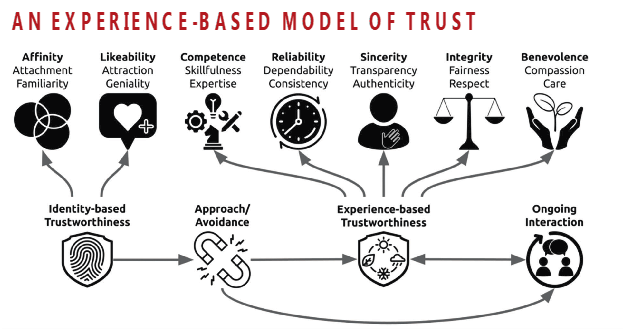
Trust is something that is learned and earned. As such, we can use theories of experiential trust to understand how leader-staff interactions build (and break) trust over time.
We analyzed approximately 300 news articles from 2018–2024—most of which were published after the COVID-19 pandemic—about leader-staff disputes in museums. These stories represent the worst-case scenarios—instances where internal trust was damaged to such an extent that it became newsworthy. We aimed to identify (1) the key topics of contention within museums and (2) the components of trust that most often come into play when contentious workplace issues arise.
The five most contentious issues discussed in these articles were unionization, workplace racism, toxic work environments, controversial funding sources (including board members and other contributors), and the Israel-Palestine conflict. For each issue, we looked at 20 randomly selected stories, analyzing leader and staff statements to determine which components of trust most factored into the internal disputes.
Not surprisingly, in many of these statements both leaders and staff framed themselves as trustworthy while casting doubt on the other side. For example, staff who pointed to their wages as evidence of leaders’ lack of concern for their wellbeing (a negative assessment of benevolence) might also point out how consistently they had shown up for work during the pandemic (a positive assessment of reliability). Leaders might point to concrete actions they were taking to remedy injustice (a demonstration of integrity) or emphasize how their actions reflected a desire to benefit the wider community (benevolence).
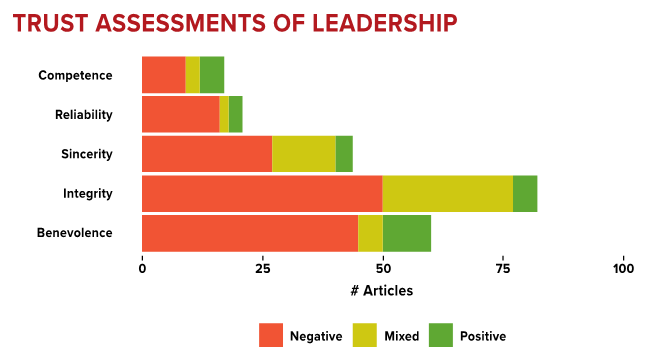
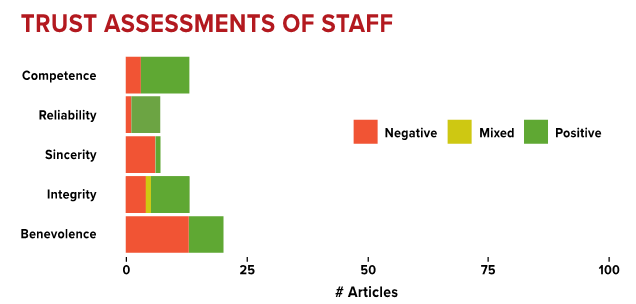
Integrity and benevolence most often informed assessments of leaders’ trustworthiness. Staff statements in news stories related to integrity included claims that a museum “failed to uphold its own policies” around equity and inclusion, did not “understand that workers have rights,” or was “complicit in […] injustices” taking place in the wider world. Staff statements about benevolence accused leaders of being “emotionally abusive;” “exploit[ing] the labor, expertise, and care of current staff;” and creating a “culture of fear.”
Assessments of staff trustworthiness were much less frequent. When quoted, museum leaders were typically responding to staff claims. In some cases, leaders cast doubt on staff members’ sincerity by claiming that their accusations were false or unfounded. Some articles also included statements implying that staff did not have the museum or community’s best interests at heart (a negative assessment of benevolence). However, most leader statements did not highlight trust criteria; often, leaders chose not to comment at all.
Forestalling the Rift
Media organizations tend to cover leader-staff disputes that have reached the point of no return. Although these are extreme cases, studying them can benefit all museums. As our findings indicate, claims about integrity and benevolence are often at the heart of museum employees’ negative assessments of leadership trustworthiness. For their part, leaders tend to question the sincerity of staff statements and staff benevolence in their counterclaims.
If these aspects of trust signal that a dispute has reached a terminal stage, then efforts to resolve disputes before trust breaks down might focus on the moral criteria of trustworthiness: sincerity, integrity, and benevolence. For example, open and collaborative discussions (sincerity) about contentious issues can help everyone weigh the tradeoffs involved in any decision. This appreciation of tradeoffs can forestall (at least some) accusations that decisions show bias or ill will (a lack of integrity and benevolence, respectively).
As “Culture of Trust” continues, we’ll be interviewing professionals from some of the museums identified in our media analysis to draw actionable insights based on museum professionals’ experiences. Through the project, we aim to provide museum leaders and staff with strategies, tools, and resources for fostering trust, even in the face of contentious issues.
How Leaders Can Build Trust
Trust between leaders and staff is fundamental to an organization’s ability to fulfill its mission. It fosters a sense of belonging that empowers and motivates staff to do their best while acting in the best interests of the organization and the communities it serves. To promote such a culture, leadership must:
- acknowledge and mitigate the power differential between themselves and their staff;
- lead by example in their professional and personal lives, demonstrating integrity, passion for the work, and care for those they manage and serve;
- demonstrate accountability through clear and open communication, including true 360-degree feedback; and
- guarantee psychological safety to all staff members, fostering an environment where staff feel free to speak up and share their concerns without fear of recrimination and loss of employment.
More Museum Workforce Research
By Jennifer Rehkamp, Senior Director of Field Services and Research at the Association of Children’s Museums, and Melissa Ballard, Director of Programs at the Association of Science and Technology Centers
The Association of Children’s Museums (ACM) and the Association of Science and Technology Centers (ASTC) collaborate to help museums and their staff make more informed decisions about their future by examining trends in hiring, retention, and staff morale. Our 2023 ACM-ASTC Workforce Survey Report highlights that museums are progressing from the COVID-19 pandemic—but not without challenges. Compensation and staffing have rebounded but not consistently across all roles. Museums are actively seeking ways to attract and retain staff but face obstacles as some workers shift to other fields for more competitive pay and benefits or different workplace policies, practices, and culture. As we navigate these tensions, ACM and ASTC are working with Knology and Innovation Resource Center for Human Resources to understand how a trust framework could support positive change between museum leadership and staff.