How can museums use their significant assets: space, resources, art works, relationships, influence etc to shape a future beautiful, beyond our wildest dreams?
At the 2026 AAM Annual Meeting & Museum Expo, staff of Intelligent Mischief–a creative design lab for social good–will help attendees explore these questions through an installation in MuseumExpo and a two hour learning lab. The Futures of Repair Dream Space (Booth 1430, MuseumExpo) will be a place for dreaming and imagining futures of repair and healing where folks can drop in to listen to guided meditations from six possible futures, and interact with artifacts from lineages of repair. The learning lab will be a live 2-hour collective imagining experience at 8:30am on Saturday, May 23rd, room 126 AB, where participants will craft their own visions for museums as sites of bold imagination and dreaming where communities that have been impacted by ongoing harms can create a more beautiful world together. Intelligent Mischief’s participation at the 2026 AAM Annual Meeting & MuseumExpo is generously supported by the Robert Wood Johnson Foundation.
What if the world reckoned with the harms of slavery and committed to repair and healing?
On March 25th the United Nations General Assembly adopted a resolution declaring the transatlantic slave trade the gravest crime against humanity. In remarks following the vote, President John Dramani Mahama of Ghana affirmed the need for healing, repair, and restitution of the direct and ongoing harms caused by the system of slavery, and the subsequent abuses and exploitations of people of African descent that continue to this day.
Chattel slavery was a totalizing, global system of domination, extraction and violence that deprived people of African descent of their freedoms, their culture, their traditions, their knowledge ways, systems of governance, their economies, their autonomy, their imaginaries, their families, their dignity and their lives. Many of our most powerful institutions were created as part of or in the wake of this tragic system and even after it was formally abolished, many of these institutions continued to operate within the broad logic of domination and extraction that underpinned the system itself. Although most of those currently stewarding these institutions and their offshoots are not directly culpable for past harms or in the perpetuation of ongoing harms, we ALL have a responsibility to repair the harms that persist for the sake of a shared peaceful existence on our planet and our collective descendants; those who will inherit the planet after we are gone.
If there was a global commitment to repairing the harm, what world would we make possible?
Harm is something that cracks, bruises and fragments. It creates trauma, fear or anxiety. It causes mistrust, separates, and creates a rift or wound. It divides. It is something that interrupts, that distracts, that limits life giving resources. And when harm is not treated it festers, and becomes infected. It compounds and grows and absorbs everything, the entire body is impacted. It can affect others directly and indirectly.
So we learn how to heal. How to repair. How to make things whole. We apply medicine. We convalesce. We remove stagnant blood. We stitch things back together. We remove the infection. We apply care. We respond to the pain. We seek remedies. We apologize. We seek forgiveness. We embrace accountability. We restore wholeness and safety. We nurture. We listen. We promise not to repeat the harm.
Even as we consider our shared purpose in repairing and healing from the harms caused by colonialism, slavery, white supremacy, and genocide; and the systems that have been constructed on top of them, we are invited to consider repair as a fractal, repair as a way of being, as a practice, as an act of devotion and creativity, as a sacred responsibility, as something we embody in every part of our lives.
What is the role of museums and cultural institutions in repairing harm?
The system of slavery was not just a political economy, it was also a deeply ingrained culture of dehumanization, exploitation, moral dissonance, fragmentation, and othering. A cultural sector operated to reinforce narratives, assumptions, behaviors and norms that make slavery seem inevitable. Objects were designed to traffic and shackle and punish and house the enslaved. Clothing was designed for the enslaved to wear, that denoted the wealth and status of land owners. Stories were written. Plays performed. Cookbooks created. Paintings created. Later, films were created to glamorize and glorify slavery and the plantation economy and to this day, a culture that could not have been possible without slavery is celebrated as plantations that should be memorials to the enslaved are instead used for weddings. Until recently, museums in North America and Europe continued to stake their endowment on the ill-gotten artifacts, some sacred, belonging to Black and Indigenous people. Some institutions are even holding on to human remains! It is no doubt that the legacy of museums in large part has included giving cover for harm in the name of curiosity, knowledge, and understanding with deeply colonial and exploitative intentions. I think of the institutions that displayed captive humans, Black and Indigenous, for polite, high society people to come and stare and point.
It is debatable, given the degree of complicity of some of the organizations we are stewarding, whether they can remain intact while at the same time shifting towards repair. Many are returning stolen artifacts, others refuse. Many are humbly shifting towards equity, centering the communities that have been most impacted by slavery and colonialism; creating new relationships and financial mechanisms and shared stewardship arrangements with descendant communities. Others have grappled honestly with the demands of activists during the Decolonize Museums movement, or the campaigns to remove board members with ties to other harmful entities.
Recognizing the integral role of culture, early abolitionists harnessed cultural strategies to make abolition irresistible. Frederick Douglass, a renowned, formerly enslaved abolitionist was known to have been the most photographed person of his time. A choice he made intentionally in order to use the then new innovation of photography to unleash a narrative of humanity and beauty in relationship to Black people. This strategy, along with his eloquent speeches and elegant attire helped to make abolition popular and eventually inevitable. It directly countered the assumption that enslavement was the natural condition of Black folks due to their “inferiority” or “3/5ths humanity”.
I had the opportunity to see Frederick Douglass’ clothing, spectacles, and other belongings first hand last year, alongside those belonging to W.E.B DuBois. They were included in the “Superfine: Tailoring Black Style” exhibit at the Metropolitan Museum (The Met), which I had the pleasure of visiting twice; once during normal (crowded) visiting hours and later with a group of Black artists, creatives, and collectors convened by my studio, Intelligent Mischief in partnership with Antoinette Cooper of Black Exhale. Antoinette is, among other roles, a freelance educator who occasionally partners with the Met to host private guided tours of their exhibitions during hours when the Met is closed to the public. The two experiences could not have been more different. During the visiting hours I guided myself through the exhibit reading descriptions and viewing the clothing, sometimes straining to see amongst the throngs of visitors. Attendees were speaking and laughing, making their own meaning, or perhaps not.
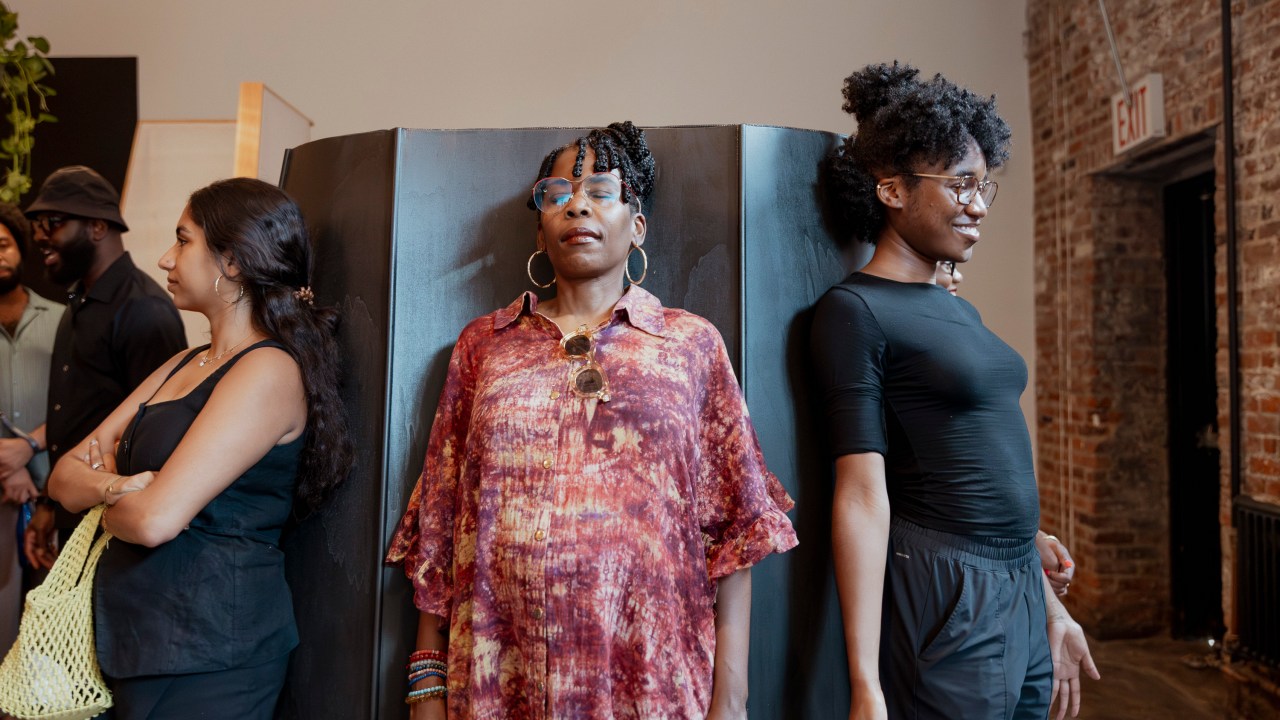
During the private tour, Antoinette invited us to ground in the history of Black Dandyism, which began with the enslaved and to hold that weight together. To honor our shared ancestors and all they had been through. To offer prayers, to breathe, to imagine, to extend gratitude. It was a transformative shared experience that invited us to interact with the exhibit in a totally different way. In that experience, we crafted meaning together. We occupied the space of the museum as if it was ours, for an hour or two. We turned the garments into sacred artifacts for memory. The hall became a place of dreaming. Tender, evocative, alive. This was not a typical experience of the Met.
Museums and cultural institutions have a particular responsibility in shaping narrative, memory, meaning, shared understanding, and imagination; and in perpetuating culture at scale. Cultural institutions play a significant role in shaping our civilizations, our sense of a collective identity. As such, the restitution of stolen artifacts and a commitment to practices and structures of equity are important strategies of repair. However, museums must also consider the ways in which they can pro-actively use their cultural power as institutions to cultivate a widespread culture of repair and healing and to shift engrained power dynamics.
Is it possible for museums to become democratic sites of bold imagination and dreaming where engaging and reckoning with our history can help shape a bold and beautiful vision of the future? What does that look like in practical terms at the museums you steward? As cultural institutions face unprecedented attacks, how can they cultivate resilience by becoming invaluable spaces for shaping an alternative vision, for connecting people, for memory, for collaborative world building? Can museums become viable Third Places for re-imagining, co-creating, and perhaps most importantly, embodying the more beautiful world our hearts know is possible? We certainly hope so.
Upcoming Events
-
Creative Museums Summit
Event Date:Presented by: MuseumNext -
-
-